
If you ask me to pick for most people, I pick the Toyota RAV4. It starts around $31,900, and it gives you up to 37.8 cu ft of cargo space behind the rear seats. It also targets up to 47 city and 40 highway mpg on the most efficient versions.
I pick the Volvo XC60 when someone wants a quieter cabin, a more premium feel, and stronger powertrain options, and they are fine starting around $51,095. Just know the XC60 is typically set up for premium fuel, and it has less cargo behind the second row at 22.4 cu ft.
One more thing. This comparison changes a lot if you are really shopping plug-in hybrids. In that case, you should be thinking RAV4 Plug-In Hybrid versus XC60 Plug-In Hybrid, not the base models.
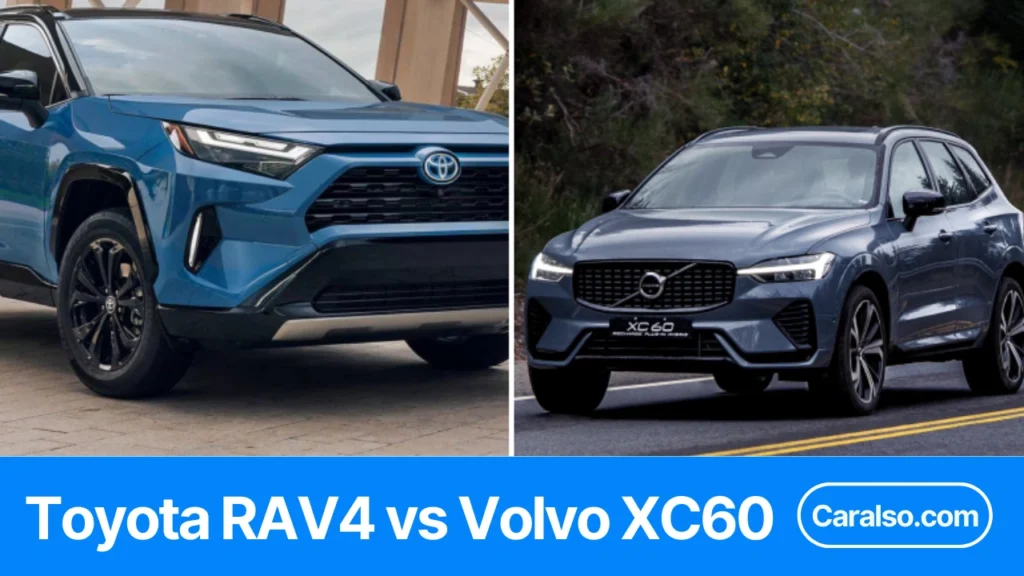
Toyota RAV4 Vs Volvo XC60:
RAV4 Vs XC60 In 30 Seconds (Pick This If…)
Here’s the fastest way I decide.
Quick Verdict Table
| Choose The Toyota RAV4 If You Want | Choose The Volvo XC60 If You Want |
|---|---|
| A lower starting price. Around $31,900 MSRP. | A luxury brand experience. Around $51,095 MSRP for the mild hybrid. |
| More cargo behind the rear seats. 37.8 cu ft. | A more premium cabin, materials, and ride feel. |
| Better fuel economy on the most efficient versions. Up to 47 city and 40 highway mpg. | More power in the plug-in hybrid version. Up to 455 hp in the XC60 plug-in hybrid. |
| A lower-stress ownership vibe for long-term, high-mile driving. | A quieter, more upscale daily drive, even if costs run higher. |
| SUV versatility with the right trim. Max towing can reach 3,500 lbs on many AWD trims. | 3,500 lbs max towing when properly equipped. |
Quick Specs Snapshot (The Numbers Most People Care About)
| Spec | Toyota RAV4 | Volvo XC60 |
|---|---|---|
| Starting MSRP (Gas Or Mild Hybrid) | $31,900 | $51,095 |
| Starting MSRP (Plug-In Hybrid) | Varies by model year and availability | $62,545 |
| Cargo Behind 2nd Row | 37.8 cu ft | 22.4 cu ft |
| Max Cargo With Seats Folded | Up to 70.4 cu ft | Up to 63.3 cu ft |
| City / Highway MPG (Non Plug-In) | Up to 47 / 40 | 23 / 30 |
| Max Towing | Up to 3,500 lbs (trim-dependent) | Up to 3,500 lbs |
Mini Decision Tree (4 Questions)
- Is your budget under $45,000 for a new SUV? I start you in the RAV4 lane.
- Do you care more about cabin quiet and premium feel than price? I push you toward the XC60.
- Do you need to tow 3,500 lbs? Either can do it, but I double-check the exact trim and drivetrain first.
- Can you charge at home and you want to drive on electricity for local trips? Compare RAV4 Plug-In Hybrid vs XC60 Plug-In Hybrid, not the standard models.
Key Differences At A Glance (Price, MPG, Space, Towing)
When I line these up the way real shoppers do, I see two totally different missions.
The RAV4 is built around efficiency and usable space at a lower price.
The XC60 is built around a premium cabin and a higher starting budget.
Here’s the clean side-by-side I use.
| Category | Toyota RAV4 | Volvo XC60 |
|---|---|---|
| Starting Price Band (New) | $31,900 base MSRP before destination. About $33,350 with destination. | $51,095 MSRP for the mild hybrid Core. |
| Fuel Economy Approach | Hybrid-first lineup. Toyota quotes up to 47 city and 40 highway mpg, depending on trim and drivetrain. | Mild hybrid standard. EPA estimate is 23 city, 30 highway, 26 combined for the B5. Plug-in hybrid version is also offered. |
| Space And Practicality | 37.8 cu ft behind the second row. Up to 70.4 cu ft with seats folded. | 22.4 cu ft behind the second row. Up to 63.3 cu ft with seats folded. |
| Towing Headline | 1,750 lbs on FWD models and the AWD LE. Up to 3,500 lbs on most other AWD trims. | Up to 3,500 lbs when properly equipped. |
| Best For | Lower monthly running costs, more cargo room, and long-term value. | Premium feel, upgraded tech, and a more luxury-focused daily drive. |
If you only remember one thing, remember this.
On paper, towing can be a tie at 3,500 lbs.
In real life, price and cargo are where the RAV4 pulls away.
Price And Trims Explained (The Reason People Cross-Shop These)
I see this cross-shop when someone has RAV4 money, but wants to know what they give up by not going luxury.
Or they have XC60 money, but want to know if the Volvo premium is worth the extra $15,000 to $20,000.
New Pricing Reality (What You Pay, Not Just MSRP)
Toyota lists the 2026 RAV4 at $31,900 as base MSRP before destination.
When you add destination, published pricing lands at $33,350 for the entry model.
Volvo lists the XC60 Core at $51,095.
That is a $17,745 gap versus a RAV4 that includes destination.
Here’s what I watch in the real world.
Luxury models often show bigger gaps between MSRP and what people pay.
For the XC60, recent transaction averages have shown buyers paying less than MSRP on base trims.
That is not a guarantee, but it changes the math for some shoppers.
The “Same Money” Scenario (Top-Trim RAV4 Vs Used Or New XC60)
This is the mental trick that helps most people.
If you have about $51,000 to spend, you have two realistic paths:
Path 1: Buy A New RAV4 And Stop Worrying
The highest non plug-in trim starts under $45,000 with destination.
That leaves roughly $6,000 to $7,000 compared with the XC60 Core.
That gap can cover taxes, registration, winter tires, a hitch setup, and a lot of fuel.
Path 2: Buy The XC60 For The Cabin And Tech
At $51,095, you enter the Volvo range on the Core trim.
You get a higher starting equipment level and a luxury brand interior experience.
If you care about features like Pilot Assist and a 360 camera, you usually land on the Plus trim, not Core.
My honest takeaway.
If your ceiling is $52,000, a new XC60 is usually a “base luxury” buy.
A new RAV4 at that budget can be a “fully loaded mainstream” buy.
Trim Translation Guide (How I Match Apples To Apples)
I do not compare “a RAV4” to “an XC60.”
I compare trim intent.
Here’s my quick translation.
| Your Goal | RAV4 Trim I Start With | XC60 Trim I Start With | What I’m Matching |
|---|---|---|---|
| Lowest price that still feels modern | LE | Core | Standard safety suite, everyday comfort features, core tech. |
| Best value features without going top trim | SE or XLE Premium | Plus | Upgraded driver assistance, parking help, and convenience tech. |
| Rugged look and higher towing capability | Woodland | Plus | AWD-focused setup and “do more” daily utility. |
| Premium features without jumping to PHEV | Limited or XSE | Ultra | HUD availability, nicer audio, more comfort features. |
Two specific feature notes I think matter:
- Screens and daily usability
On the RAV4, a 10.5-inch center screen is standard, and a larger 12.9-inch screen is available on some trims.
On the XC60, the center screen is 11.2 inches. - Driver assist and parking features
Volvo makes it very clear where the tech jumps.
Plus adds Pilot Assist and a 360 camera.
Ultra adds features like a head-up display and a Harman Kardon audio upgrade.
If you want a clean “value” build, I usually land here:
RAV4 SE or XLE Premium versus XC60 Plus.
If you want a “nice stuff” build, I usually land here:
RAV4 Limited versus XC60 Ultra.
Powertrains: Hybrid Vs Mild-Hybrid Vs Plug-In (Clear This Up Fast)
Here’s the fastest way I explain it to friends.
- Mild-hybrid: Gas engine does the driving. A small 48V system helps with stop-start and low-speed assist. You do not plug in.
- Full hybrid: Still gas-first, but it can run on electric for short stretches. You do not plug in.
- Plug-in hybrid: Big battery. Real electric range. You can drive electric daily if you charge. It still has a gas engine for road trips.
Powertrain Cheat Sheet
| What You’re Looking At | Can You Plug It In? | Can It Drive Electric-Only? | What It’s Like Day To Day |
|---|---|---|---|
| RAV4 Hybrid | No | Yes, short bursts | Best “set it and forget it” efficiency |
| XC60 B5 Mild-Hybrid | No | No | Feels like a turbo gas SUV with smoother stop-start |
| RAV4 Plug-In Hybrid | Yes | Yes, real range | EV for errands, hybrid for trips |
| XC60 Plug-In Hybrid (T8) | Yes | Yes, real range | Strong EV mode, very quick when you floor it |
RAV4 Lineup (Hybrid And Plug-In Hybrid): What Changes For Buyers
For 2026, the big shift is simple. RAV4 goes electrified-only.
What I’d expect you to cross-shop:
- RAV4 Hybrid
- Available with FWD or AWD depending on trim.
- Output is 226 hp (FWD) or 236 hp (AWD).
- You do not charge it. You just drive it.
- RAV4 Plug-In Hybrid
- AWD is standard.
- Output jumps to 324 hp.
- Electric range depends on trim.
- SE and XSE are rated up to 52 miles of all-electric range.
- Woodland is rated 49 miles.
- GR SPORT is rated 48 miles.
Charging hardware is also trim-dependent.
- XSE and Woodland get an 11 kW onboard AC charger plus a CCS1 port.
- They add DC fast charging.
- Toyota quotes 10% to 80% in about 30 minutes under ideal conditions.
- SE and GR SPORT get a 7 kW onboard charger with a J1772 port.
- Toyota quotes around 4 hours for 10% to 80% on Level 2.
XC60 Lineup (B5 Mild Hybrid Vs Plug-In Hybrid T8)
In the U.S., the XC60 lineup is much simpler than people think.
- XC60 B5 Mild-Hybrid (Gas)
- 247 hp.
- 0 to 60 mph in 6.5 seconds (as fast as).
- You never plug it in.
- EPA fuel economy sits in the mid-20s combined.
- XC60 Plug-In Hybrid (T8)
- 455 hp.
- 0 to 60 mph in 4.5 seconds.
- Up to 35 miles of EPA-estimated electric range.
- Volvo lists 63 MPGe combined, and 28 mpg combined on gas-only.
Charging is AC-focused on the Volvo.
- Volvo says 0% to 100% in around 5 hours using a home wallbox or standard public AC chargers.
If You Can Charge At Home: RAV4 Plug-In Hybrid Vs XC60 Plug-In Hybrid
This is where the choice gets real fast.
If your daily driving is mostly short trips and commuting:
- I lean RAV4 Plug-In Hybrid.
- Up to 52 miles of electric range is the headline.
- That covers a lot of round-trip commutes without burning gas.
If you care more about straight-line speed and passing power:
- I lean XC60 Plug-In Hybrid.
- 455 hp and a 4.5-second 0 to 60 changes how it feels merging and passing.
If you road-trip a lot and do not want the battery to “penalize” you after it’s empty:
- I lean RAV4 Plug-In Hybrid again.
- Toyota is quoting up to 41 mpg combined in hybrid mode on the SE and XSE grades.
- Volvo lists 28 mpg combined on gas-only.
One more practical charging detail I watch:
- The RAV4 Plug-In Hybrid can be a totally different ownership experience depending on trim.
- If you want DC fast charging, you need the trims that support it.
- The Volvo is easier to understand, but it is basically AC charging.
Incentives and availability change a lot, so I keep this evergreen:
- Plug-in availability can be tight.
- Pricing and dealer markups can swing more than the monthly fuel savings.
- Tax credits and lease credits change rules often.
- I always check current federal and state programs before I decide.
Fuel Economy And Running Costs (Where The Money Goes)
Fuel spend comes down to 3 levers.
- Your real-world mpg.
- Your fuel grade.
- How often you charge a plug-in.
MPG And MPGe Expectations (And Why Real-World Differs)
Here’s the clean way I frame expectations.
RAV4 Hybrid:
- Toyota is targeting mid-40s combined mpg on the most efficient configurations.
- In the real world, highway speed matters more than almost anything.
- At 75 mph, hybrids almost always drop compared to city driving.
XC60 B5 Mild-Hybrid:
- EPA ratings are 23 mpg city, 30 mpg highway, 26 mpg combined.
- Short trips hit it hard.
- Cold weather also hits it hard.
Plug-ins:
- Your results depend on whether you start the day charged.
- If you do not charge, a plug-in mostly behaves like a heavier hybrid.
- If you do charge, you can do a lot of miles on electricity.
MPGe is just an energy math conversion.
- The EPA uses 33.7 kWh of electricity as the “energy equivalent” of 1 gallon of gasoline.
- Volvo lists 63 MPGe combined for the XC60 plug-in hybrid.
Premium Vs Regular Fuel: Does It Matter For Your Budget?
Yes. It matters. Especially on the Volvo.
Volvo’s position:
- Volvo requires premium fuel.
- Minimum is 91 AKI.
- Volvo recommends AKI 93 for ideal performance and fuel economy.
Toyota’s position in practice:
- RAV4 owners are typically buying regular unleaded.
- That’s a real cost advantage over years.
Here’s how I quick-calc the premium penalty:
Extra annual cost = (Miles Per Year ÷ Real MPG) × (Premium Price − Regular Price)
Example:
- 15,000 miles per year
- 26 mpg
- Premium costs $0.40 more per gallon
15,000 ÷ 26 = 576.9 gallons per year
576.9 × $0.40 = $231 per year extra
That’s before you even talk about mpg differences.
Simple Annual Fuel Cost Calculator (Based On Your Miles)
Use this for either SUV.
Annual gallons = Miles Per Year ÷ Real MPG
Annual fuel cost = Annual gallons × Your Price Per Gallon
Gas-Only Calculator Table
| Input | Your Number |
|---|---|
| Miles Per Year | |
| Real MPG | |
| Fuel Price Per Gallon | |
| Annual Gallons (Miles ÷ MPG) | |
| Annual Fuel Cost (Gallons × Price) |
Quick Example (15,000 Miles Per Year)
I’m using simple example prices here so you can see the math. Swap in your local prices.
| SUV | Assumed Real MPG | Assumed Fuel Price | Estimated Annual Fuel Cost |
|---|---|---|---|
| RAV4 Hybrid | 43 mpg | $3.50 per gallon | $1,221 |
| XC60 B5 Mild-Hybrid | 26 mpg | $4.00 per gallon | $2,308 |
Plug-In Shortcut (The One That Actually Matters)
If you charge at home, this is the shortcut I use.
Electric miles per year = Days you drive on electric × Miles per day
Then I sanity-check it against the EPA electric range:
- XC60 plug-in hybrid: up to 35 miles electric.
- RAV4 plug-in hybrid: up to 52 miles electric on SE and XSE.
If your daily round trip is under those numbers, you can usually do weekday driving without buying much gas.
Performance And Driving Feel (Comfort Vs Sporty Vs “Just Fine”)
I think of this as “powertrain feel” plus “chassis feel.”
The numbers tell you most of the story.
Acceleration And Passing Power (What You’ll Feel Daily)
Here are the 0 to 60 times that matter most.
| Model | Powertrain | Horsepower | 0 To 60 mph |
|---|---|---|---|
| Toyota RAV4 | Hybrid AWD | 236 hp | 7.1 sec |
| Toyota RAV4 | Plug-In Hybrid | Up to 320 hp | 5.6 sec |
| Volvo XC60 | B5 Mild Hybrid | 247 hp | 6.5 sec |
| Volvo XC60 | Plug-In Hybrid | 455 hp | 4.5 sec |
How I translate that into real driving.
If you are coming from an older compact SUV, a RAV4 Hybrid at 7.1 seconds feels quick enough for daily merges.
If you are picky about passing power at 60 to 80 mph, both plug-ins feel stronger.
The XC60 plug-in is the clear acceleration winner at 4.5 seconds.
Weight matters too.
- RAV4 LE AWD curb weight: 3,715 lbs.
- XC60 B5 curb weight: 4,045 lbs.
That extra 330 lbs shows up when you brake hard or change lanes fast.
Ride Comfort + Road Noise (Why XC60 Buyers Pay More)
This is where I see the XC60 earn its price.
The RAV4 Hybrid is efficient, but I still hear the 2.5L under wide-open throttle.
Car testing also calls out that noise.
Wheel size is a big factor.
On the sporty RAV4 GR SPORT trim, Toyota fits 20-inch wheels.
That can sharpen response, but it can also add impact over broken pavement.
The XC60 tends to feel more controlled over the same bumps.
It also usually does a better job keeping tire noise out of the cabin.
Handling And Visibility (City Driving & Parking)
In tight parking lots, I care about 3 things.
- Length
- Width
- Turning circle
Here are the numbers.
- RAV4 length: 181.0 in
- XC60 length: 185.4 in
- RAV4 width (without mirrors): 73.0 in
- XC60 width: 78.7 in
- RAV4 turning circle: 36.9 ft
- XC60 turning circle: 37.4 ft
The turning circles are close.
The width is not.
If you parallel park a lot, or you live in narrow garages, the RAV4 is easier to place.
Space And Practicality (Specs To Real Life)
This is the part that surprises most XC60 cross-shoppers.
The RAV4 is a compact SUV, but it carries more stuff behind the second row.
Cargo Space: “Boxy Usable” Vs “Premium Shaped”
Here’s the clean cargo comparison.
| Spec | Toyota RAV4 | Volvo XC60 |
|---|---|---|
| Cargo Behind 2nd Row | 37.8 cu ft | 21.6 cu ft |
| Max Cargo With Seats Folded | 70.4 cu ft | 63.3 cu ft |
That 16.2 cu ft gap behind the second row is the big one.
That is the difference between “stroller plus groceries” versus “stroller or groceries.”
The XC60 can still haul.
It just needs the rear seats down more often.
Rear Seat Comfort + Car Seat Fit (Rear-Facing Friendly?)
Rear legroom is basically a tie.
- RAV4 rear legroom: 37.8 in
- XC60 rear legroom: 38.0 in
So what changes the experience?
Door opening shape and seat placement.
In the XC60, the rear door openings can feel tighter when you are trying to load a rear-facing seat at an angle.
In the RAV4, I usually find it easier to swing the seat in and click it down.
My simple test:
Slide the front passenger seat to your driving position.
Then install a rear-facing seat behind it.
If the front passenger still has at least 2 inches of knee clearance, you are good.
Ground Clearance And Winter Driving Confidence
Ground clearance is close, but the XC60 edges it.
- RAV4 minimum ground clearance: 8.1 in
- XC60 ground clearance: 8.5 in
If you deal with snow ruts, that 0.4 inch can help.
Tires still matter more than 0.4 inch.
If you live in a snow belt, I budget for a real winter tire set.
That does more than any AWD badge.
Towing And Hitch Use (Small Trailer / Bikes / Campers)
Both can tow 3,500 lbs, but the RAV4 depends on trim.
RAV4 towing rules I actually follow:
- FWD trims and LE AWD: 1,750 lbs
- Most other AWD hybrid trims: 3,500 lbs
- Plug-in AWD trims (SE, XSE, Woodland): 3,500 lbs
XC60 towing is simpler:
- XC60 B5: 3,500 lbs max towing capacity
What I use that for:
- 1,750 lbs: small utility trailer, light jet ski, basic landscaping runs
- 3,500 lbs: small camper, heavier utility trailer, more margin for gear
My towing reality check:
Look at the payload sticker on the driver door.
Then add passengers, cargo, hitch weight, and accessories.
Payload gets tight faster than tow rating.
Interior, Tech, And Driver Assists (Easy To Live With?)
This is where the gap between “mainstream done right” and “luxury done right” shows up.
I look at 5 things.
Screen size.
Screen layout.
Phone integration.
Buttons you can hit without thinking.
And what the driver assists actually do on a boring highway commute.
Infotainment: What’s Intuitive Vs What’s Powerful
Here’s the hardware comparison I use.
| Tech Item | Toyota RAV4 | Volvo XC60 |
|---|---|---|
| Center Screen Size | 10.5 inches standard. 12.9 inches available. | 11.2 inches standard. |
| Gauge Cluster | 12.3-inch digital gauge cluster standard. | 12.3-inch driver display. |
| Layout | Wide screen. More “tablet on dash” feel. | Vertical screen. Shows more map ahead. |
| Voice Assistant | “Hey Toyota” voice assistant. Faster on the new system. | Google Assistant with Google built-in. |
| Connectivity | Built-in 5G connectivity on the new Toyota system. | Digital services package includes unlimited data for 4 years for Google services. |
How it feels to use.
On the RAV4, I like the quick control approach.
Toyota adds a Quick Control Menu, plus a home screen you can set up with widgets.
I also like that Toyota lets you toggle driver-assist features from the screen.
On the XC60, the system is powerful because it is Google-based.
The map experience is usually the strongest part.
But it can take a little time to learn the menus.
Some icons are small.
Audio is another clean separator.
| Audio | Toyota RAV4 | Volvo XC60 |
|---|---|---|
| Standard Sound | 6 speakers on some trims. | 11 speakers standard. |
| Upgrade Path | 9-speaker JBL premium audio with amplifier and subwoofer on some trims. | 14-speaker Harman Kardon available. Bowers and Wilkins available on higher trims. |
If you care about sound, the XC60 gives you more headroom.
If you want “good enough” plus an easy upgrade, the RAV4 Limited with JBL is the one I’d point at first.
Phone Integration + UX Pain Points
This is a bigger deal than most buyers think.
It is your daily navigation, podcasts, and calls.
Here’s the clean reality.
| Phone Feature | Toyota RAV4 | Volvo XC60 |
|---|---|---|
| Apple CarPlay | Wireless. | Wired via USB-C. |
| Android Auto | Wireless. | Via USB-C. |
| Wireless Charging | Qi available. Some trims list 2 pads. | Wireless charger up to 15 watts. |
| USB-C Ports | 5 USB-C ports listed on some trims. | 4 USB-C ports. |
My real-world tips.
- If you hate cables, the RAV4 wins on day one. Wireless phone projection changes the vibe.
- If you use Google Maps and you want the car to feel like a Google device, the XC60 does that well with Google built-in.
- Watch the subscription stuff.
- On the RAV4, Traffic Jam Assist can require an active Drive Connect subscription after the trial.
- On the XC60, Google services are included for 4 years, then pricing can change after that.
Driver Assistance Comparison (Lane Centering, Adaptive Cruise)
I care about 2 functions most.
Adaptive cruise in traffic.
And lane centering on long highway miles.
Here’s how they stack up.
| Driver Assist Item | Toyota RAV4 | Volvo XC60 |
|---|---|---|
| Adaptive Cruise | Full-Speed Range Dynamic Radar Cruise Control. Designed to be set above 20 mph. | Adaptive cruise is tied to Pilot Assist. |
| Lane Support | Lane Tracing Assist helps keep the vehicle centered while cruise is in use. | Pilot Assist adds steering support. Lane assist is active up to 80 mph. |
| Lane Departure | Lane Departure Alert with Steering Assist. Designed to work above 30 mph. | Lane Keeping Aid and lane drift support features are part of Volvo’s driver support suite. |
| Automatic Emergency Braking | Pre-Collision System with Pedestrian Detection includes auto braking logic. | Collision avoidance support can warn and brake for vehicles, pedestrians, cyclists, and large animals. |
| Blind Spot + Rear Cross Traffic | Blind Spot Monitor and Rear Cross Traffic Alert are listed across trims. | BLIS with steering support and Cross Traffic Alert with auto brake are available features. |
My short take.
If you want the simplest experience that works with minimal setup, I usually like Toyota’s tuning.
If you want a more “assistant-like” highway experience, Volvo’s Pilot Assist can feel more locked-in, but you still need hands on the wheel.
I always test both the same way.
I find a 10-mile stretch of highway.
I set adaptive cruise.
Then I see how often I need to correct the wheel in gentle curves.
Reliability, Maintenance, And Ownership Risk (What Spec Pages Ignore)
This is the part I care about most.
Not the 0 to 60 time.
Not the screen size.
I care about what happens after 3 years.
That is when tires, brakes, sensors, and out-of-warranty fixes start to show up.
Here are the numbers I use to set expectations.
Reliability Expectations: Mainstream Toyota Vs European Luxury Reality
Both SUVs can look “reliable” on paper.
But the ownership math is not the same.
| Metric | Toyota RAV4 | Volvo XC60 |
|---|---|---|
| RepairPal Reliability Rating | 4.0 out of 5.0 | 4.0 out of 5.0 |
| RepairPal Average Annual Repair Cost | $429 per year | $746 per year |
| CarEdge 10-Year Maintenance And Repair Estimate | $6,005 | $12,956 |
| CarEdge Chance Of A Major Repair In 10 Years | 16.61% | 37.44% |
| Fuel Requirement | Regular is typical | Premium required. 91 AKI minimum. |
| Included Scheduled Maintenance (New) | ToyotaCare: 2 years or 25,000 miles | Volvo: 3 years or 36,000 miles |
| Basic Warranty (New) | 3 years or 36,000 miles | 4 years or 50,000 miles |
| Hybrid Battery Coverage | 10 years or 150,000 miles | 8 years or 100,000 miles for hybrid components |
My takeaway is simple.
The XC60 can be a solid vehicle.
But it usually costs more to keep it that way.
The fuel requirement alone matters.
If premium is $0.40 more per gallon in your area, that adds up fast at 15,000 miles per year.
Maintenance Cost Checkpoints (Tires, Brakes, Services, Sensors)
I see ownership cost hit in a few predictable places.
- Tires
Wheel size is one of the biggest hidden costs.
- The 2026 RAV4 runs 17-inch, 18-inch, or 20-inch wheels depending on trim.
- The XC60 has approved tire sizes up to 22 inches.
Bigger wheels usually mean higher tire prices.
They also tend to wear faster if you hit potholes a lot.
- Brakes
Hybrids can save you money here.
If you drive in traffic, regenerative braking does a lot of slowing.
That usually means longer brake pad life than a pure gas setup.
You still need brake fluid service and inspections on both.
- Service Rhythm
Volvo schedules oil service at 10,000 miles or 12 months.
Toyota owners often follow a 5,000-mile inspection and tire rotation rhythm, with oil changes commonly at 10,000 miles on synthetic.
I treat the schedule as a budget tool.
If you skip services, you do not “save” money.
You just delay the bill.
- Sensors And Calibrations
This is where luxury ownership can surprise people.
ADAS systems use cameras and sensors.
After a windshield replacement or certain suspension work, recalibration can be needed.
That can add labor time even when the part cost is not huge.
What To Check On A Test Drive (Used XC60 Checklist Vs Used RAV4 Checklist)
I do not buy either of these without a test-drive checklist.
It takes 20 minutes.
It can save you thousands.
Used Toyota RAV4 Checklist
- Roof Rail Area And Headliner
Some 2019 to 2021 RAV4 models had roof rail water leak coverage programs.
I check for water stains, a musty smell, and damp carpet in the cargo area. - Hybrid System Behavior
On a hybrid, I watch for smooth transitions.
No jolts.
No warning lights.
No strange fan noise after shutdown. - Tires And Alignment
I look for uneven wear across the tread.
That can point to alignment issues or worn suspension parts. - Driver Assist Function
I test adaptive cruise and lane tracing on a straight road.
I want clean steering input.
No warning messages. - Service Records
I want proof of routine maintenance.
Especially oil changes and coolant services at the correct intervals.
Used Volvo XC60 Checklist
- Premium Fuel Reality
Volvo requires premium fuel.
I ask the seller what they actually used.
If the answer is “whatever was cheapest,” I get cautious. - Infotainment And Cameras
I test the center screen for lag.
I test the backup camera.
I test the 360 camera if equipped.
If it glitches on a 15-minute drive, I assume it will annoy me daily. - Suspension And Steering Noise
I drive over broken pavement at 25 mph.
I listen for clunks.
I listen for a front-end rattle in turns. - Plug-In Hybrid Checks (If It Is A T8)
I verify it charges.
I verify EV mode works.
I look for warning messages related to charging or propulsion. - Service Proof
Volvo’s service rhythm is typically 10,000 miles.
I want records.
If the oil history is vague, I walk.
My final rule for both.
If the seller cannot provide records, I assume the vehicle was not maintained.
Then I price it like a risk, or I pass.
Resale Value And Depreciation (The Hidden Cost)
Depreciation is the check you write even if you never do a repair.
It matters most if you sell in 3 to 5 years.
I use this rule.
Mainstream Toyota models usually hold value better than luxury compact SUVs.
Which One Typically Holds Value Better, And Why
Here is what the depreciation math looks like using the same assumption on both models.
Good condition.
13,500 miles per year.
| Time Owned | RAV4 Depreciation | RAV4 Value Kept | XC60 Depreciation | XC60 Value Kept |
|---|---|---|---|---|
| 3 Years | $7,120 | 81.11% | $22,518 | 59.73% |
| 5 Years | $10,377 | 72.47% | $28,423 | 49.17% |
| 7 Years | $16,015 | 57.51% | $34,965 | 37.47% |
Two things jump out.
- The XC60 can lose about $22,518 by year 3 on a typical new price.
The RAV4 can lose about $7,120 in the same window. - By year 5, both can land around the high $20,000 range in resale value.
That sounds similar until you remember the XC60 started much higher.
This is why the XC60 can be a great used buy.
You are often letting the first owner eat the biggest hit.
Best Buying Strategy By Timeline (3 Years Vs 7+ Years)
I use these simple rules.
If You Plan To Sell In 3 Years
- I lean RAV4 new or lightly used.
- I lean XC60 used, not new.
- Reason: year-3 depreciation can be about $7,120 on a RAV4 versus about $22,518 on an XC60.
If You Plan To Sell In 5 Years
- I still like the RAV4 new if the price is clean.
- I like the XC60 at 2 to 3 years old, then keep it to year 7 to flatten the curve.
- Reason: the XC60 can drop about $28,423 by year 5, while the RAV4 can drop about $10,377.
If You Plan To Keep It 7 Years Or More
- Depreciation matters less.
- Maintenance and repair risk matter more.
- That pushes me toward the RAV4 for most buyers.
Real-World Buyer Scenarios (Pick The Right One For You)
This is how I match the car to the person.
I keep it simple.
I use your miles, your routine, and whether you can charge at home.
Scenario A: You Drive 15,000 Miles Per Year, Mostly City
City driving is where hybrids pay you back.
Key numbers I care about:
- RAV4 Hybrid can reach up to 47 city mpg in the most efficient setups.
- XC60 B5 is rated 23 city mpg.
- Premium fuel is required on the XC60.
Best Pick: Toyota RAV4 Hybrid
Trim/Powertrain I’d Buy: RAV4 Hybrid AWD if you get winter weather. RAV4 Hybrid FWD if you do not.
Why: City mpg is the whole game here. The price gap plus fuel grade gap usually wins the math.
When I’d still pick XC60:
If you want the premium cabin and you are fine paying more every month for fuel and depreciation.
Scenario B: You Road-Trip Often With Family And Cargo
I look at cargo behind the second row first.
That is what matters when you do not want to fold seats every day.
Key numbers:
- RAV4 cargo behind second row: 37.8 cu ft.
- XC60 cargo behind second row: 21.6 cu ft.
- RAV4 width: 73.0 in.
- XC60 width: 78.7 in.
Best Pick: Toyota RAV4
Trim/Powertrain I’d Buy: RAV4 Hybrid AWD if you want mpg. RAV4 Plug-In Hybrid if you can charge.
Why: 16.2 cu ft more cargo behind the second row is a real-world win. The narrower body is also easier in tight hotels and parking garages.
When I’d pick XC60:
If cabin comfort is your top priority and you pack light or you use a roof box often.
Scenario C: You Can Charge At Home (Does A PHEV Make Sense?)
If you can charge, the question becomes electric range.
Then it becomes performance.
Key numbers:
- RAV4 Plug-In Hybrid EV range: up to 52 miles on SE and XSE.
- XC60 Plug-In Hybrid EV range: up to 35 miles.
- RAV4 Plug-In Hybrid output: up to 324 hp.
- XC60 Plug-In Hybrid output: 455 hp.
Best Pick For Most People: Toyota RAV4 Plug-In Hybrid
Trim/Powertrain I’d Buy: SE or XSE if you want the full 52 miles.
Why: 52 miles covers more commutes without gas. It also protects you if you forget to charge for a day.
Best Pick If You Want Fast: Volvo XC60 Plug-In Hybrid
Trim/Powertrain I’d Buy: XC60 Plug-In Hybrid in the trim that gives you the tech you want.
Why: 455 hp and 4.5 seconds to 60 mph is in a different class.
My quick charging reality check:
If your daily round trip is 30 miles, both can do it electric.
If your daily round trip is 45 miles, the RAV4 Plug-In Hybrid fits more people.
Scenario D: Snow Belt + Steep Driveway
Snow capability is tires first.
Then ground clearance.
Then AWD tuning.
Key numbers:
- RAV4 ground clearance: 8.1 in.
- XC60 ground clearance: 8.5 in.
- RAV4 max towing on many AWD trims: 3,500 lbs.
- XC60 max towing: 3,500 lbs.
Best Pick For Most Buyers: Toyota RAV4 AWD
Trim/Powertrain I’d Buy: RAV4 Hybrid AWD or RAV4 Woodland if you want the rugged setup.
Why: Good clearance, strong mpg, and lower operating cost. Narrower width helps on tight, snowy streets.
Best Pick If You Want Premium Comfort In Winter: Volvo XC60
Trim/Powertrain I’d Buy: XC60 B5 with the driver assists you want.
Why: It feels more premium day to day. Just budget for premium fuel and faster depreciation.
RAV4 Vs XC60 FAQs
Is The Volvo XC60 Worth It Over A RAV4?
It can be worth it. But I only say “yes” when you care about the luxury stuff every single day.
Here is how I decide.
Pick The XC60 If:
- You want the premium cabin feel more than you want the lower monthly cost.
- You want the plug-in hybrid punch. 455 hp and 0 to 60 mph in about 4.5 seconds.
- You plan to buy used and let the first owner take the big depreciation hit.
Pick The RAV4 If:
- You want the smarter value. A typical 5-year depreciation estimate is about $10,377 for RAV4 versus about $28,423 for XC60.
- You want more cargo behind the second row. 37.8 cu ft versus 21.6 cu ft.
- You want better mpg in the mainstream setup. 39 mpg combined (RAV4 Hybrid AWD) versus 26 mpg combined (XC60 B5 AWD).
Which Is More Reliable Long-Term: RAV4 Or XC60?
If I’m keeping it 7 to 10 years, I trust the RAV4 more.
I use two real-world cost signals:
- Average annual repair cost: $429 for RAV4 versus $746 for XC60.
- Premium fuel: the XC60 is premium gas. The RAV4 Hybrid is regular gas.
Both can be “good” vehicles.
But the XC60 is a luxury SUV with more expensive parts and more expensive service paths.
That shows up later.
RAV4 Prime Vs XC60 Recharge: Which Plug-In Hybrid Is Better?
I treat this as a range-versus-power decision.
Here are the numbers that drive my pick.
| Plug-In Question | RAV4 Plug-In Hybrid | XC60 Plug-In Hybrid |
|---|---|---|
| Electric Range (EPA) | Up To 52 miles | Up To 35 miles |
| System Output | 324 hp | 455 hp |
| MPGe | Not in this table | 63 MPGe combined |
| Gas-Only MPG (Combined) | Not in this table | 28 mpg combined |
My take:
- If you want to drive electric more days of the week, I lean RAV4 Plug-In Hybrid. 52 miles covers more commutes.
- If you want the fastest feel, I lean XC60 Plug-In Hybrid. 455 hp is the headline.
One more real-life point.
A plug-in only saves you money if you actually charge it.
Which Is Better In Snow: RAV4 AWD Or XC60 AWD?
Both can be great in snow.
Tires matter more than badges.
I start with ground clearance:
- RAV4: 8.1 in
- XC60: 8.5 in
Then I look at width because it affects how easy the SUV is to place in rutted lanes:
- RAV4: 73.0 in wide (without mirrors)
- XC60: 78.7 in wide (without mirrors)
My pick:
- For most snow-belt buyers, I lean RAV4 AWD with a real winter tire set.
- I lean XC60 AWD if you want the premium cabin and you accept the higher running costs.
Which Costs Less To Own For 5 Years?
For most buyers, the RAV4 costs less to own for 5 years.
Depreciation is the big reason.
Here is a simple 5-year snapshot using common published estimates.
| 5-Year Cost Driver | RAV4 | XC60 |
|---|---|---|
| Depreciation (Estimated) | $10,377 | $28,423 |
| Avg Annual Repair Cost | $429 per year | $746 per year |
| Fuel Economy And Fuel Type | 39 mpg combined, regular gas | 26 mpg combined, premium gas |
If you want a quick fuel math example, I use this setup:
- 15,000 miles per year
- 5 years total = 75,000 miles
Estimated gallons used:
- RAV4 Hybrid at 39 mpg: 75,000 ÷ 39 = 1,923 gallons
- XC60 B5 at 26 mpg: 75,000 ÷ 26 = 2,885 gallons
Then add the premium fuel difference on top of that.
Bottom Line: The Best Choice For Most People
Most buyers should choose the Toyota RAV4 because:
- It costs less up front. About $31,900 base MSRP versus about $51,095 for an XC60 B5.
- It saves money over time. 5-year depreciation estimates are about $10,377 for RAV4 versus about $28,423 for XC60.
- It is more practical. 37.8 cu ft of cargo behind the second row versus 21.6 cu ft.
Choose The Volvo XC60 if:
- You want the luxury cabin feel and you are fine paying more for fuel, depreciation, and repairs.
- You want plug-in hybrid performance. 455 hp and about 4.5 seconds to 60 mph.
- You are buying used and you find a clean service history.
Sources
- Toyota RAV4 Official Model Page
- Volvo XC60 Overview
- FuelEconomy.gov, 2025 Toyota RAV4 Hybrid AWD (MPG and fuel type)
- Car And Driver, Toyota RAV4 Overview
- Edmunds, Toyota RAV4 Specs And Features

Hey there,
How is it going?
I’m Meraj Sarker. I am a Car Mechanic and a student of Automobile Restoration here in Florida, USA. I’ve been studying automotive for around 9 years now. So you can rely on my recommendation. For me, studying and getting knowledge about automobile it’s really fun and entertaining. I will help you to get solutions for your car through this website. If you need any help let me know.