
When friends ask me “RAV4 vs Tacoma,” I don’t start with trim names. I start with jobs. The RAV4 is a compact SUV with a liftgate and an enclosed cargo area. The Tacoma is a midsize pickup with a bed and higher tow ratings.
If you want the fastest way to pick, here it is. Ask yourself two questions. Do you need a truck bed most weeks. And do you tow more than 2,500 lb more than a couple times per year. If the answer is “no” to both, I usually steer people to the RAV4.
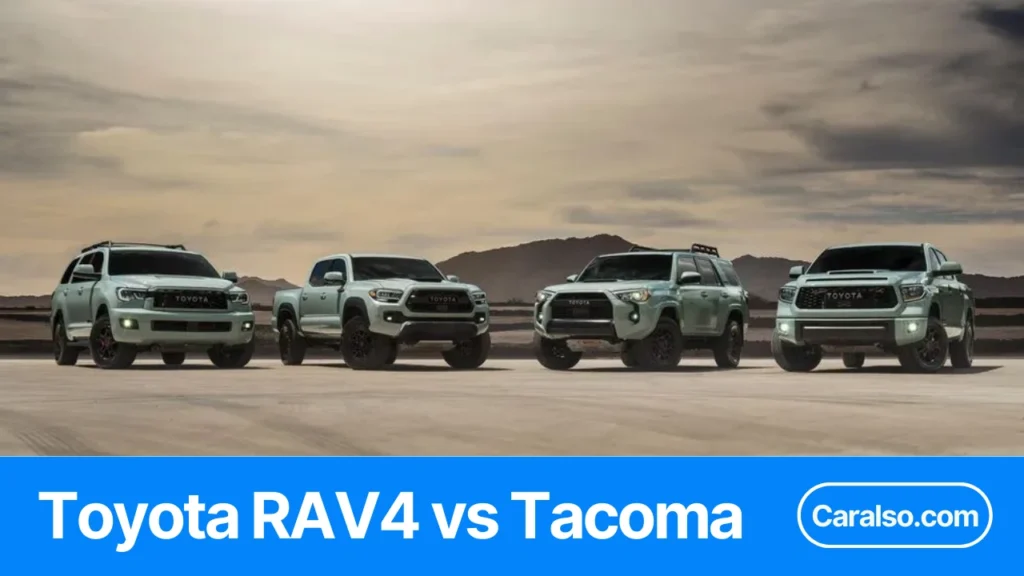
Toyota RAV4 vs Toyota Tacoma
Quick Answer
Pick The RAV4 If You Want:
- A better daily driver for commuting and parking
- Enclosed cargo for dogs, strollers, luggage, and tools
- Higher MPG, especially in Hybrid form
Pick The Tacoma If You Want:
- A real truck bed for dirty, bulky, or wet loads
- More towing headroom for bigger trailers
- More off-road hardware options in 4WD trims
Hero Summary Table (Fastest Way To Decide)
| What You Do Most | Buy This | Key Numbers That Make The Call |
|---|---|---|
| Commute, errands, kid and dog duty | RAV4 | 37.6 cu ft cargo behind the rear seats. 39 MPG combined on the Hybrid. |
| Want the lowest fuel stops on a gas budget | RAV4 Hybrid | 41 city, 38 highway, 39 combined (EPA). |
| Tow light stuff a few times a year | RAV4 | Gas model towing: 1,499 lb. Hybrid towing: 1,750 lb. Plug-in Hybrid towing: 2,500 lb. |
| Haul lumber, mulch, motorcycles, or muddy gear | Tacoma | Bed options include 5-ft or 6-ft (config-dependent). |
| Tow heavier trailers regularly | Tacoma | Up to 6,500 lb towing (properly equipped). |
| Want a pickup but still care about MPG | Tacoma | 2WD setups hit 23 MPG combined. 4WD setups are commonly 21 MPG combined (EPA). |
60-Second Decision Table
I use this table when someone wants the answer fast. I’m using common U.S. specs as reference. Numbers vary by year, trim, and drivetrain.
| Primary Need | Best Choice | Why It Wins | What You Give Up |
|---|---|---|---|
| Commuting + Parking | RAV4 | 180.9 in long. 36.1 ft turning diameter. | Bed utility. Up to 6,500 lb max tow is easier to get in a Tacoma. |
| Long Road Trips | RAV4 Hybrid | 39 MPG combined (EPA). 37.6 cu ft behind the 2nd row for luggage. | Truck stuff. Bed for tall or dirty loads. |
| Tow A Camper Or Boat Regularly | Tacoma | Up to 6,500 lb max tow (properly equipped). More payload headroom on certain trims. | Fuel cost. Parking ease. The RAV4’s 36.1 ft turning diameter is hard to beat. |
| Haul Dirty Gear Or Construction Materials | Tacoma | Bed length options around 60.3 in or 73.5 in. 44.7 in between wheel housings. | Enclosed cargo. A RAV4 gives you 69.8 cu ft with the rear seats down. |
| Snow + Mountain Driving | Depends | RAV4 is 8.4 in ground clearance in common trims. AWD helps on plowed roads. Tacoma 4WD with low range helps when speeds are slow and traction is bad. | RAV4 gives up low-range. Tacoma gives up turning radius and usually MPG. |
| Off-Road Trails Beyond Forest Roads | Tacoma | 4WD with low range is the big separator. It matters on steep, loose climbs. | Everyday ease. RAV4 is shorter by about 32 in to 45 in depending on Tacoma bed. |
| One-Vehicle Household | RAV4 | 37.6 cu ft behind the 2nd row. 69.8 cu ft behind the 1st row. Easier daily use for most families. | Heavy towing and open-bed flexibility. |
Key Differences At A Glance
- Vehicle Type: RAV4 is a unibody SUV. Tacoma is body-on-frame. Curb weight is about 3,370 lb for a RAV4 LE FWD and about 4,375 lb for one Tacoma configuration.
- Size: RAV4 is 180.9 in long. Tacoma is about 213.0 in to 226.2 in long depending on bed and cab.
- Turning Circle: RAV4 is 36.1 ft curb-to-curb. Tacoma is about 45.8 ft curb-to-curb in one common spec set.
- Cargo Style: RAV4 cargo is enclosed. 37.6 cu ft behind the 2nd row. 69.8 cu ft behind the 1st row. Tacoma cargo is an open bed.
- Bed Numbers: Tacoma bed length can be about 60.3 in or 73.5 in. Width between wheel housings is about 44.7 in.
- Fuel Economy: A gas RAV4 LE FWD is 30 MPG combined (EPA). RAV4 Hybrid trims commonly land at 39 MPG combined (EPA). Tacoma is often around 21 MPG combined in 4WD specs, with some trims reaching 23 MPG combined.
- Towing Headroom: RAV4 is usually 1,500 lb on many gas trims, 1,750 lb on many hybrid trims, and 2,500 lb on Prime. Some prior Adventure and TRD Off-Road RAV4 trims were rated 3,500 lb. Tacoma can hit 6,500 lb when properly equipped.
- Driveline Focus: RAV4 AWD is built for mixed-road traction. Tacoma offers 4WD with low range on many 4×4 trims.
- Cargo Security: RAV4 locks cargo behind glass. Tacoma usually needs a tonneau or cap if you want the same theft and weather protection.
- What Most People Regret: Tacoma buyers who do not use the bed weekly often miss the tighter turning circle and higher MPG of the RAV4. RAV4 buyers who tow a lot often wish they bought the Tacoma first.
RAV4 Vs Tacoma Specs Snapshot
I wrote this using 2025 model-year specs because those are the most common new and used cross-shops right now. Exact numbers change by trim, drivetrain, cab, and tires.
| Decision Spec | Toyota RAV4 (Compact SUV) | Toyota Tacoma (Midsize Pickup) | Why It Matters |
|---|---|---|---|
| Price Band (MSRP Range) | Gas: about $29k to $39k. Hybrid: about $32k to $41k. Plug-In: $44,815 to $48,685. | Gas 2WD: about $31.6k to $39.4k. Gas 4WD: about $34.8k to $52.6k. Hybrid 4WD: about $46.3k to $63.7k. | If you want a truck, you usually pay truck money. The gap gets bigger fast once you add 4WD and higher trims. |
| Powertrains (Real Choices) | 2.5L gas with 203 hp. Hybrid with 219 hp (net combined). Plug-In with 302 hp (combined). | 2.4L turbo with up to 278 hp and 317 lb-ft. Hybrid with up to 326 hp and 465 lb-ft. | RAV4 gives you efficiency options. Tacoma gives you torque and towing hardware. |
| MPG And Efficiency (EPA Estimates) | Gas: 30 mpg combined (LE FWD). Hybrid: 39 mpg combined. Plug-In: up to 94 MPGe combined, plus 38 mpg in hybrid mode. | 2WD gas: 23 mpg combined. 4WD gas: 21 mpg combined. Hybrid 4WD: 23 mpg combined. | If you drive 12,000 miles a year, even a 10 mpg swing can mean hundreds of gallons difference. |
| Max Towing (When Properly Equipped) | Gas: 1,500 lb. Hybrid: 1,750 lb. Plug-In: 2,500 lb. | Up to 6,500 lb. | If you tow over 2,500 lb more than once in a while, I stop looking at the RAV4 and I shop trucks. |
| Max Payload (When Properly Equipped) | Plug-In spec sheets show about 1,296 lb payload. Gas and Hybrid vary by trim and options. | Up to 1,705 lb. | Payload is what gets you first when you load people, gear, hitch weight, and a bed full of stuff. |
| Cargo Or Bed Practicality | 37.6 cu ft behind row 2. 69.8 cu ft max with seats folded. Locked and weather-protected. | 5-foot bed: 60.3 inches long. 6-foot bed: 73.5 inches long. 44.7 inches between wheel wells. | SUV cargo stays clean, dry, and secure. Truck beds swallow dirty, bulky gear, but you may want a tonneau or topper. |
What Each Is Best For
Choose RAV4 If You Want
- A daily driver that is easy to park in a normal garage.
- Better fuel economy on real commuting miles.
- Enclosed cargo for strollers, groceries, luggage, and dog gear.
- A quieter cabin on long highway runs.
- Hybrid options that make sense if you drive 40 to 80 miles a day.
- Plug-in driving if your commute is under 42 miles and you can charge at home.
My simple rule: if your “truck stuff” is occasional, I buy the RAV4 and rent a trailer or borrow a truck when I need it.
Choose Tacoma If You Want
- A bed for messy stuff: mulch, lumber, greasy parts, muddy bikes.
- Regular towing over 2,500 lb.
- Payload headroom for gear, passengers, and tongue weight.
- Real off-road durability features, plus low-range on 4WD trims.
- 5-foot or 6-foot bed choices based on how you use it.
- Hybrid torque if you want strong pull at low rpm.
My simple rule: if you tow, haul, or wrench every month, the Tacoma pays you back in convenience.
The Truck Bed Reality Check
Most people buy the Tacoma for the bed. Then they use it a few weekends per month. That is fine. But if you are paying for a bed, I want you to actually use it.
7 Questions That Decide It
I score these as Yes or No. Yes equals 1 point.
- Do you use a bed 8 days per month or more.
- Do you haul dirty loads like mulch, gravel, or fuel cans at least 2 times per month.
- Do you tow more than 2,500 lb more than 3 times per year.
- Do you need to carry items longer than 72 in at least 6 times per year.
- Do you live where rain or snow would soak open cargo 10 times per year or more.
- Do you park in tight city spots 5 days per week.
- Will adults ride in the back seat 4 days per week or more.
My Quick Scorecard
| Bed Need Score | What I Do | Why |
|---|---|---|
| 0 to 2 | I buy the RAV4 | I do not need a bed often enough to live with truck size every day. |
| 3 to 4 | I test-drive both, same week | This is the gray zone. The deciding factor is towing frequency and parking pain. |
| 5 to 7 | I buy the Tacoma | I will use the bed and towing headroom enough to justify it. |
If You Do Not Need A Bed Daily: 3 RAV4 Replaces A Truck Setups
RAV4 Plus Hitch Cargo Carrier
This is my go-to for bikes and dirty gear.
- A hitch carrier load counts as tongue weight.
- Tongue weight is often around 10 to 15 percent of what you tow, but your exact limit is in the owner’s manual.
- Example math: 1 carrier at 60 lb plus 2 bikes at 35 lb each equals 130 lb. Add a cooler at 40 lb and you are at 170 lb.
This setup keeps the cabin clean. It also keeps the roof clear for a box.
RAV4 Plus Roof Box And Rails
This is my long-trip setup.
- A roof box is great for bulky, light items.
- I put lighter stuff up top, like sleeping bags and jackets.
- I keep heavier items low in the cargo area.
If you crosswind-drive a lot, you will feel roof load more than hitch load.
RAV4 Plus A 4×8 Utility Trailer
This is how I replace a bed for Home Depot runs.
- A 4×8 trailer carries plywood flat.
- It carries long boards without sticking into the cabin.
- It keeps dirty stuff outside the vehicle.
If you tow only a few times per year, this can be cheaper than living with a truck every day.
If You Do Need A Bed: 3 Ways To Make Tacoma Livable Daily
Tire Choice And Pressure Basics
Tires change ride more than most people expect.
- Drive the Tacoma on the exact wheel size you plan to buy, like 17, 18, or 20 in.
- Check the door-jamb tire pressure sticker.
- Set pressure to that number before you judge ride.
A test drive on underinflated tires lies to you.
Add A Bed Cover Or Cap For Security
If you carry tools, you need security.
- A soft tonneau is light and simple.
- A hard tonneau adds security.
- A cap gives full weather protection and turns the bed into a big locked box.
If you live where it rains 100 days per year, a cap can change your whole relationship with a truck.
Pick The Right Cab And Bed Combo
This is where people mess up.
- Tacoma XtraCab seats 2. Double Cab seats 5.
- Tacoma bed options are about 60.3 in or 73.5 in long depending on configuration.
If adults ride in back weekly, I pick Double Cab first. Then I pick bed length based on what I haul.
Daily Driving: Ride, Noise, Comfort, And Parking
I daily-drive SUVs and trucks. The difference shows up fastest in parking, u-turns, and long highway runs.
Ride Quality Differences
Here is the mechanical reason they feel different.
- RAV4 is unibody.
- Tacoma is body-on-frame.
In plain terms, the RAV4 isolates bumps better at commuter speeds. The Tacoma feels more like a truck, especially on rough pavement.
On the Tacoma, suspension choice matters.
- Some Tacoma trims use rear coil springs.
- Some setups use other rear hardware.
If ride is a top priority, I test drive the exact trim, not “a Tacoma.”
Cabin Noise And Long-Trip Fatigue
I focus on 3 noise sources.
- Tire hum at 45 mph on rough pavement.
- Wind noise at 70 mph.
- Engine sound under a full-throttle merge.
Quick reality checks I do on every test drive:
- Do one merge from 50 to 70 mph at full throttle.
- Cruise at 70 mph for 3 minutes with the radio off.
- Drive one stretch of rough asphalt and one stretch of smooth asphalt.
RAV4 Hybrid buyers often notice the engine stays calmer in normal driving than the gas model. Tacoma buyers often notice the new-generation truck feels more refined than older Tacomas.
City Life: Turning Circle, Parking, Garage Fit, Visibility
This is where numbers make the decision.
- RAV4 turning circle is 36.1 ft curb-to-curb.
- Tacoma turning circle is about 45.8 ft curb-to-curb in one common spec set.
That is a 9.7 ft difference.
Length matters too.
- RAV4 is 180.9 in long.
- Tacoma ranges about 213.0 to 226.2 in long depending on cab and bed.
That is 32.1 to 45.3 in longer.
Weight changes how it feels in stop-and-go.
- A common RAV4 spec is about 3,370 lb curb weight.
- Tacoma curb weight commonly lands in the 4,145 to 4,560 lb range depending on configuration.
My rule in tight cities is simple. If you parallel park 5 days per week, you feel every extra inch of length and every extra foot of turning circle.
Snow And Bad Weather: AWD Vs 4WD Explained Simply
I start with tires. Every time. If you drive in snow, I want a real winter tire or at least an all-weather tire with the 3PMSF symbol.
Then I look at drivetrain.
When RAV4 AWD Is Enough (Most People)
RAV4 AWD is for grip at normal road speeds. Think plowed roads, slush, cold rain, and icy intersections.
Here is where it works best.
- Starting from a stop on slick pavement.
- Climbing a snowy hill at 15 to 45 mph.
- Staying stable when one side of the car hits slush.
Some 2025 RAV4 AWD gas models add Multi-Terrain Select with a SNOW mode. I use it when the road is slick and I want smoother throttle.
If you live in a snow state and you are not towing heavy, RAV4 AWD plus winter tires is usually the right answer.
My quick winter setup for a RAV4:
- Winter tires in the stock size.
- Keep tread depth above 6/32 in for snow season.
- Keep a small shovel and traction boards.
- If your area requires chains, buy the right size and test-fit them once.
When Tacoma 4WD Low Range Matters
Tacoma 4WD matters when speed is low and traction is bad. This is where AWD crossovers run out of tricks.
I reach for Tacoma 4WD when I am dealing with any of these.
- Unplowed roads with deep snow.
- Steep grades at 2 to 10 mph.
- Rutted two-tracks where one wheel is off the ground.
- Boat ramps with algae and slick concrete.
Tacoma can be had with part-time 4WD and some trims offer full-time 4WD. Toyota also talks about Multi-Terrain Select working in 4WD-High and 4WD-Low on off-road-focused grades. Crawl Control is basically low-speed cruise control for loose surfaces.
Low range is the key feature here. It multiplies torque at low speeds. That helps you crawl without spinning tires.
My simple rule:
- 4WD-High is for snow-covered roads at normal speeds.
- 4WD-Low is for slow climbing, deep snow, and getting unstuck.
Always follow the owner’s manual for when to use part-time 4WD. Part-time systems are not meant for dry pavement.
The Empty Bed In Winter Problem And Fixes
This is the pickup trap. The rear axle is light when the bed is empty. Traction drops. You feel it on slippery starts.
I fix it with weight and placement.
Here is what I do:
- Add 200 to 300 lb of bagged weight for winter if the truck is sliding easily.
- Put the weight directly over the rear axle, not against the tailgate.
- Strap it down so it cannot move in a panic stop.
Bad placement is worse than no weight.
- Weight behind the axle can make the rear swing more.
- Loose bags can become projectiles in a crash.
Two more winter wins for a Tacoma:
- Winter tires matter more than 4WD.
- A hard tonneau or cap keeps gear dry and adds a little stability at highway speed.
Towing And Hauling: What The Numbers Do Not Tell You
Tow ratings sell vehicles. Payload limits them.
I focus on 3 numbers.
- Tow rating
- Payload
- Tongue weight
Towing Vs Payload Vs Tongue Weight
Towing capacity is the max trailer weight. That is trailer plus everything on it.
Payload is how much weight the vehicle can carry inside and on it. That includes:
- People
- Cargo
- Hitch hardware
- Tongue weight pushing down on the hitch
Tongue weight is the downward force at the hitch. For a normal bumper-pull trailer, I aim for 10 to 15 percent of the loaded trailer weight.
Here is why this matters.
Example with a Tacoma near its max payload.
- Tacoma max payload can be up to 1,705 lb.
- Say you tow a 6,000 lb trailer.
- Tongue weight at 10 to 15 percent is 600 to 900 lb.
Now do the math.
- 1,705 minus 600 equals 1,105 lb left for people and cargo.
- 1,705 minus 900 equals 805 lb left for people and cargo.
That 805 lb disappears fast.
- 4 adults at 180 lb each is 720 lb.
- Add a 60 lb hitch.
- You are basically done.
That is why people hit payload before towing capacity.
Common Trailer Examples And What To Watch
I like real examples. These are typical loaded ranges. Yours can be higher.
4×8 Utility Trailer
- Common loaded weight: 700 to 2,000 lb
- Watch: tongue weight, sway, and trailer tire pressure
- Tip: load heavier items forward of the trailer axle to keep tongue weight in range
Jon Boat And Small Fishing Rig
- Common loaded weight: 600 to 1,800 lb
- Watch: wet ramps and braking distance
- Tip: 4WD helps at the ramp more than on the highway
Tiny Teardrop Camper
- Common loaded weight: 1,200 to 2,500 lb
- Watch: frontal area, crosswinds, and tongue weight creeping up when you pack front storage
- Tip: keep speed reasonable. Wind load feels bigger than the scale number
Pop-Up Camper
- Common loaded weight: 1,500 to 3,500 lb
- Watch: brake controller needs, and how much gear you load in the tow vehicle
My towing safety checks before every trip:
- Confirm trailer lights and brakes.
- Check tire pressure on truck and trailer.
- Re-check the hitch pin and coupler latch.
- Do a slow brake test in a parking lot.
What I Inspect On Used Vehicles If Towing Is In Your Future
If I am buying used and I plan to tow, I inspect like a skeptic.
Hitch And Wiring
- Look for a factory hitch or a quality receiver with a visible rating label.
- Check the 7-pin or 4-pin connector for corrosion.
- Look for hacked wiring under the bumper.
Rear Suspension And Tires
- Look for rear sag at rest.
- Check for uneven rear tire wear.
- Bounce test the rear. Excess motion can mean tired shocks.
Brakes
- Tow vehicles need strong brakes.
- Check pad thickness.
- Check rotor condition.
- On the test drive, do a firm stop from 45 mph.
Cooling And Fluids
- Check for coolant leaks.
- Smell the transmission fluid. Burnt smell is a red flag.
- On a Tacoma 4WD, look for records on differential and transfer case fluid services.
Frame And Rust
- Inspect around hitch mounting points.
- Inspect frame rails and crossmembers.
- If you see heavy scaling near the rear, I walk away unless you have a clean inspection report and proof of repair.
If towing is a big part of your life, I also weigh the rig at a public scale at least once. Real numbers beat guesses.
Off-Road Reality: Forest Roads Vs Real Trails
I split off-road into two buckets. Forest roads. And real trails.
Forest roads are graded dirt and gravel. Real trails have ruts, rocks, and steep climbs.
Here is the quick separation I use.
| Surface And Use | RAV4 Works | Tacoma Works | The Limiter |
|---|---|---|---|
| Graded Forest Roads | Yes | Yes | Tires and clearance |
| Washboard Gravel At 25 To 40 mph | Yes | Yes | Shocks and tire pressure |
| Deep Ruts And Rock Steps | Sometimes | Yes | Clearance and low range |
| Slow Steep Climbs At 2 To 8 mph | No | Yes | Low range |
| Mud With No Bypass | Sometimes | Yes | Tire type and recovery points |
RAV4 Soft-Roading Strengths And Limits
I like the RAV4 for trailheads and rough access roads. It is also easy to live with daily.
What it does well:
- Ground clearance is 8.4 in on a common 2025 spec.
- Approach angle is about 19.0 degrees.
- Departure angle is about 21.0 degrees.
- Multi-Terrain Select is available on AWD gas models.
- Modes include Mud and Sand, Rock and Dirt, Snow, and Normal.
Where it hits a wall:
- No low range.
- No locking rear differential.
- Stock tires are usually road-focused.
- Underbody protection is lighter than a truck.
My RAV4 rule: if you can keep speeds above 10 mph on climbs, it usually works. If you need to crawl at 2 to 5 mph, I want a real 4WD system.
One lineup note I keep in mind. The 2025 gas RAV4 lineup is simpler than past years. Toyota highlights AWD and Dynamic Torque Vectoring AWD with Rear Driveline Disconnect depending on grade. The point is still the same. It is a crossover AWD system, not a low-range 4WD system.
Tacoma TRD Trims: What You’re Paying For
This is where Tacoma earns its reputation. It has the hardware for slow, rough, technical driving.
Numbers that matter on an off-road-focused Tacoma spec:
- Running clearance is 11.5 in on TRD Off-Road.
- Approach angle is 33.8 degrees on TRD Off-Road.
- Departure angle is 22.5 degrees with a tow hitch.
- Departure angle is 26.6 degrees without a tow hitch.
- Breakover angle is 26.1 degrees on TRD Off-Road.
Hardware I look for when I am paying for TRD:
- 4WD with low range.
- Multi-Terrain Select that works in 4WD-High and 4WD-Low.
- Crawl Control for low-speed traction.
- An electronic locking rear differential on TRD Off-Road.
- Skid plates and recovery hooks.
What you pay extra for in TRD Pro and Trailhunter:
- TRD Pro gets TRD-tuned FOX QS3 Internal Bypass shocks.
- TRD Pro runs 33-inch Goodyear Territory RT tires.
- Trailhunter is built around off-road hardware and a bed setup for gear.
My Tacoma rule: if you want to drive slow and technical, I pay for TRD Off-Road or higher. If you are mostly on gravel roads, an SR5 4WD with good tires can be enough.
Ownership Costs That Actually Change The Decision
I do not obsess over tiny differences. I focus on cost levers that hit you every month.
Table first. Then the why.
| Cost Driver | RAV4 | Tacoma | What I See In Real Ownership |
|---|---|---|---|
| Fuel Cost Sensitivity | Low to Medium | Medium to High | RAV4 Hybrid is the big fuel saver. Tacoma 4WD uses more fuel in stop and go. |
| Tires Cost And Frequency | Medium | High | Tacoma tires are often larger. TRD trims can run 265/70R17 and some run 33-inch tires. Bigger tires cost more. |
| Maintenance Complexity | Medium | Medium to High | Tacoma 4WD adds transfer case and extra driveline fluids. RAV4 Hybrid adds hybrid components. |
| Insurance Direction | Medium | Medium to High | Trucks often cost more to insure. It depends on driver and ZIP code. |
| Depreciation And Resale | Strong | Very Strong | Both hold value well. Tacoma often leads. iSeeCars shows about 26.3% five-year depreciation for Tacoma and about 30.3% for RAV4. |
Fuel Is The Easiest Math
If you drive 12,000 miles per year, MPG matters.
- A 39 mpg combined RAV4 Hybrid uses about 307 gallons per year.
- A 21 mpg combined Tacoma uses about 571 gallons per year.
That is 264 gallons difference per year.
Multiply by your local fuel price. That is your real number.
Tires And Wheels Add Up Faster On The Tacoma
I budget by tire size, not by vehicle name.
- A common Tacoma TRD Off-Road setup is 265/70R17.
- TRD Pro uses 33-inch tires.
Those are heavier than typical RAV4 tires. They also cost more.
If you do gravel roads often, I also plan for more puncture risk. That is true on both. Bigger tires still cost more.
Maintenance Is Not Just Oil Changes
RAV4 gas:
- Oil and filters.
- Brake service.
- Tires.
RAV4 Hybrid:
- Same basics.
- Hybrid system is durable, but it is still more complex than gas-only.
Tacoma 4WD:
- Oil and filters.
- Front and rear differential fluids.
- Transfer case fluid.
- More suspension and steering wear if you run heavy tires.
If you tow, I also budget for brakes more often. Trailer work is hard on pads and rotors.
Resale Is A Real Advantage For Both
Resale is not a feeling. It is a percentage.
- iSeeCars lists about 69.7% five-year value retention for RAV4 among small SUVs.
- iSeeCars lists about 26.3% five-year depreciation for Tacoma, which is about 73.7% retention.
- Kelley Blue Book has repeatedly called out Tacoma’s resale strength in its category.
If you trade every 3 to 5 years, this can matter as much as fuel.
Reliability And Longevity (What Tends To Show Up)
I trust both of these long-term. They are Toyotas. But they age differently because they get used differently.
Here is one data point I actually use.
iSeeCars estimates the chance of reaching 250,000 miles at:
- Tacoma: 25.3%
- RAV4: 7.3%
- RAV4 Hybrid: 7.9%
That does not mean a RAV4 cannot hit 250,000 miles. It does. It means the Tacoma shows up at that mileage more often in their data.
RepairPal is another useful check.
- RAV4 reliability rating: 4.0 out of 5. Annual repair cost: $429.
- Tacoma reliability rating: 3.5 out of 5. Annual repair cost: $478.
I read that as: RAV4 tends to be easier on the wallet. Tacoma tends to be solid, but truck parts and truck use can raise the pain when something does happen.
What’s Simpler Mechanically (And What That Usually Means)
If I want the simplest setup for long-term ownership, this is my order.
- RAV4 gas, FWD
- RAV4 gas, AWD
- Tacoma 2WD
- Tacoma 4WD
- RAV4 Hybrid or Plug-In Hybrid
- Tacoma Hybrid
That list surprises people. The hybrid models are still reliable. But they have more parts.
Here is the plain-English version.
RAV4 gas:
- 1 engine
- 1 transmission
- AWD models add a rear driveline
RAV4 Hybrid:
- Toyota says every RAV4 Hybrid uses Electronic On-Demand AWD with a dedicated rear electric drive motor
- Toyota also says the hybrid battery has a 10-year or 150,000-mile warranty
Tacoma 4WD:
- Adds a transfer case
- Adds front differential hardware
- Adds more joints and seals to maintain
More hardware does not mean “unreliable.” It means I inspect more stuff on a used truck.
If Buying Used: Best “Look-For” Checks By Vehicle Type
I do these checks before I fall in love with the vehicle.
RAV4 Used Checklist (Gas Or Hybrid)
- Service records. I want proof of oil changes. I like to see them every 5,000 to 10,000 miles.
- Tires. Uneven wear can mean alignment or suspension issues.
- Test drive at 70 mph. I listen for wheel bearing hum.
- Full lock turns in a parking lot. I listen for clicking from CV joints.
- Braking from 45 mph. I check for steering wheel shake.
- Check for water leaks. I look under the spare tire area and under cargo trim.
- Rust check. I look at rear suspension mounting points and brake lines.
Extra Checks For RAV4 Hybrid Or Plug-In
- Scan for warning lights. I want zero hybrid system messages.
- Confirm the cooling system fans run and the A/C works well.
- Ask for a dealer health scan if mileage is high.
- If you live in road-salt states, I check whether the vehicle is covered by Toyota support programs related to high-voltage cable corrosion on some AWD hybrid models. I also inspect the underside and look for heavy corrosion.
Tacoma Used Checklist (2WD Or 4WD)
- Frame inspection. I crawl under it. I poke suspicious rust with a screwdriver. I focus on the rear frame sections and crossmembers.
- Bed and bumper mounts. I look for rust where steel overlaps.
- Steering and front end. I check for play in the wheel at 12 and 6 o’clock, then 9 and 3 o’clock.
- Rear suspension. I check leaf springs, shackles, and bushings.
- Drive it over rough pavement at 25 mph. I listen for clunks.
- Braking from 45 mph. I check for pull and pedal vibration.
Extra Checks For Tacoma 4WD
- Engage 4WD in a safe area and confirm it shifts cleanly.
- Check for leaks at the front diff, rear diff, and transfer case.
- Check CV boots for tears.
- Look for driveline vibration at 45 to 65 mph.
Extra Checks If You Tow
- I inspect the hitch and wiring for clean installation.
- I look for rear sag with no load.
- I ask for brake service history.
If you want the shortest version, here it is.
- I buy a used RAV4 on records.
- I buy a used Tacoma on frame condition and driveline condition.
My Pick For 6 Common Buyer Profiles
I make this choice the same way every time. I match the vehicle to the job.
Commuter Plus Weekend Hikes
I pick the RAV4 Hybrid.
- 39 mpg combined beats 21 to 23 mpg combined in many Tacoma trims.
- 180.9 inches long is easier to live with than 213.0 to 226.2 inches.
- 36.1 ft turning circle beats about 45.8 ft.
Homeowner Plus DIY Projects
I split it based on how often you haul dirty stuff.
- If you buy mulch or lumber once per month, I pick the RAV4 and add a 4×8 utility trailer.
- If you haul messy loads 2 times per month or more, I pick the Tacoma and I budget for a bed cover.
Camper Towing A Small Trailer A Few Times Per Year
I pick based on trailer weight.
- If your loaded trailer is under 2,500 lb, I pick the RAV4 Plug-In Hybrid or the right RAV4 trim and I keep tongue weight under control.
- If your loaded trailer is 3,000 lb to 6,000 lb and you tow more than 3 times per year, I pick the Tacoma.
Contractor Or Field Work
I pick the Tacoma.
- Bed length options around 60.3 inches or 73.5 inches matter.
- 44.7 inches between wheel wells matters for sheets and gear.
- Payload up to 1,705 lb matters when the truck is full of tools.
Snow-State Family Car
I pick the RAV4 AWD for most families.
- Enclosed cargo stays dry.
- AWD helps on plowed roads.
- A winter tire setup matters more than drivetrain.
I pick the Tacoma 4WD if your roads are unplowed often, or you climb steep grades at low speeds.
- Low range is the separator.
Off-Road Hobbyist
I pick based on trail type.
- If you mostly do gravel, washboard, and forest roads, I pick the RAV4 with good tires.
- If you do ruts, rock steps, and slow climbs at 2 to 8 mph, I pick the Tacoma 4WD. Low range is the reason.
Trim Matchmaker
I use trims to solve one problem. Your job list.
I also use wheel and tire sizes as a shortcut. More sidewall usually rides better. More aggressive tread usually makes more noise.
If You Want A More Rugged RAV4: Best Trims To Cross-Shop
If you are buying new, the rugged pick is simple.
RAV4 Hybrid Woodland Edition
- AWD is standard.
- Ground clearance is 8.1 in.
- Wheels are 18 in.
- Tires are all-terrain.
- Towing is 1,750 lb.
This is the trim I point to when someone wants trailheads, dirt roads, and winter commutes in one vehicle.
If you want a gas RAV4 that feels more “trail ready,” I focus on wheel size.
- LE and XLE often sit on 17-in wheels.
- XLE Premium often steps up to 19-in wheels.
If you plan to drive gravel often, I usually prefer 17 in or 18 in wheels over 19 in wheels. More sidewall helps.
If you want the highest RAV4 tow rating, I split it by model year.
- 2025 RAV4 gas is typically 1,500 lb.
- 2025 RAV4 Hybrid is typically 1,750 lb.
- 2025 RAV4 Plug-In Hybrid is 2,500 lb.
- 2024 RAV4 Adventure and 2024 RAV4 TRD Off-Road are rated at 3,500 lb.
So my cross-shop list looks like this.
- Woodland Edition if you want all-terrain tires and AWD, and you tow under 1,750 lb.
- Plug-In Hybrid if you want 2,500 lb towing and stronger acceleration.
- Used 2024 Adventure or 2024 TRD Off-Road if you need 3,500 lb towing in a RAV4-shaped vehicle.
If You Want A More Comfortable Tacoma: Best Configurations To Test Drive
Tacoma comfort comes down to cab, bed, and tires.
Cab Choice
- XtraCab is 2 seats.
- Double Cab is 5 seats.
If adults ride in back more than once per week, I test drive Double Cab first.
Bed And Length
- Double Cab short bed length is about 213.0 in overall.
- Double Cab standard bed length is about 226.2 in overall.
- Turning circle is about 45.8 ft curb-to-curb.
If you live in tight parking, I start with the 5-ft bed. It is easier to place.
Wheels And Tires
- SR and SR5 often use 245/70R17.
- TRD Sport commonly uses 265/65R18.
- Limited commonly uses 265/65R18.
- TRD Pro and Trailhunter use 18-in wheels with 33-in class all-terrain tires.
If you want the calmest daily drive, I avoid 33-in all-terrain tires unless you truly need them.
Here are the three Tacoma setups I tell people to test drive back-to-back.
- SR5 Double Cab, 5-Ft Bed, 2WD, 245/70R17
This is my value daily driver baseline. It is the setup that surprises people. - Limited Double Cab, 5-Ft Bed, 4WD If You Need It, 265/65R18
This is the comfort pick. Heated and ventilated front seats are available. A 14-in screen is available. JBL audio is available. - TRD Sport Double Cab, 5-Ft Bed, 265/65R18
I test drive this when someone wants a truck that feels tighter on pavement. It runs 18-in wheels and has sport-tuned suspension hardware.
If you also plan to tow and go off pavement, I add one more drive.
- TRD Off-Road Double Cab, 5-Ft Bed
It adds off-road hardware like a locking rear differential and more protection. It also tends to ride and sound different because of tire choice.
FAQs
Is The RAV4 Or Tacoma Better In Snow?
For plowed roads, I pick the RAV4 AWD for most people.
- It is shorter at 180.9 in.
- Turning circle is 36.1 ft.
- Cargo stays locked and dry.
For unplowed roads and steep hills at low speed, I pick Tacoma 4WD.
- Low range is the feature that matters.
For both, tires decide the day.
- I want winter tires or all-weather tires with the 3PMSF symbol.
- If the Tacoma rear slides easily with an empty bed, I add 200 to 300 lb over the rear axle and strap it down.
Can A RAV4 Tow A Small Camper?
Yes, if the numbers fit.
Here are the common 2025 ratings.
- Gas RAV4: 1,500 lb
- RAV4 Hybrid: 1,750 lb
- RAV4 Plug-In Hybrid: 2,500 lb
If your camper is a true 2,500 lb loaded, I still want margin. Wind, water, and gear add weight fast.
If you need 3,500 lb towing in a RAV4, I shop used.
- 2024 Adventure and 2024 TRD Off-Road are rated at 3,500 lb.
I also watch tongue weight.
- I aim for 10 to 15 percent of the loaded trailer weight.
- Tongue weight counts against payload.
Is A Tacoma Good As A Daily Driver?
Yes. But you feel the size.
- Overall length is about 213.0 to 226.2 in depending on bed.
- Turning circle is about 45.8 ft.
If you daily drive in tight areas, I start with Double Cab and the 5-ft bed.
If you want the smoothest daily feel, I keep tire size reasonable.
- SR and SR5 often use 245/70R17.
- Bigger all-terrain setups add noise and weight.
Which Is Cheaper To Own Long-Term?
For most people, the RAV4 costs less to fuel.
Here is my simple example at 12,000 miles per year.
- 39 mpg combined uses about 307 gallons.
- 21 mpg combined uses about 571 gallons.
That is 264 gallons per year difference.
But if you haul and tow often, the Tacoma can save you rental costs. That matters if you would otherwise rent a truck 6 to 12 times per year.
Which Holds Value Better?
Both hold value well. Tacoma usually leads.
One five-year depreciation data point I use:
- Tacoma: about 26.3% depreciation
- RAV4: about 30.3% depreciation
If you trade every 3 to 5 years, this can matter as much as fuel.
Should I Buy Used (And What Should I Inspect First)?
Yes, if you inspect the right stuff.
Used RAV4 Checks I Always Do
- Service records and oil change history
- Tire wear pattern
- Braking from 45 mph for vibration
- CV joint clicking on tight turns
- Water leaks under the cargo floor
- Undercarriage rust in salt states
Used Tacoma Checks I Always Do
- Frame rust and scaling, especially rear sections
- Leaks at the front diff, rear diff, and transfer case on 4WD trucks
- 4WD engagement in a safe area
- Steering play at the front wheels
- Rear suspension wear and sag
- Hitch and wiring quality if it towed
If towing is in your plan, I weigh the trailer and the loaded vehicle at a public scale once. Real numbers prevent expensive mistakes.
Sources
- Toyota RAV4 (2025)
- FuelEconomy.gov, 2025 RAV4 Results
- Edmunds, 2025 Toyota RAV4 Specs
- Car And Driver, 2025 Toyota Tacoma Specs
- iSeeCars, Toyota Tacoma Resale Value
- RepairPal, Toyota Tacoma Reliability

Hey there,
How is it going?
I’m Meraj Sarker. I am a Car Mechanic and a student of Automobile Restoration here in Florida, USA. I’ve been studying automotive for around 9 years now. So you can rely on my recommendation. For me, studying and getting knowledge about automobile it’s really fun and entertaining. I will help you to get solutions for your car through this website. If you need any help let me know.