
If you want the cleanest, lowest-risk pick for long-term ownership, I’d buy the RAV4. It tends to hold value better, and the hybrid and plug-in versions are hard to beat on efficiency numbers.
If you want the longest warranty and a more modern cabin feel for the money, I’d buy the Tucson. It also gives you slightly more cargo space behind the rear seats.
I’m going to lean on EPA fuel economy ratings and a few hard specs here, because those numbers travel well across trims and dealer hype.
Quick Answer
The 15-Second Verdict
- Pick the RAV4 if you care most about resale and efficiency.
- Pick the Tucson if you care most about warranty coverage and cabin tech for the price.
- If you’re choosing hybrid or plug-in, my short version is this: RAV4 wins on MPGs and plug-in EV range. Tucson often feels nicer feeling inside and it backs you up with a longer warranty.
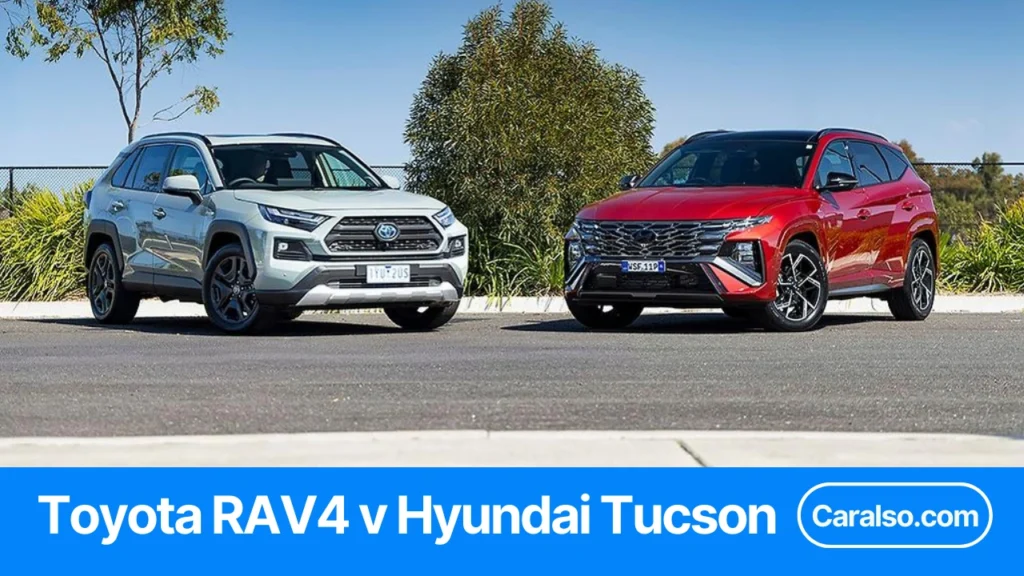
Toyota RAV4 vs Hyundai Tucson
At-A-Glance Winner Table
| Category | Winner | Why It Wins (1 Line With Numbers) |
|---|---|---|
| Resale Value | RAV4 | About 53.9% 5-year resale value estimate in KBB’s 2025 list. |
| Warranty Coverage | Tucson | 5 yr/60,000 mi basic and 10 yr/100,000 mi powertrain vs Toyota’s 3 yr/36,000 mi basic and 5 yr/60,000 mi powertrain. |
| Gas MPG (Combined) | RAV4 (Slight) | 30 mpg combined (RAV4 FWD) vs 28 mpg combined (Tucson FWD). |
| Hybrid MPG (Combined) | RAV4 | 39 mpg combined (RAV4 Hybrid) vs 35 mpg combined for Tucson Hybrid (or 38 mpg in Hybrid Blue). |
| Plug-In EV Range | RAV4 | Up to 42 miles electric vs about 32 miles electric (EPA estimate noted by Edmunds). |
| Plug-In Efficiency | RAV4 | 94 MPGe (RAV4 Plug-In) vs 77 MPGe (Tucson Plug-In). |
| Cargo Behind Rear Seats | Tucson | 38.7 cu ft vs RAV4’s 37.6 cu ft. |
| Comfort And Cabin Tech | Tucson | 12.3-in touchscreen with wireless Apple CarPlay and Android Auto called out as standard by Edmunds. |
Biggest Differences That Actually Matter
- Powertrain Choices Are Not Equal In Practice.
Both offer gas, hybrid, and plug-in. But the numbers separate them fast. RAV4 Plug-in is 42 miles of EV range. Tucson Plug-in is 32 miles. - Hybrid Feel Is Different.
RAV4 Hybrid uses an eCVT. Under hard throttle, the engine can sit at a higher rpm. Some people call that “drone.”
Tucson Hybrid uses a 6-speed automatic. It tends to feel more like a normal automatic when you roll into the gas. - Efficiency Is A Real Gap, Not A Vibe.
Gas: up to 30 mpg combined (RAV4 FWD) vs 28 mpg combined (Tucson FWD).
Hybrid: up to 39 mpg combined (RAV4 Hybrid) vs 38 mpg combined (Tucson Hybrid Blue) or 35 mpg combined (other Tucson Hybrid trims).
Plug-in: 94 MPGe (RAV4 Plug-in) vs 77 MPGe (Tucson Plug-in). - Power Swings By Powertrain.
Gas: 203 hp (RAV4) vs 187 hp (Tucson).
Hybrid: 219 hp (RAV4 Hybrid) vs 231 hp (Tucson Hybrid).
Plug-in: 302 hp (RAV4 Plug-in) vs 268 hp (Tucson Plug-in). - Warranty Vs Resale Is A Straight Trade.
Hyundai backs you with 5 years and 60,000 miles basic, and 10 years and 100,000 miles powertrain.
Toyota is 3 years and 36,000 miles basic, and 5 years and 60,000 miles powertrain.
I usually see Toyota hold value better in the real world, but warranty is the cleaner “on paper” win. - Cargo Changes More On The Plug-In.
Tucson gas and hybrid are 38.7 cu ft behind the rear seats. Tucson plug-in drops to 31.9 cu ft.
RAV4 gas is 37.6 cu ft behind the rear seats. RAV4 plug-in is 33.5 cu ft. - Towing Is Closer Than Most People Think.
RAV4 gas is 1,500 lb. RAV4 Hybrid is 1,750 lb. RAV4 Plug-in is 2,500 lb.
Tucson is 2,000 lb with trailer brakes across gas, hybrid, and plug-in. - Tech And Screens Favor Tucson In One Simple Number.
The 2025 Tucson Hybrid’s base Blue trim calls out a 12.3-inch touchscreen.
The RAV4 Plug-in calls out an available 10.5-inch multimedia display and an available 12.3-inch digital gauge cluster.
Specs Snapshot
| Powertrain | RAV4 Key Numbers | Tucson Key Numbers | Who It Fits | Key Watchouts |
|---|---|---|---|---|
| Gas | 203 hp. Up to 30 mpg combined (FWD). 37.6 cu ft cargo behind rear seats. 1,500 lb tow. | 187 hp. 28 mpg combined (FWD). 38.7 cu ft cargo behind rear seats. 2,000 lb tow with trailer brakes. | You want the lowest entry price. You do not care about plugging in. | AWD trims usually cut mpg. Check the window sticker, not the brochure. |
| Hybrid | 219 hp. Up to 39 mpg combined. AWD standard. 1,750 lb tow. | 231 hp. 38 mpg combined (Blue) or 35 mpg combined (other trims). AWD standard. 2,000 lb tow with trailer brakes. | You drive 12,000 miles a year or more. You want mpg without charging. | Test the powertrain sound on a hard on-ramp. eCVT vs 6-speed is a personal preference thing. |
| Plug-In Hybrid | 302 hp. 42 miles EV range. 94 MPGe. 38 mpg gas-only. 33.5 cu ft cargo behind rear seats. 2,500 lb tow. | 268 hp. 32 miles EV range. 77 MPGe. 35 mpg combined. 31.9 cu ft cargo behind rear seats. 2,000 lb tow with trailer brakes. | You can charge at home. You drive 10 to 40 miles most days. | Plug-ins lose some cargo. They cost more up front. Your payoff depends on how often you actually charge. |
Gas Vs Gas
If you are buying on price, this is where most people start. I look at two numbers first. Combined mpg and horsepower.
- RAV4: up to 30 mpg combined (FWD). 203 hp.
- Tucson: 28 mpg combined (FWD). 187 hp.
Here’s what 2 mpg looks like in real life math.
At 12,000 miles a year, 30 mpg uses about 400 gallons.
At 28 mpg, it’s about 429 gallons.
That’s about 29 gallons a year.
Hybrid Vs Hybrid
This is the trim where most shoppers land after a test drive. I like hybrids in this class because the mpg jump is big without the plug.
- RAV4 Hybrid: up to 39 mpg combined. 219 hp. AWD standard.
- Tucson Hybrid: 38 mpg combined (Blue) or 35 mpg combined (other trims). 231 hp. AWD standard.
If you want the simplest takeaway, it’s this.
RAV4 Hybrid usually wins mpg.
Tucson Hybrid usually wins horsepower.
Plug-In Vs Plug-In
This is the decision I make based on my daily drive. I do the same check every time. How many miles do I drive before I get back home to a charger.
- RAV4 Plug-in: 42 miles EV range. 94 MPGe. 302 hp.
- Tucson Plug-in: 32 miles EV range. 77 MPGe. 268 hp.
If you drive 30 miles a day and charge at home, both can cover that on electricity most days.
RAV4 gives you 12 extra miles of buffer.
That buffer matters when it’s 40 degrees outside and you run heat, or when you detour.
Reliability, Resale Value, And Long-Term Ownership
Which Is More Reliable In Practice?
When I say “reliable,” I mean 3 things.
- How often it needs an unscheduled repair.
- How expensive the common repairs are when they happen.
- How many small annoyances pop up over 3 to 5 years.
On paper, both are solid picks in this class. But the RAV4 has a longer track record with this basic formula. Especially on the hybrid side.
I also pay attention to third-party dependability studies. One example is J.D. Power’s Vehicle Dependability Study. In their 2025 RAV4 vs 2025 Tucson comparison, they note the RAV4 ranks 3rd in the Compact SUV segment in the 2024 VDS. That is a good sign for “third year of ownership” problems.
If you are shopping hybrid or plug-in, battery coverage matters. Toyota’s hybrid battery warranty is 10 years or 150,000 miles from the in-service date. That is a real number that reduces long-term risk.
What I do in real life before I call a vehicle “safe.”
I check open recalls by VIN. I do it on NHTSA’s site. I do it again the day I sign paperwork.
Resale Value Vs Warranty: The Trade
This is the simplest way I explain it to friends.
Hyundai tends to win the warranty headline.
5 years and 60,000 miles basic.
10 years and 100,000 miles powertrain for original owners.
Toyota is shorter on basic coverage.
3 years and 36,000 miles basic.
5 years and 60,000 miles powertrain.
But resale is where the RAV4 usually hits back.
KBB’s 2025 Best Resale Value list puts the RAV4 at 53.9% estimated 5-year resale value. That is a strong anchor point.
Depreciation studies often show the same pattern. One iSeeCars comparison shows the RAV4 Hybrid with about 30.1% 5-year depreciation versus about 45.9% for the Tucson. I treat those as directional, not absolute. But the gap is the point.
How I use this in the real world.
If the Tucson is $2,000 cheaper out the door, the warranty win matters more.
If the prices are close, I usually expect the RAV4 to give more back when I sell.
If You Keep Cars 3 Years Vs 10 Years
If you keep it 3 years:
- Depreciation matters more than repair risk.
- I lean RAV4 if the purchase prices are close.
- I lean Tucson if incentives make it meaningfully cheaper.
If you keep it 10 years:
- Reliability and warranty both matter.
- I lean RAV4 Hybrid if you want the lowest long-term risk profile, plus the 10 year and 150,000 mile hybrid battery warranty.
- I lean Tucson if you want the longer powertrain warranty and you plan to keep it from new, not as a second owner.
One quick tip I use either way.
Pick the powertrain you will actually use.
A plug-in only saves you money when you plug it in.
Fuel Economy And Efficiency
Winner Summary
- Best Gas MPG: RAV4 (30 mpg combined) vs Tucson (28 mpg combined).
- Best Hybrid MPG: RAV4 Hybrid AWD (39 mpg combined) vs Tucson Hybrid Blue (38 mpg combined).
- Best Plug-In EV Range: RAV4 Plug-in (42 miles) vs Tucson Plug-in (32 miles).
- Best Plug-In MPGe: RAV4 Plug-in (94 MPGe) vs Tucson Plug-in (77 MPGe).
- Gas-Only MPG After The Battery Is Empty: RAV4 Plug-in (38 mpg) vs Tucson Plug-in (35 mpg).
Hybrid Real-World Notes
EPA numbers are the baseline. Real-world results move.
Here’s what moves them the most in my experience:
- Temperature.
- Speed.
- Tire pressure.
- Wheel size.
- Short trips with a cold engine.
I like looking at the same-route tests, because they remove a lot of guesswork. On Edmunds’ mixed-driving route (published via AP), the Tucson Hybrid delivered 34 mpg and the RAV4 Hybrid delivered 35 mpg.
That 1 mpg gap is tiny. So I do not buy either hybrid based on that 1 number.
I buy based on how I drive.
If you do a lot of highway at 75 mph, expect lower mpg than the sticker.
If you do suburban stops at 35 to 45 mph, hybrids usually shine.
Plug-In Reality Check
Plug-ins are math. Not vibes.
The big number is EV range.
RAV4 Plug-in is 42 miles.
Tucson Plug-in is 32 miles.
That 10-mile gap can decide whether you burn gas on a normal weekday.
I also look at MPGe and “hybrid mode” mpg after the battery is depleted.
RAV4 Plug-in is 94 MPGe and 38 mpg gas-only.
Tucson Plug-in is 77 MPGe and 35 mpg combined.
One real-world detail I like. Edmunds tested a RAV4 Prime and got 48 miles of EV driving on their route. That is 6 miles over the EPA estimate. You should not expect that every day. But it shows what can happen with the right speed and conditions.
My quick rule before you pay extra for a plug-in.
If you cannot charge at home at least 4 nights per week, buy the hybrid instead.
Performance And Drivability
Acceleration And Passing Power
I look at 0 to 60 times because it predicts how calm the car feels in merges and 2-lane passes.
Gas Models
- RAV4: 8.3 seconds to 60 mph in Car and Driver testing on a TRD Off-Road. Edmunds measured 9.1 seconds on their test vehicle.
- Tucson: 8.8 seconds to 60 mph in Car and Driver testing on an AWD Limited.
My take.
If you buy gas-only, neither is quick. Both are fine for normal merges. I would not pay extra expecting a big performance jump.
Hybrid Models
- RAV4 Hybrid: 7.8 seconds to 60 mph in Edmunds testing.
- Tucson Hybrid: 7.7 seconds to 60 mph in Edmunds testing.
My take.
Hybrid is where both feel “right sized” for this segment. The gap is basically nothing in daily driving.
Plug-In Hybrid Models
- RAV4 Plug-In: 5.4 seconds to 60 mph in Car and Driver testing.
- Tucson Plug-In: 7.6 seconds to 60 mph in Edmunds testing.
My take.
If you care about straight-line punch, the RAV4 Plug-In is in a different tier. It is the only one here that feels fast when you pass at 60 to 75 mph.
Transmission Feel (CVT Vs 6-Speed Behavior)
This is the part you notice in the first 3 minutes.
RAV4 Hybrid And RAV4 Plug-In
Toyota uses an electronic CVT. It does not shift like a normal automatic. It changes ratios smoothly. Under hard throttle, the engine can hold a steady rpm. That is where the “drone” feeling comes from.
Tucson Hybrid And Tucson Plug-In
Hyundai uses a conventional 6-speed automatic that is electrified. It upshifts and downshifts like a normal automatic. It feels familiar if you are coming from a gas SUV.
How I Test “Drone” In 60 Seconds
- Find an empty on-ramp.
- Set the fan to level 2 and the radio off.
- Roll into the throttle at about 70% from 30 mph to 65 mph.
- Listen for steady rpm sound that stays constant for 3 to 5 seconds.
If that sound annoys you, pick the Tucson hybrid family. If it does not bother you, the Toyota system is usually a strong efficiency play.
Comfort, Noise, And Daily Livability
Seat Comfort And Ride Quality
I care about 2 things here. Seat support after 45 minutes. And ride motion over broken pavement.
In Edmunds’ head-to-head hybrid test, both had supportive seats, but the Tucson’s were more plush. They also gave the Tucson the edge for ride smoothness. They called the Tucson smoother over the same route.
I also pay attention to long-drive seat notes. Edmunds calls out that the RAV4 Hybrid’s front seats can lack comfort on longer drives. That is something I would test before I buy.
How I test seats quickly
- Drive 20 minutes.
- Stop.
- Adjust nothing.
- Drive another 20 minutes.
If you start shifting your hips in the second half, the seat is not right for you.
Cabin Noise Checklist (Highway And Acceleration)
Noise is not one thing. I break it into 3 checks.
- Cruise Noise At 70 mph
Car and Driver describes the Tucson as quiet and refined when cruising. That matches what I hear in most recent Tucson drives. - Acceleration Noise At 40 to 70 mph
In Edmunds’ hybrid comparison, they said the Tucson hybrid powertrain is quieter, and they said the RAV4 Hybrid tends to drone when accelerating. - Tire And Wind Noise On Rough Asphalt
This is the one you cannot solve with a spec sheet. I drive both on the same ugly stretch of road. If one sounds 3 to 5 dB louder to your ear, you will notice it every day.
My quick rule.
If you do 15,000 highway miles a year, I put more weight on cruise noise than on 0 to 60.
Visibility And Parking (Cameras, Sensors, Turning Circle)
This is where small numbers matter.
Turning Circle
- RAV4: 36.1 ft turning circle on gas and hybrid trims.
- Tucson: 38.6 ft turning circle.
That 2.5 ft difference shows up in tight parking lots and U-turns.
Cameras
In Edmunds’ hybrid comparison, the 360-degree camera was standard on the highest Tucson Hybrid trim, and optional on the top RAV4 Hybrid trims.
My parking test
- Back into a tight spot using mirrors only.
- Then do it using the camera view.
If the camera view is grainy or the guidelines lag, I do not count it as a real upgrade.
Visibility
Edmunds notes the RAV4 is easy to see out of. I still check A-pillar thickness and rear quarter window shape, because those are the blind-spot creators you feel on every commute.
Space And Practicality
Cargo Space Comparison (Seats Up/Down Table)
Here’s the cargo truth in 1 table. I separated the plug-ins because the battery packaging changes the numbers.
| Version | Tucson Cargo Seats Up | Tucson Cargo Seats Down | RAV4 Cargo Seats Up | RAV4 Cargo Seats Down |
|---|---|---|---|---|
| Gas Or Hybrid | 38.7 cu ft | 74.5 cu ft | 37.6 cu ft | 69.8 cu ft |
| Plug-In Hybrid | 31.9 cu ft | 66.3 cu ft | 33.4 cu ft | 63.1 cu ft |
My take after living with compact SUVs.
The 1.1 cu ft gap behind the rear seats is real, but it is not life changing. The bigger gap is seats-down space. Tucson is about 4.7 cu ft ahead in the gas or hybrid comparison.
The bigger surprise is the plug-in drop.
Tucson loses 6.8 cu ft behind the rear seats when you go plug-in.
RAV4 loses 4.2 cu ft behind the rear seats when you go plug-in.
Rear Seat Legroom And Car-Seat Friendliness
Rear legroom is one of the cleanest “family fit” numbers.
- Tucson rear legroom: 41.3 inches
- RAV4 rear legroom: 37.8 inches
That is a 3.5-inch difference.
You feel it when a tall front driver is set up, and you install a rear-facing seat behind them.
Car-seat hardware matters too.
IIHS child-seat anchor notes for both are similar in layout.
Both have 2 rear seating positions with complete LATCH hardware.
Both have 1 additional seating position with a tether anchor only.
Where the real-world experience splits.
Cars.com tested both with multiple seat types.
They said the 2025 RAV4 Hybrid did not fit 3 car seats across.
They also said many seats scored well because the lower anchors were easy to access, but the booster score was lower.
Cars.com graded the 2025 Tucson Hybrid’s LATCH setup an A, and they called out exposed and clearly labeled top tether anchors.
My quick car-seat test in 5 minutes
- Open the rear door all the way.
- Reach for the lower anchors without looking.
- Clip in once.
- Pull tight.
If you fight the anchors, you will hate it for 6 years.
Small-Family Vs Tall-Driver Fit Tips
If you are 6 feet tall and you plan to put someone behind you, I start with rear legroom. Tucson has the edge at 41.3 inches vs 37.8 inches.
If you haul strollers and big boxes, I look at seats-down cargo. Tucson’s 74.5 cu ft beats RAV4’s 69.8 cu ft in the hybrid comparison.
If you want a plug-in, I check cargo first, not last.
RAV4 Plug-in has 33.4 cu ft behind the rear seats.
Tucson Plug-in has 31.9 cu ft behind the rear seats.
If you want to try 3-across car seats, I treat it as a test-drive requirement. I do not assume it will work in either. RAV4 Hybrid was a “no” in Cars.com testing.
Tech And Safety
Infotainment And Screens (What’s Standard Vs Optional)
This is what I focus on every time, because you touch it every day.
Tucson
- A 12.3-inch infotainment touchscreen is the baseline setup in most writeups.
- Wireless Apple CarPlay and Android Auto are called standard by Edmunds.
- The dual-screen layout with digital gauges is standard on N Line and Limited, optional on SEL, and other trims use analog gauges with the 12.3-inch center screen.
RAV4
- Lower trims use an 8.0-inch touchscreen.
- A 10.5-inch screen is available on XLE Premium and standard on Limited.
- Wireless Apple CarPlay and Android Auto are included.
- Most trims have a 7.0-inch gauge display, and Limited gets a 12.3-inch fully digital gauge display.
My simple rule.
If you plan to keep the car 6 years, buy the screen setup you want on day 1. You will not “get used to” a system you dislike.
Driver-Assist Differences (Highway Assist, 360 Camera Availability)
I care about 2 driver-assist things. Lane centering quality and adaptive cruise behavior in traffic.
RAV4
It uses Toyota Safety Sense 2.5. That suite includes forward collision warning with automatic braking, adaptive cruise control, lane departure alert with steering assist, lane tracing assist, road sign assist, and automatic high beams.
Tucson
It uses Hyundai SmartSense. It includes forward collision-avoidance assist and lane-focused assists like lane keeping and lane following. Highway Driving Assist is not universal across trims. It is commonly listed on the Limited trim.
360 camera is a “trim truth” item.
In Edmunds’ hybrid comparison, the 360 camera was standard on the top Tucson Hybrid trim, and optional on the top RAV4 Hybrid trims.
My test for driver-assist
- Set adaptive cruise at 70 mph.
- Let it follow for 10 minutes.
- Watch braking smoothness.
- Watch lane centering ping-pong.
If it taps brakes late or weaves inside the lane, I do not pay extra for it.
Avoiding Feature Regret List
This is the list I use so I do not overpay, or under-buy.
- If you want the bigger screen setup, confirm the number.
Tucson is 12.3 inches. RAV4 is 8.0 inches on lower trims and 10.5 inches on higher trims. - If you want a full digital gauge cluster, confirm the trim.
Tucson dual-screen setup is tied to N Line and Limited, and optional on SEL.
RAV4’s 12.3-inch digital gauge display is tied to Limited. - If you want Highway Driving Assist style features, confirm the trim and the name.
On Tucson, Highway Driving Assist is commonly listed on Limited. - If you want a 360 camera, confirm if it is standard or optional on the exact trim you are pricing.
It can flip from “included” to “add-on” depending on package. - If you want the easiest child-seat life, check anchor access in person.
Tucson Hybrid got straight A grades for multiple seat types in Cars.com testing.
RAV4 Hybrid did not fit 3 across in Cars.com testing.
Pricing, Trims, And The “Best Value” Matchups
I see people overpay on this comparison for one reason. They buy a trim name. Not the features they will touch every day.
Here’s the clean pricing baseline for 2025 in the U.S.
- RAV4 gas starts at $29,800 (LE). Limited is $38,105.
- RAV4 Hybrid trims start in the low $30k range and go past $41k.
- RAV4 Plug-In is $44,815 (SE) or $48,685 (XSE).
- Tucson gas starts at about $28,705 (SE) and climbs into the high $30k range.
- Tucson Hybrid Blue starts at $33,465.
- Tucson Plug-In is $41,225 (SEL) or $48,935 (Limited).
Trim Match Table
| What You Want | RAV4 Trim That Makes Sense | Tucson Trim That Makes Sense | Don’t Overpay For |
|---|---|---|---|
| Lowest Price With The Basics | LE | SE | Bigger wheels. You will feel them more than you will love them. |
| Best Gas Value For Most People | XLE | SEL | “Top trim” seats if you do not need ventilated seats. |
| Best Value If You Want A Power Liftgate And Daily Comfort Features | XLE Premium | SEL With Convenience Package | A panoramic roof if you park outside and do not use it weekly. |
| Best Hybrid Value If You Drive A Lot | Hybrid XLE or Hybrid SE | Hybrid Blue or Hybrid SEL Convenience | Extra horsepower if you mostly commute at 25 to 70 mph. |
| Best Tech Without Jumping To The Top | XLE Premium with the screen option you want | SEL Convenience or Hybrid SEL Convenience | Premium audio if you mostly listen to podcasts. |
| Luxury Trim Match | Limited or Hybrid Limited | Limited or Hybrid Limited | A trim jump just to get a badge change. |
| Plug-In With The Best Everyday Payoff | Plug-In SE | Plug-In SEL | Plug-in if you cannot charge at home. Buy the hybrid instead. |
My quick trim rule.
I buy the trim that includes the screen and seat setup I want. Then I stop.
Best-Value Picks By Budget
Under About $33,000
- I pick RAV4 XLE if you want Toyota resale and a simple ownership story.
- I pick Tucson SEL if you want more features per dollar.
- I skip plug-ins here. The math usually does not work at this price point.
About $33,000 To $40,000
- I pick Tucson Hybrid Blue if you want a hybrid with a lower entry price.
- I pick RAV4 Hybrid LE or XLE if mpg is your top priority.
- If you want the nicest daily setup without paying top trim money, I usually land on Tucson SEL Convenience or RAV4 XLE Premium.
About $40,000 And Up
- I pick RAV4 Plug-In SE if you can charge at home and drive 10 to 40 miles most days.
- I pick Tucson Plug-In SEL if you want a plug-in SUV with a lower starting MSRP than the Toyota plug-in.
- I pick Limited trims only when you want a specific feature that is truly locked to that trim, like the larger gauge display, 360 camera availability, or ventilated seats.
2026+ Model-Year Changes You Need To Know
This is the part most comparison pages miss. The “same” choice can change fast across model years.
Differentiator Box
Toyota RAV4
- For 2026, the RAV4 switches to hybrid-only.
- A front-wheel-drive hybrid is new.
- 2026 pricing starts at $33,350 for the LE Hybrid FWD.
- Toyota has not released plug-in pricing yet, and the plug-in is expected later.
Hyundai Tucson
- The Tucson was refreshed for 2025.
- For 2026, it is expected to have no significant changes.
- Translation: if you like the updated interior and screen layout, you do not need to wait for 2026 to get it.
My takeaway.
If you are shopping new and you do not want a hybrid, the 2026 RAV4 shift matters a lot. If you are already shopping hybrid, it mostly changes price and availability.
Real-World Test Drive Scorecard
I use this exact 15-minute route. It exposes the stuff you feel every day.
The 15-Minute Route
- Rough Road Segment (3 minutes)
Speed: 25 to 35 mph
Goal: find suspension thumps, rattles, and low-speed brake feel. - Stop-And-Go Segment (4 minutes)
Speed: 0 to 45 mph
Goal: test throttle tip-in, hybrid transitions, and low-speed creep. - Highway On-Ramp Segment (3 minutes)
Speed: 30 to 70 mph
Goal: passing power feel and cabin noise under load. - Highway Cruise Segment (3 minutes)
Speed: 65 to 75 mph
Goal: wind noise, tire roar, lane-centering behavior. - Parking Lot Segment (2 minutes)
Goal: turning circle feel, camera clarity, and visibility.
Scorecard Checklist
Give each item a 1 to 5 score.
1 is “I would complain about this weekly.”
5 is “I would not think about it again.”
Noise And Ride
- Rough-road thump score: 1 2 3 4 5
- Highway wind noise score at 70 mph: 1 2 3 4 5
- Acceleration noise score from 40 to 70 mph: 1 2 3 4 5
Seats And Driving Position
- Seat comfort after 30 minutes: 1 2 3 4 5
- Steering wheel and pedal alignment: 1 2 3 4 5
- Rear seat space check with front seat set for your height: pass or fail
Powertrain Feel
- Merge confidence score: 1 2 3 4 5
- Hybrid “transition” smoothness score: 1 2 3 4 5
- Regen feel score (hybrid and plug-in): 1 2 3 4 5
Tech You Actually Use
- Wireless phone connection speed: 1 2 3 4 5
- Screen glare and touch response: 1 2 3 4 5
- Climate controls usability without looking down: 1 2 3 4 5
Driver Assist
- Adaptive cruise smooth braking score: 1 2 3 4 5
- Lane-centering ping-pong score: 1 2 3 4 5
- Blind-spot visibility score: 1 2 3 4 5
Cargo And Family Fit
- Stroller test in the cargo area: pass or fail
- Rear-facing car seat behind your driver position: pass or fail
- Seats-down flatness for long items: pass or fail
My rule at the end.
I buy the one that wins the scorecard by at least 8 total points. If it is closer than that, I buy based on price and the powertrain I will actually use.
Which One Should You Pick?
Choose The RAV4 If…
- You want the longest plug-in EV range in this matchup. It is 42 miles vs 32 miles.
- You care about 5-year resale value more than warranty length. KBB’s estimate for RAV4 is 53.9%.
- You want the highest combined MPG in the hybrids. RAV4 Hybrid is up to 39 mpg combined.
- You want the fastest version here. RAV4 Plug-In hits 60 mph in about 5.4 seconds in testing.
- You want free scheduled maintenance baked in. ToyotaCare covers 2 years or 25,000 miles.
Choose The Tucson If…
- You want the longer basic and powertrain warranty. It is 5 years and 60,000 miles basic and 10 years and 100,000 miles powertrain for original owners.
- You want more rear seat space for tall adults or rear-facing seats. Rear legroom is 41.3 inches vs 37.8 inches.
- You want more max cargo space in gas or hybrid form. It is 74.5 cu ft vs 69.8 cu ft.
- You want the hybrid to feel like a normal automatic. The hybrid uses a 6-speed automatic instead of an eCVT.
- You want more complimentary maintenance coverage on 2025 models. Hyundai covers normal scheduled maintenance for 3 years or 36,000 miles.
If You’re Torn: Tie-Breaker Rules
- If you can charge at home 4 nights a week, pick the plug-in with the range that matches your daily miles. 42 miles vs 32 miles is a real gap.
- If you keep cars 3 to 5 years, I lean resale. If you keep cars 8 to 10 years from new, I weigh warranty heavier.
- If you hate engine drone under throttle, test both hybrids on the same on-ramp. Buy the one you can live with at 65 to 75 mph.
FAQs
Which Is More Reliable Long Term?
I usually give the reliability edge to the RAV4. It has a long track record, and the hybrid battery warranty is 10 years or 150,000 miles. That takes a lot of stress out of long ownership.
I still check recalls by VIN on both before I buy. That is non-negotiable for me.
Which One Is Bigger Inside?
The Tucson is bigger where it matters for families.
Rear legroom is 41.3 inches in the Tucson and 37.8 inches in the RAV4. That is a 3.5-inch gap.
Cargo is also bigger in the Tucson in gas or hybrid form. It is 38.7 cu ft behind the rear seats and 74.5 cu ft seats down. RAV4 is 37.6 and 69.8.
Which Hybrid Is Better?
If you want the best MPG, I pick the RAV4 Hybrid. It is up to 39 mpg combined vs 38 mpg combined for the Tucson Hybrid Blue.
If you want the hybrid to feel more like a normal automatic, I pick the Tucson Hybrid. It uses a 6-speed automatic. The RAV4 uses an eCVT, and the sound under hard throttle is different.
Which Plug-In Is Better For EV-Only Driving?
I pick the RAV4 Plug-In if EV-only miles are the priority.
EV range is 42 miles for the RAV4 Plug-In and 32 miles for the Tucson Plug-In. That is 10 more miles per charge.
Efficiency also favors the Toyota. It is 94 MPGe vs 77 MPGe.
Which Is Better Value: Warranty Vs Resale?
If you buy new and plan to keep it a long time, I like the Tucson’s warranty math. 5 years and 60,000 miles basic and 10 years and 100,000 miles powertrain is hard to ignore.
If you plan to sell in 4 to 6 years, I like the RAV4’s resale story. KBB’s 5-year resale estimate is 53.9%. That can erase a lot of “value” that looks good on a window sticker.
Key Takeaways
- RAV4 Plug-In EV range is 42 miles. Tucson Plug-In is 32 miles.
- RAV4 Hybrid is up to 39 mpg combined. Tucson Hybrid Blue is 38 mpg combined.
- Tucson rear legroom is 41.3 inches. RAV4 is 37.8 inches.
- Tucson warranty is 5 years and 60,000 miles basic and 10 years and 100,000 miles powertrain for original owners.
- KBB’s RAV4 5-year resale estimate is 53.9%.
- ToyotaCare is 2 years or 25,000 miles. Hyundai complimentary maintenance on 2025 models is 3 years or 36,000 miles.
Sources
- Kelley Blue Book: 2025 Hyundai Tucson Hybrid vs. 2025 Toyota RAV4 Hybrid
- FuelEconomy.gov: 2025 Toyota RAV4 (by model year page)
- FuelEconomy.gov: 2025 Hyundai Tucson (by model year page)
- Car and Driver: 2025 Toyota RAV4 Review, Pricing, and Specs
- Edmunds: 2025 Toyota RAV4 Hybrid (0 to 60 mph and driving impressions)
- Hyundai USA: Complimentary Maintenance Program (coverage details and eligibility)

Hey there,
How is it going?
I’m Meraj Sarker. I am a Car Mechanic and a student of Automobile Restoration here in Florida, USA. I’ve been studying automotive for around 9 years now. So you can rely on my recommendation. For me, studying and getting knowledge about automobile it’s really fun and entertaining. I will help you to get solutions for your car through this website. If you need any help let me know.