
If you want the lowest running costs and the easiest long-term ownership, I’d buy the RAV4. The 2026 RAV4 lineup is hybrid-only, and it starts around $31,900 MSRP for the Hybrid FWD model.
If you want a more premium feel and stronger acceleration, I’d buy the RDX. It starts at $45,100 MSRP, makes 272 hp, and returns 23 mpg combined.
I’m using the latest 2026 published specs where they’re available. Numbers can change by trim and drivetrain.
Quick Verdict
- Lowest Price: RAV4 ($31,900 starting MSRP) vs RDX ($45,100 starting MSRP)
- Lowest Fuel Spend: RAV4 (up to 44 mpg combined, manufacturer estimate) vs RDX (23 mpg combined)
- Most Cargo Behind Row 2: RAV4 (37.8 cu ft) vs RDX (29.5 to 31.1 cu ft)
- Most Max Cargo: RDX (79.8 cu ft) vs RAV4 (70.4 cu ft)
- More Towing: RAV4 AWD (3,500 lb) vs RDX (1,500 lb)
- Longer Basic Warranty: RDX (4 yr or 50,000 mi) vs RAV4 (3 yr or 36,000 mi)
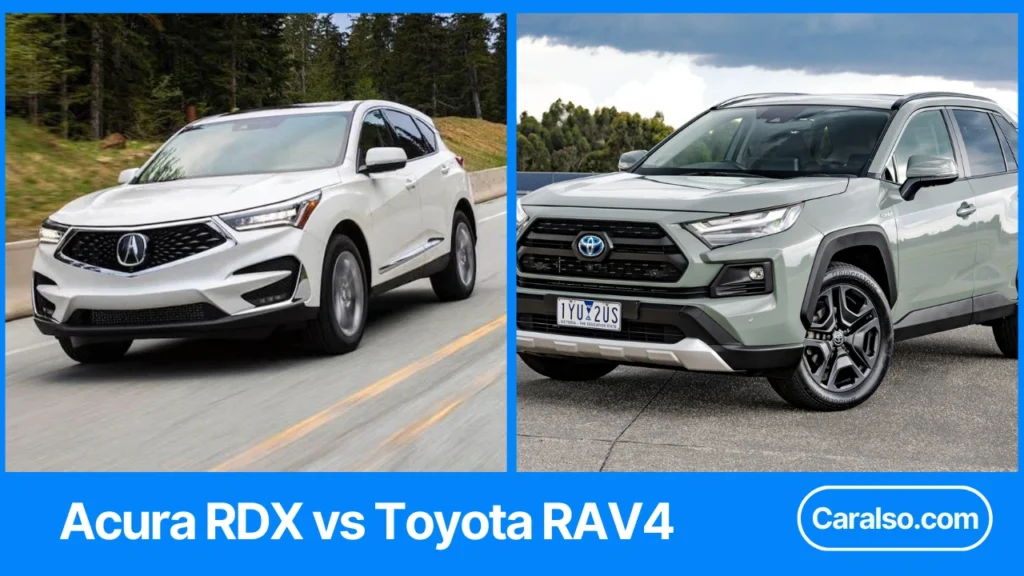
Toyota RAV4 vs Acura RDX
At-A-Glance Specs & Costs: Toyota RAV4 vs Acura RDX
Here’s the stuff I’d actually use to decide. Price, fuel, cargo, towing, and warranty.
| Item | Toyota RAV4 (2026) | Acura RDX (2026) |
|---|---|---|
| Starting MSRP | $31,900 (Hybrid FWD) | $45,100 |
| Powertrain Choices | Hybrid or Plug-In Hybrid | 2.0L turbo gas |
| Output | 226 hp (Hybrid FWD) or 236 hp (Hybrid AWD) | 272 hp |
| Fuel Economy (Combined) | Up to 44 mpg combined (manufacturer estimate, Hybrid FWD) | 23 mpg combined |
| Fuel Type | Regular unleaded (typical for RAV4 hybrids) | Premium unleaded 91 octane recommended |
| Cargo Behind Second Row | 37.8 cu ft | 29.5 to 31.1 cu ft |
| Max Cargo With Seats Folded | 70.4 cu ft | 79.8 cu ft |
| Towing Capacity | 1,750 lb (FWD) or up to 3,500 lb (AWD) | 1,500 lb |
| Basic Warranty | 3 yr or 36,000 mi | 4 yr or 50,000 mi |
| Powertrain Warranty | 5 yr or 60,000 mi | 6 yr or 70,000 mi |
| Hybrid Coverage | Hybrid components 8 yr or 100,000 mi; hybrid battery 10 yr or 150,000 mi | Not applicable |
| Complimentary Maintenance | 2 yr or 25,000 mi | 2 yr or 24,000 mi |
Notes:
- MPG and towing vary by trim and drivetrain.
- “Max cargo” can vary depending on measurement method and how far forward the front seats are set.
The 60-Second Decision Guide
If you drive 12,000 miles a year or more, then I pick the RAV4 Hybrid. Up to 44 mpg combined is a big deal at that mileage.
If you want the stronger passing feel right now, then I pick the RDX. It is 272 hp, and it runs a 10-speed automatic.
If you tow anything over 1,500 lb, then I pick the RAV4 AWD. The RDX tops out at 1,500 lb.
If you keep cars for 8 to 10 years, then I lean RAV4. Hybrid RAV4 ownership tends to be simpler on fuel costs, and resale is usually stronger.
If you lease for 36 months and you want a nicer cabin experience every day, then I can justify the RDX. Just budget for faster depreciation.
If you are shopping used, then I look at a 2 to 4 year old RDX and compare it to a new or lightly used RAV4 Hybrid. The depreciation gap is often the whole story.
If cargo behind row 2 is your daily reality, then I pick the RAV4. It has 37.8 cu ft behind the second row. The RDX is 29.5 to 31.1 cu ft.
Real-World Cost Reality (Fuel + Depreciation + Insurance)
This is where most “spec sheet” comparisons miss the point. The RDX can cost more every month even if you negotiate a good deal. Fuel, depreciation, and insurance do that.
Table 2: 5-Year Cost Drivers That Actually Move The Needle
| Cost Driver | What I Track | Toyota RAV4 | Acura RDX | What It Means In Real Life |
|---|---|---|---|---|
| Fuel Economy | Combined mpg | Up to 44 mpg combined (manufacturer estimate) | 23 mpg combined | If you drive a lot, mpg is the fastest way to feel the difference. |
| Fuel Type | Octane | Regular unleaded | Premium unleaded 91 octane recommended | Premium usually adds cost even before mpg enters the chat. |
| Depreciation | 5-year depreciation rate | 30.3% | 47.8% | This is the biggest hidden cost on luxury badges. |
| Insurance | Typical annual premium range | Often near the low end for compact SUVs | Often higher than mainstream SUVs | ZIP code matters more than brand, but luxury parts can raise claim costs. |
| Cost To Own Model | 5-year ownership estimate | About $35,894 (estimate) | About $49,656 (estimate) | Different models use different assumptions. I use it for direction, not precision. |
Premium Fuel Math
I do this quick math before I talk myself into the RDX.
Use these 3 inputs:
- Miles Per Year
- Gas Price For Regular
- Price Spread Between Premium And Regular
Step 1: Estimate gallons per year.
- Gallons = Miles Per Year ÷ MPG
Step 2: Estimate annual fuel cost.
- Annual Fuel Cost = Gallons × Price Per Gallon
Step 3: Estimate the premium fuel penalty.
- Premium Penalty = Gallons × (Premium Price Minus Regular Price)
Here’s an example you can change.
- Miles Per Year: 12,000
- RDX Combined MPG: 23
- Premium Price Spread: $0.60 per gallon
Gallons per year:
- 12,000 ÷ 23 = 522 gallons (rounded)
Premium penalty:
- 522 × $0.60 = $313 per year
That $313 is only the octane penalty.
The bigger swing is mpg.
If regular is $3.50 per gallon:
- RDX fuel spend: 522 × $3.50 = $1,827 per year
Now compare that to a RAV4 Hybrid at 44 mpg on regular:
- 12,000 ÷ 44 = 273 gallons
- 273 × $3.50 = $956 per year
In that same example, fuel alone is about:
- $1,827 minus $956 = $871 per year
Over 5 years, that is about $4,355.
And that still ignores depreciation, which is usually the larger number.
Performance & Driving Feel
Power Delivery (Turbo vs Hybrid vs NA Gas)
Here’s how they feel when I’m doing normal stuff like merging, passing, and climbing grades.
Acura RDX power is simple. It uses a turbo 2.0L with 272 hp and 280 lb-ft. Torque hits early, at 1,600 rpm. That makes it feel quick from a stop and punchy in short gaps. In Car and Driver testing, an RDX A-Spec ran 0–60 mph in 6.2 seconds and the quarter mile in 14.9 seconds at 94 mph. That is legit quick for this class.
Toyota RAV4 power depends on which hybrid you pick.
The RAV4 Hybrid AWD is 236 hp. It is responsive at low speed because the electric motors help right away. In Car and Driver testing, the AWD hybrid ran 0–60 mph in 7.1 seconds and the quarter mile in 15.3 seconds at 92 mph. That is plenty for daily driving.
The RAV4 Plug-In Hybrid is the one that actually feels fast. Toyota quotes up to 320 combined net horsepower. Car and Driver estimates 0–60 mph in 5.2 seconds. If you care about straight-line speed, that is the RAV4 I would target.
Passing And Merging Numbers I Actually Care About
These two tests tell me more than horsepower does.
RDX (Car And Driver test vehicle)
- 5–60 mph rolling start: 6.9 seconds
- 30–50 mph (top gear): 3.8 seconds
- 50–70 mph (top gear): 5.1 seconds
RAV4 Hybrid AWD (Car And Driver test vehicle)
- 5–60 mph rolling start: 7.6 seconds
- 30–50 mph (top gear): 4.0 seconds
- 50–70 mph (top gear): 5.1 seconds
My read: the RDX feels more eager when I stab the throttle. The RAV4 Hybrid feels smooth and predictable. The RAV4 Plug-In feels like it has a bigger “reserve” when I’m already moving.
Transmission Behavior Differences (10-Speed vs CVT Feel)
This is where a lot of test drives are won or lost.
RDX uses a 10-speed automatic. You feel real shifts. That can be see-saw smooth in light traffic, then sharper in Sport mode. Car and Driver notes it can be slow to downshift when you ask for sudden power. So on a test drive, I do one thing: roll at 35 mph, then go to 70% throttle without a kickdown. If it hesitates, you will notice it every week.
RAV4 Hybrid uses a hybrid eCVT style setup. There are no “gear changes” the same way. It is usually smooth in stop-and-go. The tradeoff is sound and rev behavior when you pin it. The engine can sit at a higher rpm while speed catches up. Some people call that “drone.” If that bugs you, do two full-throttle on-ramp runs during your test drive. You will know in 10 seconds.
AWD Systems In Plain English
AWD can mean traction, handling, or both. These two lean different directions.
Acura RDX SH-AWD Style Tuning (Why It Feels Sporty)
The RDX’s SH-AWD system is designed to help it rotate through corners, not just claw through snow. Multiple sources describe SH-AWD as being able to send up to 70% of engine torque to the rear axle and direct that rear torque side-to-side, including up to 100% of the rear torque to the outside rear wheel in certain situations. That outside-rear push is why it can feel more “pointy” on a curving on-ramp.
Toyota RAV4 Hybrid AWD (Why It Feels Calm In Low Grip)
On the AWD hybrid, Car and Driver describes a third electric motor added to drive the rear axle, and that’s the key idea. The rear wheels can get powered without waiting for a traditional mechanical AWD system to shuffle torque. In snow and rain, that quick rear assist is what I notice most.
What I See People Get Wrong
- The RDX AWD is not an off-road system. It’s a handling system that also helps in the wet.
- The RAV4 AWD is not a sports system. It’s a stability and traction system that can handle mild trails, especially in trims with more clearance.
Grip And Brake Reality Check (Numbers)
These surprised me because they are close.
RDX (Car And Driver test vehicle)
- Braking 70–0 mph: 180 ft
- Skidpad: 0.83 g
RAV4 Hybrid AWD (Car And Driver test vehicle)
- Braking 70–0 mph: 179 ft
- Skidpad: 0.80 g
So the RDX is the more agile tool. But the RAV4 is not “bad” here. It just does not feel as playful.
Comfort, Quietness, And Daily Livability
Cabin Noise And Ride Quality (How To Test On Your Own Test Drive)
If you do nothing else, do this 3-minute loop. I do it every time.
Pro Test Script (3 Minutes Total)
- Rough Road At 30–40 mph (60 seconds)
- Listen for sharp thumps over broken pavement.
- Feel for steering wheel shake over mid-corner bumps.
- Note if the body keeps bouncing after the bump. Count bounces. 1 bounce is good. 2+ bounces feels busy.
- Highway At 65–75 mph (90 seconds)
- Set the speed at 70 mph.
- Turn the fan to speed 2.
- Speak a full sentence to your passenger. If you need to raise your voice, log that.
One hard data point I like: Car and Driver measured the RAV4 Hybrid at 69 dBA at 70 mph cruising. Full throttle hit 75 dBA. If you are sensitive to noise, that full-throttle number matters because hybrids can be loud when you ask for everything at once.
On the RDX, Car and Driver notes something important. Some of the “engine sound” is artificial and played through the speakers under hard acceleration. If you hate fake sound, do one full-throttle pull and decide if it annoys you.
- Parking Lot Full-Lock Turns (30 seconds)
- Turn full left, creep at 5 mph, then full right.
- Listen for tire scrub and feel for steering bind.
- Check how easy it is to place the hood corners.
Ride Quality Details That Show Up Fast
Wheel size matters.
- Car and Driver’s RDX test vehicle had 20-inch wheels with adaptive dampers, and they still noted harsher impacts on the roughest roads.
- Car and Driver’s RAV4 Hybrid test vehicle ran 235/50R-20 tires.
Big wheels look good. They also reduce sidewall height. Less sidewall usually means more impact harshness.
Daily Maneuvering Numbers
RDX (Car And Driver)
- Length: 187.4 in
- Turning diameter curb-to-curb: 39 ft
- Ground clearance: 5.7 in
RAV4 Hybrid AWD test vehicle (Car And Driver)
- Length: 181.0 in
- Curb weight: 3,875 lb
RAV4 ground clearance is commonly listed at 8.1 in on multiple 2026 trim spec pages. That difference versus 5.7 in is huge if you deal with steep driveways, snow ruts, or rough parking lot entrances.
Seats + Rear Seat Reality
The back seat difference is smaller than most people expect. The cargo difference is not.
Rear Legroom And Headroom (Numbers)
RDX (Car And Driver specs)
- Front legroom: 42 in
- Rear legroom: 38 in
- Front headroom: 40 in
- Rear headroom: 38 in
RAV4 (Edmunds trim specs)
- Rear legroom: 37.8 in
- Rear headroom: 39.5 in (varies by trim listing)
That is a 0.2-inch rear legroom gap. You will not feel that. What you will feel is seat shape, cushion length, and seatback angle.
My Quick Seat Test (30 Seconds Per Row)
- Sit down and put both feet flat.
- Check thigh support. I want at least 2 fingers of cushion under my thighs.
- Lean back and look at the headrest angle. If it pushes your head forward, you will hate it in 45 minutes.
- In the rear, check where your knees land relative to the front seatback plastic.
Family Check (Car Seats + Stroller Practicality)
This is what I do with real-world gear.
Rear Doors And Car Seats
- Bring the actual car seat. Do not “imagine it.”
- Install it once with LATCH.
- Install it once with the seat belt.
- Time it. Under 2 minutes is good. Over 4 minutes gets old fast.
Stroller And Cargo Floor
- Open the hatch.
- Drop the stroller in wheels-first.
- Close the hatch without forcing it.
Cargo math usually favors the RAV4 behind the second row.
- RAV4: 37.8 cu ft behind the rear seats (commonly listed).
- RDX: 29.5 cu ft behind the rear seats (Edmunds and Car and Driver list this).
If you do Costco runs, road trips, or stroller duty, that difference is not subtle.
Space & Practicality
When I’m choosing between these two, I start with one question.
How much stuff do you carry behind the second row?
On paper, the RAV4 simply gives you more usable daily cargo space behind the rear seats. The RDX catches up when you fold everything flat, but it gets there with a longer body.
Cargo & Usability Scoreboard
| Metric That Changes Real Life | RAV4 | RDX | What It Means |
|---|---|---|---|
| Cargo Behind 2nd Row (cu ft) | 37.8 | 29.5 | RAV4 takes more grocery runs and strollers without playing Tetris |
| Max Cargo (cu ft) | 70.4 | 79.8 | RDX wins if you regularly fold seats and haul big boxes |
| Length (in) | 181.0 | 187.4 | RDX is 6.4 inches longer outside, but not bigger behind row 2 |
| Ground Clearance (in) | 8.1 | 5.7 | RAV4 is more forgiving on snow ruts and rough driveways |
| Turning Diameter, Curb To Curb (ft) | 36.9 | 39.0 | RAV4 is easier in tight parking lots |
| Max Towing Capacity (lb) | 3,500 (many AWD trims) | 1,500 | RAV4 is the better choice for small campers and utility trailers |
| Spare Tire Type | Compact | Compact | Both can be optioned with a real spare-style solution in many builds |
A quick note on towing, because people get burned here.
On the 2026 RAV4, the LE AWD is rated at 1,750 lb. Several other AWD grades are rated up to 3,500 lb. That is a huge split. I always check the exact trim before I plan a hitch and trailer.
Which One Works Better For Road Trips, Costco, Or Sports Gear
Here’s how I’d call it after living with these kinds of SUVs.
Road Trips With 2 Adults And Luggage
- I lean RAV4 if you want luggage behind the second row without blocking rear visibility. 37.8 cu ft is a real advantage.
- I lean RDX if you pack light but want more cabin room feel. Passenger volume is listed at 104 cu ft vs 98.9 cu ft.
Costco Runs And Weekly Errands
- RAV4 is easier. More behind-row cargo means fewer “seat down” moments.
- RDX works fine, but you will use the underfloor storage more often to keep things from rolling.
Sports Gear And Bulky Stuff
- RAV4 wins when the gear is tall and boxy. The shape is more upright, and the cargo number behind row 2 backs that up.
- RDX wins when you are okay folding seats. 79.8 cu ft max cargo is strong if you’re hauling larger items and you do not mind running 2-up instead of 4-up.
My Practical Tip
If you carry people and gear at the same time, I treat “cargo behind the second row” as the deciding number. That is where the RAV4 separates itself.
(And yes, I’m still comparing trims. A power liftgate, roof rails, and a factory hitch change day-to-day ownership more than most people expect.)
Tech & Safety (What You’ll Actually Use)
Infotainment Usability
This is where the personalities split.
RAV4: Touchscreen-First, Modern Connectivity
- 10.5-inch Toyota Audio Multimedia is listed on core trims.
- 12.9-inch is listed on higher trims.
- Wireless Apple CarPlay and Wireless Android Auto are listed as standard.
- Dual Bluetooth phone connectivity is listed.
- Toyota also lists a built-in drive recorder that can capture 20-second clips.
If you live in CarPlay, this matters. I want wireless. I want the map up fast. I want the screen to respond the first time.
RDX: Great Screen, But You Must Like The Touchpad
- 10.2-inch full HD center display.
- Wireless Apple CarPlay and Wireless Android Auto.
- The interface uses Acura’s True Touchpad with absolute positioning. It is not a touchscreen.
- AcuraLink connected services are advertised with a 3-year complimentary trial, including stuff like Remote Start and Find My Car.
- Available ELS Studio 3D premium audio uses 16 speakers.
My honest take as someone who uses this stuff daily.
If you already like the Acura touchpad, you’re fine. If you do not, it will annoy you every day. I would test drive specifically to run your normal routine.
Do this in the test drive:
- Pair your phone.
- Start a route.
- Change the destination mid-drive.
- Adjust audio and climate while navigating.
If that feels easy, you’re good.
Safety Ratings
I trust crash-test data more than marketing.
Here’s the headline from IIHS data.
RDX (IIHS)
- Top Safety Pick is listed.
- Small overlap front is rated Good.
- Updated side test is rated Good.
- Headlights are rated Good.
- Pedestrian front crash prevention is rated Acceptable.
RAV4 (IIHS)
- Small overlap front is rated Good.
- Updated moderate overlap front is rated Marginal.
- Updated side test is rated Acceptable.
- Headlights are rated Good.
- Pedestrian front crash prevention is rated Good.
What I do with that as a buyer.
If you want the cleanest IIHS scorecard in this matchup, the RDX is the easier pick. If you still prefer the RAV4 for ownership reasons (and I often do), I treat it as a reminder to prioritize good tires and to keep driver-assist features properly calibrated and unobstructed.
Driver Assist Features You’ll Actually Notice
On the RAV4, Toyota is listing Toyota Safety Sense 4.0 as standard on the 2026 model, plus features like Blind Spot Monitor and Rear Cross-Traffic Alert depending on grade.
On the RDX, Acura lists AcuraWatch as standard across packages, including:
- Collision Mitigation Braking System
- Adaptive Cruise Control with Low-Speed Follow
- Lane Keeping Assist System
- Blind Spot Information System
- Rear Cross Traffic Monitor
My daily-use ranking, in order:
- Adaptive cruise with low-speed follow
- Blind spot monitoring
- Rear cross-traffic alert
- AEB that is tuned well for city traffic
- A 360 camera, if you park in tight spaces
If those top 3 are your must-haves, both vehicles can cover you. The bigger difference is how much you enjoy using the screen and controls every single day.
Reliability & Long-Term Ownership
If you want the shortest reliable answer, here’s how I call it.
Both are strong long-term picks if you maintain them. On paper, the Acura RDX actually scores higher for unscheduled repair risk and severity. The Toyota RAV4 usually wins on day-to-day ownership simplicity and parts pricing. Your best move is choosing the right powertrain and the right trim, then staying ahead on fluids.
Reliability Snapshot (Real-World Repair Data)
| Metric (Unscheduled Repairs) | 2026 Toyota RAV4 | 2026 Acura RDX |
|---|---|---|
| Reliability Rating (RepairPal) | 4.0 / 5.0 | 4.5 / 5.0 |
| Segment Rank | 3rd of 26 compact SUVs | 1st of 11 luxury compact SUVs |
| Avg Annual Repair Cost | $429 | $497 |
| Avg Unscheduled Shop Visits Per Year | 0.3 | 0.4 |
| Chance A Repair Is “Severe” | 10% | 6% |
The “What Breaks And What It Costs” Lens
I do not obsess over random complaint lists. I focus on friction points that actually hit your time and wallet.
Here are the big ones.
Sensors And Glass Costs
Modern SUVs are sensor-heavy. That’s true for both.
If you crack a windshield or take a bumper hit, recalibration is the hidden bill.
A typical ADAS calibration after windshield replacement often lands around $300 to $600 on top of the glass work.
Turbo Maintenance Reality (RDX)
The RDX is turbocharged. That’s not scary. It just changes habits.
I care about oil change history. A turbo lives on clean oil.
Skip oil services and you can turn a normal engine into an expensive one later.
I also plan for more frequent spark plug and intake cleaning conversations over long mileage, because that’s common turbo ownership life.
AWD Fluid Services (RDX)
If you buy an AWD RDX, budget for driveline fluid services.
Rear differential fluid is a normal recurring item.
If a seller has no proof it was done, I price that into the deal immediately.
Hybrid System Maturity (RAV4)
For 2026, the RAV4 is hybrid-only in the mainstream lineup.
That means you get the hybrid benefits every day, not just on a premium trim.
Hybrid systems add components. But Toyota has a long track record with hybrid hardware.
The bigger day-to-day win is that the hybrid setup can reduce brake wear in stop-and-go driving, because regeneration is doing part of the work.
Used-Buyer Angle (High-Intent Reality)
If you’re choosing between a used RDX and a used or new RAV4, here’s the fastest way I filter bad deals.
Used RDX Quick Check
- Confirm AWD fluid service history if it is SH-AWD.
- Cold start listen. Any abnormal whine or rough idle gets a deeper look.
- Test the infotainment controls for 5 minutes, not 30 seconds.
- Hard brake from 40 mph once in a safe spot. You want straight tracking and consistent pedal feel.
- Look at tire wear. Uneven wear can hint at alignment or suspension work needed.
- Ask for the last 2 oil change receipts. I want dates and mileage.
Used RAV4 Quick Check
- Confirm it is up to date on scheduled services, not just oil.
- Make sure every key driver assist feature works on a test drive. Lane centering, radar cruise, camera view.
- Check for warning lights at startup and after a 15-minute drive.
- Listen for clunks over bumps. Loose end links and suspension wear show up here.
- If it has a power liftgate, cycle it 3 times. Slow or uneven motion matters.
- If you can, get a pre-purchase inspection with a scan for stored codes.
If you do one thing, do this.
Pay for a pre-purchase inspection and a full-system scan.
That is usually the cheapest “repair” you’ll ever buy.
Trim Recommendations (Stop Comparing The Wrong Builds)
Most comparisons get this wrong.
They compare a base RAV4 to a loaded RDX, then act shocked the Acura feels nicer.
So I match trims by price and by the features people actually use every day.
Best “Value Match” Trims
If You’re Looking At A Base RDX
I treat this like a “nice daily driver with power” build.
Here’s the closest RAV4 match if you want similar day-to-day equipment.
- RAV4 Limited Hybrid AWD
- RAV4 XSE Hybrid AWD
Why.
The Limited gives you the high-end comfort and tech bundle. The XSE gives you the sport look and some premium upgrades without going full top-trim.
If You’re Looking At RDX Technology
This is where the RDX starts making sense for a lot of buyers.
You’re paying for the luxury feature stack, not just the badge.
My matching RAV4 targets are:
- RAV4 Limited Hybrid AWD
- RAV4 XSE Hybrid AWD
If You’re Looking At RDX A-Spec
This is an appearance and interior vibe choice.
You are also buying bigger wheels.
My matching RAV4 targets are:
- RAV4 XSE Hybrid AWD
- RAV4 Limited Hybrid AWD
If You’re Looking At RDX Advance Or A-Spec Advance
Now we are in “I want the full suite” territory.
This is where features like a 360 camera and the top comfort tech matter most.
On the RAV4 side, I go straight to:
- RAV4 Limited Hybrid AWD
Packages That Actually Matter
These are the features that change daily life for most owners.
- 360 camera
- Ventilated front seats
- Premium audio
- Parking assist that can brake for you
- Panoramic roof if you care about cabin light
On the RAV4 side, Limited is the trim that bundles the most of this stuff in one shot.
On the RDX side, you usually need to step into Advance or A-Spec Advance for the full “camera and convenience” experience.
Table 4: Trim-To-Trim Cheat Sheet
| Budget Band (New) | Best RAV4 Pick | Best RDX Pick | Best For |
|---|---|---|---|
| Around $35k | RAV4 LE Hybrid (FWD or AWD) | Used or CPO RDX | Lowest payment, high MPG, simple daily use |
| Around $40k | RAV4 SE Hybrid AWD or XLE Premium AWD | Used or CPO RDX (higher package) | Better seat materials, more convenience features |
| Around $45k+ | RAV4 XSE Hybrid AWD or Limited Hybrid AWD | RDX Base or Technology | Similar budget, choose MPG and simplicity vs power and luxury feel |
| Around $55k+ | RAV4 Limited Hybrid AWD (loaded) | RDX A-Spec Advance | All the comfort tech, premium audio, and top feature sets |
My Quick Trim Advice
If you want the smartest RAV4 buy for most people, I land on XLE Premium or Limited depending on budget.
XLE Premium gets you the daily comfort upgrades without jumping straight to the top.
Limited is the “stop shopping” trim if you want every feature Toyota stacks in this model.
If you want the smartest RDX buy for most people, I usually point to Technology or Advance.
That’s where the RDX’s features start justifying the price jump over mainstream SUVs.
Should You Wait For Future Model Changes?
If you are waiting for a hybrid Acura RDX, you are waiting a while.
Acura has confirmed the next-generation RDX will use a two-motor hybrid system. Acura also says the current RDX is ending production in spring 2026. Several outlets also expect a gap before the next one lands, with timing estimates pointing to late 2027 as a 2028 model year.
That changes the decision.
My Simple Rule
If you need a vehicle in 2026, I do not wait for the next RDX.
If you can wait 18 to 30 months, and you specifically want an RDX Hybrid, then waiting can make sense.
Buy Now vs Wait Table
| Your Situation | What I Would Do | Why |
|---|---|---|
| You need a vehicle in the next 30 to 90 days | Buy the RAV4 Hybrid | It gives you hybrid mpg now, and it starts around $31,900 |
| You want a new RDX in 2026 | Buy or lease the 2026 RDX while inventory exists | Production is ending spring 2026, so selection will tighten |
| Your lease ends in 2026 and you want to stay in an RDX | Extend the lease if your dealer supports it | It bridges the gap without buying into peak depreciation |
| You want a hybrid RDX and can wait into late 2027 or 2028 | Wait | The two-motor hybrid is confirmed for the next generation |
| You want maximum power and still want Toyota running costs | Wait for the 2026 RAV4 Plug-In Hybrid if you can | Toyota says PHEV timing is spring 2026, with pricing in the first half of 2026 |
My personal take.
If I am shopping with my own money today, and I care about fuel spend, I buy the RAV4 Hybrid now. If I care about a premium cabin and I can lease, I lease the RDX now and set a calendar reminder for the next-gen hybrid news.
Bottom Line: Which One Wins For You?
High-Mileage Commuter
I buy the RAV4 Hybrid because up to 44 mpg combined vs 23 mpg combined is the whole budget story.
Young Family
I buy the RAV4 because 37.8 cu ft behind the second row beats 29.5 cu ft, and that matters every week.
Comfort-First Luxury Shopper
I buy the RDX because 272 hp and 104 cu ft passenger volume usually feels like the better daily cabin.
Snow-Belt Driver
I lean RAV4 because 8.1 inches of ground clearance vs 5.7 inches saves you from scraping, and AWD only works as well as your tires.
Long-Term Keeper vs Leaser
If I’m keeping it 8 to 10 years, I pick RAV4 for lower running costs and simpler ownership math.
If I’m leasing 36 months, I can justify RDX because the warranty is longer and the premium feel is what I’m paying for.
FAQs
Is The Acura RDX Worth The Extra Money Over A Toyota RAV4?
It depends on what you value daily. The RDX starts at $45,100. The RAV4 starts at $31,900. That is a $13,200 gap before taxes and fees. If you want 272 hp and a more premium interior experience, I get it. If you want lower monthly fuel spend and easier long-term math, I do not pay the gap.
Does The Acura RDX Require Premium Gas?
Acura lists premium unleaded 91 octane as the recommended fuel for the RDX. If you run lower octane, expect less power under load and possibly lower mpg. If premium is $0.60 more per gallon and you drive 12,000 miles a year at 23 mpg combined, the premium penalty alone is about $313 a year.
Which Is More Reliable: RAV4 Or RDX?
On third-party repair tracking, both score well. RepairPal lists the RAV4 at 4.0 out of 5.0 and the RDX at 4.5 out of 5.0. I treat the bigger difference as cost exposure. Luxury parts and labor tend to cost more when something does happen.
Which Is Bigger Inside?
The RDX is bigger for passengers. Total passenger volume is 104 cu ft in the RDX and 98.9 cu ft in the RAV4. The RAV4 is bigger for daily cargo behind the second row at 37.8 cu ft vs 29.5 cu ft.
Which Is Better In Snow?
If you live where snow piles up, I start with ground clearance. The RAV4 is listed at 8.1 inches. The RDX is listed at 5.7 inches. That is a 2.4-inch difference. AWD helps you go. Tires help you stop. I would rather have a RAV4 on proper winter tires than an RDX on all-seasons.
What’s The Best RAV4 Trim To Cross-Shop With An RDX?
If you are cross-shopping a base or Technology RDX, I match it to a RAV4 XSE Hybrid AWD or RAV4 Limited Hybrid AWD. That is where the RAV4 gets the comfort and tech upgrades most buyers expect at that price point.
Sources
- Toyota Pressroom, “The Next Adventure Begins: 2026 RAV4 Arrives This Winter”
- Acura, 2026 RDX Features Page
- Car and Driver, 2026 Toyota RAV4 Specs
- Edmunds, 2026 Toyota RAV4 Prices, Reviews, And Pictures
- RepairPal, Acura RDX Reliability

Hey there,
How is it going?
I’m Meraj Sarker. I am a Car Mechanic and a student of Automobile Restoration here in Florida, USA. I’ve been studying automotive for around 9 years now. So you can rely on my recommendation. For me, studying and getting knowledge about automobile it’s really fun and entertaining. I will help you to get solutions for your car through this website. If you need any help let me know.