
If you want the easiest daily driver, I’d start with the RAV4. It costs less up front. It uses a lot less fuel. And it is easier to park.
If you tow heavy or you actually go off-road, I’d start with the 4Runner. It has real 4WD hardware. It tows up to 6,000 lbs. And it is built for trail abuse in a way the RAV4 is not.
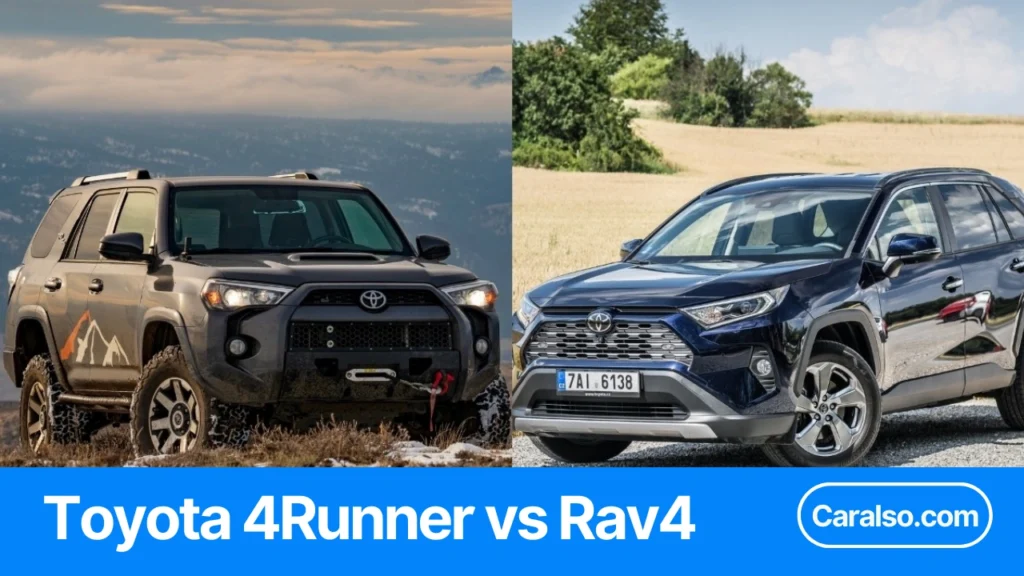
Toyota RAV4 vs 4Runner
Quick Verdict
Buy The RAV4 If vs Buy The 4Runner If (Fast Decision Table)
| What You Care About | Buy The RAV4 If | Buy The 4Runner If |
|---|---|---|
| Commute MPG | You want up to 47 city / 40 hwy (2026). | You can live with about 20 city / 26 hwy (2026 gas). |
| Towing | Your trailer is 3,500 lbs or less. | You tow up to 6,000 lbs. |
| Off-Road | You drive snow, gravel, and forest roads. | You want low range 4WD and serious trail trims. |
| Ride Comfort | You want a car-like unibody feel. | You accept a truck-based feel for capability. |
| Parking Ease | You want 181 in length and a 36.9 ft turning circle. | You accept 194.9 in length and a 39.4 ft turning circle. |
| Budget | You want the lower starting price. RAV4 starts at $31,900. | You are okay starting higher. 4Runner starts at $41,570. |
| Family Space | You want 37.8 cu ft behind the 2nd row and 70.4 cu ft max. | You want up to 48.4 cu ft behind the 2nd row and up to 90.2 cu ft max (5-seat setup). |
My 6-Line Quick Verdict List
- If you tow over 3,500 lbs even a few times a year, I pick the 4Runner.
- If you drive 12,000 miles a year or more, I start with the RAV4 for fuel cost alone.
- If your idea of off-road includes rocks, deep ruts, and low-speed crawling, I pick the 4Runner.
- If your idea of off-road is snow, sand, gravel, and muddy trailheads, I pick the RAV4 and spend on tires.
- If you park in tight city spots daily, I pick the RAV4 for the 13.9-inch shorter body.
- If you want the most “set it and forget it” choice for commuting and errands, I pick the RAV4.
Featured Snippet Answers
Which Is Better For Daily Driving?
RAV4. It is smaller, cheaper to fuel, and easier to park.
Which Is Better For Off-Road?
4Runner. It is built for trails with real 4WD hardware and dedicated off-road trims.
Which Is Better For Towing?
4Runner. Up to 6,000 lbs vs up to 3,500 lbs for the RAV4.
First, Compare The Right Model Year (2025 Vs 2026+)
I start here because this matchup is a moving target.
A 2025 RAV4 is not the same purchase as a 2026 RAV4.
A 2024 4Runner is not the same purchase as a 2025 or 2026 4Runner.
So I use one simple rule.
If you want the newest versions of both, compare 2026 RAV4 to 2026 4Runner.
If you are shopping leftover deals, you might be comparing 2025 RAV4 to 2024 4Runner. That is a totally different story.
What Changed For 2026 RAV4 Vs What Changed For The New 4Runner
| What Changed | 2026 RAV4 | 2025 To 2026 4Runner |
|---|---|---|
| Big Identity Shift | Hybrid-only lineup | New generation, still body-on-frame |
| Platform Type | Unibody (TNGA-K) | Body-on-frame (TNGA-F) |
| Powertrains | Hybrid or Plug-In Hybrid | 2.4L turbo or i-FORCE MAX hybrid |
| What It Means | Lower daily fuel cost | Higher towing and real 4WD hardware |
Buyer Note: Avoid Year-Mismatch Comparisons
This is the mistake I see most.
People read an older comparison where the 4Runner had a V6.
Then they shop a 2025+ 4Runner and it has a 2.4L turbo. Different feel. Different numbers.
Or they read an older RAV4 page and assume there is still a cheap gas base model.
In 2026, Toyota pushes the RAV4 to hybrid-only.
If you take one thing from this section, take this.
Lock the model years first. Then compare.
Specs Snapshot (The Numbers People Scan First)
These are the numbers I see shoppers scan in under 30 seconds.
Specs Snapshot Table
| Spec | 2026 Toyota RAV4 | 2026 Toyota 4Runner |
|---|---|---|
| Starting MSRP (Toyota Listed) | $31,900 | $41,570 |
| MPG (City/Hwy) | Up to 47 / 40 (Toyota estimate) | About 20 / 26 (Toyota estimate for base gas) |
| Max Towing | Up to 3,500 lbs (AWD models) | Up to 6,000 lbs |
| Cargo Behind 2nd Row | Up to 37.8 cu ft | Up to 48.4 cu ft (5-seat setup) |
| Max Cargo | Up to 70.4 cu ft | Up to 90.2 cu ft (2-row config) |
| Drivetrain Basics | FWD or AWD | RWD or 4WD, trim-dependent |
| Build Type | Unibody crossover | Body-on-frame SUV |
Two quick clarifiers I always say out loud.
Cargo on 4Runner depends on seating.
If it has a third row, cargo behind the rear seat drops hard.
MSRP depends on how it’s quoted.
Toyota’s “starting MSRP” is before dealer add-ons and often before destination. Your out-the-door number will be higher.
Pro Tip: The 3 Numbers That Decide This Choice
I only need three numbers from you.
- Your annual miles driven.
- Your typical trailer weight.
- Your roughest road type. Paved, dirt, or rocks.
If you drive 12,000 miles a year and you never tow, I start with RAV4.
If you tow 4,000 lbs or you run rocky trails, I start with 4Runner.
The Big Difference: Unibody Crossover Vs Body-On-Frame SUV
This is the whole game.
The RAV4 is a unibody crossover.
The 4Runner is a body-on-frame SUV.
That changes how they drive, how they tow, and how they hold up when the road turns into rocks.
What Unibody (RAV4) Means Day To Day
This is what I notice in daily life.
- It feels lighter on its feet at 30 to 70 mph.
- It changes lanes with less delay.
- It usually needs less steering correction on the highway.
- It tends to return higher MPG with the same driver and the same commute.
It also matches how most people actually use a compact SUV.
School runs. Commutes. Parking lots. Rain. Potholes.
What Body-On-Frame (4Runner) Means Day To Day
This is the “truck-style” build.
- It stays calmer with a trailer behind it.
- It takes repeated hits better on rough trails.
- It gives you more real 4WD hardware on many trims.
- It is built for towing and off-road loads first, daily MPG second.
If you do dirt roads every weekend, this structure matters.
If you tow often, it matters more.
Is The 4Runner A Truck?
Not a pickup truck.
But it is built like one. It uses body-on-frame construction on Toyota’s TNGA-F truck platform, which is why it can tow up to 6,000 lbs.
The Platform Names (For Nerd Cred)
If you like the official names, here you go.
- RAV4: TNGA-K
- 4Runner: TNGA-F
I use these as a quick shortcut.
TNGA-K usually means crossover priorities.
TNGA-F usually means towing and trail priorities.
Powertrains And MPG (Hybrid Efficiency Vs Turbo Strength)
Here’s the cleanest way I explain it to friends.
RAV4 is the mileage play.
4Runner is the towing and trail play.
4Runner Powertrains Explained (Simple)
Two engine choices. Both are 2.4L turbo-based.
- i-FORCE 2.4L Turbo (Gas)
- Up to 278 hp
- Up to 317 lb-ft
- i-FORCE MAX (Hybrid)
- Up to 326 hp
- Up to 465 lb-ft
Fuel economy depends on drivetrain and trim.
Toyota quotes up to 26 MPG highway for the gas turbo and up to 24 MPG highway for the hybrid.
If you want the strongest pull, I point at the 465 lb-ft number first.
That is the number you feel when you merge or climb.
RAV4 2026+ Powertrains Explained
Toyota goes all-in on electrified power.
You get two choices.
- Hybrid (HEV)
- 226 combined system net hp (FWD)
- 236 combined system net hp (AWD)
- Plug-In Hybrid (PHEV)
- Up to 320 combined system net hp
- Manufacturer-estimated 50 miles of EV range
On the MPG headline, Toyota lists up to 47 city and 40 highway for the RAV4.
On towing, it is split by trim and drivetrain.
- Up to 3,500 lbs on specific AWD grades
- 1,750 lbs on all FWD models and the LE AWD model
That towing split is why I always ask one question.
Are you actually towing, or are you just buying “just in case”?
Real-World Fuel Cost Math (My Differentiator)
I keep this fast and practical.
I use a midpoint MPG for a simple apples-to-apples estimate.
- RAV4: 43 MPG (midpoint between 47 city and 40 highway)
- 4Runner: 23 MPG (midpoint between 20 city and 26 highway)
These are not official combined ratings.
They are quick planning numbers.
| Driver Profile | Miles Per Year | RAV4 Gallons Per Year (Miles ÷ 43) | 4Runner Gallons Per Year (Miles ÷ 23) | Extra Gallons In 4Runner |
|---|---|---|---|---|
| Light Driver | 10,000 | 233 | 435 | 202 |
| Average Driver | 15,000 | 349 | 652 | 303 |
| Heavy Driver | 20,000 | 465 | 870 | 405 |
Now do one step.
Take the “Extra Gallons” number and multiply by your local fuel price.
Example: If fuel is $3.50 per gallon, 303 extra gallons is about $1,060 per year.
Also keep this in mind.
If you tow with the 4Runner, MPG drops.
If you do mostly highway in the RAV4, MPG can climb.
Towing And Hauling (The Truth Beyond The Max Rating)
If towing is a real part of your life, this choice gets easy.
The 4Runner is the towing tool.
The RAV4 is the “light trailer sometimes” tool.
Max Tow Ratings And What They’re For
Here are the headline numbers.
- 4Runner: Up to 6,000 lbs max towing.
- RAV4: Up to 3,500 lbs on specific AWD grades.
- RAV4: 1,750 lbs on all FWD models and the LE AWD model.
The detail that matters.
Not every RAV4 tows 3,500 lbs.
You have to land on the right AWD grade.
Towing Tech That Makes Life Easier
This is where the 4Runner feels like Toyota planned for towing.
4Runner towing tech highlights I care about:
- Available trailer brake controller.
- Available Trailer Back-Up Guide with Straight Path Assist.
- Blind Spot Monitor that can detect a trailer and extend its detection zone.
- Tow/Haul mode standard on all i-FORCE MAX grades and most others.
On the RAV4 side, you can tow.
But you are not getting the same trailer-focused toolset in the lineup messaging.
It’s a daily driver first.
What I’d Tow With Each (Comfortably)
I keep it simple and realistic.
With A RAV4, I like:
- Small utility trailers for home projects.
- A pair of jet skis.
- Light campers only if the loaded trailer weight stays inside your rating.
- A hitch bike rack with 2 to 4 bikes.
With A 4Runner, I like:
- Bigger campers that would push a RAV4 past its rating.
- Heavier boats.
- Trailers where tongue weight plus passengers plus gear would crush a crossover’s payload.
One rule I follow every time.
I check the door sticker payload before I get excited about tow ratings.
Payload disappears fast with people, coolers, and camping gear.
Quick tongue weight reality check:
- Most trailers run about 10% to 15% of their loaded weight on the hitch.
- That tongue weight counts against payload.
If you want the easiest towing life, the 4Runner is the answer.
If you tow a few times a year and keep it light, the RAV4 can make sense.
Featured Snippet Answer: Which Is Better For Towing?
4Runner. It tows up to 6,000 lbs and offers trailer tech like a brake controller and Trailer Back-Up Guide.
Off-Road And Bad Roads (AWD Vs Real 4WD Hardware)
I look at this as two different missions.
The RAV4 is for traction.
The 4Runner is for terrain.
4Runner Off-Road Systems That Actually Matter
This is why the 4Runner exists.
Key hardware and systems:
- Electronically controlled two-speed transfer case with high and low range on 4WD models.
- Active Traction Control (A-TRAC).
- Auto LSD on multiple configurations.
- Electronic locking rear differential standard on TRD Off-Road, TRD Pro, and Trailhunter.
- Multi-Terrain Select that works in both 4WD-High and 4WD-Low.
- Crawl Control that works like low-speed off-road cruise control.
- Downhill Assist Control for steep descents.
One more nerd note I like.
Toyota calls out stabilizer disconnect availability, which is a big deal for front suspension articulation on uneven trails.
If your “bad road” includes rocks and deep cross-axle ruts, this is the stuff that keeps you moving.
RAV4 Capability Reality Check
A RAV4 is better than people think in the places most people actually drive.
Snowy streets.
Rain-soaked highways.
Gravel driveways.
Forest roads to a trailhead.
But I do not buy it as a rock crawler.
It does not have the same low-range 4WD hardware approach.
And it is not built to take repeated hard hits the way a body-on-frame SUV is.
My rule.
If you want to go slower than walking speed over rough terrain, I pick the 4Runner.
If you want safe traction on sketchy roads at normal speeds, I pick the RAV4.
Tire-First Advice (This Beats Most AWD Debates)
If you only change one thing, change tires.
Here’s how I pick tires by use case.
If you see real winter with ice:
- Dedicated winter tires.
If you see moderate winter and want one tire all year:
- All-weather tires with the 3PMSF rating.
If you live on gravel roads or you hit dirt every weekend:
- A light all-terrain tire.
- Then accept a small MPG hit.
If you do mostly pavement:
- A good touring tire.
- Quiet and efficient usually wins daily life.
Featured Snippet Answer: Which Is Better In Snow?
For plowed roads and commuting, I lean RAV4 with the right winter tires.
For deep snow, steep climbs, and unplowed roads, I lean 4Runner with 4WD and low range.
Tires decide more than badges.
Space, Seating, And Daily Practicality
This is where the choice gets real.
If you live in parking lots and garages, the RAV4 wins.
If you live out of the cargo area, the 4Runner can win.
But only if you buy it as a 2-row.
Parking And Garage Fit (Often Ignored)
These numbers matter every single day.
- RAV4 length: 181.0 in
- 4Runner length: 194.9 in
- Difference: 13.9 in longer for 4Runner
Turning circle is the second “daily pain” number.
- RAV4 turning circle: 36.9 ft
- 4Runner turning circle: 39.4 ft
- Difference: 2.5 ft wider turn for 4Runner
Width matters in tight garages.
- RAV4 width: 73.0 in
- 4Runner width: 77.9 in
- Difference: 4.9 in wider for 4Runner
If you park in older garages, I’d measure first.
A 4.9-inch width gap is the difference between “easy” and “door ding stress.”
Cargo Loading Height And Dog Friendliness
Cargo volume is where a lot of people assume the 4Runner always wins.
It depends on how you spec it.
Behind the second row:
- RAV4: 37.8 cu ft
- 4Runner (gas models): 48.4 cu ft
Max cargo with the seats folded:
- RAV4: 70.4 cu ft
- 4Runner (2-row config): 90.2 cu ft
Now the big trap.
Third row.
With the third row up, 4Runner cargo drops to about 12.1 cu ft.
That is “a few grocery bags” space.
Dog owners should know one more thing.
4Runner has a power rear window.
That is rare.
I love it for airflow and quick check-ins at low speeds.
RAV4 has a rear seatback designed to fold flat.
And Toyota calls out an available hands-free power liftgate on the new generation.
Family Setup
If you need 7 seats, the 4Runner is the only one here that can do it.
Third-row seating is available on 4Runner.
It is trim-dependent.
If you are a 5-seat family, the RAV4 makes life easy.
Rear legroom is a quiet win for the RAV4.
- RAV4 rear legroom: 37.8 in
- 4Runner rear legroom: 34.8 in
That 3.0-inch gap shows up fast with taller teens and adult passengers.
If you do long trips with real adults in the back, I notice it.
My simple rule for families.
- If you need 3 rows even a few times a month, I pick 4Runner and accept the cargo hit.
- If you need cargo space every day, I pick RAV4 or a 2-row 4Runner.
Interior, Tech, And Comfort Over A 2-Hour Drive
I judge this part like a daily user.
Screens. Buttons. Seat comfort. Noise at 70 mph.
Infotainment And Driver Displays
Here are the screen numbers.
RAV4:
- Standard center screen: 10.5 in
- Available center screen: 12.9 in
- Digital gauge cluster: 12.3 in standard
Toyota also tied navigation deeper into the gauge cluster on the latest system.
And it added a built-in Drive Recorder feature that works like a factory dashcam.
4Runner:
- Standard center screen: 8.0 in
- Available center screen: 14.0 in
- SR5 uses a 7-inch multi-information display
- i-FORCE MAX models get a 12.3-inch digital gauge cluster
Both support wireless Apple CarPlay and Android Auto in Toyota’s latest setup.
4Runner also calls out Qi wireless charging and USB-C ports throughout the cabin.
If you care about tech, I’d shop screens by trim, not by nameplate.
An 8-inch base screen and a 14-inch upgraded screen feel like different vehicles.
Road Noise And Ride Comfort Differences
This part goes back to the build type.
RAV4 is unibody.
It usually feels more “car-like” over broken pavement.
4Runner is body-on-frame.
It can feel more truck-like on pavement, especially on off-road trims.
Tires matter a lot.
Toyota lists 33-inch tires on Trailhunter and TRD Pro grades.
A 33-inch all-terrain tire usually adds noise compared to a touring tire.
Suspension tuning matters too.
Toyota says Limited and Platinum trims offer adaptive variable suspension tuning for a smoother on-road setup.
That is the direction I’d go if you want a 4Runner that does more highway time.
What Matters If You Commute Daily
If your commute is the main use, I focus on three things.
- Parking math
RAV4 is 181.0 inches long and turns in 36.9 ft.
4Runner is 194.9 inches long and turns in 39.4 ft. - Screen and control comfort
RAV4 starts at 10.5 inches.
4Runner starts at 8 inches.
Both can go bigger, depending on trim. - Seat time
RAV4 gives 37.8 inches of rear legroom.
4Runner is 34.8 inches.
If you want the easiest daily routine, I lean RAV4.
If you want trail hardware and towing first, I accept the 4Runner compromises and spec it carefully.
Reliability, Maintenance, And Resale
These are both Toyotas. So I start from a good place.
But they are built for different lives. That changes what you pay over time.
What Historically Holds Value Better (And Why)
If resale is a top priority, I usually give the edge to 4Runner.
Kelley Blue Book’s 2025 Best Resale Value list puts:
- 4Runner at 60.0% 5-year resale value
- RAV4 at 53.9% 5-year resale value
That difference tracks with real demand.
4Runner is a body-on-frame SUV with a loyal buyer base.
RAV4 is a higher-volume daily driver, so there is more supply.
Here is my simple resale takeaway.
If you sell in 3 to 5 years, 4Runner often protects value better.
If you keep it 8 to 12 years, resale matters less than fuel and tires.
Maintenance Reality (Tires, Brakes, Suspension Wear)
This is where the weight difference shows up.
Curb weight snapshots:
- 2026 RAV4 is roughly 3,745 to 3,865 lbs depending on version.
- 2026 4Runner SR5 4WD is listed at 4,685 lbs.
That is roughly an 800 to 1,000 lb gap in the real world.
What that usually means:
- 4Runner tires cost more, especially on the off-road grades.
- 4Runner brakes do more work.
- 4Runner suspension parts are built for heavier loads, and replacements can cost more.
And then there is tire size.
Toyota calls out 33-inch tires on TRD Pro and Trailhunter.
Toyota also calls out 33-inch all-terrain tires on TRD Off-Road.
If you run 33-inch all-terrains, you should expect:
- More tire noise.
- A bigger hit to MPG.
- Higher replacement cost than a typical crossover tire.
On the RAV4 side, it is simpler.
Smaller tires.
Less weight.
Less fuel.
Fewer “truck” wear items.
New-Gen Caution Notes (First-Year Changes)
I say this the same way every time.
New generation vehicles are awesome.
They also get small fixes in the first 12 to 24 months.
For 2026 RAV4, Toyota is rolling out a redesigned model with new software and a hybrid-only lineup.
That is great.
But it also means early software updates are normal.
For the new-gen 4Runner, Toyota replaced the old V6 with a 2.4L turbo lineup and added a hybrid option.
That is a big change too.
If you are risk-averse, my move is simple.
- Buy the newest generation in year two if you can.
- Or buy the last year of the previous generation if you want proven patterns.
If you are not risk-averse, I just do two things.
- I check for open recalls and service campaigns before I buy.
- I make sure the dealer has applied the latest software updates.
Trim Recommendations (Fast Path To The Smart Buy)
I pick trims based on what you actually do.
Not the fantasy version of your weekends.
Best Value RAV4 Trim For Most People
I usually land on the 2026 RAV4 XLE Premium.
It is the trim that makes daily life nicer without going full top-trim pricing.
It is also still in the core “efficient hybrid” sweet spot.
If budget is tight, I go LE.
If you want a sportier feel without the bigger price jump, I go SE.
Pricing context with destination included:
- LE: $33,350
- SE: $36,150
- XLE Premium: $37,550
- Woodland: $41,350
- XSE: $42,750
- Limited: $44,750
One more quick drivetrain tip.
If you want max towing in the RAV4 world, I focus on the AWD grades that can tow up to 3,500 lbs.
Best Value 4Runner Trim For Most People
I split this into two buyers.
If you are mostly commuting and road-tripping, I start at SR5.
It is the value anchor.
It gets you into the platform without paying for off-road hardware you will not use.
If you will actually hit trails, I start at TRD Off-Road.
It adds the stuff that changes capability fast.
It also keeps you far below TRD Pro and Trailhunter pricing.
Toyota’s own lineup notes I use for shopping:
- SR5, TRD Sport, TRD Sport Premium start with the i-FORCE turbo.
- i-FORCE MAX hybrid is standard on Platinum, TRD Pro, and Trailhunter.
- i-FORCE MAX hybrid is available on TRD Off-Road, TRD Off-Road Premium, and Limited.
My simple rule.
If you tow often or you live in the mountains, I at least test drive an i-FORCE MAX trim.
That 465 lb-ft number is the one you feel.
Best Adventure Picks (Woodland vs TRD Off-Road vs TRD Pro vs Trailhunter)
This is the section where people overspend.
So I keep it blunt.
RAV4 Woodland
I pick Woodland if your “adventure” is:
- Gravel roads.
- Snowy trailheads.
- Muddy campsites.
- Forest service roads.
It is still a unibody crossover.
So it is not a low-range rock tool.
But it is a smart way to get AWD and rugged intent without jumping into truck costs.
4Runner TRD Off-Road
I pick TRD Off-Road if you want real 4WD hardware and you will use it.
Toyota calls out the stuff that matters here:
- Two-speed transfer case with high and low range on 4WD models.
- Multi-Terrain Select.
- Crawl Control.
- Underbody protection.
- 33-inch all-terrain tires.
This is the “do real trails without the halo trim tax” pick.
4Runner Trailhunter
I pick Trailhunter if you are building an overland setup.
Toyota positions it as purpose-built and calls out:
- Old Man Emu shocks
- Onboard air compressor
- ARB roof rack
- 33-inch tires
- High-mount intake
- Standard i-FORCE MAX hybrid
If you know you will add a roof rack, suspension, and lighting anyway, Trailhunter can pencil out.
4Runner TRD Pro
I pick TRD Pro if you want the top factory off-road package and you care about the full TRD setup.
Toyota calls out:
- TRD-tuned FOX shocks with adjustability
- 33-inch tires
- Trail tech like Multi-Terrain Monitor
- Standard i-FORCE MAX hybrid
This is the “I want the flagship” choice.
Not the value choice.
Which One Should You Pick? (Use-Case Decision Tree)
I use this decision tree because it ends the debate fast. Pick the first line that matches your life.
Step 1: Are You Towing More Than 3,500 Lbs?
- Yes. I pick the 4Runner.
Trim Direction: Start with SR5 if you mostly tow and commute. Jump to TRD Off-Road if you tow and do trails. - No. Go to Step 2.
Step 2: Do You Need Low Range 4WD For Rocks, Ruts, Or Slow Crawling?
- Yes. I pick the 4Runner.
Trim Direction: TRD Off-Road for most people. TRD Pro or Trailhunter only if you want the factory overland build. - No. Go to Step 3.
Step 3: Do You Drive 12,000 Miles A Year Or More?
- Yes. I pick the RAV4.
Trim Direction: LE if you want the lowest price. XLE Premium if you want the best daily mix. - No. Go to Step 4.
Step 4: Is Parking Tight Where You Live?
Use these quick checks:
- If your garage opening is narrow.
- If you parallel park daily.
- If you hate multi-point turns.
- Yes. I pick the RAV4.
Trim Direction: LE or XLE Premium, then choose FWD or AWD based on your climate. - No. Go to Step 5.
Step 5: Do You Need A Third Row?
- Yes. I pick the 4Runner with the third row.
Trim Direction: SR5 with third row. Then accept the cargo hit behind the third row. - No. Go to Step 6.
Step 6: Is Your “Adventure” Mostly Snow And Forest Roads?
- Yes. I pick the RAV4 with AWD and the right tires.
Trim Direction: Woodland if you want the rugged vibe, or XLE Premium if you want comfort first. - No. Go to Step 7.
Step 7: Do You Want The “Truck Feel” And Higher Resale More Than MPG?
- Yes. I pick the 4Runner.
Trim Direction: SR5 for value. Limited if you want more road comfort. - No. I pick the RAV4.
Trim Direction: XLE Premium is my default “smart buy” unless you need max towing on an AWD grade.
My shortest version:
- Commute and errands. RAV4.
- Tow and trails. 4Runner.
FAQs
Is The 4Runner Better Than The RAV4 For Off-Road?
Yes. I pick 4Runner for real off-road.
It offers 4WD with high and low range on 4WD models, plus trail systems like Crawl Control and Multi-Terrain Select.
RAV4 is better for snow, gravel, and forest roads.
Is The RAV4 Better For Commuting?
Yes. I pick RAV4 for commuting.
It is smaller, it uses less fuel, and it is easier to park.
Toyota lists up to 47 city and 40 highway MPG estimates on the 2026 RAV4.
Can A RAV4 Tow A Camper?
Sometimes. I match the camper to the exact RAV4 grade.
Toyota lists up to 3,500 lbs towing on specific AWD grades.
Toyota lists 1,750 lbs on all FWD models and the LE AWD model.
If your loaded camper is over 3,500 lbs, I stop and switch to 4Runner.
What Is The Difference Between AWD And 4WD?
AWD is automatic traction for mixed surfaces at normal speeds.
4WD is a system built for tougher terrain, and it can include low range for slow climbing and crawling.
If you need low range, I pick 4Runner. If you need winter traction, AWD can be enough with the right tires.
Which Is Cheaper To Own?
RAV4 is usually cheaper to run day to day.
Fuel is the biggest reason.
Tires and brakes also tend to cost less on a lighter vehicle with smaller tires.
How Much Can The 4Runner Tow?
Toyota lists the 4Runner at up to 6,000 lbs towing.
If towing is a weekly thing, I start there.
Does The 4Runner Have A Third Row?
Yes, but it is trim-dependent.
Also, cargo behind the third row is tight. I treat it as “people or stuff,” not both.
Is The 2026 RAV4 Hybrid-Only?
Yes. Toyota positioned the 2026 RAV4 as hybrid-only, with a plug-in hybrid option also offered.
Sources
- Toyota: 2026 RAV4 Overview
- Car And Driver: 2026 Toyota RAV4 Specs (Turning Circle, Dimensions)
- Edmunds: 2026 Toyota RAV4 (Overview, Cargo, Updates)
- Kelley Blue Book: 2025 Best Resale Value Awards (4Runner 60.0%, RAV4 53.9%)
- Car And Driver: 2026 Toyota RAV4 Pricing And Hybrid-Only Change

Hey there,
How is it going?
I’m Meraj Sarker. I am a Car Mechanic and a student of Automobile Restoration here in Florida, USA. I’ve been studying automotive for around 9 years now. So you can rely on my recommendation. For me, studying and getting knowledge about automobile it’s really fun and entertaining. I will help you to get solutions for your car through this website. If you need any help let me know.