
If you searched “toyota rav4 paint recall,” you are probably seeing white paint peel off in sheets. I have seen it most on white RAV4s where the base layer shows through and the paint lifts fast.
Here is the key point. Toyota handled this as a Customer Support Program, not a safety recall. The program name you will see is ZKG. It covers specific white paint codes on specific years, and it only applies if the paint is actually peeling on an exterior metal panel.
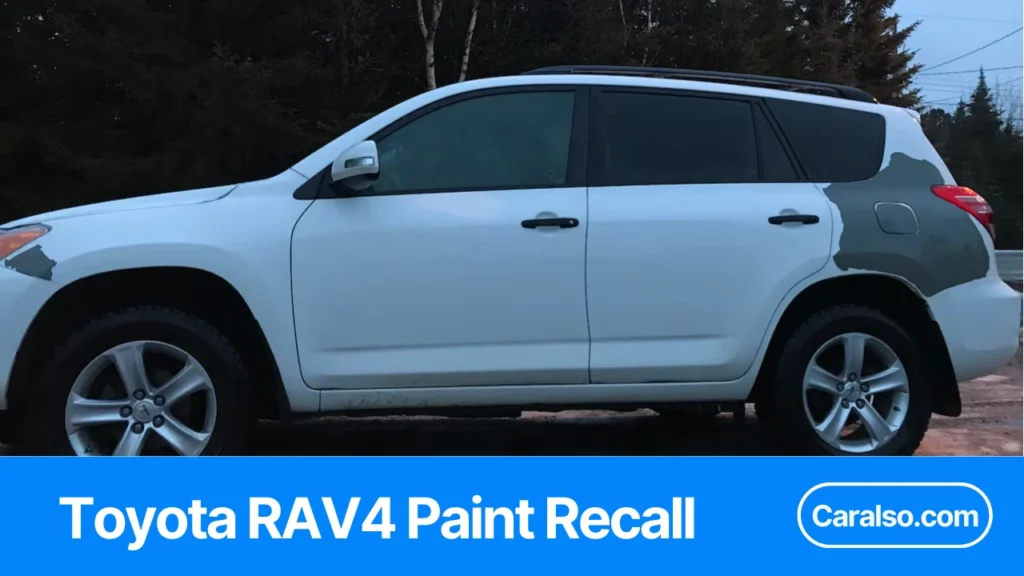
Toyota RAV4 Paint Recall
Quick Eligibility Snapshot
| Check This First | What I Look For | What It Means |
|---|---|---|
| Paint Code | 040 (Super White) or 070 (Blizzard Pearl) | If you have a different code, this program usually does not apply |
| Symptom | Paint peeling, not just chips | Peeling is the trigger. Normal rock chips are not the same claim |
| Panel Material | Metal panel, not plastic | Metal panels qualify. Plastic panels do not |
| Time Window | 10 years from the date of first use | If you are outside the window, coverage can end |
Quick verdict in 3 lines:
- If your RAV4 is 2008 to 2017 and your paint code is 040 or 070, you are in the right neighborhood.
- If the paint is peeling on a metal panel, you have the right symptom.
- Your next step is to confirm your date of first use, then book a dealer inspection.
Is There A Toyota RAV4 Paint Recall?
Not in the strict “recall” sense.
Toyota did not label this as a safety recall. Instead, Toyota created a Customer Support Program (ZKG) that pays for repainting when the factory white paint peels from exterior metal body panels.
This matters because it changes how you should approach it. A recall is automatic and VIN-driven. This paint program is condition-driven. Your RAV4 has to show the peeling issue, and the dealer has to confirm it.
What The Program Covers (In Plain English)
Toyota describes a specific failure mode. The paint can peel between the primer layer and the E-coat layer. When it peels, you may see a gray or brownish-green layer underneath. If Toyota verifies that condition, the fix is repainting the affected panel. It is not a full-vehicle repaint.
Which RAV4 Years Are In Scope
When I look at Toyota’s program list, the RAV4 model years called out are 2008 to 2017.
You may also see a technical service bulletin that lists RAV4 as 2009 to 2017. That difference confuses people. In practice, I treat it like this: the program list tells you the broad “who might qualify,” and the dealer confirmation process decides the final answer for your VIN and your paint code.
Which Paint Colors Matter
This program is tied to 2 Toyota paint codes:
- 040: Super White
- 070: Blizzard Pearl
If you have white paint but a different code, I do not assume you are covered. I confirm the code first. It takes about 60 seconds if your door label is readable.
What Is Not Covered (The Stuff That Trips People Up)
These are the common deal-breakers:
- Plastic panels are not covered. Think bumpers and certain trims.
- Damage can block the repair. Collision damage, dents, deep scratches, and deep rock chips can make a panel “not paintable” until you pay to fix the damage.
- Clear coat issues alone are not the same as this peeling pattern.
So if your bumper is peeling, that is a problem, but it is usually not a ZKG claim. If your metal hood or roof is peeling and the paint code matches, that is when the program becomes relevant.
How Long The Coverage Lasts
Toyota set up 2 timing rules:
- Primary coverage lasted until December 11, 2022.
- Secondary coverage is 10 years from the vehicle’s date of first use.
In real life, the “date of first use” is the number you care about. It is basically the in-service date. If your RAV4 was first put into service on June 15, 2016, the 10-year window runs to June 15, 2026.
One more detail I keep in mind. Toyota has guidance for claims where the peeling was confirmed before a vehicle’s coverage expired, but the paperwork or repair finished later. That is why documentation timing matters if you are near the end of your window.
What I Would Do Next (Fastest Path)
If you want the shortest path to an answer, I do this in order:
- Check the paint code for 040 or 070.
- Confirm the peeling is on a metal panel.
- Find your date of first use.
- Book a Toyota dealer inspection and ask them to document the peeling properly.
That is the difference between getting a clean “yes” and getting bounced around with “maybe.”
Quick Eligibility Checklist (60-Second Check)
If you want the fastest yes or no, I run this exact check.
Step 1: Check Your Paint Code (10 Seconds)
You are looking for one of these codes:
- 040 (Super White)
- 070 (Blizzard Pearl)
If your code is not 040 or 070, I stop here. Most “RAV4 paint recall” cases are tied to those two codes.
Step 2: Confirm It Is Peeling On A Metal Panel (20 Seconds)
This program is about paint peeling off exterior metal body panels.
What I look for:
- Paint lifting in sheets or flakes.
- A gray or brownish-green layer showing under the missing paint.
- The problem on panels like the hood, roof, doors, tailgate, or fenders.
Fast panel check I use:
- If a small magnet sticks, it is metal.
- If it does not stick, it could be plastic or aluminum. I treat it as “needs dealer confirmation.”
Common example:
- Front and rear bumpers are usually plastic. Those typically do not qualify.
Step 3: Check Your Coverage Window (30 Seconds)
Here is the timing rule that matters most:
- Secondary coverage is 10 years from the vehicle’s date of first use.
What I use as the date of first use:
- The day the car was first put in service. Often the original retail sale date.
- A Toyota dealer can see it by VIN.
- A vehicle history report often shows it too.
If you are close to the deadline, I do not wait. I book the dealer inspection and get the condition documented.
Quick Denial Check (10 Seconds)
These issues can block the repair even if the paint code matches:
- Collision damage on the same panel.
- Dents on the same panel.
- Deep scratches.
- Deep rock chips.
If that damage is present, Toyota may require you to fix it first at your cost.
What You Need To Confirm
| Item | What I Check | What I Write Down |
|---|---|---|
| Paint Code | Driver door jamb label | 040 or 070 |
| Symptom | Peeling on the panel surface | “Peeling” not “chips” |
| Panel Material | Magnet test plus visual check | Metal or plastic |
| Date Of First Use | Dealer lookup or history report | Month and year |
| Damage On Panel | Dents, deep scratches, collision marks | Yes or no |
If you can confirm paint code plus peeling on a metal panel, you are doing better than 90 percent of people walking into the dealer.
Which RAV4 Years Are Affected By The Paint Peeling Program?
Most owners want a clean year range. I get it. But Toyota’s documents show two slightly different ranges, and that is where the confusion starts.
Affected RAV4 Model Years (And Why You See Different Ranges Online)
Here is what I see in Toyota’s paperwork:
- The Customer Support Program list calls out RAV4 model years 2008 to 2017.
- The condition-confirmation bulletin used by dealers lists RAV4 as 2009 to 2017.
Why the mismatch happens:
- The Customer Support Program is the coverage umbrella. It is built for owners and dealers to process claims.
- The dealer bulletin is the inspection process. It is built to confirm the condition and route the repair steps.
- Some early-build vehicles can blur lines between model year labeling and production timing.
The practical takeaway I use:
- Year range is only a starting filter.
- Eligibility is decided by VIN, paint code, the peeling condition, and the date of first use.
So I never rely on “my RAV4 is a 2016” as proof. I confirm 040 or 070 first.
RAV4 Paint Colors Involved (Codes That Matter)
For this paint peeling program, these are the codes that matter:
- 040 Super White
- 070 Blizzard Pearl
Other RAV4 colors can chip or fade. That is normal wear. The “paint recall” searches are almost always about white paint peeling tied to these two codes.
RAV4 Paint Program Snapshot
| What You Are Looking At | RAV4 Years Shown | Paint Codes | Panels Covered | Coverage Logic | What I Do Next |
|---|---|---|---|---|---|
| Customer Support Program Vehicle List | 2008 to 2017 | 040, 070 | Exterior metal panels only | Primary coverage ended Dec 11, 2022. Secondary coverage is 10 years from date of first use | Confirm paint code, confirm peeling, then book dealer inspection |
| Dealer Condition Confirmation Bulletin | 2009 to 2017 | 040, 070 | Metal panels only | Used to verify the condition and route the repair | Bring photos and ask the dealer to document peeling on each panel |
If your RAV4 is outside these ranges, I still do not guess. I check the paint code and then ask the dealer to confirm by VIN. It takes minutes. It can save you a full repaint bill.
How To Find Your RAV4 Paint Code (040 Or 070) In Under 1 Minute
I always start with the paint code. It is the fastest filter.
Door Jamb Label Location (What To Look For)
- Open the driver door.
- Look at the label on the driver-side door jamb or the driver-side door pillar.
- Find the line that starts with C/TR.
- Read the first 3 characters after C/TR.
That first code is your exterior paint code.
What you might see:
- C/TR 040 ….
- C/TR 070 ….
- C/TR: 070/….
If you see two codes separated by a space or a slash, do not overthink it.
- The first code is the paint color.
- The second code is the interior trim.
My quick trick.
I take a photo with my phone, then zoom in. It saves time if the label is scratched or dusty.
If The Label Is Missing (Backup Options)
If the sticker is gone or unreadable, I use these backups.
Option 1: Dealer Confirmation By VIN
- Any Toyota dealer can pull your paint code from your VIN.
- I ask them to confirm whether the exterior paint code is 040 or 070.
Option 2: Body Shop Paint Scan (Last Resort)
- A good body shop can scan your paint with a handheld camera tool.
- It is called a spectrophotometer in most shops.
- This is great for paint matching.
- It is not my first choice for program eligibility, because the program is tied to the factory code.
If you only do one thing today, do the door jamb check. It takes about 30 seconds.
What Counts As “Paint Peeling” (Covered) Vs Normal Wear (Not Covered)
This part decides everything. I see owners get turned away because they describe the wrong symptom.
Covered Pattern: Peeling Or Delamination On Metal Panels
Toyota describes this as a paint adhesion failure.
In plain English, the paint loses its grip on the layer underneath and lifts off.
What I look for:
- Paint peeling in sheets or large flakes.
- A sharp edge where the paint stops and the underlayer starts.
- Gray or brownish-green underlayer showing under the missing paint.
- The issue on metal panels like the hood, roof, doors, fenders, or tailgate.
Toyota also ties the cause to sunlight over time degrading adhesion between layers on metal body panels.
That matters because it is not the same as a rock chip.
Normal Wear That Usually Is Not Covered
These are common paint issues, but they are not the same as the peeling condition:
- Small rock chips on the front bumper, hood edge, or A-pillars.
- Scratches from branches or car washes.
- Faded clear coat with no peeling into layers.
- Bird droppings etching.
- Sap stains.
- Swirl marks.
If the paint is chipped but still bonded around the chip, I call that wear.
If the paint is lifting at the edges and spreading, I call that peeling.
Common Reasons Claims Get Denied
Even when the paint code is right, Toyota can still say no if the panel cannot be repainted as-is.
These issues can block the repair:
- Collision damage.
- Dents.
- Deep scratches.
- Deep rock chips.
Here is why.
If the panel has damage, a body shop often has to repair that damage before repainting.
Toyota’s program does not pay for that damage repair.
You may be asked to pay for the dent repair or scratch repair first.
My advice.
If you have peeling plus damage on the same panel, document both.
Then ask the dealer what needs to be fixed to make the panel paint-ready.
Metal Vs Plastic Panels (Big Gotcha)
This is the one that surprises people.
Toyota’s paint peeling coverage is for exterior metal body panels.
Plastic body panels are not covered.
Toyota even calls out plastic bumper covers as an example.
So if your bumper is peeling, you may still need a fix.
But it usually will not be paid for under this paint peeling program.
Quick Comparison Table I Use
| What I See | Usually Covered Under The Program | Usually Not Covered |
|---|---|---|
| Paint lifts off in sheets on a metal panel | Yes | No |
| Gray or brownish-green underlayer visible | Yes | No |
| Small chips on the hood edge | No | Yes |
| Scratches through the paint | No | Yes |
| Peeling on a plastic bumper cover | No | Yes |
| Peeling plus dents on the same panel | Maybe, but dents can block approval | Yes, until damage is repaired |
If you are unsure, I do one simple test.
I bring clear photos and I use the word “peeling” when I describe it.
That matches how Toyota writes the condition.
Coverage Timeline Explained (This Is Where Most Pages Lose People)
This program has two clocks. I keep it simple. I treat it like a coverage ladder.
Primary Vs Secondary Coverage (What It Means)
Primary coverage was the easy window.
- It ran until December 11, 2022.
- Mileage did not matter during this window.
Secondary coverage is the rolling window.
- It runs for 10 years from your vehicle’s date of first use.
- Mileage does not matter here either.
Here is the part most people miss.
Primary coverage ended on December 11, 2022.
After that, secondary coverage is what decides your eligibility.
So the program can still be “active” for you in 2026, but only if your 10-year window is still open.
How To Calculate Your Deadline Using Date Of First Use
I calculate it the same way every time.
- Find the date of first use.
- Add 10 years.
- That date is your secondary coverage deadline.
Real examples:
Example 1
- Date of first use: June 15, 2016
- Add 10 years: June 15, 2026
- Status on February 22, 2026: Still inside the window
Example 2
- Date of first use: March 10, 2014
- Add 10 years: March 10, 2024
- Status on February 22, 2026: Window is closed
Example 3
- Date of first use: November 1, 2018
- Add 10 years: November 1, 2028
- Status on February 22, 2026: Still inside the window
If you do not know your date of first use, I do not guess.
I ask a Toyota dealer to pull it by VIN.
A vehicle history report often shows it too.
What If The Program “Expired” (The Nuance Competitors Skip)
This is the rule I care about if you are near your deadline.
Toyota has a post-expiration procedure.
It is built for people who got the condition confirmed before coverage ended.
Here is what matters:
- The dealer has to confirm the peeling condition before your coverage expires.
- The dealer has to upload the required photos of the peeling panels before your coverage expires.
- Photos uploaded after the expiration date can be rejected for payment.
- If your VIN was diagnosed before expiration, Toyota can require the repair and claim submission within 12 months of your vehicle’s expiration date.
So if you are close to your deadline, I push for documentation now.
I want the dealer to upload the photos and get them accepted in Toyota’s system.
If you want the quick answer to “Is the Toyota RAV4 paint recall still active?”
My answer is yes for some owners.
It depends on your date of first use and whether your 10-year window is still open.
How To Get Toyota To Fix Peeling Paint (Step-By-Step)
I treat this like a claim file, not a casual complaint.
That mindset gets faster approvals.
Step 1: Document It Like A Claim Reviewer
I take photos that answer three questions.
- What panel is it?
- How big is the peeling area?
- Is it peeling, not chipping?
My photo set:
- Wide shot of the whole side of the vehicle.
- Medium shot of the full panel.
- Close-up that shows the peeling edge and the underlayer.
- Angle shot that shows the panel shape and location.
- One photo in good daylight. No garage shadows.
I also write down:
- Paint code (040 or 070).
- Which panels are peeling.
- Any prior body work on those panels.
- Any dents, deep scratches, or collision marks on those panels.
If a panel has damage, I document it.
Damage can block the repaint under this program.
Step 2: Book A Dealer Inspection (What To Request)
I call the service department and say one sentence.
“I have peeling paint on a metal panel, and my paint code is 040 or 070. I want you to check eligibility under the paint peeling customer support program and document it.”
When I arrive, I ask for three things:
- Verify eligibility by VIN in Toyota’s system.
- Document the peeling on each panel.
- Upload the required photos right away if I am close to my coverage deadline.
Dealers follow a specific workflow.
They identify peeling panels, upload photos to Toyota’s site, and mark which panels are peeling.
That photo upload timing matters if you are near expiration.
Dealer Script (Copy And Paste)
I use this if the service advisor looks confused.
“Hi, I am here for peeling factory paint. My paint code is 040 or 070. The peeling is on exterior metal panels. Please verify eligibility and document the peeling with the required photos for the program.”
Step 3: What Happens After Approval
If Toyota approves it, the repair is usually panel-based.
They repaint the specific peeling panels.
It is not a full-vehicle repaint.
Here is what I expect next:
- The dealer generates a report listing the approved peeling panels.
- A body shop writes a preliminary estimate for those panels.
- Toyota can approve or deny labor hours and cost based on the panels marked as peeling.
One important detail.
If a panel has dents or deep damage that must be repaired before painting, that damage repair is usually on you.
I ask the body shop for two estimates.
- One estimate for the program-covered repaint.
- One separate estimate for damage repair I might have to pay.
Toyota also allows the dealer to coordinate repairs with a collision center or body shop in many cases.
But I still start at the Toyota dealer, because coverage confirmation runs through Toyota’s process.
Step 4: Time Expectations And Loaner Questions
I set expectations before I leave the counter.
Toyota’s own guidance says repair time can vary.
A typical range is about 1 day to 2 weeks, depending on how many panels need paint and the body shop schedule.
I ask these questions:
- How many panels are approved for repaint?
- When will the body shop start?
- When will the vehicle be reassembled and ready for pickup?
- Will you provide a loaner if the repair time exceeds 4 hours?
- If you cannot provide a loaner, do you offer rental assistance?
If you are near your coverage deadline, I ask one more question.
“Are the photos uploaded and accepted in the system today?”
That one question can save a denied claim later.
Reimbursement: What If You Already Paid For Repainting?
I get this question a lot. The short answer is this. Reimbursement can be possible, but Toyota put hard cutoff dates on it.
When Reimbursement Is Sometimes Possible
Toyota’s paint peeling program includes a reimbursement path for some owners who paid out of pocket before Toyota launched the repair.
Here is how I think about it:
- If you paid for a repaint before Toyota’s reimbursement cutoff date for your phase, you might qualify.
- If you paid after that cutoff date, Toyota usually does not reimburse those costs.
For the original ZKG rollout, the owner FAQ and letter language most people see says the expense had to be incurred before September 26, 2019. Toyota also states they do not reimburse expenses incurred after that date.
One more detail I do not skip.
Toyota wants an authorized Toyota dealer inspection tied to the program. That inspection confirms the condition and which areas count.
If you are not sure which cutoff date applies to your VIN, I use the owner letter as the source of truth. Toyota ran this program in phases, and the date can vary by phase.
What Documentation You’ll Need
I build a clean packet. The easier you make it for the reviewer, the better.
This is what I include:
- VIN (17 digits)
- Proof of ownership at the time of repair
- Repair order or invoice that lists the work performed
- Proof of payment (receipt, credit card record, or paid invoice)
- Repair date
- Shop name, address, and phone number
- Panel list (hood, roof, door, tailgate, fender)
- Before photos if you have them
- After photos if you have them
I also add one simple note on top.
“I paid for repainting due to factory paint peeling. Paint code is 040 or 070. Panels repaired are listed below.”
If you are missing one item, I still submit what I have. But I expect delays.
If Toyota Won’t Cover It: Realistic Options And Cost Expectations
Sometimes Toyota says no. Or the car is outside the window. Or the panel has damage that blocks refinishing. When that happens, I shift to the fastest path that protects the body and keeps the cost controlled.
Get A Second Dealer Opinion (Why It Can Change Outcomes)
I have seen two Toyota dealers handle the same peeling complaint very differently.
Here is why a second opinion helps:
- Some advisors confuse this program with a recall.
- Some dealers are better at documenting the condition the way Toyota wants.
- The program requires the condition to be confirmed through Toyota’s process.
What I do at the first dealer visit:
- I ask them to verify my VIN in Toyota’s system for program involvement.
- I ask them to confirm the paint code is 040 or 070.
- I ask them to write down the reason for denial if they say no.
Common denial reasons I see:
- It is chipping, not peeling.
- The peeling is on plastic, like a bumper cover.
- The panel has dents, deep scratches, collision damage, or deep rock chips that prevent a proper repaint.
- The vehicle is outside the coverage timeline.
If I still believe it qualifies, I go to another dealer with my photos and the denial reason in writing. It saves time.
Body Shop Options (Panel Respray Vs Blend Vs Wrap)
If Toyota will not cover it, I price it like a body shop job, not like a full repaint.
Here is the range I see most often in the U.S. for common options:
| Fix Option | Typical Use Case | Typical Price Range |
|---|---|---|
| Touch-Up Or Chip Repair | Small exposed spots, temporary protection | $150 to $250 |
| Partial Respray (One Panel) | One peeling panel, like hood or roof section | $400 to $1,200 |
| Full Vehicle Repaint | Multiple panels peeling, owner wants uniform finish | $1,000 to $10,000+ |
| Full Vinyl Wrap (SUV) | Cosmetic reset without paint, if surface is stable | $3,000 to $5,000 |
| Partial Wrap | Hood or roof only, budget option | $600 to $2,600 |
Two real-world notes I keep in mind:
- Blending can add cost. If the shop blends into adjacent panels for a cleaner color match, expect more labor and more materials.
- Wraps need stable paint. If your paint is flaking, vinyl can lift with it. I fix peeling edges first before I wrap anything.
If you only have 1 or 2 peeling panels, a targeted respray is usually the best value. I get 2 quotes. One from a Toyota certified collision center. One from a highly rated independent shop.
Prevent Rust If Metal Is Exposed (What To Do Immediately)
If you can see bare metal, rust can start. Especially in wet climates or salted winter roads.
I handle this in a simple order.
- Take photos first.
If you might still pursue Toyota coverage, get clear photos before you touch anything. - Clean and dry the area.
I wash with soap and water. Then I dry it fully. - Seal it temporarily.
After documentation, I use a basic touch-up approach to seal exposed metal. The goal is to block moisture and oxygen until a proper repaint happens.
I avoid heavy sanding or DIY repaint work before the dealer documents the condition. It can complicate the claim. I keep it minimal and reversible.
If the peeling is spreading fast, I do not wait months. I book a body shop estimate within 7 days.
Used-Car Buyer Section: How To Avoid Buying A Problem RAV4
If I am shopping a used RAV4, I treat peeling paint like a $1,000 to $5,000 decision. I want to know three things fast. Paint code. Panel type. Coverage window.
Where Peeling Typically Starts (Quick Inspection Map)
I start with the panels that get the most sun and the least protection.
My 2-minute walkaround:
- Hood, center area and near the windshield edge
- Roof, especially above the front seats and near the windshield line
- Top of the doors near the window frames
- Rear quarter area above the wheel arch
- Tailgate skin, especially the upper half
Then I check the tricky spots:
- Under the hood edges
- Panel seams and body lines where peeling can hide
- Any spot where I see a hard paint edge and a different underlayer color
One reminder I use.
Bumpers are usually plastic. This program is about metal panels.
Pricing Leverage: What Peeling Paint Should Reduce The Price By
I price it by panels, not by vibes.
Here is the cost reality I use for negotiation:
- A partial respray for one panel often lands in the $400 to $1,200 range.
- If blending is needed, a single panel can climb toward $1,400.
- A full repaint can run $1,000 to $10,000+ depending on prep and quality.
My discount rule is simple.
I ask for 1.2x the repair estimate, because I am paying with time and risk.
Use this table as a quick starting point.
| What I See On The Car | What I Expect To Fix | Discount I Ask For |
|---|---|---|
| One peeling panel (hood or roof) | 1 panel respray | $800 to $2,000 |
| Two to three peeling panels | 2 to 3 panel resprays, possible blending | $1,500 to $4,000 |
| Peeling on multiple sides plus roof | 4+ panels, higher mismatch risk | $3,000 to $7,000 |
| Seller says “it was repainted already” | Quality check needed, possible redo | $1,000 to $3,000 unless I see clean proof |
One more angle that matters.
If the car is still within the 10-year window, I still negotiate. Even if Toyota might cover it, I am taking on the dealer visits and the wait.
Pre-Purchase Inspection Checklist (Paint + Prior Repairs)
This is the checklist I use on white RAV4s.
Paint Program Filters
- I check the door jamb label for paint code 040 or 070.
- I ask for the date of first use. If the seller does not know it, I plan a dealer VIN check.
- I confirm the peeling is on a metal panel, not a plastic bumper cover.
Peeling Pattern Checks
- I look for paint lifting in sheets, not peppered chips.
- I look for the gray or brownish-green underlayer.
- I take photos of every peeling spot. Wide shot and close-up.
Repaint And Bodywork Clues
- I check for overspray on rubber seals, badges, and inside door jamb edges.
- I look for tape lines in the door jambs and around trim.
- I compare orange peel texture panel to panel.
- I check panel gaps around the hood, fenders, and tailgate.
Optional Tool Check (If I Am Serious About The Car)
- I use a paint thickness gauge if I can.
- Factory paint is often around 100 to 180 microns.
- If I see readings over 250 microns on one panel, I assume it was repainted.
- If I see big swings side to side, I ask why.
Paperwork Checks
- I ask for repair orders for any paint work.
- I check vehicle history for collision entries.
- I ask if the seller ever tried the Toyota paint program and what the dealer said.
If the seller cannot answer basic questions, I lower my offer. Or I walk.
FAQs
What Years Of Toyota RAV4 Have Paint Peeling Problems?
The RAV4 years most tied to the paint peeling program are 2008 to 2017, depending on the document you look at. I treat year as a starting filter. The real filters are paint code 040 or 070, peeling on a metal panel, and your date of first use.
How Do I Know If My RAV4 Is Super White 040 Or Blizzard Pearl 070?
I check the driver door jamb label. Look for C/TR. The first three characters after C/TR are the paint code. If it says 040 or 070, you have the codes tied to this peeling program.
Is The Toyota RAV4 Paint Recall Still Active?
For some owners, yes. Primary coverage ended on December 11, 2022. The bigger rule now is secondary coverage. That is 10 years from the date of first use. If your 10-year window is still open, you can still be eligible.
Will Toyota Repaint The Whole Car?
Usually no. The repair is typically panel-based. Toyota covers repainting the affected metal panels that meet the peeling criteria. If only the hood and roof are peeling, those are the panels that usually get painted.
Are Bumpers Covered?
No in most cases. Bumpers are typically plastic, and the program is written for exterior metal body panels. If your bumper paint is peeling, I treat it as a separate repair plan.
What If I Missed The Deadline?
If you are outside the 10-year window, coverage can end. I still do two things.
- I ask a dealer to verify eligibility by VIN, because timing details can be specific.
- I ask about goodwill assistance if the peeling is severe and the car is close to the limit.
If you are near the deadline, I do not wait. I get the condition documented at the dealer as soon as possible.
Sources
- NHTSA TSB: T-SB-0162-19 (Paint Peeling, 040/070)
- Toyota Paint Code Reference (Toyota)
- Edmunds: Vinyl Wrap Overview
- Auto Body Repair Cost Guide
- Cost Reference: Hood Paint

Hey there,
How is it going?
I’m Meraj Sarker. I am a Car Mechanic and a student of Automobile Restoration here in Florida, USA. I’ve been studying automotive for around 9 years now. So you can rely on my recommendation. For me, studying and getting knowledge about automobile it’s really fun and entertaining. I will help you to get solutions for your car through this website. If you need any help let me know.