
I’ve owned and wheeled a bunch of compact SUVs. The RAV4 is the one I see absolutely everywhere.
This guide is your map. Year by year. Generation by generation. Gas, Hybrid, and Prime.
I’m focusing on U.S. models, since the U.S. lineup runs a little different from Europe or Japan. The first RAV4 hit the U.S. for the 1996 model year, and the 6th-generation hybrid-only RAV4 is landing for 2026.
If you want deep dives on best and worst years, problems, towing, or Hybrid battery life, I’ve got separate guides for those. This page is just here to answer one thing clearly:
“What RAV4 models existed in each year, and what changed?”
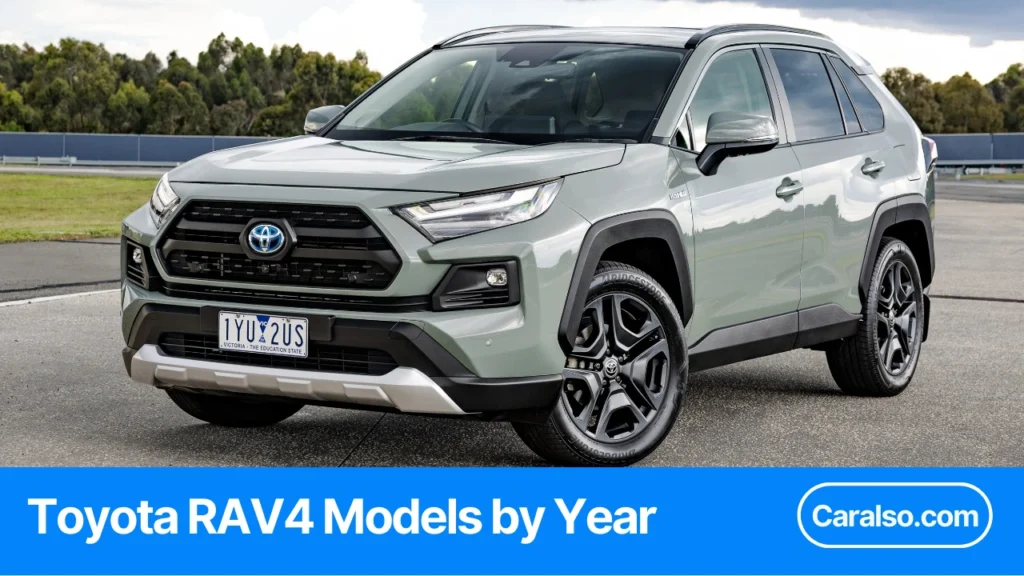
Toyota RAV4 models by year at a glance (Quick chart)
Here’s the hero asset. One place where you can see every U.S. RAV4 model year from 1996 through 2026 with the generation, powertrains, and main changes.
Tip: Use this table to spot the years that added Hybrid, Prime, Adventure, TRD Off-Road, Woodland, and the 6th-gen hybrid-only setup.
| Model year | Generation (code) | Powertrains (U.S.) | Key changes and notes |
|---|---|---|---|
| 1996 | 1st gen RAV4 (XA10) | Gas 2.0L I4 | RAV4 launches in the U.S. as a small “soft-roader” with 3-door and 5-door bodies, FWD or 4WD, manual or automatic. |
| 1997 | 1st gen (XA10) | Gas 2.0L I4 | Minor updates. Power bumps slightly. Soft-top 2-door convertible version joins the lineup. |
| 1998 | 1st gen (XA10, facelift) | Gas 2.0L I4 | Light facelift front and rear. Interior tweaks, new lighting, extra cup holders. Power up again a bit vs 1996. |
| 1999 | 1st gen (XA10) | Gas 2.0L I4 | 2-door hardtop dropped for the U.S. 5-door and soft-top stay. Otherwise mostly carryover. |
| 2000 | 1st gen (XA10 final year US) | Gas 2.0L I4 | Last U.S. model year for 1st-gen RAV4 before the full redesign in 2001. |
| 2001 | 2nd gen RAV4 (XA20) | Gas 4-cyl | All-new 2nd gen. Bigger body, new platform, still offered with 5-door in U.S. 2.0L 4-cyl; FWD or 4WD. |
| 2002 | 2nd gen (XA20) | Gas 4-cyl | Carryover with small option tweaks. Early 2000s safety and features. |
| 2003 | 2nd gen (XA20 facelift) | Gas 4-cyl | Facelift. Updated styling. 2.4L 2AZ-FE 4-cyl begins to appear in the range globally; U.S. sees more power later in the run. |
| 2004 | 2nd gen (XA20) | Gas 2.4L 4-cyl | U.S. gets the more powerful 2.4L 4-cyl shared with Camry, plus interior and safety improvements. |
| 2005 | 2nd gen (XA20 final year US) | Gas 2.4L 4-cyl | Final year of 2nd gen before a much larger 3rd gen. Trim and equipment tweaks only. |
| 2006 | 3rd gen RAV4 (XA30) | Gas 2.4L I4, 3.5L V6 | All-new, larger 3rd gen. Long-wheelbase U.S. model. Optional 3.5L V6 and available 3rd-row seat; serious jump in space and towing. |
| 2007 | 3rd gen (XA30) | Gas I4, V6 | Carryover. 3rd-row and V6 remain available. More interior and feature options roll in. |
| 2008 | 3rd gen (XA30) | Gas I4, V6 | Running updates. Optional V6 stays popular for towing and performance. |
| 2009 | 3rd gen (XA30 facelift) | Gas 2.5L I4, V6 | Facelift. New 2.5L 4-cyl engine and revised styling. V6 continues. |
| 2010 | 3rd gen (XA30) | Gas 2.5L I4, V6 | Carryover with small equipment changes. Still one of the best “big space + V6” years. |
| 2011 | 3rd gen (XA30) | Gas 2.5L I4, V6 | Late-run tweaks. Stability and safety features improve versus early 3rd-gen years. |
| 2012 | 3rd gen (XA30 final year US) | Gas 2.5L I4, V6 | Final year with optional 3.5L V6 and 3rd row before 4th-gen redesign drops both. |
| 2013 | 4th gen RAV4 (XA40) | Gas 2.5L I4 | All-new 4th gen. Rear door becomes top-hinged liftgate. Spare moves under floor. V6 and 3rd row discontinued. New 6-speed auto. |
| 2014 | 4th gen (XA40) | Gas 2.5L I4 | Tech package adds lane-departure warning and blind-spot monitoring on higher trims. |
| 2015 | 4th gen (XA40 facelift) | Gas 2.5L I4 | Mid-cycle refresh with updated styling and interior touches. No major powertrain change. |
| 2016 | 4th gen (XA40) | Gas 2.5L I4, Hybrid | Facelift continues. First RAV4 Hybrid arrives (XLE / Limited / later SE). New SE trim for gas model. |
| 2017 | 4th gen (XA40) | Gas, Hybrid | Many driver-assist features (Toyota Safety Sense) become standard on most trims. Platinum trim added. |
| 2018 | 4th gen (XA40 final year) | Gas, Hybrid | Adventure trim added for a more rugged look; SE trim gets increased ride height. Last 4th-gen year. |
| 2019 | 5th gen RAV4 (XA50) | Gas, Hybrid | All-new 5th gen on TNGA-K platform. New 2.5L engine with 8-speed auto. Apple CarPlay and Toyota Safety Sense standard. Adventure and XSE Hybrid trims available. |
| 2020 | 5th gen (XA50) | Gas, Hybrid | Android Auto added as standard. TRD Off-Road trim launches with off-road suspension and AT tires. |
| 2021 | 5th gen (XA50) | Gas, Hybrid, Prime PHEV | RAV4 Prime plug-in hybrid joins lineup (SE and XSE). Otherwise light changes. |
| 2022 | 5th gen (XA50)** | Gas, Hybrid, Prime | 9-inch touchscreen becomes available. New SE Hybrid trim adds a sportier hybrid option. |
| 2023 | 5th gen (XA50) | Gas, Hybrid, Prime | New Toyota Audio Multimedia system. Bigger 10.5-inch screen and digital cluster on some trims. Woodland Edition Hybrid debuts. |
| 2024 | 5th gen (XA50) | Gas, Hybrid, Prime | Largely carryover from 2023. RAV4 continues with the same basic powertrains and trim mix. |
| 2025 | 5th gen (XA50 final year) | Gas, Hybrid, Plug-in Hybrid | Adventure and TRD Off-Road trims discontinued for 2025 MY. RAV4 Prime branding starts shifting to RAV4 Plug-in Hybrid for 2025 PHEV models. |
| 2026 | 6th gen RAV4 (XA60) | Hybrid only (HEV + PHEV) | All-new 6th gen. Fully electrified lineup with 5th-gen hybrid and 6th-gen plug-in. Arene software platform, new digital cockpit, and design themes: Core (LE/XLE/Limited), Adventure (Woodland), Sport (SE/XSE/GR Sport PHEV). Hybrid standard across all trims. |
A couple of quick notes so you can read this thing fast:
- I’ve kept this table U.S. focused. Other markets get diesels and different trims that never come here.
- Hybrids show up in the U.S. from 2016 onward. The RAV4 Prime / Plug-in Hybrid runs from 2021 5th-gen into the 2026 6th-gen lineup.
From here, we can zoom in by generation and by powertrain. But if all you needed was a clean “models by year” map, this chart is the core reference I use when I help friends shop RAV4s.
Toyota RAV4 generations explained (1st–6th gen)
Here’s the big picture. Six generations, each with its own feel. I’ll keep it tight so you can see what changed and why it matters.
1st generation RAV4 (1996–2000, XA10)
This is the original RAV4 that started the whole crossover thing.
It hit the U.S. for the 1996 model year with a 2.0-liter 4-cyl, manual or auto, and either front wheel drive or all wheel drive. You could get a short 3-door or a more practical 5-door early on.
I think of 1st gen as light, simple, and a bit quirky. Safety and tech are very basic by today’s standards, but the small size and car-like ride are what made people pay attention in the first place.
2nd generation RAV4 (2001–2005, XA20)
Second gen is where the RAV4 grows up a bit.
Toyota stretched the body, cleaned up the styling, and made the ride more car-like. The U.S. focuses on the 5-door model with a 4-cyl engine and better safety gear. Later years pick up the stronger 2.4-liter 4-cyl that most of us know from the early 2000s Camry.
Inside, it feels more “normal SUV” than funky soft-roader. Still small, still easy to park, just less toy-like than the 1st gen.
3rd generation RAV4 (2006–2012, XA30)
Third gen is the big jump into true compact SUV territory.
North America gets the long-wheelbase version with way more interior space. You can get a 2.4 or 2.5-liter 4-cyl, or a strong 3.5-liter V6. Some trims even offer a small 3rd-row seat.
This is the era I look at if someone wants to tow a small camper or just needs maximum cargo room on a budget. The V6 and optional 3rd row go away after this generation, so if you want those, you shop here.
4th generation RAV4 (2013–2018, XA40)
Fourth gen is a full redesign into a more modern, urban SUV.
Toyota swaps the side-hinged rear door for a proper liftgate and moves the spare tire under the floor. The V6 and 3rd row disappear. All U.S. models use a 2.5-liter 4-cyl with a 6-speed automatic.
The big milestone is 2016, when the RAV4 Hybrid joins the lineup. From that point on, you can get decent MPG and AWD with Toyota’s hybrid setup in a compact SUV body.
To me, late 4th gen (2016–2018) is the sweet spot if you want something that feels modern but not brand new money.
5th generation RAV4 (2019–2025, XA50)
Fifth gen is what you see everywhere right now. Boxier, more truck-like styling on a TNGA-K platform.
Power comes from a 2.5-liter 4-cyl with an 8-speed auto. You can choose gas, Hybrid, or plug-in hybrid. Toyota Safety Sense and Apple CarPlay are standard from launch. Android Auto joins in 2020.
In 2021 Toyota adds the RAV4 Prime plug-in hybrid, which later gets renamed RAV4 Plug-in Hybrid. It uses a higher-output hybrid system with about 300+ hp and real EV range.
If you want all the modern safety tech and connectivity in a familiar shape, this is the generation you’re probably shopping.
6th generation RAV4 (2026–… , XA60)
Sixth gen is where Toyota flips the script. The entire lineup is hybrid.
Starting with the 2026 model year, every RAV4 in the U.S. runs a hybrid setup. You can pick a regular hybrid (HEV) or a plug-in hybrid (PHEV). The PHEV jumps to around 320 hp and more EV range, and it can DC fast charge on CCS, which is rare for a plug-in.
Under the skin, the 6th gen brings Toyota’s Arene software platform, bigger digital screens, and updated Toyota Safety Sense. Trims are grouped into design “families” like Core, Rugged, and Sport, but the basic idea is simple. From 2026 on, if you buy a new RAV4, you are getting a hybrid.
When you line the generations up like this, it’s easy to see the pattern: small and simple in the 90s, bigger and more powerful in the 2000s, then a steady push into hybrids and software with 5th and 6th gen.
Toyota RAV4 year-by-year changes (US models)
Here I’m not trying to list every option package. I’m hitting the real changes you’ll feel when you shop or drive a RAV4 in the U.S.
1996–2000 RAV4 – changes by year (1st gen)
1996
- First year in the U.S.
- 2.0L 4-cyl, 5-speed manual or 4-speed auto, FWD or AWD.
- 3-door and 5-door body styles.
1997
- Power bumped slightly vs 1996.
- Soft-top 3-door convertible added to the lineup.
1998
- Front and rear restyle (facelift).
- Small interior updates like different trim and extra cup holders.
1999
- 2-door hardtop dropped in the U.S.
- 5-door and soft-top continue.
2000
- Final year of the 1st gen in the U.S.
- Mostly carryover before the full redesign in 2001.
2001–2005 RAV4 – changes by year (2nd gen)
2001
- All-new 2nd gen.
- Still compact, but more space and refinement.
- 2.0L 4-cyl with FWD or 4WD.
2002
- Mostly equipment and trim tweaks.
- Same basic powertrain and layout as 2001.
2003
- Global facelift starts around this time.
- U.S. models get mild styling and feature updates.
2004
- Bigger change year.
- Styling refresh plus more powerful 2.4L 4-cyl shared with the Camry.
- Safety and refinement improved.
2005
- Last 2nd-gen year.
- Mostly carryover from 2004, setting up for the bigger 3rd gen in 2006.
2006–2012 RAV4 – changes by year (3rd gen)
2006
- All-new 3rd gen on a new platform.
- Long-wheelbase body for North America with much more interior space.
- 4-cyl plus optional 3.5L V6 and available 3rd-row seat.
2007
- Small feature and option updates.
- Same basic styling and powertrains as 2006.
2008
- Running changes only.
- V6 and 3rd row remain available.
2009
- Mild facelift.
- New 2.5L 4-cyl replaces the older 2.4L on most models, with better power and economy.
2010
- Carryover styling.
- Equipment and safety features shuffled and updated.
2011
- More incremental feature and option changes.
- Still offered with 4-cyl or V6.
2012
- Final 3rd-gen year.
- Last chance for the V6 and factory 3rd-row before the 2013 redesign drops both.
2013–2018 RAV4 – changes by year (4th gen)
2013
- All-new 4th gen.
- V6 and 3rd-row seat discontinued.
- New 6-speed automatic improves fuel economy vs old 4-speed.
- Rear cargo door becomes top-hinged liftgate; spare moves under the floor.
2014
- Tech package adds lane-departure warning and blind-spot monitoring on higher trims.
2015
- No major mechanical changes.
- Styling and trim refined before the mid-cycle refresh.
2016
- Facelifted 4th gen.
- SE trim added.
- First U.S. RAV4 Hybrid offered (XLE / Limited and later SE).
2017
- Many driver-assist features (Toyota Safety Sense) become standard.
- Platinum trim added at the top of the range.
2018
- Adventure trim added for a tougher look and light off-road focus.
- SE trim gets increased ride height.
- Final year of the 4th gen.
2019–2025 RAV4 – changes by year (5th gen)
2019
- All-new 5th gen on TNGA-K platform.
- New 2.5L 4-cyl with 8-speed automatic.
- Apple CarPlay and Toyota Safety Sense standard.
- RAV4 Hybrid returns on the new platform.
2020
- Android Auto added as standard on all models.
- TRD Off-Road trim launches with off-road suspension and all-terrain tires.
- Power driver seat becomes standard on XLE.
2021
- CarMax lists “no significant changes.”
- Lineup now clearly includes gas, Hybrid, and RAV4 Prime plug-in hybrid (PHEV) in the U.S.
2022
- Available 9-inch touchscreen on some trims.
- New SE Hybrid mid-grade trim with sportier look and suspension.
2023
- New Toyota Audio Multimedia software.
- Larger 10.5-inch touchscreen and digital instrument cluster available.
- Woodland Edition Hybrid added with a more rugged setup.
2024
- CarMax and Toyota call it “virtually unchanged” from 2023.
- Same basic engine, hybrid, and Prime lineup.
2025
- Adventure and TRD Off-Road trims discontinued.
- RAV4 Prime name shifts to “RAV4 Plug-in Hybrid” in North America for the PHEV model.
2026–2027 RAV4 – changes by year (6th gen)
2026
- All-new 6th-generation RAV4 (XA60).
- Hybrid power standard across the lineup. No more pure gas models.
- New 5th-gen hybrid system (up to 236 hp) and 6th-gen plug-in hybrid with about 320 hp and DC fast charging on the PHEV.
- Runs Toyota’s new Arene software platform with bigger digital screens and updated Toyota Safety Sense.
2027
- Second year of the 6th gen.
- At this point, Toyota and the big guides mostly describe it as a likely carryover with minor tweaks, since the full redesign just happened for 2026. Always check current Toyota and Cars.com / Edmunds info once 2027 details are fully published.
This is the zoomed-in view I use when I’m helping someone figure out “what actually changed” between two RAV4 years. From here we can match these years to trims, powertrains, or your budget in the next sections.
Toyota RAV4 trims by year (LE, XLE, Adventure, TRD Off-Road & more)
Trim names on the RAV4 look like alphabet soup at first. Here’s how I break it down when I help someone shop.
How RAV4 trim names changed over time
1st and 2nd gen (1996–2005)
- Simple trims like Base / L / Sport / Limited depending on year and market.
- Focus is on body style (2-door, 4-door) and drivetrain more than fancy trim branding.
3rd gen (2006–2012)
- U.S. lineup settles into Base / Sport / Limited.
- All three trims can be had with 4-cyl or V6 in many years.
4th gen (2013–2018)
- Toyota swaps to the familiar LE / XLE / Limited structure.
- SE joins in 2016.
- Platinum joins in 2017 at the top end.
- Adventure shows up in 2018 as the rugged look package.
5th gen (2019–2025)
- Core trims: LE, XLE, XLE Premium, Adventure, TRD Off-Road, Limited on gas models.
- Hybrids add Hybrid LE, Hybrid XLE, SE, XLE Premium, XSE, Limited, Woodland Edition by 2023.
- RAV4 Prime / Plug-in Hybrid uses SE and XSE trims. For 2025 the name changes from “Prime” to RAV4 Plug-in Hybrid but the trims stay SE and XSE.
6th gen (2026–…)
- Toyota groups trims into “design styles.”
- In the U.S. you see LE, SE, XLE Premium, Woodland, XSE, Limited on the hybrid.
- PHEV adds a GR Sport style trim as the hot one.
Quick trim map by ERA
This is the fast way I log trims when I am scanning listings.
3rd gen (2006–2012)
- 2006–2012 gas:
- Base
- Sport
- Limited
4th gen (2013–2018)
- 2013–2015 gas:
- LE / XLE / Limited
- 2016–2017 gas:
- LE / XLE / SE / Limited
- Plus Platinum at the top in 2017.
- 2018 gas:
- LE / XLE / SE / Adventure / Limited / Platinum
- 2016–2018 Hybrid:
- Mostly Hybrid XLE and Hybrid Limited (plus Hybrid SE later).
5th gen (2019–2025)
- 2019 gas:
- LE / XLE / XLE Premium / Adventure / Limited
- 2020 gas:
- Same as 2019
- TRD Off-Road added.
- 2021–2025 gas:
- LE / XLE / XLE Premium / Adventure / TRD Off-Road / Limited with small package tweaks.
- Adventure and TRD Off-Road dropped for the 2025 model year.
- 2019–2025 Hybrid (5th gen):
- Mix of Hybrid LE, Hybrid XLE, SE, XLE Premium, XSE, Limited, Woodland Edition by 2023–2025.
- 2021–2025 RAV4 Prime / Plug-in Hybrid:
- SE and XSE trims.
- For 2025, Toyota calls it RAV4 Plug-in Hybrid instead of RAV4 Prime, but trim names stay SE and XSE.
6th gen (2026–…)
- 2026 hybrid (HEV):
- LE / SE / XLE Premium / Woodland / XSE / Limited.
- 2026 plug-in (PHEV):
- SE-like base, XSE, and GR Sport style trims (sportier look and tune).
That is enough detail to decode most listings without drowning you.
Trims I like as “value” picks
If you just want a quick steer from someone who lives in this stuff:
- 3rd gen (2006–2012):
- Sport if you want firmer suspension.
- Limited if you want comfort features and still might tow.
- 4th gen (2013–2018):
- XLE for decent features at a sane price.
- SE or Adventure if you like a slightly firmer ride and tougher look.
- 5th gen (2019–2025):
- XLE or XLE Premium are my usual gas picks.
- Hybrid XLE / SE / XSE hit a nice MPG and features balance.
- Woodland Hybrid only if you actually use the extra ground clearance and kit.
- RAV4 Prime / Plug-in:
- SE if you care more about price.
- XSE if you want the full fast and loaded experience.
- 6th gen (2026+):
- SE looks like the sweet spot on paper.
- Woodland if you actually go off pavement.
- GR Sport PHEV only if you really want the hot one.
When I shop used, I pick a trim that already has the stuff I want. Adding factory-type features later gets expensive fast.
Gas vs Hybrid vs Prime – RAV4 powertrain options by year
Now let’s talk engines and batteries. This is where the years really matter.
Gas-only RAV4 years
From the 1996 launch through 2015, every U.S. RAV4 is gas only. No factory Hybrid or plug-in.
Rough powertrain timeline:
- 1996–2000: 2.0L 4-cyl, manual or 4-speed auto.
- 2001–2005: 2.0L, then 2.4L 4-cyl in later years.
- 2006–2012: 2.4L then 2.5L 4-cyl plus optional 3.5L V6.
- 2013–2018: 2.5L 4-cyl with 6-speed auto. No more V6.
Even after hybrids show up in 2016, you can still buy gas-only trims up through 2025. The full switch to hybrid-only happens in 2026.
RAV4 Hybrid model years
Hybrids start late in the 4th gen and stick around.
- 2016–2018:
- First-gen RAV4 Hybrid in the U.S.
- 2.5L 4-cyl plus electric motors and e-AWD.
- Trims like Hybrid XLE, SE, and Limited.
- 2019–2025:
- Second-gen RAV4 Hybrid on the TNGA platform.
- 2.5L 4-cyl hybrid with e-AWD standard.
- Trim ladder grows to LE, XLE, SE, XLE Premium, XSE, Limited, Woodland Edition.
- 2026+ (6th gen):
- Hybrid becomes the standard powertrain.
- New system makes about 226 hp FWD or 236 hp AWD in the 2026 RAV4.
So from 2016 on, there is some kind of RAV4 Hybrid every year, and from 2026 on, every new RAV4 is a hybrid of some type.
RAV4 Prime / Plug-in Hybrid model years
The plug-in sits on top of the Hybrid.
- 2021–2024:
- RAV4 Prime PHEV in the 5th gen.
- 2.5L engine plus stronger electric motors and a bigger battery.
- About 302 hp and roughly 42 miles of EV range.
- 2025:
- Same plug-in hardware, but Toyota renames it RAV4 Plug-in Hybrid instead of “Prime.” Badging and PHEV logos change.
- 2026+ (6th gen PHEV):
- New 6th-gen plug-in setup.
- Up to 320 hp and about 50 miles EV range.
- Adds CCS DC fast charging and a stronger onboard charger.
If you want real EV driving without going full electric, the PHEV years start in 2021 and only get better from there.
Fuel economy ranges by powertrain and generation
Here are simple combined numbers I keep in my head when someone asks “what MPG can I expect?”
These are typical EPA combined ratings, rounded.
| Gen / powertrain | Typical combined MPG / MPGe | Notes |
|---|---|---|
| 3rd gen gas (2006–2012) | Mid-20s | 4-cyl around 24–25 combined. V6 lower but strong power. |
| 4th gen gas (2013–2018) | Around 25 | 2.5L with 6-speed auto. |
| 5th gen gas (2019–2025) | About 27–30 | CarMax lists 27–30 combined for recent non-hybrid RAV4s. |
| 4th gen Hybrid (2016–2018) | Low–mid 30s | Real world often in low 30s combined. |
| 5th gen Hybrid (2019–2025) | About 38–40 | Toyota quotes up to 40 combined for most trims, 37 for Woodland. |
| 5th gen PHEV / Plug-in (2021–2025) | ~94 MPGe, ~42 EV miles | 302 hp, about 94 MPGe combined and 42 miles EV range. |
| 6th gen Hybrid (2026+) | Not fully published yet | Hybrid-only lineup with 226–236 hp. Expect high 30s combined once EPA posts. |
| 6th gen PHEV (2026+) | Higher MPGe, ~50 EV miles | Up to 320 hp, longer EV range, DC fast charge. |
So if you want simple and cheap, any gas RAV4 works.
If you want MPG and low running costs, I point you at 5th-gen Hybrids or the PHEV years from 2021 on, and if you plan to buy new from 2026 forward, you will be in a hybrid no matter what.
RAV4 models by year for space, towing and light off-road
This is the part I care about most in the real world. Can it haul people. Can it tow. Can it get you down a fire road without drama.
Which RAV4 years have a 3rd-row seat?
If you want a 3rd row in a RAV4, your window is small.
- 3rd gen RAV4 only:
- Model years: 2006–2012
- Trims: certain 4-cyl and V6 models with the “3rd-row” option
- These were the first and only RAV4s to offer 3 rows from the factory.
From 2013 onward (4th gen and newer), the RAV4 is 2-row only in the U.S.
If a seller claims a 2013+ RAV4 has a factory 3rd row, I assume it is a mistake or an aftermarket setup and I double check.
Towing capacity by year and engine
I keep these numbers simple when I’m planning trailers.
3rd gen RAV4 (2006–2012)
- 4-cyl models:
- Rated around 1,500 lb with a tow package.
- 3.5L V6 models with tow package:
- Rated up to 3,500 lb.
So if you want a small camper or a pair of sleds, a V6 2006–2012 is the old-school go-to.
4th gen RAV4 (2013–2018)
- All U.S. models use the 2.5L 4-cyl.
- Most are rated around 1,500 lb.
- Some tow packages bump it a bit, but not into V6 territory.
5th gen RAV4 (2019–2025)
Toyota splits towing by trim:
- Most gas and Hybrid trims:
- Around 1,500 lb tow rating.
- Adventure, TRD Off-Road, some Woodland / higher-spec Hybrids:
- Up to 3,500 lb when properly equipped with AWD and the right package.
So if you want max tow in a 5th gen, I look straight at Adventure and TRD Off-Road (and now certain Woodland / 2026 trims).
6th gen RAV4 (2026+ hybrids)
- Toyota lists up to 3,500 lb towing on select 2026 hybrid RAV4 trims.
- That keeps it in the same ballpark as the 3rd-gen V6 and 5th-gen Adventure / TRD Off-Road rigs, just with a hybrid powertrain.
No matter the year, I never tow up to the full sticker number in the mountains. I leave some margin so the RAV4 and the brakes live longer.
Off-road-oriented RAV4 trims by year
The RAV4 is not a rock crawler, but some trims are much better on dirt.
2018 (4th gen)
- RAV4 Adventure arrives.
- Higher ride height, different front styling, and an off-road look package. More “soft-roader” than hardcore, but a clear step up from a base LE.
2019–2024 (5th gen)
- Adventure continues on the new platform.
- TRD Off-Road joins for 2020+ with:
- All-terrain tires
- TRD-tuned suspension
- Standard AWD and up to 3,500 lb tow rating on some years
- Woodland Edition Hybrid shows up for 2023:
- Hybrid powertrain, all-terrain tires, roof rack, and a bit more ground clearance.
Adventure and TRD Off-Road are dropped for 2025, so the off-road-ish gas trims are limited to 2019–2024. Woodland carries on as the rugged Hybrid.
6th gen (2026+)
- Woodland returns on the new hybrid platform as the adventure trim.
- GR Sport joins the PHEV lineup with a firmer suspension tuned by Toyota Gazoo Racing and a more aggressive look.
If you actually leave pavement, my short list looks like this:
- 3rd-gen V6 with tow package
- 5th-gen TRD Off-Road
- 5th-gen Woodland Hybrid
- 6th-gen Woodland or GR Sport PHEV
Then I add real all-terrain tires and skid plates if the owner has not already done it.
How RAV4 tech and safety evolved by generation
Here’s how the RAV4 grew up from basic 90s safety to hybrid-only with big screens. I’ll keep it to the stuff that matters when you drive or buy.
Safety features timeline
1st gen (1996–2000)
- Front airbags, basic structure.
- No electronic stability control (ESC).
- Good for its time, but far behind modern crash and active safety.
2nd gen (2001–2005)
- More airbags and stronger body.
- ESC and traction control start to appear in the Toyota lineup around this era, but not yet the full modern safety suite.
3rd gen (2006–2012)
- ESC and ABS become common on small SUVs like the RAV4.
- More advanced crash structure and side airbags.
- This is where the RAV4 starts to feel “modern enough” for family duty from a safety point of view.
4th gen (2013–2018)
- Stronger crash performance in IIHS / NHTSA tests vs older gens.
- Toyota Safety Sense (TSS-P) arrives around the 2016–2017 window on RAV4, bundling:
- Pre-collision braking
- Lane departure alert
- Automatic high beams
- Adaptive cruise control
By 2017, many U.S. RAV4 trims have TSS standard, not just on top trims.
5th gen (2019–2025)
- Toyota Safety Sense 2.0 / 2.5 continues the trend with better lane-keeping and improved camera/radar.
- Toyota’s own press for the 2019 global RAV4 says the latest TSS package is standard on all models.
- A Toyota release for the 2023 RAV4 notes all trims stepping up to TSS 2.5.
6th gen (2026+)
- New RAV4 runs on Toyota’s Arene software platform.
- That system ties the latest Toyota Safety Sense into a more capable “software-defined” setup with updated sensors, better lane-keeping, traffic-jam features, and over-the-air updates.
If safety is your top priority, I tell people to start at late 3rd gen and go newer. If you want the newest active safety, you look at 2019+, and the 6th gen will be the best of the lot once we see full test scores.
Infotainment and connectivity timeline
Pre-2013 (1st–3rd gen)
- Simple radios and CDs.
- Optional factory nav on later 3rd gen.
- No Apple CarPlay or Android Auto.
2013–2018 (4th gen)
- Touchscreen audio becomes common.
- Optional nav and better Bluetooth support.
- Still no factory CarPlay or Android Auto in this era.
2019–2020 (early 5th gen)
- 2019: Apple CarPlay standard on the new RAV4.
- 2020: Android Auto added to all trims and integrated into the existing head unit.
2022–2023 (5th gen refresh)
- 2022: 9-inch touchscreen appears on some models.
- 2023: New Toyota Audio Multimedia system launches on RAV4.
- Up to 10.5-inch center screen
- Available 12.3-inch digital gauge cluster on some trims
- Cloud-based nav, better voice control, wireless updates
2026+ (6th gen Arene platform)
- New infotainment runs on Toyota’s Arene software platform.
- Reuters notes a new multimedia system with voice agent, center display, and improved safety tie-ins as part of the 6th-gen RAV4 launch.
If you want CarPlay and Android Auto, I tell folks to stick to 2019+.
If you want the bigger screens and the newest Toyota software, you look at 2023+ 5th gen or the upcoming 6th gen.
Comfort and convenience milestones
Here are the big comfort upgrades I actually notice when I sit in the truck.
- 2006–2012 (3rd gen):
- Big jump in cabin space vs older RAV4.
- Available 3rd row and more family-friendly storage.
- 2013–2018 (4th gen):
- Cleaner dash layout.
- Available power liftgate and dual-zone climate control on higher trims.
- 2019–2022 (early 5th gen):
- More upright seating position and better materials on higher trims.
- Options like heated and ventilated front seats, heated rear seats, and panoramic glass roof on certain Limited / XSE / higher trims.
- 2023–2025 (5th gen updated):
- Digital cluster, bigger screens, better cameras.
- More USB-C ports and nicer steering wheels / soft surfaces in many trims.
- 2026+ (6th gen):
- Arene platform allows more over-the-air tweaks to comfort features.
- New seats, updated interior design, and more standard equipment at the low end as Toyota moves the RAV4 more upmarket.
So if you want maximum comfort and tech in a used RAV4, I push people toward late 4th gen (2016–2018) or 5th gen 2020+, and if you are buying new, the 6th gen hybrid-only trucks will be the top of the pile.
Quick reliability snapshot by generation (with links to full guide)
This is the quick version so you can connect each generation to its reliability story.
1st and 2nd gen RAV4 (1996–2005)
- Reliability: Simple and generally tough. Most problems are age, rust, and wear, not design.
- Big caution: 2001–2003 2nd gen has a known ECM problem that can kill the automatic transmission early. That’s why most “years to avoid” lists start there.
- How I treat them: Fun and cheap if clean and rust-free, but I’m picky with any 2001–2003 automatic.
For full details and the safe years list, see: Best & Worst Toyota RAV4 Years (Caralso).
3rd gen RAV4 (2006–2012)
- Reliability: Mixed early, strong late.
- 2006–2008: Known for 2.4L oil consumption and steering shaft issues. These years show many complaints and TSBs.
- 2009–2012: Much better. Newer 2.5L engine, available 3.5L V6, and improved reliability scores from J.D. Power and owner surveys.
- Key recall: Rear suspension arm recall that must be done correctly.
4th gen RAV4 (2013–2018)
- Reliability: Early teething, then a sweet spot.
- 2013: Roughest year with more transmission and body/paint complaints.
- 2014–2015: Better but still “okay” rather than great.
- 2016–2018: This is the strong zone. Multiple sources call 2016–2018, especially 2018, some of the most reliable RAV4 years.
- Hybrid: Starts in 2016. Early hybrids are decent, but I still like 2018+ or 2020+ better for long-term peace of mind.
5th gen RAV4 (2019–2025)
- Reliability: Very good overall, but with one clear bad apple.
- 2019: The problem child. Rough 8-speed shifts, fuel pump recall, fuel tank issues on Hybrids. Most guides mark 2019 as the worst modern RAV4 year.
- 2020: Better, but still shares some fuel hardware. I treat it as a caution year.
- 2021–2025: Strong reliability so far for gas and Hybrid. RAV4 Hybrid and Prime show up on “best used hybrid SUVs” lists and get high scores in surveys.
6th gen RAV4 (2026–…)
- Reliability: Too new to judge.
- We know the layout (hybrid-only, new plug-in, Arene software), but not the long-term failure patterns yet.
- I always tell people to treat the first couple of years of any new generation as “wait and see” unless you really want to be an early adopter.
I’ll update the main Best & Worst RAV4 Years guide once we have real-world data on the 6th gen.
How to choose the right RAV4 model year for you
You’ve seen the history. Now let’s make it practical. Here’s how I match RAV4 years to real drivers.
If you’re a budget commuter
You want cheap to buy, cheap to run, and safe enough.
- Start with:
- 2009–2012 (3rd gen, late)
- 2013–2015 (early 4th gen)
- Why: Late 3rd gen and early 4th gen give you a modern feel, decent safety, and lower prices than the 2016+ trucks.
- Watch for: Rear suspension recall on 2006–2012, and basic rust / age checks.
If money is really tight, a clean 2004–2005 RAV4 can also work, but safety tech is older.
If you want a family SUV with modern safety
You care about crash scores, stability control, and driver-assist features.
- My go-to picks:
- 2016–2018 (4th gen facelift, gas or Hybrid)
- 2021+ (5th gen gas, Hybrid, or Prime)
- Why: These years pack Toyota Safety Sense, better structure, and more airbags, plus strong reliability scores.
If budget allows, I jump straight to 2021+, since they skip the 2019–2020 fuel pump and tank mess.
If you care most about MPG and low running cost
Fuel is expensive. Hybrids and PHEVs shine here.
- Best Hybrid bets:
- RAV4 Hybrid 2020–2024
- Best plug-in bets:
- 2022 RAV4 Prime / Plug-in Hybrid in the 5th gen
- 2026+ PHEV if you want the newest setup
Why I like them:
- RAV4 Hybrid 2020+ gets around 38–40 mpg combined and good reliability scores.
- RAV4 Prime / Plug-in gives you ~42–50 miles EV range plus 300+ hp, depending on gen.
I only consider 2016–2017 and 2019 Hybrids if they are cheap and have perfect history, since they show more complaints.
If you tow or camp and hit light off-road
Here I care about power, tow rating, and suspension more than touchscreen size.
- Old-school tow / power:
- 2009–2012 RAV4 V6 with tow package
- Rated up to 3,500 lb and feels strong on grades.
- Modern soft-roader:
- 2019–2024 Adventure and TRD Off-Road (gas)
- Woodland Edition Hybrid in 5th gen
- 2026+ Woodland / GR Sport PHEV in 6th gen
These trims give you taller ride height, better tires, and higher tow ratings on some models. They’re not rock crawlers, but they handle forest roads and dirt tracks just fine with good tires.
If you want tech and comfort above all
You live in your car and care about screens, CarPlay, and quiet.
- Best bets:
- 2020–2024 5th gen (for CarPlay, Android Auto, and decent screens)
- 2023–2025 if you want the new Multimedia system and digital cluster
- 2026+ 6th gen if you want the Arene software and the latest everything
I don’t overpay for a year just for a slightly bigger screen, but if all else is equal, I’ll pick the truck with better infotainment and driver aids.
Simple way to pick your starting year
Here’s my quick rule of thumb when friends ask:
- Tight budget, basic needs: start with 2009–2012 or 2013–2015.
- Family SUV, want safety and value: start with 2016–2018.
- Want “buy it and forget it” plus MPG: start with 2020+ Hybrid, or 2022+ Plug-in.
- Towing and camping: start with V6 2009–2012, or Adventure / TRD Off-Road / Woodland / 6th-gen rugged trims.
Then I always finish with the same step: pull the VIN, check recalls, and cross-check the year in my Best & Worst Toyota RAV4 Years guide before anyone signs papers.
FAQ – Toyota RAV4 models by year
When did the Toyota RAV4 first come out?
The RAV4 name showed up in Japan in 1994, but the first U.S. RAV4 arrived for the 1996 model year. That is the first year you will see in U.S. price guides and model-year tools.
In this guide I treat 1996 as the starting point, since we are focused on U.S. models.
What year did the RAV4 get a V6 engine and a 3rd row?
Both the 3.5 liter V6 and the optional 3rd row show up with the 3rd generation RAV4, starting in 2006. They run through the 2012 model year in the U.S.
So if you want a factory 3rd row or the strong V6, you shop 2006–2012. From 2013 on, the RAV4 is 4 cylinder only and 2 row only.
What years is the RAV4 Hybrid available?
For U.S. buyers, think of it like this:
- 2016–2018 – first RAV4 Hybrid, based on the 4th gen
- 2019–2025 – 5th gen RAV4 Hybrid on the TNGA platform
- 2026+ – 6th gen RAV4 is hybrid only, so every new RAV4 is some kind of hybrid
So any model year 2016 or newer can be a Hybrid, and from 2026 on they all are.
What years is the RAV4 Prime / Plug-in Hybrid available?
In North America the plug in story looks like this:
- 2021–2024 – RAV4 Prime plug in hybrid in the 5th gen lineup
- 2025 – same PHEV, but renamed RAV4 Plug in Hybrid in North America
- 2026+ – 6th gen RAV4 Plug in Hybrid with a new 6th gen PHEV system
The new 2026 plug in gets up to 320 hp and about 50 miles of electric range, plus DC fast charging.
What year did the RAV4 get Apple CarPlay and Android Auto?
In the U.S. 5th gen:
- 2019 – Apple CarPlay becomes standard on the redesigned RAV4
- 2020 – Android Auto is added as standard across the lineup
From 2023 onward, the RAV4 also gets Toyota’s newer Audio Multimedia system with bigger screens and better phone integration.
When did the 6th generation RAV4 start, and what changed in 2026?
The 6th generation RAV4 starts with the 2026 model year. That is a big reset:
- Hybrid only lineup – no more pure gas trims
- Regular hybrid around 226–236 hp, plug in hybrid up to 320 hp
- PHEV adds DC fast charging and longer EV range, around 50 miles
- New Arene software platform for infotainment and safety
- Larger digital screens and updated Toyota Safety Sense
If you buy a new RAV4 from the 2026 model year on, you are getting a hybrid of some kind by default.
Sources
Here are the main pages I used to build and double check this guide.
- Toyota USA – 2025 RAV4 Plug in Hybrid (formerly RAV4 Prime)
- Toyota USA – upcoming 2026 RAV4 Plug in Hybrid
- Toyota and dealer RAV4 generation guides
- Toyota UK – Apple CarPlay and Android Auto upgrade info
- Reuters – Toyota debuts Arene software in revamped RAV4
- Houston Chronicle – 2026 RAV4 hybrid only, power and trims

Hey there,
How is it going?
I’m Meraj Sarker. I am a Car Mechanic and a student of Automobile Restoration here in Florida, USA. I’ve been studying automotive for around 9 years now. So you can rely on my recommendation. For me, studying and getting knowledge about automobile it’s really fun and entertaining. I will help you to get solutions for your car through this website. If you need any help let me know.