
I drive in snow every winter. I have owned AWD crossovers and I have tested enough tire setups to see the pattern fast.
Here is the truth. A Toyota RAV4 can be very capable in snow. But it only feels that way when the tires match the weather.
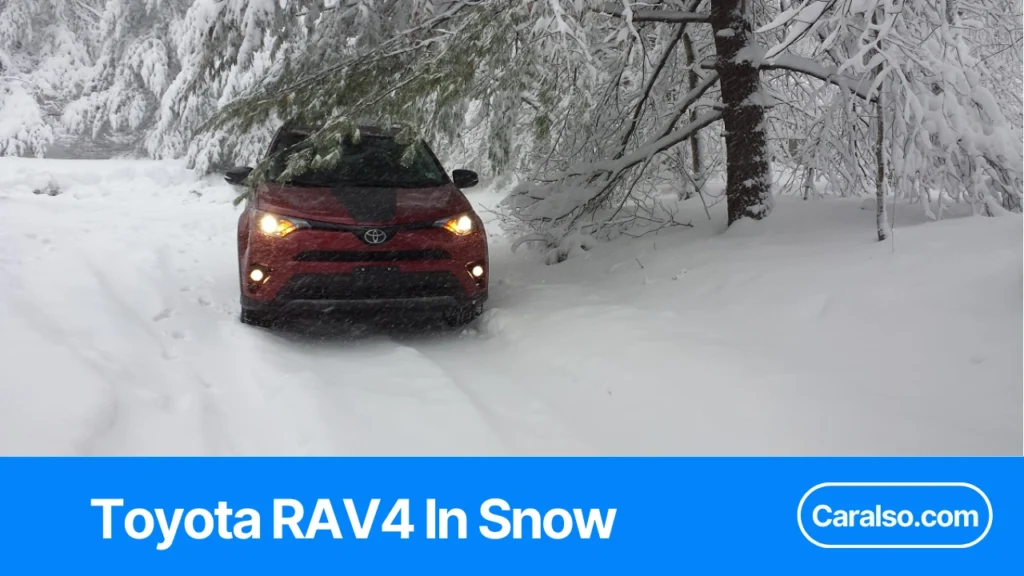
Toyota RAV4 In Snow
Quick Verdict: How is the RAV4 in the snow?
Yes, the RAV4 is good in snow when it has AWD and the right tires.
Best Setup For Plowed City Roads
- RAV4 AWD
- All-weather tires with the 3PMSF symbol, or true winter tires if you see ice often
Best Setup For Mountain Passes And Steep Hills
- RAV4 AWD
- Winter tires
- Carry cables if your area posts chain controls
Best Setup For Rural Roads And Unplowed Driveways
- RAV4 AWD
- Winter tires
- Carry cables and a shovel
One Data Point I Trust
- In a Tire Rack test cited by MotorTrend using two identical RAV4s, winter tires stopped in 34 ft on ice from 12 mph. All-season tires needed 57 ft. That is a 23 ft gap.
Snow Readiness Scorecard
| Your Conditions | Drivetrain Pick | Tire Pick | Carry Cables? | Best RAV4 Trim Type |
|---|---|---|---|---|
| Plowed Roads, Light Snow | AWD if you can | All-weather 3PMSF | Optional | Any AWD trim |
| Plowed Roads, регуляр Ice | AWD | Winter tires | Optional | Any AWD trim |
| Hills, Mountain Roads | AWD | Winter tires | Yes in chain zones | AWD trims with more traction features |
| Unplowed Roads, Deep Snow | AWD | Winter tires | Yes | AWD trims, prioritize ground clearance and traction aids |
Is The Toyota RAV4 Good In Snow?
The Short Answer
Yes, the Toyota RAV4 can be good in snow, especially with AWD. The real limiter is tires, because tires control braking and turning.
What The RAV4 Does Well In Winter
Gets Moving Without Drama
- AWD helps you pull away from a stop with less wheelspin.
- Traction control helps manage slip when one tire starts to spin.
Handles Moderate Snow Depth
- Many RAV4 trims sit around 8.4 inches of ground clearance.
- Some trims go up to about 8.6 inches.
- That is enough for fresh snow on most roads, as long as you are not pushing a plow berm.
Stays Predictable On Slippery Pavement
- Stability control and ABS work best when the tires can grip.
- With the right tires, the RAV4 feels calm in light to moderate conditions.
Where People Overestimate It
Stopping Distance
- AWD does not help you stop.
- Tires do.
- The RAV4 winter tire test is a good example: 34 ft vs 57 ft from 12 mph on ice.
Turning On Ice
- If your tires do not have bite, the front end will push wide.
- That is true even with AWD.
Deep Snow Berms
- Ground clearance matters, but snow piles fast.
- If snow packs under the chassis, you can get high-centered even with AWD.
What Matters Most For RAV4 Snow Performance (Ranked)
If you remember one thing, remember this. Tires decide what happens in snow. AWD just helps you get moving.
1. Tires First (With Proof)
I have seen this play out over and over.
In a test with two identical Toyota RAV4s, the RAV4 on winter tires stopped in 34 ft on ice from 12 mph.
The RAV4 on all-season tires needed 57 ft.
That is a 23 ft gap at 12 mph.
Here is another number I use when people say “I’m fine on all-seasons.”
In a Tire Rack test on a snow-packed road at 30 mph, the winter-tire car stopped in about 59 ft.
The all-season car took about 30 ft more.
That is why I start with tires before I talk about trims or drive modes.
What I Look For On The Sidewall
- 3PMSF (Three-Peak Mountain Snowflake). That symbol means the tire passed a standardized snow traction test.
- M+S is not the same thing. M+S is mostly a tread design label, not a severe snow performance badge.
When All-Weather Tires Make Sense
- All-weather tires can be a good middle ground if your winters bounce between 20 F and 45 F and roads are usually plowed.
- I still prefer true winter tires if you deal with ice, steep hills, or packed snow that sticks around for weeks.
2. AWD Second (But Only If You Understand Which AWD You Have)
AWD helps you start moving.
It also helps you climb a hill without spinning one front tire into smoke.
What AWD Does Well
- Better launches from a stop in slush.
- More confidence pulling into traffic on a snowy street.
- Less drama climbing a driveway when one side is slick.
What AWD Does Not Do
- It does not shorten your stopping distance.
- It does not fix a tire that cannot grip on ice.
If you want a safer RAV4 in snow, put money into tires first. Then add AWD.
3. Ground Clearance Third (And What Snow Depth Is Realistic)
Ground clearance is your snow depth limit.
It is not your traction limit. Tires and throttle control handle that.
On recent gas RAV4 trims, ground clearance is commonly:
- 8.4 in on LE and XLE
- 8.6 in on XLE Premium and Limited
That 0.2 in difference is not huge. But it can be the difference between scraping and floating in rutted snow.
My Real-World Rule
- Once snow gets close to your rocker panels, you are playing with high-centering.
- Plowed roads are usually fine.
- Unplowed roads with ruts are where clearance matters fast.
4. Driver Aids And Driving Style Fourth
The RAV4’s systems can help, but they cannot beat physics.
The Big Three
- ABS helps you keep steering control while braking.
- Traction control helps limit wheelspin.
- Stability control helps reduce a slide once it starts.
What I Do Behind The Wheel
- I roll into the throttle. No stabs.
- I leave more space. If I normally follow at 3 seconds, I aim for 6 seconds in snow.
- I brake earlier. Every time.
- I slow down before the turn, not in the turn.
RAV4 AWD Systems Explained (And Which One You Want For Snow)
Toyota uses a few different AWD setups on the RAV4 lineup. If you know which one you have, you can set expectations the right way.
The 3 RAV4 AWD Systems (Simple Definitions)
Dynamic Torque Control AWD (Gas Models)
- This is the “standard” AWD setup on many gas trims.
- It runs mainly as front-wheel drive until the system sees slip or extra demand.
- It can send up to 50% of engine torque to the rear when needed on certain versions.
- Some versions can disconnect the rear driveline for efficiency when AWD is not needed.
Dynamic Torque Vectoring AWD With Rear Driveline Disconnect (Gas Models, Higher Capability)
- This is the more capable gas AWD system.
- It can send torque rearward and also side-to-side across the rear wheels.
- It is the setup I want if you drive steep snowy roads and you want the best “keep moving” feel.
Electronic On-Demand AWD (Hybrid And Prime)
- This system uses a rear electric motor to drive the rear wheels when needed.
- There is no mechanical driveshaft from the engine to the rear.
- It can engage proactively on launch and in low-traction conditions.
- Hybrid and Prime models also use Trail Mode for extra low-speed traction control logic.
AWD System By Trim (Table)
This is how I think about it for recent North American RAV4s. Trim names and availability can change by model year, so I focus on the pattern.
| RAV4 Version | AWD Type | Snow Mode Or MTS | Best Use Case In Snow |
|---|---|---|---|
| Gas LE, XLE, XLE Premium (AWD Equipped) | Standard Gas AWD (Dynamic Torque Control Type) | Multi-Terrain Select With A Snow Setting | Plowed roads, commuting, light to moderate storms |
| Gas Adventure, TRD Off-Road (Common On 2019 To 2024) | Dynamic Torque Vectoring AWD With Rear Driveline Disconnect | Multi-Terrain Select With A Snow Setting | Steeper hills, deeper snow, unplowed driveways |
| Gas Limited AWD | Dynamic Torque Vectoring AWD With Rear Driveline Disconnect (common on newer years) | Multi-Terrain Select With A Snow Setting | Highway plus winter weather, good mix of comfort and traction |
| RAV4 Hybrid (All AWD Hybrids) | Electronic On-Demand AWD (rear electric motor) | Trail Mode (not MTS Snow mode) | Slippery city roads, mixed conditions, strong efficiency in winter commuting |
| RAV4 Prime (Plug-In Hybrid) | Electronic On-Demand AWD (rear electric motor) | Trail Mode | Low-traction starts, hill climbs, strong all-weather grip with the right tires |
My takeaway is simple.
If you want the best chance of keeping moving in messy snow, I want winter tires first. Then I want AWD. Then I care about which AWD system you have.
What Matters Most For RAV4 Snow Performance (Ranked)
When I set up a RAV4 for winter, I follow one rule.
Tires decide what happens.
AWD helps you get moving.
1. Tires First
If your tires cannot grip, nothing else matters.
What I Recommend Most Often
- Winter tires if you see ice, steep hills, or packed snow that sticks around
- All-weather tires with the 3PMSF symbol if your roads are plowed fast and temps bounce around
- All-season tires only if snow is rare and you drive slow on storm days
What I Check Before Winter
- Tread depth in 32nds
- I get nervous under 4/32 in snow season
- Tire pressure when temps drop
2. AWD Second
AWD helps you start moving.
It helps you climb.
It does not help you stop.
It does not help you turn on ice.
That is why I do tires first.
Then I care about AWD.
3. Ground Clearance Third
Ground clearance sets your snow depth limit.
Most recent RAV4 trims sit around 8.4 in to 8.6 in of ground clearance.
That is enough for most plowed roads and fresh snow.
It is not enough for deep, unplowed snow once ruts form.
That is when you get high-centered.
4. Driver Aids And Driving Style Fourth
The RAV4’s traction and stability systems can help.
But they work best when the tires can grip.
What I Do In Snow
- Smooth throttle
- Brake early
- Slow down before the turn
- More following distance than I think I need
RAV4 AWD Systems Explained (And Which One You Want For Snow)
Toyota uses a few AWD setups across the RAV4 lineup.
I like to explain them in plain terms.
One setup is “basic AWD.”
One setup is “more capable AWD.”
Hybrids and the plug-in use a rear electric motor.
The 3 RAV4 AWD Systems (Simple Definitions)
Dynamic Torque Control AWD (Common On Gas AWD Trims)
- Front wheels drive most of the time
- The system can send power to the rear when it detects slip
- This is the AWD I recommend for commuting and plowed roads
Dynamic Torque Vectoring AWD With Rear Driveline Disconnect (Higher Capability Gas AWD)
- Can send power to the rear and move it side-to-side across the rear wheels
- This is the AWD I want for hills, deeper snow, and messy conditions
Electronic On-Demand AWD (RAV4 Hybrid And RAV4 Plug-In Hybrid)
- Rear wheels are driven by a rear electric motor when needed
- No mechanical driveshaft from the engine to the rear
- This setup is very quick off the line on slippery pavement when paired with the right tires
AWD System By Trim (Quick Guide)
Trim names change by model year.
So I use this as a pattern guide.
| RAV4 Version | AWD Type | Best Snow Use Case |
|---|---|---|
| Gas AWD Trims (Mainstream) | Dynamic Torque Control AWD | Plowed roads, commuting, light to moderate storms |
| Gas Adventure Or TRD Off-Road Type Trims | Dynamic Torque Vectoring AWD | Hills, deeper snow, unplowed driveways |
| RAV4 Hybrid (AWD) | Electronic On-Demand AWD | Slippery city streets, mixed conditions, winter commuting |
| RAV4 Plug-In Hybrid (AWD) | Electronic On-Demand AWD | Slippery starts, hill climbs, all-weather grip with good tires |
My simple recommendation for snow
- If you live where storms hit hard, I want AWD plus winter tires.
- If you live where roads get plowed fast, AWD plus all-weather 3PMSF tires can be enough.
Snow Mode Vs Trail Mode (What To Use And When)
These modes help.
But they are not magic.
I use them like tools.
Right job, right setting.
Multi-Terrain Select Snow Setting (Gas AWD)
On many gas AWD RAV4s, Multi-Terrain Select has a Snow setting.
Here is what I expect it to do:
- Reduce wheelspin by managing throttle input
- Use brake control logic to help the tire with grip keep moving
- Make takeoffs smoother on slick surfaces
When I Use It
- Packed snow starts
- Slushy intersections
- Short hills where one side is slick
When I Do Not Use It
- Dry pavement
- High-speed highway driving
- Long drives where conditions are mostly normal
Trail Mode (Hybrid And Plug-In Hybrid)
On the Hybrid and the plug-in, Trail Mode is the traction helper I reach for when one wheel is slipping.
Here is what it is trying to do:
- Brake a spinning wheel
- Send torque to the wheel that still has grip
- Help you pull away without digging one tire into ice
When I Use It
- Getting unstuck
- Crawling up a slick incline at low speed
- Pulling out of a rutted spot
When I Do Not Use It
- Normal commuting on plowed roads
- Any time I want smooth, predictable behavior at speed
When To Leave It In Normal
Most winter driving is boring.
That is a good thing.
If roads are plowed and you are cruising, I leave it in Normal.
I focus on smooth inputs.
That usually beats mode switching.
How Much Snow Can A RAV4 Handle?
This is the question I get the most.
The answer comes down to ground clearance and snow type.
Powder is easier.
Wet snow and slush pack hard.
Ground Clearance By Trim (Quick Table)
Here is a simple way to think about it.
| Common RAV4 Trim Types | Ground Clearance |
|---|---|
| Many Mainstream Trims | 8.4 in |
| Some Higher Trims | 8.6 in |
That 0.2 in difference is small.
Tires and speed matter more.
What Actually Stops You (Not Just Clearance)
High-Centering
- Snow packs under the chassis
- The tires lose some weight and traction
- You stop moving even with AWD
Plow Berms
- The pile at the end of a driveway can be dense
- It can grab the bumper and drag the front end down
Ruts
- Ruts can be deeper than you expect
- Once the car bottoms out, you lose momentum
My Rule Of Thumb
- If snow is getting close to the bottom of the doors, I slow down and reassess.
- If you cannot see tire tracks ahead, you are guessing.
- That is when people get stuck.
If you want a safer “snow depth” limit, measure clearance first.
Then leave yourself a margin.
Snow is never uniform.
Best Tires For A Toyota RAV4 In Snow
If you want your RAV4 to feel planted in snow, tires are the upgrade that changes everything.
I start with two questions.
How often do you see ice?
How often do temps sit under 45 F?
Winter Vs All-Weather Vs All-Season (Who Should Buy What)
Winter Tires
I buy winter tires when:
- Temps are under 45 F for weeks at a time.
- I drive on ice, packed snow, or steep hills.
- I need predictable braking.
In one Tire Rack test, the winter-tire vehicle stopped in about 59 ft from 30 mph on packed snow.
The all-season vehicle needed about 30 ft more.
That is why I spend money on winter tires before I chase a “more off-road” trim.
All-Weather Tires (3PMSF)
I buy all-weather tires when:
- Roads get plowed fast.
- Snow is common, but ice is not constant.
- I want one tire year-round.
All-weather is the sweet spot for a lot of city drivers.
But it is still not a true winter tire on glare ice.
All-Season Tires
I stick with all-seasons when:
- Snow is rare.
- I can stay home on storm days.
- My roads are cleared fast and I drive slow.
If you go winter, I run 4 winter tires.
Not 2.
I want balanced grip for braking and turning.
Cost Reality Check
A set of 4 winter tires can run about $600 to $1,800+ depending on size and brand.
I plan on that range before I shop.
The 3PMSF Mark Explained
3PMSF means Three-Peak Mountain Snowflake.
It is the mountain-with-a-snowflake symbol on the sidewall.
It matters because it is performance-based.
A 3PMSF tire has passed a standardized snow traction test on medium-packed snow.
That is why I trust it more than an M+S stamp.
Quick decoding:
- 3PMSF: tested for severe snow traction
- M+S: tread category label, not a severe snow performance badge
If you live where chain control signs go up, 3PMSF tires can also help you meet some traction requirements.
Rules vary by state and pass.
I always check the local signs and DOT guidance.
Minimum Tread Depth And Tire Pressure Basics
Tread Depth
I measure tread depth in 32nds.
My winter rule:
- Begin shopping at 4/32.
- At 4/32, snow traction drops fast.
- At 2/32, the tire is basically done for winter work.
Quick DIY check:
- Use a tread gauge if you have one.
- Or do a coin test.
- Then verify with a gauge when you can.
Tire Pressure
Cold weather drops tire pressure.
A simple number I use:
- About 1 PSI drop for every 10 F drop in temperature.
What I do:
- Check pressures monthly in winter.
- Check when tires are cold.
- Inflate to the door-jamb spec, not the number on the tire sidewall.
If you see a TPMS light on the first cold morning, it is often pressure.
I add air, then recheck 24 hours later.
Do You Need Snow Chains Or Cables On A RAV4?
Sometimes, yes.
Even with AWD.
This depends on where you drive, local chain laws, and your exact RAV4 wheel and tire setup.
What Toyota Says (And Why The Owner’s Manual Wins)
Toyota’s general guidance is simple.
Install chains or cables on the drive wheels.
But here is the problem for AWD.
All four wheels can be drive wheels depending on the system.
That is why I treat the owner’s manual as the final word.
It can specify:
- Which axle gets chains
- Cable-only requirements
- Tire size restrictions
- Speed limits
If you drive mountain passes, you can also run into chain control signs that require you to carry traction devices.
AWD does not always exempt you.
Chain Clearance And “Class S” Considerations
Modern crossovers can have tight clearance inside the wheel well.
That is where “Class S” comes in.
Class S is a low-clearance standard for traction devices.
It is designed for vehicles that do not have much space around the tire.
What I choose when clearance is tight:
- Low-profile cables
- Low-profile chains that meet Class S
- Snow socks, if allowed where I travel
Why I care:
- A bulky chain can slap the wheel well.
- It can damage brake lines, ABS wiring, or suspension parts.
- It can also chew up the fender liner.
If you buy chains or cables, I test-fit them at home in daylight.
Not for the first time at 18 F on the shoulder.
My Simple Rule For Carrying Them (Even If You Rarely Use Them)
If you drive in these conditions, I carry traction devices:
- Mountain passes
- Chain control zones
- Rural roads that stay unplowed
- Long drives where weather can change fast
If you only drive plowed city roads, I usually skip chains.
I spend that money on better tires instead.
What I keep in my winter kit:
- Gloves
- Headlamp
- Kneeling pad or trash bag
- Small shovel
- A bag for wet chains
- A practice run completed once before the first storm
Driving Tips For A RAV4 In Snow
I treat snow driving like a traction budget.
Every big input spends traction.
Throttle. Brake. Steering.
If I keep inputs smooth, the RAV4 feels stable.
If I get impatient, it feels slippery fast.
Starting From A Stop
I do this every time:
- Straight wheels first. Then I roll into the throttle.
- If the tires spin, I back off. I do not stay in it.
- I leave traction control on for normal driving. It usually helps.
If you are stuck, that is a different situation.
I cover that below.
My stoplight rule:
- If I can start without spinning, I am going the right speed for the road.
Braking And Following Distance
I brake earlier than I think I need.
Every time.
A number I use:
- 5 to 6 seconds of following distance in winter conditions
If it is icy, I give even more space.
I care more about space than AWD.
My braking technique:
- Firm, steady brake pressure
- No stabbing
- I keep the wheels pointed where I want to go
If your RAV4 has ABS, you may feel pulsing.
That is normal.
I keep pressure on the pedal.
Hills And Descents
Hills are where people get in trouble.
Going Up
- I build a little momentum before the hill
- I keep throttle steady
- I avoid stopping mid-hill if I can
If I lose traction climbing:
- I ease off and try again with less throttle
- If I keep spinning, I stop and reassess
- Spinning polishes ice
Going Down
- I slow down before the hill
- I stay off the brakes as much as possible
- I use light brake pressure and keep it steady
If your RAV4 has a downhill assist feature, use it if you know how it works.
If you do not, keep it simple.
Slow speed. Big following distance. Smooth braking.
If You Get Stuck (What To Do In Order)
I follow this order.
It saves time and it saves tires.
- Stop Spinning The Tires
Spinning digs holes and turns snow into slick ice. - Clear Snow In Front Of The Tires
I clear 2 to 3 feet ahead of the front tires.
I also clear behind if I plan to back up. - Straighten The Wheels
Straight wheels roll easier than turned wheels. - Rock It Gently
Reverse a few feet. Then drive a few feet.
Small throttle. No wheelspin. - Add Grip
I use traction sand, kitty litter, or a traction mat.
Floor mats can work in a pinch.
I keep them flat so they do not shoot out. - Call It Early If You Are High-Centered
If the car is sitting on packed snow, tires can spin with no load.
That is tow-truck territory.
My winter kit basics:
- Shovel
- Gloves
- Headlamp
- Tow strap
- Traction sand or mats
Toyota RAV4 In Snow Vs Rivals (Quick Comparison)
I am going to keep this simple.
Tires decide the winner on snow and ice.
After tires, I look at two things:
- Ground clearance
- How the AWD system behaves at low speed
Quick Spec Snapshot That Matters In Snow
| SUV | AWD Availability | Ground Clearance | Traction Mode Feature |
|---|---|---|---|
| Toyota RAV4 | AWD available on gas, AWD standard on Hybrid | About 8.4 in to 8.6 in | Snow Mode on many gas AWD trims, Trail Mode on Hybrid and Plug-In |
| Honda CR-V | AWD available | 7.8 in (2WD) or 8.2 in (AWD) | Real Time AWD with Intelligent Control System |
| Subaru Forester | AWD standard | 8.7 in | Symmetrical AWD plus X-Mode |
RAV4 Vs CR-V In Snow (What Changes The Outcome)
On plowed roads with good tires, both can do well.
The difference usually shows up in two places.
- Ground Clearance
CR-V AWD ground clearance is listed at 8.2 in.
RAV4 is commonly listed around 8.4 in to 8.6 in.
That extra clearance helps in ruts and deeper slush. - Traction Help Modes
RAV4 has Snow Mode on many gas AWD trims.
Hybrid models use Trail Mode logic for low-speed traction control.
CR-V’s Real Time AWD is designed to send torque rearward proactively during acceleration and hill climbing.
That helps it feel composed in slick starts.
My take:
- If you drive mostly plowed roads, choose based on tires and comfort.
- If you deal with ruts and deeper snow, clearance starts to matter.
RAV4 Vs Forester (Clearance And AWD Philosophy)
Forester is the easy pick for two reasons:
- AWD is standard
- 8.7 in of ground clearance is a real advantage in rutted snow
Subaru also leans hard on X-Mode for slippery and steep conditions.
It is built to optimize throttle response and torque delivery when traction is limited.
RAV4 fights back with variety.
You can pick the AWD system that matches your needs.
You can also pick Hybrid AWD if you want winter traction plus strong fuel economy.
My take:
- Forester has the clearance advantage.
- RAV4 has more drivetrain and trim variety.
- With winter tires, either can be very capable.
FAQs
Is The RAV4 AWD Always On?
Not usually.
Most RAV4 AWD systems are on-demand.
Here is what I mean by that:
- In normal driving, it can run like a front-wheel-drive vehicle.
- When it senses slip, or you ask for more traction, it sends power to the rear.
- On Hybrid and Plug-In Hybrid models, the rear wheels are driven by a rear electric motor when extra traction is needed.
If you want the simplest winter rule, I use this.
Assume AWD helps you start and climb.
Do not assume it helps you stop.
Does The RAV4 Hybrid Have Snow Mode Or Trail Mode?
On many model years, the Hybrid uses Trail Mode.
That is the traction mode I use when one wheel is slipping at low speed.
On many gas AWD trims, you may see Snow Mode as part of Multi-Terrain Select.
That is more of a “slick road launch” helper.
My way to pick:
- Snow Mode for packed roads and slick intersections.
- Trail Mode for getting unstuck, ruts, and low-speed crawling.
Trim and model year can change what you get.
I always confirm your exact drive modes on the window sticker or the owner’s manual.
What Tires Are Best For A RAV4 In Snow?
I pick tires based on temperature and ice.
If You See Ice Or Packed Snow Often
- Winter tires.
If Roads Are Plowed Fast And Temps Bounce Around
- All-weather tires with the 3PMSF symbol.
If Snow Is Rare
- All-season tires can work, but I drive slower and avoid storms.
Two quick rules I use:
- I start shopping for winter traction at 4/32 tread depth.
- I check tire pressure when temps drop. Cold air lowers PSI.
How Much Snow Can A RAV4 Drive Through?
I use ground clearance as my limit.
Many RAV4 trims sit around 8.4 in to 8.6 in of clearance.
Real-world, I care more about what is under the car than what is under the tires.
Deep snow can pack under the chassis and high-center you.
My practical rule:
- If snow is getting close to the bottom of the doors, I slow down and reassess.
- If you cannot see tire tracks ahead, you are guessing.
- Plow berms at the end of driveways can stop you fast, even with AWD.
Do I Need Chains On A RAV4 AWD?
Sometimes, yes.
It depends on where you drive.
I carry cables if:
- I drive mountain passes.
- My area posts chain controls.
- I travel where weather can change fast.
My chain rule:
- The owner’s manual is the final word on where to install them.
- Clearance matters. I prefer low-profile cables for crossovers.
- I test-fit at home once before the first storm.
Key Takeaways
- I treat tires as the main upgrade for snow. AWD is second.
- AWD helps you start and climb. It does not shorten braking distance.
- Snow Mode and Trail Mode can help, but smooth driving matters more.
- Ground clearance is usually the limiter in deeper snow and ruts.
- If you drive passes or chain zones, I carry cables and a basic winter kit.
Sources
- MotorTrend, Are Snow And Winter Tires Worth It?
- Tire Rack, Tire Test Results: All Season Vs. Winter (Passenger Vehicle) (Stopping Distance Data)
- Toyota, 2025 RAV4 Features And Specs (Multi-Terrain Select With Snow Mode Listed)
- MotorTrend, Hooning The 2020 Toyota RAV4 TRD Off-Road And Hybrid In Snow (AWD System Details)
- Subaru, 2025 Forester Features (Standard AWD, 8.7 In Ground Clearance)
- Les Schwab, Tire Chains Buying Guide (Class S And Manual-First Guidance)

Hey there,
How is it going?
I’m Meraj Sarker. I am a Car Mechanic and a student of Automobile Restoration here in Florida, USA. I’ve been studying automotive for around 9 years now. So you can rely on my recommendation. For me, studying and getting knowledge about automobile it’s really fun and entertaining. I will help you to get solutions for your car through this website. If you need any help let me know.