
When the engine light comes on in a RAV4, most people jump straight to worst case scenarios. I do not. I treat it as a message from the engine computer. The light tells me there is a stored fault. My job is to figure out how serious it is and what to do next.
On a RAV4, that fault can be something small like a loose gas cap or something serious like an active misfire. The difference is not guesswork. The way the light behaves and how the car feels tell you a lot in the first minute.
In this guide I will give you three things. What the RAV4 engine light actually means. How to tell if your situation is low, medium, or high risk. And a simple set of next steps, including DIY checks and realistic cost ranges for the common fixes.
Quick Answer – What Does The Engine Light Mean On A Toyota RAV4?
On any modern RAV4, the engine light is the malfunction indicator light for the engine computer. It turns on when the computer stores a fault code for the engine, fuel, ignition, or emissions system. A solid engine light usually points to an emissions or performance issue that needs attention soon. A flashing engine light almost always means an active misfire that can damage the catalytic converter if you keep driving.
If the light is solid and the RAV4 still drives normally, you can usually drive locally while you plan a scan and a repair. If the light is flashing or the engine feels rough or weak, you treat it as urgent, avoid driving, and set up a proper diagnosis or a tow.
Light Status, Symptoms, Risk And What To Do
Use this table as a quick filter before you decide what to do with your RAV4.
| Engine Light Status / Symptoms | Likely Problem Type | Risk Level | What To Do Next |
|---|---|---|---|
| Solid engine light. RAV4 runs normally. No new noises or loss of power. | EVAP leak. Loose gas cap. Oxygen sensor. Mild emissions issue. | Low to Medium | Check gas cap and tighten it. Look for obvious issues under hood. Schedule a code scan in a few days. |
| Solid engine light. Rough idle or hesitation. Worse fuel economy. | Oxygen or air fuel sensor. Dirty or failing MAF. Early ignition wear. Small misfire. | Medium | Avoid long trips and heavy loads. Get the codes read soon. Plan repair based on the actual fault. |
| Flashing engine light. Shaking or misfire you can feel. Power feels down. | Active misfire. Unburned fuel reaching catalytic converter. | High | Stop driving as soon as it is safe. Arrange a tow to a shop. Ask for urgent misfire diagnosis. |
| Engine light on with VSC / 4WD / TRAC lights also on. RAV4 drives smoothly. | Engine or emissions fault that makes stability and AWD back off. | Medium | Drive only short local trips. Book a scan soon. If any roughness starts, stop and tow instead. |
| Engine light on with VSC / 4WD / TRAC lights. Rough or low power. | Engine fault plus reduced stability or AWD function. | Medium to High | Do not keep driving. Park it and tow to a shop. Have engine and ABS systems scanned together. |
| Engine light on RAV4 Hybrid or Prime with extra hybrid warning messages. | Engine side fault plus possible hybrid system concern. | Medium to High | Treat as a high priority. Avoid long trips. Have a Toyota literate or hybrid specialist scan it. |
From here the next step is always the same. Read the code, match it to the likely cause, and then decide whether it is a cheap fix you can plan for or a high risk issue that needs immediate attention.
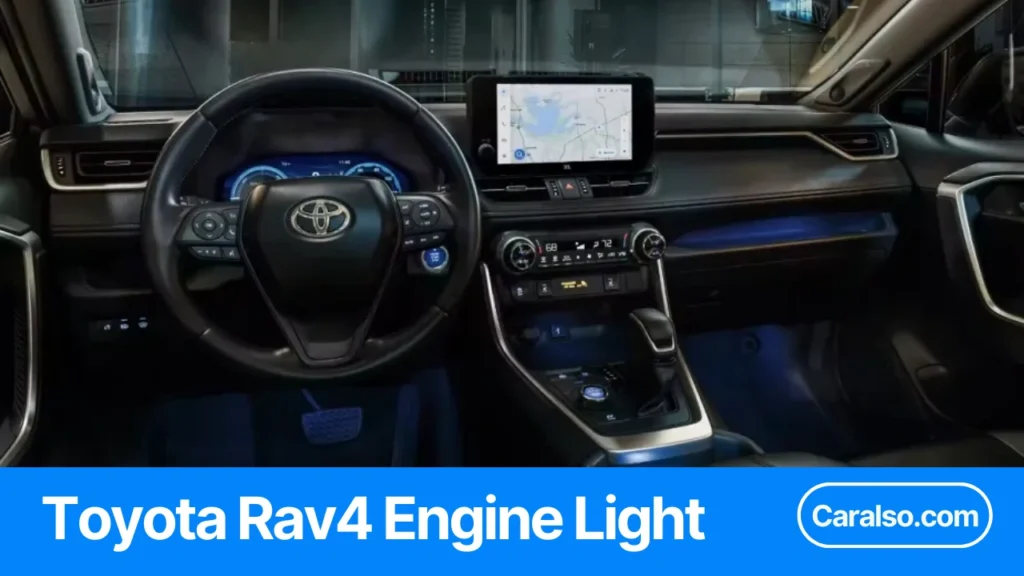
Toyota RAV4 Engine Light
What The Engine Light Actually Means On A RAV4
When that little engine icon lights up on a RAV4, the car is not guessing. The engine control module has seen something outside its normal range and has stored at least one fault code. That code lives in the OBD system. The light is your only visible clue until you plug in a scanner.
Malfunction Indicator Light (MIL) Basics
Every modern RAV4 uses OBD-II. The engine control module watches sensors and actuators in real time. When a reading is clearly wrong, or a test fails twice, it saves a diagnostic trouble code and turns the malfunction indicator light on.
On a RAV4 that light can appear three ways.
- As the words “Check Engine”.
- As a simple outline of an engine.
- As a combination of the two.
The light by itself cannot tell you which part failed. A loose gas cap and a failing catalytic converter both light the same icon. That is why reading the code is so important. The code is the detailed message. The light is only the envelope.
Solid Vs Flashing Engine Light On RAV4
RAV4 dealers and Toyota service bulletins say the same thing. Solid and flashing mean different risk levels.
- Solid engine light
- The computer sees a fault. Often emissions related.
- Common causes are EVAP leaks, O2 sensors, MAF issues, and some ignition problems.
- You still need to fix it, but you usually have time to plan.
- Flashing engine light
- The computer sees an active misfire that can damage the catalytic converter fast.
- Unburned fuel is hitting the cat and superheating it.
- Dealers are very clear here. If the light is flashing, you stop driving as soon as it is safe and arrange a tow.
So my rule is simple. Solid light plus smooth running means “diagnose soon.” Flashing light plus rough running means “park it now.”
Engine Light Vs Maintenance Required Vs Engine Maintenance Required
Toyota did us no favors with similar phrases here. There are three different things.
- Check Engine Light
- This is the real malfunction indicator.
- It means the ECM has stored a fault code.
- It always needs diagnosis, even if the RAV4 feels normal.
- Maintenance Required
- This is a mileage timer.
- It counts miles since the last reset and comes on around service intervals, usually oil changes.
- It does not mean a failure. It means “time for scheduled service.”
- Engine Maintenance Required
- This one trips a lot of newer RAV4 owners.
- On recent models it is a special message for specific engine related faults, not a simple oil reminder.
- Owners and techs have traced it very often to coolant bypass valve failures on 2019+ RAV4. There is now a Toyota bulletin and a customer support program around that valve.
If you see “Maintenance Required” with no engine icon, you are likely looking at routine service. If you see “Engine Maintenance Required” in the multi info display, you treat it like a real fault and scan it. If you see the engine symbol or “Check Engine”, you are definitely in fault code territory.
Here is how I explain it to friends in one shot.
- Maintenance Required = mileage reminder.
- Engine Maintenance Required = special engine fault on newer RAV4.
- Check Engine icon = stored fault code, all years.
Most Common Toyota RAV4 Engine Light Causes
There are hundreds of codes in the book. In real RAV4 life I keep seeing the same groups of problems. If someone texts me a picture of their engine light, odds are high it is one of these.
Loose Gas Cap And EVAP System Leaks
This is the first thing I check. Dealers keep putting it at the top of their own lists for a reason. A loose or cracked gas cap lets fuel vapors escape and breaks the sealed EVAP system. The computer runs a pressure test, sees a leak, and sets an EVAP code. That lights the engine icon.
The fix can be as simple as tightening the cap until it clicks 3 times. If the rubber seal is hard or split, I replace the cap. Then I either clear the code or drive 20 to 40 miles and let the system retest. If the light comes back with the same EVAP code, the leak is somewhere else in the lines, valves, or canister.
Oxygen Sensor And Air Fuel Ratio Sensor Problems
Oxygen sensors and air fuel ratio sensors sit in hot exhaust gas all day. They age. On dealer RAV4 check engine pages, O2 sensors are always near the top of the “common causes” list.
When they drift or fail, the mixture control goes off. You might see:
- Worse fuel economy.
- Occasional roughness.
- A sulfur smell from the exhaust.
- Codes for sensor circuits or catalyst efficiency.
Left alone, bad O2 or A/F sensors can help destroy a catalytic converter. So I do not treat them as optional. The fix is usually a new sensor with the correct part number and fresh gaskets.
Dirty Or Faulty Mass Airflow Sensor (MAF)
The MAF measures how much air the engine is pulling in. If it gets dirty or coated in oil, or if it fails electrically, the computer can no longer meter fuel correctly. Toyota dealer articles call out MAF faults as one of the five main reasons a check engine light comes on.
Typical signs:
- Hesitation when you accelerate.
- Surging at light throttle.
- Lean or rich mixture codes.
On a RAV4 I start with basics. Clean air filter. Tight intake hose. If everything is in place, I may remove the MAF and clean it with MAF specific cleaner, never with brake cleaner. If the sensor body is cracked or the readings stay bad, then it is time for a replacement.
Ignition Misfires (Spark Plugs And Coils)
Misfires are the classic reason an engine light switches from solid to flashing. RAV4 dealer sites are blunt about this. A flashing light usually means a severe misfire that is dumping raw fuel into the exhaust and can overheat the catalytic converter in minutes.
Misfires often feel like:
- Shaking at idle.
- Stuttering under load.
- A clear loss of power.
On older RAV4s, worn spark plugs and tired ignition coils are common. On newer ones, a bad coil on one cylinder can still show up well before plug wear. I always treat misfire codes as urgent. Fixing them early is a few hundred dollars. Ignoring them can turn into a four figure catalytic converter job.
Catalytic Converter And Emissions Control Issues
If you ignore upstream problems long enough, the cat pays the price. A converter that runs too hot or gets loaded with soot and ash will eventually lose efficiency. Many Toyota and dealer guides mention a bad catalytic converter as a major check engine cause once the vehicle has enough years and miles on it.
Typical signs are:
- P0420 type codes.
- Poor performance on hills.
- Increased fuel use.
- Sometimes a rotten egg smell.
Here is how I think about it. If a RAV4 has a converter code plus older plugs, tired O2 sensors, or a history of misfires, I fix those other issues first. Then I clear the codes and see if the cat code returns. If it does, and live data shows the cat really is weak, then I talk about replacement.
Fuel Injection, Head Gasket And More Serious Engine Faults
These are less common, but they sit in the background of every engine light conversation. Dealer content lists fuel injection faults and head gasket issues as possible, but not frequent, check engine causes on RAV4.
The clues here are stronger.
- Hard starting, rough running all the time.
- Coolant loss with white smoke from the exhaust.
- Oil that looks milky.
- Persistent overheating.
If I see engine light plus any of those, I stop thinking about “cheap cap and sensor” territory. I tell people to park the car and let a good shop run proper compression, leak down, and cooling system tests before they drive another mile.
Battery, Charging And Low Voltage Issues
Low voltage can make modern electronics act strange. Some Toyota and dealer warning light guides point out that a weak battery, bad alternator, or poor ground can light multiple warning icons at once, including the engine light.
If the engine light appeared right after:
- A battery change.
- A slow crank event.
- Jump starting.
Then I check voltage first. Resting battery should be around 12.4 to 12.7 volts. Running voltage should be around 13.5 to 14.5 volts. Loose or corroded terminals are easy to spot. Once I fix any obvious electrical issue, I clear the codes once and see what comes back. If the same code returns with healthy voltage, then the underlying problem is real, not just a side effect of low power.
RAV4 Hybrid And Prime – Engine Light Vs Hybrid System Warnings
On RAV4 Hybrid and RAV4 Prime, the engine side still has a normal check engine light. It comes on for the same reasons as a gas model. EVAP leaks. O2 sensors. MAF issues. Misfires.
What you also have are separate hybrid warnings. Things like “Check hybrid system” or battery symbols. Those belong to the high voltage side. If I see an engine light only, I treat it like a gas RAV4 and work through the normal code list. If I see engine light plus hybrid system messages, I bump the urgency up a notch and prefer a dealer or hybrid specialist for the scan and repair.
The main idea is simple. Most RAV4 engine lights come from a small group of familiar causes. Gas cap, sensors, ignition, cat, or electrical basics. If you know those patterns and combine them with how the car feels, you can move from blind panic to a clear plan in a few minutes.
RAV4 Generation Differences (Quick Overview)
I do not treat every RAV4 engine light the same. The basic logic is the same across years, but the failure patterns are not. Here is how I think about it by generation.
2001-2005 RAV4
These early RAV4s use simpler electronics and older engines. When the engine light comes on, it is usually for classic reasons. Fuel, spark, air, or basic emissions parts.
Oxygen sensors, catalytic converters, EVAP leaks, and ignition parts are the usual players once these trucks have 15 to 20 years behind them. The stability and traction systems are simpler too, so you see fewer stories about long chains of lights stacking up from one small issue.
If I am dealing with a 2001-2005 and the engine light is on, my first thought is traditional engine diagnostics. Compression, ignition, fuel, and emissions basics. Not software campaigns or complex message centers.
2006-2012 RAV4
This is the sweet spot for the engine light plus VSC plus 4WD combo. Owner forums for this generation are full of cases where one engine side fault lights up half the dash. Gas cap and EVAP codes. Oxygen sensors. MAF issues. EGR flow codes. Wheel speed sensors. All of these show up over and over.
The reason is simple. Stability control and on demand AWD are now tightly linked to the engine and ABS computers. If the engine module logs a fault, it often shuts off some traction and AWD functions and warns you with extra lights.
On these trucks I go straight to code reading and then match what I see against those common patterns. It is rarely a mystery once you have the codes. It is very often a sensor, a leak, or a basic ignition or intake issue that got bad enough to trigger the light.
2013-2018 RAV4
On 2013-2018 models the pattern shifts a bit. You still see the classic engine light causes. EVAP leaks. O2 sensors. MAF readings. Ignition parts that have simply aged out. But another theme joins the party. Electrical health.
These years sit inside a battery terminal and hold down class action and related recall story. The settlement describes defective battery terminals that can corrode, overheat, and even lead to stalling or fire risk on some vehicles. That tells me one thing clearly. A healthy 12 volt system matters a lot on these RAV4s.
So if a 2013-2018 owner has an engine light plus odd electrical behavior, I do not skip the basics. I test the battery, inspect the terminals and hold down, and make sure there are no obvious signs of overheating or corrosion before I chase deeper engine codes. Fixing marginal power supply problems early can prevent a stack of random codes and bigger headaches later.
2019 And Newer RAV4, RAV4 Hybrid And Prime
From 2019 onward, the RAV4 gets more digital. Bigger screens. More messages. More software and firmware in the mix. The core engine light still works like before. The computer stores a code and lights the icon. But you now have extra messages and campaigns to keep in mind.
One of the big new players is the “Engine Maintenance Required” message. Owners and techs have pinned that phrase very often to a failed or leaking coolant bypass valve on 2019 and newer RAV4. Toyota now has a customer support program and a bulletin that walks dealers through confirming the condition and replacing the valve.
You also see more software updates and recalls around digital instrument clusters and warning displays on newer Toyota models. A display that goes blank can hide the engine light and other warnings, which is why Toyota has recalled some vehicles to fix that.
On 2019 plus gas, Hybrid, and Prime models, my playbook is always the same.
- Take any “Engine Maintenance Required” message seriously.
- Treat the engine light as a real fault, even if the car feels fine.
- Make sure the dealer checks for open recalls, software campaigns, and coolant bypass valve coverage by VIN.
The hardware is newer. The logic is the same. If you read the codes and know these patterns, you are ahead of most owners already.
DIY Checks Before You Spend Money
Before I tell anyone to book a dealer visit, I walk them through a few simple checks. These do not replace proper diagnostics. They do catch a lot of easy problems and help you talk to a shop with better information.
Step 1 – Read The Message And Icon Correctly
First, make sure you know what you are looking at.
- Is it a check engine icon or “Check Engine” text.
- Is it a “Maintenance Required” reminder in the corner of the dash.
- Is it an “Engine Maintenance Required” message in the middle display on a newer RAV4.
If it is just Maintenance Required with no engine icon, you are in normal service reminder territory. If you see an engine symbol or Engine Maintenance Required, you are in fault code territory and you move to the next steps.
Step 2 – Gas Cap And Easy External Checks
Next I do a 60 second walk around.
Open the fuel door. Remove the gas cap. Inspect the rubber seal. If it is hard, cracked, or missing chunks, plan on a new cap. Reinstall it and tighten until you feel at least three solid clicks. A loose cap is one of the most common, cheapest reasons for a RAV4 engine light.
While you are outside the car, use your nose. Smell for raw fuel around the back of the vehicle and under the hood. Look under the car for obvious fluid puddles. Glance at the tailpipe while the engine runs. Heavy white smoke, thick blue smoke, or constant black soot are all strong signs that this is not a simple gas cap problem.
Step 3 – Under The Hood
Then I look under the hood for simple air and power issues.
- Air filter and intake hose
- Pop the air box clips and check the filter. If it is filthy, it is time to replace it.
- Check the large rubber intake hose between the air box and throttle body. It should be fully seated and clamped at both ends. No splits or holes.
- MAF connector and nearby wiring
- Find the mass airflow sensor in the intake tube. Make sure its plug is fully clicked in and that the wiring is not rubbed through or hanging loose.
- Look at any visible oxygen sensor connectors near the exhaust manifold. Again you are checking for loose or obviously damaged wiring.
- 12 volt battery and terminals
- Check the age sticker if you can see it. A battery older than 5 or 6 years is on borrowed time.
- Look for corrosion on the terminals. Green or white fuzzy buildup is a clue that you need a clean and possibly new hardware.
- Make sure the terminals and hold down bracket are tight.
None of this requires special tools. You are looking for “this is clearly wrong” type issues that you can fix or at least describe clearly to a shop.
Step 4 – Scan For Codes, Do Not Guess
At this point, I stop guessing. I scan the car.
You do not need dealer gear for this. A basic OBD2 reader and a phone app can read codes on any RAV4 built in the last two decades. Many parts stores will also pull codes for free. The important part is writing them down before anyone clears them.
I like to note:
- The exact code numbers. For example P0440, P0138, P0301.
- Whether they are current or stored history.
- Any short description the scanner gives.
That list is your map. It tells you whether you are chasing an EVAP leak, an oxygen sensor, a misfire, or something deeper. It also lets a shop skip straight to useful tests instead of starting from zero.
Step 5 – Decide If You Can Drive Or Should Tow
Once I have the DIY checks and the code list, I make one safety call. Can this RAV4 drive to the shop, or does it need a tow.
I ask myself four questions.
- Is the engine light solid or flashing.
- Does the engine feel smooth or rough.
- Is there a clear loss of power.
- Are there any extra warning lights for coolant, brakes, ABS, or hybrid system.
If the light is solid, the engine feels normal, and there are no extra warnings, I am usually fine with short local driving to a shop or parts store. I still avoid long highway runs and steep mountain routes until I know more.
If the light is flashing, the engine shakes, power is down, or there are other serious warnings, I stop there. I do not send that RAV4 back into traffic. I call a tow and let someone with proper tools take over.
Those five steps cost almost nothing. They can uncover cheap fixes, give you useful data, and protect you from making a bad call on whether it is safe to keep driving. After that, the next move is a proper diagnosis and a plan based on the codes and the generation of RAV4 you have.
Is It Safe To Drive With The Engine Light On In A RAV4?
When someone calls me with this question, I do not start with the light. I start with how the RAV4 feels. The light tells me there is a stored fault. The way the engine runs tells me how much risk there is.
I split it into two buckets in my head. Situations where short trips are usually ok, and situations where I want the car parked and towed.
When It Is Usually Safe For Short Trips
I am comfortable with short local drives if all of these are true at the same time.
- The engine light is solid. It is not flashing.
- The RAV4 idles smoothly. No shaking.
- Power feels normal. It accelerates like it did last week.
- There are no new mechanical noises. No knocking or clattering.
- There are no extra red warnings for temperature, oil pressure, or brakes.
If that matches your RAV4, I treat the light as “needs attention soon” instead of “park it now.” Here is how I handle it.
- Keep trips short. Think 5 to 10 mile errands, not 200 mile highway runs.
- Avoid towing, heavy loads, and long high speed climbs.
- Get the codes read within a day or two. Not “sometime next month.”
In that window you can usually drive to a parts store or your usual shop without drama. The goal is to catch a small EVAP, O2, or MAF issue before it grows into something more expensive.
When You Should Not Drive
If any of these show up, I move the RAV4 into the “do not drive” column.
- The engine light is flashing.
- The engine shakes at idle or under load.
- Power is clearly down. The car struggles to keep up with traffic.
- You hear new ticking, knocking, or metallic noises.
- The temperature gauge climbs higher than normal.
- A red oil, temperature, or brake warning appears.
A flashing engine light with a misfire is the big one. That means unburned fuel is going straight into the catalytic converter. The converter can overheat and melt internally. That takes you from a few hundred dollars in ignition parts to a four figure exhaust repair.
If I see that pattern on a RAV4, I do not tell anyone to “see if it clears.” I tell them to park it somewhere safe and call for a tow. A tow bill is cheaper than a converter and much cheaper than an engine.
How Long You Can Ignore It Before Costs Spike
I think in weeks, not months.
A solid engine light on a smooth running RAV4 is not pure emergency, but it is not a decoration either. A mild O2 sensor or EVAP problem today can turn into a worn converter or a failed inspection later if you ignore it.
Here is the simple timing rule I use.
- If the RAV4 drives normally and the light is solid, I want codes read within 2 to 3 days.
- If the codes point to emissions only faults and the car still drives well, I want repairs done within a few weeks at most.
- If the light is flashing or the engine feels wrong, I want it off the road right now and into a proper diagnostic bay.
The more miles you stack on with a lit engine light, the more unknowns you add. You risk extra wear, extra heat, and failures downstream that cost more than the original repair. Catch things early and most RAV4 engine light fixes land in the low hundreds, not the thousands.
How To Read And Reset A Toyota RAV4 Engine Light
Resetting the engine light is the easy part. The important part is reading what the computer is trying to tell you before you clear anything. I always treat the reset as the last step, not the first.
Reading Codes With OBD2
You do not need dealer gear to talk to a RAV4. Any OBD2 scanner will do.
Here is the basic process I walk people through.
- Find the OBD port.
- It sits under the dash near the steering column on most RAV4s.
- Turn the ignition on.
- On push button cars, press start without your foot on the brake.
- You want the dash lit up, but the engine can stay off for a quick read.
- Plug in the scanner and let it connect.
- Follow the app or tool prompts.
- Read all stored codes.
- Focus on “Powertrain” or “P” codes for the engine.
- Some tools will also read ABS and other modules, which is a bonus.
- Write down exactly what you see.
- Example: P0440, P0138, P0302.
- Save any descriptions or freeze frame data if the tool shows them.
Generic codes start with P0. Manufacturer specific ones often start with P1. Both matter. They point to systems, not always single parts, but they give you a clear starting point.
Why Clearing Codes Without Fixing The Problem Is Risky
I never clear codes before I have read and saved them. There are a few reasons.
- You erase the history. The code list is your map. Without it, your mechanic has to wait for the fault to happen again.
- You can hide intermittent issues. A problem that appears once a week is much harder to catch after you wipe the record.
- You can reset emissions readiness monitors. That can cause a test station to reject your RAV4 even if everything is working fine that day.
There is also a human trap here. If you clear the light and it stays off for a few days, it is very tempting to forget about it. If the underlying fault is still there, it will come back. Sometimes it comes back as a bigger, more expensive version of the first problem.
So my rule is this. Codes first. Fix second. Clear third. In that order.
Clearing Codes After Repair
Once you have fixed the cause, then it is time to clear the light and see if the repair holds.
With a scanner, the steps are simple.
- Plug the scanner back in.
- Turn the ignition on.
- Use the “erase” or “clear DTC” function in the app or on the tool.
- Confirm that the engine light turns off on the dash.
After that, I always do a few normal drives. Mix city and short highway stretches. If the light stays off for several trips and no new codes appear, I call that a successful repair. If the same code returns, something is still wrong. Either the part was not the real cause, or there is a related issue that also needs attention.
Some minor issues will clear themselves once the computer sees enough “good” drive cycles. A loose gas cap that has been tightened properly is a good example. The system runs its leak test again. If it passes a few times in a row, the light can turn off without you touching a scanner. But I still prefer to read and clear codes with a tool so I know what actually happened.
Battery Disconnect Reset – Pros And Cons
Pulling the battery cable is the old school way to clear an engine light. I almost never use it as the first choice on a RAV4.
The good part is simple.
- Disconnect the negative terminal.
- Wait a few minutes.
- Reconnect it.
Most of the time the engine light will be off when you restart. The problem is that you just wiped more than the codes. You also wiped radio presets, clock settings, and some learned fuel and idle values. The car may idle differently for a short time while it relearns.
More important, you erased all the diagnostic data the computer had stored. If the fault was intermittent, a technician now has no history to look at. They have to start from zero, which can cost you more time and labor.
There are only two times I consider a battery disconnect on a RAV4.
- After a repair, when I do not have a scanner handy but I want to clear old adaptations and see how the engine behaves fresh.
- After I have already read and saved the codes from a one time low voltage event and have fixed the battery or terminal problem.
Even then, a small OBD2 scanner is a better investment. It lets you clear the light without nuking everything else and keeps you in control of what the car is trying to tell you.
Typical RAV4 Engine Light Repair Costs (By Cause)
I like to give people ballpark numbers before they walk into a shop. It makes the engine light feel less mysterious. These ranges are based on national averages and typical parts prices for the RAV4. Actual quotes will move around with labor rates, model year, and where you live.
Cost Table – Cause Vs Typical Range
These are rough United States independent shop ranges, not dealer quotes. DIY costs are parts only.
| Cause Category | Typical Repair (Parts + Labor) | DIY Difficulty | Approx Independent Shop Cost (USD) |
|---|---|---|---|
| Gas cap / small EVAP leak | New gas cap, clear EVAP code, basic smoke test if needed | Very easy | $50 to $150 |
| O2 / A/F sensor replacement | Replace failed oxygen or air fuel ratio sensor | Medium | $250 to $550 per sensor |
| MAF cleaning / replacement | Clean MAF and intake, or replace MAF sensor if readings are bad | Easy to medium | $200 to $400 |
| Spark plugs and coil for one cylinder | New plug and coil on misfiring cylinder, clear misfire codes | Medium | $250 to $500 |
| Catalytic converter replacement | Replace failing converter, new gaskets and hardware | Hard | $900 to $1,500+ |
| Battery replacement + charging check | New 12 volt battery, test alternator and grounds | Easy to medium | $200 to $400 |
A few quick notes behind those numbers. Genuine and name brand gas caps usually land between 15 and 35 dollars at parts counters, which lines up with total bills in the 50 to 150 dollar range once labor and diagnostics are added.
Oxygen sensor jobs for the RAV4 commonly fall in the mid 200s to low 500s once you add labor, with some estimates sitting around 228 dollars on the low side and around 500 dollars on the high side.
Mass airflow sensor replacement sits in a similar band. Many RAV4 estimates run roughly 270 to 376 dollars for the full job. A careful cleaning and inspection can sometimes avoid replacement if the sensor itself is still healthy.
Ignition repairs depend on how many cylinders are involved. A single coil on a RAV4 often lands in the high 200s to upper 300s. A full spark plug service by a dealer can push into the 400 to 600 dollar zone, which matches real owner reports.
Catalytic converters are the big ticket item. Converter parts alone for a RAV4 can range from the low hundreds for universal units to well over 1,000 dollars for direct fit and OEM pieces. Total repair averages around 970 to just over 1,000 dollars in typical estimates, with 1,500 dollars or more possible in some markets.
For the standard 12 volt battery, most RAV4 sized units sit roughly between 100 and 300 dollars at retail. Many dealer and service guides quote full installed costs for traditional RAV4 batteries in the 200 to 300 dollar range, which matches what I see on invoices. Hybrid traction battery numbers are much higher and are a different conversation.
I always remind people. These are guides, not quotes. A solid written estimate from a local shop that has read your codes and looked at your RAV4 will always beat any table on the internet.
FAQs
What Is The Most Common Reason For A Toyota RAV4 Engine Light?
In real life, I see two things again and again. A loose or worn gas cap that triggers an EVAP leak code. And oxygen sensor faults on higher mileage RAV4s. Multiple dealer check engine pages list loose gas caps, EVAP leaks, and O2 sensor issues as the most frequent triggers on recent RAV4 models.
So when someone texts me a photo of a solid engine light and says the RAV4 still drives fine, I check the gas cap first and then expect to see EVAP or O2 codes when we plug in a scanner.
Why Is My RAV4 Engine Light On But The Car Runs Fine?
If the RAV4 feels completely normal, you are probably dealing with an emissions side fault instead of a hard mechanical failure. Things like EVAP leaks, oxygen sensors, and mass airflow problems often show up as solid engine lights on otherwise smooth running RAV4s. Dealer guides describe this exact pattern where the car “drives fine” with EVAP, O2, and fuel trim codes stored in the background.
It still needs a scan and a fix. You just have a little more time to plan compared to a flashing light and a misfire.
Can A Loose Gas Cap Cause The Engine Light On My RAV4?
Yes. It is one of the most common reasons for a RAV4 engine light. Toyota dealers and hybrid guides repeatedly call out loose or damaged gas caps as a frequent trigger. The EVAP system checks that the fuel tank holds pressure. If the cap leaks, the test fails, the computer stores an EVAP code, and the engine light turns on.
If the light came on right after a fill up, I always check that the cap is present, tight, and not cracked. If it was loose and you fix it, the light may go out on its own after a few successful drive cycles, or you can clear the code with a scanner once you are sure there are no other leaks.
What Does “Engine Maintenance Required” Mean On A RAV4?
This is not the same as the normal “Maintenance Required” oil reminder. On newer RAV4 models, “Engine Maintenance Required” is a special message that shows up for certain engine related faults. Owners and techs have tied it very often to coolant bypass valve failures on 2019 and newer RAV4, and Toyota has issued a bulletin and customer support program around that part.
So if you see “Engine Maintenance Required,” you treat it like a real fault. You scan the car, check coverage by VIN with a dealer, and do not assume it is just a mileage reminder.
How Do I Turn Off The Check Engine Light On A RAV4?
The correct way is boring but safe. You read the codes, fix the cause, and then clear the light with an OBD2 scanner. If the repair is solid, the light stays off through several normal drives. If the same code comes back, there is still a problem. Toyota and dealer guides warn against simply erasing codes without fixing the root cause, because it can hide issues and reset emissions readiness before an inspection.
Some minor faults, like a gas cap that was loose and is now tightened, can self clear after the computer sees a few clean test cycles. I still prefer to confirm with a scanner so I know exactly what happened.
Does The RAV4 Engine Light Mean The Same Thing On A Hybrid Or Prime?
The engine light itself still points to engine side faults on RAV4 Hybrid and RAV4 Prime. EVAP leaks, oxygen sensors, MAF issues, and misfires all live there, just like on the gas model. Separate hybrid system warnings cover the high voltage side. Dealer hybrid pages are clear that a flashing check engine light on a RAV4 Hybrid is still a serious issue and should be treated with urgency.
My rule is simple. Engine light by itself on a Hybrid or Prime gets the same process as a gas RAV4. Engine light plus hybrid system warnings moves it into “see a hybrid trained tech” territory as soon as you can.
Key Takeaways
- The RAV4 engine light is the malfunction indicator for the engine computer. It comes on when the computer stores a fault code for the engine, fuel, ignition, or emissions system.
- A solid engine light usually points to an emissions or performance issue that needs attention soon. A flashing engine light almost always means an active misfire that can damage the catalytic converter fast if you keep driving.
- The real world heavy hitters behind RAV4 engine lights are loose gas caps and EVAP leaks, oxygen and air fuel ratio sensors, mass airflow sensor issues, ignition misfires, and aging catalytic converters. Dealer data puts EVAP and O2 problems at the top of that list over and over.
- It can be safe to drive short local trips with a solid engine light if the RAV4 runs smoothly, has normal power, and shows no extra warnings. If the light is flashing, the engine shakes, power is down, or you see red temperature or oil warnings, the safe move is to park it and tow it.
- Reading the codes with an OBD2 scanner is the key step. Guessing at parts wastes money. A simple scan tells you whether you are in gas cap territory, sensor territory, or misfire territory, and gives your shop a clear starting point.
- Most RAV4 engine light fixes sit in the low to mid hundreds of dollars when you catch them early. Letting misfires or sensor faults run for months is how people end up buying catalytic converters and facing four figure repair bills instead. Catch it early, read the code, and act on what the data tells you.
Sources
- Bill Estes Toyota – Toyota RAV4 Check Engine Light (common causes including loose gas cap, O2 sensors, dirty MAF, ignition issues)
- Toyota of Greenville – 2024 Toyota RAV4 Check Engine Light (lists loose gas cap, O2 sensor faults, EVAP leaks, misfires, catalytic converter issues)
- Desert Toyota – Toyota Check Engine Light Guide (MIL basics, OBD-II, common causes, risk of ignoring misfires)
- Kerry Toyota – Warning Lights And Indicators (check engine warning light, maintenance required light, and related icons)

Hey there,
How is it going?
I’m Meraj Sarker. I am a Car Mechanic and a student of Automobile Restoration here in Florida, USA. I’ve been studying automotive for around 9 years now. So you can rely on my recommendation. For me, studying and getting knowledge about automobile it’s really fun and entertaining. I will help you to get solutions for your car through this website. If you need any help let me know.