
I still like the 2014 RAV4 as a used buy. But I only like it when it passes a short, focused test drive and a quick recall check.
In my experience, most “2014 RAV4 problems” come down to 3 buckets. The infotainment head unit dying. A torque converter shudder you can feel at 25 to 50 mph. And a small set of safety recalls you do not want to ignore.
Quick Answer (Read This First)
Quick Verdict
- Yes, a 2014 RAV4 can be a solid used SUV. I treat it as a buy if it drives smooth at 25 to 50 mph, shifts cleanly, and the recalls show as completed.
- The 3 problems that change the deal for me are torque converter shudder, transmission slipping behavior, and a dead head unit.
- You can catch the biggest red flags in 10 minutes with a warm test drive and 2 simple checks under the hood.
Hero Summary Table
| Problem | What You’ll Notice | Deal Breaker? | What I Do Next |
|---|---|---|---|
| Torque Converter Shudder (U760E/U760F) | Brief vibration under light throttle at 25 to 50 mph. Often feels like driving over rumble strips for 1 to 3 seconds. | Sometimes | Recreate it twice on the same road. If repeatable, I ask for proof of repair history or I price it like a transmission job. |
| Transmission Slipping Complaints | Flare in RPM, delayed engagement, or obvious slip. | Often | I do not “hope it goes away.” I walk unless there is documented repair. Typical reported repair cost on this specific complaint page is $5,160. |
| Stereo Or Head Unit Failure | Screen is black. No audio. Random reboots. Touch response dead. | Not usually | I test Bluetooth, camera, and buttons. Typical reported repair cost on this specific complaint page is $700. |
| Battery Can Move And Short (Safety Recall) | Often no symptom until it is a problem. Risk increases if the battery is the wrong top size or not clamped tight. | No, if recall is done | I check open recalls by VIN. If open, I schedule the free dealer remedy. I also check the battery hold-down is tight. |
| Electric Power Steering Assist Loss (Recall) | Warning lamp. Steering gets heavy at low speed. Parking takes real effort. | Safety issue | I confirm recall completion. I do low-speed turns in a lot to feel for assist dropouts. |
| Windshield Wipers Can Stop (Recall) | Wipers slow down, bind, or stop working. | Safety issue | I test wipers on low and high speed. I confirm recall completion. |
My 10-Minute Test Drive Checks
- Start the drive and get the drivetrain warm. 10 minutes is enough in normal traffic.
- Hold 30 to 45 mph, light throttle, flat road. Do this for 60 to 90 seconds. I am trying to trigger the 25 to 50 mph shudder pattern.
- Do 3 gentle roll-ons from 20 to 50 mph. I watch for flare in RPM or slipping feel.
- Find a parking lot. Do 6 to 10 tight turns at low speed. I am listening for odd noises and feeling for steering assist changes.
- While parked, test the head unit. Radio, Bluetooth, backup camera, volume knob, and touch input.
- Pop the hood. Look at the battery. The clamp should be tight. The positive terminal cover should be in place.
Quick Reliability Snapshot (2014 RAV4 In Context)
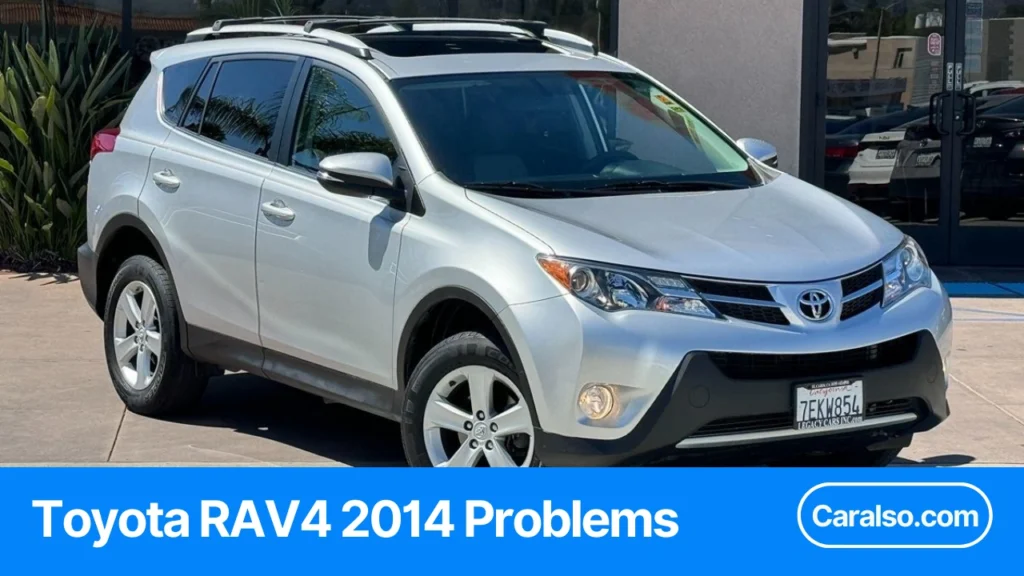
The 2014 RAV4 is the second model year of the 4th-gen redesign. In the U.S., it is a gas-only setup with a 2.5L 4-cylinder and a 6-speed automatic, in FWD or AWD.
In real life, I see 2 themes more than anything else.
- Annoying electronics. Mostly the factory head unit.
- Specific transmission behavior complaints. People mix up normal shift feel with the torque converter shudder pattern.
If you want the short version, here is how I frame a 2014 used buy.
| Area | What Tends To Come Up | My Buy Or Pass Rule |
|---|---|---|
| Powertrain | Occasional shudder complaints around 25 to 50 mph | Pass if I can reproduce it on a warm test drive and there is no proof of a completed fix |
| Electronics | Head unit reboot loop, dead screen, lost audio | Buy if everything works and the seller can prove a replacement if it was done |
| Safety Items | EPS recall check, battery hold-down recall check | Buy only after I verify recall status by VIN |
| Paint | Some white paint peeling cases | Buy if paint is clean now and there is no active peeling on roof, hood, or pillars |
Who This Car Fits Best
- Commuters doing 10 to 60 miles a day.
- Small families who want simple controls and easy cargo access.
- Light-duty use. Think strollers, groceries, weekend trips.
- Not my first pick if you hate tech glitches or you cannot do a long test drive before buying.
Top Problems On The 2014 RAV4 (Ranked By Real-World Impact)
1) Infotainment / Stereo Failures (Screen, Audio, Reboot, Dead Unit)
This is the most common “daily annoyance” problem I hear about on 2014s.
Symptoms Checklist
- Touchscreen freezes.
- Screen stays black.
- Audio cuts out.
- Bluetooth will not pair or drops calls.
- Backup camera works inconsistently.
- Boot loop. Toyota logo. Then restart. Repeat.
Likely Causes
- The head unit itself is the usual suspect.
- Less common: wiring or a bad connection behind the unit.
- Software can be part of it, but a lot of owners end up with hardware replacement.
Seriousness
- Usually driveable.
- You lose camera, phone, audio, and sometimes settings access. That matters every single day.
Cost Range
- I treat it as a mid-3-digit to low-4-digit problem depending on what you install.
- On owner-reported data summaries, the “typical” repair cost lands in the $550 to $700 zone.
What I Test Before Purchase
- Cold start. Then let it run for 3 minutes. Watch for rebooting.
- Pair my phone. Make a 60-second call.
- Play audio for 2 minutes. Then switch sources twice.
- Test steering wheel audio buttons.
- Engage reverse 3 times. Confirm the camera image every time.
- Tap the screen in 10 different spots. Look for dead zones.
Negotiation Tip
- If they say “it was replaced,” I ask for the invoice and the part number line.
- If they do not have proof, I price it like it is still original.
2) Transmission Behavior: Slipping Vs Shudder Vs “Normal Shift Feel”
The 2014 uses a conventional 6-speed automatic. Some shift feel is normal. Some is not.
Define The Terms So You Do Not Misdiagnose
- Normal shift feel: a small change in RPM during a light throttle upshift. No vibration.
- Gear hunting: it upshifts and downshifts more than you expect on a slight grade.
- Slip: RPM rises but speed does not follow at the same rate. It feels like a flare.
- Shudder: a vibration you feel through the seat or floor at steady light throttle, often 25 to 50 mph.
Red Flags Vs Acceptable Behavior
- Acceptable: mild hunting on hills, especially at 30 to 45 mph.
- Red flag: a 500 to 1,500 RPM flare during a gentle 2 to 3 or 3 to 4 shift.
- Red flag: delayed engagement into Drive or Reverse longer than 1 second.
- Red flag: repeated harsh clunks on downshifts in normal driving.
What I Do If I Detect It On A Drive
- I stop trying to “drive around it.”
- I repeat the same speed and throttle input on the same road to confirm it.
- If I can reproduce it twice, I treat it as a real issue, not a one-time quirk.
- I walk away unless the seller has paperwork showing a verified diagnosis and a completed repair.
3) Torque Converter Shudder (The Pattern People Mean)
This is the specific pattern Toyota documented on certain 2013 to 2014 RAV4s.
Light throttle. Warm drivetrain. 25 to 50 mph. Brief intermittent shudder.
Here is the part most shoppers miss.
This shudder may not trigger a check engine light.
So you cannot rely on a dashboard warning to save you.
15-Minute Test Drive Script
- Start cold. Drive normally for 10 minutes to get everything warm.
- Find a flat road where you can hold 35 to 45 mph safely.
- Hold a steady light throttle. Do not mash it.
- Let it sit in that 25 to 50 mph window for 60 to 90 seconds.
- If it happens, you will usually feel a vibration through the seat or floor, not a loud bang.
- Repeat once more after a gentle slowdown. Same road. Same light throttle.
What Repairs Are Commonly Involved
- New torque converter.
- Additional transmission pan magnets.
- Updated engine control software.
Paperwork I Request
- A repair order that specifically mentions torque converter replacement.
- A line that indicates an ECM software update was performed.
- Any note referencing the Toyota bulletin number for the shudder fix.
- If it was handled under a warranty enhancement program, I want the dealership documentation.
If I Feel It On The Drive
- I do not buy the car “hoping it goes away.”
- I price it like a major driveline repair unless I have verified proof the fix was completed.
4) Electric Power Steering (EPS) Concerns / Warning Signs
EPS issues are rare compared with the radio stuff, but I treat them as higher risk.
Symptoms I Take Seriously
- Steering suddenly feels heavier, especially at low speeds.
- EPS warning light.
- Steering assist comes and goes.
- One side feels different than the other during a slow turn.
Safety Angle
- A loss of assist can increase crash risk, especially in a panic maneuver or a tight parking lot situation.
What I Check Before Purchase
- VIN recall status for the EPS campaign.
- A parking-lot test: full lock left, full lock right, 2 times each.
- A low-speed sweep turn at 10 to 20 mph. I listen for odd noises and feel for any “steps” in assist.
If Anything Feels Off
- I do not guess.
- I get a pre-purchase inspection that includes a scan for EPS-related codes.
5) Battery / No-Start / Battery Hold-Down Risk (And Why It Matters)
There is a recall tied to certain replacement 12-volt batteries not fitting the tray correctly.
If the battery can move, it can contact the hold-down bracket and short.
That is a fire risk.
Owner Symptoms To Take Seriously
- Battery that is not solid in the tray.
- Signs of movement. Scuffing near the hold-down area.
- Burning smell near the battery.
- Melted plastic on the positive terminal cover.
Why Replacement Batteries Matter
- The recall is not about “any battery.”
- It is about fit and secure hold-down. A slightly different case size can change everything.
What I Check In 60 Seconds
- Grab the battery. Try to move it by hand. It should not shift.
- Look for a proper clamp and a proper terminal cover.
- Ask if the recall remedy parts were installed.
If The Seller Cannot Confirm
- I run the VIN recall check.
- I assume I will be making a dealer appointment before I treat it as fully sorted.
6) Paint / Exterior Quality Issues Reported By Owners
White paint peeling is the big thing I see discussed most, especially on older Toyotas.
Toyota issued coverage support for certain models and years, including RAV4 in that era.
What I Look For
- Roof edge above the windshield.
- Hood front edge.
- A-pillars.
- Top of the doors near the weather stripping.
- Rear hatch edges.
When It Gets Expensive
- Once clearcoat or paint starts lifting, it usually spreads.
- A proper body shop fix can jump into $1,000+ territory fast depending on how many panels are involved.
My Used-Buy Rule
- If I see active peeling, I either negotiate hard with a plan in writing, or I pass.
- If the paint is clean, I still check the VIN history and ask about prior paint work.
7) “Common But Smaller” Issues (Quick Hits)
ABS Wheel Speed Sensor Wear
- Symptom: ABS light, traction light, stored ABS codes.
- Typical timing: higher mileages.
- Repair note: cleaning rust and debris at the mounting area matters.
- Cost range: about $335 to $528 for a wheel speed sensor replacement estimate.
Oxygen Sensor Related Repairs
- Symptom: check engine light, MPG drop, occasional hesitation.
- Cost range: about $486 to $572 for an oxygen sensor replacement estimate.
Brake Noise And Rotor Wear
- Symptom: steering wheel shake under braking from 50 to 70 mph, squeal at light stops.
- My check: 3 medium stops from 50 mph, then feel for pulsing. Listen with windows down at 10 mph.
If you want, I can turn this problem list into a one-page pre-purchase checklist you can print.
Recalls And TSBs For The 2014 RAV4
I always check recalls before I get serious about a 2014 RAV4. It takes 2 minutes. And it can save you from buying somebody else’s safety problem.
Here is the key point. Recalls are free fixes. TSBs are not automatically free. A TSB is Toyota telling techs how to diagnose and repair a known pattern.
Major Recalls That May Apply To A 2014 RAV4
On the U.S. 2014 RAV4, these are the big ones I see come up.
| Recall No. | What It Is | What Can Happen | What The Dealer Does |
|---|---|---|---|
| 23V734000 | 12-Volt Battery Fitment And Hold-Down Issue | Short circuit risk. Fire risk. | Replaces the battery clamp sub-assembly, battery tray, and positive terminal cover. Free. |
| 15V144000 | Electric Power Steering ECU Damage | Loss of power steering assist. Higher crash risk. | Inspects serial number. Replaces EPS ECU if affected. Free. |
| 15V011000 | SET Accessory Trailer Light Module Software | Trailer lights can shut off if module falsely detects a short. | Replaces module with corrected software. Free. |
| 14V828000 | SET Accessory Fasteners Not Torqued | Dealer-installed accessory can detach. | Inspects and tightens affected bolts. Free. |
Two quick notes I tell friends:
- The SET recalls are distributor and accessory related. Your car may not be in that region. Your car may not have those accessories. The VIN check will tell you.
- The battery recall has phased notifications. For 2013 to 2014 owners, Toyota mailed owner letters on December 27, 2024. There were additional phases starting May 14, 2025 and later in 2025. That is why some owners hear about it “late.”
The One TSB That Matters Most On A 2014 RAV4
If you read about “2014 RAV4 transmission shudder,” this is the document behind it.
TSB: Torque Converter Flex Lock-Up Shudder (T-SB-0023-15)
- What it describes: a brief intermittent shudder under light loads at about 25 to 50 mph.
- Why it matters: it may not set a check engine light. No code does not mean no shudder.
- What the fix looks like on paper: updated torque converter and updated ECM logic.
Toyota also published a Warranty Enhancement Program for this exact shudder on certain 2013 to 2015 RAV4 vehicles.
- It is not a recall.
- Toyota stated the torque converter is normally covered 5 years or 60,000 miles.
- Toyota added extra coverage in two layers:
- Primary coverage until December 31, 2018, regardless of mileage.
- Secondary coverage for 8 years from date of first use or 150,000 miles, whichever comes first.
Most 2014 models on the road today are outside that enhanced window. That is exactly why service records matter so much. I want to see that the fix was done back when Toyota was covering it.
How I Check Your VIN And What Proof I Ask For
This is my simple process.
Step 1: Run A VIN Recall Lookup
- I use the NHTSA recall page and Toyota’s recall lookup.
- I screenshot the results or save the page for the seller conversation.
Step 2: Ask For A Dealer Recall Completion Printout
- Any Toyota service desk can print open and completed campaigns for that VIN.
Step 3: Match Paperwork To The Car
- For battery recall work, I want a repair order showing the parts replaced.
- For EPS recall work, I want the RO that shows inspection and replacement if needed.
- For the torque converter shudder history, I want a repair order that mentions torque converter replacement and an ECM update.
What Documents Count
- A repair order with a campaign code and a “completed” status line.
- A dealer invoice showing labor and parts at $0.00 for the recall.
- A Toyota service history printout tied to the VIN.
Deal-Breaker Vs Acceptable With The Right Checks
I do not treat every issue the same. Some are “price it in.” Some are “walk away.”
Here is my decision table. I use this when I am standing in a driveway looking at a 2014 RAV4.
| Finding | Risk Level | OK To Buy If | I Walk Away If |
|---|---|---|---|
| Torque Converter Shudder At 25 To 50 Mph | High | I cannot reproduce it after 2 tries on a warm drive. Or seller shows paperwork for torque converter replacement plus ECM update. | I can reproduce it twice on the same road, same throttle, and there is no proof of a completed fix. |
| Clear Transmission Slip Or RPM Flare | High | There is a documented diagnosis and a completed repair from a reputable shop. | RPM rises without matching speed increase, or engagement is delayed, and seller has no paperwork. |
| EPS Assist Drops Out Or Warning Light Is On | High | Recall shows completed and a test drive has 0 assist dropouts in a parking lot. | Assist drops out even once, or recall is open and the seller refuses to handle it before sale. |
| Open Battery Hold-Down Recall Or Loose Battery | High | Recall is scheduled and battery is secure right now with correct hold-down and terminal cover. | Battery can move by hand, there are signs of arcing or heat, or seller shrugs it off. |
| Trailer Light Module Recall (If Equipped) | Medium | You do not tow. Or recall is completed. | You tow at night and the recall is open, or trailer lights shut off during a test. |
| Loose Dealer-Installed Accessories (Running Boards, Etc.) | Medium | Recall is completed or fasteners are verified torqued and secure. | Any accessory is visibly loose, rattles, or shows missing hardware. |
| Dead Head Unit Or Reboot Loop | Low To Medium | Price reflects replacement cost and I am fine using an aftermarket unit. | Seller claims “it is fine” but it fails 2 times in a 10-minute test, and they will not adjust price. |
My simple rule is this.
If a problem can raise crash risk, I treat it as a hard stop until the VIN shows it is handled. If a problem is comfort or tech, I treat it as a number and negotiate.
2014 RAV4 Used Buying Checklist (Printable-Style)
I use this checklist every time. It keeps me from guessing.
10-Minute Test Drive Checklist
Before You Move
- Cold start. Listen for 10 seconds.
- Idle for 60 seconds. Watch RPM stability.
- Test the head unit for 2 minutes. Radio and touch.
- Pair Bluetooth. Make a 60-second call.
- Put it in Reverse 2 times. Confirm camera image.
On The Road (Aim For 10 Minutes Total)
- Warm it up for 5 to 10 minutes.
- Hold 35 to 45 mph for 60 to 90 seconds.
- Use light throttle only.
- Feel for shudder in the 25 to 50 mph window.
- Do 3 roll-ons from 20 to 50 mph.
- Watch for RPM flare. Look for delayed shifts.
- Coast down from 50 to 20 mph. Listen for clunks.
- Do 2 steady pulls up a small hill, if possible.
Parking Lot Checks (2 Minutes)
- Full lock left. Then full lock right. Do 2 cycles.
- Feel steering assist. It should be consistent.
- Do 2 slow circles at 5 to 10 mph.
- Brake from 25 mph to 0 mph, 2 times.
- Feel for steering wheel shake or pedal pulsing.
Quick Pass Rule I Use
- If I can reproduce shudder twice, I pass.
- If the trans slips or flares, I pass.
- If EPS assist drops once, I pause the deal.
Under-Hood And Under-Car Quick Checks
Under The Hood (60 Seconds)
- Battery does not move by hand.
- Battery hold-down is present and tight.
- Positive terminal cover is installed.
- No wet oil on the front of the engine.
- Coolant level is between MIN and MAX.
- No crusty residue around the coolant tank.
- Brake fluid is not below MIN.
Under The Car (Use A Flashlight)
- No fresh wet spots on the transmission case.
- No wetness at the transfer case or rear diff on AWD.
- CV boots are not torn.
- Exhaust is not hanging low.
- No uneven tire wear on the inner edges.
Body And Paint (30 Seconds)
- Check roof edge above windshield.
- Check hood front edge.
- Check A-pillars.
- Look for peeling or fresh respray lines.
Scan Tool Quick Check (OBD Codes To Pay Attention To)
I bring a basic OBD2 reader. I do not buy blind.
What I Check First
- Stored codes
- Pending codes
- Freeze-frame data, if available
- Readiness monitors
Codes That Make Me Slow Down
- Any transmission-related P07xx code
- Any torque converter clutch related code
- Any misfire code that is current, not history
- Any ABS or stability control code (often shows as C-codes)
- Any airbag code
One Simple Rule
- If the seller cleared codes that day, I walk.
Paperwork Checks (Maintenance + Recall Completion)
This is where the good deals separate fast.
Must-Have Items
- Title matches VIN on the dash.
- VIN recall status printout or screenshot.
- Proof of recall completion if a recall shows up.
Nice-To-Have Items
- Oil change records with mileage and date.
- Brake work receipts.
- Tire purchase date and size.
- Any repair order referencing torque converter shudder work.
What I Ask The Seller Directly
- “Has the head unit ever been replaced?”
- “Has the transmission ever been repaired?”
- “Any open recalls right now?”
- “Do you have dealer service history under this VIN?”
Preventive Maintenance Habits That Reduce The Common Issues
I do not overcomplicate this. I focus on the stuff that prevents expensive surprises.
Battery And Electrical Habits
This matters on a 2014. It affects starting, infotainment, and charging.
My Battery Rules
- I use the correct battery size for the tray.
- I keep the hold-down tight.
- I clean the terminals once a year.
- I replace a weak battery before winter.
Fast Check
- If the battery can move 0.25 inch by hand, I fix it.
Oil Change Habits That Keep The 2.5L Happy
I follow Toyota’s interval when the oil and use case match.
Then I adjust for my driving.
My Simple Schedule
- If I run 0W-20 synthetic and do longer trips, I change oil at 10,000 miles or 12 months.
- If I do lots of short trips, I change oil at 5,000 miles.
- I rotate tires every 5,000 miles.
One Tip That Saves Engines
- I check oil level once a month. It takes 60 seconds.
Transmission Habits That Reduce Shudder Risk
If you are shopping used, your goal is to avoid buying a shudder car.
If you already own it, your goal is smooth lock-up and clean fluid.
What I Do
- I avoid wide-open throttle when the fluid is cold.
- I let the car do 5 minutes of normal driving first.
- If I plan to keep the car past 150,000 miles, I do a drain-and-fill service around 60,000-mile intervals.
What I Do Not Do
- I do not flush a high-mile transmission as a first step.
- I do not “add additives” to hide shudder.
If You Feel A Shudder
- I document the speed and throttle.
- I get it diagnosed. I do not guess.
Cabin Air Filter And A/C Odor Prevention
A dirty cabin filter can make the A/C smell bad.
It can also reduce airflow.
My Routine
- I check the cabin filter every 10,000 miles.
- I replace it if it is dark or clogged.
- If I drive dusty roads, I check it every 5,000 miles.
A/C Smell Fix That Works Often
- Replace the cabin filter first.
- Then run the fan on fresh air for 5 minutes after A/C use.
Keeping The Infotainment Stable
A weak battery makes infotainment glitches worse.
I see it all the time.
What I Do
- I keep battery voltage healthy.
- I avoid jump-starting unless I have to.
- If the head unit starts rebooting, I test the battery before blaming the radio.
- If the unit is glitchy but not dead, I try a reset and check for updates during service visits.
If The Head Unit Is Dead
- I price it like a hardware replacement.
- I do not expect a “software fix” to save it.
FAQs
Is The 2014 RAV4 A Good Used Car?
Yes, if it passes 2 things. A warm test drive with no shudder at 25 to 50 mph. And a clean recall status by VIN.
If you skip those checks, you can still get a good one. You just raise your odds of buying a problem you could have caught in 10 minutes.
What Mileage Do 2014 RAV4 Problems Usually Show Up?
It depends on the issue.
On complaint-summary data, stereo failures often show average mileages around 59,200 miles. Some “stereo not working properly” reports average around 75,850 miles. Infotainment system stopped working reports average around 58,850 miles.
Transmission slipping complaints on summary pages show an average around 53,650 miles. But the complaint count is small. So I treat it as a warning, not a prediction.
For torque converter shudder, I do not rely on mileage. I rely on a test drive. The pattern is about speed and light throttle, not a magic number on the odometer.
How Do I Know If Mine Has The Torque Converter Shudder?
I look for a repeatable vibration under light throttle at 25 to 50 mph.
Here is my quick test.
- Drive 10 minutes to warm it up.
- Hold 35 to 45 mph on a flat road for 60 to 90 seconds.
- Use light throttle. Do not accelerate hard.
- If it happens, it often feels like a short rumble strip vibration for 1 to 3 seconds.
- Repeat once more on the same road.
If I can reproduce it twice, I stop guessing and get it diagnosed.
Do All 2014 RAV4s Have The Battery Recall?
No. Not every VIN is included.
The recall applies to certain 2013 to 2018 RAV4 vehicles using a specific battery hold-down assembly and tray design. The only reliable answer is a VIN lookup.
If your VIN is included, I treat it as urgent. The risk is a short circuit and fire. The dealer remedy replaces the hold-down clamp, tray, and positive terminal cover at no cost.
What Should I Pay Attention To On A Test Drive?
I focus on 5 checks.
- Warm-drive shudder check
Hold 35 to 45 mph for 60 to 90 seconds. Light throttle. Feel for vibration. - Shift quality check
Do 3 roll-ons from 20 to 50 mph. Watch for RPM flare or delay. - Low-speed steering check
In a parking lot, do full lock left and right 2 times. Assist should not drop. - Brake feel check
Do 2 medium stops from 40 to 10 mph. No pulsing. No steering wheel shake. - Head unit stress test
Bluetooth call for 60 seconds. Backup camera 3 times. Touch response across the screen.
If it passes those, I move to paperwork and recall status.
Key Takeaways
- I buy a 2014 RAV4 when it is smooth at 25 to 50 mph and recalls are closed by VIN.
- My top deal-changers are torque converter shudder, clear transmission slip, and steering assist problems.
- Head unit failures are common. Average mileages in complaint summaries cluster around 58,850 to 75,850 miles.
- Transmission slipping complaints show an average around 53,650 miles on summary data, but the sample is small.
- The battery hold-down recall matters because it involves short circuit and fire risk. I confirm by VIN every time.
- My best tool is a warm test drive plus a 2-minute infotainment test.
- If a seller cleared codes the same day, I walk.
Sources
- Cars.com, 2014 Toyota RAV4 Recalls (23V734000, 15V144000, 15V011000, 14V828000)
- NHTSA, Torque Converter Flex Lock-Up Shudder TSB (T-SB-0023-15) PDF
- CarComplaints, 2014 RAV4 Stereo Not Working
- Toyota Support, Oil Change Intervals Using Synthetic Oil (10,000 miles or 12 months for many 0W-20 required vehicles)
- Edmunds, 2014 Toyota RAV4 Review (powertrain context and driving notes)

Hey there,
How is it going?
I’m Meraj Sarker. I am a Car Mechanic and a student of Automobile Restoration here in Florida, USA. I’ve been studying automotive for around 9 years now. So you can rely on my recommendation. For me, studying and getting knowledge about automobile it’s really fun and entertaining. I will help you to get solutions for your car through this website. If you need any help let me know.