
If you are stuck between the Highlander and the RAV4, I boil it down to one question.
Do you need a third row often enough to justify it?
If the answer is yes, I go Highlander. It seats 7 with captain’s chairs, and some trims can seat 8 with a bench. If the answer is no, I go RAV4. It is the easier daily SUV to park, fuel, and live with.
Quick Answer
Here is the fastest way I decide for most buyers.
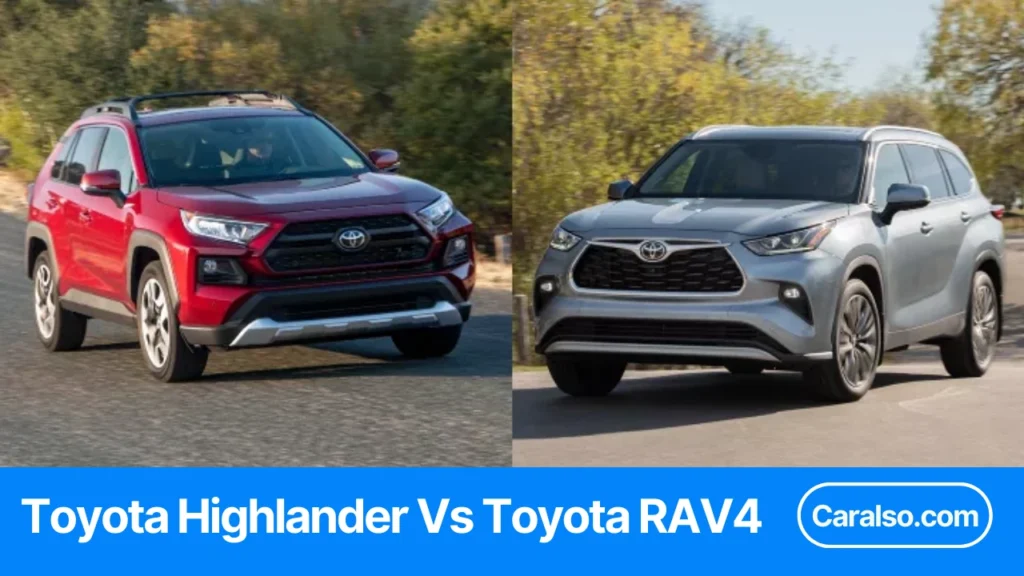
Toyota Highlander vs RAV4
Highlander Vs RAV4 Quick Verdict Table
| What You Care About Most | Pick RAV4 | Pick Highlander |
|---|---|---|
| Seats | 5 | 7 standard, 8 on some trims |
| Rows | 2 | 3 |
| Max Towing | Up to 3,500 lb | Up to 5,000 lb (gas) |
| Hybrid MPG Snapshot | Up to 47 city and 40 highway (est.) | 35 mpg combined (hybrid, manufacturer estimated) |
| Price Starting Point | $31,900 starting MSRP (Hybrid FWD) | $45,270 starting MSRP (gas XLE) |
| Cargo Headline | Up to 37.8 cu ft cargo capacity | Up to 84.3 cu ft with 2nd and 3rd rows folded |
My Quick Verdict (If You Want The Short Version)
- Buy the Highlander if you need 6 to 8 seats, or you tow close to 5,000 lb, or you want a 3-row cabin for kid and friend carpools.
- Buy the RAV4 if you carry 1 to 5 people most days, want up to 47 city mpg (est.), and want the smaller SUV that is easier to park.
One Sentence Summary
If you need the third row, you buy the Highlander. If you do not, the RAV4 usually makes more sense and costs less to run.
60-Second Decision Guide
Choose Highlander If…
- You regularly carry 6–8 people.
- You need a third row more than “once in a while.”
- You want 7 seats standard, with 8 seats available on specific trims.
- You tow close to 3,500 lbs often, or you want the extra margin of a 5,000-lb rating on gas models.
- You want a bigger cabin by the numbers. Highlander has 139.5 cu ft of passenger volume vs 98.9 cu ft in the RAV4.
- You want maximum cargo with seats folded. Highlander goes up to 84.3 cu ft with the rear rows down.
My real-world take: I pick Highlander when the third row is part of normal life. Not an emergency seat. If the third row is getting used every week, I do not fight it. I buy the bigger tool.
Choose RAV4 If…
- You carry 1–5 people most days.
- You want lower fuel use. The 2026 RAV4 lineup is hybrid or plug-in hybrid only.
- You do not need a third row. Ever.
- You want a smaller SUV for parking. RAV4 is 181 inches long vs 194.9 inches for Highlander. That is about 14 inches shorter.
- You want strong cargo space in a 2-row shape. RAV4 has 37.8 cu ft behind the rear seats and 70.4 cu ft with the rear seats folded.
- You tow light stuff. Many trims can do up to 3,500 lbs. Some configurations are rated at 1,750 lbs, so you have to match the trim to the trailer.
My real-world take: I pick RAV4 when the job is commuting, errands, and weekend trips with 2–4 people. It is the easier daily vehicle. And with 2026 being electrified across the board, the fuel-cost math usually favors it fast.
Specs Snapshot Table (Fast Comparison)
I’m using current 2026 model-year specs here because that’s what you can actually buy today.
| Category | RAV4 | Highlander | What It Means In Real Life |
|---|---|---|---|
| Seating | 2-row, 5 seats | 3-row, 7 seats standard, 8 available on some trims | If you need 3 rows weekly, Highlander is the simpler answer. |
| Passenger Volume | 98.9 cu ft | 139.5 cu ft | Highlander feels roomier because it is. This shows up on long trips. |
| Cargo Behind Rear Seats | 37.8 cu ft (behind 2nd row) | 16.0 cu ft (behind 3rd row) | Highlander’s third row eats cargo fast. RAV4 stays usable with seats up. |
| Max Cargo | 70.4 cu ft | 84.3 cu ft | If you fold seats often, Highlander can haul more. |
| Towing | Up to 3,500 lbs (varies by trim and drivetrain) | Gas up to 5,000 lbs. Hybrid towing is typically lower. | If you tow a camper or larger boat, Highlander gas is the safer bet. |
| Fuel Economy Highlights | Hybrid and PHEV lineup. Hybrid models can hit 44 mpg combined (manufacturer estimate). | Gas is 24 mpg combined (manufacturer estimate). Hybrid is 35 mpg combined (manufacturer estimate). | If you drive 12,000 miles a year, mpg differences become real money. |
| Plug-In Option | Plug-in hybrid available. Up to 52 miles EV range (manufacturer estimate). | No plug-in Highlander in the 2026 lineup. | If you can charge at home, PHEV can cut gas use hard. |
| AWD Availability | FWD or AWD depending on grade | AWD is standard across gas and hybrid grades | Highlander simplifies the decision. RAV4 makes you pick the grade carefully. |
| Footprint | 181 in length. 36.9 ft turning circle | 194.9 in length. 37.4 ft turning circle | Highlander is longer. Parking and tight garages favor RAV4. |
| Power | Hybrid 226 hp (FWD) or 236 hp (AWD). PHEV 324 hp | Gas 265 hp and 310 lb-ft | Highlander gas feels stronger under load. RAV4 PHEV is the quick one. |
Biggest Differences That Actually Change Ownership
Size And Seating: Compact Vs Midsize (And Why It Matters)
This is the part you feel every day.
RAV4 is about 181 inches long. Highlander is 194.9 inches long. That is about 14 inches.
Turning circle is close. RAV4 is 36.9 feet. Highlander is 37.4 feet. But the extra length still matters in garages, curb parking, and tight lots.
Inside, Highlander has a lot more passenger volume. It is 139.5 cu ft. RAV4 is 98.9 cu ft.
Second-row legroom is similar. RAV4 is 37.8 inches. Highlander is 38.7 inches.
Third row is the real separator. Highlander gives you a third row with 28.0 inches of legroom. I treat that as kid-friendly seating. Or short trips for adults.
If you carry 6 people once a month, I still lean RAV4. If you carry 6 people once a week, I lean Highlander.
Cargo: More Space Is Not Always More Usable
I look at cargo with seats up. Not seats folded. Seats folded is easy.
RAV4 gives you 37.8 cu ft behind the second row. Highlander gives you 16.0 cu ft behind the third row.
That gap changes real life.
If you keep Highlander’s third row up, you have to think small. Grocery run, backpacks, a couple of duffel bags. That kind of load.
If you keep RAV4’s second row up, you still have a big square space. Stroller, groceries, sports gear. That is the everyday advantage of a 2-row SUV.
When you fold seats, Highlander wins on total volume. Highlander goes to 84.3 cu ft. RAV4 goes to 70.4 cu ft.
So I ask one question.
Do you drive with the third row up often?
If yes, plan your cargo like a smaller SUV. If no, Highlander’s extra capacity is nice to have.
Powertrains: Gas, Hybrid, Plug-In Logic
For 2026, RAV4 is 100% electrified. You choose Hybrid or Plug-in Hybrid.
Hybrid output depends on drive type. It is 226 hp in FWD form. It is 236 hp in AWD form. Plug-in Hybrid is 324 hp.
Hybrid fuel economy is up to 44 mpg combined in the FWD model. Plug-in Hybrid is up to 41 mpg combined. Plug-in Hybrid EV range is up to 52 miles.
Highlander keeps it simpler.
Gas Highlander uses a 2.4-liter turbo four-cylinder. It makes 265 hp and 310 lb-ft of torque. Highlander Hybrid makes 243 net combined hp and is rated at 35 mpg combined.
Here is how I choose.
If you do mostly city driving, hybrid pays back faster. Stop-and-go miles give you more chances to use regen and electric assist.
If you do mostly highway miles, both can still make sense. But I care more about cabin space and towing at that point. That pushes some buyers to Highlander.
If you can charge at home, the RAV4 Plug-in Hybrid can cut gas use hard. Even 20 EV miles per day changes your monthly fuel bill.
Towing And Capability (With “Don’t Get Burned” Notes)
Highlander gas models are rated to tow 5,000 lbs. Highlander Hybrid is rated to tow 3,500 lbs.
RAV4 towing depends on the configuration.
On 2026 RAV4, front-wheel drive models are rated at 1,750 lbs. Many AWD grades go to 3,500 lbs. The AWD LE trim is also rated at 1,750 lbs.
This is where people mess up.
They shop “RAV4 towing capacity” and assume every RAV4 is 3,500 lbs.
I do three checks before I buy.
- I check the exact trim and drivetrain.
- I check the owner’s manual for that powertrain.
- I verify the hitch setup and the cooling requirements for towing.
If you are towing a 3,200-lb camper, I want margin. I prefer the 5,000-lb Highlander gas rating. Or I pick an AWD RAV4 grade that is clearly rated at 3,500 lbs.
If you are towing a 1,200-lb utility trailer a few times a year, both work. Then I pick based on seating and parking.
Family Fit Reality Check
I do not decide this on a spec sheet.
I decide it in 15 minutes with real stuff.
Car-Seat And Stroller Test
If you have kids, do this before you sign.
What I bring to the dealer:
- Your rear-facing seat.
- Your forward-facing seat.
- Your stroller.
- The diaper bag.
- A carry-on bag.
What I do in the RAV4:
- I install 2 car seats.
- I sit in the middle seat for 2 minutes.
- I check shoulder room and buckle access.
- I load the stroller with the rear seats up.
What I do in the Highlander:
- I decide bench vs captain’s chairs first.
- Bench can seat 8 in some trims. Captain’s chairs usually seat 7.
- I test third-row access with a car seat installed in row two.
- I load the stroller with the third row up.
- I fold the third row and repeat.
If your routine is 2 kids and a dog, RAV4 often works fine. If your routine is 3 kids, I test Highlander hard. The third row and wider cabin can save you daily frustration.
Road-Trip Comfort Checklist
I do a short loop that includes:
- 25 to 35 mph rough pavement.
- 60 to 75 mph highway.
- A few tight turns in a parking lot.
Then I check:
- Seat comfort at minute 10.
- Cabin noise at 70 mph.
- Second-row comfort with the seat set to your normal driving position.
- HVAC strength in the back rows.
- Phone connection speed and screen glare.
- Adaptive cruise behavior in traffic.
If something annoys you in 10 minutes, it will annoy you in 3 hours.
Garage And Parking Sanity Check
This is my final step.
I measure the garage depth. Then I compare it to vehicle length.
RAV4 is about 181 inches long. Highlander is 194.9 inches long.
That is about 14 inches. In some garages, 14 inches is the difference between walking around the nose and squeezing past it.
In the parking lot, I do:
- One tight back-in.
- One tight pull-in.
- One U-turn attempt in a narrow aisle.
Turning circle is close on paper. RAV4 is 36.9 feet. Highlander is 37.4 feet.
But the longer body still changes how often you need a second adjustment.
If parking is part of your daily stress, I lean RAV4.
Trim And Powertrain Recommendations (Buying Shortcuts)
Best Value Picks (New)
Here’s the fastest way I sort these two in my head. I start with seats, towing, and fuel.
| Use Case | My RAV4 Pick | My Highlander Pick | The “Why” In One Line |
|---|---|---|---|
| Most Families | XLE Premium Hybrid | XLE (Gas) AWD | Best features per dollar for daily kid duty |
| High-Miles Commuter | LE Hybrid FWD | Highlander Hybrid XLE | Lowest fuel burn without going full EV |
| Tow A Small Trailer | Woodland AWD | Any Gas Highlander (XLE+) | 3,500 lb vs 5,000 lb changes everything |
Best For Most Families (Highlander Trim Logic)
If you actually use the third row, I default to the Highlander XLE (gas) as my “buy it and stop thinking” pick.
Why the XLE works.
- You get 3 rows.
- You get AWD standard on 2026 models.
- You can spec an 8-seat bench on XLE if you need 8 seats.
- You get the 5,000 lb tow rating on the gas model, which is the real family road-trip flex.
When I step up from XLE.
- I go to Limited if I want the nicer cabin touches and I am keeping it 6+ years.
- I go to Platinum only if I care about the top-end features enough to pay for them and I know I will use them weekly.
Hybrid note.
- If I drive a lot of miles, I like the Highlander Hybrid XLE.
- You give up towing. It is 3,500 lb on the hybrid.
- You gain fuel efficiency. Toyota quotes 35 mpg combined on the hybrid.
Best Commuter Pick (RAV4 Hybrid Logic)
For commuting, I love the 2026 RAV4 because every trim is hybrid, and the base numbers are strong.
My default commuter trim is the RAV4 LE Hybrid (FWD).
- It is the lowest buy-in.
- Toyota lists up to 47 city and 40 highway mpg.
- It still gets Toyota Safety Sense 4.0.
When I upgrade from LE.
- I go SE Hybrid if I want the sport look but I do not want a giant payment.
- I go XLE Premium Hybrid if I want the comfort wins that matter every day. Heated seats. Power liftgate. Parking assist features.
Quick power reality check.
- FWD hybrid is rated at 226 net hp.
- AWD hybrid is rated at 236 net hp.
- That 10 hp is not the reason to buy AWD. Traction is the reason.
Best If You Tow Occasionally (What I’d Actually Buy)
This is where people buy the wrong trim.
If you want to tow with a RAV4, I do not start at the base grade.
- The RAV4 LE AWD is listed at 1,750 lb towing.
- The trims set up for it jump to 3,500 lb towing.
My “tow-smart” RAV4 picks.
- Woodland AWD if you want the off-pavement vibe and a tow-ready setup. It includes a 2-inch hitch receiver and is rated at 3,500 lb.
- XLE Premium AWD if you want a more normal daily driver and still want the 3,500 lb tow rating.
My “tow-smart” Highlander picks.
- Any gas Highlander trim (XLE, XSE, Limited, Platinum) if towing matters. Toyota lists 5,000 lb towing for the gas models.
- Highlander Hybrid only if you know you will stay at or under 3,500 lb.
One more real-world tip I use.
- If you are towing more than 2,500 lb more than a few weekends a year, I lean Highlander gas.
- The extra mass and the 5,000 lb rating buys you margin.
If You’re Shopping Used (Quick Guidance)
I shop used by “feature generations,” not just model years.
Which Prior-Gen Features Matter Most
RAV4 used shortcuts I follow.
- 2019 RAV4 is the big reset year. It brought Toyota Safety Sense 2.0 as standard.
- 2023 RAV4 is the tech upgrade year. Toyota rolled in the newer Toyota Audio Multimedia system across the lineup and bumped screen sizes on many trims.
- 2026 is a full redesign with Toyota Safety Sense 4.0 and a new multimedia system. So used shoppers are usually cross-shopping 2019 to 2025 vs new 2026.
Highlander used shortcuts I follow.
- 2020 Highlander is the start of the current generation.
- 2021 and newer Highlander got Toyota Safety Sense 2.5+ called out by Toyota in its model updates.
- 2023 Highlander changed the powertrain story by moving to the 2.4L turbo gas engine and it brought the newer Toyota Audio Multimedia setup.
What I Prioritize In A Test Drive And Inspection
I run the same loop on both.
Paperwork first.
- Service records matter more than trim badges.
- I want oil changes, coolant services, and brake fluid changes documented.
Drive test.
- Cold start. Listen for rough idle.
- Highway run at 65 to 75 mph. Watch for steering shake.
- Brake from 60 mph down to 10 mph. Feel for pulsation.
Hybrid-specific checks.
- Make sure the car transitions between EV and gas smoothly.
- Check for any warning lights and confirm the 12V battery is healthy.
- Pay attention to fan noise from the rear area on some hybrids. It can hint at a clogged battery cooling intake.
AWD-specific checks.
- Tight parking lot turns. Listen for binding or clicking.
- Ask if the AWD fluids were ever serviced if the miles are high.
Tire math I always do.
- If it has 20-inch wheels, I budget for higher tire costs.
- If it has mismatched tires on an AWD model, I walk or renegotiate hard.
Reliability And Ownership Costs
What To Expect From Toyota Ownership (General)
Both are Toyotas. That usually means you are not living at the repair shop. But costs still differ because size and weight change wear items.
Weight is the sneaky cost driver.
- A 2026 RAV4 is roughly in the 3,745 to 3,865 lb curb-weight range depending on spec.
- A 2026 Highlander can land around 4,376 lb in curb weight in common configurations.
- That extra mass shows up in tires and brakes over time.
Fuel cost direction is not close.
- 2026 RAV4 is rated up to 47 city and 40 highway mpg.
- 2026 Highlander gas is listed at 24 mpg combined.
- 2026 Highlander hybrid is listed at 35 mpg combined.
What usually costs more on the Highlander.
- Tires. More 20-inch wheel setups.
- Brakes. More weight to slow down.
- Insurance. Higher replacement cost tends to push premiums up, but it varies by ZIP and driver profile.
What can cost more on the RAV4.
- If you buy AWD and you ignore tire matching, you can create expensive AWD headaches.
- If you buy a plug-in hybrid and never charge it, you paid for a big feature you are not using.
My simple ownership-cost shortcut.
- If you drive 12,000 miles a year, the Highlander’s space can be worth it.
- If you drive 18,000 miles a year, I start leaning hybrid hard. Especially on Highlander.
- If you drive 22,000 miles a year and you do not need a third row, I lean RAV4.
Resale Value Logic (Why These Hold Value)
I look at resale like this. How fast can a clean one sell when gas spikes or rates jump.
Why these two usually resell well.
- They are household names.
- They fit common use cases. Commuting, small families, road trips.
- Hybrids stay in demand when fuel prices rise.
What tends to resell easiest.
- RAV4 hybrids in mid trims. Think SE and XLE Premium style trims.
- Highlander XLE and Limited trims. They hit the family sweet spot.
- AWD in cold-weather regions. It is less important in the Sunbelt.
What hurts resale faster than people expect.
- Weird wheel and tire setups that are expensive to replace.
- Accident history with airbag deployment.
- Neglected interior. Kids can destroy a third row. Buyers notice.
My resale-friendly buying rules.
- Buy the trim that most buyers shop for, not the trim that looks coolest on a dealer lot.
- Keep the wheels reasonable if you hate replacing tires.
- Keep maintenance receipts. A folder of records can add real money at sale time.
Alternatives (Handles “Maybe Neither” Intent)
If You Need A Better Third Row Than Highlander
I look at Grand Highlander first.
It exists for two reasons. Adult-friendly third-row space. More cargo behind that third row.
Here are the numbers that matter:
- Cargo behind the third row: 20.6 cu ft (Grand Highlander) vs 16.0 cu ft (Highlander)
- Max cargo with seats folded: 97.5 cu ft (Grand Highlander) vs 84.3 cu ft (Highlander)
Powertrain choices are also wider on Grand Highlander.
- Hybrid is rated at a manufacturer-estimated 34 mpg combined.
- Hybrid MAX is rated at 362 hp.
My shortcut: If you want 3 rows and you hate playing luggage Tetris, I point you at Grand Highlander.
If You Want Toyota Efficiency Plus 3 Rows
I point families to the Sienna hybrid.
It is hybrid-only. Toyota lists 245 total system horsepower. And up to a manufacturer-estimated 36 mpg combined.
This is why I mention it in a Highlander vs RAV4 comparison.
- Sliding doors make daily kid loading easier in tight parking spots.
- Third-row access is easier than most 3-row SUVs.
- Fuel economy is strong for the space.
If your life is car seats and school runs, I at least test drive a Sienna before I decide.
FAQs
Is The Highlander Bigger Than The RAV4?
Yes.
Highlander is 194.9 inches long. RAV4 is 181 inches long. That is about 14 inches.
Highlander also has more passenger volume. 139.5 cu ft vs 98.9 cu ft in the RAV4.
Which Gets Better Gas Mileage: RAV4 Or Highlander?
RAV4.
A 2026 RAV4 Hybrid can be rated up to 44 mpg combined, depending on configuration. Toyota also lists up to 47 city and 40 highway mpg.
Highlander gas is listed at a manufacturer-estimated 24 mpg combined. Highlander Hybrid is listed at a manufacturer-estimated 35 mpg combined.
Which Is Better For A Family Of 4? Of 5? Of 6?
Family of 4: I usually pick RAV4 if you do not need a third row. You get 5 seats and 37.8 cu ft of cargo behind the second row.
Family of 5: I still like RAV4 if your fifth seat is not used every day. If you do 5 seats daily and take road trips, Highlander starts to make more sense.
Family of 6: I pick Highlander. You get 7 seats standard, with 8 seats available on some trims.
Can A RAV4 Tow A Camper?
Sometimes.
This is the rule: match the camper’s loaded weight to the trim’s tow rating.
Some RAV4 configurations are rated at 1,750 lbs. Many other trims are rated up to 3,500 lbs. Highlander gas is rated up to 5,000 lbs.
My personal towing rule is margin. I try to keep the loaded trailer under about 80% of the tow rating.
Does Highlander Have A Plug-In Hybrid Like RAV4 Prime?
No.
For 2026, Highlander is gas or hybrid. No plug-in hybrid is listed in Toyota’s 2026 Highlander lineup info.
If plug-in matters, I look at the RAV4 Plug-in Hybrid instead.
Should I Buy Highlander Or Grand Highlander?
I ask one question.
Do you need real cargo behind the third row?
Grand Highlander gives you 20.6 cu ft behind the third row and up to 97.5 cu ft max cargo. Highlander gives you 16.0 cu ft behind the third row and up to 84.3 cu ft max cargo.
If you want the shorter vehicle for parking and you only use the third row sometimes, I stick with Highlander.
Key Takeaways (Bullet Recap)
- I buy Highlander when I need 7 to 8 seats and tow up to 5,000 lbs.
- I buy RAV4 when I only need 5 seats and want up to 47 city mpg.
- Cargo with seats up is the daily difference: 37.8 cu ft (RAV4) vs 16.0 cu ft (Highlander behind third row).
- If I want a better third row and more third-row-up cargo, I cross-shop Grand Highlander: 20.6 cu ft behind row 3 and 97.5 cu ft max cargo.
- If I want Toyota efficiency plus 3 rows, I test drive Sienna: 245 system hp and up to 36 mpg combined.
- For towing, I verify the exact trim: some RAV4s are 1,750 lbs, many are 3,500 lbs, Highlander gas is 5,000 lbs.
Sources
- Toyota Pressroom: The Next Adventure Begins: 2026 RAV4 Arrives This Winter
- Car And Driver: 2026 Toyota RAV4 Review, Pricing, And Specs
- MotorTrend: Toyota RAV4 Or Highlander, Which Is Better
- TrueCar: Toyota Highlander Vs Toyota RAV4 Comparison
- Edmunds: 2026 Toyota Highlander Features And Specs

Hey there,
How is it going?
I’m Meraj Sarker. I am a Car Mechanic and a student of Automobile Restoration here in Florida, USA. I’ve been studying automotive for around 9 years now. So you can rely on my recommendation. For me, studying and getting knowledge about automobile it’s really fun and entertaining. I will help you to get solutions for your car through this website. If you need any help let me know.