
I’ve owned and driven a lot of Toyota crossovers, and this is the simple truth: in the U.S., most “C-HR vs RAV4” shopping is really used C-HR versus new or used RAV4. Toyota ended C-HR sales in the U.S. after the 2022 model year, so the gas C-HR you see on lots is almost always a 2018 to 2022 used car.
Your decision usually comes down to space and your powertrain plan. The C-HR gives you 19.1 cu ft of cargo space behind the rear seats. A RAV4 gives you 37.6 cu ft behind the rear seats. That is a 18.5 cu ft gap before you even fold anything down. If you do strollers, Costco runs, or road trips, you feel that difference fast.
There is one more twist now. Toyota has confirmed a 2026 C-HR Battery Electric Vehicle with a manufacturer-estimated 290 miles of range. So you might be choosing between used gas C-HR, gas or hybrid RAV4, or waiting for the new EV.
Kia Sportage Vs Toyota RAV4: Which Compact SUV Should You Buy?
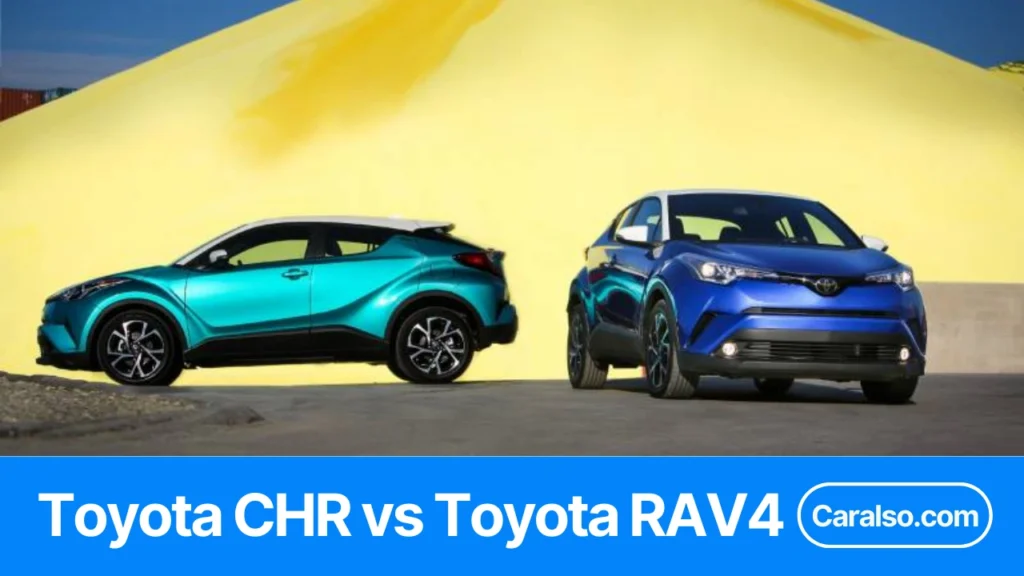
Toyota C-HR vs RAV4
Quick Answer (60 Seconds)
Quick Verdict Table (Hero Asset)
| If This Is You | I’d Buy | The Fast Reason | The Tradeoff |
|---|---|---|---|
| You park in tight city spots daily and want the smallest footprint | Used Toyota C-HR (2018 to 2022) | Smaller body, 19.1 cu ft cargo behind the rear seats | Less cargo than RAV4 by 18.5 cu ft |
| You carry people and stuff most weeks | Toyota RAV4 | 37.6 cu ft cargo behind the rear seats | Usually costs more to buy |
| You want the best mix of efficiency and AWD in a RAV4-sized SUV | Toyota RAV4 Hybrid | Hybrid option, AWD is common on Hybrid trims | Higher price than a used C-HR |
| You can charge at home and want an EV in this size class | 2026 Toyota C-HR BEV | 290 miles estimated range, 74.7 kWh battery | You have to wait for availability |
| You mainly drive solo and your “cargo” is a backpack and groceries | Used Toyota C-HR | Lower used-market entry point, simple daily use | Less passing power feel vs RAV4 for some drivers |
My 60-Second Pick
- If you need space, I pick the RAV4. The cargo number is 37.6 cu ft behind the rear seats.
- If your life fits in a smaller box, I pick the used C-HR. The cargo number is 19.1 cu ft behind the rear seats.
- If you want an EV and you can charge reliably, I’d at least consider waiting for the 2026 C-HR BEV. Toyota is quoting 290 miles of estimated range.
First Question: Which C-HR Are We Talking About? (Important)
I always start here because “C-HR” now means two very different vehicles.
If You’re In The U.S.
If you’re shopping a gas C-HR in the U.S., you are shopping used.
Toyota ended C-HR sales here after the 2022 model year.
That matters because the U.S. gas C-HR is a simple setup:
- Model years you’ll mostly see: 2018 to 2022
- Drivetrain: front-wheel drive only
- Engine: 2.0L 4-cylinder
- Power: 144 hp
- Transmission: CVT
- Cargo behind the rear seats: 19.1 cu ft
If you want Toyota AWD, towing, or a hybrid option, you jump to RAV4.
If You’re Cross-Shopping The 2026 C-HR BEV
This is a different vehicle. It is electric. It is not the old gas C-HR.
Here’s the quick reality check I use:
- Drivetrain: AWD is standard
- Power: 338 hp combined system net
- Battery: 74.7 kWh
- Range: up to 290 miles (manufacturer estimate)
- DC fast charge: 10% to 80% in around 30 minutes under ideal conditions
- Charge port: NACS
- Cargo behind the rear seats: up to 25.4 cu ft
- Length: 177.9 inches
So if you are saying “C-HR vs RAV4” and you mean the EV, you are really asking an EV vs hybrid question.
I treat those as different buys.
Biggest Differences At A Glance (Table)
I’m going to keep this table focused on the most common shopping reality in the U.S.
Used Gas C-HR (2018 to 2022) vs current RAV4 (gas or hybrid).
Figures vary by year and trim, but these are the numbers that usually decide the purchase.
C-HR Vs RAV4 Quick Verdict Table
| Category | Used Toyota C-HR (Gas, U.S.) | Toyota RAV4 (Gas Or Hybrid) | Winner |
|---|---|---|---|
| Size And Cargo | 19.1 cu ft behind rear seats | 37.6 cu ft behind rear seats | RAV4 |
| Length | 172.6 in | 180.9 in | Depends (C-HR for parking, RAV4 for space) |
| Power | 144 hp | 203 hp gas, 219 hp hybrid | RAV4 |
| Fuel Economy (EPA Combined) | 29 mpg combined (example: 2020 C-HR) | 30 mpg combined gas, 39 mpg combined hybrid | RAV4 Hybrid |
| AWD Availability | FWD only | FWD or AWD depending on trim and powertrain | RAV4 |
| Towing | Not a tow pick in most buyer guides | 1,500 lb on many gas trims | RAV4 |
| Best Use Case | City driving, smaller cargo, lower buy-in on the used market | Families, road trips, car seats, cargo, winter driving | RAV4 |
| Watch-Outs I See Most | Small cargo number (19.1 cu ft) and no AWD | Higher purchase price and more trim complexity | Depends |
One Simple Rule I Use
If you need the extra 18.5 cu ft of cargo space behind the rear seats, I stop overthinking it and pick the RAV4.
If you do not need that space, the used C-HR can make sense as a smaller daily driver.
Size & Practicality (The Reason Most People Switch To RAV4)
Cargo Space (What The Numbers Actually Mean)
This is the part that decides most buys.
A used gas C-HR gives you 19.1 cu ft behind the rear seats.
A RAV4 gives you 37.6 cu ft behind the rear seats.
That means the C-HR has about 51% of the RAV4’s behind-seat cargo space.
Fold the seats and the gap gets bigger.
- C-HR cargo behind the front seats: 37.0 cu ft
- RAV4 cargo behind the front seats: 69.8 cu ft
- Difference: 32.8 cu ft
Here’s the quick practicality snapshot I use.
Practicality Numbers That Matter
| Measure | Used Toyota C-HR (Gas, 2018 To 2022) | Toyota RAV4 (Gas Or Hybrid) |
|---|---|---|
| Cargo Behind Rear Seats | 19.1 cu ft | 37.6 cu ft |
| Cargo Behind Front Seats | 37.0 cu ft | 69.8 cu ft |
| Ground Clearance | 5.9 in | 8.4 in |
| Turning Diameter (Curb To Curb) | 34.2 ft | 36.1 ft |
| Length | 172.6 in | 180.9 in |
My real-world test is simple.
Bring what you actually haul.
One stroller. Two carry-ons. One Costco-sized box.
If the hatch closes without a fight, you are fine.
If you are stacking to the roofline, you want the RAV4.
Rear Seat Comfort (Adult + Car Seat Reality)
Rear seat legroom is the second big swing.
- C-HR rear legroom: 31.7 inches
- RAV4 rear legroom: 37.8 inches
- Difference: 6.1 inches
That 6.1 inches shows up fast with a rear-facing car seat.
Here’s how I check it on a test drive.
- Set the front seat to my driving position.
- Put a rear-facing seat behind it.
- Check if the front seat can still slide back 1 inch.
- Sit in the back and see if my knees touch.
If you carry adults in the back, the RAV4 is the safer bet.
If the back seat is “sometimes,” the C-HR can work.
Visibility & Daily Livability
I like the C-HR’s size in a city.
But visibility is a real complaint.
Multiple reviews and comparison pages call out poor visibility on the C-HR.
The rear pillars are thick, and the rear glass is smaller than you expect.
I check three things before I buy one.
- Over-the-shoulder lane change view in both directions
- Backing into a space using mirrors only, then camera
- Parking lot right turns where the front pillars can hide cross traffic
The RAV4 is longer by 8.3 inches.
But it still turns in 36.1 ft curb to curb.
That keeps it easy to live with.
Ground clearance is also a daily factor.
- C-HR: 5.9 inches
- RAV4: 8.4 inches
If you deal with snow ruts, steep driveways, or curb cuts, 8.4 inches helps.
Powertrains & Performance
Used C-HR (2018–2022): What You Get
In the U.S., the gas C-HR is basically one formula.
- 2.0L 4-cylinder
- 144 hp
- 139 lb-ft of torque
- CVT
- FWD only
It is fine in city traffic.
It can feel busy on highway merges if you are loaded up.
If you want AWD or a hybrid option, you move to RAV4.
The C-HR does not give you that choice in the U.S. gas years.
RAV4: Gas Vs Hybrid Vs Plug-In Hybrid (Why This Matters)
RAV4 is a menu.
This is why the “which should I buy” answer changes.
RAV4 Powertrain Cheat Sheet
| Powertrain | What You Get | The Number That Matters |
|---|---|---|
| RAV4 Gas | 2.5L 4-cylinder, 8-speed automatic, FWD or AWD | 203 hp and 184 lb-ft |
| RAV4 Hybrid | Hybrid system with eCVT, AWD is common | 219 net combined hp |
| RAV4 Plug-In Hybrid | Plug-in hybrid for short EV driving, then gas | 42 miles EV range (EPA estimate) |
How I choose.
If you do mostly highway and you never plan to charge, I pick the regular hybrid first.
It is the easiest “set it and forget it” option.
If your daily drive is under 42 miles and you can charge at home, the plug-in can cut gas use hard.
If you cannot charge, the plug-in is mostly a heavier hybrid.
If your budget is tight and you want Toyota reliability, the gas RAV4 is the simple play.
You still get 203 hp and an 8-speed automatic.
2026 C-HR BEV Vs RAV4 (If Shopping Electric Vs Hybrid)
This is the fork in the road.
The 2026 C-HR BEV is a full EV.
- AWD standard
- 338 hp combined system net
- 74.7 kWh battery
- 290 miles estimated range
- NACS charge port
- About 30 minutes for 10% to 80% under ideal fast-charge conditions
The RAV4 Hybrid is not an EV.
It is a gas-electric hybrid you refuel anywhere.
The RAV4 Plug-In Hybrid splits the difference.
It gives you 42 miles of EV range, then runs as a hybrid.
My rule:
- If you can charge at home and you want an EV, I look at the 2026 C-HR BEV.
- If you road trip a lot and you do not want to think about charging, I pick RAV4 Hybrid.
- If you can charge sometimes and you want EV miles during the week, I look at the RAV4 Plug-In Hybrid.
Fuel Economy & Running Costs
MPG/Efficiency: What To Expect By Scenario
Here’s how I think about efficiency for this matchup.
If you’re shopping a used gas C-HR, you’re in the high 20s combined.
If you’re shopping a gas RAV4, you’re around 30 mpg combined in many trims.
If you’re shopping a RAV4 Hybrid, you’re usually high 30s combined.
If you’re waiting for the 2026 C-HR BEV, Toyota is talking range, not mpg.
Mini Efficiency Table
| Vehicle | What You’ll See In Listings | The Number I Use For Planning |
|---|---|---|
| C-HR Gas (Used, U.S.) | 2018–2022 | 29 mpg combined (EPA example years) |
| RAV4 Gas | Common on 2025 and older | 30 mpg combined (EPA examples by trim) |
| RAV4 Hybrid | Common on 2019–2026 | 39 mpg combined (2025 EPA), up to 44 mpg combined (2026 manufacturer estimate, FWD) |
| 2026 C-HR BEV | New EV | 290 miles range (manufacturer estimate) |
Now the part that hits your wallet fast.
Fuel Cost Example (10,000 Miles Per Year)
I use this formula:
Annual fuel cost = (miles driven ÷ mpg) × fuel price
Example at $3.50 per gallon:
- C-HR at 29 mpg: 345 gallons per 10,000 miles. About $1,210 per year.
- RAV4 gas at 30 mpg: 333 gallons per 10,000 miles. About $1,170 per year.
- RAV4 Hybrid at 39 mpg: 256 gallons per 10,000 miles. About $900 per year.
Real costs depend on your local fuel price.
But the mpg math is the same everywhere.
Maintenance And Routine Costs
This is where hybrids and EVs can quietly win.
Gas C-HR and gas RAV4 basics:
- Oil changes.
- Engine air filter.
- Spark plugs eventually.
- Transmission fluid service depending on your plan and driving.
RAV4 Hybrid basics:
- Still needs oil changes.
- Still has an engine air filter.
- Often uses less brake pad life because regen braking does more slowing.
2026 C-HR BEV basics:
- No oil changes.
- No spark plugs.
- Still needs tires, alignment, cabin air filter, and brake fluid service.
- Tire costs can be higher if you go with larger wheel packages.
My shortcut.
If you want lower day-to-day hassle, I lean hybrid or EV.
If you want the simplest purchase and repair ecosystem, I lean gas.
Depreciation & Resale (Why RAV4 Usually Costs More Up Front)
This surprises a lot of people.
A data set comparing the C-HR and the RAV4 Hybrid shows both losing about 30% over five years.
The difference between them is small.
Depreciation Snapshot (5-Year)
| Model | 5-Year Depreciation |
|---|---|
| Toyota C-HR | 30.6% |
| Toyota RAV4 Hybrid | 30.1% |
So why does the RAV4 often cost more up front?
Because you are buying more vehicle.
More cargo space. More rear legroom. More AWD availability.
And demand is steady.
I also see a big spread in used pricing depending on trim, miles, and title history.
That spread is wider on RAV4 Hybrid than C-HR in most markets.
Capability (AWD, Snow, Towing)
AWD Availability & What It Changes
This is a clean split.
Used gas C-HR in the U.S. is front-wheel drive only.
No AWD option.
RAV4 is where Toyota gives you drivetrain choices.
- 2025 and older RAV4: you can find FWD or AWD depending on trim.
- 2026 RAV4: hybrid-only lineup, with FWD or AWD depending on grade.
- RAV4 Plug-in Hybrid: AWD is standard on many model years.
And the new 2026 C-HR BEV flips the script.
It comes standard with AWD.
Here’s what AWD changes for real people.
- Snowy commute: AWD helps you get moving from a stop.
- Wet on-ramps: AWD can reduce front tire spin under throttle.
- Gravel roads: AWD helps keep momentum with less drama.
Here’s what AWD does not change.
Stopping distance.
That’s tires.
If you drive in real winter, I’d rather have FWD with winter tires than AWD with all-seasons.
Towing
This is where I see buyers make expensive mistakes.
If towing is part of your life, treat it like a requirement, not a nice-to-have.
Used gas C-HR in the U.S.:
- Many U.S. spec sources list towing capacity as not rated.
- That is enough for me to treat it as a no-tow pick.
RAV4:
- 2025 gas RAV4 is commonly listed at 1,500 lbs max towing.
- 2026 RAV4 hybrid models list 1,750 lbs on FWD and some AWD grades.
- 2026 RAV4 can be rated up to 3,500 lbs on certain AWD grades.
My quick towing sanity check:
- Look up the exact trim and year.
- Confirm the tow rating in the brochure or spec sheet for that model year.
- Budget payload too. Tongue weight counts against payload.
- Add trailer brakes when needed.
- Use a weight distributing setup if your trailer and manual call for it.
If you want to tow a small utility trailer a few times a year, many RAV4 trims can do it.
If you want to tow a camper, I focus on the trims rated at 3,500 lbs.
Comfort, Noise, And Ride (Real Ownership Feel)
If you drive 30 to 60 minutes a day, this section matters more than horsepower.
The short version is simple. The RAV4 is commonly described as quieter on the highway. The C-HR is commonly described as louder, especially on rough pavement.
On paper, you can see why. The 2022 C-HR rides on a 103.9-inch wheelbase and comes with 18-inch wheels and 225/50R18 tires. The RAV4 rides on a 105.9-inch wheelbase, and the base trims can run 17-inch wheels with taller sidewalls. That difference shows up in ride and noise.
City Comfort Vs Highway Comfort
In the city, I like the C-HR’s footprint. It feels easy to place in tight lanes. It also sits lower, with about 5.9 inches of ground clearance. That helps it feel more car-like in quick turns.
On the highway, I prefer the RAV4. The longer wheelbase helps it feel calmer at 65 to 75 mph. Multiple reviewers also call out the RAV4’s quiet cabin and comfortable ride quality in this class.
Here’s what I do on a test drive. It takes 10 minutes.
- Drive 3 miles on the roughest road you can find at 35 to 45 mph
- Drive 5 miles at 65 to 75 mph
- Do two medium passes from 40 to 70 mph
- Turn the audio off for the whole test
- Listen for tire roar first, then wind noise, then engine drone
If the C-HR bothers you at 70 mph, it usually will not get better with time.
Road Noise Expectations
Road noise is the C-HR’s most repeated real-world complaint. One major review flat-out calls the C-HR loud inside, with noticeable wind noise and excessive road noise that rises with speed and coarse asphalt.
The RAV4’s story is different. Reviews commonly describe it as generally quiet at highway speeds. You can still hear the engine when you ask for a burst of acceleration, especially in the hybrid, but the baseline cabin noise tends to be lower than the C-HR.
Tires and wheels change everything. I focus on 3 numbers.
- Wheel size: 17-inch usually rides quieter than 19-inch
- Tire profile: a 65-series sidewall usually rides quieter than a 50-series sidewall
- Speed: noise differences become obvious around 60 mph
If you buy used, check the tires. A fresh set of touring all-seasons can change the cabin more than most people expect.
One more ownership note. Visibility affects comfort. Multiple reviews criticize the C-HR’s rear and side visibility, which makes some drivers feel more “on alert” in traffic. That is a real fatigue factor on long drives.
Tech And Safety
Toyota Safety Sense, Why Version And Year Matters
Both vehicles can come with Toyota Safety Sense driver-assist features. But the exact version and the exact feature set depend on model year and trim.
I care about this for one reason. Toyota updated these systems over time. The newer versions add capability in scenarios that matter, like turns at intersections and emergency steering support.
Here’s the baseline feature set you should look for when you are shopping used.
- Pre-collision braking with pedestrian detection
- Adaptive cruise control
- Lane departure alert with steering assist
- Lane tracing or lane centering support
- Automatic high beams
- Road sign recognition
Toyota’s own model-year chart shows the 2022 C-HR under Toyota Safety Sense 2.0, while the 2022 RAV4 is listed under Toyota Safety Sense 2.5. In practice, the shopping move is the same either way. Confirm the exact features on the car you are buying.
What changes when you move up the versions.
- Toyota Safety Sense 2.5 and 2.5+ add enhancements to pre-collision tech, including intersection support in certain situations
- Toyota also added emergency steering assist as part of the evolution of these systems
Here’s the quick way I verify it on a test drive.
- Turn on adaptive cruise at 35 mph, then again at 70 mph
- Confirm it tracks smoothly and does not “hunt” speed
- Confirm lane support is available and not disabled due to warnings
- Watch for camera or radar errors on the dash
- If the windshield was replaced, ask if the camera was recalibrated
Also, do not buy either one assuming it is hands-free driving. These are driver aids. I keep my hands on the wheel.
Infotainment And Daily Tech
This is where the RAV4 usually feels like the newer product, especially in 2024 to 2025 models.
For the 2022 C-HR, the setup is straightforward. Reviews note an 8-inch touchscreen that is easy to operate. Smartphone integration for Apple CarPlay and Android Auto is commonly listed as standard. Navigation can be available depending on the configuration.
For the 2025 RAV4, major reviewers list an 8-inch touchscreen as standard, with a 10.5-inch screen available on higher trims. They also note wireless Apple CarPlay and Android Auto on many trims, plus available in-car data features like a Wi-Fi hotspot. Upper trims can add larger digital gauge displays.
What I care about day to day is usability, not screen size.
These are my buy-used checks.
- Pair my phone in the driveway in under 60 seconds
- Make a call and listen for mic clarity at 30 mph and 70 mph
- Run CarPlay or Android Auto and test voice commands
- Test the backup camera in low light
- Check that steering-wheel buttons control audio and cruise properly
- Confirm USB ports actually charge, not just connect
One more safety tech note that impacts daily life. On the 2022 C-HR, blind-spot monitoring with rear cross-traffic alert is listed as part of the driver-aid package. On the RAV4, blind-spot monitoring and rear cross-traffic alert are commonly standard on higher trims, but can be extra-cost or packaged on the base model. If you want it, verify it before you buy.
Real-World Decision Tools
5-Minute Fits My Life Test (Checklist)
I do this on every test drive. It saves me from buying the wrong size.
- Parking And Turning
- Do a tight U-turn in a parking lot.
- Compare turning diameter. C-HR is 34.2 ft. RAV4 is 36.1 ft.
- If you clip lines in the RAV4, you will do it every week.
- Rear-Seat Entry And Car Seat Check
- Open the rear door. Step in. Step out.
- Measure legroom expectations. C-HR is 31.7 in. RAV4 is 37.8 in.
- Install a rear-facing seat behind the driver seat.
- If the front seat cannot slide back 1 inch after the install, I move to RAV4.
- Cargo Test With Your Real Stuff
- Bring a stroller or two carry-ons.
- Behind-seat cargo is the big number. C-HR is 19.1 cu ft. RAV4 is 37.6 cu ft.
- If you stack above the window line, you want the RAV4.
- Highway Merge And Passing Feel
- Do a 45 to 70 mph pull.
- C-HR is 144 hp. RAV4 gas is 203 hp. RAV4 Hybrid is 219 net hp.
- If the C-HR feels strained with two adults and luggage, that will not change.
- Blind-Spot Check
- Do a lane change using mirrors only.
- Then do it using mirrors plus the blind-spot warning if equipped.
- If you cannot see a car in the next lane for 2 full seconds, I call that a deal-breaker.
Buyer Decision Matrix (Table)
Choose C-HR Vs RAV4 If You Want A Clear Answer
| Your Situation | Best Pick | Why I Pick It | What You Give Up |
|---|---|---|---|
| You park on tight streets daily and drive solo | Used C-HR (2018–2022) | 172.6 in length and 34.2 ft turning diameter | 19.1 cu ft cargo behind seats |
| You have kids or adults in back more than once a week | RAV4 | 37.8 in rear legroom vs 31.7 in | Longer body at 180.9 in |
| You do road trips with luggage | RAV4 | 37.6 cu ft behind seats, 69.8 cu ft behind front seats | Higher buy-in vs used C-HR |
| You want the best fuel savings without charging | RAV4 Hybrid | 39 mpg combined EPA example years | Higher purchase price than gas C-HR |
| You drive in snow and want AWD | RAV4 AWD or RAV4 Hybrid AWD | C-HR gas is FWD only in the U.S. | More trim choices to sort through |
| You need towing for a small trailer | RAV4 | Many trims list 1,500 lb, some 2026 grades up to 3,500 lb | Not all trims tow the same |
| You can charge at home and want an EV | 2026 C-HR BEV | 290 miles estimated range, AWD, 338 hp | Cargo up to 25.4 cu ft, not 37.6 cu ft |
Used-Buyer Mini Guide (US Focus)
I treat this like two different shopping missions.
Mission one is a lower-cost commuter. That is the used C-HR.
Mission two is a do-everything family crossover. That is the RAV4.
Budget Band Shortcuts I Use
| Budget Band (Used Market) | What I’d Shop First | Why | My Must-Check Items |
|---|---|---|---|
| Under $20k | C-HR first, then high-mile RAV4 | C-HR listings are common in this band | Tire wear, brake feel, CVT behavior, visibility comfort |
| $20k to $25k | Best-condition C-HR or older RAV4 | This is the crossover zone | Service history, accident history, rear-seat fit test |
| $25k to $30k | RAV4 gas or early RAV4 Hybrid | You start getting the “bigger life” benefits | Cargo test, AWD function, hybrid health scan if possible |
| $30k+ | Newer RAV4 Hybrid, possibly Plug-In | Fuel savings can matter more at this point | Battery and charging checks for Plug-In, warranty transfer |
My used rule is simple.
I do not buy without a real cargo test and a rear-seat test.
Numbers on a page do not load groceries.
FAQs
Is The Toyota C-HR Discontinued In The US?
Yes. Toyota ended C-HR sales in the U.S. after the 2022 model year. That means most U.S. C-HR shopping is used-only, usually 2018 to 2022. If you want a new Toyota in this size bracket today, you are usually looking at Corolla Cross or RAV4.
Is The C-HR Smaller Than The RAV4?
Yes. The C-HR is 172.6 inches long. The RAV4 is 180.9 inches long. The bigger difference is cargo. C-HR has 19.1 cu ft behind the rear seats. RAV4 has 37.6 cu ft behind the rear seats. That is 18.5 cu ft more in the RAV4.
Which Is Better For A Small Family?
I pick the RAV4 for most small families. Rear legroom is 37.8 inches in RAV4 and 31.7 inches in C-HR. That is a 6.1-inch gap. Cargo behind the rear seats is 37.6 cu ft in RAV4 and 19.1 cu ft in C-HR. Strollers and car seats fit easier in the RAV4.
Which Is Cheaper To Own?
It depends on purchase price, but fuel math favors the RAV4 Hybrid. Using 10,000 miles per year and $3.50 per gallon, a 29 mpg C-HR is about $1,210 in fuel. A 39 mpg RAV4 Hybrid is about $900. That is about $310 per year saved on fuel at that mileage and price.
Should I Wait For The 2026 C-HR EV?
I wait if you can charge at home and you want an EV. Toyota quotes 290 miles of estimated range, AWD, and 338 hp. It also lists up to 25.4 cu ft of cargo behind the rear seats. If you road trip often and you do not want to plan charging, I buy the RAV4 Hybrid instead and use its 39 mpg combined EPA example rating.
Sources
- Toyota USA Newsroom (2026 C-HR BEV Announcement)
- MotorTrend (2026 Toyota C-HR Electric Overview)
- Car And Driver (C-HR Discontinued After 2022 In North America)
- Edmunds (2022 Toyota C-HR Specs And Features)
- FuelEconomy.gov (2020 Toyota C-HR)

Hey there,
How is it going?
I’m Meraj Sarker. I am a Car Mechanic and a student of Automobile Restoration here in Florida, USA. I’ve been studying automotive for around 9 years now. So you can rely on my recommendation. For me, studying and getting knowledge about automobile it’s really fun and entertaining. I will help you to get solutions for your car through this website. If you need any help let me know.