
If you are cross-shopping Tiguan vs RAV4, you are usually trying to solve 3 things fast. Fuel cost. Cabin and tech feel. Long-term value.
I split this comparison into “buy new now” reality. The Tiguan was redesigned and it dropped the third-row option. The RAV4 moves to a hybrid-only lineup for 2026. Those two changes swing the math and the day-to-day experience.
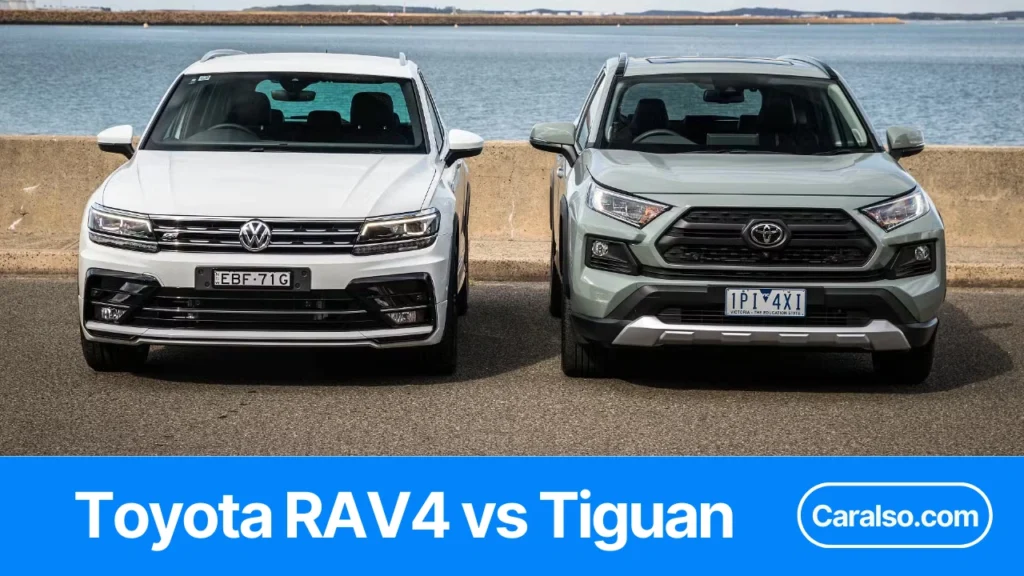
Tiguan Vs RAV4
Quick Answer (Best Pick In 30 Seconds)
Hero Asset: Tiguan Vs RAV4 Quick Verdict Table (AWD Examples)
| What You Care About | Tiguan (AWD Example) | RAV4 (Hybrid AWD Example) |
|---|---|---|
| EPA Combined MPG | 25 mpg | 39 mpg |
| Annual Fuel Cost (EPA Default) | $1,750 | $1,150 |
| Power Snapshot | 201 hp base, 268 hp top trim | 236 hp (AWD hybrid) |
| Resale Signal | Not in iSeeCars Top 3 Small SUVs list | #1 Small SUV, 69.7% 5-year resale value |
Best For Lowest Fuel Cost
- RAV4 Hybrid. I use the EPA math as my baseline. 39 mpg combined and $1,150 a year in fuel cost on the AWD hybrid example. The Tiguan AWD example is 25 mpg combined and $1,750 a year.
Best For Nicest Cabin And Tech Feel
- Tiguan in the higher trims. VW’s SEL R-Line Turbo setup brings 268 hp and a tech-heavy cabin. If screens and features matter more than fuel math, I start here.
Best For Long-Term Ownership And Resale
- RAV4. The RAV4 is #1 on iSeeCars’ Best Resale Value Small SUVs list at 69.7% 5-year resale value. I also like that the 2026 RAV4 hybrid system is standard across the lineup.
If You Only Read One Thing
- If you drive a lot or you care about resale, I pick the RAV4. If you want the most premium tech feel and you are fine paying more at the pump, I look at the Tiguan.
Tiguan Vs RAV4 Snapshot Table
| Category | 2026 Volkswagen Tiguan | 2026 Toyota RAV4 |
|---|---|---|
| Starting MSRP Range (Current Model Year) | $30,805 to about $43,085 | $31,900 to $43,300 |
| Power (Hp) | 201 hp (most trims), 268 hp (SEL R-Line Turbo) | 226 hp (FWD Hybrid), 236 hp (AWD Hybrid), PHEV up to 324 hp |
| Powertrain Options | Gas (2.0T turbo). No hybrid offered. | Hybrid standard. Plug-in Hybrid (PHEV) available. |
| Seats | 2-row, 5-seat | 2-row, 5-seat |
| Cargo Behind 2nd Row (Cu Ft) | 33.8 cu ft | Up to 37.8 cu ft |
| AWD Availability | Available 4MOTION AWD. Standard on SEL R-Line Turbo. | AWD available. Standard on some trims. |
| Warranty Basics | 4 yr or 50,000 mi limited. 2 yr or 20,000 mi maintenance. | 3 yr or 36,000 mi basic. 5 yr or 60,000 mi powertrain. Hybrid battery 10 yr or 150,000 mi. |
What Most Comparison Pages Miss (Read This Before You Decide)
Don’t Compare The Wrong Model Years
I see this mistake a lot.
People compare an older Tiguan to the newest RAV4, then decide based on features that do not exist anymore.
Here’s the quick reality check.
The Tiguan was redesigned for 2025. The optional third row is gone. It is a 2-row SUV now.
The RAV4 was redesigned for 2026. Toyota also dropped the gas-only engine. Every 2026 RAV4 is a hybrid.
So if you are shopping in January 2026, I would compare 2025 or 2026 Tiguan to 2026 RAV4. Not 2024 Tiguan listings you find randomly online.
One more timing note.
Toyota said 2026 RAV4 Hybrid models start arriving at dealers in December 2025. Toyota said RAV4 PHEV pricing comes in the first half of 2026, with arrivals expected in spring 2026.
That matters if you want plug-in capability and you are trying to buy immediately.
Match Trims, Not Just Brand Names
Base-vs-base comparisons can mislead you.
Because these two brands “bundle” features differently.
So I match trims by the stuff you actually use every day.
Here’s how I think about it:
- If you want the lowest payment, compare Tiguan S to RAV4 LE.
- If you want the popular middle, compare Tiguan SE to RAV4 SE or RAV4 XLE Premium.
- If you want the nicest cabin and most features, compare Tiguan SEL R-Line Turbo to RAV4 Limited.
Then I sanity-check two deal-breakers before I get lost in minor features:
- Do you want a hybrid or plug-in option? If yes, RAV4 is the easy answer.
- Do you want the strongest acceleration option? If yes, Tiguan SEL R-Line Turbo is the one you test drive.
Trim Match Guide (Fastest Way To Compare Apples To Apples)
I match trims by price and by what you touch every day. Seats. Screens. Driver assists. AWD.
Tiguan Trim Ladder (S, SE, SE R-Line Black, SEL R-Line Turbo)
Tiguan S
- Base MSRP: $30,805 (FWD)
- Why I look at it: lowest entry price, still a 2-row 5-seat SUV
Tiguan SE
- Base MSRP: $33,605 (FWD)
- Why I look at it: the “normal person” pick. More features without the styling tax
Tiguan SE R-Line Black
- Base MSRP: $37,245 (FWD)
- Why I look at it: sportier look. You pay for appearance and wheel upgrades
Tiguan SEL R-Line Turbo
- Base MSRP: $43,085 (AWD standard)
- Why I look at it: the 268 hp engine. VW’s top trim features live here
Quick AWD Note
- 4MOTION AWD is optional on S, SE, and SE R-Line Black
- SEL R-Line Turbo is AWD only
RAV4 Trim Ladder (LE, SE, XLE Premium, Woodland, XSE, Limited, Plus Hybrid And PHEV Notes)
For 2026, every RAV4 is electrified. Hybrid is standard. Plug-in Hybrid is a separate model line.
RAV4 LE
- Base MSRP: $31,900
- My quick take: cheapest way into a hybrid RAV4
RAV4 SE
- Base MSRP: $34,700
- My quick take: sporty styling at a mid price
RAV4 XLE Premium
- Base MSRP: $36,100
- My quick take: comfort-focused. This is the trim a lot of families land on
RAV4 Woodland
- Base MSRP: $39,900
- My quick take: off-road styling and hardware focus. AWD is standard
RAV4 XSE
- Base MSRP: $41,300
- My quick take: sport trim with the bigger 12.9-inch screen listed as a highlight
RAV4 Limited
- Base MSRP: $43,300
- My quick take: top comfort and tech bundle. This is the “everything” trim
Quick Drivetrain Note
- LE, SE, and XLE Premium can be FWD or AWD
- Woodland, XSE, and Limited are AWD standard
Trim Match Table (Closest Match With A 1-Line Reason)
I use this table to stop the endless “but what trim are you comparing” loop.
| Tiguan Trim (Base MSRP) | RAV4 Closest Match (Base MSRP) | Why This Match Makes Sense |
|---|---|---|
| S ($30,805) | LE ($31,900) | Entry trims. You compare them when price is the #1 filter. |
| SE ($33,605) | SE ($34,700) | Mid trims. Similar money. Good place to compare daily comfort and tech. |
| SE R-Line Black ($37,245) | XLE Premium ($36,100) | Similar budget. One leans sporty look, the other leans comfort features. |
| SEL R-Line Turbo ($43,085) | Limited ($43,300) | Top trims at nearly the same MSRP. This is the real head-to-head. |
My quick rule
- If you want a hybrid or plug-in option, I start you in the RAV4 lineup.
- If you want the quickest Tiguan, I start you at SEL R-Line Turbo.
Price And Value (Is The VW Worth The Extra Or Not?)
I treat this section like a receipt. What do you pay. What do you get. What do you use.
MSRP Vs Typical Equipment You Actually Get
Here’s the clean price picture using base MSRPs.
| Price Point | Tiguan Trim | RAV4 Trim | What Usually Decides It Here |
|---|---|---|---|
| About $31k | S | LE | Do you want hybrid standard (RAV4) or VW cabin style (Tiguan)? |
| About $34k | SE | SE | Fuel-cost math vs cabin and tech preference. |
| About $36k to $38k | SE R-Line Black | XLE Premium | Sport appearance vs comfort-focused equipment. |
| About $43k | SEL R-Line Turbo | Limited | Power and premium interior (Tiguan) vs hybrid efficiency and resale signal (RAV4). |
What I see most often in real shopping:
- Tiguan looks like a better deal on the lot at lower trims.
- RAV4 wins the long game if you drive a lot, because the hybrid is standard.
Packages To Watch (Panoramic Roof, Audio, Driver Assists, Wheel Sizes)
This is where people overspend without realizing it.
Tiguan Packages And Options I Watch
- 4MOTION AWD on S, SE, and SE R-Line Black
- SEL R-Line Turbo for the 268 hp engine
- Big screen jump on the top trim
- Wheel size climbs fast on the R-Line trims, and tires cost more as wheel size goes up
RAV4 Packages And Options I Watch
- FWD vs AWD, because AWD bumps output from 226 hp to 236 hp on the hybrid setup
- Trim step that includes the larger 12.9-inch screen if you care about infotainment size
- Plug-in Hybrid timing if you want to drive on electricity for short trips
My rule
- If you want a panoramic roof and premium audio, price the exact build you want. Do not assume “mid trim” includes it.
Value Verdict
Buy The Cheaper One If
- You drive under 10,000 miles a year and fuel cost is not a big deal.
- You keep cars 3 to 5 years and you shop payments first.
- You want a simpler trim match and you do not care about hybrid power.
Pay More If
- You drive 12,000 miles a year or more and you want lower fuel bills.
- You want the best resale signal in the segment.
- You want the quickest Tiguan and you are willing to pay for the top trim.
- You want plug-in capability and you can wait for the PHEV availability window.
Fuel Economy And Powertrains (The Deciding Factor For Many Buyers)
This is where I see most people make the decision. Not on screens. Not on badges. On fuel cost and how the powertrain feels every day.
Tiguan Powertrain Summary
The Tiguan is gas-only.
Here’s the simple breakdown for 2026:
- Engine: Turbo 2.0-liter four-cylinder
- Power: 201 hp on most trims
- Top Trim Power: 268 hp and 258 lb-ft on SEL R-Line Turbo
- Transmission: 8-speed automatic
- AWD: Available 4MOTION, with AWD called out on SEL R-Line Turbo
Fuel economy depends on drivetrain.
- A recent EPA baseline for Tiguan AWD is 25 mpg combined.
- Front-drive versions rate higher.
My real takeaway.
If you are hoping for a Tiguan Hybrid, it is not here yet. If hybrid is non-negotiable, I move you to RAV4.
RAV4 Powertrain Summary
The 2026 RAV4 flips the script.
Toyota makes it 100% electrified for 2026.
You pick Hybrid or Plug-In Hybrid.
Hybrid (Standard Across The Line)
- FWD Hybrid: 226 net combined system hp
- AWD Hybrid: 236 net combined system hp
- Toyota calls out up to a 44 mpg manufacturer combined rating on FWD Hybrid
Plug-In Hybrid (PHEV)
- AWD is standard
- 324 net combined system hp
- Up to 52 miles manufacturer-estimated all-electric range
- Up to a manufacturer estimated 41 mpg combined rating on SE and XSE PHEV grades
My real takeaway.
If you drive a lot of city miles, the RAV4 Hybrid math is hard to beat.
If you can charge at home and your daily drive is under 40 miles, the PHEV can change your fuel spending fast.
Simple Fuel Cost Math
Here is the exact math I use.
Annual Fuel Cost Formula
- Annual gallons = miles per year ÷ mpg
- Annual fuel cost = annual gallons × your local price per gallon
EPA Baseline Example (AWD)
I use this as a clean reference point because it is based on published EPA numbers.
Assumptions:
- Tiguan AWD: 25 mpg combined
- RAV4 Hybrid AWD: 39 mpg combined
| Miles Per Year | Tiguan AWD (25 MPG) Gallons | RAV4 Hybrid AWD (39 MPG) Gallons | Gallons Saved With RAV4 |
|---|---|---|---|
| 10,000 | 400 | 256 | 144 |
| 12,000 | 480 | 308 | 172 |
| 15,000 | 600 | 385 | 215 |
Now multiply the gallons saved by your fuel price.
Example at $3.50 per gallon:
- 172 gallons saved × $3.50 = $602 per year
Example at $4.00 per gallon:
- 172 gallons saved × $4.00 = $688 per year
That is why I start with fuel economy first.
Space And Daily Practicality
This is the “family life” section. Car seats. Strollers. Costco runs. Road trip bags.
Passenger Space And Car Seats
I look at rear legroom first because rear-facing car seats eat space.
Rear Legroom
- Tiguan: 40.2 inches
- RAV4: 37.8 inches
That 2.4-inch gap is real.
If you are tall and you run a rear-facing seat behind you, Tiguan is easier to fit without moving the front seat forward.
LATCH And Tether Reality
- Tiguan (2025 to 2026 rating): 2 rear seating positions with complete LATCH hardware, plus 1 more seating position with a tether anchor only
- RAV4: Cars.com notes easy access to LATCH and tether anchors on the 2026 RAV4, with no fit issues called out in their test
My quick car-seat test drive script:
- Put the front seat in your driving position first.
- Install your rear-facing seat behind it.
- Check if your knees hit the dash when you brake.
- Then install a forward-facing seat and check tether access.
Cargo Space (Stroller And Suitcase Reality)
Here are the numbers that matter.
Cargo Behind The Second Row
- Tiguan: 33.8 cu ft
- RAV4: 37.8 cu ft
Max Cargo With Seats Folded
- Tiguan: 69.8 cu ft
- RAV4: 70.4 cu ft
My take.
The big difference is behind the second row. The RAV4 gives you about 4.0 cu ft more. That can be the difference between a stroller plus groceries, or needing to drop one rear seat.
Also, the RAV4 cargo area is boxy. That helps with cooler sizes and square luggage.
Third Row Myth Check
I want to kill this myth fast.
The current Tiguan does not offer a third row. Volkswagen removed it starting with the redesign.
So if you need 7 seats, you should not be shopping Tiguan vs RAV4.
You should be shopping larger SUVs.
If someone tells you “Tiguan has a third row,” they are usually thinking about older model years.
Driving And Comfort (What It Feels Like Every Day)
Ride And Noise
I think about two things first. Wheel size and powertrain behavior.
Tiguan (What I Notice)
- The SEL R-Line Turbo runs 20-inch wheels in Car and Driver testing.
- That setup helps steering response.
- It can also make sharp bumps feel more obvious.
- The ride gets called stiff in multiple drives of the Turbo trim.
RAV4 (What I Notice)
- The 2026 RAV4 Hybrid Limited hit 69 dB at 70 mph in Car and Driver testing.
- Under full throttle, it hit 75 dB.
- The 2.5-liter engine is the loud part.
- The hybrid transition is smoother than before.
My quick rule
- If you hate cabin noise under acceleration, you need to do a full-throttle merge in both.
- If your roads are rough, pay attention to wheel size. Especially on the Tiguan Turbo.
City Driving And Parking
This is where hybrid behavior matters.
RAV4 Hybrid In The City
- Low-speed driving is smoother because the electric motors fill gaps.
- Toyota’s lane and cruise systems are designed to work together.
- A panoramic view monitor is available.
- Advanced Park is available on 2026.
Tiguan In The City
- The cabin feels more “German” in layout at higher trims.
- VW’s Travel Assist combines adaptive cruise and lane centering behavior.
- Rear legroom is 40.2 inches, which helps if you run rear-facing seats behind a tall driver.
My quick rule
- If you parallel park weekly, I care more about cameras and sensors than screen size.
- If you carry car seats daily, I care more about second-row space and how wide the rear door opens.
Highway Passing And Power Delivery
This is the section that decides it for a lot of drivers.
Tiguan Numbers That Matter
- SEL R-Line Turbo: 268 hp and 258 lb-ft
- 0 to 60 mph: 6.7 seconds in Car and Driver testing
- EPA estimates for AWD versions land around 22 city and 29 to 30 highway depending on trim
RAV4 Numbers That Matter
- Hybrid AWD: 236 net combined hp
- 0 to 60 mph: 7.1 seconds in Car and Driver testing for an AWD Limited
- AWD hybrid fuel economy reference point many shoppers use: 39 mpg combined on EPA listings for 2025
My quick rule
- If you want the quicker feel at 40 to 70 mph, Tiguan SEL R-Line Turbo is the one you drive first.
- If you want lower fuel burn every week, the RAV4 Hybrid is the easier win.
Tech And Controls (Screens, Buttons, And Annoyances)
Infotainment, CarPlay/Android Auto, Gauge Cluster
This is where these two SUVs feel most different.
Tiguan Tech Layout
- Standard 12.9-inch infotainment screen, with an available 15.0-inch screen
- VW also calls out a standard 12-inch display
- Rotary volume knob is still there
- Physical drive mode control is still there
- Wireless device charging is standard
- Premium audio can be a 12-speaker Harman Kardon setup
RAV4 Tech Layout
- Standard 12.3-inch digital gauge cluster
- Infotainment screen is 10.5 inches or 12.9 inches depending on trim
- Toyota puts climate controls into the bottom of the touchscreen on the new setup
What annoys me in real use
- If I have to do 3 taps to change fan speed, I notice it in week one.
- If I can grab a knob without looking, I notice that too.
My quick rule
- If you love physical controls, the Tiguan setup is easier to live with.
- If you want the biggest screens and you are fine with touch controls, the RAV4 is built for that.
Driver Assistance: IQ.DRIVE Vs Toyota Safety Sense
I care about two behaviors. Lane centering feel and stop-and-go smoothness.
VW IQ.DRIVE Highlights I Actually Use
- Travel Assist blends adaptive cruise control and lane keep assist
- It supports steering, braking, and acceleration within system limits
- Lane Assist activates above 35 mph on roads with visible markings
- Emergency Assist is designed to bring the vehicle to a stop if the driver becomes unresponsive
Toyota Safety Sense 4.0 Highlights I Actually Use
- Pre-Collision System with Pedestrian Detection
- Full-Speed Range Dynamic Radar Cruise Control that is designed to be set above 20 mph
- Lane Departure Alert with Steering Assist above 30 mph
- Lane Tracing Assist that helps keep the vehicle centered while cruise is active
My quick rule
- I do not buy a car based on the feature list.
- I buy based on how it behaves on my exact commute.
Pro Tip: My 10-Minute Test-Drive Script (Do This In Both)
I do this every time. It saves me from “package regret.”
- Lane Centering Check (2 Minutes)
- Turn on adaptive cruise and lane support.
- Hold the wheel lightly.
- Watch for ping-pong behavior between lane lines.
- Stop-And-Go Feel (2 Minutes)
- Find slow traffic or a 35 to 45 mph stretch.
- Let the system brake and re-accelerate.
- Note how often it taps the brakes.
- Noise Check (2 Minutes)
- Do one full-throttle merge from 40 to 70 mph if it’s safe.
- If you want a simple metric, use a phone dB meter app.
- Compare what you hear and what you feel in the pedal.
- Camera And Parking Check (2 Minutes)
- Put it in reverse.
- Check image clarity and guide lines.
- If it has a 360 view, switch through each camera.
- Climate Controls While Moving (2 Minutes)
- Change fan speed.
- Change temperature.
- Count how many presses or taps it takes.
- If it takes more than 2 steps, you will notice it every day.
Reliability, Warranty, And Long-Term Ownership
I separate this into 3 buckets. Warranty coverage. Routine upkeep. Depreciation.
Warranty Comparison
Here are the numbers I use.
Volkswagen Tiguan (VW)
- New Vehicle Limited Warranty: 4 years or 50,000 miles
- Powertrain Warranty: 4 years or 50,000 miles
- Scheduled Maintenance: 2 years or 20,000 miles
- Roadside Assistance: 3 years or 36,000 miles
Toyota RAV4 (Toyota)
- Basic Warranty: 36 months or 36,000 miles
- Powertrain Warranty: 60 months or 60,000 miles
- Hybrid-Related Component Warranty: 8 years or 100,000 miles
- Hybrid Battery Warranty: 10 years or 150,000 miles
- ToyotaCare Scheduled Maintenance: 2 years or 25,000 miles
- Roadside Assistance: 2 years, unlimited miles
My take
VW gives you more bumper-to-bumper time. Toyota gives you more powertrain time. Toyota also gives longer hybrid coverage, including 10 years or 150,000 miles for the battery.
Maintenance Reality And Common Cost Triggers
I do not overthink the first 2 years. Both brands include scheduled maintenance.
After that, the long-term costs usually come from a few predictable places.
Tires And Wheels
- Tiguan SEL R-Line Turbo runs 20-inch wheels in testing.
- Big wheels mean higher tire prices and less sidewall.
- RAV4 trims can also climb in wheel size, but the RAV4 “efficiency play” usually keeps people on more reasonable wheel packages.
AWD Service
- Both can be AWD.
- AWD adds fluid services over time.
- I price that into my ownership plan.
Tech Repairs
This is the hidden cost category on both.
- Parking sensors and cameras
- Panoramic roof mechanisms
- Large screens and modules
If I buy a higher trim, I check every camera angle and every sensor on day one. It saves headaches later.
Hybrid Ownership
The 2026 RAV4 is hybrid standard, so you are buying electrified hardware either way.
Toyota’s warranty coverage is the big comfort blanket here.
- 8 years or 100,000 miles on hybrid-related components
- 10 years or 150,000 miles on the hybrid battery
My take
If you keep cars past 100,000 miles, that hybrid coverage matters.
Resale Value And Depreciation Expectations
Depreciation is usually the biggest ownership cost. So I start here.
RAV4 Resale Signal
- iSeeCars lists the RAV4 as the best resale value in the small and compact SUV segment.
- iSeeCars says the RAV4 retains 69.7% of its value after 5 years.
Tiguan Resale Signal
- iSeeCars says a Tiguan depreciates 47.8% after 5 years.
- That equals a 52.2% residual value after 5 years.
My take
If you trade every 3 to 5 years, resale can outweigh a lot of smaller pros and cons.
If you keep a car 8 to 10 years, the depreciation gap matters less than maintenance discipline and avoiding bad trim choices.
Which One Should You Buy? (Decision Tree)
I use this as my final filter.
Buy The RAV4 If…
- You want a hybrid standard lineup in 2026.
- You want lower fuel use for city driving.
- You care about resale value at 5 years.
- You want longer powertrain coverage at 60 months or 60,000 miles.
- You want hybrid coverage, including 10 years or 150,000 miles for the battery.
Buy The Tiguan If…
- You want the strongest acceleration option in this matchup.
- You want 268 hp and 258 lb-ft in the top trim.
- You want more rear legroom for car seats, with 40.2 inches.
- You want more physical controls, like a rotary volume knob.
- You want 4 years or 50,000 miles of bumper-to-bumper coverage.
My Recommended “Default” Picks By Buyer Type
Commuter
- I pick RAV4 Hybrid AWD most of the time.
- Fuel savings show up every week.
Family With Car Seats
- I test Tiguan first if I have a tall driver and a rear-facing seat.
- 40.2 inches of rear legroom can save your knees.
Road-Tripper
- I pick RAV4 if I care about fuel stops and resale.
- I pick Tiguan SEL R-Line Turbo if I care about passing power more than mpg.
Tech-First Buyer
- I test both.
- Tiguan wins if I want more physical controls.
- RAV4 wins if I want the newest Toyota tech stack and the electrified lineup.
Long-Term Ownership Buyer
- I lean RAV4.
- The 60,000-mile powertrain warranty and the hybrid coverage numbers fit a 8 to 12 year plan better.
FAQs
Schema Note: I Wrote These In Short Q And A Format For FAQ Rich Results.
Which Is More Reliable, Tiguan Or RAV4?
I give the edge to the RAV4 for long-term ownership.
One simple data point I use is average annual repair and maintenance cost. RAV4 is listed at $429 per year. Tiguan is listed at $730 per year.
I also like that conventional hybrids tend to score well in large owner reliability surveys. The RAV4 Hybrid and RAV4 Prime get called out as strong performers.
Is The Tiguan Bigger Than The RAV4?
It depends on what “bigger” means to you.
Tiguan is longer at 184.4 inches. RAV4 is 181.0 inches. Tiguan also gives you more rear legroom at 40.2 inches vs 37.8 inches.
RAV4 gives you more cargo behind the second row at 37.8 cu ft vs 33.8 cu ft. Ground clearance also favors RAV4 at 8.1 inches vs 7.0 inches.
Does The Tiguan Have A Third Row?
Not on the current redesign.
The 2026 Tiguan is a 2-row, 5-seat SUV. Seating capacity is listed as 5.
If you saw a Tiguan with a third row, you are usually looking at an older model year with an optional small third row.
Is RAV4 Hybrid Worth It Vs Tiguan?
For most drivers, yes. The fuel math is the reason.
Using common AWD reference numbers, 25 mpg combined vs 39 mpg combined, a 12,000-mile year looks like this:
- Tiguan AWD: 480 gallons
- RAV4 Hybrid AWD: 308 gallons
- Difference: 172 gallons
At $3.50 per gallon, that is $602 per year. At $4.00 per gallon, that is $688 per year.
If you drive under 8,000 miles a year, the payback takes longer. If you drive 12,000 miles or more, I see the savings show up fast.
Which Is Better In Snow: 4MOTION Or AWD?
Both can do the job. Tires decide the outcome more than badges.
VW 4MOTION is a traditional AWD system, and the Tiguan has a Snow mode available. Toyota’s RAV4 Hybrid AWD uses a dedicated rear electric motor for on-demand AWD.
My real-world rule:
- If you run all-season tires, both will struggle on ice.
- If you run true winter tires, both become very capable.
- If you deal with deep ruts and unplowed streets, I also care about ground clearance. RAV4 is listed at 8.1 inches. Tiguan is listed at 7.0 inches.
Key Takeaways
- If you want the lowest fuel spend, I pick RAV4 Hybrid. A 12,000-mile year can save about 172 gallons vs a 25 mpg AWD Tiguan reference.
- If you want the quickest version in this matchup, I pick Tiguan SEL R-Line Turbo at 268 hp and 258 lb-ft, with a 6.7-second 0 to 60 mph test.
- If you run rear-facing car seats behind a tall driver, I test Tiguan first. Rear legroom is 40.2 inches vs 37.8 inches in RAV4.
- If you haul bulky stuff behind the second row, I pick RAV4. Cargo behind row two is 37.8 cu ft vs 33.8 cu ft in Tiguan.
- If you deal with deep snow ruts, I lean RAV4 on clearance alone. 8.1 inches vs 7.0 inches.
- If you trade every 3 to 5 years, I lean RAV4 because resale data favors it. One study lists 69.7% value retained at 5 years for RAV4, and 47.8% depreciation for Tiguan.
- If you want longer bumper-to-bumper coverage, I lean Tiguan at 4 years or 50,000 miles vs 3 years or 36,000 miles.
- If you want longer hybrid coverage, I lean RAV4. Hybrid battery coverage is listed at 10 years or 150,000 miles.
- If you care about snow traction, I buy tires first. Winter tires matter more than AWD for braking and steering.
- If you want an electrified lineup by default, 2026 RAV4 is built around it. Hybrid is standard, and there is a Plug-In Hybrid option.
Sources
- Volkswagen Tiguan Model Page
- Toyota RAV4 Model Page
- Edmunds 2026 VW Tiguan Specs
- Car And Driver VW Tiguan Review Hub
- FuelEconomy.gov RAV4 Hybrid AWD Compare
- iSeeCars Best Resale Value Small SUVs
- RepairPal Toyota RAV4 Reliability
- MotorTrend Winter Tires vs AWD

Hey there,
How is it going?
I’m Meraj Sarker. I am a Car Mechanic and a student of Automobile Restoration here in Florida, USA. I’ve been studying automotive for around 9 years now. So you can rely on my recommendation. For me, studying and getting knowledge about automobile it’s really fun and entertaining. I will help you to get solutions for your car through this website. If you need any help let me know.