
I compare these two all the time because they solve the same problem in different ways.
The Outback is the “long roof” choice. It’s built around standard AWD, higher ground clearance, and big max cargo. The RAV4 is the “efficient compact SUV” choice, and it gets really hard to ignore once you factor in the Hybrid.
Quick Answer
If you want the best fuel economy and the easiest commute math, I pick the RAV4 Hybrid. If you want standard AWD, more ground clearance, and more max cargo for camping gear, I pick the Outback.
Buy An Outback If…
- You want AWD standard on every trim.
- You want more ground clearance (8.7 in on most trims).
- You want more max cargo (75.6 cu ft with seats folded).
- You want more towing on the trims that matter (up to 3,500 lbs on XT trims).
Buy A RAV4 If…
- You want a Hybrid option with 40 mpg combined.
- You want more cargo behind the rear seat (37.6 cu ft).
- You want an easier-to-park footprint (it’s a smaller class).
- You want a plug-in option, and you can actually charge it.
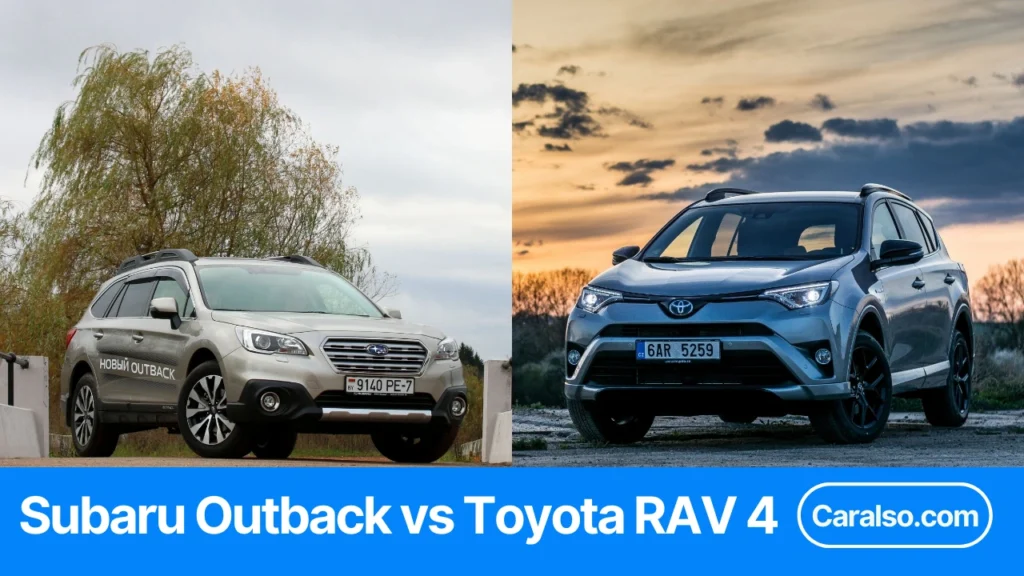
Subaru Outback Vs Toyota RAV4
Hero Table: At-A-Glance Winners
| Metric | Subaru Outback (2025 Baseline) | Toyota RAV4 (2025 Baseline) | What It Means In Real Life |
|---|---|---|---|
| MPG | 26 city, 32 hwy (2.5) or 22 city, 29 hwy (XT) | 28 to 30 mpg combined (gas) or 40 mpg combined (Hybrid) | If you drive 12,000 miles a year, the Hybrid usually wins on fuel cost. |
| Standard AWD | Yes | No (varies by trim and powertrain) | Outback keeps the snow setup simple. You never have to “remember to add AWD.” |
| Ground Clearance | 8.7 in (9.5 in Wilderness) | 8.4 in (up to 8.6 in on some trims) | Outback takes ruts and snow berms with less bumper stress. |
| Cargo Behind 2nd Row | 32.6 cu ft | 37.6 cu ft | RAV4 carries more groceries and strollers without folding seats. |
| Max Cargo | 75.6 cu ft | 69.8 cu ft | Outback wins when you fold seats and pack for road trips. |
| Towing | 2,700 lbs (2.5) or 3,500 lbs (XT) | 1,500 lbs | If you tow a small camper, the Outback is the more realistic pick. |
| Snow Confidence | Standard AWD + X-MODE is common | Depends on AWD setup | Both work with winter tires. Outback makes it harder to “buy the wrong one.” |
| Resale | Strong in snow states | Strong nationally | I usually see more used demand for RAV4, especially Hybrid. |
| Hybrid Options | No | Hybrid and Plug-In Hybrid | If your commute is heavy traffic, RAV4 Hybrid is the biggest differentiator. |
First, Make Sure You’re Comparing The Right Model Year (2025 Vs 2026+)
I always ask this first.
Are you buying a 2025 model, or are you shopping new 2026 inventory? Because both models shift in 2026.
Why The 2026 RAV4 Changes The Whole Conversation (Hybrid-Only)
Toyota moved the 2026 RAV4 lineup to hybrid-only, plus a plug-in hybrid option. That matters because the “base” RAV4 is no longer the gas-only model.
Here’s what I tell shoppers:
- If you were planning to buy the cheapest gas RAV4, that play basically ends with 2025.
- If you already wanted a Hybrid, 2026 is the year where Toyota makes that the default direction.
Timing and pricing signals I watch:
- Toyota says 2026 RAV4 Hybrid models start arriving at dealers in December 2025.
- Toyota also publishes a starting MSRP for the Hybrid model.
- Plug-in hybrid pricing comes later, with spring 2026 arrival timing.
Why The 2026 Outback Is Not The Same Outback As 2025
The 2026 Outback is an all-new redesign. It moves more into SUV shape and away from the older wagon vibe.
The changes I think shoppers will actually feel:
- A new standard 12.1-inch touchscreen.
- A new standard 12.3-inch digital instrument cluster.
- Standard Symmetrical AWD stays part of the Outback identity.
- The familiar engine choices carry over, including the 2.5-liter and the 2.4-liter turbo.
- There is still no Outback Hybrid confirmed in the mainstream lineup.
Pricing also shifts. Subaru sets the new base at the Premium trim for 2026, and the “Outback” base trim is gone.
Quick Guidance For New Buyers
If You Are Buying New In 2026…
- I compare 2026 Outback to 2026 RAV4, not leftover 2025s.
- I budget for higher starting prices on both sides.
- I treat “Hybrid” as the default RAV4 assumption.
If You Are Shopping Used 2020 To 2025…
- I compare 2025 Outback to 2025 RAV4 first, since the spec sheets are stable.
- I pick powertrain first, then trim.
- I do a cargo test with my real stuff, because the shape difference matters more than 1 number.
Specs Snapshot (The Numbers Shoppers Scan First)
I’m going to use 2025 models here, because that’s what most shoppers are cross-shopping on lots right now. I’ll call out where the RAV4 Hybrid and RAV4 Plug-In Hybrid change the math.
Specs That Decide This Purchase
| Spec | 2025 Subaru Outback | 2025 Toyota RAV4 (Gas) | 2025 Toyota RAV4 Hybrid | 2025 Toyota RAV4 Plug-In Hybrid |
|---|---|---|---|---|
| MPG (Combined) | 28 (2.5) or 25 (XT) | 28 to 30 (varies by trim and AWD) | 39 | 38 (gas + electric, battery depleted) |
| EV Range | Not Offered | Not Offered | Not Offered | 42 miles |
| Ground Clearance | 8.7 in (9.5 in Wilderness) | 8.4 in | 8.1 in | Around 8 in (varies by source) |
| Towing Capacity | 2,700 lbs (3,500 lbs XT and Wilderness) | 1,500 lbs | 1,750 lbs | 2,500 lbs |
| Cargo Behind 2nd Row | 32.6 cu ft | 37.6 cu ft | 37.6 cu ft | 33.5 cu ft |
| Max Cargo Seats Folded | 75.6 cu ft | 69.8 cu ft | 69.8 cu ft | Not consistently published |
| Rear Legroom | 39.5 in | 37.8 in | 37.8 in | Similar to gas model |
| Drivetrain | AWD Standard | FWD Standard, AWD Optional | AWD Standard | AWD Standard |
| Transmission Type | CVT | 8-speed automatic | eCVT | eCVT |
A quick note on the Outback engines.
The base 2.5-liter is 182 hp.
The turbo XT is 260 hp.
That power jump is real, but the MPG drops.
The 3 Specs That Matter Most For Families
- Rear legroom.
Outback is 39.5 inches.
RAV4 is 37.8 inches.
That 1.7-inch gap shows up fast with rear-facing seats. - Cargo behind the 2nd row.
RAV4 is 37.6 cu ft.
Outback is 32.6 cu ft.
If you keep a stroller upright most days, the RAV4 starts ahead. - Transmission behavior.
Outback is CVT only.
RAV4 gas is an 8-speed automatic.
If you hate CVT feel, the RAV4 gas is the easy pick.
The 3 Specs That Matter Most For Snow States
- AWD availability.
Outback is AWD standard on every trim.
RAV4 gas is FWD standard and AWD optional.
RAV4 Hybrid is AWD standard. - Ground clearance.
Outback is 8.7 inches.
RAV4 gas is 8.4 inches.
Outback Wilderness is 9.5 inches if your roads get ugly. - Approach and departure angles.
Subaru publishes these clearly for the Outback, including Wilderness.
If you drive rutted access roads to ski lots, this matters more than you think.
I still tell people to look under both and check what hangs low.
The 3 Specs That Matter Most For Road Trips And Camping
- Fuel tank size and range.
Outback fuel tank is 18.5 gallons.
RAV4 gas and Hybrid use a 14.5-gallon tank.
Bigger tank equals fewer stops, even when MPG is similar. - Max cargo length.
Outback is 75.0 inches with the rear seats folded.
That number is camping gold. - Towing headroom.
Outback XT and Wilderness are 3,500 lbs.
RAV4
Powertrain Choice (Hybrid MPG Vs Turbo Pull)
This is the fork in the road.
If you want lower fuel cost and smoother stop and go driving, I start with the RAV4 Hybrid.
If you want stronger passing power without plugging in, I start with the Outback XT.
RAV4 Gas Vs RAV4 Hybrid Vs RAV4 PHEV
RAV4 Gas (2.5L)
- 203 hp.
- 8-speed automatic.
- FWD standard. AWD optional.
- 0 to 60 mph: 8.0 seconds in Car And Driver testing of the gas model they referenced alongside the Woodland Hybrid test.
- Best fit: you want a simple powertrain and do not care about hybrid MPG.
RAV4 Hybrid
- 219 hp combined system output.
- eCVT-style hybrid transmission.
- AWD standard because a rear electric motor powers the rear axle.
- 0 to 60 mph: 7.3 seconds in Car And Driver testing of the Woodland Edition Hybrid.
- EPA estimate: 40 mpg combined on the standard Hybrid setup, with the Woodland Edition testing lower on Car And Driver’s highway loop.
- Best fit: heavy traffic, lots of city miles, or you just want fewer fuel stops.
RAV4 PHEV (Plug-In Hybrid)
- 302 hp combined system output.
- 0 to 60 mph: 5.4 seconds in Car And Driver testing.
- EPA-estimated EV range: 42 miles.
- Charging: 2.5 hours on a 240V outlet, about 12 hours on a 120V outlet.
- Best fit: you can charge at home most nights and your daily driving fits inside that 42-mile range.
My short take.
If you cannot charge, I skip the plug-in.
If you sit in traffic, I test the Hybrid first.
Outback Base Engine Vs XT Turbo
Outback 2.5 (Base)
- 182 hp.
- CVT.
- AWD standard.
- Towing: up to 2,700 lbs.
- Fuel economy: 26 city, 32 hwy.
- 0 to 60 mph: Car And Driver’s testing of an Outback with the 182-hp engine ran 8.5 seconds.
Outback XT (2.4 Turbo)
- 260 hp.
- 277 lb-ft.
- CVT.
- AWD standard.
- Towing: up to 3,500 lbs on XT trims.
- Fuel economy: 22 city, 29 hwy.
- 0 to 60 mph: Car And Driver tested an Outback Wilderness with the turbo at 5.8 seconds.
My short take.
If you want towing headroom and passing power, I look at the XT.
If you want lower fuel use and a lower price, I stick with the 2.5.
Fuel Cost Break-Even Box (Featured Snippet Candidate)
Copy this and do the math on your phone.
Inputs
- Miles per year
- Gas price per gallon
- Gas MPG (your real target)
- Hybrid MPG (your real target)
- Hybrid price premium after fees
Formulas
- Gas gallons per year = miles per year / gas MPG
- Hybrid gallons per year = miles per year / hybrid MPG
- Annual gas cost = gas gallons per year x gas price
- Annual hybrid cost = hybrid gallons per year x gas price
- Annual savings = annual gas cost minus annual hybrid cost
- Break-even years = hybrid premium / annual savings
Example With Clean Numbers
- 12,000 miles per year
- $3.50 per gallon
- 30 mpg gas vs 40 mpg hybrid
Fuel use
- Gas: 12,000 / 30 = 400 gallons
- Hybrid: 12,000 / 40 = 300 gallons
Fuel cost
- Gas: 400 x 3.50 = $1,400
- Hybrid: 300 x 3.50 = $1,050
Savings
- $1,400 minus $1,050 = $350 per year
Break-even
- $1,400 hybrid premium = 4 years
- $2,100 hybrid premium = 6 years
My rule.
If break-even is under 4 years, I usually take the Hybrid.
If break-even is over 6 years, I only take the Hybrid if I really value the smoother traffic drive.
Snow And Dirt-Road Capability (AWD, Tires, Clearance)
Both can do winter.
Both can do graded dirt roads.
The big difference is how easy it is to buy the right setup.
Standard AWD Explanation (Outback)
Every Outback is AWD.
You do not have to “remember to add it.”
X-MODE is also standard.
Subaru says X-MODE optimizes the AWD system for traction on slippery surfaces.
Hill Descent Control is part of the package.
Subaru says Hill Descent Control can work automatically up to 12 mph when a steep decline is detected after you enable X-MODE.
Dual-function X-MODE matters if you actually leave pavement.
Subaru lists Snow/Dirt and Deep Snow/Mud as the two modes on the dual-mode system.
That dual-mode setup is standard on trims like Onyx and Wilderness.
Ground clearance is the other Outback advantage.
- 8.7 inches on most Outbacks.
- 9.5 inches on Outback Wilderness.
RAV4 AWD Reality By Powertrain (Gas Vs Hybrid)
RAV4 Gas
- FWD is standard.
- AWD is optional.
- Car And Driver notes Toyota dropped the Adventure and TRD Off-Road trims for 2025, so the more advanced torque-vectoring AWD system tied to those trims is gone for 2025.
- This means your 2025 gas RAV4 AWD choice is simpler than older TRD and Adventure models.
RAV4 Hybrid
- AWD is standard.
- It uses a rear electric motor to drive the rear axle when needed.
- That setup is great for low-speed traction and smooth takeoffs in snow.
RAV4 PHEV
- AWD is standard.
- It uses more powerful electric motors than the standard Hybrid and runs the same basic idea of electrified AWD.
My quick buying guidance.
If you want AWD and you do not want trim shopping headaches, Outback is the easy answer.
If you want AWD plus better mpg, I start with RAV4 Hybrid.
Tires Matter More Than AWD (Quick Checklist)
This is the part most comparison pages skip.
I do not skip it.
Winter Tire Checklist
- Choose a true winter tire if you see ice and packed snow often.
- Look for the Three-Peak Mountain Snowflake rating if you want one tire for all year and your winters are moderate.
- Replace tires before you hit 4/32 tread depth if winter traction matters.
Vehicle Setup Checklist
- Check your ground clearance needs. Snow ruts are real.
- Keep a small shovel and traction boards if you drive unplowed roads.
- Practice one stop on a safe empty road. You will learn more than any AWD brochure.
My simple take.
Good tires plus 8.7 inches of clearance beats AWD arguments fast.
Wilderness Vs Woodland (Who Actually Needs These)
Outback Wilderness
- 9.5 inches of ground clearance.
- Standard all-terrain tires.
- Standard dual-function X-MODE.
- 3,500 lbs towing.
- Best fit: forest service roads, ruts, rocks, deep snow, and camping access roads.
RAV4 Hybrid Woodland Edition
- Hybrid AWD.
- All-terrain tires and a TRD-tuned off-road suspension package are part of the Woodland story.
- Car And Driver tested the Woodland Hybrid at 0 to 60 mph in 7.3 seconds.
- Best fit: you want Hybrid mpg but also want more tire and suspension confidence on gravel and dirt.
Who Should Skip Both
- If 95% of your driving is pavement, I would rather buy the normal trim you want and spend the money on the right tires.
- You will feel that upgrade every day.
Driving Experience (Daily Comfort Vs Handling)
Ride Comfort And Noise (What To Test In 5 Minutes)
If I am buying with my ears and my lower back, I start with the Outback. It rides like a taller wagon. It feels settled on broken pavement.
The RAV4 feels more like a classic compact SUV. It is stable at speed. But the drivetrain can sound a bit gruff when you ask for a quick pass.
Here is my 5-minute comfort test. I do it in this exact order.
- 0 to 30 mph: I listen for drivetrain noise and feel for low-speed surging.
- 30 to 50 mph on a rough road: I check how many sharp impacts make it into the seat.
- One speed bump at 15 mph: I watch for a second bounce after the bump.
- 55 to 70 mph: I listen for wind noise around the mirrors and top of the windshield.
- 70 to 0 mph brake check: I see if the pedal is easy to modulate and if the nose dives hard.
If you like numbers, I use braking distance as a reality check. In Car and Driver testing, a RAV4 TRD Off-Road stopped from 70 to 0 mph in 176 ft. A tested Outback Wilderness stopped from 70 to 0 mph in 191 ft. That is trim-specific, but it matches what I feel. The RAV4 tends to feel a bit more eager to shed speed.
Steering And Visibility
If you drive in tight parking lots every day, size matters.
- Outback length: 191.9 in
- RAV4 length: 180.9 in
That 11.0 inches shows up in real life. The Outback needs a little more planning in short parking spots.
The turning circle is basically a tie.
- Outback turning diameter: 36.1 ft
- RAV4 turning diameter: 36.1 ft
So the difference is not the U-turn. It is the extra body behind you in the Outback.
My visibility test is simple.
- I look left and right through the A-pillars at a 4-way stop.
- I do a lane change and watch how fast the blind spot appears in the side mirror.
- I back into a space using mirrors only, then I repeat using the camera.
The Outback’s wagon shape tends to feel easier to place at the corners for me. The RAV4 feels a little more upright from the driver’s seat, which some people prefer in traffic.
Transmission Feel (CVT Vs Automatic Vs Hybrid)
This is where a test drive can flip your decision.
The Outback uses a CVT. Around town it is smooth. When I floor it, I can feel the CVT do the “hold RPM” thing. The turbo Outback is quicker, but the CVT still does not feel like a crisp stepped automatic.
The gas RAV4 uses an 8-speed automatic. It feels more traditional. It can still hesitate on a quick kickdown, especially if you roll into the pedal instead of a clean stab.
If you are considering a hybrid RAV4, the feel changes a lot. The hybrid system gives you a more instant shove at low speeds. It is the easiest one here to drive smoothly in stop-and-go traffic.
My quick test for all three.
- Cruise at 50 mph.
- Press to 70 mph for a pass.
- Count how many seconds it takes to respond.
- Feel for a downshift bump or a CVT flare.
That one move tells me more than a spec sheet.
Interior And Tech (What You Touch 50 Times A Day)
Infotainment Layout And Daily Usability
This is where I see the biggest day-to-day difference.
In the Outback, the base setup uses dual 7.0-inch screens. If you move up to the trims most people actually shop, you get the big vertical 11.6-inch screen. Subaru also keeps physical volume and tuning knobs, plus some physical buttons. I like that on rough roads.
In the RAV4, the screen layout is simpler and more traditional.
- 8.0-inch touchscreen on lower trims
- 10.5-inch screen available on XLE Premium and standard on Limited
I also pay attention to the driver display.
- RAV4: most trims use a 7.0-inch gauge display, with a 12.3-inch digital display standard on Limited
- Outback: the cluster is straightforward, and Subaru leans more on the center screen for settings and info
My usability test is the same every time.
- Pair my phone in under 60 seconds.
- Change audio source twice.
- Set a destination once.
- Adjust cabin temperature once without looking down for more than 2 seconds.
If a system fails those, I do not care how big the screen is.
Driver Assist Tech (EyeSight Vs Toyota Safety Sense)
Both can do the big three I want for highway miles.
- Forward automatic emergency braking
- Adaptive cruise control
- Lane keeping support
Subaru EyeSight is standard on the Outback. It includes features like adaptive cruise with lane centering, pre-collision braking, and can add automatic emergency steering when there is space to help avoid a hit.
On the RAV4, the core driver assists are also widely standard, including automated emergency braking with pedestrian detection, lane-departure warning with lane-keeping assist, and adaptive cruise control. One key detail I watch is trim packaging. Blind-spot monitoring and rear cross-traffic alert can be extra-cost on the base trim.
My advice. Do not assume you will love either system.
On the test drive, I do this.
- Turn on lane support on a clearly marked road.
- Put the cruise set 5 mph over the limit.
- See if it centers calmly or ping-pongs.
- See how often it asks for steering input.
- Cancel it once with the brake, then once with the steering wheel button.
Phone Integration, Charging, And Controls
I treat wireless phone connection like a must-have now.
On the Outback, wireless Apple CarPlay and Android Auto are standard on many trims, especially once you step up from the base model. Subaru also offers USB-C charging ports for front and rear passengers, plus USB-A ports depending on trim.
On the RAV4, wireless Apple CarPlay and Android Auto are part of the package, and the interface is generally quick to learn. A wireless charging pad is typically optional.
My quick ownership tip.
If you use your phone for navigation every day, check three things in person.
- Can I start wireless CarPlay in under 20 seconds from engine start?
- Does the phone stay locked in place on the charging pad through one hard corner?
- Can I change fan speed without digging through 3 menus?
Those are the “50 times a day” moments that decide who you are happier with.
Reliability, Maintenance, And Resale Value
This is the section that saves you money.
It is also the section that saves you weekends.
What Typically Drives Resale On These Two
RAV4 resale usually comes down to demand.
It is a top-of-mind nameplate.
And the Hybrid trims pull a lot of buyers.
Outback resale usually comes down to region.
In snow states, people pay for standard AWD and ground clearance.
In warm states, it competes more on price.
If you want a quick number check, I look at 5-year depreciation.
On Kelley Blue Book’s cost-to-own estimates, a 2025 RAV4 shows about $13,641 in depreciation over 5 years.
A 2025 Outback shows about $16,933 in depreciation over 5 years.
That is roughly a $3,292 difference.
That gap is not a guarantee.
But it is the direction I usually see when you compare these two on paper.
One more resale note.
Kelley Blue Book’s Best Resale Value Awards list puts the 2025 RAV4 at 53.9% for 5-year resale value.
That is a strong signal that it holds demand.
Warranty And Hybrid Coverage Notes
I treat warranties like a baseline, not a reason to buy.
But it matters if you plan to keep the car 6 to 10 years.
Subaru basics for a new Outback are simple.
- 3 years or 36,000 miles bumper-to-bumper
- 5 years or 60,000 miles powertrain
Toyota basics for a new RAV4 are similar.
- 3 years or 36,000 miles basic coverage
- 5 years or 60,000 miles powertrain
If you are shopping RAV4 Hybrid or RAV4 Plug-In Hybrid, there is one line I care about most.
Toyota’s hybrid battery coverage is 10 years or 150,000 miles, starting with model year 2020.
Also, Toyota includes ToyotaCare on new vehicles.
It covers normal factory scheduled maintenance for 2 years or 25,000 miles.
If you hate paying for the first few services, that is real value.
Used Buyer Checklist (Outback)
I do this list in order.
It takes me 10 minutes.
- Tires first.
Subaru AWD likes even tire wear.
I measure tread depth on all 4.
If one tire is 2/32 different from the others, I ask questions. - CVT behavior.
I do a slow roll from 5 to 25 mph.
Then I do a 35 to 60 mph pass.
I am looking for shudder, flare, or weird surging. - Brake feel.
I do one 50 to 0 stop.
Then one 70 to 0 stop if the road is safe.
I feel for steering shake. - Windshield and EyeSight.
I check for chips and cracks.
If the windshield was replaced, I ask if EyeSight was recalibrated. - Undercarriage.
I look for rust on suspension bolts and subframes.
I also check for fresh undercoating that looks like it is hiding something. - Water leaks.
I lift the rear cargo floor.
I check for moisture, musty smell, and stained carpet. - Service history.
Oil changes on time matter more than any “brand reliability” argument.
If there is no record, I price the car like it is overdue for everything.
Used Buyer Checklist (RAV4)
Same deal.
Fast checks.
Clear deal-breakers.
- 8-speed shift quality on gas models.
I do a gentle 1 to 3 upshift.
Then I do a quick kickdown at 45 mph.
I am looking for harsh shifts or long hesitation. - AWD fluid basics.
If it is AWD, I ask about rear diff service intervals.
If nobody knows, I assume it has not been done. - Hybrid specific.
I look for warning lights at start-up.
I listen for odd rear-end noises in tight turns.
Then I ask about hybrid system inspection history. - Roof rail water leak check on 2019 to 2021 models.
I look at the headliner edges.
I check the A-pillars.
I look for water staining in the cargo area. - HV cable corrosion program check on some 2019 to 2022 RAV4 Hybrid AWD models.
I ask if the HV cable inspection and any support program work was done.
If the seller has no idea, I run the VIN and call a dealer. - Plug-In Hybrid check.
If it is a RAV4 Plug-In Hybrid, I confirm the charge port works.
I confirm it charges on Level 1.
I also confirm the seller has the OEM charging cable. - VIN check.
I always check for open recalls and service campaigns.
It is free.
It prevents dumb surprises.
Trim Recommendations (Fast Path To The Smart Buy)
I pick trims based on how people actually use these cars.
Commute.
Kids.
Snow.
Trips.
Not fantasy off-road.
Outback Best Value Trim
I start with the 2025 Outback Premium.
It is the most popular trim for a reason.
It lands in the sweet spot before the price jump to the higher trims.
Pricing reference:
- 2025 Outback Premium MSRP: $34,480
My build approach:
- Skip the turbo unless you know you want it.
- Spend your money on tires, brakes, and maintenance history if you are buying used.
Outback Best Trim For Snow + Camping
If your roads get ugly, I go straight to the 2025 Outback Wilderness.
It is the trim that changes your “can I get there?” confidence.
It also brings the best hardware for ruts and deep snow.
Pricing reference:
- 2025 Outback Wilderness MSRP: $43,130
My simple test:
If you regularly drive through snow ruts or access roads with rocks, the Wilderness makes sense.
If you do not, buy a regular Outback and put the money into the right tires.
RAV4 Best Value Trim
For the gas RAV4, I start with the 2025 RAV4 XLE.
It avoids the base-trim penalty where common features get chopped.
It also keeps the price below the bigger jump to XLE Premium and Limited.
Pricing reference:
- 2025 RAV4 XLE MSRP: $32,760
My advice:
If you are going gas, pick the XLE and put AWD on it if you need it.
Then stop.
Do not climb trims just to chase cosmetics.
RAV4 Best Trim If You Want Hybrid MPG Without Overpaying
I start with the 2025 RAV4 Hybrid XLE.
It is the Hybrid trim that most buyers land on.
It keeps you away from the pricier “appearance” trims.
And it still gives you the Hybrid drivetrain advantage.
Pricing reference:
- 2025 RAV4 Hybrid XLE MSRP: $35,810
My rule:
If your break-even math is under 4 years, Hybrid is usually the smart buy.
If it is over 6 years, I only do Hybrid if I value the smoother traffic drive.
If you are considering the Plug-In Hybrid, I keep it simple.
Buy it only if you can charge at home.
If you cannot, the standard Hybrid is the better tool.
Pricing reference:
- 2025 RAV4 Plug-In Hybrid SE MSRP: $44,815
- 2025 RAV4 Plug-In Hybrid XSE MSRP: $48,685
Which One Should You Pick? (Use-Case Decision Tree)
I use this the same way every time. I start with how you drive. Not what looks cooler on the lot.
Best For Commuters
If you drive a lot of miles, I start with the RAV4 Hybrid.
It is rated at 39 to 40 mpg combined, depending on trim.
The gas RAV4 is closer to 28 to 30 mpg combined, depending on drivetrain.
That mpg gap is the whole story for many commuters.
Winner: RAV4 Hybrid, because 39 to 40 mpg combined cuts fuel cost fast.
Best For Families
I split this into two questions.
Do you need more cargo behind the second row?
Or do you need more rear legroom?
Cargo behind the second row:
- RAV4: 37.6 cu ft
- Outback: 32.6 cu ft
Rear legroom:
- Outback: 39.5 in
- RAV4: 37.8 in
If you keep a stroller up all the time, the RAV4’s extra 5.0 cu ft matters.
If you have a tall driver and a tall passenger behind them, the Outback’s extra 1.7 inches matters.
Winner: RAV4 for stroller and grocery volume. Outback for back-seat comfort.
Best For Snow States
If you want the simplest snow setup, I pick the Outback.
AWD is—or no trim drama.
Every Outback has AWD.
Ground clearance is 8.7 inches on most trims.
Wilderness goes to 9.5 inches.
The RAV4 can be great in snow too.
But on the gas model you have to choose AWD.
On the Hybrid, AWD is standard.
My tire rule still stands.
Good winter tires matter more than AWD marketing.
Winner: Outback, because AWD is standard and clearance is 8.7 inches.
Best For Road Trips And Camping
This is where the Outback’s shape shows up.
Fuel tank size:
- Outback: 18.5 gallons
- RAV4: 14.5 gallons
Max cargo:
- Outback: 75.6 cu ft
- RAV4: 69.8 cu ft
Cargo length matters if you camp inside.
The Outback’s cargo length behind the first row is listed at 75 inches.
If your road trips are mostly highway miles and you hate fuel stops, the Outback’s bigger tank helps.
If your road trips are mostly mixed driving and you want to spend less on fuel, the RAV4 Hybrid still wins fuel math.
Winner: Outback for cargo length and range planning. RAV4 Hybrid for fuel cost.
Best If You Trade Every 3 To 5 Years
I usually lean RAV4 here.
Used demand is strong.
Hybrid demand is even stronger.
If you trade often, the RAV4 Hybrid tends to be the safest bet for resale.
Winner: RAV4, especially the Hybrid.
FAQs
Is The Outback Bigger Than The RAV4?
Yes in max cargo and overall footprint.
Outback max cargo is 75.6 cu ft.
RAV4 max cargo is 69.8 cu ft.
But behind the second row, the RAV4 carries more.
RAV4 is 37.6 cu ft behind the second row.
Outback is 32.6 cu ft behind the second row.
Which Gets Better MPG?
The RAV4 Hybrid.
It is rated at 39 to 40 mpg combined, depending on trim.
The Outback 2.5 is rated around 28 mpg combined.
The turbo Outback is around 25 mpg combined.
Which Is Better In Snow?
The Outback is the easy answer because AWD is standard.
Ground clearance is 8.7 inches on most trims, and Wilderness is 9.5 inches.
A RAV4 with AWD and good winter tires can do great too.
But you have to choose the right drivetrain and trim.
Which One Can Tow More?
Outback wins if you pick the right engine.
Outback 2.5 is rated up to 2,700 lbs.
Outback XT and Wilderness are rated up to 3,500 lbs.
RAV4 gas is rated up to 1,500 lbs.
RAV4 Hybrid is rated up to 1,750 lbs.
RAV4 Plug-In Hybrid is rated up to 2,500 lbs.
Is The RAV4 Hybrid Worth It?
If you drive a lot of miles, usually yes.
The Hybrid is rated 39 to 40 mpg combined.
The gas model can be 28 to 30 mpg combined depending on drivetrain.
I do break-even math using your miles per year and gas price.
If break-even is under 4 years, I usually take the Hybrid.
Can You Sleep In The Back Of An Outback?
Yes, it is one of the easiest mainstream vehicles to do it in.
Cargo length behind the first row is listed at 75 inches.
I still test it with your real sleeping pad.
Some pads are 78 inches long.
Should I Buy Outback Wilderness Or RAV4 Woodland?
Only if you actually use them.
Outback Wilderness brings 9.5 inches of clearance and the 3,500 lb tow rating.
It makes sense for rutted access roads and deep snow.
RAV4 Woodland keeps the Hybrid drivetrain and adds more trail-ready hardware.
It makes sense if you want hybrid mpg and you spend weekends on dirt roads.
If your driving is 95% pavement, I usually buy the normal trim and spend on tires.
Should I Wait For The 2026 Models?
Only if the redesign fixes your main pain point.
If you want the newest tech layout and a fresh platform, waiting can make sense.
If you are shopping used 2020 to 2025, I do not wait.
I buy the best condition car with the best service history.
Key Takeaways (Bullets)
- If you want the best fuel economy, I buy the RAV4 Hybrid for 39 to 40 mpg combined.
- If you want AWD without trim shopping, I buy the Outback because AWD is standard.
- If you need more cargo behind the second row, I buy the RAV4 for 37.6 cu ft vs 32.6 cu ft.
- If you need more rear seat comfort, I buy the Outback for 39.5 inches of rear legroom vs 37.8 inches.
- If you tow, I buy an Outback XT or Wilderness for up to 3,500 lbs.
- If you road trip long distances, I like the Outback’s 18.5-gallon tank vs 14.5 gallons in the RAV4.
- If you camp and want a long, flat load floor, I like the Outback’s 75-inch cargo length behind the first row.
- If you trade every 3 to 5 years, I lean RAV4 because resale demand is usually stronger.
- If you live in deep snow, I prioritize ground clearance, and Outback gives you 8.7 inches, or 9.5 inches on Wilderness.
- If you cannot charge at home, I skip the plug-in and focus on Hybrid vs gas.
Sources
- Kelley Blue Book: Subaru Outback vs Toyota RAV4 Comparison
- Edmunds: 2025 Subaru Outback Overview
- Car And Driver: 2025 Toyota RAV4 Review, Pricing, And Specs
- Toyota: RAV4 Plug-In Hybrid (Official Page)
- Subaru: 2025 Outback Model Page

Hey there,
How is it going?
I’m Meraj Sarker. I am a Car Mechanic and a student of Automobile Restoration here in Florida, USA. I’ve been studying automotive for around 9 years now. So you can rely on my recommendation. For me, studying and getting knowledge about automobile it’s really fun and entertaining. I will help you to get solutions for your car through this website. If you need any help let me know.