
If you want the short answer, I use this rule.
Pick the RAV4 if you care most about fuel economy and electrified options. A 2025 RAV4 Hybrid is rated at 39 mpg combined and gives you 37.5 cu ft of cargo behind the second row.
Pick the Forester if you care most about standard AWD feel, visibility, and easy daily usability. A 2025 Forester has 8.7 inches of ground clearance, and the Wilderness trim steps up to 9.2 inches and 3,000 lbs of towing.
One more thing before we get into the table. Model years matter right now. The 2026 RAV4 shifts to hybrid power as standard across the lineup. That can change price, power, and mpg expectations versus a 2024 to 2025 RAV4.
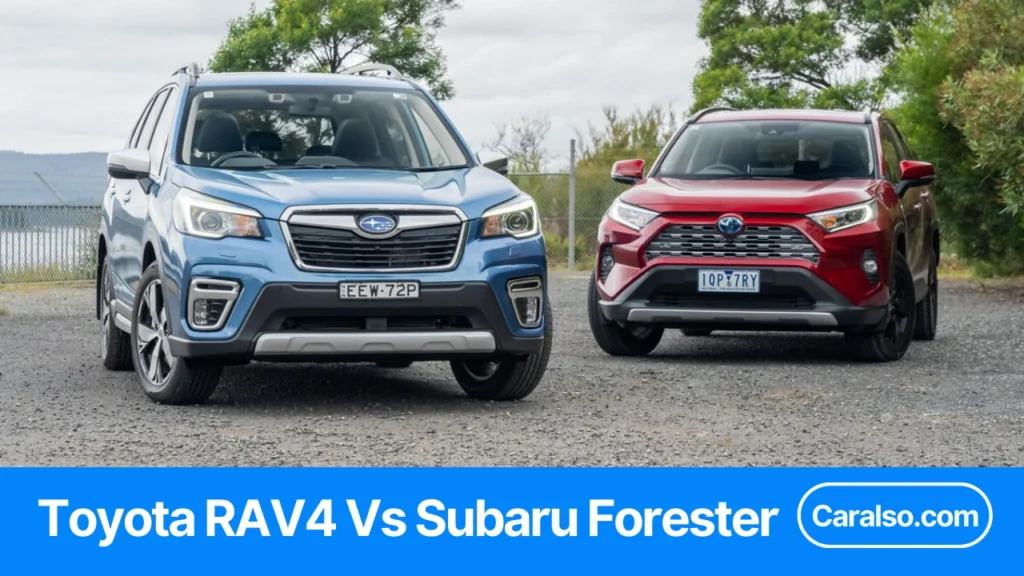
Toyota RAV4 Vs Subaru Forester
RAV4 Vs Forester At A Glance (30-Second Decision Table)
| Category | Winner | The Quick Why (With Numbers) | What To Watch For |
|---|---|---|---|
| Fuel Economy And Hybrid Options | RAV4 | 2025 RAV4 Hybrid is rated at 39 mpg combined. Forester gas is rated at 29 mpg combined. | Forester Hybrid exists, but trim availability and pricing can change your math. |
| AWD And Snow Confidence | Forester | AWD is standard on Forester. Ground clearance is 8.7 inches on Forester. | Tires matter more than badges. Budget for true winter tires if snow is your life. |
| Ground Clearance And Light Trails | Forester | Forester: 8.7 inches. Forester Wilderness: 9.2 inches. RAV4 Hybrid: 8.1 inches. | Clearance helps, but approach angles and tire choice decide what you actually clear. |
| Cargo Behind The Second Row | RAV4 | RAV4 Hybrid: 37.5 cu ft. Forester: 27.5 cu ft. | Cubic feet do not tell you floor shape. Bring a bin or stroller on your test drive. |
| Curb Weight (Feel And Efficiency) | Forester | Forester is listed at 3,569 lbs curb weight. RAV4 Hybrid is listed at 3,775 lbs. | Heavier can feel more planted. It can also mean more tire and brake spend over time. |
| Towing (Common Real Use) | Forester For Higher Tow Needs | Forester Wilderness: 3,000 lbs. RAV4 Hybrid is listed up to 1,750 lbs. | If towing is a must, trim choice matters more than model choice. |
| Best One-Trim Buy For Most People | Tie | I usually steer shoppers toward the “mid” trims. They hit the best price-to-feature ratio. | Compare a RAV4 XLE Hybrid to a Forester Premium. Then decide if you want Wilderness-type hardware. |
| Biggest 2026+ Twist | RAV4 | 2026 RAV4 goes hybrid as standard, with AWD hybrid output listed up to 236 hp in some coverage. | If you are comparing 2025 to 2026, you are not cross-shopping the same powertrain story. |
Key Differences That Actually Matter (Not Spec Trivia)
The “Feel” Differences You’ll Notice On A Test Drive
Visibility And Seating Position
If you sit tall and you care about sight lines, I notice the Forester wins fast.
- The Forester has a more upright “greenhouse” feel. Big glass. Thinner-looking pillars.
- The driving position feels a touch more vertical. It is easy to place in a parking lot.
- The RAV4 feels more “crossover-sporty.” The hood line feels a little higher and the cabin feels a bit more cocooned.
If you do a lot of city driving, that visibility difference matters every day.
Power Delivery (CVT Feel Vs Hybrid Smoothness)
This is where most people form an opinion in the first 3 minutes.
- RAV4 gas uses an 8-speed automatic. It feels like normal shifting.
- Forester gas uses a CVT. Subaru programs “steps,” but under hard throttle it can still feel like the revs climb before speed catches up.
- RAV4 Hybrid uses Toyota’s eCVT style hybrid system. In stop-and-go, it feels smoother than a typical CVT because it is not doing “fake shifts” the same way.
- Forester Hybrid also uses a CVT-based setup. It is more efficient than the gas Forester, but it still does not match the RAV4 Hybrid on MPG.
If you hate CVT behavior, I would test-drive the RAV4 Hybrid first. It is the quickest shortcut to “yep, this feels right.”
Steering And Ride Tuning (Especially Outdoorsy Trims)
I pay attention to 3 things: low-speed steering effort, mid-corner body movement, and how it handles rough pavement.
- Forester leans a bit more into comfort and compliance. It feels calm at normal speeds.
- RAV4 can feel a little firmer, especially in the adventure-style trims with chunkier tires.
- On broken pavement, both can get busy on big wheels and stiff tires. Wheel size matters more than most people expect.
If you want the most “settled” ride, I usually tell people to avoid the biggest wheels on either SUV.
The Ownership Differences That Show Up After 12 Months
Fuel Spend You Actually Feel
Here’s the math I run for friends.
Assume 12,000 miles per year and $3.50 per gallon.
- RAV4 Hybrid at 39 mpg combined: about 308 gallons per year.
- Forester gas at 29 mpg combined: about 414 gallons per year.
- Difference: about 106 gallons, or about $370 per year.
Now compare the hybrids.
- Forester Hybrid at 35 mpg combined: about 343 gallons per year.
- RAV4 Hybrid at 39 mpg combined: about 308 gallons per year.
- Difference: about 35 gallons, or about $120 per year.
If you keep a vehicle 5 years, that gap can buy a lot of tires and brakes.
Tire Wear And AWD Habits
If you buy AWD, you also buy tire discipline.
- Forester has AWD standard. Subaru AWD systems are famously picky about keeping tire tread depth matched.
- That means rotations matter. And you usually want to replace tires as a set, not “two now, two later.”
- RAV4 gas can be FWD or AWD. RAV4 Hybrid is AWD standard.
If you are the person who forgets rotations, budget for it. It prevents driveline stress and it keeps the car driving straight.
Tech Usability
This is not about having more features. It is about how often you get annoyed.
- Forester uses a big portrait-style screen on most trims. It looks modern, but more functions can live in the screen.
- RAV4 feels more traditional in daily use. Fewer “where is that setting?” moments for me.
My advice is simple. Pair your phone. Change the cabin temp. Use the cameras. If that feels clunky, it will feel clunky every day.
Cargo And Cabin Routines
This is the sneaky one.
- RAV4 (gas and hybrid) has about 37.5 to 37.6 cu ft behind the second row. Forester ranges about 27.5 to 29.6 cu ft depending on roof setup.
- Forester’s boxy shape makes it easy to stack tall items.
- RAV4 Plug-In Hybrid gives up space for battery packaging. You are closer to 33.5 cu ft behind the second row.
If you live out of the cargo area, measure your real stuff. Stroller width. Dog crate. Cooler height. That beats reading another spec sheet.
Specs Snapshot (Simple, Scannable)
US-Spec Numbers. Most common 2025-model configurations. Trims and wheels can change MPG and clearance.
| Item | RAV4 (Gas) | RAV4 Hybrid | RAV4 Plug-In Hybrid | Forester (Gas) | Forester Hybrid |
|---|---|---|---|---|---|
| Powertrains Available | 2.5L gas, 8-speed auto, 203 hp | 2.5L hybrid, eCVT, 219 hp | plug-in hybrid, 302 hp, 42-mile EV range | 2.5L gas, CVT, 180 hp | hybrid system, CVT, 194 hp |
| Drivetrain | FWD or AWD (trim dependent) | AWD standard | AWD standard | AWD standard | AWD standard |
| MPG (EPA) | up to 27 city / 35 hwy / 30 comb (FWD). AWD varies by trim | up to 41 / 38 / 39. Woodland is lower | 94 MPGe combined (electric + gas). 38 mpg combined when battery is drained | 26 / 33 / 29 (common rating). Some trims rate lower | 35 city / 34 hwy / 35 comb |
| Cargo (Behind 2nd Row / Max) | 37.6 cu ft / 69.8 cu ft | 37.5 cu ft / 69.8 cu ft | 33.5 cu ft / about 63.2 cu ft | 27.5 to 29.6 cu ft / 69.1 to 74.4 cu ft | 27.5 cu ft / 69.1 cu ft (most trims) |
| Ground Clearance And Towing | ground clearance commonly 8.4 in (varies by trim). towing up to 1,500 lb | 8.1 in. towing up to 1,750 lb | about 8.2 in. towing up to 2,500 lb | 8.7 in. towing 1,500 lb. Wilderness tows 3,000 lb and has 9.2 in clearance | 8.7 in. towing 1,500 lb |
| Warranty Basics | 3 yr / 36k basic. 5 yr / 60k powertrain | same, plus hybrid battery 10 yr / 150k (2020+ Toyota hybrids) | same, plus hybrid battery 10 yr / 150k (2020+ Toyota hybrids) | 3 yr / 36k basic. 5 yr / 60k powertrain | same, plus hybrid system warranty 8 yr / 100k |
RAV4 Engine Light, VSC & 4WD Lights On: Meaning, Causes, Fixes
Powertrains And MPG: Gas Vs Hybrid Vs Plug-In (Where The Comparison Flips)
I see most “RAV4 vs Forester” decisions flip on one thing. Miles per year.
If you drive 12,000 miles a year or more, the RAV4 Hybrid usually makes the decision easy. The Forester Hybrid narrows the gap, but it does not erase it.
If You Drive A Lot: Which Powertrain Saves Money Fastest?
I run the same quick math every time. I use EPA combined mpg. I use 12,000 miles per year. I use $3.50 per gallon.
| Model | EPA Combined MPG | Gallons Per 12,000 Miles | Fuel Cost Per Year At $3.50 |
|---|---|---|---|
| RAV4 Hybrid | 39 | 308 | $1,078 |
| Forester Hybrid | 35 | 343 | $1,201 |
| Forester Gas | 29 | 414 | $1,449 |
That is a $371 per year gap between RAV4 Hybrid and Forester gas in this example. That is a $123 per year gap between RAV4 Hybrid and Forester Hybrid.
Now add performance and feel.
- 2025 RAV4 gas is 203 hp with an 8-speed automatic.
- 2025 Forester gas is 180 hp with a CVT.
- 2025 RAV4 Hybrid is 219 hp.
- 2025 Forester Hybrid is 194 hp.
- 2025 RAV4 Plug-In Hybrid is 302 hp.
If you want the most “easy” powertrain in traffic, I point people to the RAV4 Hybrid first. It is smooth at low speed. It also has the best mpg of the three non plug-in choices in this matchup.
When A Plug-In Hybrid Actually Makes Sense
A plug-in hybrid only “wins” if you charge it. Regularly.
Here is the simple use case.
- Your normal daily driving is 40 miles or less.
- You can charge at home on Level 2, or you can charge at work most days.
- You do not want a full EV yet.
A 2025 RAV4 Plug-In Hybrid is rated for 42 miles of electric range. That covers a lot of commutes. If you drive 30 miles a day, 5 days a week, that is 7,800 miles a year that can be mostly electric if you charge daily.
The other reason plug-ins matter right now is the 2026 update. Toyota has said the 2026 RAV4 plug-in supports CCS-compatible DC fast charging. That is rare for a plug-in hybrid. If you road trip a lot, that feature can change how often you actually use EV mode away from home.
2026+ Watch-Out: RAV4 Hybrid-Only Changes The Value Math
If you are cross-shopping a 2025 RAV4 against a 2026 RAV4, you are not comparing the same formula.
Car and Driver reports the 2026 RAV4 goes hybrid-only, and the base price rises with it. They list $33,350 for the 2026 RAV4 LE FWD. They also list an AWD upcharge of $1,400 and a power bump from 226 hp to 236 hp.
My advice is simple.
- If you want the lowest buy-in price, a leftover 2025 gas RAV4 can still make sense.
- If you want hybrid mpg and you were going to buy a hybrid anyway, the 2026 lineup removes a lot of decision friction.
- If you want a plug-in, expect higher pricing. Toyota had not published 2026 plug-in pricing in that report.
AWD, Snow, And Light Off-Road: What “Better AWD” Really Means
I live in the real world with these systems. So I think about traction in three layers.
Layer 1 is tires. Layer 2 is ground clearance. Layer 3 is how the system manages wheelspin.
Daily Winter Driving (Plowed Roads, Slush, Hills)
For normal winter roads, both SUVs can do the job. Tires still decide the ceiling.
Here is what is different.
Forester behavior:
- Subaru’s X-MODE changes throttle, transmission behavior, AWD torque split, and braking logic.
- Subaru says X-MODE is designed for low-speed low-traction driving, and it works best below about 18 mph.
- Subaru also says Hill Descent Control with X-MODE works below 12 mph.
That matters on steep icy driveways and rutted access roads.
RAV4 behavior:
- On the RAV4 Hybrid, Toyota uses an electronic on-demand AWD setup that adds a dedicated rear electric motor to send power to the rear when needed.
- On certain gas AWD RAV4 trims, Toyota offers a torque-vectoring AWD system that can send up to 50 percent of power to the rear and then shift it side to side across the rear wheels. It can also disconnect the rear driveline for efficiency when it is not needed.
In snow, I treat that like this.
- Forester gives you predictable, always-on AWD feel.
- RAV4 Hybrid gives you fast rear assist, with fewer mechanical parts in the rear.
- RAV4 torque-vectoring gas trims are the ones I look at if you care about cornering traction in slick conditions and you want a more “active” rear axle.
If you want one upgrade that changes everything, buy winter tires. Even a $900 set will usually beat any AWD marketing claim.
Trailhead And Forest Roads: Wilderness Vs Woodland, Adventure, TRD
This is where I separate “trail road” from “technical terrain.”
Trail road means gravel, ruts, mud patches, and a steep dirt grade. Both can do that with the right tires.
Technical terrain means rocks, deep ruts, and ledges. Neither is a true off-roader, but the Wilderness trim is built to push farther.
Here are the numbers I look at first.
- 2025 Forester has 8.7 inches of ground clearance.
- 2025 Forester Wilderness has 9.2 inches of ground clearance and 3,000 lbs of towing.
- MotorTrend and Edmunds both note Wilderness-style trims add more than just tires. They call out clearance, bumpers, and terrain-focused tuning.
On the Toyota side, the “trail” trims are the ones that matter.
MotorTrend describes the RAV4 Woodland package as getting all-terrain tires and a Trail mode that changes throttle and traction control behavior. They also note added hill-descent control and a 360 camera on the 2026 version.
So here is how I’d choose for light off-road use.
- If you want maximum clearance and a factory setup aimed at ruts, Forester Wilderness is the easy answer.
- If you want hybrid mpg and you still want to reach trailheads, RAV4 Hybrid Woodland-style trims make sense. You just accept less clearance than Wilderness.
Snow And Trail Setup Checklist (What I Actually Recommend)
- Tires: 3PMSF rated all-terrain, or real winter tires for snow season.
- Air pressure gauge: $15. Lowering from 35 psi to 28 psi on rough gravel can reduce wheelspin.
- Recovery points: know where they are before you get stuck.
- Shovel and traction boards: cheap insurance.
- Underbody check: look for exposed plastic and low-hanging edges before you commit to a rutted road.
- Braking plan: use hill descent control if you have it. If not, descend slowly and avoid riding the brakes.
If you follow that list, either SUV can do a lot more than most owners ever try.
Space & Practicality: Cargo Shape Beats Cargo Claims
I care less about the published cubic-feet number and more about the opening, the floor, and the shape. That is where these two split.
If you want the easiest life with bulky stuff, the Forester’s boxier cargo area and big door openings make daily loading simpler. If you want more stated cargo volume behind the rear seat, the RAV4’s spec sheet usually looks better. Real life is closer than the numbers suggest.
Cargo: What Fits Better In Real Life?
Here’s the quick way I think about it.
- RAV4 wins on the spec sheet for cargo behind the second row.
- Forester wins on “stuff fits like a box” shape and loading ease.
- In bag tests, the Forester edges the RAV4 by 1 carry-on in the same kind of repeatable test.
Cargo And Back Seat Numbers That Matter
| Measurement | RAV4 | Forester |
|---|---|---|
| Carry-On Suitcases Behind Rear Seat | 10 | 11 |
| Carry-On Suitcases With Rear Seat Folded | 22 | 23 |
| Cargo Volume Behind Second Row | 38 cu ft | 27.5 to 29.6 cu ft |
| Max Cargo Volume | 70 cu ft | 69.1 to 74.4 cu ft |
| Cargo Box Width At Wheelhousings | Not listed | 43 in |
| Liftover Height | Not listed | 32 in |
Why I say “cargo shape beats cargo claims” with the Forester:
- Subaru’s published number for cargo behind the rear seat can look low on paper, but real-world loading tests show the space acts bigger than that number suggests.
- Edmunds loaded 6 suitcases easily, then added a cooler and duffles, and called the result basically equal to a RAV4 in their testing.
- The Forester’s rear gate opening is wide, and the floor is easy to work with.
Where the RAV4 still makes sense:
- If your “cargo” is mostly grocery runs and soft bags, the RAV4’s extra published volume behind the second row is not fake. It just does not tell you how easy it is to use every inch.
- The RAV4’s rear seats fold to a nearly flat load floor. That matters for long boxes and sleep-platform people.
My quick cargo test drive routine:
- Bring a tape measure. Measure your dog crate width at its widest point.
- Measure the narrowest point between the wheel wells.
- Open the rear gate and check liftover height. Your lower back will care.
- Fold the rear seats. Look for a flat floor and check for a hard “step” that makes sliding heavy bins annoying.
Back Seat Livability: Car Seats, Tall Passengers
Both are friendly for families. The details are different.
Forester entry and car-seat workflow:
- The rear doors open to almost 90 degrees. That is a big deal with rear-facing seats.
- Cars.com gave the Forester an A grade for LATCH, infant seat, rear-facing convertible, and forward-facing convertible.
- The booster seat score dropped to a B mainly because of low buckles that can be hard for kids to grab.
RAV4 entry and car-seat workflow:
- Cars.com also gave the RAV4 Hybrid an A grade for LATCH, infant seat, and rear-facing convertible.
- Forward-facing convertible was a B because the top tether anchor is harder to access.
- Booster seat dropped to a C because the cushion bolstering can push the booster over the buckle and the buckles sit low.
If you use boosters a lot, I would not guess. I would test your actual booster in both. Buckle access is a make-or-break detail.
Tall passenger reality:
- Rear legroom is close. Think roughly 38 inches in the RAV4 and about 39 inches in the Forester depending on trim and how the front seats are set.
- The Forester’s upright greenhouse helps it feel airier. That is not a feeling thing only. The windows are simply bigger, and the roofline is taller.
- One real note I watch for in the Forester: the panoramic moonroof hardware can cut into rear headroom for extra-tall riders.
My “tall driver” check:
- Set the driver seat for your legs. Lock it in.
- Sit behind yourself. Knees should clear. Feet should slide under the front seat.
- Check headroom with the seatback at your normal angle, not bolt upright.
- If you run rear-facing seats, do that test with the front passenger seat set for a real adult, not pushed forward like a toy.
Comfort & Quietness: Highway + Broken Pavement
Most people say “quiet” when they mean 2 things.
- Wind and tire noise at 70 mph.
- Suspension reaction over broken pavement at 25 to 45 mph.
Here’s the cleanest data point I can share from instrumented testing.
In one Car and Driver test set, both the Forester Hybrid and the RAV4 measured 69 dBA at a 70-mph cruise. At full throttle, the Forester was 73 dBA and the RAV4 was 75 dBA in that same test context.
So on steady highway cruising, I treat them as a tie. The bigger difference is what you hear when you accelerate hard.
Ride Quality Differences By Trim
Ride quality is often a wheel-and-tire story.
Two examples from tested trims:
- A Forester Touring Hybrid ran 235/50R-19 tires.
- A RAV4 Limited AWD ran 235/50R-20 tires.
Same tire “series,” but that extra inch of wheel often means you feel more sharp edges over pothole repairs. Especially in winter states where roads are patched nonstop.
If ride comfort is your priority, my rule is simple:
- Pick the smallest wheel the trim allows.
- Avoid the biggest wheel packages unless you love the look enough to pay for it in impact harshness.
Outdoorsy trims can also change the vibe:
- More aggressive tires can add more tread noise at 50 to 75 mph.
- Some “off-road” trims add ground clearance and protection, but the tuning can trade smoothness for control on rough surfaces.
Seat Comfort & Driving Position
Seats are personal. But I have a checklist that saves me from buyer’s remorse.
In both cars, I do this in 5 minutes:
- Seat bottom length. Your thighs should be supported for at least 2/3 of their length.
- Lumbar travel. I want a noticeable change, not a decorative bump.
- Steering wheel range. I want elbows slightly bent with shoulders relaxed.
- Right-foot comfort. Hold 70 mph for 2 minutes. If your ankle angle feels strained, it will annoy you on every road trip.
- Headrest position. It should touch the back of your head without forcing your chin down.
Driving position differences I notice quickly:
- The Forester tends to feel more upright with great outward visibility. It makes parking and tight trails easier.
- The RAV4 feels more “crossover sporty” in seating and dash layout depending on trim. That can feel more cockpit-like, especially in higher trims.
My quietness test route:
- 1 mile of rough city pavement at 25 to 35 mph.
- 2 miles of highway at 70 mph.
- 3 hard accelerations from 40 to 70 mph.
- Turn the audio off. Set the fan to speed 2. Listen for tire roar and engine drone.
If you do only one thing, do that last part. Hard acceleration is where most compact SUVs show their real noise personality.
Tech And Safety: Toyota Safety Sense Vs Subaru EyeSight (How They Behave)
Driver Assist Personality (Lane Centering, Beeps, Nags)
Both SUVs give you the big three driver-assist basics. Auto emergency braking. Adaptive cruise control. Lane assist.
The difference is how they act on a real commute.
In the most recent back-to-back testing I have seen, the Forester’s EyeSight setup was called out for stronger lane centering, with less of the old-school beeping that earlier EyeSight systems were known for. The tradeoff is the steering-wheel “proof” prompt. Expect to give the wheel a small wiggle every 1 to 2 miles on some highways, even when you are clearly engaged.
Toyota’s system feels different. The same test noted capacitive touch sensors on the Toyota steering wheel, plus the ability to do smooth automated lane changes with adaptive cruise. That is convenient. Toyota also adds more “guardian” behavior. Driver monitoring can feel picky. And at least one safety feature (a safe-exit warning) was described as re-enabling at every restart.
If you are cross-shopping, here is exactly what I do on the test drive.
Test Drive Checks I Actually Use
- Lane Centering On A Straight Highway
Set adaptive cruise at 65 mph. Turn lane centering on. Watch for ping-ponging between lane lines. Feel how often it asks for hand input. - Gentle Curves At Speed
Hold 65 mph through a long curve. See if it drifts wide. See if it brakes unexpectedly. - Stop-And-Go Cruise
Use adaptive cruise in traffic. Feel how it accelerates from a stop. Feel how it brakes behind a cut-in. - Alerts And “Nags”
Count how often it beeps in 10 minutes. Count how often it demands steering input. Check if you can lower alert volume. - Driver Monitoring
If the car has it, wear sunglasses and see if it complains. Then turn your head for 1 second to check a mirror and see if it overreacts.
My quick take. If you hate beeps and nags, you need to drive both for 20 minutes. These systems can feel totally different, even when the spec sheet sounds identical.
Safety Ratings Reality Check
If you care about crash-test performance, I always look up the current IIHS page for the exact model year.
The 2025 Forester earned an IIHS Top Safety Pick+ award (with a trim exception noted by Subaru). That is a high bar because it includes updated tests and pedestrian crash prevention performance.
The 2025 RAV4’s IIHS page shows a “Marginal” overall evaluation on the updated moderate overlap front test (rating applies across multiple model years). That does not automatically mean “unsafe.” It does mean I would not assume the RAV4 and Forester score the same across every updated test.
Infotainment Usability And Controls
This is where the daily experience can flip your decision.
RAV4 Tech Basics (2025)
- 8.0-inch touchscreen on lower trims
- 10.5-inch screen available, and standard on Limited
- Wireless Apple CarPlay and Android Auto
- 12.3-inch digital gauge cluster standard on Limited
Forester Tech Basics (2025)
- Dual 7.0-inch screens on the base model
- 11.6-inch portrait touchscreen on most trims
- Wireless Apple CarPlay and Android Auto on the 11.6-inch setup
On usability, I see two consistent patterns.
First, Toyota’s layout tends to feel faster and simpler for phone projection. In a recent hands-on writeup, the newer Toyota interface was praised for quick boot-up and smart use of screen space for wireless CarPlay.
Second, Subaru’s big 11.6-inch screen looks great on paper, but multiple reviewers complain about speed. A long-term Forester update flat-out called the 11.6-inch touchscreen the weak spot, with slow operation.
So my advice is practical. Plug your phone in. Or connect wireless. Do these 5 tasks before you buy.
- Change the cabin temp
- Turn seat heat on and off
- Switch audio sources
- Enter a destination
- Cancel a route and start a new one
If those 5 things feel slow or annoying, you will feel it every day.
Reliability And Long-Term Ownership (What We Can Say Responsibly)
What Tends To Be Low-Drama Vs What Needs More Diligence
I like using the same data source for both vehicles so the comparison is apples-to-apples.
RepairPal’s summary numbers favor the RAV4.
- RAV4 reliability rating: 4.0 out of 5
- RAV4 rank: 3rd out of 26 compact SUVs
- RAV4 average annual repair cost: $429
- RAV4 average shop visits per year: 0.26
Forester is still decent, but it is not as strong on that dataset.
- Forester reliability rating: 3.5 out of 5
- Forester rank: 21st out of 26 compact SUVs
- Forester average annual repair cost: $632
- Forester average shop visits per year: 0.37
That does not mean every RAV4 is trouble-free. Or that every Forester is a headache. It does mean that, in aggregate, the Toyota tends to cost less per year in repairs and land in the shop less often.
If you are buying new, this matters less in years 1 to 3. If you are buying used at 60,000 miles, it matters a lot more.
What I Watch Closely On Both (So I Do Not Get Surprised)
AWD Tire Discipline
This is the big one people ignore. AWD systems hate mismatched tires. I want matching brand, matching model, and similar tread depth across all 4 corners. I also want proof of rotations.
Service History Clarity
I want dated records. Not “dealer maintained” vibes. Oil changes, brake fluid, coolant, and alignment notes.
Infotainment And Driver-Assist Bugs
Software issues are real ownership issues now. I test every camera view. I pair my phone twice. I check for random warning lights.
Hybrid-Specific Basics (If You Are Shopping RAV4 Hybrid Or A Forester Hybrid)
I check for smooth transitions at low speed. I listen for odd fan noise. I make sure the car has not lived its life with a blocked rear seat area that could restrict battery cooling airflow.
Maintenance Habits That Matter Most (Both Models)
Subaru’s maintenance cadence is straightforward. Many schedules are built around 6,000-mile intervals for oil and tire rotation.
Toyota owners often live on a 5,000-mile rhythm for tire rotations and inspections, with oil changes commonly landing around 10,000 miles with synthetic oil under normal use. If you do short trips, lots of idling, dust, or towing, I treat that as severe use and shorten intervals.
My “Keep It Boring” Habits
- Rotate tires on schedule
- Align once per year, or any time you see uneven tire wear
- Change brake fluid every 3 years
- Do not ignore small coolant loss
- Replace a weak 12V battery early, especially on hybrids
How I Buy Used Safely (Quick Checklist)
- Run the VIN for open recalls.
- Ask for service records. I want dates and mileage.
- Cold-start the engine. Listen for 30 seconds with the hood up.
- Drive 15 minutes on rough pavement. Listen for suspension clunks.
- Do 3 moderate accelerations from 20 to 60 mph. Feel for CVT flare or weird surging.
- Test every camera view and every driver-assist feature you care about.
- Pay for a pre-purchase inspection. I want a scan for stored codes and a look underneath.
If the seller cannot support basic maintenance history, I walk. There are too many good RAV4s and Foresters on the market to gamble.
Pricing And Trims: The Only Trim Map You Need
Here’s how I shop these two.
I match trims by the stuff you actually feel every day. Seats. Screen. Driver assists. AWD hardware. Not badges.
Trim Equivalency Map (2025)
| What You Want | RAV4 Pick | RAV4 Starting MSRP | Forester Pick | Forester Starting MSRP | My Note |
|---|---|---|---|---|---|
| Lowest Buy-In | RAV4 LE | $31,250 | Forester Base | $31,415 | Both are “get the job done” trims. |
| Mainstream Sweet Spot | RAV4 XLE | $32,760 | Forester Premium | $34,805 | This is where features jump without luxury pricing. |
| Comfort Focus | RAV4 Limited | $39,555 | Forester Touring | $43,015 | You pay for ventilated seats and the nicer tech. |
| Trailhead Focus | RAV4 Hybrid Woodland | $37,520 | Forester Wilderness | $37,705 | Woodland is the RAV4’s off-pavement flavor in 2025. Wilderness is the Forester’s. |
| MPG Focus | RAV4 Hybrid XLE | $35,810 | Forester Premium Hybrid | $38,015 | If you drive a lot, the math starts to matter fast. |
| Plug-In Option | RAV4 Plug-In Hybrid SE | $46,265 | Not Available | N/A | If you can charge at home, this is the one Forester can’t match. |
The 2 Trim Shortcuts I Use
- If I’m buying a gas RAV4, I skip straight to XLE most of the time.
It adds blind-spot monitoring and several comfort upgrades that matter every single drive. - If I’m buying a Forester, I start at Premium.
That is usually where the cabin and convenience features feel “complete” without going full Touring pricing.
The “Don’t Get Burned” Notes
- Forester Wilderness is its own thing in 2025.
It is based on the outgoing Forester generation. The infotainment setup and some tech feel different than the redesigned trims. - RAV4 gas trims are simpler in 2025.
Four trims. LE, XLE, XLE Premium, Limited. If you want the more rugged look and hardware, you are usually looking at the Hybrid Woodland instead. - Watch the destination fee and packages.
A $34,805 trim can turn into a $37,805 deal fast with a package, accessories, and dealer add-ons.
Quick Price Ladder (2025)
| Model | Starting MSRP Range (By Trim) |
|---|---|
| RAV4 (Gas) | $31,250 to $39,555 |
| RAV4 Hybrid | $34,300 to $42,605 |
| RAV4 Plug-In Hybrid | $46,265 to $50,135 |
| Forester (Gas) | $31,415 to $43,015 |
| Forester Hybrid | $38,015 to $44,715 |
| Forester Wilderness | $37,705 |
If your budget ceiling is under $35,000, I usually see this choice land like this:
RAV4 XLE vs Forester Premium. Or RAV4 Hybrid LE vs Forester Premium if MPG is the priority.
Which One Should You Pick? (Use-Case Decision Tree)
Pick The RAV4 If You…
- Want the best MPG option in this matchup.
The RAV4 Hybrid sits in the low 40s combined mpg, depending on trim and drivetrain setup. - Want a plug-in.
If you can charge at home, a plug-in can cover a lot of local miles on electricity. - Want a more traditional automatic feel in the gas model.
Gas RAV4 uses an 8-speed automatic. - Want the lowest starting price for the non-hybrid models.
The entry trims are close, but the RAV4 lineup usually gives me more “price steps” before I hit $40k. - Want the easier “trim math.”
Four gas trims. Seven hybrid trims. Two plug-in trims. It is straightforward.
Pick The Forester If You…
- Want AWD on every trim, no decision required.
Every Forester comes standard with Symmetrical AWD. - Want more ground clearance without stepping into a special trim.
Forester lists 8.7 inches on regular models. Wilderness goes to 9.2 inches. - Care about towing more than MPG.
Forester is 1,500 lb. Forester Wilderness is 3,000 lb. That is a real jump. - Prefer the “big windows” driving position.
Forester’s visibility is a big part of why people buy it. - Want the off-road-flavored trim at a price that is not a moonshot.
Wilderness is priced near mid-trim money, not top-trim money.
If You’re Torn: Run This 7-Question Checklist
- Do you drive 12,000 miles a year or more?
If yes, I lean Hybrid first, then pick the brand. - Can you charge at home at least 3 nights a week?
If yes, the RAV4 Plug-In Hybrid becomes the wildcard pick. - Do you deal with snow or steep driveways often?
If yes, both work, but I budget for winter tires before I argue AWD systems. - Will you tow more than 1,500 lb even once or twice a year?
If yes, I point you to Forester Wilderness. - Do you want ventilated seats?
If yes, you are usually looking at RAV4 Limited or Forester Touring. Price jumps with that requirement. - Do you hate big touchscreens for basic controls?
If yes, sit in both and do a 60-second test. Volume. Defrost. Heated seats. Don’t guess. - Do you keep cars 8 years or longer?
If yes, I prioritize the powertrain you actually want to live with. Hybrid vs gas vs plug-in. That choice matters more than trim badges.
15-Minute Test Drive Checklist
I do this exact loop when I’m stuck between a RAV4 and a Forester. It takes 15 minutes. It tells you more than a spec sheet.
Minute 0 To 2: Visibility Check
- Set the seat for your legs first. Then set the wheel.
- Look over your shoulder at both rear corners.
- Check the A-pillars at a 4-way stop. Count how often you lean forward to see.
Minute 2 To 4: Parking Lot Tight Turns And Steering Feel
- Do a full-lock U-turn both directions.
- Do one reverse park and one pull-in park.
- Look for steering weight at 5 mph. Then again at 20 mph.
Minute 4 To 6: Broken Pavement Ride
- Find rough asphalt. Aim for 25 to 35 mph.
- Hit 3 pothole patches with one wheel at a time.
- Listen for dash rattles. Feel seat bounce over sharp edges.
Minute 6 To 9: Highway Merge Power
- Do a 40 to 70 mph merge.
- Count seconds in your head.
- Pay attention to sound under hard throttle. Some drivetrains get loud fast.
Minute 9 To 12: Driver Assist Behavior
- Turn on adaptive cruise at 65 to 70 mph.
- Turn on lane centering.
- Count how often it asks for steering input in 2 miles.
- Note if it brakes hard when a car cuts in.
Minute 12 To 14: Cargo Loading Test (Bring A Bin Or Stroller)
- Bring one 18-gallon storage tote or your stroller.
- Put it in flat. Then turn it sideways.
- Check the wheel-well pinch point.
- Check liftover height. Then try sliding it in.
Minute 14 To 15: Rear-Seat And Car-Seat Check
- Sit behind your own driving position.
- Check knee room and foot space under the front seat.
- If you have a kid seat, install it. Do not guess.
- Buckle a booster. Low buckles can turn into daily frustration.
If one of these steps annoys you on the test drive, it will annoy you every day.
FAQs
Is The RAV4 Or Forester Better For Snow?
For normal winter roads, both are good with the right tires.
If I’m picking purely for winter confidence with zero extra thought, I lean Forester because AWD is standard and X-MODE is built for low-speed slick stuff.
If I’m picking for winter plus fuel savings, I lean RAV4 Hybrid. It gives you AWD with hybrid mpg.
My snow rule stays the same. Spend money on tires before you spend money on trim badges. A set of winter tires can change braking distance and uphill traction more than any AWD mode.
Which Has More Cargo Space In Real Life?
On paper, RAV4 usually wins behind the second row. Think about 37.5 cu ft for a RAV4 Hybrid versus about 27.5 to 29.6 cu ft for a Forester.
In real-life packing tests, it is closer than the cubic-feet numbers suggest.
- Behind the rear seat: Forester fit 11 carry-on bags. RAV4 fit 10.
- Seats folded: Forester fit 23. RAV4 fit 22.
So here’s my practical answer.
If you load boxy things and you care about an easy opening, Forester feels easier.
If you load soft bags and you want the bigger “seats up” spec number, RAV4 is the safer bet.
One more detail. RAV4 Plug-In Hybrid has less cargo space than the regular RAV4 because of the battery packaging.
Which Is More Reliable Long Term?
I treat the RAV4 as the safer long-term bet if you want low shop time and predictable running costs.
On one widely used repair-cost dataset, RAV4 shows a higher reliability score and a lower average annual repair cost than Forester.
That said, the best used example is the one with records. I would rather buy a Forester with documented maintenance than a mystery-history RAV4.
Does The Forester Have A Hybrid? Does The RAV4?
Yes to both, depending on model year.
RAV4 is the easiest “yes.”
- 2025 RAV4 has gas, Hybrid, and Plug-In Hybrid.
- Plug-In Hybrid is the one with 42 miles of rated electric range.
Forester hybrid availability depends on year and market rollout.
- Forester Hybrid is rated at 35 mpg combined in EPA listings for the hybrid model.
If mpg is your top goal, compare Hybrid to Hybrid. Gas to gas comparisons can mislead you.
Forester Wilderness Vs RAV4 Woodland, Adventure, Or TRD: Which Is More Capable?
For capability on rough trails, I give the edge to Forester Wilderness.
In a recent off-road-focused comparison, the Forester Wilderness was the clear winner on confidence and compliance on washboard and hill climbs. It also brought details that matter off pavement, like a full-size spare and extra cooling for the drivetrain.
RAV4 Woodland is the more balanced pick if your life is 90 percent commuting and you still want trailhead access. In the same style of testing, the Woodland trim earned points for helpful cameras and good traction hardware, but it was also called out for a firm ride.
My quick guidance:
- More trail difficulty and ruts: Forester Wilderness.
- More miles per year and more pavement: RAV4 Woodland, especially if you want hybrid mpg.
Which Is Quieter On The Highway?
In instrumented testing, both measured 69 dBA at 70 mph. So at steady highway speed, I call it a tie.
The difference shows up under hard acceleration.
- Forester Hybrid measured 73 dBA at full throttle in that test.
- RAV4 Hybrid measured 75 dBA at full throttle.
If you hate engine noise when you merge, do a 40 to 70 mph pull in both. That one move tells you everything.
Which Is Better For A Family With Car Seats?
Both work well. Neither is a true three-across car-seat vehicle in common testing.
Forester usually makes life easier because the rear doors open wider, and the back seat feels more “square” to work in.
In standardized car-seat checks:
- Forester scored a B on booster fitment.
- RAV4 Hybrid scored a C on booster fitment.
If you use boosters daily, I would test your exact booster in both cars. Buckle access is the detail that turns “fine” into “annoying.”
Sources
- Toyota Newsroom: 2025 Toyota RAV4 Overview
- Toyota: RAV4 Plug-In Hybrid Model Page
- Subaru: 2025 Forester Features
- IIHS: 2025 Toyota RAV4 Ratings
- Car And Driver: Subaru Forester (Specs, Review, Updates)
- Edmunds: 2025 Forester Overview

Hey there,
How is it going?
I’m Meraj Sarker. I am a Car Mechanic and a student of Automobile Restoration here in Florida, USA. I’ve been studying automotive for around 9 years now. So you can rely on my recommendation. For me, studying and getting knowledge about automobile it’s really fun and entertaining. I will help you to get solutions for your car through this website. If you need any help let me know.