
If you are stuck between a RAV4 and a Camry, I can usually decide it in 30 seconds. It comes down to one thing. Do you want SUV utility or sedan comfort.
For 2026, this comparison gets even cleaner. The Camry is hybrid-only. The RAV4 is also positioned as a hybrid-first lineup for 2026. So you are not really choosing “gas vs hybrid” anymore. You are choosing body style, ride feel, and how you use your space every week.
I’m going to keep this practical. I will use the numbers that change daily life, like cargo volume, ground clearance, and MPG.
Quick Answer (10 Seconds)
Buy the RAV4 if you want the hatch, the taller seating position, and extra clearance for snow, curbs, and rough driveways.
Buy the Camry if you want the quieter highway vibe, the lower step-in height, and the best fuel economy Toyota offers in this price range.
If you are still unsure, take the 60-second quiz below.
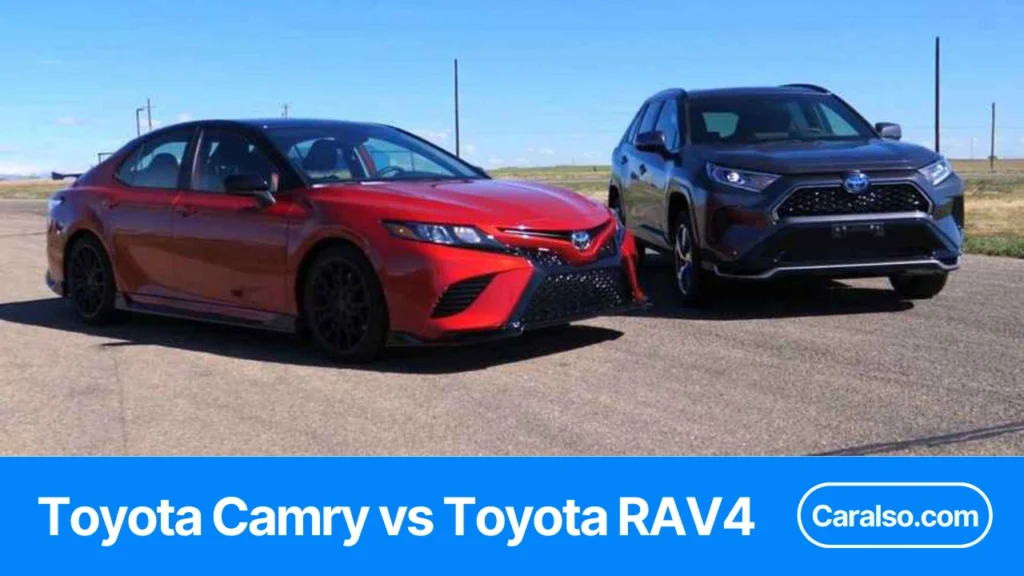
RAV4 Vs Camry
RAV4 Vs Camry Quick Verdict Table
| What Most People Care About | Winner | The Number That Makes It Obvious |
|---|---|---|
| Cargo For Strollers, Dogs, Costco Runs | RAV4 | 37.8 cu ft behind the 2nd row (RAV4) vs 15.1 cu ft trunk (Camry) |
| Snow, Driveways, Bad Roads | RAV4 | 8.1 in ground clearance (RAV4) vs 5.4 in (Camry) |
| MPG On A Typical Commute | Camry | Up to 52 city / 49 hwy (Camry) vs up to 47 city / 40 hwy (RAV4) |
| Turning In Tight Parking Lots | Slight RAV4 Edge | 36.9 ft turning circle (RAV4) vs 37.4 ft (Camry) |
| Seating | Tie | 5 seats in both |
My Fast “Pick This One” Rules
Pick the RAV4 if:
- You regularly fill the back with bulky stuff.
- You want 8.1 inches of ground clearance.
- You want up to 3,500 lbs of towing on the right trims and setup.
Pick the Camry if:
- Your driving is mostly pavement and highway.
- You want the highest MPG number Toyota puts on this matchup.
- You want sedan dynamics and a lower ride height.
RAV4 Vs Camry Quick Winner Table
Here is the clean way I compare them. I look at the numbers that change your daily routine.
| Category | Winner | Why It Wins (1 Line) |
|---|---|---|
| Cargo And Loading | RAV4 | 37.8 cu ft behind the 2nd row vs a 15.1 cu ft trunk. |
| Ground Clearance | RAV4 | 8.1 in vs 5.4 in. That is a 2.7 in gap. |
| Fuel Economy | Camry | Up to 52 city and 49 highway vs up to 47 city and 40 highway. |
| Parking And Easy City Driving | RAV4 | 181 in long and 36.9 ft turning circle vs 193.5 in and 37.4 ft. |
| Ride Comfort | Camry | 111.2 in wheelbase vs 105.9 in. Longer wheelbase usually helps ride. |
| Long Trip Legroom | Camry | 42.1 in front legroom vs 41.0 in. Rear legroom is 38.0 in vs 37.8 in. |
| Tall Passenger Headroom | RAV4 | 39.5 in rear headroom vs 37.6 in. |
| Snow And Rough Driveways | RAV4 | 8.1 in clearance matters more than AWD alone when snow piles up. |
| Resale Value | RAV4 | 5-year depreciation is listed at 30.3% vs 37.7%. |
| Towing | RAV4 | RAV4 is listed up to 3,500 lb on certain trims, while some trims list 1,750 lb. |
60-Second Decision Quiz
I use this when a friend texts me, “RAV4 or Camry?” and I want a fast answer.
How To Score It
- Answer Yes or No.
- Give 1 point to the model named in the question.
- Total your points.
The Questions
- Do you regularly need more than 15 cu ft of cargo space behind the rear seats?
Yes = RAV4 - Do you want 52 city and 49 highway MPG as your top target?
Yes = Camry - Do you deal with steep driveways, deep snow ruts, or rough parking lot entrances where 5.4 in clearance can scrape?
Yes = RAV4 - Do you want the smaller footprint for tight garages and street parking, like 181 in length instead of 193.5 in?
Yes = RAV4 - Do you care most about highway ride and a longer wheelbase, like 111.2 in?
Yes = Camry - Are rear-seat headroom complaints common in your household, like anyone 6 ft tall sitting back there often?
Yes = RAV4 - Do you want the lowest step-in height and a lower car that sits about 10 in shorter overall than the RAV4?
Yes = Camry - Is resale a top priority, like you plan to sell within 5 years?
Yes = RAV4
Your Result
- Mostly Camry points: Buy the Camry. You drive more miles on pavement. You want MPG and sedan comfort first.
- Mostly RAV4 points: Buy the RAV4. You live in the cargo area. You want clearance, loading flexibility, and SUV practicality.
- Tie: Use the tie-breakers below.
Tie-Breakers I Actually Use
- Garage Fit: If your garage is tight, measure length. The RAV4 is about 12.5 in shorter.
- Driveway And Snow: If you ever scrape today, 8.1 in clearance usually fixes that problem.
- Dog Or Stroller: If you load bulky items weekly, the hatch wins fast.
- Back Seat Adults: If tall adults ride back there often, rear headroom matters more than trunk shape.
Biggest Differences In Plain English (Sedan Vs SUV)
This is not a “which Toyota is better” question. It is a body style question.
A Camry is a midsize sedan. A RAV4 is a compact SUV. That changes how you sit, how you load stuff, and what happens when the road gets ugly.
Seating Position And Entry Exit
I start with height. It is the easiest number to feel.
- RAV4 height: 67.0 in
- Camry height: 56.9 in
That is a 10.1 in difference.
That 10.1 in shows up every time you get in and out. In the RAV4, you step in. In the Camry, you step down.
If you have knee or hip pain, this matters more than people admit.
Cargo Shape (Hatch) Vs Trunk
This is the part that tricks people.
- RAV4 cargo behind the 2nd row: 37.8 cu ft
- Camry trunk: 15.1 cu ft
That is a 22.7 cu ft gap.
But the shape matters even more than the number.
A trunk has a small opening and a fixed lid. A hatch has a wide opening and vertical height. That means:
- A stroller fits easier in the RAV4 because you can tilt it in.
- A dog crate fits easier in the RAV4 because you can stack tall.
- A 55-inch boxed TV is easier in the RAV4 because the opening is taller.
If you mostly carry flat things, like luggage and groceries, the Camry trunk works fine. If you carry bulky things, the hatch wins fast.
Ground Clearance And Winter Driveways
This is my snowbelt reality check.
- RAV4 ground clearance: 8.1 in
- Camry ground clearance: 5.4 in
That is 2.7 in more clearance.
2.7 in is the difference between scraping and not scraping. It is the difference between getting over plowed slush and getting stuck on it.
AWD helps you move. Clearance helps you not become a snowplow.
If you live where snow piles up at the end of the driveway, I lean RAV4.
Price And Value (New + Used)
I think about price in two buckets.
- The number on the window sticker.
- The number you can sell it for later.
New Price Reality And Why Model-Year Matching Matters
For 2026, the starting numbers look like this:
- Camry starting MSRP: $29,100
- RAV4 starting MSRP: $31,900 (Toyota press info, excludes processing and handling)
Some pricing lists show the RAV4 base starting at $33,350.
So you should plan on the RAV4 costing more up front in most builds.
Now the big warning.
Most comparison pages do not match years and powertrains. They will compare a hybrid Camry to a gas RAV4 from another year. That makes the MPG and price story messy.
Callout: Avoid Misleading Comparisons
- Match the model year first.
- Match hybrid to hybrid.
- If you compare a 2026 Camry to a 2025 gas RAV4, you are not comparing the same fuel system.
If you keep it apples to apples in 2026, both are hybrid-focused. Your decision swings back to space, clearance, and ride feel.
What Changed Recently That Affects Value
Two things changed the value math.
First, the 2026 Camry is hybrid-only. Toyota says it is exclusively hybrid, and it brings an estimated 51 MPG combined on the LE FWD grade. It is also expected to arrive at dealers in fall 2025.
Second, the 2026 RAV4 is hybrid-only and redesigned. Toyota says the 2026 RAV4 hybrid models are expected to start arriving in December 2025. Toyota also says plug-in hybrid pricing comes in the first half of 2026, and plug-in models are expected in spring 2026.
Here is how I use that info:
- If you want the lowest new-car price, the Camry usually wins. $29,100 starts the conversation.
- If you want the most flexible “one car” setup, the RAV4 usually earns its higher price with cargo and clearance.
- If you are shopping used, older gas versions can be the value play. A pre-2026 RAV4 has non-hybrid trims. Older Camry model years also have non-hybrid options. The trade is lower MPG.
One more simple value check I like:
- If you will keep it 5+ years, buy the one that fits your weekly routine.
- If you will sell in 3 to 5 years, I look harder at SUV resale trends, because demand for compact SUVs is usually stronger.
Fuel Economy And Running Costs (What Most People Really Mean By MPG)
When someone tells me “I care about MPG,” they usually mean three things.
- How often they will fill up.
- How much the car hates short trips and traffic.
- Whether the car feels expensive to run when they do nothing but drive to work.
In 2026, both the Camry and RAV4 are hybrid-focused. So the gap is not “hybrid vs not.” The gap is how the body style and trim choices change your real-world number.
Hybrid Vs Non-Hybrid Comparisons (Apples-To-Apples Rules)
I follow a simple rule. If you break it, the MPG comparison becomes noise.
Match these three things:
- Model year
- Drive type (FWD vs AWD)
- Trim and wheel size (bigger wheels usually cost MPG)
Example: A Camry LE FWD will usually beat an AWD RAV4 on fuel economy. That is not a surprise. It is also not a fair apples-to-apples comparison if you need AWD and cargo.
If you are shopping used, it gets even messier. Older Camry and older RAV4 model years include non-hybrid versions. Those will almost always lose to the 2026 hybrids on fuel economy. But they can win on purchase price.
My take: decide on body style first. Then compare the powertrain and trim inside that body style.
Real-World MPG Patterns (City Vs Highway)
Hybrids tend to shine in two situations.
- Stop and go city driving
- Suburban driving with lots of gentle braking
Highway is different. Aerodynamics matter more. Speed matters more. At 75 mph, most hybrids drop from their best-case numbers.
Here is what I watch for:
- If your commute is mostly city, the Camry’s top trims can still be efficient, but the LE FWD is usually the MPG king.
- If your commute is mostly highway at 70 to 80 mph, the gap shrinks. The Camry still tends to win, but it is not always a blowout.
One more thing. If you can charge at home, the RAV4 Plug-In Hybrid changes the whole conversation. If your daily driving fits inside the electric range, you can do a lot of your miles without using gas at all.
| Powertrain | Best For | MPG Expectation (Range, Not One Number) |
|---|---|---|
| Camry Hybrid FWD | Maximum MPG for commuting | City 47 to 52. Highway 45 to 49. Combined 46 to 51. |
| Camry Hybrid AWD | Snow traction without a big MPG penalty | City 43 to 50. Highway 43 to 49. Combined 43 to 50. |
| RAV4 Hybrid FWD | City mileage with SUV space | City 48. Highway 42. Combined 44 on the most efficient setup. |
| RAV4 Hybrid AWD | The “do everything” setup | City 41 to 46. Highway 36 to 42. Combined 39 to 44 depending on trim. |
| RAV4 Plug-In Hybrid (Gas Mode + EV) | Short commutes plus home charging | Gas mode combined about 37 to 41. EV range about 48 to 52 miles. MPGe is listed around 98 to 107. |
The Running Cost Stuff People Forget
MPG is not the whole cost.
Here are the two sneaky ones.
Wheel and tire size
Camry base trims can run smaller wheels. The LE is often on 16-inch wheels. Many RAV4 trims live on 18-inch wheels, and the GR SPORT goes bigger. Bigger tires usually cost more per set.
Weight
In real testing trim-to-trim, the RAV4 can be hundreds of pounds heavier than the Camry. That can show up in tire wear and braking wear.
Maintenance coverage
On the basics, Toyota keeps it simple. Both are typically covered with 2 years or 25,000 miles of complimentary scheduled maintenance. Hybrid components are listed at 10 years or 150,000 miles.
If you want a clean way to estimate fuel cost, I do this:
- Annual fuel gallons = miles per year ÷ your real-world MPG
- Annual fuel cost = annual gallons × your local price per gallon
That gets you to a real number fast.
Comfort, Noise, And Ride Quality (Commuter Priority)
If you commute, I care about two numbers before I care about screens.
- 70 mph cabin sound
- Wheelbase
That is where your fatigue comes from.
Highway Comfort And Road Noise
Here is the simplest way I can show it with data.
Car and Driver measured interior sound at 70 mph like this:
- Camry: 67 dBA and 22 sones
- RAV4: 69 dBA and 24 sones
That is a small but real advantage for the Camry at cruise.
Under hard acceleration, both can get louder. The Camry’s full-throttle number is listed at 73 dBA in that test, and the RAV4 is listed at 75 dBA.
Wheelbase matters for ride, too.
- Camry wheelbase: 111.2 in
- RAV4 wheelbase: 105.9 in
That 5.3-inch difference helps explain why the Camry often feels more settled on long highway stretches.
One more detail I pay attention to: trim matters.
Car and Driver notes that Camry XLE and XSE add acoustic-laminated glass. That can take the edge off wind and road noise.
On the RAV4 side, multiple reviews still mention the 2.5-liter engine getting noisy when you ask for full power. That is not a deal-breaker for most people. But if you are sensitive to sound, it is something you will notice on on-ramps.
Seating Comfort And Visibility
This is where I see the biggest commuter split.
RAV4 visibility wins for a lot of drivers. You sit higher. You see over traffic. You get an easier “look ahead” view in city driving.
Camry comfort wins in a different way. You sit lower. The car is longer and more aerodynamic. The wheelbase is longer. On the highway, that tends to reduce the busy SUV feel.
If you want a quick numbers-based snapshot from the same test sources:
- Camry passenger volume (front and rear listed separately): 53 and 46 ft³
- RAV4 passenger volume (front and rear listed separately): 51 and 48 ft³
So the Camry tends to give a bit more up front, and the RAV4 tends to give a bit more in the rear.
My practical advice: if you can only test-drive one thing, do this.
- Drive both at 70 mph for 10 minutes.
- Do two full-throttle merges.
- Then decide which cabin you want to live in.
Space And Practicality (Family Reality Check)
This is where the RAV4 usually wins in real life. Not because the cabin is bigger. It is not by much. It wins because the space is easier to use.
Here are the cabin numbers I lean on:
- Passenger volume: 98.9 cu ft (RAV4) vs 99.9 cu ft (Camry)
- Rear legroom: 37.8 in (RAV4) vs 38.0 in (Camry)
- Rear headroom: 39.5 in (RAV4) vs 37.6 in (Camry)
Rear legroom is basically a tie. Rear headroom is not.
Rear-Seat Space And Car-Seat Friendliness
If you are dealing with car seats, I care about two things.
- Can an adult sit in front of a rear-facing seat without eating the dash.
- Can you buckle without bending your neck into the door frame.
On legroom alone, both work.
- Front legroom: 41.0 in (RAV4) vs 42.1 in (Camry)
- Rear legroom: 37.8 in (RAV4) vs 38.0 in (Camry)
So the “will it fit” part is fine either way.
Where the RAV4 pulls ahead is height.
- Vehicle height: 67.0 in (RAV4) vs 56.9 in (Camry)
- Rear headroom: 39.5 in (RAV4) vs 37.6 in (Camry)
That 10.1 in height gap shows up when you lean in to buckle. You have more roof space. You also usually get a more upright seatback angle in the rear.
If you have two kids and you do school drop-off twice a day, that matters.
Cargo Use-Cases
I do not obsess over cubic feet. I look at what fits.
Stroller Test
If you have a stroller, the opening matters more than the floor area.
- RAV4 cargo behind the rear seats: 37.8 cu ft
- Camry trunk: 15.1 cu ft
The RAV4 also has a taller opening. So you can tilt a stroller in without fighting the trunk lid line.
Costco Run
I like suitcase testing because it is simple.
In Car and Driver testing:
- RAV4 fit 10 carry-on suitcases behind the rear seats.
- Camry fit 7 carry-on suitcases in the trunk.
That matches what I see in real shopping runs. The RAV4 handles tall bulk better. The Camry handles normal grocery bags fine, but you run out of vertical space fast.
Bike Or Bulky Items
If you fold seats, both can carry long items. But the RAV4 makes it easier.
In Car and Driver testing:
- RAV4 fit 24 carry-on suitcases with the rear seats folded.
- Camry fit 19 carry-on suitcases with the rear seats folded.
The Camry’s limitation is the opening. The trunk pass-through is still a sedan opening. The RAV4 is a hatch. It is wider and taller where you need it.
Usable Space Score (My Rubric)
This is my quick scoring system. Each category is 1 to 5.
- Opening Height: How tall the opening is for bulky items.
- Load Floor: How easy it is to slide things in without lifting high.
- Seat-Fold Utility: How flat and useful the folded space feels.
| Criteria (1 To 5) | RAV4 Score | Camry Score |
|---|---|---|
| Opening Height | 5 | 2 |
| Load Floor | 4 | 3 |
| Seat-Fold Utility | 4 | 3 |
| Total (Out Of 15) | 13 | 8 |
If you live in the cargo area, the RAV4 wins. If you mostly haul people and a few bags, the Camry is enough.
Snow, AWD, And Bad Roads
This section is where people overthink AWD and underthink clearance and tires.
I keep it simple.
- Camry ground clearance: 5.4 in
- RAV4 ground clearance: 8.1 in
That is a 2.7 in gap.
If you deal with plowed snow piles, ruts, or a steep driveway, 2.7 in is not a rounding error. It is the difference between scraping and cruising.
Camry AWD Vs RAV4 AWD (Who Actually Benefits)
Both can be had with AWD in 2026. Both use an electric motor at the rear axle when equipped with AWD.
Camry AWD is for someone who wants:
- Sedan ride height.
- High MPG.
- Better traction on wet roads and light snow.
Toyota says the Camry’s Electronic On-Demand AWD is available across grades. AWD models are rated at 232 net combined hp. FWD models are 225 net combined hp.
RAV4 AWD is for someone who wants:
- Clearance first.
- Trailhead roads, gravel lots, and deeper snow days.
- Cargo plus traction.
Toyota says RAV4 Hybrid AWD models use a dedicated rear electric motor for the Electronic On-Demand AWD system. Toyota also lists 236 net combined hp on AWD and 226 on FWD. Toyota even lists rear motor torque at 89 lb-ft on AWD models.
My take: Camry AWD is great for traction. RAV4 AWD is traction plus clearance plus a hatch.
Ground Clearance And Why It Matters
I do not care how many drive modes you have if you are high-centered.
Ground clearance is the first gate.
- 5.4 in clearance means you have to pick lines in slush.
- 8.1 in clearance means you usually do not.
MotorTrend made the same point years ago in a simple way. AWD helps you move. Clearance helps you not get stuck on the snow itself.
If your roads are plowed fast and you are mostly on pavement, Camry AWD can be enough. If you see unplowed side streets, rural roads, or deep end-of-driveway piles, I pick the RAV4.
Pro Tip: The Most Important Upgrade Is Not AWD. It Is Tires.
If you do one thing for winter traction, do this.
Pick one:
- A real winter tire set.
- A 3PMSF-rated all-weather tire.
Then drive the same route.
A FWD car on good winter tires can feel safer than an AWD car on worn all-seasons. Tires are the only part touching the road.
If you live where snow sticks around for months, I would rather have:
- Camry FWD with winter tires
than - Camry AWD with cheap all-seasons
And if you want the most winter-proof setup in this pair:
- RAV4 AWD with winter tires
Reliability And Maintenance (Avoid Overclaiming)
Both of these are Toyotas. Both are hybrids in 2026. That usually means you are starting from a good place.
But “reliable” is not one thing. It is two things.
- Powertrain reliability.
- Wear-and-tear from how you use the vehicle.
What Reliability Means Here (Powertrain Simplicity Vs Use-Case Wear)
The Camry and RAV4 share a lot of Toyota hybrid DNA. That is the good news.
The difference is how people treat them.
A Camry usually lives on pavement. It usually hauls people and bags. It usually does fewer “max load” trips.
A RAV4 often hauls more weight. It carries taller cargo. It sees more potholes, gravel lots, and curb hits. That can show up as faster wear on tires and suspension parts.
If you want one data point, iSeeCars rates both near the top. It gives the RAV4 a reliability score of 8.2 out of 10 and the Camry 8.1 out of 10. I treat that as “both strong” with a tiny edge to the RAV4 in that dataset.
My real-world rule is simple.
If you buy used, the owner matters more than the badge. Service records beat vibes.
Maintenance Cost Drivers (Tires, Brakes, Suspension Wear Differences)
I look at three cost buckets.
Tires. Brakes. And alignment.
Here is why the RAV4 can cost more.
- It often runs larger wheels than a base Camry.
- It can weigh more depending on trim and AWD.
- It gets used like an SUV.
Here is a quick cost-driver table I use.
| Item | Camry Tends To Do | RAV4 Tends To Do | Why It Matters |
|---|---|---|---|
| Wheel Size | Smaller on base trims | 17 to 20 in depending on trim | Bigger tires usually cost more per set. |
| Curb Weight | About 3,450 lb in base form | About 3,745 to 3,875 lb depending on trim | More weight can mean faster tire and brake wear. |
| Brakes | Hybrid regen helps | Hybrid regen helps | Regen can reduce pad wear in both. Driving style still matters. |
| Alignment | Less curb contact | More curb and pothole exposure | Misalignment eats tires fast. |
Service intervals are where people get confused.
Many Toyotas with synthetic oil follow a 10,000-mile oil change interval. But the 5,000-mile service interval is still real. It is usually inspections and tire rotation.
If you do lots of short trips, heavy loading, dusty roads, or towing, I would not stretch intervals. Severe use is severe use.
Two ownership perks to know:
- ToyotaCare covers normal factory scheduled maintenance for 2 years or 25,000 miles.
- Toyota’s hybrid battery warranty is 10 years or 150,000 miles.
Recalls And How To Check By VIN
I never buy a used car without doing this first.
- Find the 17-character VIN. Check the lower left windshield or the driver door jamb label.
- Go to the NHTSA recall page and run the VIN.
- If it shows an open recall, call any Toyota dealer. Recall repairs are free.
Two details most people miss:
- The VIN tool shows unrepaired safety recalls. It does not show recalls that were already fixed.
- Some very new recalls may not show up immediately for every VIN. So I re-check later.
I do this twice a year. It takes 60 seconds.
Resale Value And Depreciation (Why RAV4 Often Wins)
This is where the market usually favors the RAV4.
Not because the Camry is bad. Because SUVs sell fast.
Market Demand (SUV Tax Vs Sedan Bargains)
Compact SUVs are in high demand. The RAV4 sits right in the middle of that.
That demand does two things:
- It helps RAV4 trade-in values.
- It keeps used RAV4 prices high.
Sedans are the flip side.
A used Camry can be a better deal for the buyer. Lower depreciation can be great for the seller. But higher used prices can be painful for the shopper. Sedans sometimes give you more car for the money.
So ask yourself this:
Do you want a better deal today. Or a higher sale price later.
What Datasets Show (And Limits)
One clean data point comes from iSeeCars.
It lists 5-year depreciation like this:
- RAV4: 30.3%
- Camry: 37.7%
That is a 7.5-point difference.
Put real money on it. If you start at $35,000, 7.5% is $2,625.
Now the limits.
Depreciation is not a guarantee. It depends on:
- Miles per year
- Condition and accident history
- Trim and options
- Color and wheels
- Local supply and demand
My practical resale tips are boring. They work.
- Keep service records.
- Fix windshield chips fast.
- Match tires as a full set.
- Avoid mods that make it harder to sell.
If resale is a top priority, the RAV4 usually makes the math easier. If you want maximum value per dollar on the used market, the Camry can be the smarter buy.
Best Trims For Most People (Trim Picks That Speed Decisions)
I pick trims the same way every time. I start with the job the car has to do. Then I pick the trim that hits that job with the fewest compromises.
Here are the trims I point most people to.
| Budget Or Need | Camry Trim To Target | RAV4 Trim To Target | Why |
|---|---|---|---|
| Commuter Value | Camry LE FWD | RAV4 LE FWD | Lowest starting MSRP in each lineup. Top fuel economy in the lineup trims. Smaller wheels on Camry LE at 16 inches. |
| Quiet And Comfort | Camry XLE | RAV4 XLE Premium | Camry XLE gets front-side acoustic laminated glass. It also gets a standard 12.3-inch digital gauge cluster. RAV4 XLE Premium adds SofTex seats and heated front seats, plus a power liftgate. |
| Snow Belt | Camry LE AWD | RAV4 Woodland | Camry AWD is available on every Camry grade and bumps output to 232 net combined hp. RAV4 Woodland adds all-terrain tires and 8.5 inches of ground clearance. |
| Family Hauling | Camry SE | RAV4 XLE Premium | Camry SE is the best value if you want a sporty look and the daily-driver features without jumping to the top trims. RAV4 XLE Premium adds a height-adjustable power liftgate and parking assist with automatic braking. |
| Least Hassle Long-Term | Camry LE AWD | RAV4 LE AWD | I keep it simple. Fewer big wheels. Fewer extras. Still gets the hybrid system, the safety suite, and the core tech. AWD is there if you need it. |
Quick Notes I Tell Friends Before They Click “Build”
Camry notes:
- LE, SE, Nightshade, XLE, and XSE all offer FWD or AWD.
- If you want the quietest Camry setup, start with XLE or XSE. Those get front-side acoustic laminated glass.
- If you want the sport-tuned suspension, look at SE, Nightshade, or XSE.
RAV4 notes:
- LE, SE, XLE Premium, Woodland, XSE, and Limited are the core grades listed.
- Woodland is the one I pick for rough roads. Toyota lists 8.5 inches of ground clearance on Woodland.
- If you want the biggest screen Toyota lists on RAV4, the XSE calls out a 12.9-inch Toyota Audio Multimedia system.
Test-Drive Checklist (Actionable, Trust-Building)
I do not buy on spec sheets. I drive both on the same route. Same speeds. Same bumps. Same parking lot.
Do this and the answer gets obvious.
Camry Checks
- Do A 70 MPH Sound Check
Drive at 70 mph for 10 minutes. Note the cabin sound. Camry testing has shown 67 dBA at 70 mph in instrumented runs. Use your ears anyway. - Do Two Full-Throttle Merges
Hit an on-ramp twice. Listen for engine flare. Hybrids can sound busy when you pin it. - Check Seat Fit In 3 Minutes
Set the seat, then lock it in. Check thigh support. Check if your right knee hits the console. Then sit behind yourself. - Check Trunk Reality, Not Trunk Volume
Open the trunk. Put your biggest regular item in it. Stroller. Golf bag. Large suitcase. The Camry trunk is 15.1 cu ft. The opening shape is the real test. - Check AWD Engagement On A Tight Turn
If you are driving an AWD Camry, do a low-speed U-turn in a quiet lot. Listen for anything odd. Feel for any shudder. It should be smooth.
RAV4 Checks
- Do A Cargo Load Height Test
Open the hatch. Lift a heavy item into the cargo floor. The RAV4 cargo space is 37.8 cu ft behind the rear seats. The load height and opening decide if you will love it. - Do A Visibility Sweep
Check front corners. Check over-shoulder blind spots. Then do a lane change with mirrors only. The seating height is 67.0 inches overall vehicle height, so the view is different right away. - Do A Ride Test Over Sharp Bumps
Find a rough patch at 25 to 35 mph. Listen for suspension noise. Feel the hit. SUVs can feel busier than sedans on the same bumps. - Do A 70 MPH Sound Check
Same as the Camry. RAV4 testing has shown 69 dBA at 70 mph in instrumented runs. The difference is small. Your sensitivity decides if it matters. - Do A Parking Lot Maneuver Test
Do a tight turn into a spot. Then back out. The RAV4 turning circle is listed at 36.9 ft in specs. The higher hood and hatch visibility matter more than the number.
FAQs
Is The RAV4 Bigger Than The Camry?
It depends on what you mean by “bigger.”
The Camry is longer. About 193.5 inches vs 181 inches for the RAV4.
The RAV4 is taller. 67.0 inches vs 56.9 inches for the Camry.
Inside, passenger space is basically a tie. About 98.9 cu ft (RAV4) vs 99.9 cu ft (Camry).
Cargo is not a tie. 37.8 cu ft behind the rear seats in the RAV4 vs a 15.1 cu ft trunk in the Camry.
Is The Camry More Comfortable Than The RAV4?
Most commuters will say yes. And the numbers support why.
The Camry wheelbase is 111.2 inches. The RAV4 is 105.9 inches.
A longer wheelbase often rides smoother on highway waves.
Cabin sound tests at 70 mph also lean Camry. 67 dBA for Camry vs 69 dBA for RAV4 in instrumented runs.
If you want the easiest way to decide, drive both at 70 mph for 10 minutes. Then do two hard merges. Pick the one that feels calmer.
Which Is Better In Snow?
If snow gets deep or rutted, the RAV4 is the safer bet.
Ground clearance is the big number.
RAV4 is 8.1 inches. Camry is 5.4 inches. That is a 2.7-inch gap.
Both can have AWD. But AWD does not help if the car is pushing snow with the belly.
My winter rule is simple. Tires matter more than AWD. Put real winter tires on either one and it will feel like a different vehicle.
Which Is Cheaper To Own?
Usually the Camry costs less day to day. The RAV4 can cost less to “get out of” later.
Camry starts lower in price. $29,100 vs $31,900 for RAV4 in Toyota’s early 2026 pricing.
Camry can also use less fuel if you pick the high-MPG trims.
RAV4 often costs more for tires. Many trims run larger wheels.
RAV4 often holds value better. Some datasets show lower 5-year depreciation for RAV4 than Camry.
If you keep the car 8 to 10 years, daily costs matter more. I lean Camry.
If you trade every 3 to 5 years, resale matters more. I lean RAV4.
Hybrid: Which Makes More Sense For My Driving?
For 2026, this is easy.
Camry is hybrid-only. Pick it if you want the best MPG numbers and you drive lots of pavement miles.
RAV4 Hybrid is for people who want hybrid efficiency plus cargo and clearance.
RAV4 Plug-In Hybrid is for a specific person. You can charge at home. Your daily driving fits inside the EV range. Many listings show about 48 to 52 miles of EV range depending on trim and conditions. If that is you, it can cut your gas use a lot.
Key Takeaways
- Pick RAV4 for cargo and clearance. 37.8 cu ft behind the rear seats. 8.1 inches of ground clearance.
- Pick Camry for commuting efficiency. Up to 52 city and 49 highway MPG.
- The Camry is longer. About 193.5 inches vs 181 inches for RAV4.
- The RAV4 is taller. 67.0 inches vs 56.9 inches for Camry.
- Passenger space is basically a tie. About 98.9 cu ft vs 99.9 cu ft.
- Snow decision comes down to clearance and tires. 8.1 inches vs 5.4 inches matters more than AWD marketing.
- If you flip cars every 3 to 5 years, RAV4 resale usually helps. If you keep cars a long time, Camry fuel costs often win.
Sources
- Toyota USA Newsroom, 2026 RAV4 Arrives This Winter (timing, MSRP, lineup details)
- Toyota USA Newsroom, 2026 Toyota Camry Vehicle Page (press kit hub)
- Toyota Official Camry Model Page (general trims and official info, may be script-heavy)
- Car And Driver, 2026 Toyota RAV4 Review, Pricing, And Specs (test results, noise, cargo suitcase count)
- Edmunds, 2026 Toyota Camry Specs And Features (trunk volume, turning circle, key dimensions)
- iSeeCars, Toyota RAV4 vs Toyota Camry Comparison (5-year depreciation comparison)

Hey there,
How is it going?
I’m Meraj Sarker. I am a Car Mechanic and a student of Automobile Restoration here in Florida, USA. I’ve been studying automotive for around 9 years now. So you can rely on my recommendation. For me, studying and getting knowledge about automobile it’s really fun and entertaining. I will help you to get solutions for your car through this website. If you need any help let me know.