
When I see a RAV4 with the engine light, VSC light, and 4WD light all on together, I do not assume three separate failures. On most RAV4s, especially 2006 to 2012, that trio usually means the engine computer has stored a fault and then switched off stability control and four wheel drive helpers as a precaution.
In other words, the check engine light is the leader. VSC and 4WD are followers. Fix the engine or emissions problem and the other two lights usually go away with it. The trick is to read the code first, then work through the likely causes instead of throwing random parts at the car.
Quick Answer – What It Means When RAV4 Engine, VSC & 4WD Lights Are On
On a RAV4, that combination almost always means the engine control module has stored a fault in the engine or emissions system. Once that happens, the computer may disable stability control and automatic four wheel drive functions, so it turns on the VSC and 4WD lights to warn you. The car might still drive, but some safety and traction features can be limited until you fix the root cause.
The lights are basically telling you three things in this order.
- Read the fault code with a scan tool.
- Fix the underlying engine, emissions, or sensor issue that set the code.
- Then clear the codes and confirm the lights stay off after a few drives.
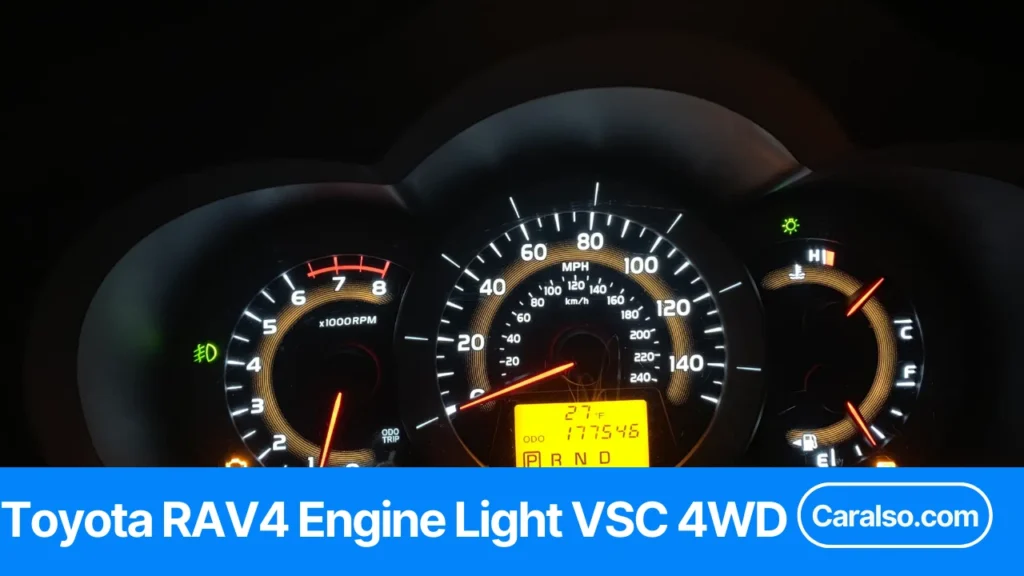
RAV4 Engine Light, VSC & 4WD
Lights And Symptoms To Likely Causes
Use this as a quick filter before you panic.
| Lights / Symptoms | Likely Cause Category | Risk Level | What To Do Next |
|---|---|---|---|
| Engine, VSC, 4WD lights on. RAV4 drives normally. No obvious noise or power loss. | EVAP leak or loose gas cap. O2 or A/F sensor fault. MAF or intake hose issue. | Low to Medium | Check gas cap and tighten it. Inspect intake hose and air filter. Scan for codes within a few days. |
| Engine, VSC, 4WD lights on. Rough idle. Shaking at stops. Noticeable power drop. | Misfire. O2 or A/F sensor. EGR or intake deposits. Fuel delivery or MAF problem. | Medium to High | Avoid long trips and hard driving. Get codes read as soon as you can. Fix before highway or towing use. |
| Engine, VSC, 4WD lights on. Strong power loss or limp mode. Car struggles to reach 20 to 40 mph. | Serious engine or emissions fault. Possible catalyst, EGR, sensor failure, or in rare cases transmission or 4WD control issue. | High | Stop driving if you can. Arrange a tow to a shop. Ask for full diagnostic and do not just clear codes. |
| Engine, VSC, 4WD lights come on mostly in heavy rain or after deep puddles. Sometimes go away when dry. | Wheel speed sensor or ABS wiring affected by moisture. Connector or harness corrosion. Marginal sensor that acts up when wet. | Medium | Try to scan while lights are on. Inspect wheel speed sensor wiring at the hubs. Clean and repair as needed. |
| Engine, VSC, 4WD lights appeared right after a battery change or a very weak battery incident. | Low voltage stored codes. Incomplete readiness. Possibly loose battery terminals or ground. | Low to Medium | Check battery and charging voltage. Tighten terminals. Clear codes once and see if they return. |
From here, the next steps are simple. Confirm the basics like the gas cap and intake. Then get the codes read so you know which path you are on. Everything else in the guide builds on that.
What These Lights Actually Mean On A RAV4
When I see these three lights together on a RAV4, I treat the check engine light as the boss and the VSC and 4WD lights as followers. The engine control module has seen something it does not like, stored a code, and then turned off stability and 4WD helpers so it does not have to rely on a possibly sick engine.
Check Engine Light – The Master Trigger
The check engine light means the engine control module has stored a diagnostic trouble code. That code is a number that points to a system, sensor, or type of fault. It can be an EVAP leak, an oxygen sensor, a misfire, a MAF issue, or something more serious.
On Toyotas, once that light is on, a lot of other systems start to take a step back. Cruise control may stop. Stability control logic changes. AWD engagement rules can change. This is why you see all three lights at once so often.
The important part is simple. You have to read the code. Guessing is how people end up buying a gas cap, then an O2 sensor, then a MAF, and still have the same problem. A ten minute scan with a basic OBD tool or at a parts store is worth more than a pile of random parts.
VSC Light – Stability Control Disabled When The Engine Is Not Right
VSC on a RAV4 is Vehicle Stability Control. It uses wheel speed sensors, steering angle, yaw sensors, and engine power to keep the car pointed where you ask. If the engine or emissions system has a problem, the computer does not want to rely on precise power cuts to keep you safe. So it turns VSC off and lights the VSC warning.
You might still feel the car drive fine in normal conditions. The difference only shows up in extreme situations. Sudden lane changes, wet curves, icy patches. With VSC off, the car behaves more like an older SUV even if the check engine issue is something small like an EVAP leak. That is why I never ignore this, even when the car feels normal around town.
4WD / 4×4 Light – Why It Comes On With Check Engine
On an on demand AWD RAV4, the system uses clutch packs and electronic control to send power to the rear wheels when needed. The AWD controller depends on good data from the engine and ABS systems to know how much torque it can safely send and when. If the engine has a fault, that data is no longer trusted.
Toyota techs and owners see this pattern all the time. Check engine light comes on. At the same moment, VSC and 4WD lights also come on and stay on. Cruise control often stops working too. Fix the engine side fault and clear the code, and all three lights usually go out together.
So the 4WD light in this scenario often does not mean a broken differential. It means AWD and traction control are in a restricted mode until the engine or emissions system is healthy again.
Most Common Causes Of RAV4 Engine + VSC + 4WD Lights
Now I will walk through the causes I see over and over again when a RAV4 shows this triple light combo. The code list on each car can be long, but the patterns are pretty consistent.
Loose Or Failing Gas Cap / EVAP Leak
This is the simplest cause and it shows up a lot. The EVAP system keeps fuel vapors from venting to the air. If the gas cap is loose, cracked, or its rubber seal is hard, the system cannot hold pressure. The ECM sees this as a leak and sets a code like P0440 through P0457. That lights the check engine. VSC and 4WD follow.
On RAV4 forums you can find people who chased this for weeks, only to find the cap did not even make one solid click when they tightened it. Clean the O ring, reinstall, get at least 3 clicks, and in some cases the lights clear right away or after a few trips. If the cap will not seal tightly, I replace it before I start hunting deeper leaks.
Oxygen Sensor Or Air Fuel Ratio Sensor Faults
Oxygen sensors and air fuel ratio sensors live in a very hot, dirty environment. On 2006 to 2012 RAV4 in particular, failing O2 or A/F sensors are a very common cause of check engine plus VSC and 4WD lights. Typical codes include P013x or P014x for sensor circuits and sometimes P0420 for catalyst efficiency if the readings are out of range for a long time.
When these sensors age, the engine computer may run the mixture too rich or too lean. You might notice worse fuel economy, a slight stumble, or a smell from the exhaust. Or you might not feel anything, and only the three lights give the game away. In most cases the fix is to replace the failed sensor with the correct part number and clear the codes. Catch it early and you help protect the catalytic converter too.
MAF Sensor And Intake Hose Problems
The MAF sensor sits in the air intake and tells the computer how much air is flowing in. If it gets coated with dust and oil, or if the intake hose is loose or cracked, the reading can be way off. Several RAV4 owners have reported that cleaning a dirty MAF and reseating the intake hose cured their check engine, VSC, and 4WD lights in one shot.
The symptoms can range from nothing obvious to rough idle and hesitation. Typical codes may talk about MAF performance, lean mixture, or general fuel metering faults. I like to pull the MAF, clean it only with proper MAF cleaner, let it dry, and make sure the hose clamps at the air box and throttle body are tight. If the sensor is cracked or heavily corroded, I replace it. This is often a mid cost fix rather than a major one.
EGR And P0400 Type Codes
Some RAV4 owners see the triple lights along with messages like “Check engine system, check 4×4 system, check VSC system” and a code P0400 in memory. That is an EGR flow code. The exhaust gas recirculation system recirculates a controlled amount of exhaust back into the intake to reduce NOx emissions.
On certain engines, the EGR valve and passages can coke up with carbon. When that happens, the commanded flow and the actual flow do not match. The ECM logs a fault, lights the check engine, and again VSC and 4WD follow. Depending on how bad the blockage is, the engine may run rough, especially at light throttle. The fix can be as simple as cleaning passages and replacing the valve, or in heavy cases replacing more components.
Wheel Speed Sensors And ABS Related Issues
Wheel speed sensors feed data to ABS, traction control, and stability control. If one of them fails, gets hit by debris, or the wiring corrodes, the system may think a wheel is doing something impossible. That can throw ABS codes and stability control faults. On some RAV4 cases, that shows up together with the check engine light and 4WD light.
You may see ABS or traction lights too, or feel ABS kick in when it should not. Diagnosis is usually by reading ABS and chassis codes in addition to engine codes, then checking the suspect wheel sensor and harness at the hub. In rust belt states, the sensor bolts and tone rings can also corrode. Replacement sensors are not the cheapest wear item on the car, but they are still nowhere near engine rebuild money.
Low 12 Volt Battery, Ground Or Charging Issues
Low voltage events can put modern Toyotas in a strange mood. A weak 12 volt battery or poor connection can cause modules to boot up incorrectly. That can scatter random codes across the engine, ABS, VSC, and 4WD systems. Many owners report engine plus VSC lights showing up soon after a dead battery incident or a battery change.
If the lights started right after a jump start or battery swap, I always check basics first. Battery age, resting voltage, alternator output, and how clean and tight the terminals and grounds are. If voltage is low or unstable, I fix that first, then clear the codes once and see which, if any, come back. If the lights return with the same code after a healthy voltage check, I treat the stored code as a real fault rather than just a side effect of a weak battery.
RAV4 Generation Differences (2001–2012 Vs Newer)
I look at the lights a little differently depending on which RAV4 generation I am working on. The basic rule is the same. Engine fault first. VSC and 4WD follow. The hardware and common failure points do change by year though.
2001 To 2005 RAV4 – Earlier Stability And 4WD Control
On the 2001 to 2005 RAV4 you have earlier versions of stability and four wheel drive control. The systems are simpler than on newer trucks, but the logic is familiar. If the engine control module sees a serious fault and turns the check engine light on, it can also change how traction and 4WD behave.
These years can still throw the same trio of lights. Engine, VSC or TRAC, and a 4WD related warning. The root cause is usually an engine side problem, not a transfer case failure. Things like oxygen sensors, EVAP leaks, ignition faults, or intake issues are still high on the list.
Parts are older now, so I pay extra attention to wiring and grounds on these. Corrosion at connectors and tired 12 volt batteries create more “ghost” issues. The approach does not change. Read the codes. Fix the engine or emissions issue first. Then confirm the stability and 4WD functions work with the lights out.
2006 To 2012 RAV4 – Most Common For This Complaint
The 2006 to 2012 RAV4 is where I see this three light combo the most. This is the XA30 generation. Stability control and on demand AWD are more tightly integrated with the engine and ABS systems. When the ECM is not happy, it tends to light everything up.
On these years, the usual suspects look like this in my notes.
- Gas cap or small EVAP leak.
- Oxygen sensor or air fuel ratio sensor faults.
- MAF sensor or intake hose problems.
- EGR flow issues on certain engines.
- Wheel speed sensor or ABS harness damage.
- Low or weak 12 volt battery after years in service.
Most of the forum stories you find with “check engine, check 4×4, check VSC” come from this generation. People see the three lights, scan the codes, find something like P0440, P0138, P0400, or a wheel speed sensor code, fix that, and all three lights clear together.
Because this generation is right in the sweet spot for age and mileage, I treat it as the main target for this guide. The good news is that many of these fixes are straightforward once you know where to look.
2013 And Newer RAV4 – Same Logic, Newer Modules
From 2013 onward the RAV4 moved to newer platforms and electronics. The dash layout changed. The AWD setup changed. Stability control got smarter. The core idea did not change. When the engine has a stored fault, the computer may pull back VSC and AWD and light those warnings.
On these newer trucks I still see the same broad themes. EVAP issues. O2 sensors. MAF readings. Wheel speed sensors. Battery and charging problems. The difference is in how the modules talk to each other and which codes you see. There are also more software and firmware updates in the mix.
I treat 2013 and newer RAV4 the same way as far as the first steps. I check the basics. I scan for codes. I fix the engine or emissions problem first. Then I clear the codes and confirm that stability and AWD functions come back online with no new warnings. The stack is newer, but the workflow is the same.
DIY Checks Before You Spend Money
Before you book a dealer visit or start ordering sensors, I always recommend a few simple checks. These can catch the cheap and easy stuff and also give you better information to hand to a shop if you do need help.
Step 1 – Check The Gas Cap Properly
I start at the fuel door because it takes 30 seconds.
Open the door. Remove the cap. Look at the rubber seal. If it is cracked, flattened, or missing chunks, plan on a new cap. If it looks good, reinstall it and tighten it until you get at least three solid clicks. Not one half turn. Real clicks.
If the cap was loose, the lights may not clear instantly. The EVAP system needs a few drive cycles to retest. That can mean a couple of cold starts and some mixed driving. If you have a scan tool, you can clear the code once after tightening the cap and then see if it comes back. If the same EVAP code returns, the leak is somewhere else.
Step 2 – Look Under The Hood
Next I go straight to the air path.
Pop the hood. Find the air box and the large intake hose that runs to the throttle body. Make sure the hose is fully seated on both ends and that the clamps are tight. If that hose is loose, the engine can pull in air that the MAF never sees, and that can set lean codes and make the car run poorly.
Open the air box and look at the filter. If it is dark, oily, or packed with debris, replace it. A filthy filter can load the MAF with dust and oil.
Find the MAF sensor in the intake tube. Check that its connector is fully seated and the wiring is not rubbed through. Do the same quick check on any easy to see oxygen sensor connectors near the engine. I do not yank on anything. I just look for obvious loose plugs or broken clips.
Sometimes that is all it takes. I have seen RAV4s with this three light combo where the only real issue was a loose intake snorkel after a DIY air filter job. Tighten the hose. Clear the code. Drive. Lights stay off.
Step 3 – Scan For Codes, Not Just Reset
This is the most important DIY step. You need to know what the computer is mad about.
You do not need an expensive shop tool. A basic OBD2 dongle and a phone app can read codes on any OBD compliant RAV4. Many parts stores will also read codes for free. I always write them down before anyone clears them.
There are two parts to this.
- The code itself. Examples: P0440 to P0457 for EVAP leaks. P013x or P014x for O2 sensors. P0xxx for many engine and emissions faults. C0xxx or similar for ABS and stability codes.
- The freeze frame or context. Engine load, rpm, coolant temp, speed when the code set.
Even if you do not fully understand the meaning yet, having that list of codes and conditions keeps you from guessing. You can then match those codes to the common causes in this guide or hand the list to a shop and save them time.
What I do not do is clear codes blindly before I know what they were. Once you wipe them, you lose the roadmap.
Step 4 – Quick Brake And 4WD Function Check
With those three lights on, some or all of the stability and 4WD functions can be limited. I like to get a feel for what is still working in a safe place.
Find an empty, safe area with some loose gravel or a dirt shoulder. At a low speed, brake firmly and see if you feel the ABS pedal pulsing. If ABS still cycles, that part of the system is awake. If a wheel locks up easily with no ABS feel, you may have an ABS or wheel sensor fault in addition to the engine code.
For 4WD, find a tight, slow turn on a loose or wet surface. Gently accelerate. On an on demand AWD RAV4 you should feel the rear wheels contribute and the car should pull itself out without front wheel spin alone. If the rear never seems to help, and you already have the 4WD light on, the system may be in a reduced mode.
I do not beat on the car to test this. I just gather clues. Combined with the codes, this helps me sort out whether I am dealing with a simple engine side issue that dragged the other lights along, or a deeper problem that touches ABS and AWD hardware too.
Is It Safe To Drive With RAV4 Engine, VSC & 4WD Lights On?
When someone calls me with this exact question, I think about safety first, convenience second. The lights are warning you about two things at once. The engine or emissions system has a fault. Stability control and four wheel drive helpers may be limited. Whether you can drive or should park it comes down to how the car feels, not just what the dash looks like.
When It Is Usually Safe Short Term
There are cases where I will tell a friend they can drive short distances while they plan a proper check. For me, all of these boxes have to be true.
- The engine feels smooth at idle and while driving.
- There is no strong loss of power. The car accelerates normally.
- There are no new noises. No knocking, clattering, or metallic sounds.
- There are no extra warning lights for brakes, ABS, or coolant temperature.
If all of that checks out, I treat it like this.
- Local trips only. Think 5 to 10 mile radius.
- No heavy loads, towing, or long highway runs.
- Avoid steep mountain roads or deep snow where you really need stability and 4WD.
In that situation, you can usually drive the RAV4 to a parts store or your shop for a scan without drama. I still want the codes read within a day or two. I do not ignore a lit check engine on a modern car, even when it feels fine. Small problems can grow if you keep driving for weeks.
When You Should Park It Or Tow It
If any of these show up with the three warning lights, I stop calling it “driveable” and start calling for a tow.
- Rough idle or constant shaking.
- Strong power loss. The car struggles to get above 20 to 40 miles per hour.
- Hesitation or bucking when you try to accelerate.
- Any new mechanical noise from the engine or transmission.
- Strong fuel smell in the cabin or under the hood.
- Overheating. Temperature gauge climbing higher than normal.
- Brake warning light or red master warning light on top of the three we already have.
Driving a misfiring engine can ruin a catalytic converter quickly. Driving a car in limp mode in traffic can put you in a bad spot if you cannot keep up with traffic speed. Add limited stability control and traction to that and you have too many risks for my taste.
My rule to friends is simple. If the car feels clearly worse than it did last week, or makes you nervous on a short test drive, do not push it. Park it somewhere safe and have it towed for proper diagnosis. A tow bill is cheaper than a blown engine or a crash.
Why VSC And 4WD Can Be Off Even If The Car Feels Fine
The most confusing part for people is when the RAV4 seems to drive normally. No misfire. No noise. Yet they see three lights staring back at them.
The logic here is conservative by design. VSC and 4WD functions on a RAV4 depend on predictable engine power and clean sensor data. If the computer sees an engine or emissions fault, it cannot be sure the powertrain will react exactly as it expects in an emergency. So it turns those helpers off and tells you with the VSC and 4WD lights.
You might not notice any difference in dry city driving. The change only really matters when you hit a wet curve too fast, slam on the brakes on ice, or try to pull away on a steep snowy hill. With VSC and 4WD limited, the car behaves more like an older front drive SUV with basic ABS.
That is why I do not blow off these lights even when the RAV4 feels “fine.” I assume my traction and stability margin is smaller until I clear the underlying fault and confirm everything is working again.
Common Fixes And Typical Repair Costs
Once you have the codes in hand, the good news is that many of the common causes are not catastrophic. Some are cheap driveway fixes. Others sit in the normal repair range for a 10 to 15 year old SUV. Here is how I group them when people ask “what am I in for.”
Cost Table – Common Causes And Typical Ranges
These are ballpark United States numbers for a RAV4 at a normal independent shop. Dealer rates can be higher. DIY costs are parts only. I keep the ranges wide on purpose because labor rates and parts brands vary a lot.
| Cause Category | Typical Fix | DIY Difficulty | Approx Parts Cost (USD) | Approx Shop Cost (USD) |
|---|---|---|---|---|
| Gas cap / small EVAP leak | New gas cap. Clear EVAP code if problem solved. | Very easy | $15 to $40 | $80 to $150 |
| Air filter / MAF cleaning | New air filter. MAF cleaner or new MAF sensor. | Easy to medium | $20 to $60 (filter + spray) / $100 to $250 (MAF) | $120 to $300 |
| O2 / A/F sensor replacement | Replace faulty upstream or downstream sensor. | Medium | $100 to $300 per sensor | $250 to $600 per sensor |
| Wheel speed sensor replacement | Replace failed sensor at one wheel. | Medium | $60 to $180 per sensor | $200 to $450 per wheel |
| EGR cleaning / repair | Clean EGR valve and passages or replace valve. | Medium to hard | $30 to $80 (gaskets, cleaner) / $150 to $350 (valve) | $250 to $700 |
| Battery / charging repair | New 12 volt battery. Check and fix charging or grounds if needed. | Easy to medium | $120 to $250 (battery) | $200 to $500 |
These numbers are not quotes. They are the sort of ranges I see in real invoices and estimates for RAV4s with these issues. A shop in a big city at 180 dollars per hour will land on the high side. A rural independent at 90 dollars per hour with aftermarket parts will land low.
How I Use This When Advising Someone
When a friend sends me a picture of these three lights and a code list, I run through a quick mental tree.
- If we see an EVAP code and the gas cap looks tired, I tell them to start with a new cap and a reset. If the code does not return, that might be the whole story.
- If we see one clear O2 or A/F sensor code and the truck has 150,000 miles, I treat a sensor as a normal wear item. One sensor plus labor is not cheap, but it is not a crisis.
- If we see a wheel speed sensor code and they live in a rust belt state, I expect a sensor job in that 200 to 450 dollar per corner range.
- If we see multiple misfire codes, catalyst codes, or EGR flow codes, I stop calling it a “cheap lights off” job and push for a real diagnostic plan.
For bigger jobs, I like to get at least one estimate from a dealer and one from a good independent shop. Sometimes the dealer is actually cheaper because they know the job cold and have fixed price menus. Sometimes the independent wins because they can use quality aftermarket parts and lower labor rates.
The point is simple. The triple light combo on a RAV4 looks scary, but the fix is often something in the low hundreds, not the thousands. The key is reading the codes, doing the simple checks, and then spending money where the data points, not where fear points.
Sources
- Toyota Owners Club (UK) – “Vsc&4Wd Warning Lights+Loss Of Power” (stuck EGR spindle causing VSC/4WD lights and limp mode)
- Reddit r/MechanicAdvice – “Toyota RAV4 2007 check engine, VSC and 4WD lights on” (wheel speed sensor / ABS guidance)
- JustAnswer – “2008 RAV4 AWD: Check Engine, VSC, and 4WD Lights On” (gas cap and sensor diagnostic flow)
- Edmunds Forums – “Toyota RAV4 Engine Indicator Lights” (EVAP leak and gas cap as likely cause)

Hey there,
How is it going?
I’m Meraj Sarker. I am a Car Mechanic and a student of Automobile Restoration here in Florida, USA. I’ve been studying automotive for around 9 years now. So you can rely on my recommendation. For me, studying and getting knowledge about automobile it’s really fun and entertaining. I will help you to get solutions for your car through this website. If you need any help let me know.