
I’ll save you the time. Adventure and TRD Off-Road share the same “big” hardware. Same AWD system. Same ground clearance. Same 3,500-lb tow rating.
The real difference is what touches the road and what protects the nose. Tires. Wheels. Suspension tuning. Skid plate. Then a few packaging differences that change the price fast.
One more thing. Toyota dropped both trims for 2025, so most people are shopping used 2020 to 2024.
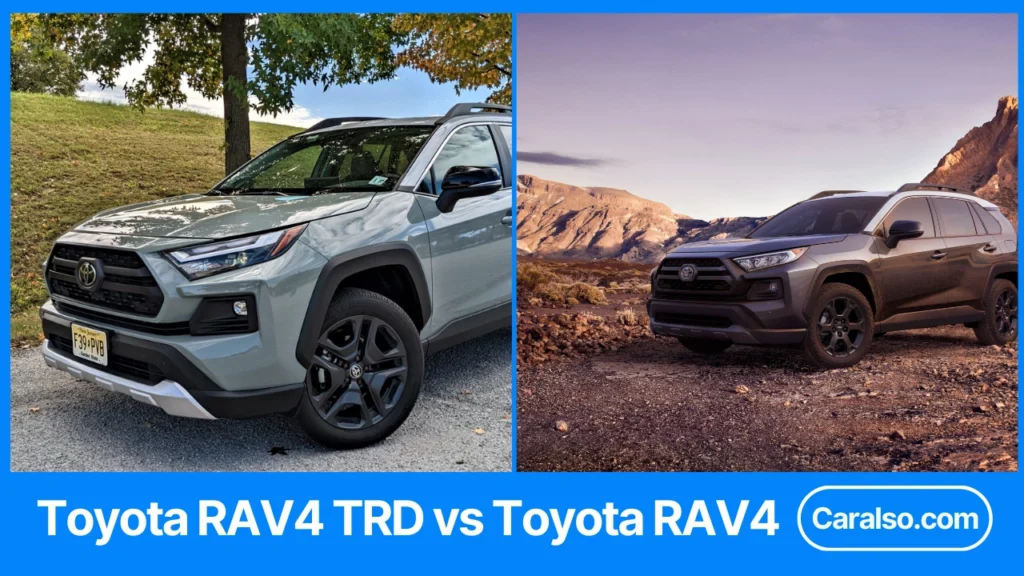
RAV4 Adventure Vs TRD Off-Road
RAV4 Adventure Vs TRD Off-Road Quick Answer (Table)
Baseline below uses 2024 specs because it’s the newest year where both trims exist. The pattern is the same across most 2020 to 2024 listings.
| Category | RAV4 Adventure | RAV4 TRD Off-Road | What It Means In Real Life |
|---|---|---|---|
| Towing Capacity | 3,500 lb | 3,500 lb | Tow rating is not the reason to choose TRD. Pick based on tires and setup. |
| AWD System | Dynamic Torque Vectoring AWD with Rear Driveline Disconnect | Dynamic Torque Vectoring AWD with Rear Driveline Disconnect | Traction hardware is basically the same. Both can handle snow and gravel with the right tires. |
| Multi-Terrain Select | Mud & Sand, Rock & Dirt, Snow | Mud & Sand, Rock & Dirt, Snow | Same drive modes. You are not getting extra modes by going TRD. |
| Ground Clearance | 8.6 in | 8.6 in | They sit the same height. TRD does not solve scraping issues by itself. |
| Approach / Departure | 19.0° / 21.0° | 19.0° / 21.0° | Clearance geometry is the same. Don’t expect TRD to climb steeper entries. |
| Wheels | 19-in split 5-spoke matte-gray alloy | 18-in 6-spoke matte-black TRD flow-formed alloy | 18s usually ride better on rough roads. 19s usually feel sharper on pavement. |
| Tires | All-season tires (19-in fitment) | Falken WILDPEAK All-Terrain tires | This is the biggest functional difference. TRD has more bite on loose surfaces. |
| Skid Plate | No TRD front skid plate listed as standard | TRD-stamped stainless steel front skid plate | TRD gives you real front underbody protection for trailheads and ruts. |
| Suspension | Standard Adventure tuning | TRD-tuned suspension | TRD is set up for rougher surfaces. It is not a lift kit. |
| EPA MPG (City / Hwy / Comb) | 25 / 33 / 28 | 25 / 32 / 28 | Same combined MPG. Adventure is usually 1 mpg better on the highway. |
| Infotainment Screen | 8-in standard | 10.5-in standard | TRD starts “more loaded” on day one. Adventure often needs packages. |
| Key Packages | Weather Package available. Convenience Package available. | Weather Package available. Advanced Technology Package available. | Adventure is more “build it your way.” TRD is easier to find loaded. |
| Base MSRP When New (2024) | $34,870 | $38,295 | TRD costs $3,425 more before options and fees. |
| Used Price Range (Example: 2024 Used) | $31,009 to $37,964 | $37,988 to $44,286 | On the used market, TRD can carry a $6,000+ premium fast. |
Quick Verdict (Bullet Decision)
- Buy RAV4 Adventure If You Want Lower Cost And More Street Bias
- You want the 3,500-lb tow rating, but you do not need all-terrain tires.
- You prefer 19-inch wheels.
- You want the better highway MPG. Adventure is 33 mpg highway. TRD is 32 mpg highway.
- You want the lower starting price. Adventure started at $34,870. TRD Off-Road started at $38,295.
- You are fine with the 8-inch screen, or you plan to add the Convenience Package to get the 10.5-inch screen.
- Buy RAV4 TRD Off-Road If You Want The Most “Ready Today” Setup
- You want Falken WILDPEAK all-terrain tires from the factory.
- You want the TRD-stamped stainless steel front skid plate.
- You want TRD-tuned suspension.
- You want the 10.5-inch screen standard.
- You want the stronger option packages. TRD can add an Advanced Technology Package that includes parking assist with automatic braking and more.
- Skip Both And Buy This Instead If You Are Shopping New Or Want Hybrid MPG
- If you want a rugged look plus hybrid MPG, I look at RAV4 Hybrid Woodland Edition first. It trades the 3,500-lb tow rating for a 1,750-lb tow rating, and it sits at 8.1 inches of ground clearance.
- If you want the most comfort tech and you stay on pavement, I look at a RAV4 Limited. On some years it can be optioned with the torque-vectoring AWD system, but it does not keep the 3,500-lb tow rating.
- If you want plug-in range and you tow up to 2,500 lb, I look at RAV4 Plug-in Hybrid. It is a different budget.
One simple note. Adventure and TRD Off-Road were dropped for 2025, so most buyers are shopping used 2020 to 2024.
What Is The Difference Between RAV4 Adventure And TRD Off-Road?
I like to start with what is the same. That prevents bad assumptions. Then I focus on the few parts that actually change the driving and ownership experience.
These are the big shared items that make both trims “the tow and trail” RAV4s.
- Engine And Transmission
- 2.5L 4-cylinder gas engine
- 203 hp
- 8-speed automatic transmission
- AWD Hardware
- Dynamic Torque Vectoring AWD with Rear Driveline Disconnect
- It can send up to 50% of engine torque to the rear wheels
- It can also send more torque to either rear wheel side to side
- Drive Modes
- Multi-Terrain Select modes: Mud & Sand, Rock & Dirt, Snow
- Tow Rating
- 3,500 lb on both
- Clearance And Angles
- 8.6 inches of ground clearance on both
- 19° approach angle on both
- 21° departure angle on both
If you are buying based on tow rating, AWD system, or ride height, Adventure and TRD Off-Road are basically the same starting point.
The Real Differences (Hardware + Daily Feel)
This is where the trims split. These differences show up every day.
Wheels And Tires
- Adventure
- 19-inch split 5-spoke alloy wheels with matte-black accents
- All-season tires
- TRD Off-Road
- 18-inch 6-spoke matte-black TRD flow-formed alloy wheels
- Falken WILDPEAK all-terrain tires
How that changes daily life.
- 18-inch wheels usually give you more tire sidewall than 19-inch wheels. That can help on potholes and washboard gravel.
- All-terrain tires usually add traction on loose dirt and slushy snow. They can also add road noise at 60 to 75 mph.
- If you drive 95% pavement, the Adventure setup makes more sense for most people.
Suspension And Underbody Protection
- Adventure
- No TRD front skid plate listed as standard
- Standard Adventure suspension tuning
- TRD Off-Road
- TRD-tuned suspension
- TRD-stamped stainless steel front skid plate
- Red-painted coil springs
How I think about it.
- The skid plate is the most “real” off-road add-on. It helps on trailhead ruts and bad entry angles.
- The suspension tuning matters most on rough roads, not rock crawling.
- Neither trim is a lift kit. Ground clearance is still 8.6 inches on both.
Infotainment And Packaging
- Adventure
- 8-inch screen standard
- 10.5-inch screen available with the Convenience Package
- TRD Off-Road
- 10.5-inch screen standard
- Advanced Technology Package available (adds items like parking assist with automatic braking and wireless charging)
My shortcut.
If you want the bigger screen and the “loaded” feel without hunting packages, TRD is easier to shop used.
Seats And Interior Accents
- Adventure
- SofTex seats with orange accents and stitching
- Orange-accented interior stitching
- TRD Off-Road
- SofTex seats with red accents and stitching
- TRD stitching in the front headrests
- TRD all-weather floor mats and cargo liner
This is personal preference, but it does affect used value. TRD-specific interior touches are part of why used TRD listings often price higher than Adventure.
MPG (The Small But Real Difference)
For 2024 EPA estimates:
- Adventure: 25 city, 33 highway, 28 combined
- TRD Off-Road: 25 city, 32 highway, 27 combined
If you drive a lot of highway miles, that 1 mpg difference adds up.
Wheels And Tires: The Biggest Functional Difference
If you only remember one thing, remember this.
Adventure rides on 19-inch wheels with all-season tires.
TRD Off-Road rides on 18-inch TRD wheels with Falken WILDPEAK all-terrain tires.
That changes ride comfort, noise, winter traction, and what you pay when it is time to replace tires.
Adventure Wheel And Tire Setup (Why 19s Matter)
Adventure uses a 19-inch wheel setup.
The common OE size is 235/55R19.
Here is what that means in numbers.
- Sidewall height: 235 x 0.55 = 129 mm. That is 5.08 in.
- Overall tire diameter: (2 x 5.08) + 19 = 29.16 in.
Why I care about that.
- Less sidewall usually means less “cushion” over potholes.
- 19-inch tires are usually more expensive than 18-inch tires in the same quality tier.
- The tire selection leans more toward touring all-season choices than true all-terrain choices.
TRD Off-Road Wheel And Tire Setup (Why 18s And A/T Matter)
TRD Off-Road uses 18-inch TRD flow-formed wheels and Falken WILDPEAK all-terrain tires.
The common OE size is 225/60R18.
Here is the same math.
- Sidewall height: 225 x 0.60 = 135 mm. That is 5.31 in.
- Overall tire diameter: (2 x 5.31) + 18 = 28.62 in.
Now compare the two.
- Sidewall difference: 5.31 in vs 5.08 in. That is 0.23 in more sidewall on TRD.
- Diameter difference: 28.62 in vs 29.16 in. That is 0.54 in smaller on TRD.
What I see in real driving.
- That extra 0.23 in of sidewall helps on washboard gravel and sharp potholes.
- The all-terrain tread gives you more bite on loose dirt and slushy snow.
One important snow detail.
The Falken Wildpeak A/T Trail line is marketed as severe snow rated.
But not every replacement version shows the same rating on every retailer page.
When you replace tires, I always check the sidewall for the 3-Peak Mountain Snowflake marking.
Tire Noise, Winter Grip, And Replacement Cost (Practical Buyer Notes)
This is the section most pages skip. This is where the money goes.
Tire Noise
All-terrain tread usually makes more noise at highway speed.
Not always. But usually.
My quick rule.
- If you do 80% highway, Adventure’s all-season setup is easier to live with.
- If you do 30% gravel, mud, or snow roads, TRD’s all-terrain setup earns its keep.
Winter Grip
All-season is not the same as winter tire.
All-terrain is also not the same as winter tire.
What I trust.
- If you live where roads stay under 40°F for months, I run a real winter tire.
- If you want one set year-round, I at least want a tire with the 3-Peak Mountain Snowflake marking.
Replacement Cost (Real Numbers)
I use “per tire” first, then I multiply by 4.
I also budget $120 to $200 total for mounting and balancing.
Typical Online Pricing Examples
- 235/55R19 all-season options often land around $204 to $289 per tire.
- 225/60R18 all-terrain options like the Wildpeak A/T Trail 01A show around $232 per tire.
Here is what that looks like as a set.
| Replacement Item | Typical Price Per Tire | Typical Set Of 4 |
|---|---|---|
| 235/55R19 All-Season (Adventure Size) | $204 to $289 | $816 to $1,156 |
| 225/60R18 Falken Wildpeak A/T Trail 01A (TRD Size) | About $232 | About $928 |
My ownership takeaway.
- TRD tires can cost the same or more than Adventure tires depending on brand and rating.
- The bigger cost difference is often tread life.
- Many touring all-seasons carry higher treadwear ratings than the all-terrain options.
If you are buying used, I always look at tire brand and tread depth first.
It tells me how the last owner spent money.
Suspension And Underbody: What TRD Actually Adds
TRD Off-Road adds suspension tuning and real front protection.
It does not change the vehicle’s height or geometry.
Both trims still sit at 8.6 inches of ground clearance.
Both still show 19° approach and 21° departure.
TRD-Tuned Suspension (What That Means)
Toyota spells this out better than most brands.
TRD Off-Road suspension changes include:
- Red coil springs tuned for an off-road focus
- Twin-tube shocks that are re-valved
- Internal rebound springs in the shocks
- New bump stops designed to maximize compression-direction wheel travel
What I feel from that setup.
- Better control over repeated bumps on rough roads.
- Less “float” after big dips.
- No magic on rocks. You still do not have low range.
Adventure does not get those TRD-specific suspension parts.
Skid Plate Coverage (What’s Included, What Isn’t)
TRD Off-Road includes a TRD-stamped stainless steel front skid plate.
Here is how I translate that.
- It protects the front underside area that tends to take the first hit.
- It helps on trailheads, rutted entrances, and surprise rocks in the center track.
What it does not do by itself.
- It does not turn the RAV4 into a rock crawler.
- It does not give you full-length underbody armor.
- It does not give you rock rails.
If you are buying TRD expecting full skid coverage front to back, you will be disappointed.
If you are buying TRD because you want one solid layer of front protection, it makes sense.
Is TRD More Capable Off-Road? (Reality Check)
I call it “slightly” more capable, mostly because of tires and protection.
Here is what does not change.
- Ground clearance: 8.6 in on both
- Approach and departure: 19° and 21° on both
- Tow rating: 3,500 lb on both
- AWD system: the same torque-vectoring AWD hardware family
Here is what does change.
- TRD all-terrain tires give more grip on loose surfaces.
- The skid plate gives more confidence when you touch the front underside.
- The TRD suspension tuning can help keep the body controlled on rough roads.
My real conclusion.
If your off-road is gravel roads, snow, and trailheads, TRD has a real advantage.
If your off-road is rocks and deep ruts, both trims run out of clearance first.
Towing And “Weekend SUV” Use: Are They The Same?
Yes. For towing numbers, they are basically twins.
Both the RAV4 Adventure and RAV4 TRD Off-Road are rated to tow 3,500 lb.
Both have the same curb weight at 3,615 lb.
Both have the same payload rating at 1,025 lb.
That last number is the one most people ignore. Payload is what limits you first.
3,500-Lb Tow Rating Explained (Why These Two Trims Get It)
Here’s what I look at on these trims:
- Both are the only gas trims rated at 3,500 lb.
- Toyota also lists tow-prep equipment that includes an automatic transmission fluid cooler.
- Other gas trims sit at 1,500 lb.
In plain terms, Toyota gives the higher tow rating to the trims with the right drivetrain setup and cooling to handle the load.
What You Can Realistically Tow (Examples + Safety Notes)
I plan towing around real loaded trailer weight, not dry weight.
Examples that usually fit a 3,500 lb rating:
- A small utility trailer with 2 dirt bikes.
- Trailer 700 lb
- Bikes 500 lb
- Gear 200 lb
- Total 1,400 lb
- A pair of jet skis on a double trailer.
- Trailer 600 to 900 lb
- Two skis 800 to 1,100 lb
- Fuel and gear 100 to 200 lb
- Total 1,500 to 2,200 lb
- A small pop-up camper.
- Many land between 2,000 and 3,000 lb loaded
What I avoid:
- Trailers that land at 3,300 to 3,500 lb loaded for long highway trips.
- I personally try to keep my loaded trailer under about 2,800 lb if I’m doing hours at 65 to 75 mph.
Safety notes I always follow:
- Keep tongue weight in the 10% to 15% range.
- At 3,500 lb, that is about 350 to 525 lb on the hitch
- Slow down.
- Leave more braking distance.
- If your trailer has electric brakes, use them.
If You Tow Often, What Else Should You Consider?
This is the checklist I use before I buy parts.
Payload Math (This Is The Real Limit)
- Payload rating: 1,025 lb
- Subtract people, cargo, and tongue weight
Quick example:
- 4 adults at 180 lb each = 720 lb
- Cargo in the trunk = 150 lb
- Tongue weight = 400 lb
- Total = 1,270 lb
That is over the 1,025 lb payload rating.
So if you tow near the limit, you usually end up doing one of these:
- Fewer passengers
- Less cargo inside the SUV
- Lower trailer weight
Hitch And Wiring Reality
- A tow hitch and trailer wiring harness are typically optional, even on these trims.
- Many setups are 4-pin for basic trailer lights.
- If you need a 7-pin connector for trailer brakes or a charge line, plan on extra wiring.
Brake Controller
- If your trailer has electric brakes, you will need a brake controller.
- Most small SUVs do not come with an integrated one from the factory.
If you tow every weekend, I also tell people to look at:
- Tire load rating
- Trailer brake requirements in your state
- Cooling and service intervals for the transmission fluid
MPG And Running Costs: How Much Does TRD Cost You Per Year?
On paper, the fuel difference is tiny.
The bigger money differences are purchase price and tires.
EPA MPG Comparison (Adventure Vs TRD)
These are the EPA estimates for the gas models:
- RAV4 Adventure: 25 city, 33 highway, 28 combined
- RAV4 TRD Off-Road: 25 city, 32 highway, 28 combined
So the TRD is down 1 mpg on the highway.
What that means in real dollars, using 12,000 miles per year and a 60% highway mix:
- Extra fuel used by TRD: about 6.8 gallons per year
- At $2.90 per gallon, that is about $20 per year
Even at 15,000 miles per year, it is still only about $25 per year.
Tire Cost And Wear (The Hidden Cost)
This is where the TRD can cost more.
TRD Off-Road tires:
- Factory type is an all-terrain tire (Falken Wildpeak A/T Trail family)
- Replacement pricing I see is about $230 per tire online
- A set of 4 is about $930 before install
Adventure tires:
- It runs a 19-inch all-season tire size
- Common replacement sets land around $900 to $1,000 before install, depending on brand
The real difference is wear and rolling resistance.
All-terrain tires often:
- Wear faster if you do mostly pavement
- Lose a little highway mpg for grip
My practical rule:
- If you do 90% pavement, budget for TRD tires a bit sooner than a typical touring all-season.
- Over 5 years, that can be a few hundred dollars, not thousands.
Resale And Used Price Spread (What The Market Shows)
When I look at used pricing by trim, the TRD Off-Road usually sits higher.
For the same model year, I often see:
- Adventure in the low to mid $30,000 range
- TRD Off-Road closer to the high $30,000s into the low $40,000s
The interesting part is depreciation rate.
The trims can lose a similar percentage over 5 years, but the TRD starts higher, so the dollar loss can be higher.
My takeaway:
- If you want the TRD look and tire setup, you often pay more upfront and you also pay more used.
- If you want the 3,500 lb tow rating for the lowest buy-in, Adventure is usually the cheaper path.
Real-World Test: The 3 Surfaces That Expose The Differences
When I test-drive Adventure vs TRD Off-Road, I do the same 3-surface loop. It shows the tire and suspension differences fast.
I do not need a trail. I need 30 minutes and one rough road.
Highway (70 Mph): Tire Noise + Lane Feel
This is where people argue online. Some reviewers say the TRD tires add no noticeable noise. Other reviewers call them loud. So I measure it myself.
What I Do
- Set the HVAC fan to 2.
- Set the radio off.
- Put my phone in the same cupholder spot each time.
- Use a basic dB meter app.
- Hold 70 mph for 60 seconds on smooth pavement.
What I Record
- Cabin noise average (dBA).
- Peak noise (dBA) when I hit expansion joints.
- Steering corrections per minute on a straight stretch.
What I Expect
- Adventure usually wins on steady highway quiet because it runs a more street-focused tire.
- TRD can be close if the pavement is smooth and the tires are fresh.
- If the TRD tires are worn or cupped, noise jumps fast.
My Quick Buying Tip
- If you hear a low hum that rises with speed, look at tire wear before you blame the trim.
- Uneven tread wear is common on used listings with bad alignments.
Washboard Gravel: Shock Control + Cabin Rattle
This is where TRD’s suspension tuning can actually show up.
What I Do
- Find a maintained gravel road with washboard.
- Drive 25 mph, then 35 mph.
- Do it twice.
- Same tire pressures on both cars.
What I Record
- How many interior rattles I hear in 60 seconds.
- If the steering wheel shakes in my hands.
- How fast the body settles after a bigger dip.
What I Expect
- TRD usually feels more controlled over repeated bumps because of the TRD-specific shock tuning and bump stop changes.
- Adventure usually feels fine, but it can feel busier when the washboard gets sharp.
My Quick Buying Tip
- If you drive gravel weekly, 18-inch wheels plus more sidewall is a real comfort upgrade.
- This matters more than badges.
Snowy Parking Lot: Launch Grip + Tire Bite
This test is about tires, not AWD marketing.
Both trims use the same torque-vectoring AWD system family and the same drive modes. Tires still decide the first 20 feet.
What I Do
- Find an empty lot after a fresh snowfall.
- Do 3 launches from a stop to 20 mph.
- Do 3 moderate stops from 20 mph to 0.
- Keep stability control on for the first round. Then try one run with TRAC reduced if your car allows it.
What I Record
- Wheelspin time in seconds.
- 0 to 20 mph time using a phone GPS timer.
- Stopping feel. Straight or squirrelly.
What I Expect
- TRD’s all-terrain tire usually bites sooner on packed snow and slushy snow.
- Adventure’s all-season tire can be fine, but it depends heavily on the exact tire model and tread depth.
- If you live where it stays under 40°F for months, a real winter tire beats both.
My Quick Buying Tip
- If the used TRD is on worn all-terrain tires, it can lose its advantage.
- I like to see at least 6/32 inch of tread for winter use.
My “Worth It” Score (Simple 10-Point Rubric)
This is the scorecard I use to decide if TRD money is actually doing something for my life.
| Category | Points | Adventure Score | TRD Off-Road Score | How I Score It |
|---|---|---|---|---|
| Highway Comfort And Noise | 3 | 3 | 2 | Tire noise, steering corrections, long-drive comfort. |
| Gravel Road Control | 3 | 2 | 3 | Shake, rattle, body control at 25 to 35 mph. |
| Snow Traction On All-Season Setup | 2 | 1 | 2 | Launch bite and stopping bite on the factory-style tire. |
| Underbody Confidence | 2 | 1 | 2 | Front protection and “oops” moments on trailheads. |
| Total | 10 | 7 | 9 | TRD wins if you actually use the rugged bits. |
My takeaway is simple.
- If your life is 90% pavement, Adventure usually gives me the better value.
- If you hit gravel, snow, and trailheads often, TRD earns points every week.
Pro Tip: How To Build An “Adventure Plus” For Less Than TRD Money
The MSRP gap between Adventure and TRD Off-Road was about $3,425 for 2024.
So I treat $3,425 as my mod budget. If I can get 80% of the TRD benefit for under that number, Adventure becomes the smarter buy for a lot of people.
What You Can Copy Cheap (Tires, Liners, Protection)
These are the upgrades that actually change capability day-to-day.
Adventure Plus Stage 1: Keep Your 19s And Change The Tire
- Swap to a more aggressive all-terrain style tire in 235/55R19.
- Example: Falken Wildpeak A/T Trail is sold in 235/55R19 and is commonly listed as 3PMSF-certified.
Typical Cost
- Tires: about $271 per tire is a common online number.
- Set of 4: about $1,084.
- Mount and balance: about $120 to $200.
Why It Works
- This gives you most of the snow and loose-dirt traction gain you feel in real life.
Add Factory-Style Front Protection
- Add the Toyota front skid plate accessory that fits Adventure and TRD Off-Road models.
Typical Cost
- Skid plate: about $356 on discount sites, and up to about $450 MSRP.
Why It Works
- This is the “don’t punch the nose” protection you actually want on rutted entrances.
Add All-Weather Floor Liners
- Toyota all-weather liner sets are commonly listed around $147 to $199 depending on retailer.
Why It Works
- If you camp, ski, or haul wet gear, this is the best quality-of-life mod.
Adventure Plus Stage 1 Budget Example
- Tires: $1,084
- Skid plate: $356
- Floor liners: $148
- Install costs: $150
- Total: about $1,738
That is still well under the old TRD price jump.
Adventure Plus Stage 2: Switch To 18-Inch TRD Wheels
If you want the TRD wheel and tire feel, this is the move.
Two ways to do it.
- Buy used takeoff TRD wheels. I often see around $245 per wheel as a baseline.
- Buy new OEM TRD wheels. Pricing is all over the map by dealer.
Then run a common TRD-size tire.
- 225/60R18 is the common TRD fitment size.
- Wildpeak A/T Trail 01A is widely listed in that size, with prices varying a lot by retailer.
Typical Cost (Used Takeoffs Path)
- Wheels: $245 x 4 = $980
- Tires: $170 to $232 x 4 = $680 to $928
- Total before install: $1,660 to $1,908
Why It Works
- More sidewall. Less harshness on potholes.
- Better tire selection in 18-inch sizes for mixed surfaces.
What You Cannot Copy Exactly (TRD Suspension Tuning, Factory Integration)
This is where TRD keeps some real advantages.
- TRD-Tuned Suspension
Toyota calls out re-valved twin-tube shocks, internal rebound springs, new bump stops, and TRD-tuned coil springs. You can swap shocks aftermarket, but you are not getting the exact factory TRD tuning without trial and error. - Factory Packaging And “Standard” Equipment
TRD Off-Road often came standard with the bigger 10.5-inch screen in later years. Adventure often needed a package to match that. - Resale Signaling
TRD badges and the factory TRD identity can hold value with a certain buyer. Mods do not always translate into resale dollars.
Who This Path Is For (Used Buyers, Budget Builds)
I recommend the Adventure Plus path if:
- You want 3,500-lb towing but you want the lowest buy-in.
- You want better tires and basic protection, not a different identity.
- You plan to keep the car 3+ years and you care more about use than resale hype.
I tell people to just buy the TRD Off-Road if:
- You want the TRD package without shopping parts.
- You want the skid plate, TRD suspension tuning, and factory tire setup today.
- You keep your vehicles stock and you want the easiest resale story.
Best Years To Buy Used (Adventure And TRD Off-Road)
If you want the shortest answer, I shop 2023 to 2024 first. Then I drop back to 2021 to 2022 if the price is right.
2020 To 2022 Vs 2023 To 2024 (Why Shoppers Prefer Later Tech)
Here’s the real split I see on used listings.
2020 To 2022
- Best for lower purchase price.
- You still get the same core stuff that makes these trims special.
- 3,500-lb towing on Adventure and TRD Off-Road.
- 8.6 inches of ground clearance on both.
- I buy these years when I do not care about the newest screens.
2023 To 2024
- Best for tech and daily usability.
- Toyota upgraded the screens and the infotainment setup for 2023.
- Adventure gets an 8-inch screen.
- TRD Off-Road gets a 10.5-inch screen standard.
- TRD Off-Road can also be optioned with a 12.3-inch driver display.
- Toyota Safety Sense 2.5 is standard.
My quick rule:
- If you care about infotainment and driver display, start at 2023.
- If you care about price more than screens, 2021 to 2022 can be the sweet spot.
2025 Update: Why You’re Shopping Used Now
Adventure and TRD Off-Road were not offered for the 2025 model year.
That is why used prices can stay firm on clean examples.
There is no new version to cross-shop on the dealer lot.
What To Buy Instead If You Want Rugged Looks New
If you want a newer RAV4 with a more rugged vibe, I point people to these two paths.
RAV4 Hybrid Woodland Edition
- It comes with TRD-tuned suspension and all-terrain tires.
- It uses 18-inch bronze TRD wheels.
- It keeps the roof rails and outdoor-focused details.
- Towing is 1,750 lb, not 3,500 lb.
- Ground clearance is 8.1 inches.
RAV4 Limited AWD (If You Want Comfort Features)
- You can get the nicer cabin and more available tech.
- Dynamic Torque Vectoring AWD can be available depending on year and build.
- Towing is still 1,500 lb, not 3,500 lb.
If towing is your must-have, used Adventure or TRD Off-Road is still the cleanest answer.
Used Buyer Checklist (Fast And Practical)
This is the exact order I use on a used walkaround. It takes me about 15 minutes.
Tires (Match Sets, Tread Depth, Snow Rating)
- Confirm all 4 tires match brand and model.
- Measure tread depth.
- I want at least 6/32 inch if you drive in snow.
- I get nervous at 4/32 inch.
- Check tire size.
- Adventure is commonly 235/55R19.
- TRD Off-Road is commonly 225/60R18.
- Look for uneven wear.
- Inside-edge wear usually means alignment.
- Cupping usually means weak shocks or bad alignment.
- If you want one-tire winter confidence, look for the 3-Peak Mountain Snowflake marking on the sidewall.
Suspension Clunks, Alignment, Uneven Wear
- Test drive at 25 mph over small bumps with the radio off.
- Listen for a front end clunk.
- Do a steady 60 mph cruise.
- The steering wheel should sit straight.
- The car should not wander.
- Brake from 50 mph to 10 mph.
- The wheel should not shake.
- If it shakes, I suspect warped rotors or uneven tire wear.
Evidence Of Off-Road Damage (Underbody Scrapes)
TRD owners actually use these trims. I check underneath.
- Look at the front lower bumper and valance for deep scrapes.
- Look under the nose.
- TRD should have a front skid plate.
- Check for dents, gouges, or missing hardware.
- Check the pinch welds and rocker area.
- Look at the rear lower bumper corners.
- If you see fresh undercoating only in one area, ask why.
Verify Package Content (Weather, Advanced Tech, Convenience)
Used listings mess this up all the time. I verify inside the car.
Adventure Packages I Check For
- Weather Package items
- Heated steering wheel
- Heated front seats
- Rain-sensing wipers
- Convenience Package items
- Power liftgate
- Moonroof
TRD Off-Road Packages I Check For
- Weather Package items
- Heated steering wheel
- Heated and ventilated front seats
- Rain-sensing wipers
- Advanced Technology Package items
- Front and rear parking assist with automatic braking
- Qi wireless charging
- JBL audio
- Digital rearview mirror
- Two-tone paint, if equipped
My shortcut:
- I open the settings screen and confirm the screen size.
- I check the center console area for the Qi charging pad.
- I put the car in reverse and see if parking sensors and camera views match what the listing claims.
The Two Paper Checks I Always Do
- Run a VIN recall check before you drive across town.
- Ask for service history.
- Oil change records matter.
- Tire rotation records matter more than people think.
If the car passes tires, alignment, and underbody checks, I usually feel good moving forward.
FAQs
Is RAV4 TRD Off-Road Worth It Over Adventure?
It depends on how often you use the TRD-specific parts.
I pay for TRD Off-Road when I want these 3 things from the factory:
- 18-inch TRD wheels
- Falken WILDPEAK all-terrain tires
- TRD-stamped front skid plate
If I drive 90% pavement, I usually buy Adventure.
Then I spend money on tires and protection only if I need it.
Quick math from when both were sold new in 2024:
- Adventure started at $34,870
- TRD Off-Road started at $38,295
- Difference: $3,425
If you will never scrape the nose, never drive gravel, and never need all-terrain traction, TRD money is hard to justify.
Do Adventure And TRD Off-Road Have The Same AWD System?
Yes.
Both use Dynamic Torque Vectoring AWD with Rear Driveline Disconnect.
Both also get Multi-Terrain Select modes like Mud & Sand, Rock & Dirt, and Snow.
If you are buying TRD because you think it has a different AWD system, it does not.
Which One Rides Better On The Street?
On smooth pavement, Adventure usually feels more street-friendly.
It runs 19-inch wheels with an all-season tire.
All-season tread is usually quieter at 65 to 75 mph than an all-terrain tread.
On rough roads, TRD Off-Road can feel more controlled.
It runs 18-inch wheels, which usually means more tire sidewall.
It also gets TRD-tuned suspension parts.
That combo can help on washboard gravel and potholes.
My rule:
- More highway driving. I lean Adventure.
- More gravel and trailheads. I lean TRD Off-Road.
Can Both Tow 3,500 Pounds?
Yes.
Both are rated at 3,500 lb.
That tow rating is not the reason to choose TRD.
What I watch instead is payload.
The brochure lists 1,025 lb payload for these trims.
If you tow near the limit, payload gets tight fast.
A 3,500 lb trailer can put 350 to 525 lb on the hitch at 10% to 15% tongue weight.
That comes out of payload, along with people and cargo.
Why Did Toyota Drop Adventure And TRD Off-Road?
Toyota did not offer the gas-powered RAV4 Adventure and TRD Off-Road grades for the 2025 model year.
So if you want either trim, you are shopping used.
Most buyers end up looking at 2020 to 2024.
If you want a newer rugged look, I point people at RAV4 Hybrid Woodland Edition.
If you want towing at 3,500 lb, used Adventure or TRD Off-Road is still the clean answer.
Key Takeaways
- Adventure and TRD Off-Road share the same AWD system, the same 8.6 inches of ground clearance, and the same 3,500-lb tow rating.
- The biggest functional difference is wheels and tires. Adventure is 19-inch all-season. TRD is 18-inch with Falken WILDPEAK all-terrain tires.
- TRD adds a TRD-stamped stainless steel front skid plate and TRD-tuned suspension parts.
- Adventure is usually the better value for pavement-heavy driving. TRD is the better pick if you see gravel, snow roads, and trailheads often.
- Both trims were dropped for 2025, so the best deals are usually clean 2021 to 2022, with the best tech in 2023 to 2024.
Sources
- Toyota 2024 RAV4 eBrochure (PDF)
- CarsDirect: 2025 Toyota RAV4 Drops TRD, Adventure Trims
- BuyAToyota: 2024 RAV4 Models And Pricing
- iSeeCars: Toyota RAV4 Adventure vs TRD Off-Road (Used Pricing, Depreciation)
- Rave Offroad: TRD Wheel Price Example

Hey there,
How is it going?
I’m Meraj Sarker. I am a Car Mechanic and a student of Automobile Restoration here in Florida, USA. I’ve been studying automotive for around 9 years now. So you can rely on my recommendation. For me, studying and getting knowledge about automobile it’s really fun and entertaining. I will help you to get solutions for your car through this website. If you need any help let me know.