
If you are choosing between a 2025 Nissan Rogue and a 2025 Toyota RAV4, I look at two numbers first. MPG and powertrain options. The Rogue wins gas mileage in gas form at up to 33 mpg combined (FWD).
The RAV4 wins if you want hybrid or plug-in choices, because you can get 39 mpg combined in the RAV4 Hybrid, or a plug-in RAV4 with 42 miles of electric range.
If you are shopping new in 2026, model year matters a lot. The 2026 RAV4 moves to a hybrid-only lineup (Hybrid or Plug-In Hybrid). The 2026 Rogue adds a Plug-In Hybrid with 38 miles of electric range and 7 seats. That single change can flip your decision.
Quick Verdict And Scorecard
Quick Verdict (Most Buyers)
- If you want the best gas MPG without plugging in, I pick Rogue FWD (33 mpg combined).
- If you want the lowest fuel use overall, I pick RAV4 Hybrid (39 mpg combined).
- If you want a plug-in, I pick based on your needs:
- More EV range: RAV4 Plug-In Hybrid (42 miles in 2025, up to 52 miles estimated for 2026).
- 7 seats: Rogue Plug-In Hybrid (7 seats, 38 miles estimated EV range).
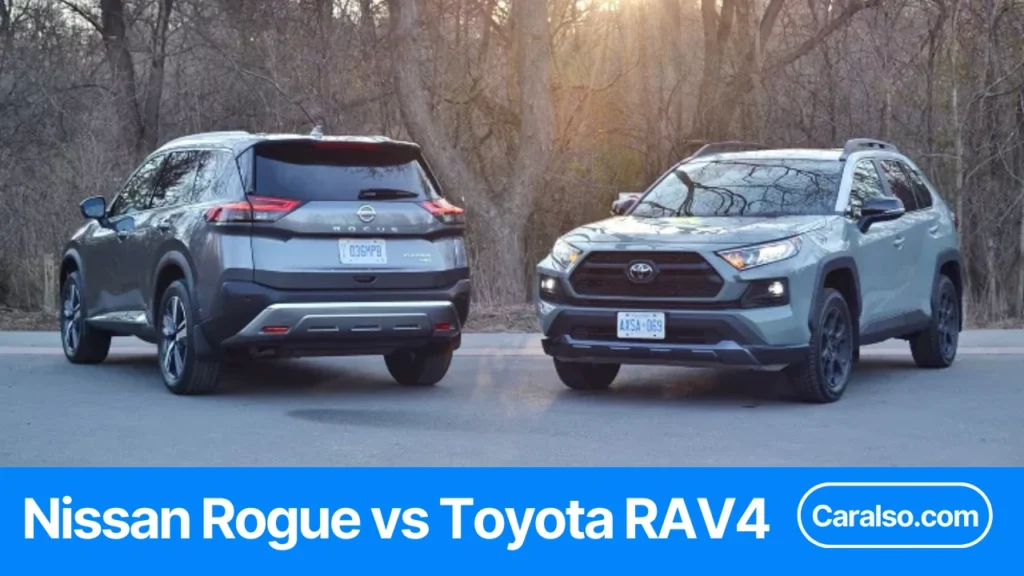
Nissan Rogue Vs Toyota RAV4
At-A-Glance Scorecard (Key Numbers That Decide It)
| Category | 2025 Rogue (Gas) | 2025 RAV4 (Gas) | Winner For Most People |
|---|---|---|---|
| Horsepower | 201 hp | 203 hp | Tie (within 2 hp) |
| Torque | 225 lb-ft | 184 lb-ft | Rogue (more torque) |
| EPA MPG (Best Gas Setup) | 33 combined (FWD) | 30 combined (FWD) | Rogue (gas MPG) |
| EPA MPG (Best Non-Plug Option) | No hybrid in 2025 | 39 combined (Hybrid AWD) | RAV4 (hybrid MPG) |
| Cargo Behind Rear Seats | Up to 36.5 cu ft | 37.5 cu ft | RAV4 (cargo) |
| Plug-In Option | Not in 2025 | 42-mile EV range (PHEV) | RAV4 (plug-in in 2025) |
| Big 2026 Change | 38-mile EV range PHEV, 7 seats | Hybrid-only lineup, up to 52-mile EV range PHEV | Depends on your use case |
What We’re Comparing (And Why Model Year Matters)
I am comparing US-market Rogue and RAV4 trims you can actually buy in the 2025 and 2026 shopping window. And I am treating 2026 as a pivot year for both models.
Here is why the year matters:
- In 2025, Rogue is gas-only. RAV4 can be gas, hybrid, or plug-in.
- In 2026, RAV4 shifts to an electrified-only lineup (Hybrid or Plug-In Hybrid).
- In 2026, Rogue adds a Plug-In Hybrid with an estimated 38 miles of EV range and 7 seats
2025 Rogue Vs 2025 RAV4 (Gas-To-Gas Baseline)
This is the cleanest apples-to-apples comparison if you do not want a hybrid or plug-in.
Powertrain Basics
- Rogue: 1.5L turbo 3-cylinder, 201 hp, 225 lb-ft, CVT.
- RAV4: 2.5L 4-cylinder, 203 hp, 184 lb-ft, 8-speed automatic.
Fuel Economy (EPA)
- Rogue FWD: 33 mpg combined (30 city, 37 highway).
- RAV4 FWD: 30 mpg combined (27 city, 35 highway).
- Rogue AWD: 31 mpg combined (28 city, 35 highway).
- RAV4 AWD: 29 mpg combined (27 city, 33 highway).
Space You Feel Every Day
- Cargo behind rear seats: RAV4 at 37.5 cu ft. Rogue up to 36.5 cu ft depending on trim.
- Max cargo with seats folded: RAV4 69.8 cu ft. Rogue 74.1 cu ft.
My Take On The 2025 Gas Choice
- If you want the best highway MPG in this pair, I lean Rogue FWD.
- If you want the simpler transmission feel many buyers prefer, I lean RAV4’s 8-speed.
- If cargo behind the rear seats matters more than max cargo, I lean RAV4.
Where Hybrids Change The Comparison (RAV4 Hybrid Or Plug-In Hybrid Vs Rogue’s Evolving Lineup)
In 2025, this is where the RAV4 can separate fast.
2025 RAV4 Hybrid (No Plug)
- 39 mpg combined (EPA).
- That is 9 mpg more than a 2025 RAV4 gas FWD at 30 mpg combined.
- It is also 6 mpg more than a 2025 Rogue FWD at 33 mpg combined.
2025 RAV4 Plug-In Hybrid (Plug-In)
- 42 miles of electric range (EPA).
- 94 MPGe combined (EPA).
- It also lists 38 mpg combined on gas-only operation.
What Changes In 2026
- 2026 RAV4 moves to Hybrid or Plug-In Hybrid only.
- Toyota says up to 44 mpg combined (manufacturer estimate) for a FWD hybrid.
- Toyota says up to 52 miles of EV range (manufacturer estimate) for the Plug-In Hybrid.
- Nissan’s 2026 Rogue Plug-In Hybrid is expected early 2026 with an estimated 38 miles of EV range, 248 hp, 332 lb-ft, and 7 seats.
So if you are buying in 2026 and you want to plug in, it is no longer “RAV4 only.” It becomes a real matchup.
Price And Trims: Where The Best Value Actually Is
Which Is Cheaper To Start?
For 2025, the Rogue is cheaper at the base trim.
Base MSRP (Before Destination)
- 2025 Nissan Rogue S: $28,590
- 2025 Toyota RAV4 LE: $29,800
That is a $1,210 gap in favor of the Rogue.
Destination and dealer fees can erase part of that gap. But the Rogue usually still starts lower.
If you are shopping 2026, the math changes.
- The 2026 RAV4 moves to a hybrid-only lineup.
- The base price jumps. The base LE starts at $33,350.
So, if you want the cheapest new RAV4-style vehicle, 2025 matters.
Best Value Trim For Most Buyers (Rogue)
I usually land on the Rogue SV.
Here is why.
- It is $1,000 more than the S trim.
- It is the trim Edmunds points most street-focused buyers toward.
Base MSRP (Before Destination)
- Rogue S: $28,590
- Rogue SV: $29,590
If you want the off-road look, I look at Rock Creek.
- It has standard AWD.
- It uses 235/65R17 all-terrain tires on 17-inch wheels.
- It costs you MPG. It is rated at 29 mpg combined.
Base MSRP (Before Destination)
- Rogue Rock Creek: $33,490
My rule for Rogue trims is simple.
- SV for daily driving value.
- Rock Creek if you want the look and standard AWD.
- SL or Platinum only if you want the luxury features enough to pay for them.
Best Value Trim For Most Buyers (RAV4)
For a 2025 gas RAV4, I usually land on the XLE.
It is the trim Edmunds recommends because you get more features without a big jump.
Base MSRP (Before Destination)
- RAV4 LE: $29,800
- RAV4 XLE: $31,310
That is a $1,510 step from LE to XLE.
One big 2025 note.
Toyota dropped the Adventure and TRD Off-Road trims for 2025.
So the “off-road” RAV4 decision shifts to either:
- A regular gas AWD RAV4
- Or a Hybrid Woodland if you want the rugged flavor
If you want hybrid MPG, you are shopping a different RAV4 lineup.
- 2025 RAV4 Hybrid starts at $34,300.
If you want a plug-in, Toyota makes that easy.
- 2025 RAV4 Plug-In Hybrid SE: $44,815
- 2025 RAV4 Plug-In Hybrid XSE: $48,685
Spend Or Skip Options (What I Pay For)
Spend If You Will Use It Weekly
- Heated seats and heated steering wheel if winter temps hit 40 F
- Power liftgate if you load cargo 3 times a week
- Blind-spot monitoring if you drive highways daily
- A real spare tire if you road trip far from towns
Spend If You Road Trip
- Adaptive cruise and lane centering upgrades
- Better headlights if you drive 30 miles at night often
- Upgraded front seats if you sit 60 minutes per commute
Skip If You Are Watching The Budget
- Panoramic roof if you want lowest long-term leak risk
- Big wheels if you want cheapest tire replacements
- Premium audio if you listen to podcasts 80% of the time
My plug-in rule.
- If you cannot charge at home or work, skip the plug-in.
- If you can charge at home, plug-in trims can make sense fast.
Table: Trim Matchmaker
| If You Want This | Pick This Rogue Trim | Pick This RAV4 Trim |
|---|---|---|
| Lowest Start Price | S | LE |
| Best Value For Most Buyers | SV | XLE |
| Standard AWD And Rugged Look | Rock Creek | Hybrid Woodland (rugged-style) |
| Best MPG Without Plugging In | Rogue S or SV FWD (33 mpg combined) | RAV4 Hybrid (39 mpg combined) |
| Most Luxury | Platinum | Limited |
| Plug-In Option | Not available in 2025 | Plug-In Hybrid SE or XSE |
Engines, Performance, And AWD: What You’ll Feel On A Test Drive
Power Delivery (Torque Vs Horsepower In Plain English)
These two SUVs make almost the same horsepower.
They do not make the same torque.
Numbers That Matter
- Rogue: 201 hp, 225 lb-ft
- RAV4: 203 hp, 184 lb-ft
That 41 lb-ft gap is why the Rogue often feels stronger at low speed.
I also watch where the torque shows up.
- Nissan lists the Rogue’s peak torque at 2,800 to 4,000 rpm.
That usually means less pedal to get moving at 25 mph.
The RAV4’s 2.5L feels more traditional.
- You press.
- It revs.
- It builds speed in a more linear way.
Transmission Behavior (CVT Vs 8-Speed)
This is the biggest “feel” difference on a normal drive.
Rogue CVT Feel
- A CVT can hold rpm steady while speed rises.
- On a long on-ramp, it can sit at one rpm for several seconds.
- Listen for engine drone at 60 to 75 mph.
RAV4 8-Speed Feel
- You will feel shifts under load.
- On rolling hills, it may downshift more often than a CVT.
- If you like a connected feel, this is usually the one.
My quick rule.
- If you hate CVT behavior, test the Rogue first.
- You will know in 3 minutes.
AWD Systems (Everyday Traction Vs Light Trail Use)
Rogue AWD
- Nissan’s Intelligent AWD adds drive modes.
- You get Sport, Auto, and Eco.
- You can also get Snow and Off-Road modes.
Rock Creek adds trail-ready hardware choices.
- All-terrain tires.
- Hill descent control.
RAV4 AWD
For 2025 gas trims, AWD is an option on some trims.
But the more advanced AWD system tied to the Adventure and TRD Off-Road trims is gone for 2025.
If you want AWD with the RAV4 “feel,” I usually point people to the hybrid.
- The RAV4 Hybrid uses an electronic AWD setup.
- It is built around the hybrid system, not a driveshaft.
My traction rule.
- For snow tires and winter commuting, either works.
- For light dirt roads, the Rogue Rock Creek is the most purpose-built Rogue.
- For efficiency plus AWD, the RAV4 Hybrid is the cleanest answer.
My 2-Minute Test Drive Script
I do this in the same order every time.
0:00 To 0:30
- Set the seat.
- Check steering wheel reach.
- Check mirror blind spots.
0:30 To 1:00
- Do a normal takeoff to 35 mph.
- Watch for jerkiness at 10 mph.
- Watch the tach behavior in the Rogue.
1:00 To 1:20
- Brake from 35 mph to 0.
- Note pedal travel and nose dive.
- Listen for cabin rattles over a rough patch.
1:20 To 1:45
- Do a 45 to 70 mph merge.
- Count how long it takes to feel “ready” in the lane.
- Listen for engine noise at high load.
1:45 To 2:00
- Set adaptive cruise if available.
- Toggle lane centering.
- See how often it nags you in 30 seconds.
If a car fails this 2-minute script, I do not “wait to get used to it.”
I move on.
Fuel Economy And Range: Gas Vs Hybrid Reality
Gas Model MPG Expectations (And Why They Vary)
I use EPA numbers as my baseline. Then I adjust for AWD, tire size, and speed.
Here are the EPA combined ratings that matter most for this matchup.
2025 Nissan Rogue (Gas)
- Rogue FWD: 33 mpg combined (30 city, 37 highway)
- Rogue AWD: 31 mpg combined (28 city, 35 highway)
- Rogue Rock Creek AWD: 29 mpg combined (27 city, 32 highway)
2025 Toyota RAV4 (Gas)
- RAV4 FWD: 30 mpg combined (27 city, 35 highway)
- RAV4 AWD: 29 mpg combined (27 city, 33 highway)
- One AWD listing shows 28 mpg combined (25 city, 33 highway)
Now the range reality.
EPA Estimated Total Range
- Rogue FWD: 478 miles
- Rogue AWD: 450 miles
- RAV4 gas: 435 miles
- RAV4 Hybrid: 566 miles
- RAV4 Plug-In Hybrid: 600 miles total, with 42 miles electric range
Why MPG moves in real life
- AWD usually costs 1 to 2 mpg in this pair.
- All-terrain tires cost more. The Rogue Rock Creek drops to 29 mpg combined.
- Speed matters. 75 mph takes more fuel than 65 mph.
- Short trips hurt MPG. Cold starts are the problem.
- Roof boxes and big crossbars can cost mpg at 70 mph.
If you want one simple rule, use this.
- Start with EPA combined.
- Subtract 1 mpg if you drive AWD.
- Subtract 2 mpg if you run chunky tires.
- Subtract 2 mpg if most of your miles are under 5 miles per trip.
If MPG Is The Priority: When RAV4 Hybrid Wins (And When It Doesn’t)
If you do not want to plug in, the RAV4 Hybrid is the mileage leader here.
EPA Combined MPG Comparison
- Rogue FWD gas: 33 mpg combined
- RAV4 Hybrid: 39 mpg combined
That is a 6 mpg gap.
If you compare RAV4 gas to RAV4 Hybrid, the gap is bigger.
- RAV4 gas FWD: 30 mpg combined
- RAV4 Hybrid: 39 mpg combined
- That is a 9 mpg gap
When the hybrid win is biggest
- Stop and go driving.
- Lots of 25 to 45 mph roads.
- Short merges and short freeway bursts.
When the hybrid win shrinks
- Long highway runs at steady speed.
- Heavy roof loads.
- Winter temps with short trips.
I also like real test data as a sanity check.
Car and Driver got 37 mpg on its 200-mile highway route in a RAV4 Hybrid.
That is close to the EPA highway number (38 mpg).
One more hybrid nuance.
Toyota’s Woodland Edition Hybrid shows lower EPA numbers than other RAV4 Hybrids.
- RAV4 Hybrid Woodland: 37 mpg combined (38 city, 35 highway)
- Regular RAV4 Hybrid listings: 39 mpg combined (41 city, 38 highway)
So if MPG is the whole reason you are buying hybrid, I avoid the rugged tire setup.
Rogue Hybrid Roadmap (Plug-In Now, Then E-Power)
This is the big story if you are shopping 2026.
2026 Rogue Plug-In Hybrid (Coming Early 2026)
- 38 miles estimated electric range
- 420 miles estimated total range
- 7 seats
- 248 horsepower
- 332 lb-ft of torque
That is a very different Rogue than the 2025 gas-only model.
Then there is the next step.
Nissan says the 2027 Rogue will get the e-Power hybrid system in the US.
That system is not plug-in.
It uses an engine as a generator.
The electric motor drives the wheels.
My shopping rule with these timelines
- If you can charge at home, the 2026 Rogue Plug-In Hybrid is the first Rogue that competes directly with a RAV4 Plug-In Hybrid on concept.
- If you cannot charge, I wait to see final EPA numbers for Rogue e-Power before calling it a RAV4 Hybrid replacement.
Table: Powertrain Choices (Pick By Commute And Charging)
| Your Typical Day | Charging Access | Best Fit | Why I Pick It |
|---|---|---|---|
| 10 to 40 miles per day | Home or work charging | Plug-In Hybrid | 42 miles EV on RAV4 Plug-In Hybrid can cover most days. Rogue Plug-In Hybrid targets 38 miles EV. |
| 10 to 40 miles per day | No charging | Hybrid | 39 mpg combined on RAV4 Hybrid. No plug needed. |
| 40 to 80 miles per day | Home charging | Plug-In Hybrid Or Hybrid | Plug-in still helps, but you will burn gas on longer days. Hybrid is simpler if you rarely plug in. |
| 40 to 80 miles per day | No charging | Hybrid | You still get the mpg benefit in traffic without plugging in. |
| Mostly highway at 70 to 80 mph | Any | Gas Or Hybrid, Depends | Hybrid gap shrinks on steady highway. I decide based on price and how much city driving you do weekly. |
| Mixed driving, lowest upfront cost | Any | Gas | Rogue FWD at 33 mpg combined is strong for a gas-only pick. |
Space And Practicality: Cargo Numbers And Real-Life Usability
Passenger Space (Front And Rear Comfort)
These are close in size. But the Rogue has more room by the numbers.
Interior Space Snapshot
- Passenger volume: Rogue 105.4 cu ft, RAV4 98.9 cu ft
- Front legroom: Rogue 41.5 in, RAV4 41.0 in
- Rear legroom: Rogue 38.5 in, RAV4 37.8 in
- Rear hip room: Rogue 53.4 in, RAV4 47.7 in
That rear hip room number is the one I watch for family use.
It can matter when you have two bulky car seats side by side.
One more city-life detail.
Turning circle:
- Rogue: 35.4 ft
- RAV4: 36.1 ft
It is not huge. But I feel it in tight parking lots.
Cargo Space (Behind Rear Seats Vs Max Cargo)
This is where the two flip depending on how you pack.
Cargo Behind The Second Row
- Rogue: 36.5 cu ft
- RAV4: 37.6 cu ft
Max Cargo Behind The Front Seats
- Rogue: 74.1 cu ft
- RAV4: 69.8 cu ft
My take:
- If you travel with the rear seats up, the RAV4 has a slight edge.
- If you fold seats often, the Rogue’s max cargo advantage is real.
Family-Fit Notes (Strollers, Car Seats, Door Openings)
I do not trust “feels roomy” impressions alone.
I use three checks.
Check 1: Rear Legroom
- Rogue: 38.5 inches
- RAV4: 37.8 inches
If you run a rear-facing seat, that 0.7 inch can matter.
Check 2: Rear Hip Room
- Rogue: 53.4 inches
- RAV4: 47.7 inches
That 5.7-inch gap is big on paper.
It can help with two seats plus an adult in the middle.
Check 3: Cargo Behind The Seats
- RAV4: 37.6 cu ft
- Rogue: 36.5 cu ft
If you keep a stroller upright behind the second row, the RAV4 has a small edge.
One more practical note for 2026 shoppers.
The 2026 Rogue Plug-In Hybrid is a 7-seater.
The RAV4 is a 5-seater, even in plug-in form.
If you truly need 6 or 7 seats, this decision can get simple fast.
Differentiation: Family Loading Score (Numbers-First)
I score each SUV on measurable proxies.
It is not vibes.
It is space and maneuvering.
Scoring Method (6 Categories, 2 Points Each)
- Passenger volume (cu ft)
- Rear legroom (in)
- Rear hip room (in)
- Cargo behind second row (cu ft)
- Max cargo (cu ft)
- Turning circle (ft)
For each category:
- Winner gets 2 points.
- The other gets 1 point.
Family Loading Score Results (Out Of 12)
- Nissan Rogue: 11
- Toyota RAV4: 7
Why the Rogue leads here
- 105.4 cu ft passenger volume vs 98.9
- 53.4 in rear hip room vs 47.7
- 74.1 cu ft max cargo vs 69.8
- 35.4 ft turning circle vs 36.1
Why the RAV4 still matters for families
- 37.6 cu ft behind the second row vs 36.5
That is the “seats up” win that shows up on grocery runs.
Comfort And Interior Quality: Commuting Matters
This is the section I care about most for daily driving. I can live with 0.5 seconds slower to 60 mph. I cannot live with a seat that hurts after 30 minutes.
When I compare the Rogue and RAV4 for commuting, I focus on three things:
- Seat shape and adjustability.
- Tire and wheel setup, because it changes ride and noise fast.
- Climate controls and storage, because you touch them every day.
Seat Comfort And Driving Position
In a 2025 Rogue, seat adjustability depends on trim. The base setup is a 6-way manual driver seat. Higher trims add an 8-way power driver seat plus 2-way power lumbar support. Passenger seat adjustment also changes by trim, from 4-way manual to 4-way power on higher trims. Some packages add driver seat and mirror memory.
If you do long drives, lumbar support matters more than leather. I use the lumbar on every trip longer than 20 miles.
In a 2025 RAV4, the base LE trim is more bare-bones inside. Cloth seats. More hard plastics. Single-zone manual climate control. If you want the cabin to feel “finished,” you usually end up shopping above LE. Car and Driver calls out the XLE Premium as the trim that cuts the compromises with faux-leather upholstery, a stitched and padded dash, and dual-zone automatic climate control.
My test drive seat check is simple:
- Set the seat low enough that my eyes sit in the top half of the windshield.
- Set the steering wheel so my elbows stay bent at 9 and 3.
- Drive 15 minutes without touching the seat controls.
If I need to move around in that first 15 minutes, I know it will bug me later.
Road Noise And Ride Comfort: What I Evaluate
Wheel and tire choice changes the commute feel more than most people expect.
On the RAV4, Edmunds lists 17-inch wheels on LE and XLE, then 19-inch wheels on XLE Premium and Limited. Tire sizes also step up from 225/65R17 to 235/55R19. That shorter sidewall can feel sharper over broken pavement. It can also raise tire replacement cost.
On the Rogue, Nissan and Goodyear list common tire sizes by trim. You will typically see:
- 235/65R17 on S.
- 235/60R18 on SV.
- 235/55R19 on SL and Platinum.
- 235/65R17 on Rock Creek.
Here is what I do on a real test drive.
- Find a rough road at 35 to 45 mph. Listen for tire roar.
- Find an expansion-joint highway section at 65 to 75 mph. Feel for the quick up-down motion.
- Take one cloverleaf ramp at steady throttle. Feel if the body leans once and settles, or keeps bouncing.
- Turn the audio off for 3 minutes. Most people never do this.
If you want the calmest commute, I usually prefer the smaller wheel setup. More sidewall. More cushion.
Climate Controls And Storage Design
The Rogue can be very commuter-friendly when optioned right. Nissan offers Dual-Zone Automatic Temperature Control and also Tri-Zone Automatic Temperature Control on higher trims and packages. Rear passenger vents are available. It also offers practical details I actually use, like the Divide-N-Hide cargo system with multiple configurations.
For charging and daily device stuff, Nissan lists USB-C ports and available wireless charging depending on trim. Higher trims can also add a Head-Up Display and larger screens, which helps if you hate looking down at the cluster.
The RAV4 layout is straightforward. But the base LE trim is light on comfort extras. If you want dual-zone climate, nicer cabin materials, and the feel-good stuff like a power liftgate, you typically end up in XLE Premium territory based on how Toyota packages the trims.
One more 2026 note. A full redesign can change interior controls a lot. Some early 2026 RAV4 redesign coverage suggests more screen-focused controls, including climate integrated into the touchscreen on at least some versions. If you are cross-shopping 2025 and 2026, physically touch the HVAC controls on your test drive and decide what you can live with.
Tech And Driver-Assist: Which System Is Easier To Live With?
I separate this into two buckets.
- Infotainment, meaning screens, phone connection, and daily usability.
- Driver-assist, meaning highway help and how annoying it is when it nags you.
Infotainment Basics
Here is the quick, daily-use tech snapshot.
| Feature | 2025 Nissan Rogue | 2025 Toyota RAV4 |
|---|---|---|
| Base Touchscreen Size | 8.0 inches (lower trims) | 8.0 inches (lower trims) |
| Upgrade Touchscreen Size | 12.3 inches (higher trims) | 10.5 inches (available on XLE Premium, standard on Limited) |
| Wireless Phone Integration | Wireless Apple CarPlay and Wireless Android Auto on higher trims | Wireless Apple CarPlay and Android Auto |
| Built-In Apps | Google Maps, Google Assistant, Google Play on higher trims | 4G LTE hotspot available, nav and JBL audio optional |
| Digital Gauge Cluster | 12.3-inch fully digital cluster on higher trims | 12.3-inch fully digital gauge display standard on Limited |
In the Rogue, MotorTrend notes the big tech step-up happens on higher trims. You go from an 8.0-inch screen with CarPlay and Android Auto to a 12.3-inch touchscreen with Google Maps, Google Assistant, and Google Play. Those higher trims also add wireless smartphone mirroring and a 12.3-inch fully digital instrument cluster.
In the RAV4, Car and Driver lays it out clearly. Lower trims get an 8.0-inch touchscreen. The 10.5-inch screen is available on XLE Premium and standard on Limited. Wireless Apple CarPlay and Android Auto are included, and there is a 4G LTE hotspot. The 12.3-inch fully digital gauge display is standard on Limited, while most models use a separate 7.0-inch display in the cluster.
One more real-life detail. Software updates matter now. Toyota says vehicles with the latest Toyota Audio Multimedia system can receive over-the-air updates through the display. That is a quality-of-life feature if you plan to keep the SUV for 6 to 10 years.
Driver-Assist Comparison: What They Do Well, What Annoys People
The Rogue’s headline feature is ProPILOT Assist progression by trim.
TrueCar describes it like this:
- SV upgrades to ProPILOT Assist that adds adaptive cruise control and lane-keeping assist.
- SL gets ProPILOT Assist 1.1, which uses map data and traffic sign recognition to adjust speed in curves.
- ProPILOT Assist 2.1 is optional on SL and Platinum, and it allows hands-free driving on approved single-lane highways.
Nissan also markets ProPILOT Assist 2.1 as an eyes-on system that can run hands off and feet off on compatible roads, plus it adds other driver-assist tools depending on how the vehicle is equipped.
The RAV4 approach is simpler. Car and Driver lists standard automated emergency braking with pedestrian detection, standard lane-departure warning with lane-keeping assist, and standard adaptive cruise control. But it also notes that blind-spot monitoring and rear cross-traffic alert cost extra on the base model.
Here is my quick “annoyance test” for both SUVs.
- Turn lane centering on. Drive on a road with faded lane lines. See how often it drops out.
- Follow a car at 65 mph. Change following distance. Listen for beeps and feel for abrupt braking.
- Signal and change lanes with the system active. See if it fights you.
- Turn off the lane feature with one button press. If it takes 5 taps in a menu, I get tired of it fast.
Best Trims For Tech Without Overspending
If you want Rogue tech without going overboard, decide what you actually want.
- If you just want adaptive cruise plus lane help, SV is where ProPILOT Assist shows up per TrueCar.
- If you want the bigger tech stack, MotorTrend points to higher trims with the 12.3-inch screen, Google built-in, wireless smartphone mirroring, and the 12.3-inch digital cluster.
On the RAV4 side, Car and Driver’s own pick is XLE Premium because it adds the comfort and convenience features most people want, and it is also the first trim where the 10.5-inch screen is available. If you want the 12.3-inch fully digital gauge display, plan on Limited, because Car and Driver says it is standard there.
If it were my money for a daily commuter setup:
- Rogue: I would pick the trim that gets me the tech I will touch every day, then stop. Screen, wireless phone, and highway assist.
- RAV4: I would start at XLE Premium, then only go Limited if I truly want the larger tech and cluster features.
Safety: Independent Test Ratings, Not Just Feature Lists
When I compare safety, I do not start with a features list. I start with IIHS ratings. Then I look at what changes by trim, like headlights.
Here is the headline for 2025.
- Rogue scores Good in small overlap front, Acceptable in the updated moderate overlap front test, and Acceptable in the updated side test.
- RAV4 scores Good in small overlap front, Marginal in the updated moderate overlap front test, and Acceptable in the updated side test.
That updated moderate overlap result is the biggest separation in these two SUVs.
IIHS Crashworthiness Highlights (What Stands Out For Each)
Nissan Rogue (2025)
- Small overlap front: Good
- Moderate overlap front, updated test: Acceptable
- Side, updated test: Acceptable
Toyota RAV4 (2025)
- Small overlap front: Good
- Moderate overlap front, updated test: Marginal
- Side, updated test: Acceptable
Why I care about the updated moderate overlap test.
It includes rear passenger measures. In the IIHS breakdown, the Rogue’s rear passenger restraints and dummy kinematics rating is Acceptable. The RAV4 shows Marginal in that area in the updated moderate overlap test.
If you haul people in the second row often, that matters more than a bigger screen.
Crash Prevention And Headlights (Why Trim Choice Can Affect Outcomes)
Both SUVs do well in crash avoidance on IIHS.
- Front crash prevention, vehicle-to-vehicle 2.0: Acceptable for both.
- Front crash prevention, pedestrian: Good for both.
I like that because it means you are not forced into a pricey trim just to get a working AEB system.
Headlights are also Good for both in the IIHS headlight evaluation.
And IIHS lists the ratings as applying to all trims for both models.
That is not always the case in this class, so it is worth calling out.
My real-world safety rule.
- I still check the exact headlights on the window sticker.
- Then I drive a dark road for 5 minutes on low beams.
If the beam pattern feels short, I do not buy it.
Safety Pick Summary (Simple Buyer Takeaway)
Here is how I call it for 2025.
- If you want the stronger IIHS result in the updated moderate overlap front test, I lean Rogue.
- If you are focused on crash prevention tech, I call it a tie on IIHS because both score Acceptable for vehicle-to-vehicle and Good for pedestrian.
Table: Safety Snapshot (IIHS)
| Category (IIHS) | 2025 Nissan Rogue | 2025 Toyota RAV4 |
|---|---|---|
| Small Overlap Front | Good | Good |
| Moderate Overlap Front, Updated Test | Acceptable | Marginal |
| Side, Updated Test | Acceptable | Acceptable |
| Headlights | Good | Good |
| Front Crash Prevention, Vehicle-To-Vehicle 2.0 | Acceptable | Acceptable |
| Front Crash Prevention, Pedestrian | Good | Good |
| Seat Belt Reminders | Good | Good |
| LATCH Ease Of Use | Good | Good |
Reliability, Depreciation, And 5-Year Ownership Cost: The Part Most Pages Skip
This is the section that decides who wins for a lot of buyers.
I look at two things:
- Depreciation percentage over 5 years.
- A 5-year cost-to-own estimate, broken into depreciation, fuel, and maintenance.
Depreciation And Resale Outlook (Why It Changes Your Real Cost)
Depreciation is the silent bill.
You pay it when you sell, trade, or total the vehicle.
Here is a clean 5-year comparison from iSeeCars.
- Rogue: 48.6% 5-year depreciation
- RAV4: 30.3% 5-year depreciation
That is an 18.4 percentage point gap.
If you keep a vehicle 3 to 5 years, that gap can matter more than 2 mpg.
5-Year Cost-To-Own Comparison (Fuel, Depreciation, Insurance Buckets)
I like Edmunds True Cost to Own because it shows the categories.
To keep it simple, I matched base trims.
Edmunds 5-Year True Cost To Own
- 2025 Rogue S FWD: $37,878
- 2025 RAV4 LE FWD: $34,787
That is a $3,091 difference over 5 years.
Monthly Math (Total Divided By 60 Months)
- Rogue S FWD: $631 per month
- RAV4 LE FWD: $580 per month
- Difference: $52 per month
Where the money goes is the interesting part.
Rogue S FWD (Edmunds 5-Year Totals)
- Depreciation: $13,846
- Fuel: $6,981
- Maintenance: $5,363
- Repairs: $712
- Insurance: $4,242
RAV4 LE FWD (Edmunds 5-Year Totals)
- Depreciation: $10,742
- Fuel: $7,671
- Maintenance: $4,411
- Repairs: $601
- Insurance: $4,010
What I take from that.
- The RAV4 costs more in fuel in this base-to-base comparison.
- The Rogue costs more in depreciation.
Depreciation is the bigger gap.
One hybrid note.
Edmunds shows a 2025 RAV4 Hybrid LE AWD at $34,335 total over 5 years, with fuel at $5,907.
So hybrid can lower fuel cost without blowing up the 5-year total in that estimate.
If You’ll Keep It 8 To 10 Years Vs A 3-Year Lease (Two Different Answers)
If you lease or trade every 3 years, I weight resale and depreciation heavily.
That pushes me toward the RAV4 more often, because resale is a real advantage in this segment.
If you keep it 8 to 10 years, my weighting changes.
- Depreciation becomes less emotional because you spread it across more years.
- Maintenance and repair experience matters more.
I also keep my reliability talk grounded.
I do not assume. I look at broad indicators.
J.D. Power’s Quality and Reliability scores for 2025:
- Rogue: 84 out of 100
- RAV4: 77 out of 100
That does not guarantee your specific SUV will be problem-free.
But it is a useful data point when you are deciding between two mainstream models.
My rule for long ownership.
- Buy the one you will maintain on time.
- Then pick the powertrain you will actually use.
If you can charge and drive 10 to 40 miles per day, a plug-in can cut fuel spend fast.
If you cannot charge, I would rather have a hybrid than a plug-in.
Table: The Ownership Reality Table (Base Trim Comparison)
| Cost Item (5 Years) | 2025 Rogue S FWD | 2025 RAV4 LE FWD | Difference (Rogue Minus RAV4) |
|---|---|---|---|
| Total 5-Year Cost (Edmunds) | $37,878 | $34,787 | $3,091 |
| Cost Per Month (Total ÷ 60) | $631 | $580 | $52 |
| Depreciation | $13,846 | $10,742 | $3,104 |
| Fuel | $6,981 | $7,671 | -$690 |
| Maintenance | $5,363 | $4,411 | $952 |
| Repairs | $712 | $601 | $111 |
| Insurance | $4,242 | $4,010 | $232 |
Which Should You Buy? (Use-Case Decision Hub)
If you tell me your top 1 priority, I can usually pick in 10 seconds. I use numbers, not brand vibes.
Best For Long Commutes
If your commute is mostly highway at 65 to 80 mph, I start with gas MPG and range.
Pick The Rogue (Most Gas Commuters)
- Up to 33 mpg combined (FWD).
- Up to 478 miles of range (FWD).
- 225 lb-ft of torque helps on merges.
Pick The RAV4 Hybrid (If You Sit In Traffic)
- 39 mpg combined.
- 566 miles of range.
- Hybrid gains show up most at 25 to 45 mph.
Pick A Plug-In (Only If You Can Charge)
- 2025 RAV4 Plug-In Hybrid: 42 miles electric range.
- 2026 Rogue Plug-In Hybrid: 38 miles estimated electric range.
If you cannot charge, you are paying for hardware you will not use.
Best For Families
I focus on rear-seat room, cargo with seats up, and max cargo with seats down.
Pick The Rogue If You Need Cabin Room
- 105.4 cu ft passenger volume.
- 38.5 in rear legroom.
- 53.4 in rear hip room.
- 74.1 cu ft max cargo.
Pick The RAV4 If Your Cargo Is Mostly Seats Up
- 37.6 cu ft behind the second row.
One simple 2026 call.
- If you truly need 7 seats, the 2026 Rogue Plug-In Hybrid is the one in this matchup.
Best For Snow States
Snow performance is mostly tires plus AWD.
If You Will Run Winter Tires
- Either SUV can do the job.
If You Want Standard AWD With A Rugged Setup
- Rogue Rock Creek is the Rogue I look at first.
If You Want AWD Plus MPG
- RAV4 Hybrid is the simple answer at 39 mpg combined.
Best For Long-Term Ownership
This is where depreciation and total cost hit.
If You Trade Every 3 To 5 Years
- I lean RAV4 more often.
- 5-year depreciation: Rogue 48.6% vs RAV4 30.3%.
That is an 18.4 point gap.
If You Keep It 8 To 10 Years
- I still care about depreciation.
- But I care more about maintenance history and how you actually drive.
A well-maintained Rogue beats a neglected RAV4 every time.
Best If You Want Hybrid Or Plug-In
If You Want Hybrid Now
- RAV4 Hybrid is the clear pick for 2025.
- 39 mpg combined.
If You Want Plug-In Now
- 2025 RAV4 Plug-In Hybrid is the plug-in option today.
- 42 miles electric range.
If You Want Plug-In And You Need 7 Seats
- Wait for the 2026 Rogue Plug-In Hybrid.
- 38 miles estimated electric range and 7 seats.
Best For Tech And Driver Assist
This depends on what kind of tech you want.
If You Want Hands-Free Highway Capability
- Rogue is the one I check first, because ProPILOT Assist 2.1 is part of the Rogue story on higher trims.
If You Want Simple, Standard Safety Tech
- RAV4 is easy because core driver-assist features are standard, but some items can be extra on the base model.
My Quick Decision Tree (8 Questions)
- Can you charge at home or work at least 4 days per week?
- Yes: go to 2
- No: go to 4
- Do you need 6 or 7 seats?
- Yes: 2026 Rogue Plug-In Hybrid
- No: go to 3
- Is EV-only range your top goal?
- Yes: RAV4 Plug-In Hybrid (42 miles in 2025)
- No: choose based on price and availability in your area
- Is your driving at least 40% city or stop and go?
- Yes: RAV4 Hybrid (39 mpg combined)
- No: go to 5
- Is lowest purchase price your top goal?
- Yes: Rogue S or SV
- No: go to 6
- Do you dislike CVT feel?
- Yes: RAV4 gas
- No: go to 7
- Do you plan to sell in 3 to 5 years?
- Yes: RAV4 (depreciation advantage)
- No: go to 8
- Do you want the strongest IIHS result in the updated moderate overlap test?
- Yes: Rogue
- No: either is fine, then choose on MPG and space
Buying Tips (New + Used)
New-Buy Negotiation Pointers (What I Actually Do)
- Get 3 out-the-door quotes.
- Same trim.
- Same drivetrain.
- Same color if possible.
If you let trims drift, the quote comparison becomes useless.
- Ask for an itemized out-the-door price.
You want these listed separately:
- Vehicle price
- Destination
- Dealer fees
- Accessories
- Tax and title
- Kill the add-on stack fast.
If you see $500 to $2,000 items you did not ask for, I say one sentence:
“I’m buying the car, not the add-ons.” - Shop the financing like you shop the car.
I compare:
- Dealer APR
- My bank or credit union APR
- Any manufacturer APR incentives available that week
Then I pick the lowest total cost.
- Match the trim to your actual life.
Most buyers overpay here.
I pick tech I touch daily:
- Wireless phone
- Adaptive cruise
- Heated seats if winter temps hit 40 F
Everything else has to earn its keep.
Used-Buy Checklist (What I Check Before Money Changes Hands)
I do this in the same order every time.
Step 1: Run the VIN for open recalls.
If there is an open safety recall, I want proof it is fixed before purchase.
Step 2: Check history and ownership.
I look for:
- Clean title
- Consistent mileage
- Service records
If the seller has zero records, I assume maintenance was skipped.
Step 3: Pay for a pre-purchase inspection.
It is the cheapest big decision you will make.
I want a lift inspection and a scan for codes.
Step 4: Tire and brake math.
I look at:
- Tire tread depth
- Tire brand and date codes
- Brake pad thickness
A set of tires can be $800 to $1,200 fast on 19-inch setups.
Step 5: Test drive with a plan.
I do:
- 10 minutes city
- 10 minutes highway
- 5 minutes rough road
Then I park and check for smells and leaks.
Model-Specific Used Checks (Rogue)
I treat the Rogue like a torque-forward turbo SUV with a CVT.
My Rogue checklist
- CVT behavior at 20 to 40 mph. I want smooth, no flare, no shudder.
- Highway drone check at 70 mph for 3 minutes with the radio off.
- Ask for proof of the scheduled maintenance being done on time.
- On AWD models, I check for even tire wear. Uneven wear can stress AWD systems.
If you want more warranty coverage on a used Rogue, I check Nissan Certified inventory first.
Nissan Certified includes:
- 7-year / 100,000 mile limited warranty
- 167-point inspection
- 1 year prepaid maintenance or first 15,000 miles
There is also a $100 deductible per visit on warranty-covered repairs.
Model-Specific Used Checks (RAV4)
I treat the gas RAV4 like an 8-speed SUV and the hybrid like a system.
My RAV4 checklist
- 8-speed shift behavior under light throttle at 20 to 35 mph.
- AWD function check if equipped. I do 3 tight turns in a parking lot and listen for binding.
- If it is a Hybrid or Plug-In, I ask for a health check printout if the seller has it.
- I verify hybrid battery warranty eligibility. Toyota lists 10 years or 150,000 miles for the hybrid battery on recent hybrids.
If you want a used RAV4 with a strong factory-backed safety net, I look at Toyota Certified.
Toyota Certified includes:
- 12 months or 12,000 miles comprehensive warranty
- 7 years from sale date or 100,000 total miles powertrain warranty
- $0 deductible
- 160-point inspection
Warranty Basics (New And Used)
Here is how I simplify it.
New Nissan
- 3 years or 36,000 miles basic warranty.
- 5 years or 60,000 miles powertrain warranty.
New Toyota
- 3 years or 36,000 miles basic warranty.
- 5 years or 60,000 miles powertrain warranty.
- ToyotaCare is a no-cost maintenance plan for 2 years or 25,000 miles on eligible new Toyotas.
Used matters more than new if you are buying a 3 to 6 year old SUV.
That is where Certified programs and service records can save you real money.
FAQs
Which Is More Reliable Long Term?
If you sell in 3 to 5 years, I usually lean RAV4. The resale math is strong. iSeeCars shows 5-year depreciation at 48.6% for Rogue vs 30.3% for RAV4.
If you keep it 8 to 10 years, I call it closer. Maintenance history matters more than the badge. For a data point, J.D. Power rates 2025 Rogue at 84 out of 100 for Quality and Reliability, and 2025 RAV4 at 77.
Which Has Better Fuel Economy In The Real World?
If you buy gas-only, Rogue usually wins the EPA numbers. Rogue FWD is rated 33 mpg combined vs 30 mpg combined for a RAV4 FWD.
If you buy hybrid, RAV4 Hybrid wins. It is rated 39 mpg combined.
For real highway testing, Car and Driver recorded 37 mpg on its 200-mile highway route in a RAV4 Hybrid. Car and Driver also recorded 31 mpg at 75 mph in an AWD Rogue Platinum test vehicle. Trim and speed matter a lot.
Which Has More Cargo Space With Seats Up?
RAV4 is slightly bigger with the rear seats up.
- RAV4: 37.6 cu ft
- Rogue: 36.5 cu ft
If you fold seats often, Rogue wins max cargo.
- Rogue: 74.1 cu ft
- RAV4: 69.8 cu ft
Is There A Rogue Hybrid (And Should You Wait)?
For 2025, Rogue is gas-only.
Nissan has announced two electrified steps:
- A 2026 Rogue Plug-In Hybrid coming early 2026 with 38 miles estimated EV range, 420 miles total range, and 7 seats.
- A Rogue e-Power hybrid planned for the 2027 model year, with Nissan saying it arrives late 2026.
Should you wait?
- If you can charge at home and want 6 or 7 seats, I would wait for the 2026 Rogue Plug-In Hybrid.
- If you want a hybrid right now without plugging in, I would not wait. I would buy a RAV4 Hybrid.
Which Is Better In Snow: Rogue AWD Or RAV4 AWD?
With winter tires, both can work.
If you want a rugged tire setup from the factory, Rogue Rock Creek is the easiest pick. It comes with all-terrain tires and still rates 29 mpg combined.
If you want AWD plus the best MPG, I pick RAV4 Hybrid. It is rated 39 mpg combined and comes standard with AWD in most trims.
My snow rule is simple.
- Buy the tires first.
- Then pick AWD.
Which Trims Are The Best Value?
These are the trims I land on most often.
Best Value Rogue
- Rogue SV at $29,590 before destination.
It is $1,000 more than S. It is the sweet spot for features.
Best Value RAV4 (Gas)
- RAV4 XLE at $31,310 before destination.
It is $1,510 more than LE and usually fixes the “base trim” compromises.
Best Value RAV4 (Hybrid)
- RAV4 Hybrid LE starts at $34,300.
If MPG is your reason for shopping this class, I start here.
Key Takeaways
- If you care about the best gas MPG and range, pick Rogue FWD at 33 mpg combined and up to 478 miles of range.
- If you care about the lowest fuel use without plugging in, pick RAV4 Hybrid at 39 mpg combined and 566 miles of range.
- If you care about seats-up cargo, pick RAV4 at 37.6 cu ft behind the second row.
- If you care about max cargo with seats folded, pick Rogue at 74.1 cu ft.
- If you care about resale in 3 to 5 years, pick RAV4 with 30.3% 5-year depreciation vs 48.6% for Rogue.
- If you care about IIHS updated moderate overlap performance, pick Rogue with Acceptable vs Marginal for RAV4.
- If you care about hands-free highway capability, start your search with Rogue trims that offer ProPILOT Assist 2.1.
- If you care about a plug-in right now, pick RAV4 Plug-In Hybrid with 42 miles of EV range.
- If you care about plug-in plus 7 seats, wait for the 2026 Rogue Plug-In Hybrid with 38 miles estimated EV range and 7 seats.
Sources
- Toyota 2025 RAV4 Model Page
- Toyota 2025 RAV4 Specs
- Nissan 2025 Rogue Features Page (HP, Torque, MPG Claims)
- IIHS 2025 Nissan Rogue Ratings
- NHTSA Vehicle Detail Search 2025 Toyota RAV4 PHEV AWD
- Car and Driver 2025 Toyota RAV4 Review

Hey there,
How is it going?
I’m Meraj Sarker. I am a Car Mechanic and a student of Automobile Restoration here in Florida, USA. I’ve been studying automotive for around 9 years now. So you can rely on my recommendation. For me, studying and getting knowledge about automobile it’s really fun and entertaining. I will help you to get solutions for your car through this website. If you need any help let me know.