
If you want the shortest answer from someone who actually cares about the details, here it is.
Buy the Outlander if you genuinely need a third row sometimes, or you want the longest powertrain warranty for peace of mind. Buy the RAV4 if you want the easiest long-term ownership play with higher fuel economy and stronger resale.
Quick Answer
Pick The Outlander If:
- You need 7 seats sometimes, even if the third row is kid-sized
- You want a lower starting price on the gas model
- You care a lot about a long powertrain warranty
Pick The RAV4 If:
- You want better fuel economy, especially with Hybrid
- You want stronger resale value over 5 years
- You want a simpler “buy it and forget it” ownership vibe
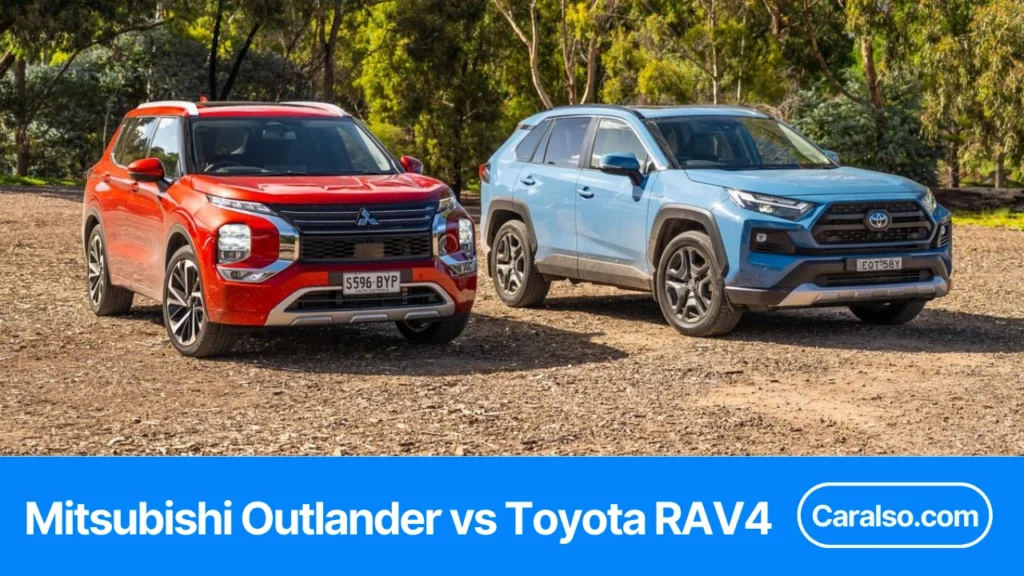
Mitsubishi Outlander vs Toyota RAV4
Outlander vs RAV4 Quick Comparison
| Category | 2025 Mitsubishi Outlander | 2025 Toyota RAV4 |
|---|---|---|
| Starting MSRP (Gas) | $29,645 (FWD) | $29,800 |
| Seating | 7 | 5 |
| Cargo Behind 2nd Row | 30.6 cu ft | 37.6 cu ft |
| Cargo Behind 3rd Row | 10.9 cu ft | Not applicable |
| Gas MPG (Combined) | 26–27 mpg (drivetrain-dependent) | 28–30 mpg (trim/drivetrain-dependent) |
| Hybrid Option | No (gas only) | Yes (39 mpg combined on Hybrid AWD) |
| Plug-In Option | Yes (Outlander PHEV) | Yes (RAV4 Plug-in Hybrid) |
| Plug-In EV Range | Up to 38 miles | Up to 42 miles |
| Max Towing | 2,000 lbs (gas) | 1,500 lbs (gas), 1,750 lbs (Hybrid), 2,500 lbs (Plug-in) |
| Warranty Highlight | 10 yr/100k powertrain (original owner), 5 yr/60k basic | 5 yr/60k powertrain, 3 yr/36k basic, 10 yr/150k hybrid components |
| 5-Year Depreciation | 51.1% (iSeeCars) | 30.3% (iSeeCars) |
Note: Towing and MPG vary by trim, drivetrain, and powertrain. Also, some older RAV4 trims from past years could tow 3,500 lbs, but the 2025 lineup is generally lower on towing.
One more 2026 note that matters: the 2026 RAV4 moves to hybrid-only and the base price jumps to $33,350. If you are cross-shopping 2025 vs 2026, that price shift is real. It can change the whole value equation.
Sources: Mitsubishi pricing and specs, Toyota pricing and plug-in specs, FuelEconomy.gov, iSeeCars depreciation, and 2026 RAV4 pricing coverage.
Biggest Differences (What Actually Changes The Decision)
You Need A Third Row Sometimes, Outlander Wins
This is the Outlander’s trump card. It seats 7. The RAV4 seats 5.
But I need to be super clear about what “third row” means here.
- The Outlander’s third-row legroom is 18.7 inches.
- Cargo behind the third row is 10.9 cu ft.
- Fold the third row down and cargo behind the second row jumps to 30.6 cu ft.
So yes, it works. But it works best for kids, short trips, and “we need one extra seat twice a month.”
If you plan to carry adults back there, or you want real cargo with all seats up, you will feel the compromise fast.
Where the RAV4 quietly wins is day-to-day cargo. With the second row up, the RAV4 is at 37.6 cu ft behind the second row. That is a meaningful gap versus 30.6 cu ft in the Outlander with its third row folded.
My simple rule:
- If you need 6 or 7 seats even a few times a month, I’d rather you buy the Outlander and live with the smaller cargo moments.
- If you never need 7 seats, I’d rather you buy the RAV4 and enjoy the bigger “normal mode” cargo space every day.
Sources: Mitsubishi cargo volumes and Outlander third-row dimensions, plus commonly listed RAV4 cargo volume.
You Want Best Fuel Economy And Resale, RAV4 Wins
This is where the RAV4 usually pulls away.
Fuel economy first:
- RAV4 Hybrid AWD is 39 mpg combined on the EPA page.
- Outlander gas is typically in the mid-to-high 20s combined, depending on drivetrain.
Here’s what that looks like in real usage if you drive 15,000 miles a year:
- 39 mpg uses about 385 gallons
- 27 mpg uses about 556 gallons
- That is about 171 gallons per year difference
Now resale:
iSeeCars puts a 5-year depreciation gap at 51.1% for the Outlander vs 30.3% for the RAV4. That is not a rounding error. That is the kind of number that changes what the “cheap” choice really costs over time.
One more 2026 reality check:
- The 2026 RAV4 goes hybrid-only, and the base price is reported at $33,350.
If you were hoping to buy a cheaper gas-only RAV4 new, that window basically closes with the 2026 change.
Sources: EPA fuel economy for RAV4 Hybrid, RAV4 gas MPG ranges as commonly published by Toyota dealers, iSeeCars depreciation comparison, and 2026 RAV4 pricing coverage.
You Want Plug-In Hybrid, Compare Outlander PHEV vs RAV4 Plug-In Hybrid
If you can charge at home, plug-ins can be awesome. I run them like this: electric for the boring daily miles, gas for long trips.
Here are the headline numbers that matter:
- Outlander PHEV: up to 38 miles electric range, 64 MPGe
- RAV4 Plug-in Hybrid: up to 42 miles electric range, up to 94 MPGe
Towing also splits them:
- Outlander PHEV towing: 1,500 lbs
- RAV4 Plug-in Hybrid towing: 2,500 lbs
And here’s a practical differentiator almost nobody talks about:
- Outlander PHEV offers DC fast charging support (CHAdeMO).
That can matter if you road trip and want a faster top-up sometimes.
Price matters too:
- RAV4 Plug-in Hybrid starting MSRP is listed at $44,815.
- Outlander PHEV trims start lower than that depending on trim lineup.
My plug-in rule:
- If you want the best efficiency numbers and more towing headroom, I lean RAV4 Plug-in Hybrid.
- If you want 3 rows plus plug-in capability, I lean Outlander PHEV.
There are not many plug-in SUVs that even offer that combo.
Price & Trims (What You’ll Actually Cross-Shop)
Starting Price vs “Popular Build” Price (Real Buyer Behavior)
When I see people cross-shop these two, they usually land in one of three buckets.
- Gas under $35k.
- Hybrid around the mid $30k range.
- Plug-In Hybrid around the mid $40k range.
Here is the clean pricing picture, using base MSRPs that are easy to compare.
| Model | Powertrain | Starting MSRP (Base Trim) |
|---|---|---|
| Mitsubishi Outlander | Gas | $29,645 |
| Toyota RAV4 | Gas | $28,850 |
| Toyota RAV4 | Hybrid | $31,900 |
| Mitsubishi Outlander PHEV | Plug-In Hybrid | $40,445 |
| Toyota RAV4 Plug-In Hybrid | Plug-In Hybrid | $43,865 |
Now the real world part.
Most buyers do not stay on the base trim. They add AWD, then they add at least one comfort package, then they add a bigger screen or a moonroof.
So I like to anchor the “popular build” with the trims I see people actually ask for.
| What People Usually Shop | Why It’s Popular | MSRP Anchor |
|---|---|---|
| RAV4 XLE (Gas) | Mid-trim features without jumping to the top trim | $32,155 |
| RAV4 Hybrid XLE | Hybrid mpg without paying for the top trims | $35,810 |
| Outlander PHEV SE | Plug-in value point before the premium trims | $43,095 |
| Outlander PHEV SEL | Where the comfort and charging upgrades start showing up | $46,395 |
If you are trying to stay under $35k, the Outlander PHEV is usually off the table. The gas Outlander and gas RAV4 are the play.
If you want the best mpg without plugging in, the RAV4 Hybrid is the center of the bullseye.
If you want to run errands on electricity, both PHEVs do it. The Outlander PHEV usually costs less than a comparably equipped RAV4 Plug-In Hybrid, but the RAV4 brings more power.
Best Value Trims (Shortlist)
I keep this simple. I pick trims based on what changes daily life.
Outlander: Value Pick And Family Pick
Value pick: Outlander PHEV SE
This is the trim where I see the feature set jump. It is priced at $43,095. It adds things like an 8-way power driver seat, a 9.0-inch nav screen, heated front seats, wireless phone charging, and synthetic leather seating surfaces.
Family pick: Outlander PHEV SEL
This starts at $46,395. It adds 3-zone climate control, and it is also where DC fast charging capability shows up in the trim list. If you road trip a lot and you actually plan to use public charging, this matters.
If you are shopping the gas Outlander instead, I still treat the trim ladder the same way. I look for the first trim that gets you the comfort and driver-assist features you want, then I stop. I do not chase the top trim unless I want the exact interior materials.
RAV4: Value Pick And Hybrid Value Pick
Value pick: RAV4 XLE (Gas)
It is the trim I see most buyers land on. It is priced at $32,155 in the common pricing guides I use.
Hybrid value pick: RAV4 Hybrid XLE
This is the hybrid trim that usually hits the best balance. It is listed at $35,810 in common MSRP breakdowns. You get the hybrid system and you avoid the highest trim pricing.
If you are going Plug-In Hybrid on the Toyota side, the SE is the entry point. Toyota lists it at $43,865.
What To Avoid Paying Extra For
I am not ضد fun options. I just want the money to show up in daily use.
Here is what I usually skip unless you really care.
Bigger wheels
Moving to 19-inch or 20-inch wheels can cost more and it can make tire replacement more expensive. It can also hurt ride comfort on rough roads.
Premium audio packages
If you are not the kind of person who notices speaker placement, you can save the money.
Two-tone paint and appearance packages
They look cool. They rarely change the drive or the ownership experience.
Panoramic roof
It is nice. It also adds complexity. If you never open a sunroof, skip it.
Top trims for “one feature”
If the only thing you want is ventilated seats or a power liftgate, try to get it via a mid-trim package first.
Powertrains & MPG (Two-Track Comparison)
Before I break this down, here is the numbers-first map.
| Model | Powertrain | Output | Drivetrain | EPA Efficiency |
|---|---|---|---|---|
| Outlander (Gas) | 2.5L I4 + CVT | 181 hp, 181 lb-ft | 2WD or AWD | 27 mpg combined (2WD) or 26 mpg combined (AWD) |
| RAV4 (Gas) | 2.5L I4 + 8-speed auto | 203 hp, 184 lb-ft | FWD or AWD | 30 mpg combined (FWD) or 30 mpg combined (AWD) |
| RAV4 Hybrid | 2.5L hybrid system | 219 hp (system) | AWD | 39 mpg combined (most trims), 37 mpg combined (Woodland) |
| Outlander PHEV | 2.4L + twin motors + 20.0 kWh battery | 248 hp, 332 lb-ft | AWD | 64 MPGe, up to 38 miles EV range |
| RAV4 Plug-In Hybrid | Plug-in hybrid system | 302 hp (system) | AWD | 94 MPGe, about 42 miles EV range |
Now I like to compare these two ways.
Track A: Gas Models (Outlander Gas vs RAV4 Gas)
Power feel
The RAV4 has 203 hp and an 8-speed automatic. The Outlander has 181 hp and a CVT. If you care about passing power or highway merging, the RAV4 has the advantage on paper and it usually feels more direct.
MPG expectations
The RAV4 gas model is rated at 30 mpg combined in both FWD and AWD form. The Outlander gas model is rated at 27 mpg combined in 2WD and 26 mpg combined in AWD.
How I’d choose for a commute
If your drive is mostly steady highway, I lean RAV4 gas because of the power and the efficiency.
If you need a third row for short trips, the Outlander gets the nod because the RAV4 does not offer it.
Track B: Electrified Models
RAV4 Hybrid vs Outlander Gas (The Most Common Cross-Shop)
This is the decision I see most often.
If you want better mpg without plugging in, the RAV4 Hybrid is the clean answer. It is rated at 39 mpg combined in most trims. Even the lower-rated Woodland is 37 mpg combined.
Against the Outlander gas at 26 to 27 mpg combined, that is a big gap.
If you do 12,000 miles a year, the difference between 27 mpg and 39 mpg is not small. It is hundreds of gallons over time. That is why I always tell people to at least run the math before they dismiss the hybrid.
Outlander PHEV vs RAV4 Plug-In Hybrid (Apples To Apples)
This one is more about your charging life than anything else.
Power
Outlander PHEV is listed at 248 hp and 332 lb-ft.
RAV4 Plug-In Hybrid is listed at 302 hp. Toyota also quotes a 0–60 time of 5.5 seconds.
EV range and efficiency
Outlander PHEV is rated at up to 38 miles of EV range and 64 MPGe.
RAV4 Plug-In Hybrid is rated at about 42 miles of EV range and 94 MPGe.
Charging differences that matter
Outlander PHEV lists DC fast charging capability on SEL and higher trims, and it notes that DC fast charging is tied to CHAdeMO. That can be useful if you actually plan to charge away from home.
For the 2025 RAV4 Plug-In Hybrid, Toyota positions it as home and public Level 2 charging. Toyota’s redesigned 2026 RAV4 Plug-In Hybrid is where DC fast charging becomes a headline feature. So for 2025 shopping, I treat Toyota’s plug-in as an at-home charger first.
Towing
Outlander gas is rated at 2,000 lbs.
Outlander PHEV is rated at 1,500 lbs when equipped with the factory hitch.
RAV4 towing varies a lot by powertrain and trim, so I always tell people to verify the exact trim they are buying before they plan a trailer purchase.
Space And Practicality (Where The Numbers Don’t Tell The Whole Story)
If you only look at cargo volume, you miss the point.
The Outlander is a 7-seat layout. That third row eats space when it is up.
The RAV4 is a 5-seat layout. It uses that space for cargo all the time.
Here are the numbers I keep in my head when I’m comparing these two.
| Measurement | Outlander | RAV4 |
|---|---|---|
| Seating Capacity | 7 | 5 |
| Front Legroom | 41.7 in | 41.0 in |
| Second-Row Legroom | 39.9 in | 37.8 in |
| Third-Row Legroom | 18.7 in | Not Available |
| Cargo Behind Second Row | 30.6 cu ft | 37.6 cu ft |
| Cargo Behind Third Row | 10.9 cu ft | Not Available |
| Max Cargo With Seats Folded | 64.3 cu ft | 69.8 cu ft |
Seating And Comfort
Front seats are a wash for space.
Both give you about 41 inches of legroom.
The second row is where the Outlander pulls ahead.
It has 39.9 inches of legroom.
The RAV4 has 37.8 inches.
That 2.1-inch gap matters when you have a rear-facing car seat.
It also matters if the driver is 6 feet tall and the seat is set back.
The third row is the real story.
The Outlander gives you 18.7 inches of legroom back there.
That is why I treat it as a kid seat.
My practical rule:
If you plan to use the third row every week, bring your tallest kid and your bulkiest booster to the test drive.
If your kid’s knees hit the second-row seatback in 30 seconds, you have your answer.
Cargo Space (Strollers, Suitcases, Costco Runs)
The RAV4 is the better daily cargo tool.
You get 37.6 cu ft behind the second row.
Fold the second row and you get 69.8 cu ft.
The Outlander trades that for a third row.
With all seats up, you get 10.9 cu ft behind the third row.
Fold the third row and you get 30.6 cu ft behind the second row.
Fold rows two and three and you get 64.3 cu ft.
This is why people feel two different Outlanders.
Outlander in 5-seat mode.
It is fine for luggage and a stroller.
Outlander in 7-seat mode.
Cargo gets tight fast.
If you do airport runs with 6 people, the Outlander will carry the people.
You will probably need a cargo box or a hitch basket for the bags.
If you do Costco runs with 2 kids, the RAV4 is easier.
It gives you more room without doing any seat math.
Family Fit Scorecard (Differentiation Section Competitors Don’t Have)
I judge “family fit” with three tests.
Car seat install.
Third-row reality.
Road-trip packing.
Here is my quick scorecard.
| Family Task | Outlander | RAV4 |
|---|---|---|
| Second-Row Legroom For Rear-Facing Seats | 39.9 in | 37.8 in |
| Lower Anchors In Second Row | 2 sets | 2 sets |
| Top Tether Anchors In Second Row | Yes | 3 anchors |
| Third Row For Kids | Yes | Not Available |
| Cargo With All Seats In Use | 10.9 cu ft | 37.6 cu ft |
Car-Seat Checklist
This is the checklist I run before I fall in love with any SUV.
- Lower anchors.
If you have 2 car seats, you are almost always using the two outer positions. - Center position reality.
On the Outlander, the manual warns against using the center seat with the lower anchors.
That pushes most families toward seatbelt installs in the middle, if you are doing 3-across. - Top tethers.
The RAV4 gives you three top tether anchors on the seatback.
That makes forward-facing installs more straightforward across the back. - Front seat clearance.
This is where the Outlander’s 39.9 inches of second-row legroom helps.
If you put a rear-facing seat behind a tall driver, you have more margin.
My tip:
Bring your actual car seat to the dealer.
Install it.
Then move the front seat to your normal driving position.
If you feel cramped in 60 seconds, it will not get better later.
Third-Row Reality Check
I treat the Outlander third row as a tool, not a lifestyle.
Here is what the numbers say.
Third-row legroom is 18.7 inches.
Here is what that means in real use.
Kids fit.
Adults fit for short trips.
Not for long trips.
Now the part that surprises families.
If you have a rear-facing seat in the second row, you often slide the second row forward to open up the third row.
That can reduce second-row comfort on the side you use for access.
My rule:
If your family plan is 2 kids in the second row and 1 kid in the third row, do a full mock setup on the test drive.
Second row in car-seat mode.
Third row up.
Then have the third-row kid climb in and out twice.
If it is annoying in the parking lot, it will be worse in the school line.
Road-Trip Setup
This is where these two split cleanly.
RAV4 road trip with 4 people.
You keep the second row up.
You still have 37.6 cu ft for bags.
That is easy.
Outlander road trip with 4 people.
I put it in 5-seat mode.
Third row folded.
You have 30.6 cu ft behind the second row.
That usually works.
Outlander road trip with 6 or 7 people.
Third row up.
Cargo drops to 10.9 cu ft.
That is the point where you plan for a roof box, hitch basket, or fewer bags.
Plug-in note.
If you are looking at the Outlander PHEV or RAV4 Plug-In Hybrid, the best family road-trip move is still the same.
Charge at home.
Use EV miles for daily driving.
Use gas for the long legs.
The cargo and seating math stays the deciding factor.
Ride, Handling & Noise (Daily Livability)
Ride Comfort Vs Busy Suspension
If you drive rough pavement every day, I’d start with the Outlander in 2025.
Mitsubishi did a mid-cycle refresh and recalibrated the steering plus the springs, shock absorbers, and stabilizer bars. Those parts are exactly what I feel in the first 3 minutes of a test drive. Small bumps. Expansion joints. That quick up-down motion you get at 25 to 45 mph.
The RAV4 is a little more trim-dependent. The Hybrid SE is called out for a sport-tuned setup with more taut springs and shock absorbers. So if you cross-shop SE or XSE, expect more road feel than an LE or XLE. Not bad. Just different.
My 10-minute test loop for ride is simple.
- One rough back road at 25 to 35 mph
- One highway on-ramp
- One lane change at 55 to 65 mph
If the Outlander feels calmer on the rough stuff, that refresh is doing its job.
If the RAV4 feels tighter and a bit busier, you are probably in one of the sport-tuned trims.
Cabin Noise And Audio/Insulation Updates (Outlander Refresh)
This is where the 2025 Outlander refresh actually matters.
Mitsubishi added sound-deadening and claims more than 0.5 dB less road noise and nearly 6 dB more overall sound isolation versus the 2024 model. That is a big claim. And it lines up with what I listen for on concrete highways.
Also, Yamaha audio becomes part of the story for 2025 Outlander. Stereo quality will not fix wind noise, but it does change daily enjoyment. I always test this with the same 3 tracks, at the same volume, and I listen for front door buzz and dash vibration.
On the RAV4 side, it is usually quiet enough at cruise. But when you ask for a burst of speed, the engine can sound coarse. In a measured test on the redesigned 2026 RAV4 Hybrid, interior sound was logged at 69 dBA at 70 mph and 75 dBA at full throttle. That lines up with the common “fine at cruise, louder when pushed” vibe.
So here’s how I’d translate that into a decision:
- If you care about steady highway calm, both can work.
- If you hate engine roar when merging, the RAV4 can annoy you more when you drive it hard.
- If you hate tire slap and general road texture noise, the refreshed Outlander is worth a serious listen.
Controls And Visibility
This part is underrated. And it is easy to test fast.
Here’s what I check in 5 minutes, parked in the lot:
- Can I rest my right arm and hit the screen without leaning forward?
- Do I have real buttons for climate and volume?
- Can I see the hood corners from the driver seat?
- How thick are the A-pillars at a 45-degree left turn?
Then I drive and do two quick checks:
- I look for a clean “center” feeling in the steering wheel at 65 mph.
- I lightly brake from 35 mph to 0 and feel for smoothness at the last 5 mph.
If the steering feels twitchy or the brake pedal feels grabby at low speed, that is the stuff that makes a car feel tiring every day.
AWD, Snow, Light Trails & Towing
AWD Systems Explained Simply (Including S-AWC Context)
I like to explain AWD by answering one question.
How does it get power to the rear when the front slips?
Outlander (Gas)
- Mitsubishi’s S-AWC system pairs with a drive mode selector.
- You can switch between Eco, Normal, Tarmac, Gravel, Snow, and Mud.
- That matters because the car changes how it manages traction and stability depending on surface.
Outlander PHEV
- It adds Twin Motor S-AWC in the official trim description.
- It also adds a Power mode in the drive mode list.
- In real use, the smooth EV torque helps in slick conditions at low speed. It is easier to be gentle.
RAV4 (Gas)
- Toyota spells out two AWD types on gas models: Standard AWD or Dynamic Torque Vectoring AWD with rear driveline disconnect.
- The torque-vectoring setup can send up to 50% of engine torque to the rear, and it can also distribute torque left or right at the rear.
- Rear driveline disconnect is a fuel-saver when AWD is not needed, because it can stop the rear driveshaft from spinning.
RAV4 Hybrid
- The Hybrid uses an Electronic On-Demand AWD system that operates at all vehicle speeds.
- Practically, it gives you rear assist without a traditional driveshaft feel.
If you live where it snows, I treat both as “good enough” systems.
The bigger difference in real traction is usually tires, not the badge on the tailgate.
Snow, Light Trails, And The Stuff People Actually Do
Neither of these is a rock crawler.
No low range.
No locking diffs.
That is fine.
What they are good at is:
- Snowy hills
- Unplowed neighborhoods
- Muddy trailhead parking lots
- Gravel access roads
Ground clearance is close enough to call it a tie for light-duty use.
- Outlander is listed at 8.4 inches.
- RAV4 Plug-in Hybrid is called out at 8.0 inches in Toyota’s info.
The traction tools matter more than the clearance number.
- Outlander gives you Snow and Mud modes right in the drive selector.
- RAV4 gives you Multi-Terrain Select on AWD gas models with Mud and Sand or Rock and Dirt settings.
- RAV4 Hybrid Woodland Edition also gets Trail Mode that acts like a virtual limited slip differential, sending power to specific wheels when needed.
My practical rule for light trails is simple.
If you see deep ruts, sharp rocks, or a steep loose climb, stop and walk it first.
If you would not walk it in regular sneakers, you probably should not drive it in either of these on street tires.
Towing Numbers Plus What They Mean In Real Life
Here is the towing reality most owners live with.
| Model | Max Tow Rating (Typical) | Real-World Use Case |
|---|---|---|
| Outlander (Gas) | 2,000 lb | Small utility trailer, 1 to 2 bikes plus gear |
| Outlander PHEV | 1,500 lb | Lightweight utility trailer, smaller loads |
| RAV4 (Gas) | 1,500 lb | Same lightweight trailer use |
| RAV4 Hybrid | 1,750 lb | Better margin for a small camper or heavier gear |
| RAV4 Plug-In Hybrid | 2,500 lb | The best match here for towing in this price band |
Two things I want you to remember:
- Payload is often the limiter, not tow rating.
- Tongue weight usually lands around 10% to 15% of trailer weight.
If you tow a 1,500 lb trailer and you put 150 lb to 225 lb on the hitch, that load counts against payload. Add 4 people and cargo and you can hit limits faster than you expect.
One more note for 2026 cross-shoppers.
Toyota has already said the all-new RAV4 lineup includes grades capable of 3,500 lb towing, with lower-tow models at 1,750 lb. If towing is a big part of your life, that alone can justify waiting.
Tire Choice Matters More Than Most People Think
If you do one upgrade for snow traction, do tires.
Here’s what I do:
- If you see snow every winter, I run 3PMSF-rated tires or dedicated winter tires.
- If you see mostly rain and cold temps, a 3PMSF all-weather tire can be the sweet spot.
Two quick tire tips that actually show up in daily driving:
- More aggressive tread usually increases road noise.
- Wider tires can hydroplane sooner and float more on slush.
So if you test drive one that feels loud on the highway, check the tire type before you blame the whole vehicle.
Tech & Driver Assistance (What’s Standard vs Paywalled)
Infotainment & Phone Integration
If you live in Apple CarPlay or Android Auto, here’s the cleanest split.
The 2025 RAV4 comes with Toyota Audio Multimedia. Toyota lists an 8-inch touchscreen as standard on most trims. Toyota also lists wireless Apple CarPlay and wireless Android Auto as standard. Some trims offer a 10.5-inch screen, and a 12.3-inch digital gauge cluster.
The Outlander story is different. Mitsubishi lists a 12.3-inch Smartphone-link Display Audio system with navigation even on the ES trim. Mitsubishi also lists wireless Apple CarPlay and wireless Google Android Auto.
What that means in real life:
- If you want a bigger screen without trim hopping, the Outlander tends to get you there sooner.
- If you want a simpler, familiar interface and you do not care about built-in navigation, I find the RAV4’s setup easy to live with.
Quick Tech Snapshot
| Item | 2025 Toyota RAV4 | Mitsubishi Outlander (2026 Spec Sheet As Reference) |
|---|---|---|
| Base Screen Size | 8 in (most trims) | 12.3 in (listed on ES) |
| Bigger Screen Option | 10.5 in (some trims) | 12.3 in (listed across trims) |
| CarPlay | Wireless | Wireless |
| Android Auto | Wireless | Wireless |
| Digital Cluster | 12.3 in available | 12.3 in listed on higher trims |
Note: Mitsubishi’s public trims page I’m using is for the 2026 Outlander. If you’re buying a 2025, confirm screen sizes on the window sticker.
Driver Assists You’ll Actually Use
I care about 3 things here.
Adaptive cruise that does not hunt.
Lane support that does not ping-pong.
AEB that actually reacts early.
On the 2025 RAV4, Toyota lists Toyota Safety Sense 2.5 as standard. The feature set Toyota calls out includes:
- Pre-Collision System with Pedestrian Detection
- Dynamic Radar Cruise Control
- Lane Departure Alert with Steering Assist
- Lane Tracing Assist
- Road Sign Assist
- Automatic High Beams
On the Outlander, Mitsubishi lists a strong base safety package on ES, including:
- Forward Collision Mitigation with Pedestrian Detection
- Blind Spot Warning with Lane Change Assist
- Rear Automatic Emergency Braking
- Rear Cross Traffic Alert
- Rear parking sensors
- Automatic High Beams
Then there is the “paywalled” part.
Mitsubishi lists MI-PILOT Assist with Navi-link Adaptive Cruise Control and Stop & Go on specific trims like Trail Edition. That is the stuff you want if highway miles are your weekly routine.
My shortcut:
- If you want lane centering plus adaptive cruise on every commute, I would not assume it. I would verify the exact system name on the trim features list or window sticker.
- If you want blind spot monitoring without thinking about packages, the Outlander is more likely to hand it to you on the lower trims.
Safety (Crash Tests + Safety Tech)
IIHS Overview (What The Scores Actually Say)
I like IIHS because it shows where modern SUVs are still getting caught out.
Here’s the quick snapshot for 2025 model-year ratings on the core vehicles.
Crash Test Snapshot (IIHS)
| IIHS Category | 2025 Toyota RAV4 | 2025 Mitsubishi Outlander |
|---|---|---|
| Small Overlap Front | Good | Good |
| Moderate Overlap Front (Updated Test) | Marginal | Marginal |
| Side (Updated Test) | Acceptable | Good |
| Headlights | Good | Good |
Two notes that matter:
- Both are tagged with a Marginal result in the updated moderate overlap front test. That is not rare lately, but it is real.
- The Outlander shows a stronger result in the updated side test here.
Also, do not skip the “applies to” fine print on IIHS pages. Some ratings apply across multiple years and can depend on build timing or equipment.
Safety Tech Isn’t Equal Across Trims
This is where a lot of comparison articles get lazy.
IIHS lists blind spot detection as optional availability on the 2025 RAV4.
IIHS lists blind spot detection as standard on the 2025 Outlander.
So if safety tech is your top priority, I would shop like this:
RAV4 Trim Minimum I Would Target For Safety Tech
- A trim that includes blind spot monitoring.
- If available on your build, rear automatic braking is a nice bonus.
Outlander Trim Minimum I Would Target For Safety Tech
- Even ES lists blind spot plus rear AEB.
- If you want more “hands-on highway help,” look for MI-PILOT Assist on the trim list.
Practical tip:
- When you test drive, force a real scenario. Set adaptive cruise at 65 mph. Follow a car that changes speed. Then try a gentle curve with lane support on. You will feel the difference in 30 seconds.
Reliability, Recalls & Warranty (Trust Section)
Warranty Comparison (Read The Fine Print)
This is the easiest place to make a bad assumption.
Toyota’s new-vehicle coverage is the classic 3 years or 36,000 miles basic, and 5 years or 60,000 miles powertrain. For hybrids, Toyota’s guide spells out additional hybrid coverage, including 8 years or 100,000 miles for the hybrid system, and 10 years or 150,000 miles for the hybrid battery.
Mitsubishi’s headline is the 10 years or 100,000 miles powertrain coverage, but Mitsubishi states that powertrain coverage is for the original owner only. Mitsubishi also states that subsequent owners receive the balance of the 5-year or 60,000-mile New Vehicle Limited Warranty. Mitsubishi also advertises 5-year unlimited-mile roadside assistance and a 2-year or 30,000-mile limited maintenance program, with specific limitations.
Warranty At A Glance (U.S.)
| Coverage | Toyota RAV4 (Gas) | Toyota RAV4 Hybrid | Mitsubishi Outlander |
|---|---|---|---|
| Basic | 3 yr / 36,000 mi | 3 yr / 36,000 mi | 5 yr / 60,000 mi (new vehicle limited) |
| Powertrain | 5 yr / 60,000 mi | 5 yr / 60,000 mi | 10 yr / 100,000 mi (original owner only) |
| Hybrid System | N/A | 8 yr / 100,000 mi | N/A |
| Hybrid Battery | N/A | 10 yr / 150,000 mi | N/A |
| Roadside | Varies by program | Varies by program | 5 yr / unlimited mi (listed) |
If you’re buying used, this is the key takeaway:
- Toyota’s structure is straightforward.
- Mitsubishi’s biggest number is tied to original ownership. So you need the in-service date and owner history to know what you really get.
Recalls That Matter To Shoppers
Recalls are normal. The important part is how fast you can confirm and fix them.
One recent example on the Mitsubishi side:
- Mitsubishi had a recall tied to an in-vehicle infotainment software issue that can cause the rearview camera image to freeze or not appear. The campaign covers certain 2022 to 2024 Outlander models and certain 2023 to 2025 Outlander PHEV models. The remedy is a software update.
On the Toyota side, there have also been recent recall actions affecting various Toyota and Lexus models, including some RAV4 model years, tied to instrument panel display concerns. I do not treat this as a reason to panic. I treat it as a reason to run the VIN before you negotiate.
My rule:
- If a seller cannot show “no open recalls,” I price the hassle into the deal. Even if the fix is free, your time is not.
How To Check Your VIN In 60 Seconds
I do this before I talk monthly payment.
- Find the VIN.
- Lower left windshield.
- Driver door jamb label.
- Registration or insurance card.
- Run it in the NHTSA recall tool.
- This catches open safety recalls across brands.
- Run it in the manufacturer tool.
- Toyota has its own recall lookup.
- Mitsubishi has an owner recall portal and dealer network lookup.
- Look for these words.
- Open. Remedy available.
- Open. Remedy not yet available.
- If it says “remedy not yet available.”
- Ask the dealer to print the campaign page.
- Decide if you want to wait, or move on.
Ownership Costs And Resale (Where The Money Goes)
If you only look at MSRP, you miss the biggest bill.
Depreciation is usually the biggest cost in the first 5 years. And the gap between these two is not small.
Depreciation Snapshot (Translate It Into Buyer Meaning)
Here is what the big calculators show.
iSeeCars 5-year depreciation:
- Outlander: 51.1%
- RAV4: 30.3%
- Gap: 20.9 percentage points
CarEdge 5-year depreciation:
- Outlander: 55%
- RAV4: 28%
Different sources. Same direction.
If you plan to trade in 4 to 6 years, the RAV4 usually puts more money back in your pocket.
Here is the same idea in dollars using CarEdge’s 5-year ownership breakdown:
- RAV4 depreciation: $10,377
- Outlander depreciation: $21,252
That is a $10,875 gap just from value loss.
Maintenance And Repair-Risk Positioning (High Level, Not Fear)
Most people want one answer here.
Which one is cheaper to keep on the road.
On RepairPal’s averages:
- RAV4 average annual repair cost: $429
- Outlander average annual repair cost: $519
On CarEdge’s 10-year estimates:
- RAV4 maintenance and repairs: about $6,005 over 10 years
- Outlander maintenance and repairs: about $7,839 over 10 years
I also look at complexity.
- Gas RAV4 and gas Outlander are the simplest to maintain.
- Hybrids and plug-ins add components, but they often reduce brake wear because of regen braking.
- Plug-ins add charging hardware. That is another system to own.
If you want the lowest-stress setup, I usually rank them like this:
- RAV4 gas
- Outlander gas
- RAV4 Hybrid
- Outlander PHEV or RAV4 Plug-In Hybrid
That is not about fear. It is about parts count and long-term troubleshooting.
Insurance Plus Fuel (What To Expect, What Changes It)
Insurance is personal. But the estimates are still useful for planning.
CarEdge estimated annual insurance:
- RAV4: about $1,999 per year
- Outlander: about $2,687 per year
Those estimates assume a single-car policy, full coverage, a good driving record, and good credit.
Fuel is easier. I do it in gallons, not guesses.
Gas Use Per 10,000 Miles
| Vehicle | Combined Rating Used For Math | Gallons Per 10,000 Miles |
|---|---|---|
| RAV4 Gas | 30 mpg | 333 |
| Outlander Gas | 26 mpg | 385 |
| RAV4 Hybrid | 39 mpg | 256 |
Now multiply by your local gas price.
Example:
If gas is $3.50 per gallon, the gap between 333 gallons and 385 gallons is 52 gallons.
That is $182 per 10,000 miles.
Plug-in fuel cost depends on your charging life.
If you can charge at home and you drive 30 to 40 miles a day, your gas use can drop a lot.
If you cannot charge, you are carrying battery weight without the main benefit.
5-Year Ownership Snapshot
This is the table I’d show a friend who wants the money story in one screen.
| Category | Outlander (Gas) | RAV4 (Gas) | RAV4 Hybrid |
|---|---|---|---|
| 5-Year Depreciation Trend | Higher | Lower | Lower |
| 5-Year Depreciation (Example Source) | 51.1% | 30.3% | Often strong |
| 5-Year Cost To Own (CarEdge) | $51,772 | $35,894 | Varies by trim |
| Insurance Estimate (CarEdge, Per Year) | $2,687 | $1,999 | Similar ballpark |
| Avg Annual Repair Cost (RepairPal) | $519 | $429 | Similar ballpark |
| Free Maintenance Programs | 2 years or 30,000 miles limited maintenance | 2 years or 25,000 miles ToyotaCare | 2 years or 25,000 miles ToyotaCare |
| Best Use Case For Value | Need 3 rows and you will keep it long | Best resale and low hassle | Best fuel math without plugging in |
One more ownership note.
Mitsubishi’s 10-year or 100,000-mile powertrain coverage is for the original owner. That matters a lot if you buy used.
Which One Should You Pick? (Decision Tree)
Choose The Outlander If
- You need 7 seats sometimes
- You want 39.9 inches of second-row legroom
- You want a lower-priced way into a plug-in SUV with 3 rows
- You want a long powertrain warranty as the original owner
- You live in a place where Snow and Mud drive modes matter and you will use them
- You are fine with lower resale value because you will keep it longer
Choose The RAV4 If
- You want stronger resale over 5 years
- You want 37.6 cu ft of cargo behind the second row every day
- You want 39 mpg combined with the Hybrid and no charging routine
- You want a simpler “buy it and forget it” ownership path
- You tow and want the strongest option in this pair, which is the RAV4 Plug-In Hybrid at 2,500 lbs
- You want the biggest used market and easiest parts availability
If You’re Stuck, Do This 10-Minute Test Drive Checklist
I do this every time. Same loop. Same checks.
Parking Lot, 2 Minutes
- Sit in the driver seat. Set the seat and wheel.
- Check hood visibility and mirrors.
- Open the rear door. Check car seat access.
- Fold the second row. Look at the cargo floor and load height.
City Street, 4 Minutes
5. Drive 25 to 35 mph over rough pavement.
6. Brake from 35 mph to 0. Feel the last 5 mph.
7. Do one left turn where the A-pillar could block pedestrians.
Highway, 4 Minutes
8. Merge hard once. Listen to engine noise at 60 to 70 mph.
9. Set adaptive cruise at 65 mph behind a car that varies speed.
10. Turn on lane support and take one gentle curve.
If one of them feels tiring in 10 minutes, it will feel tiring in 10 months.
FAQs
Which Is More Reliable: Outlander Or RAV4?
If you mean “which one is more likely to cost less over time,” I lean RAV4.
Here is why I say that.
- Average annual repair cost estimates put RAV4 at $429 and Outlander at $519.
- 5-year depreciation estimates show a big gap. About 30.3% for RAV4 vs 51.1% for Outlander.
If you buy new and plan to keep it a long time, the Outlander warranty can still matter. Just remember the 10-year or 100,000-mile powertrain coverage is tied to the original owner.
Is The Outlander’s Third Row Usable?
Yes. For kids. And for short trips.
The numbers tell the story.
- Third-row legroom is 18.7 inches.
- Cargo behind the third row is 10.9 cu ft.
If you plan to use the third row weekly, do this on the test drive.
- Put the second row in your real car-seat position.
- Flip the third row up.
- Have your kid climb in and out twice.
If that feels annoying in the lot, it will feel worse in daily life.
Outlander PHEV Vs RAV4 Plug-In Hybrid: Which Is Better For Commuters?
It depends on your daily miles and whether you can charge at home.
If you drive 15 to 40 miles a day and you can charge at home:
- RAV4 Plug-In Hybrid gives about 42 miles EV range and 94 MPGe.
- Outlander PHEV gives up to 38 miles EV range and 64 MPGe.
If you need 6 to 7 seats sometimes:
- Outlander PHEV is the plug-in that can do it.
If you do not have home charging:
- I would usually skip both plug-ins and buy a RAV4 Hybrid at 39 mpg combined.
Which One Holds Value Better?
RAV4.
Here is the cleanest number set I use:
- Outlander 5-year depreciation: 51.1%
- RAV4 5-year depreciation: 30.3%
If you trade every 4 to 6 years, that gap matters more than a small MSRP difference.
Which Is Better In Snow?
Both can do winter duty. Tires decide more than anything else.
What I like about each:
- Outlander gives you Snow mode and Mud mode right on the selector.
- RAV4 Hybrid has electronic AWD and a strong efficiency advantage.
Two numbers I keep in mind:
- Outlander ground clearance is 8.4 inches.
- RAV4 Plug-In Hybrid ground clearance is listed at 8.0 inches.
My snow rule:
If you want one upgrade that actually changes traction, buy 3PMSF-rated tires or true winter tires.
Key Takeaways
- If you need 7 seats sometimes, Outlander is the only option here. RAV4 is 5 seats.
- Outlander third-row legroom is 18.7 inches. Think kids, not adults.
- RAV4 cargo behind the second row is 37.6 cu ft. Outlander is 30.6 cu ft with the third row folded.
- RAV4 Hybrid is 39 mpg combined. Outlander gas is 26 to 27 mpg combined.
- Plug-in EV range is about 42 miles for RAV4 Plug-In Hybrid and up to 38 miles for Outlander PHEV.
- Towing peaks at 2,500 lbs on RAV4 Plug-In Hybrid. Outlander gas is 2,000 lbs. Outlander PHEV is 1,500 lbs.
- Resale leans hard RAV4. 5-year depreciation is about 30.3% for RAV4 vs 51.1% for Outlander.
- Warranty math is not equal. Mitsubishi’s 10-year or 100,000-mile powertrain coverage is for the original owner.
- In snow, AWD helps. Tires help more.
Sources
- Toyota 2025 RAV4 Model Page
- The Verge (Prime Name Change To Plug-in Hybrid)
- Car and Driver (2026 RAV4 Pricing, Hybrid Standard)
- Mitsubishi 2025 Outlander Model Page
- IIHS 2025 Toyota RAV4 Ratings
- NHTSA Recalls VIN Lookup Tool
- RepairPal 2025 Toyota RAV4 Repair Costs

Hey there,
How is it going?
I’m Meraj Sarker. I am a Car Mechanic and a student of Automobile Restoration here in Florida, USA. I’ve been studying automotive for around 9 years now. So you can rely on my recommendation. For me, studying and getting knowledge about automobile it’s really fun and entertaining. I will help you to get solutions for your car through this website. If you need any help let me know.