
I shop this matchup a lot because it is a real fork in the road.
If you want the easiest win for fuel costs and resale, I buy the RAV4, especially as a hybrid.
If you want the sportier feel and more rear legroom in a smaller cargo footprint, I buy the CX-5.
Quick Answer
Pick the Toyota RAV4 if you care most about MPG, cargo space, and hybrid options.
Pick the Mazda CX-5 if you care most about steering feel, standard AWD, and 2nd-row legroom.
Choose RAV4 If:
- You want 40 mpg combined from the hybrid.
- You want more cargo space. 37.6 cu ft behind the rear seat.
- You want hybrid or plug-in hybrid options.
- You care about resale value and long-term demand.
Choose CX-5 If:
- You want standard AWD on every trim.
- You want more 2nd-row legroom. 39.6 in vs 37.8 in.
- You want a smaller cargo area that is easier to keep organized. 29.1 cu ft behind the rear seat.
- You are cross-shopping for a more “car-like” feel in corners.
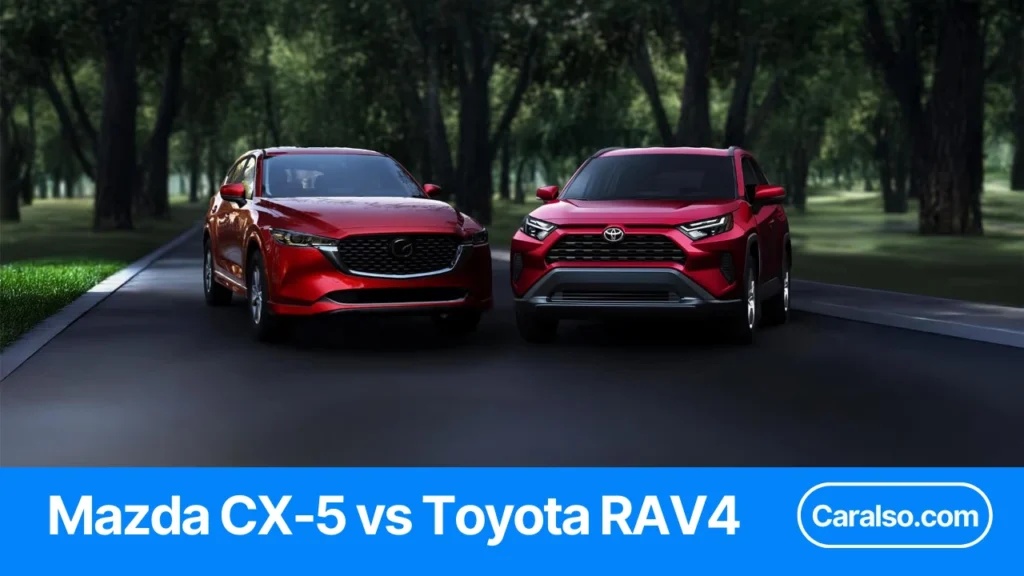
Mazda CX-5 Vs Toyota RAV4
At-A-Glance Winners
| What You Care About | CX-5 | RAV4 | Notes |
|---|---|---|---|
| MPG | Winner | 2025 RAV4 Hybrid: 40 mpg combined. 2025 gas RAV4: 28 mpg combined. | |
| Hybrid Availability | Winner | RAV4 offers hybrid and plug-in hybrid options. | |
| Cargo Behind Rear Seat | Winner | CX-5: 29.1 cu ft. RAV4: 37.6 cu ft. | |
| 2nd-Row Legroom | Winner | CX-5: 39.6 in. RAV4: 37.8 in. | |
| Standard AWD | Winner | CX-5 is standard AWD. RAV4 varies by trim. | |
| Price Entry Point (2025) | Slight Edge | CX-5 and RAV4 start close in price, but trims and drivetrain change the deal fast. | |
| Driving Feel | Winner | If you care about steering and body control, CX-5 usually feels tighter. | |
| Resale Demand | Winner | RAV4 demand is consistently strong, especially hybrids. |
First, Make Sure You’re Comparing The Right Model Year (2025 Vs 2026+)
This matters more than most people think.
The 2025 RAV4 is the last year of the older generation. The 2026 RAV4 is a redesign and goes hybrid-only.
The 2025 CX-5 can be bought with a turbo. The 2026 CX-5 redesign drops the turbo.
What Changed On The 2026 Mazda CX-5
Here is what I would treat as “decision changing.”
- Turbo is gone. The engine lineup centers on a 2.5L 4-cylinder with 187 hp.
- AWD is standard.
- Pricing starts at $31,485.
- Mazda stretched the wheelbase. That usually means more rear room.
- A hybrid is expected later, not for 2026.
If you were shopping a 2025 CX-5 Turbo, the 2026 CX-5 is not the same product.
What’s Changing On The 2026 Toyota RAV4
The 2026 RAV4 is a major reset.
- It is redesigned for 2026.
- It is hybrid-only. You choose hybrid or plug-in hybrid.
- Toyota announced a $31,900 starting MSRP for the hybrid before dealer fees.
- Hybrid models were scheduled to start arriving at dealers in December 2025.
- Plug-in hybrid pricing was planned for the first half of 2026, with arrivals in spring 2026.
So if you are comparing “new RAV4” today, you might be looking at a totally different SUV than a 2025 on a leftover deal.
Quick Guidance If You’re Buying New Vs Used
If You’re Buying New:
- Ask the dealer what model year is physically on the lot. Do not assume.
- If it is a 2026 RAV4, you are shopping a hybrid by default.
- If it is a 2026 CX-5, you are not shopping a turbo.
If You’re Buying Used:
- Keep the comparison apples-to-apples. Most used listings will be 2017 to 2025.
- In that case, compare 2025-style RAV4 powertrains and CX-5 turbo availability, not the 2026 redesigns.
Specs Snapshot (The Numbers Shoppers Scan First)
Here are the specs I see people compare in the dealership parking lot. These are 2025-model numbers.
| Spec (2025) | Mazda CX-5 | Toyota RAV4 (Gas) | Toyota RAV4 Hybrid | Toyota RAV4 Plug-In Hybrid |
|---|---|---|---|---|
| EPA Combined Efficiency | 24 to 28 mpg | 30 mpg (FWD rating) | 39 to 40 mpg | 94 MPGe (electric) and 38 mpg (gas only) |
| Max Towing Capacity | 2,000 lb | 1,500 lb | 1,750 lb | 2,500 lb |
| Cargo Behind 2nd Row | 29.1 cu ft | 37.6 cu ft | 37.6 cu ft | 33.5 cu ft |
| Cargo Max (Seats Folded) | 58.1 cu ft | 69.8 cu ft | 69.8 cu ft | Varies by source and trim |
| Rear Legroom | 39.6 in | 37.8 in | 37.8 in | 37.8 in |
| Drivetrain Availability | AWD standard | FWD or AWD | AWD standard | AWD standard |
| Transmission Type | 6-speed automatic | 8-speed automatic | CVT (eCVT style) | CVT (eCVT style) |
Cargo And Seating Reality (Strollers, Costco Runs, Road Trips)
If cargo is your pain point, the RAV4 wins on simple math.
The RAV4 gives you 37.6 cu ft behind the rear seats.
The CX-5 gives you 29.1 cu ft.
That gap shows up fast with a real stroller.
It also shows up with a cooler plus two carry-ons.
One nuance I like on the CX-5.
Mazda quotes up to 59.3 cu ft with the rear seats folded and the cargo floor set up for max space.
So the “max cargo” number depends on how you measure it and how you set the floor.
Rear seat space is the opposite story.
The CX-5 has 39.6 inches of rear legroom.
The RAV4 has 37.8 inches.
If you regularly put an adult behind a tall driver, I notice the CX-5 feels less cramped in knees-to-seat contact.
Fuel Economy (Gas Vs Hybrid Implications)
If you do mostly city driving, hybrid matters more.
Stop-and-go is where the Hybrid earns its keep.
Here’s a simple fuel math example at 12,000 miles a year.
28 mpg uses about 429 gallons a year.
40 mpg uses 300 gallons a year.
That’s about 129 gallons saved.
That is why the RAV4 Hybrid is so easy to recommend for commuters.
The Plug-In Hybrid changes the game if you can charge.
It is rated for 42 miles of electric range.
That can cover a lot of daily driving with zero gas trips.
Towing And Ground Clearance (Light Utility Vs “Just In Case”)
Most compact SUV owners do not tow weekly.
But towing ratings still matter for small trailers and hitch racks.
The CX-5 is rated up to 2,000 lb.
The RAV4 gas model is rated up to 1,500 lb.
The RAV4 Hybrid is rated up to 1,750 lb.
The RAV4 Plug-In Hybrid is rated up to 2,500 lb.
Ground clearance is another quick filter.
The RAV4 is listed at 8.4 inches.
The CX-5 is listed at 7.6 inches in many spec sheets, and Mazda also quotes a small range depending on wheels.
In real life, I treat this as “rutted dirt road confidence.”
It is not “go rock crawling.”
Powertrain Choice: Hybrid Efficiency Vs “Turbo Feel” (And What You Give Up)
This is where most people actually decide.
It is not just power.
It is how the power shows up day to day.
RAV4 Gas Vs RAV4 Hybrid Vs RAV4 Plug-In Hybrid (Who Each Is For)
RAV4 Gas
- I pick this when you want the lowest upfront price.
- You get a traditional 8-speed automatic.
- You also give up the hybrid’s low-speed torque feel.
RAV4 Hybrid
- I pick this when you drive a lot of miles.
- It makes 219 hp combined.
- It is also quicker than the gas model in instrumented testing.
- It uses a CVT-style hybrid transmission, so the engine can sound steady under hard throttle.
RAV4 Plug-In Hybrid
- I pick this when you can charge at home or work.
- It makes 302 hp combined.
- It is the quickest RAV4 powertrain.
- It is rated for 42 miles of electric range.
- It can also charge faster on a 240V outlet than a normal wall plug.
The trade you make with the Plug-In Hybrid is simple.
You pay more.
You carry more battery weight.
You also lose some cargo space versus the non-plug-in RAV4.
CX-5 Non-Turbo Vs Turbo (Who Should Pay For Turbo, And Who Shouldn’t)
CX-5 Non-Turbo
- 187 hp.
- Better mpg than the turbo.
- Plenty for calm driving, but it is not a “pass at 80 mph” powerhouse.
CX-5 Turbo
- Up to 256 hp and 320 lb-ft on premium fuel.
- On regular fuel, output drops, so you do not get the full headline numbers.
- It feels stronger in real passing and short merges.
If you love that “push in the back” feeling, this is the CX-5 you actually want.
If you are buying on budget and you drive gently, the non-turbo makes more sense.
One more thing I always mention.
Mazda sticks with a 6-speed automatic on both engines.
Toyota’s hybrids use the CVT-style setup.
Some people strongly prefer how a traditional automatic feels.
The 3-Question Powertrain Picker (Snippet-Ready List)
- Can you charge at home at least 4 nights a week?
- Yes: RAV4 Plug-In Hybrid is the smart one to test first.
- No: move to question 2.
- Do you drive more than 12,000 miles a year or sit in traffic a lot?
- Yes: RAV4 Hybrid usually wins on fuel math.
- No: move to question 3.
- Do you care more about “quick passing power” than mpg?
- Yes: CX-5 Turbo is the one I would drive first.
- No: RAV4 gas or CX-5 non-turbo will do the job, so I’d decide based on space and price.
Driving Experience: Comfort Vs Handling (What It Feels Like Daily)
This is the part I care about most.
Specs do not tell you how a car feels at 7:30 a.m. in traffic.
So I focus on 4 daily things.
Acceleration.
Noise.
Brake feel.
Transmission behavior.
Acceleration In Real Numbers
Here are the 0 to 60 mph times from instrumented testing.
Mazda CX-5
- Base engine: 8.1 seconds.
- Turbo: 6.2 seconds.
Toyota RAV4
- Gas model: around 8.0 to 8.3 seconds depending on trim and test vehicle.
- Hybrid: 7.3 seconds.
- Plug-In Hybrid: 5.4 seconds.
If you want the quickest one, it is the RAV4 Plug-In Hybrid.
If you want strong passing power without plugging in, it is the CX-5 Turbo.
Noise And Comfort On The Highway
I do a simple test.
Set cruise at 70 mph.
Then do 1 full-throttle pass from 45 to 70 mph.
In a Car And Driver comparison test, the RAV4 measured 70 dB at a 70-mph cruise and 76 dB at full throttle.
Both numbers were 3 dB louder than the CX-5 in that same test.
That matches what I hear in real driving.
The RAV4 is fine cruising.
It gets louder when you ask for power.
Handling And Braking In Numbers
I care about brake confidence more than cornering heroics.
But both are easy to compare.
In that same Car And Driver comparison test:
- RAV4 skidpad: 0.84 g.
- CX-5 skidpad: 0.78 g.
- RAV4 braking from 70 mph: 161 feet.
- CX-5 braking from 70 mph: 175 feet.
So the Toyota can put up strong numbers.
The Mazda usually feels more natural in steering and body control.
My quick check.
Take one medium-speed corner at 35 to 45 mph.
If you like steering that gives you feedback, you will notice it quicker in the CX-5.
Transmission Behavior In Daily Driving
This is a big difference between these two.
CX-5
- 6-speed automatic.
- Controlled, predictable shifts in normal driving.
- Easy to drive smoothly at 20 to 45 mph.
RAV4 Gas
- 8-speed automatic.
- It can hesitate on quick downshifts depending on the situation.
RAV4 Hybrid And Plug-In Hybrid
- Hybrid transmission design.
- Smooth in traffic.
- Under hard throttle, engine sound can hold steady while speed climbs.
My test-drive move.
Do a 30 to 50 mph roll-on with light throttle.
Then do it again with deeper throttle.
If you do not like the sound and response, that will not change later.
Interior And Tech: What You Touch 50 Times A Day
I judge interiors on 2 things.
What my hands touch.
How fast the tech does the basics.
Cabin Design And Materials
CX-5 leans premium.
Even the layout is built around the driver.
Controls are close.
Screen sits higher.
If you go up the trim ladder, CX-5 offers real upgrades like leather-trimmed seats.
Top trims add Nappa leather and layered wood trim.
RAV4 is more utility-first.
It is designed around storage and easy cleanup.
Step up to trims like XLE Premium and Limited and you get SofTex-style seating and more soft-touch surfaces.
Limited trims add features like heated and ventilated front seats.
If you have kids or dogs, I do not ignore seat material.
SofTex-style surfaces wipe down faster than perforated leather in a lot of real life messes.
Infotainment Usability (Screens, Controls, Learning Curve)
Here are the screen sizes most people notice right away.
CX-5
- 10.3-inch center display.
- Controlled primarily by a rotary controller and buttons.
- Apple CarPlay and Android Auto are standard.
RAV4
- 8.0-inch touchscreen on lower trims.
- 10.5-inch touchscreen on higher trims.
- Wireless Apple CarPlay and wireless Android Auto are available.
- Limited can add a 12.3-inch digital gauge cluster.
The control style is the key difference.
If you like a touchscreen, the RAV4 is the easier fit.
If you like a dial you can use without leaning forward, the CX-5 is the easier fit.
My 60-second tech test at the dealer:
- Pair your phone.
- Start navigation.
- Change audio source.
- Adjust cabin temp.
If any of those steps annoy you, it will matter more than the sound system brand.
Driver Assists (What’s Standard Vs Trim-Locked)
Both are strong on safety tech.
But the details matter.
RAV4 includes Toyota Safety Sense 2.5, which bundles basics like:
- Pre-collision braking with pedestrian detection.
- Lane departure alert with steering assist.
- Lane tracing assist.
- Full-speed radar cruise control.
- Road sign assist.
- Automatic high beams.
CX-5 includes Mazda’s i-Activsense suite and common standard features like:
- Smart brake support.
- Blind spot monitoring.
- Lane keep assist.
- Radar cruise control on many trims.
What I look for on your test drive:
- Does lane centering feel smooth or ping-pong?
- Does adaptive cruise brake gently or late?
- Does the blind-spot system alert early enough for your driving style?
The One Feature That Changes Daily Life
If you parallel park a lot, look for a 360-degree camera.
On the RAV4, the Panoramic View Monitor is available on certain trims and packages.
If you remote-start a lot, look at app functions and trial periods.
CX-5 includes Mazda Connected Services with remote functions through the MyMazda app, and Mazda lists trial periods by model year.
Reliability, Maintenance, And Resale Value (Confidence Section)
This is where I stop thinking about horsepower.
I think about 5 years and 80,000 miles.
Reliability Reputation And Why Resale Differs
I treat both of these as “buy with confidence” compact SUVs.
But the RAV4 usually wins resale on pure demand.
Here is one hard data point.
Kelley Blue Book’s Best Resale Value Awards list the 2025 Toyota RAV4 at 53.9% for 5-year resale value.
That is top-10 across all vehicles in that award list.
Now the money side.
KBB’s 5-year Cost To Own tool shows:
- 2025 RAV4: $49,850 total cost to own, with $15,403 in depreciation in their default setup.
- 2025 CX-5: $54,990 total cost to own, with $18,005 in depreciation in their default setup.
That is not a promise.
It is an estimate.
But it matches what I see in the market.
Why the gap happens:
- More buyers chase the RAV4, and that keeps used prices up.
- The RAV4 Hybrid and Plug-In Hybrid pull in commuters, rideshare drivers, and fuel-savers.
- Toyota’s reliability reputation is a resale multiplier, even when a rival is also reliable.
If you keep cars a long time, both can make sense.
If you trade every 3 to 5 years, I give the resale edge to RAV4.
Warranty Basics (What’s Similar, What Isn’t)
These two are very similar on the core warranty.
- Basic warranty: 3 years or 36,000 miles.
- Powertrain warranty: 5 years or 60,000 miles.
Two differences matter.
- Hybrid battery coverage on RAV4 Hybrid and RAV4 Plug-In Hybrid.
Toyota lists 10 years or 150,000 miles for the hybrid battery warranty. - Free scheduled maintenance.
ToyotaCare covers normal factory scheduled maintenance for 2 years or 25,000 miles.
Mazda does not include complimentary scheduled maintenance on the CX-5.
That can be a few hundred dollars in the first 2 years, depending on where you service.
Used Buyer Watch-Outs (CX-5-Specific And RAV4-Specific)
If you are shopping used, I use a short checklist.
I want to rule out the expensive surprises.
CX-5 Used Checklist
- Ask for oil-change history. Especially on turbo models.
- Check tires for inside-edge wear. That can hint at alignment issues.
- Check for vibration at 65 to 75 mph. That can be wheel balance or bent wheel.
- Test every power feature twice. Windows, liftgate, seat motors, heated seats.
- On turbo models, do a 40 to 70 mph pull. Then check for any smoke smell at idle.
RAV4 Used Checklist
- If you are looking at 2019 to 2021 models with roof rails, check the headliner and cargo area for water stains.
Toyota issued a customer support program for roof rail water leaks on certain 2019 to 2021 RAV4, RAV4 Hybrid, and RAV4 Prime vehicles. - If you are looking at a 2019 to 2022 RAV4 Hybrid AWD or a 2021 to 2022 RAV4 Prime, ask the dealer to check for the high-voltage cable corrosion customer support program coverage.
Toyota published a customer support program tied to HV cable corrosion on certain models and years. - Listen for wind noise at 70 mph and check door seals. Used cars can have bad prior repairs.
- On hybrids, confirm it starts cleanly every time. No warning lights. No “ready” light delays.
My rule.
If the seller cannot show maintenance history, I price it like it needs brakes, tires, and fluids now.
Trim Recommendations (Fast Path To The “Smart Buy”)
I am going to keep this simple.
I buy trims for features I will use weekly.
Not for badges.
Best-Value Mazda CX-5 Trims (2 Picks)
Value Pick: CX-5 2.5 S Preferred
- Mazda lists $31,730 starting price for this trim.
- It adds leather-trimmed seats.
- It adds an 8-way power driver seat with 2-position memory.
- This is the trim where the CX-5 starts feeling “fully equipped” without chasing luxury pricing.
Nice-To-Have Pick: CX-5 2.5 S Premium Plus
- Mazda lists $35,680 starting price for this trim.
- It adds a 360-degree view monitor and front and rear parking sensors.
- It adds ventilated front seats.
If you live in a hot state or you parallel park daily, those 2 features earn their keep fast.
If you want turbo power, I test-drive the Turbo Premium first.
It adds the turbo engine plus heated rear seats.
Best-Value Toyota RAV4 Trims (2 Picks)
I like the RAV4 in the middle of the lineup.
That is where features land without Limited pricing.
Value Pick: RAV4 XLE
- In KBB pricing, the XLE is listed at $32,155.
- It is the best “daily driver” setup for most buyers.
- You can still choose FWD or AWD.
Family Road-Trip Pick: RAV4 XLE Premium
- In KBB pricing, the XLE Premium is listed at $35,045.
- It is the trim where comfort and convenience features usually stack up the fastest.
Edmunds notes it builds on XLE and adds upgrades like synthetic leather upholstery.
If you are buying Hybrid, I use the same logic.
XLE is the value anchor.
XLE Premium is the comfort upgrade.
Then I only jump to Limited if I specifically want ventilated seats and the higher-end feature bundle.
Options I Would Prioritize (So You Don’t Waste Money)
CX-5
- Preferred or higher if you want memory seats and leather.
- Premium Plus if you want 360 camera and ventilated seats.
- Turbo only if you care about passing power at 60 to 80 mph.
RAV4
- AWD if you live with snow, steep driveways, or frequent dirt roads.
- Convenience features if you use a liftgate daily.
- Hybrid if you do a lot of stop-and-go driving.
- Plug-In Hybrid only if you can charge at home.
My buying shortcut.
I pick the trim that gets me 3 things: heated seats, the best headlights available in budget, and the driver-assist features I will use daily.
Then I stop.
Quietness Test (Same Road, Same Speed, Same HVAC Setting)
I keep it boring on purpose. Same road. Same settings. Same speed.
I also do one full-throttle run. That is where differences show up fast.
A reminder I use: 3 dB is not a rounding error. It is usually noticeable.
Visibility + Parking Test (Tight Lot, Mirror Coverage, Camera Quality)
I do not trust “it feels easy to park” until I try a tight space.
These two are close on turning circle. Around 36 feet curb-to-curb for both.
So the real difference is what you can see.
A-pillar blind spots.
Mirror coverage.
Camera clarity.
Sensor placement.
Back-Seat & Cargo Test (Your Real Items: Stroller, Suitcase, Car Seat Fit)
This is where the numbers save time.
Rear legroom:
- CX-5: 39.6 inches.
- RAV4: 37.8 inches.
Cargo behind the rear seat:
- CX-5: 29.1 cu ft.
- RAV4: 37.6 cu ft.
If you have one bulky item, the RAV4’s extra 8.5 cu ft is hard to ignore.
If you have a tall driver and a tall rear passenger, the CX-5’s extra 1.8 inches of rear legroom matters.
“Decision Math” Mini-Box: When A Hybrid Premium Usually Makes Sense
I do not guess. I do quick math.
Here’s the simplest version.
- Take the hybrid price gap after fees.
- Divide by your annual fuel savings.
Example with clean numbers:
- Miles per year: 12,000
- Gas price: $3.50
- 30 mpg vs 40 mpg
Fuel use:
- 12,000 / 30 = 400 gallons
- 12,000 / 40 = 300 gallons
Fuel cost:
- 400 x $3.50 = $1,400
- 300 x $3.50 = $1,050
Savings:
- $1,400 – $1,050 = $350 per year
Break-even:
- If your hybrid gap is $2,100, break-even is 6 years.
- If your hybrid gap is $1,400, break-even is 4 years.
That is the whole decision for most commuters.
If you can charge at home, I treat plug-in hybrid differently.
Toyota rates the RAV4 Plug-In Hybrid for up to 42 miles of electric range.
That can wipe out a big chunk of weekly gas use if your driving fits inside that range.
Which One Should You Pick? (Use-Case Decision Tree)
I keep this decision tree simple. Answer the first question that fits your life.
Best For Commuters
If you sit in traffic, I start with the RAV4 Hybrid.
40 mpg combined is the headline.
The smoother low-speed drive is the daily benefit.
If you can charge at home, I test the RAV4 Plug-In Hybrid next.
Toyota rates it for up to 42 miles of electric range.
Winner: Toyota RAV4 Hybrid, because 40 mpg combined is hard to beat in daily stop-and-go.
Best For Young Families
I look at cargo first.
RAV4 cargo behind the rear seat is 37.6 cu ft.
CX-5 cargo behind the rear seat is 29.1 cu ft.
That is an 8.5 cu ft gap.
That is often the difference between “fits” and “does not fit” with a stroller plus groceries.
Rear legroom goes the other way.
CX-5 has 39.6 inches.
RAV4 has 37.8 inches.
So if you carry tall adults in back often, test the CX-5 too.
Winner: Toyota RAV4, because 37.6 cu ft behind the second row makes family hauling easier.
Best For Long Highway Trips
I care about two things.
Fuel stops. And cabin noise.
The RAV4 Hybrid’s mpg helps on distance days.
But noise under throttle is worth testing.
In instrumented testing, the RAV4 posted 70 dB at a 70-mph cruise and 76 dB at full throttle.
Those readings were 3 dB louder than the CX-5 in that test.
So I do the same two checks on my drive.
Cruise noise.
Then a passing run.
Winner: Toyota RAV4 Hybrid, because 40 mpg combined reduces fuel stops on long days.
Best For Snow Climates / Light Trails
I look at AWD and ground clearance.
CX-5 has AWD standard.
RAV4 depends on trim and drivetrain, but the Hybrid lineup is AWD.
Ground clearance:
- RAV4: 8.4 inches.
- CX-5: 7.6 inches.
That 0.8-inch gap can matter in rutted snow.
One more thing I do not skip.
Tires.
A good set of winter tires beats AWD arguments fast.
Winner: Toyota RAV4 Hybrid, because AWD plus 8.4 inches of clearance is a strong combo for winter roads.
Best If You Keep Cars 10+ Years Vs Trade Every 3–5
If you trade often, resale matters more than you think.
Toyota demand usually helps the RAV4, especially the Hybrid.
If you keep a car 10+ years, maintenance history matters more than badges.
Both can be long-term cars if you service them on time.
Winner: Toyota RAV4 for trading cycles, because resale demand is usually stronger.
FAQs
Is The RAV4 Bigger Than The CX-5?
Yes on cargo.
I see it in real loading.
RAV4 cargo behind the rear seat is 37.6 cu ft.
CX-5 cargo behind the rear seat is 29.1 cu ft.
If you care more about back-seat legroom, the CX-5 is bigger where it counts for passengers.
CX-5 rear legroom is 39.6 in.
RAV4 rear legroom is 37.8 in.
Which Is Better On Gas Mileage?
The RAV4 Hybrid.
I start there for most commuters.
RAV4 Hybrid is rated at 40 mpg combined.
Most CX-5 trims land in the mid to high 20s combined depending on trim and AWD.
If you can charge at home, the RAV4 Plug-In Hybrid can cut gas use a lot because it is rated for up to 42 miles of electric range.
Which Is More Reliable Long Term?
I put both in the “good long-term bet” bucket if you maintain them.
Oil changes on time.
Fluids on schedule.
Tires and alignment kept in check.
If you trade every 3 to 5 years, I usually see the RAV4 hold value better, especially the Hybrid.
That resale strength is part of why it feels like the safer financial play.
Which Is Quieter On The Highway?
I usually hear less noise in the CX-5 at highway speed.
In instrumented testing, the RAV4 measured 70 dB at a 70-mph cruise and 76 dB at full throttle.
Those readings were 3 dB louder than the CX-5 in that same test.
My advice is simple.
Do a 70 mph cruise for 60 seconds in both.
Then do one full-throttle pass from 45 to 70 mph.
Pick the one you can live with.
Is The CX-5 Turbo Worth It?
It is worth it if you care about passing power.
Turbo output is up to 256 hp and 320 lb-ft on premium fuel.
On regular fuel, the numbers drop.
If you mostly drive calmly and want lower fuel use, the non-turbo makes more sense.
Also, if you want turbo, shop 2025 and earlier.
The 2026 CX-5 drops the turbo.
Should I Buy The RAV4 Hybrid Or The RAV4 Plug-In Hybrid?
I use one question.
Can you charge at home at least 4 nights a week?
If yes, I test the Plug-In Hybrid first.
It is rated for up to 42 miles of electric range.
If no, I buy the Hybrid.
It is rated at 40 mpg combined and is easy to live with.
Which One Is Better In Snow?
Both can do winter if you pick the right setup.
CX-5 has AWD standard.
RAV4 depends on trim and drivetrain, and the Hybrid is AWD.
Ground clearance favors the RAV4 at 8.4 inches versus 7.6 inches for the CX-5.
My big rule.
Buy winter tires if you get real snow.
That matters more than the badge.
Should I Wait For The Next Redesign?
I only wait if the redesign changes the thing you care about.
If you want a turbo CX-5, I do not wait.
You shop 2025 and earlier.
If you want a new RAV4 and you prefer hybrid power, waiting can make sense because the 2026 RAV4 shifts the lineup toward hybrids.
If you are buying used, I do not overthink it.
Pick the best condition, best maintenance history, and the trim that fits your life.
Key Takeaways (Bullets)
- If you drive in traffic and care about fuel cost, I buy the RAV4 Hybrid first.
- If you need cargo space for a stroller plus groceries, I buy the RAV4 because 37.6 cu ft beats 29.1 cu ft.
- If you carry tall adults in the back often, I test the CX-5 because 39.6 in rear legroom beats 37.8 in.
- If you want the quickest setup, I test the RAV4 Plug-In Hybrid first, but only if I can charge at home.
- If you want strong passing power without plugging in, I test the CX-5 Turbo, and I shop 2025 and earlier.
- If you care about highway quiet, I lean CX-5, but I confirm with a 70 mph cruise test drive.
- If you trade every 3 to 5 years, I lean RAV4 because resale demand tends to stay stronger.
- If you live with real snow, I pick the one that lets me run good winter tires and gives me the clearance I need, and the RAV4’s 8.4 inches helps.
- If you are stuck between them, I decide by one question: do you need more cargo or do you want more rear legroom and steering feel.
Sources
- Kelley Blue Book: 2025 Mazda CX-5 vs. 2025 Toyota RAV4 Comparison
- Car And Driver: 2019 Mazda CX-5 vs. 2019 Toyota RAV4 Comparison Test
- Toyota: 2025 RAV4 Plug-In Hybrid (Official Page)
- Mazda USA: 2025 Mazda CX-5 (Official Model Page)
- Edmunds: 2025 Toyota RAV4 Trims Comparison
- NHTSA: Customer Support Program 22TE09 (HV Cable Corrosion) (PDF)

Hey there,
How is it going?
I’m Meraj Sarker. I am a Car Mechanic and a student of Automobile Restoration here in Florida, USA. I’ve been studying automotive for around 9 years now. So you can rely on my recommendation. For me, studying and getting knowledge about automobile it’s really fun and entertaining. I will help you to get solutions for your car through this website. If you need any help let me know.