
If you want the shortest honest take, here it is. In 2026, the RAV4 is the efficiency and space play. The CX-50 is the driving feel play, especially if you want a traditional automatic and a turbo option.
The big twist this year is powertrain shopping. The 2026 RAV4 is hybrid or plug-in hybrid only. The CX-50 lets you choose gas, turbo, or hybrid.
Quick Verdict Box (Read This And You Can Stop Here)
Pick The CX-50 If…
- You want a 6-speed automatic on the gas or turbo models.
- You want a turbo option with up to 3,500 lb towing.
- You care more about cabin vibe and steering feel than max cargo.
Pick The RAV4 If…
- You want the best mpg in this matchup, especially on Hybrid FWD.
- You want more cargo behind the rear seats.
- You want a plug-in option with real EV miles.
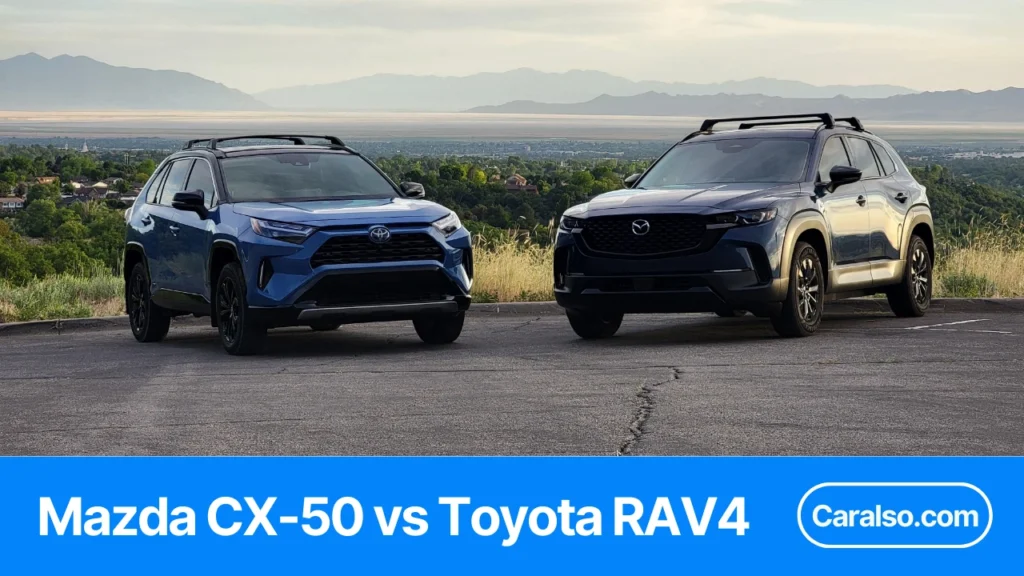
Mazda CX-50 Vs Toyota RAV4
Quick Verdict Table
| Category | Winner | The 1 To 2 Numbers That Decide It | Pick It If You… |
|---|---|---|---|
| Base Price | CX-50 | $29,900 vs $31,900 | Want the lower entry point |
| Best MPG | RAV4 | Up to 44 mpg combined (Hybrid FWD) vs 38 mpg combined (CX-50 Hybrid) | Drive a lot every week |
| Max Power | RAV4 PHEV | 324 hp vs 256 hp (CX-50 Turbo) | Want the quickest version |
| Cargo Behind Rear Seat | RAV4 | 37.8 cu ft vs 31.4 cu ft | Haul strollers, coolers, and boxes |
| Max Towing | Tie (Trim-Dependent) | Up to 3,500 lb on the right trims | Tow a small camper or utility trailer |
| Transmission Feel | CX-50 (Gas And Turbo) | 6-speed automatic vs e-CVT | Hate CVT-style behavior |
How We’re Comparing
I do not compare these like most listicles do. I trim-match first. Then I look at the numbers that change your day-to-day life. Cargo behind the rear seat. MPG. Towing rating by trim. And the stuff you touch every day, like controls and seats.
Model-Year Scope
For this guide, I’m treating 2026 as the “new shopper” baseline.
That matters because both lineups changed how you shop.
- 2026 RAV4: Hybrid and plug-in hybrid only.
- 2026 CX-50: Gas, turbo, and hybrid options.
If you’re shopping used, I still use the same method. I match trims and powertrains first. Then I compare the numbers that do not lie.
The Data Sources I Rely On
To keep this clean, I use sources that publish hard specs and test data.
- Manufacturer specs and trim sheets.
- EPA fuel economy where it exists, and manufacturer estimates where it does not yet.
- IIHS and NHTSA safety results.
- Road tests with instrumented numbers (0 to 60, braking, real-world mpg).
Price And Value (What You Pay To Get The Same Stuff)
When I compare these two, I ignore the lowest advertised price.
I match the stuff most people actually want. AWD, heated seats, power liftgate, and driver assist.
One more thing. Mazda and Toyota show MSRPs without destination fees.
Most shopping sites show numbers with destination baked in. That is why you will see two different “starting” prices for the same trim.
Base Price Vs Realistic “I’d Actually Buy This” Price
Here’s how the numbers shake out if you shop like a normal person.
| Buying Goal | Mazda CX-50 Trim | CX-50 Starting MSRP (Before Destination) | Toyota RAV4 Trim | RAV4 MSRP (With Destination) | Notes That Change The Real Price |
|---|---|---|---|---|---|
| Cheapest AWD Daily Driver | 2.5 S Select | $29,900 | LE | $33,350 | CX-50 is AWD standard. RAV4 is FWD standard on LE, and AWD is optional on some trims. |
| Best “Comfort Per Dollar” | 2.5 S Preferred | $32,400 | SE | $36,150 | This is the level where most buyers stop regretting their choice after 6 months. |
| “Outdoor Look” Trim | 2.5 S Meridian Edition | $33,150 | Woodland | $41,350 | Toyota’s Woodland comes standard with AWD. Mazda’s Meridian is a value play if you want the look without turbo money. |
| Near-Loaded Without Going Full Luxury | 2.5 S Premium | $34,900 | XLE Premium | $37,550 | This is the closest “same stuff” match for most shoppers. |
| Power Upgrade | 2.5 Turbo | $37,900 | XSE | $42,750 | Mazda gives you a turbo punch. Toyota gives you hybrid shove plus standard AWD on XSE. |
My simple rule: if you want AWD no matter what, the CX-50’s pricing stays clean because AWD is standard across the lineup.
With the RAV4, the payment can jump fast once you add AWD where it is optional.
Also, the 2026 RAV4 is hybrid-only. That changes the math.
If you drive 12,000 miles a year and you are paying real-world fuel prices, saving even 3 to 5 mpg can matter more than a $30 to $60 monthly payment difference.
Best Value Trims (Shortlist)
I’ll keep this tight. These are the trims I’d put my own money on.
CX-50 Best Value Picks
- Best Value Gas: 2.5 S Preferred (Starting at $32,400)
This is where the CX-50 feels like a complete vehicle instead of a “base trim with a touchscreen.” - Best Value Turbo: 2.5 Turbo (Starting at $37,900)
If you care about passing power and towing confidence, this is the turbo trim I’d start with before you climb higher. - Best Value Hybrid: CX-50 Hybrid (Starts at $34,750 before destination)
If your goal is mpg without giving up AWD, this is Mazda’s cleanest value move.
RAV4 Best Value Picks
- Best Value Hybrid: LE (Starts at $33,350 with destination)
This is the lowest-cost way into a hybrid RAV4. If you do not need AWD, it is the value hammer. - Best Value For AWD: SE with AWD (or Woodland if you want the package)
On trims where AWD is optional, Toyota’s AWD step is big enough that you should price it before you fall in love with a trim. - Best Value Plug-In: Not calling it yet
Toyota has not published 2026 plug-in hybrid pricing in a way I trust for a “best value trim” call. If you can charge at home and you do lots of short trips, plug-in can still win. I just won’t pretend the pricing is settled.
Dealer Reality
Here’s what I see in the numbers, not the vibes.
- Mazda CX-50 buyers have been paying about 3% under MSRP on average in recent transaction data.
- Toyota RAV4 buyers have been closer to about 2% under MSRP on average.
That is not a huge gap, but it is real money.
How I shop these without overpaying:
- I ask for an out-the-door price. Not a monthly payment.
- I refuse dealer add-ons by name. Nitrogen, paint protection, VIN etch, wheel coverage.
- I compare at least 3 stores. I include one dealer outside my metro area.
- I make them quote the exact trim and drivetrain. RAV4 FWD vs AWD is a real price swing.
- I am flexible on color. That is how you get the easiest discount.
Size, Cargo, And Day-To-Day Livability
This is where most people decide.
Not horsepower. Not brand loyalty. Space and usability.
Cargo Reality (Seats Up And Seats Folded)
Here’s the clean spec snapshot I use.
| Spec That Impacts Daily Life | Mazda CX-50 | Toyota RAV4 |
|---|---|---|
| Cargo Behind Rear Seats | 31.4 cu ft | 37.8 cu ft |
| Cargo With Rear Seats Folded | 56.3 cu ft | 70.4 cu ft |
| Rear Legroom | 39.8 in | 37.8 in |
| Rear Headroom | 37.5 in | 39.5 in |
| Length | 185.8 in | 181.0 in |
| Width (No Mirrors) | 75.6 in | 73.0 in |
| Wheelbase | 110.8 in | 105.9 in |
| Turning Circle (Curb To Curb) | about 36.0 ft | 36.9 ft |
Two big takeaways:
- The RAV4 carries more stuff.
It has 6.4 cu ft more cargo space behind the rear seats, and 14.1 cu ft more with the seats folded. - The CX-50 gives rear passengers more legroom.
It has 2.0 inches more rear legroom, but the RAV4 has more rear headroom.
What Fits Tests (Stroller, Carry-Ons, Dog Crate)
I like real luggage tests because they translate fast.
Carry-On Suitcase Test (Car And Driver Style)
- CX-50: 9 carry-on suitcases behind the rear seats. 20 with the seats folded.
- RAV4: 10 carry-on suitcases behind the rear seats. 24 with the seats folded.
Stroller Reality
- If you have a compact stroller, both are easy.
- If you have a big travel-system stroller, the RAV4 is the safer bet if you want space left over for groceries.
Dog Crate Reality
- If your crate is around the common 36-inch size, both can work.
- If you want a larger crate plus a cooler plus bags, the RAV4’s extra 14.1 cu ft with seats folded is a real advantage.
My pro tip: bring a tape measure.
Measure the crate length, then measure the cargo floor length with the rear seats up and down. That beats guessing.
Rear Seat And Car Seat Friendliness
If you run rear-facing seats, the CX-50’s rear legroom helps.
It gives you more “front seat not slammed forward” breathing room.
But if you have tall teens or tall adults in back, the RAV4’s rear headroom is a real win at 39.5 inches.
My quick rear-facing checklist:
- Put the car seat behind the passenger seat first. It usually fits easier.
- Slide the front seat to your normal driving position. Do not “cheat” it forward.
- Check knee-to-seatback contact for whoever rides shotgun.
- Check head clearance for the kid seat angle. Some seats sit taller than you expect.
City Driving And Parking
These two are closer than people think in tight places.
Turning circle is basically a tie.
- CX-50: about 36.0 ft curb-to-curb
- RAV4: 36.9 ft curb-to-curb
The difference I feel more often is size in the lane and in the garage:
- The CX-50 is 4.8 inches longer.
- The CX-50 is 2.6 inches wider.
If your parking spot is tight, that width matters more than the turning circle.
My garage-fit checklist:
- Measure your garage opening width.
- Subtract 10 inches. That is your “stress-free” buffer.
- If you park next to a wall, measure mirror clearance too, not just body width.
- If you use roof racks, measure height with the rack installed. The RAV4 is taller at 67.0 inches.
Performance And Drivability (Commute Vs Road Trip)
CX-50 Gas Vs Turbo Vs Hybrid (What Changes)
I think about CX-50 powertrains like three personalities.
Base 2.5 S is the simple one.
It makes 187 hp and 185 lb-ft.
EPA is 24 city, 30 highway, 26 combined.
Curb weight is about 3,741 lb.
Where It Works Best
- Normal commuting.
- Flat highways.
- You want the lowest buy-in price.
Where It Feels Weak
- Short on-ramp merges with 4 adults and luggage.
- Mountain grades at 70 mph.
- Passing from 60 to 80 mph.
Turbo is the “I Tow Stuff And Pass People” pick.
With premium fuel, it makes up to 256 hp and 320 lb-ft.
EPA is 23 city, 29 highway, 25 combined.
Curb weight is about 3,915 lb.
Where Turbo Matters
- Highway passing without planning 6 seconds ahead.
- Higher elevations.
- Towing. Turbo CX-50 is rated up to 3,500 lb when equipped and in towing mode.
- You drive loaded a lot.
Hybrid is the efficiency play.
It’s rated up to 219 hp.
EPA is 39 city, 37 highway, 38 combined.
Curb weight is about 4,008 lb.
Where Hybrid Matters
- Stop and go.
- Parking-lot creep.
- Short trips where you hate watching the mpg sink.
What The Transmission Feel Difference Is Likely To Be
- The gas and turbo CX-50 use a regular stepped automatic feel. You get clear “gears.”
- The hybrid uses a Toyota-style hybrid setup. It behaves like an eCVT. It is smooth. It can also hold rpm under load. That can sound “dronier” if you mat it.
If you want the shortest gap between pedal and speed, I pick turbo.
If you want the calmest low-speed behavior and best fuel numbers, I pick hybrid.
If you want the simplest long-term ownership vibe, I pick the base engine.
RAV4 Hybrid Vs Plug-In (What Changes)
For 2026, RAV4 is electrified across the board.
That changes the whole feel vs older gas-only RAV4s.
RAV4 Hybrid Output
- 226 hp in FWD form
- 236 hp in AWD form
Around-Town Response
- Hybrid feels quick off the line because of electric motor torque.
- It is usually easiest to drive smoothly at 0 to 30 mph.
Highway Passing
- Hybrid has enough power for normal passing.
- It is not “pin you back” fast.
- If you do a lot of 2-lane passing, the plug-in is the one I look at.
RAV4 Plug-In Hybrid Output
- 324 hp net combined system horsepower
- Up to a 52-mile manufacturer-estimated all-electric range on SE and XSE
Around-Town Response
- This is the fastest RAV4 flavor.
- In EV mode, throttle response feels immediate at city speeds.
Highway Passing
- The extra power shows up most from 50 to 80 mph.
- It has more reserve, even with passengers.
Road Trip Behavior
- Hybrid is the simplest road trip tool. No charging plans.
- Plug-in is awesome if you can charge at home and still want gas backup for long days.
- On certain plug-in trims, DC fast charging is available, which can matter if you do long routes and actually want to add EV miles mid-trip.
My quick rule:
If you cannot plug in at home or work, I treat the plug-in as a performance trim first, and a fuel saver second.
Noise And Ride (Real-World)
This is the part I always test the same way.
I do a 10 to 15 minute loop at 65 to 75 mph.
I pick one rough section of pavement and one smooth section.
What I Listen For At 65 To 75 MPH
- Engine rpm behavior on small hills. Does it climb and hold rpm, or does it shift and settle.
- Wind noise at the mirror area.
- Tire roar on rough asphalt. That is usually the biggest “highway noise” culprit.
How Wheel Size Changes The Feel
- Bigger wheels usually mean shorter tire sidewalls.
- Shorter sidewalls usually mean sharper impacts over potholes.
- On sporty trims, 20-inch wheels often look great, but they can add road noise and edge to the ride.
- If comfort is a priority, I lean toward smaller wheels with taller tires when possible.
One more tip I use:
I brake from 45 mph down to 5 mph a few times.
Hybrids blend regen and friction brakes.
I want a smooth, predictable pedal in the last 10 mph.
Fuel Economy And Hybrids (Where The Gap Can Flip)
MPG Snapshot Table (Featured Snippet Candidate)
These are the numbers I use for quick, honest comparisons.
| Model (2026) | Drivetrain | City MPG | Hwy MPG | Combined MPG | EV Range |
|---|---|---|---|---|---|
| CX-50 2.5 S | AWD | 24 | 30 | 26 | N/A |
| CX-50 2.5 Turbo | AWD | 23 | 29 | 25 | N/A |
| CX-50 Hybrid | AWD | 39 | 37 | 38 | N/A |
| RAV4 Hybrid (Most Efficient) | FWD | 48 | 42 | 44 | N/A |
| RAV4 Hybrid (Common AWD Trims) | AWD | 44 | 39 | 42 | N/A |
| RAV4 Hybrid Woodland | AWD | 41 | 36 | 39 | N/A |
| RAV4 Plug-In (SE, XSE) | AWD | 44 | 38 | 41 | 52 miles |
| RAV4 Plug-In Woodland | AWD | 42 | 35 | 38 | 49 miles |
What Jumps Out To Me
- CX-50 Hybrid is a real step up from CX-50 gas. 38 combined vs 26 combined.
- RAV4 Hybrid can beat both on fuel, especially in the FWD configuration.
- RAV4 Plug-In is about charging access, not just mpg.
Hybrid Payback Math (Simple Calculator Section)
I keep this dead simple.
Step 1: Pick Your Annual Miles
Example: 12,000 miles per year.
Step 2: Use Combined MPG
Example: 26 mpg vs 38 mpg.
Step 3: Calculate Annual Fuel Cost
Annual gallons = miles ÷ mpg
Annual fuel cost = gallons × gas price
Step 4: Break-Even
Annual savings = cost (lower mpg) − cost (higher mpg)
Break-even years = price difference ÷ annual savings
Example 1: CX-50 Gas Vs CX-50 Hybrid
Assumptions
- 12,000 miles per year
- $3.50 per gallon
- 26 mpg combined vs 38 mpg combined
- Starting MSRP gap: $34,750 hybrid minus $29,900 gas = $4,850
Math
- Gas: 12,000 ÷ 26 = 461.5 gallons. Cost = 461.5 × 3.50 = $1,615.
- Hybrid: 12,000 ÷ 38 = 315.8 gallons. Cost = 315.8 × 3.50 = $1,105.
- Savings = $1,615 − $1,105 = $510 per year
- Break-even = $4,850 ÷ $510 = 9.5 years
Example 2: If You Drive 20,000 Miles Per Year
Same assumptions, different miles
- Savings works out to about $850 per year
- Break-even is about 5.7 years
Plug-In Payback (The Honest Version)
I only “count” plug-in savings if you can charge consistently.
Here’s the clean way to do it without guessing.
What You Need
- Your electricity price per kWh
- The plug-in’s kWh per 100 miles in EV mode from the window sticker
- Your percent of miles you can run on electricity
Quick Template
- EV miles per year = annual miles × EV percent
- EV cost per year = (EV miles ÷ 100) × (kWh per 100 miles) × (electricity price)
- Gas miles per year = annual miles − EV miles
- Gas cost per year = (gas miles ÷ hybrid mpg) × (gas price)
If you cannot plug in at home or work, I do not expect the plug-in to “pay back” on fuel.
I buy it for power and EV driving convenience.
CX-50 Hybrid “Toyota Powertrain” Explained Simply
Here’s what “Toyota hybrid” means in day-to-day terms.
The Hardware Is The Proven Toyota-Style Hybrid Layout
- A 2.5-liter gas engine.
- Electric motors that help move the car and recover energy under braking.
- An eCVT-type hybrid drive that blends power instead of shifting like a normal automatic.
What That Means For Parts And Service
- The hybrid system design is well known in the market.
- You still service it at Mazda, but the core hybrid approach is not a first-year science experiment.
What It Means For Driving Feel
- Low-speed smoothness is usually better than a non-hybrid.
- Throttle response from 0 to 30 mph is strong for the power level.
- Under hard acceleration, the engine can hold rpm instead of “shifting,” which is where some people notice more engine sound.
My takeaway:
If you like the CX-50 cabin and driving position but want the fuel numbers to make more sense, the hybrid is the powertrain that changes the math.
AWD, Snow, And Light Off-Road (What Matters More Than Marketing)
I ignore the badges. I focus on three things.
- Tires
- Ground Clearance
- How the AWD actually sends power
AWD Systems In Plain English
Mazda CX-50 (Gas And Turbo)
- AWD is standard.
- Mazda i-Activ AWD is predictive.
- It uses sensors and driver inputs to decide when to shift torque.
What I notice in real driving:
- It feels front-biased most of the time.
- It pulls the rear in before you get obvious wheelspin.
Mazda CX-50 Hybrid
- AWD is still standard.
- Mazda calls it on-demand e-AWD.
- In plain terms, the rear axle is helped by an electric motor when needed.
Toyota RAV4 Hybrid (2026)
- You can get it as FWD or AWD, depending on trim.
- The AWD setup is an electronic on-demand system.
- There is no driveshaft running to the rear like old-school AWD setups.
- The rear wheels get power from a rear electric motor when traction is needed.
Toyota RAV4 Plug-In Hybrid (2026)
- AWD is standard.
- Same idea. Rear electric motor for the back wheels.
My quick takeaway:
- Both brands deliver real traction in slick conditions.
- Neither is a low-range, rock-crawling setup.
- Tires decide the day.
Snow Setup Checklist
This is the checklist I use every winter. It works on both.
Tires First
- If you see ice and packed snow, get winter tires.
- If you stay on all-seasons, look for the 3-peak mountain snowflake rating.
- Replace before 4/32 tread depth if snow grip matters.
Ground Clearance Next
Here are the numbers that matter.
CX-50 Ground Clearance
- Mazda lists about 8.3 to 8.6 inches depending on trim and wheels.
RAV4 Ground Clearance (2026)
- 8.1 inches on LE, XLE Premium, SE, and XSE
- 8.5 inches on Woodland
- 7.5 inches on GR Sport
If your neighborhood gets ruts and plow berms, clearance can matter more than AWD.
Visibility And Control
- Fresh wiper blades.
- Winter washer fluid.
- Clean the rear camera lens.
- Turn off the “I’m late” mindset. Smooth throttle wins on ice.
Recovery Gear I Actually Carry
- Compact shovel
- Gloves
- Flashlight
- Tow strap
Light Trail Reality
Most “off-road” use is trailheads, forest roads, and muddy parking lots.
That is not crawling over boulders.
Here’s what I care about.
Tires And Sidewall Height
- All-terrain tires help more than most AWD marketing.
- Taller sidewalls help more than 20-inch wheels on sharp rocks.
Underbody Protection
- Look under the front bumper.
- Look under the engine area.
- If you see exposed plastic panels and low-hanging bits, drive accordingly.
Best Trailhead Trims In This Matchup
CX-50
- Meridian Edition if you want all-terrain tires from the factory.
- Turbo if you drive loaded or tow and still want trail access.
RAV4
- Woodland if you want the “show up ready” package.
- It is the trim built around all-terrain tires and the highest ground clearance in the lineup at 8.5 inches.
My honest limit:
- If you are regularly dragging the belly on washouts, you are shopping the wrong class of vehicle.
- At that point, you need more clearance and more tire.
Towing And Hauling (Small Trailer Truth)
Towing ratings are trim-dependent. I do not guess.
I also assume most owners will hit payload limits before they hit tow limits.
Towing By Powertrain (Don’t Guess)
Here’s the clean table I use.
| Vehicle | Powertrain | Max Tow Rating | What Has To Be True |
|---|---|---|---|
| Mazda CX-50 | 2.5 S (Non-Turbo) | Up to 2,000 lb | Proper hitch setup and you keep cargo weight reasonable |
| Mazda CX-50 | 2.5 Turbo | Up to 3,500 lb | Towing Mode engaged, correct hitch, and the load is balanced |
| Mazda CX-50 | Hybrid | 1,500 lb | Light trailers only |
| Toyota RAV4 | Hybrid FWD | 1,750 lb | This is the “small utility trailer” category |
| Toyota RAV4 | Hybrid AWD (Most Trims) | Up to 3,500 lb | Only specific AWD grades get the higher rating |
| Toyota RAV4 | Hybrid AWD LE | 1,750 lb | Base AWD trim stays at the lower rating |
| Toyota RAV4 | Plug-In Hybrid AWD (SE, XSE, Woodland) | Up to 3,500 lb | Same idea, specific grades get the higher rating |
My simple towing advice:
- If your trailer is over 2,000 lb loaded, I start with CX-50 Turbo or an AWD RAV4 grade rated at 3,500 lb.
- If you tow a couple times a year and you stay under 1,500 lb loaded, any of these can work.
What Else Changes When You Tow
This is the part most people skip. It matters more than the headline tow number.
Payload Is The Real Limit
Your SUV has a payload sticker on the driver door jamb.
That number includes:
- People
- Cargo
- Hitch weight
- Accessories
If you load 4 adults and a cooler, your towing “comfort zone” drops fast.
Tongue Weight Rule (Easy Version)
- Plan for 10% to 15% of the trailer’s weight on the hitch.
Example:
- A 2,500 lb trailer can put 250 to 375 lb on the hitch.
- That counts against payload.
Brakes And Control
- Above about 2,000 lb loaded, I want trailer brakes if the trailer supports it.
- I also want a brake controller plan. Some setups are plug-and-play. Some are not.
Tires And Pressure
- Inflate to the recommended pressure for load.
- Do not tow on worn tires. Replace first. It is cheaper than a blowout.
Cooling And Speed
- Turbo towing is easy power, but heat is the enemy.
- Use Tow Mode when the vehicle offers it.
- Keep speeds sane. Wind resistance climbs hard above 60 mph.
My last rule:
- “Dry weight” is not the number that matters.
- I care about loaded trailer weight, with water, gear, propane, and food.
Safety And Driver Assistance (What’s Standard Vs Optional)
I care about two things here. Crash protection. And how the driver assists behave on a boring commute at 25 mph and a long highway run at 75 mph.
Both SUVs come with a strong base kit. The difference is how fast you hit the “nice stuff” like lane centering in traffic, parking automation, and a clean camera view at night.
Safety Suite Comparison Table
| Feature Most People Actually Use | 2026 Toyota RAV4 (Toyota Safety Sense 4.0) | 2026 Mazda CX-50 (i-Activsense) |
|---|---|---|
| Automatic Emergency Braking | Standard | Standard |
| Pedestrian Detection | Standard | Standard |
| Lane Departure Warning | Standard | Standard |
| Lane Keeping Assist | Standard | Standard |
| Adaptive Cruise Control | Standard | Standard |
| Lane Centering On Highway | Standard core suite, feel varies by road paint | Available as Mazda “Cruising And Traffic Support” on higher trims |
| Blind Spot Monitoring | Trim-dependent on many builds | Standard |
| Rear Cross Traffic Alert | Trim-dependent on many builds | Standard |
| Front And Rear Parking Sensors | Trim-dependent | Optional on higher trims |
| 360-Degree Camera | Trim-dependent | Available on higher trims |
| Traffic Jam Assist | Available, subscription trial or plan required | Available on higher trims |
| Automated Parking | Available “Advanced Park” | Not the same style as Toyota, relies more on sensors and camera aids |
My quick read: CX-50 tends to give you blind-spot and rear cross-traffic earlier. RAV4 tends to give you more “automation” options once you climb trims, like hands-off-the-wheel parking assistance.
Crash Ratings Snapshot
Here’s how I handle crash ratings without overpromising.
- I check IIHS first for small overlap, side impact, and headlights.
- I check NHTSA for the star rating and rollover risk.
On the Mazda side, the CX-50 is an IIHS Top Safety Pick+ winner in the most recent award cycle. That’s a strong signal, especially because IIHS has gotten stricter.
On the Toyota side, IIHS has a 2026 RAV4 page live with test results and category breakdowns. NHTSA also lists the 2026 RAV4 Hybrid and Plug-In Hybrid as selected for testing, which usually means a published star rating can show up later.
My rule: use ratings as a filter, not a tiebreaker. The tiebreaker is how the assists behave in your hands.
Test Drive Checklist For Driver Assists
I do this every single time. It takes 10 minutes.
- Lane Centering Feel
- Put it on with cruise at 65 mph.
- Watch if it ping-pongs between lane lines.
- Feel for constant steering “nibbles” vs smooth correction.
- Adaptive Cruise Smoothness
- Set a 2-car gap at 60 mph behind a steady driver.
- Watch braking. If it taps brakes a lot, you will hate it in traffic.
- Then try a cut-in. See how hard it reacts.
- Stop-And-Go Behavior
- Try it in a 0 to 25 mph crawl.
- Check how it restarts after a full stop.
- Some systems need a resume tap. Some roll by themselves.
- Night Camera Check
- Back into a darker corner of a parking lot.
- Look for glare, blur, and crushed shadows.
- If the image is grainy, you will avoid using it.
- Blind Spot Timing
- Have a friend pass you slowly.
- Check when the light turns on.
- Early warning beats a late beep.
If the assists annoy you in 10 minutes, they will annoy you for 5 years.
Reliability And Ownership Costs (Honest)
This is where I get practical. Warranty is easy. Maintenance is predictable. Depreciation is where people get surprised.
Warranty And Included Maintenance
| Item | 2026 Toyota RAV4 | 2026 Mazda CX-50 |
|---|---|---|
| Basic Warranty | 3 years or 36,000 miles | 3 years or 36,000 miles |
| Powertrain Warranty | 5 years or 60,000 miles | 5 years or 60,000 miles |
| Free Scheduled Maintenance | Yes, 2 years or 25,000 miles | None |
If you plan to use dealers for everything, Toyota’s included maintenance is real money. It also means fewer excuses to skip early services.
Common Cost Drivers Over 5 Years
These are the big ones I see owners underestimate. I’m using real-world ranges because labor rates swing hard by city.
- Tires
- Expect 40,000 to 55,000 miles on typical all-season tires.
- A set installed is often $800 to $1,400 depending on wheel size.
- 20-inch tires cost more than 17-inch tires. Every time.
- Brakes
- Front pads and rotors commonly land in the $350 to $700 range per axle.
- Rear can be similar, sometimes slightly less.
- Hybrids often stretch brake life because regen does a lot of the work.
- AWD And Differential Fluids
- Budget $150 to $350 when the service hits.
- If you do snow, sand, or lots of short trips, I do it sooner than the “forever fluid” crowd.
- Batteries
- The 12V battery is still a wear item.
- Figure $200 to $400 installed every 3 to 6 years depending on climate and driving.
- Driver Assist Sensors
- Windshield replacements and bumper taps can mean recalibration.
- A calibration visit can be $200 to $600 depending on what needs aiming.
My money-saving move: pick the smallest wheel you can live with. It cuts tire cost and curb-damage pain.
Resale Value And Depreciation
If resale is a top-3 priority, I lean RAV4 most of the time.
Why.
- Demand is massive.
- Hybrid is the default for 2026, which matches where the market is going.
- Toyota brand perception is resale rocket fuel.
CX-50 can still be a smart buy if you keep it longer.
- If you keep it 7 to 10 years, depreciation matters less than enjoying the drive.
- If you buy a higher trim, keep the wheels in good shape. Tires and curb rash hit resale hard.
My simple resale playbook.
- Buy a common color. White, gray, black.
- Keep wheel size reasonable.
- Keep service records in one folder.
- Fix windshield chips fast.
- Do not ignore warning lights.
Which One Should You Buy? (Use-Case Verdicts)
I’ll make this simple. I buy these for different reasons.
Pick The CX-50 If You Are…
A Driving Feel Buyer
- You want a 6-speed automatic on the gas and turbo models.
- You care about steering weight and brake feel more than max mpg.
A Turbo Power Buyer
- You want up to 256 hp and 320 lb-ft on premium fuel.
- You want up to 3,500 lb towing with the turbo models.
An “I Want Standard AWD” Buyer
- AWD is standard across the CX-50 lineup.
- You do not want to pay extra for traction.
A “Give Me The Premium Stuff Earlier” Buyer
- On the Hybrid Preferred, you get a power rear liftgate and heated front seats.
- On the 2.5 S Preferred, you get the same core convenience upgrades.
Pick The RAV4 If You Are…
A Hybrid-First Buyer
- The 2026 RAV4 lineup is hybrid or plug-in hybrid only.
- Best-case mpg is up to 44 mpg combined on Hybrid FWD.
A Cargo And Family Buyer
- Cargo behind the rear seat is 37.8 cu ft.
- That is a real gap versus 31.4 cu ft in the CX-50.
A Plug-In Buyer With Home Charging
- Plug-in power is up to 324 hp.
- EV range is up to 52 miles.
A Long-Haul Commuter
- 44 mpg combined changes your monthly fuel spend fast.
- Hybrid regen can also stretch brake life.
A “More Driver Assist Options” Buyer
- Some trims add Traffic Jam Assist.
- Limited adds Advanced Park and a 3D panoramic camera system.
Three Question Tiebreaker
If you are stuck, answer these three. Do not overthink it.
- How Often Are Adults In The Back Seat?
- If it’s weekly, I lean RAV4 first for space and cargo flexibility.
- If it’s rare, I pick based on driving feel and mpg.
- Do You Care About Passing Power At 60 To 80 mph?
- If yes, I lean CX-50 Turbo or RAV4 Plug-In.
- If no, any hybrid version is fine.
- Do You Have Home Charging Access?
- If yes, RAV4 Plug-In gets way more electric miles than a regular hybrid.
- If no, the Hybrid RAV4 is the easy value play.
Differentiation Section
Most comparisons stop at specs. I don’t. I run fit tests you can copy.
Real-World Fit Tests
Use this as a scorecard. I write down results in inches and minutes.
The “Costco Run” Load Test
What I Bring
- 2 cases of water
- 1 bulky paper goods pack
- 4 reusable grocery bins
- 1 stroller or wagon if you have kids
How I Score It
- Trunk floor height: measure from ground to cargo floor lip in inches
- Hatch opening height: measure to the lowest point of the hatch in inches
- Real usable rows: count how many items fit with the cover on
- Lift strain: can you load the water cases without hitting your back
My Quick Rule
- If you do weekly big-box runs, cargo behind the rear seats matters more than total cargo with seats folded.
Rear-Facing Car Seat Test
What I Do
- Set the driver seat for your normal driving position.
- Put a rear-facing seat behind the driver.
- Measure knee clearance from the back of the driver seat to the child seat shell in inches.
Minimum I Accept
- 2 inches of knee clearance for the driver.
- If you hit 0 inches, you will hate long trips.
Also Check
- Door opening angle.
- Can you buckle without twisting your wrist.
Two Adults In Back Test
What I Do
- Put two adults in the back.
- Sit them behind a 5 ft 10 in driver seating position if you want a consistent baseline.
- Measure knee room in inches for the passenger behind the driver.
- Time the entry and exit in seconds.
What Usually Shows Up
- CX-50 feels tighter in the rear than many shoppers expect.
- RAV4 feels more square, which helps shoulders and knees.
Night-Drive Tech Test
Do This On The Same Road In Both Cars
- Turn on lane centering and adaptive cruise at 65 mph.
- Watch for steering corrections. Count how many corrections you feel in 60 seconds.
- Test the backup camera in a dark parking lot.
What I Write Down
- Camera clarity: can you see curb edges
- Headlight throw: can you read signs at distance
- Lane assist behavior: smooth vs constant micro-corrections
Trim Equivalency Cheat Sheet
This is the fastest way to avoid trim regret.
| Feature You Probably Want | Lowest 2026 CX-50 Trim That Gets It | Lowest 2026 RAV4 Trim That Gets It |
|---|---|---|
| Hybrid Powertrain | CX-50 Hybrid Preferred | RAV4 LE (Hybrid is standard across trims) |
| Plug-In Hybrid | Not Offered | RAV4 SE Plug-In |
| Turbo Power | CX-50 2.5 Turbo | Not Offered |
| Heated Front Seats | 2.5 S Preferred (and Hybrid Preferred) | RAV4 SE |
| Ventilated Front Seats | 2.5 S Premium (or Hybrid Premium) | RAV4 XSE |
| Power Liftgate | 2.5 S Preferred (and Hybrid Preferred) | RAV4 XLE Premium |
| Hands-Free Liftgate | Not listed as a CX-50 feature highlight | RAV4 XSE or Limited |
| 360 Camera System | 2.5 Turbo Premium Plus (360 View Monitor) | RAV4 XSE (3D Panoramic View Monitor) |
| Traffic Jam Assist | 2.5 Turbo Premium Plus | RAV4 XSE or Limited |
| Advanced Park | Not Offered | RAV4 Limited |
| Panoramic Roof | 2.5 S Preferred (panoramic moonroof) | RAV4 Limited (panoramic glass roof) |
| 3,500 lb Towing Rating | CX-50 Turbo trims | RAV4 AWD grades rated at 3,500 lb |
Quick Note
- Packages can move features around.
- I always confirm on the window sticker.
10-Minute Test Drive
I do this route every time. It works.
Minute 0 To 2: Parking Lot Checks
- Turn radius in one full loop.
- Brake pedal feel at 5 mph.
- Camera clarity in shade.
Minute 2 To 5: City Street
- 0 to 30 mph in normal traffic.
- Listen for engine and tire noise.
- Check throttle response at 10 to 20 mph.
Minute 5 To 8: Highway Merge
- 40 to 70 mph merge.
- Count seconds it takes to hit 70 mph.
- Check if the drivetrain feels strained.
Minute 8 To 10: Driver Assist Reality Check
- Adaptive cruise at 65 mph.
- Lane centering on.
- Note how many steering corrections you feel in 60 seconds.
My Scoring Shortcut
- If one car annoys you in 10 minutes, it will annoy you in 10 months.
FAQs
Is CX-50 Bigger Than RAV4?
Yes in footprint. No in usable space.
CX-50 is 185.8 in long and 75.6 in wide.
RAV4 is 181.0 in long and 73.0 in wide.
But RAV4 carries more cargo. That is the part most people feel first.
Which Has More Cargo Space?
RAV4.
- RAV4 cargo behind rear seats: 37.8 cu ft
- CX-50 cargo behind rear seats: 31.4 cu ft
With seats folded:
- RAV4: 70.4 cu ft
- CX-50: 56.3 cu ft
If you haul strollers, coolers, and boxes weekly, I pick the RAV4.
CX-50 Turbo Vs RAV4 Hybrid, Which Feels Quicker?
CX-50 Turbo.
It has up to 256 hp and 320 lb-ft on premium fuel.
The 2026 CX-50 Turbo runs 0 to 60 mph in 6.4 seconds in instrumented testing.
The 2026 RAV4 Hybrid runs 0 to 60 mph in 7.1 seconds in instrumented testing.
In real driving, I feel the turbo advantage most from 50 to 80 mph.
CX-50 Hybrid Vs RAV4 Hybrid, Which Gets Better MPG?
RAV4 Hybrid.
- CX-50 Hybrid: 38 mpg combined
- RAV4 Hybrid (most efficient configuration): up to 44 mpg combined (manufacturer estimate)
If you drive 12,000 miles a year, that mpg gap can be real money.
Which Is Better In Snow?
It depends on the trim and your tires.
If you buy any CX-50, you get AWD.
If you buy a RAV4, you need to make sure you choose an AWD grade if AWD is non-negotiable.
Ground clearance matters too.
- CX-50: 8.3 to 8.6 in depending on trim and wheels
- RAV4: 8.1 in on several trims, 8.5 in on Woodland
My snow rule is simple. Tires first. Clearance second. AWD third.
Which Costs Less To Own Over 5 Years?
If you mean maintenance and repairs, the RAV4 usually wins.
Estimated maintenance and repairs over 5 years:
- RAV4: $1,938
- CX-50: $2,529
If you mean total cost to own with depreciation, fuel, and insurance, it depends on trim and miles. But the RAV4 tends to come out lower in most mainstream cost-to-own trackers.
Should I Wait For Deals Or Buy Now?
Here’s how I decide.
- If you want the RAV4 Plug-In Hybrid, I wait. Toyota has said pricing lands in the first half of 2026 and arrivals are expected in spring 2026.
- If you want a RAV4 Hybrid, you can shop now. Toyota said hybrids started arriving in December 2025.
- If you want a CX-50 Turbo or CX-50 Hybrid, I shop now and focus on getting the exact trim you want. Mazda trims are easier to match because AWD is standard across the board.
My simple rule: buy when the trim you want is on the lot and the out-the-door number makes sense. Do not buy the wrong powertrain just to buy today.
Key Takeaways
- If you want more cargo, I pick RAV4. 37.8 cu ft vs 31.4 cu ft behind the rear seats.
- If you want the quicker gas-style feel, I pick CX-50 Turbo. 6.4 sec 0 to 60 vs 7.1 sec for RAV4 Hybrid.
- If you want the best mpg, I pick RAV4 Hybrid. Up to 44 mpg combined vs 38 mpg combined for CX-50 Hybrid.
- If AWD is non-negotiable, CX-50 is simpler. AWD is standard on every trim.
- If snow clearance is your limiter, CX-50 can have the edge. 8.3 to 8.6 in vs 8.1 in on many RAV4 trims.
- If you tow, trim matters more than brand. CX-50 Turbo goes up to 3,500 lb. CX-50 Hybrid is 1,500 lb.
- If you want plug-in EV miles, the choice is RAV4. Up to 52 miles EV range on SE and XSE.
- If you want lower 5-year maintenance and repair estimates, RAV4 is usually cheaper. $1,938 vs $2,529.
- If you park in tight spaces, RAV4 is easier on width. 73.0 in vs 75.6 in.
- If you want the “buy it once and stop thinking about it” hybrid lineup, RAV4 is built around that for 2026.
Sources
- Toyota Pressroom: The Next Adventure Begins: 2026 RAV4 Arrives This Winter
- Mazda USA: 2026 Mazda CX-50 Overview (Towing Mode, Clearance FAQ, Hybrid Callouts)
- Car And Driver: 2026 Toyota RAV4 Review (0–60, Towing, Range, MPG Estimates)
- Edmunds: 2026 Toyota RAV4 (Overview, Cargo Notes, Availability Context)
- IIHS: 2026 Mazda CX-50 Crash Ratings
- TrueCar: 2026 Toyota RAV4 Pricing And Market Data

Hey there,
How is it going?
I’m Meraj Sarker. I am a Car Mechanic and a student of Automobile Restoration here in Florida, USA. I’ve been studying automotive for around 9 years now. So you can rely on my recommendation. For me, studying and getting knowledge about automobile it’s really fun and entertaining. I will help you to get solutions for your car through this website. If you need any help let me know.