
I’m going to say the quiet part out loud first. This is not a fair size fight.
The Mazda CX-30 is a subcompact SUV. The Toyota RAV4 is a compact SUV. That’s why people cross-shop them when they want Mazda’s driving feel, but they need Toyota-level space.
If you buy based on the badge, you can regret it fast. If you buy based on what you carry and how you drive, this one gets easy.
Quick Answer (Pick This If You Want X)
Pick The CX-30 If You Want:
- A smaller SUV with easier parking and a tighter footprint.
- Standard AWD on every trim.
- 186 hp standard, or up to 250 hp and 320 lb-ft with the turbo.
Pick The RAV4 If You Want:
- A lot more cargo space behind the rear seat. 37.8 cu ft vs 20.2 cu ft.
- A hybrid-first lineup for 2026, with up to 44 mpg combined in the most efficient setup.
- A plug-in option with up to 324 hp and up to 52 miles of EV range (manufacturer estimate).
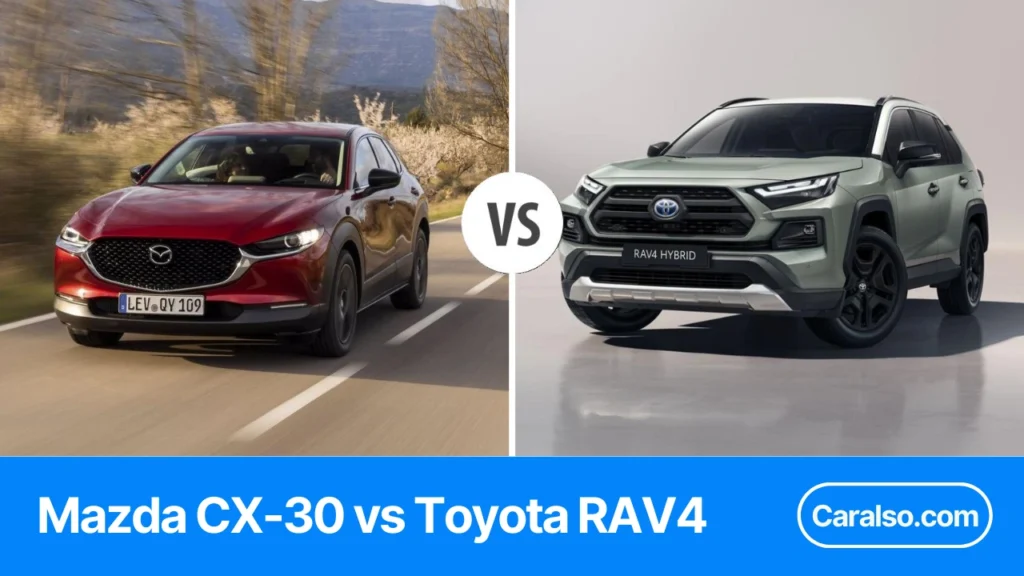
Mazda CX-30 Vs Toyota RAV4
Biggest Reason People Switch Sides:
They start with CX-30 for the drive, then move to RAV4 when they measure cargo and rear-seat reality.
30-Second Scoreboard (2026)
| What Most Buyers Care About | Mazda CX-30 | Toyota RAV4 |
|---|---|---|
| Vehicle Class | Subcompact SUV | Compact SUV |
| Starting Price (MSRP) | $25,975 | $31,900 (excludes fees) |
| Cargo Behind 2nd Row | 20.2 cu ft | 37.8 cu ft |
| Max Cargo (Seats Folded) | 45.2 cu ft | 70.4 cu ft |
| Standard Horsepower | 186 hp | 226 hp (hybrid FWD) |
| Top Output Option | 250 hp, 320 lb-ft (turbo, premium fuel) | 324 hp (plug-in hybrid) |
| Drivetrain Reality | AWD standard | FWD or AWD on hybrid, AWD standard on plug-in |
| Fuel Economy Story | 27 mpg combined (EPA, non-turbo) | Up to 44 mpg combined (manufacturer estimate, hybrid) |
Mazda CX-30 Vs RAV4 At-A-Glance Winners Table
If you only read one thing, read this. These two are not the same kind of buy. I use this table to decide in 60 seconds.
| Category | Winner | Why It Matters In Real Life |
|---|---|---|
| City Parking Footprint | Mazda CX-30 | It is 173 in long vs 181 in for the RAV4. Turning circle is 34.8 ft vs 36.9 ft. That is fewer multi-point turns in tight lots. |
| Cargo Behind Second Row | Toyota RAV4 | 37.8 cu ft vs 20.2 cu ft. That is 17.6 cu ft more, about 87% more space for strollers, coolers, and airport bags. |
| Rear Seat For Car Seats | Toyota RAV4 | Rear legroom is 37.8 in vs 36.3 in. That extra 1.5 in helps with rear-facing seats and front-seat comfort. |
| Highway Passing Power (CX-30 Turbo Vs RAV4 Hybrid) | Mazda CX-30 Turbo | 0 to 60 is about 6.2 sec for the CX-30 turbo vs 7.1 sec for the RAV4 Hybrid AWD. If you merge hard, you will feel it. |
| Fuel Economy Strategy (Hybrid Vs Gas) | Toyota RAV4 | RAV4 is hybrid-only for 2026 and is rated up to 44 mpg combined in the best setup. CX-30 is gas-only. |
| Resale Value Pattern | Toyota RAV4 | 5-year depreciation is about 30.3% for RAV4 vs about 39.5% for CX-30. If you sell in 3 to 6 years, that gap matters. |
| Best Used-Buy Value | Mazda CX-30 | Typical used pricing is lower. A 3-year-old CX-30 averages about $23,501 vs about $28,465 for a 3-year-old RAV4. If you do not need the RAV4 space, the CX-30 is the cheaper used play. |
First Reality Check: These Are Different Size Classes
You can compare them. Plenty of people do. But I treat it like comparing a small sneaker to a hiking boot. Both work. One is built for more load.
Footprint And Space Table (The “Apples vs Oranges” Fix)
| Spec | Mazda CX-30 | Toyota RAV4 |
|---|---|---|
| Length | 173.0 in | 181.0 in |
| Wheelbase | 104.4 in | 105.9 in |
| Rear Legroom | 36.3 in | 37.8 in |
| Cargo Behind Second Row | 20.2 cu ft | 37.8 cu ft |
Here is how I translate that table.
The CX-30 fits the city life better. It is 8.0 in shorter, and it turns tighter.
The RAV4 carries more stuff. The cargo gap is 17.6 cu ft behind the second row. That is the difference between “two carry-ons” and “two carry-ons plus a folded stroller.”
Who This Comparison Is For
- You are cross-shopping on price, not badge.
- You want a nicer-feeling cabin and you do not haul bulky gear every week.
- You live in a city, park in tight spots, and do most trips with 1 or 2 people.
- You want AWD for weather, not for rock crawling.
If You Actually Need A Mazda In The RAV4 Class
If you want Mazda driving feel but you need RAV4-size utility, I look at CX-5 or CX-50 instead. They land closer on cargo and rear-seat space, so the comparison is cleaner.
Price And Value (New And Used)
This is where the class difference shows up fast. The RAV4 costs more because it is bigger, and for 2026 it is hybrid-only.
The CX-30 costs less to get into. But the turbo trims can land in the same monthly payment zone as a lower-trim RAV4.
New Pricing Ranges (What You Pay To Step Up In Size)
Here are the clean numbers I use when I price these out.
| Model (2026) | Lowest Base MSRP | Highest Base MSRP Shown | What That Usually Means |
|---|---|---|---|
| Mazda CX-30 | $25,975 | $37,900 | You pay for turbo power and top trim, not size. |
| Toyota RAV4 (Hybrid) | $31,900 | $43,300 | You pay for more space and a hybrid drivetrain on every trim. |
Two pricing notes I always keep in mind:
- Mazda lists a $1,530 destination charge on CX-30. That lands on top of MSRP.
- Toyota lists its starting MSRP excluding its dealer processing and handling fee. That also lands on top of MSRP.
So the real gap is not just $31,900 vs $25,975. The gap is what you pay after destination, fees, and dealer add-ons.
Why The RAV4 Costs More:
- It is a size class up. More body, more cargo volume, more weight.
- It is electrified only for 2026. Hybrid hardware costs money.
Used Market Strategy
I like used shopping on this comparison because you can control the biggest variable. Depreciation and demand.
Here is a simple “what people actually pay” snapshot from recent used listings averages.
| Age Band | CX-30 Average Used Price | RAV4 Average Used Price |
|---|---|---|
| 3 Years Old | $23,501 | $28,465 |
| 5 Years Old | $19,720 | $25,151 |
My shortcut strategy:
- If you want the lowest cost per month, I start at 4 to 6 years old. That is where prices usually soften without going full “old car life.”
- If you want newer safety tech and fewer miles, I look at 2 to 4 years old. Just know you will still pay the Toyota tax on RAV4.
When A Used CX-30 Makes More Sense:
- You do not need the RAV4 cargo behind the second row.
- You want AWD standard without paying up for a package.
- You want turbo power without paying plug-in hybrid money.
When A Used RAV4 Makes More Sense:
- You haul bulky stuff weekly. Stroller, dog crate, big Costco runs.
- You want hybrid efficiency without changing your habits.
- You plan to sell in 3 to 6 years and you care about resale strength.
Hidden Cost Checklist
These are the costs that change the “best deal” in the real world.
- Destination and fees. Mazda lists $1,530 destination on CX-30. Toyota adds a processing and handling fee on RAV4.
- Dealer add-ons. Think tint, paint protection, nitrogen, wheel locks. Ask for a line-item sheet.
- Interest rate. A 2% rate swing can erase the “cheaper MSRP” win.
- Insurance. Get quotes before you fall in love with a trim.
- Tires. Bigger wheels cost more. A 20-inch tire set usually costs more than a 16-inch set.
- Fuel. If you drive mostly city, a hybrid can pay you back every week.
Powertrains Explained (Gas Vs Hybrid Vs Plug-In) | Choose The Right One
This section is the real decision. The CX-30 is gas-only. The 2026 RAV4 is hybrid or plug-in hybrid only.
So I do not ask “which is better.” I ask “which powertrain fits my life.”
CX-30 Powertrain Cheat Sheet
Mazda keeps it simple. One layout. Two engine choices.
- Standard Engine
- 2.5L gas engine
- 186 hp and 186 lb-ft
- 6-speed automatic
- AWD standard
Who I Think This Fits:
- You drive mixed city and highway.
- You want a normal ownership routine. Gas. Oil changes. Done.
- Optional Turbo Engine
- 2.5L turbo gas engine
- Up to 250 hp and 320 lb-ft on premium fuel
- AWD standard
Who I Think This Fits:
- You do a lot of short highway merges.
- You pass on 2-lane roads.
- You want speed without learning charging.
One detail I always tell friends:
Turbo power is fun. But it also increases your fuel spend. You feel it if you drive hard.
RAV4 Powertrain Cheat Sheet
Toyota flips the script for 2026. Every RAV4 is electrified.
- Hybrid (HEV)
- FWD or AWD depending on trim
- 226 hp (FWD) or 236 hp (AWD)
- Up to a 44 mpg combined manufacturer estimate on the FWD hybrid
Who I Think This Fits:
- You drive a lot of city miles.
- You cannot charge at home.
- You want efficiency without changing habits.
- Plug-In Hybrid (PHEV)
- AWD standard
- 324 net combined hp
- Up to 52 miles of EV range (manufacturer estimate)
- Up to a 41 mpg combined manufacturer estimate
Who I Think This Fits:
- You can charge consistently.
- Your daily drive is 10 to 40 miles.
- You want EV driving most days, with gas backup for road trips.
One important 2026 reality:
Toyota said plug-in hybrid pricing comes later. So if your budget is tight, you may end up in hybrid anyway.
Simple Picker
I use these rules because they work in real life.
- If you cannot charge 4 days a week, skip the plug-in hybrid.
- If you drive mostly city, prioritize the RAV4 hybrid.
- If you drive mostly highway at 70 to 80 mph, the hybrid still helps, but the gap shrinks.
- If you want the smallest footprint and AWD standard, the CX-30 is the easy pick.
- If you want torque and quick passing without charging, pick CX-30 turbo.
Fuel Economy And Range (And Why Your MPG Will Differ)
This is the simple truth. The CX-30 burns gas every mile. The 2026 RAV4 is hybrid-only, and that changes your weekly fuel spend.
One quick note before the table. CX-30 numbers are EPA estimates. Most 2026 RAV4 numbers are Toyota estimates right now, because EPA ratings are not posted yet for the new model.
EPA Snapshot Table
| Model | Rating Type | City | Highway | Combined | Range Note |
|---|---|---|---|---|---|
| CX-30 2.5 (Non-Turbo) | EPA | 24 mpg | 31 mpg | 27 mpg | 12.7-gal tank. About 343 miles per tank at 27 mpg. |
| CX-30 2.5 Turbo | EPA | 22 mpg | 30 mpg | 25 mpg | 12.7-gal tank. About 318 miles per tank at 25 mpg. |
| RAV4 Hybrid LE (FWD) | Toyota Estimate | 48 mpg | 42 mpg | 44 mpg | Gas range depends on trim and tank size. |
| RAV4 Hybrid (Most Other Trims) | Toyota Estimate | Not always listed | Not always listed | 39 to 42 mpg | AWD and wheels usually drop the number. |
| RAV4 Plug-In Hybrid (SE, XSE) | Toyota Estimate | Not always listed | Not always listed | 41 mpg | Up to 52 miles EV range (manufacturer estimate). |
If you want a quick fuel-cost rule, I use this.
If you drive mostly city, the RAV4 hybrid is the easy win.
If you drive mostly highway at 75 mph, the gap shrinks.
Real-World MPG Variables
These are the things that move your number more than most people expect.
Speed
- At 75 mph, both SUVs drop versus the window sticker.
- In one 75-mph test, a RAV4 Hybrid AWD returned 36 mpg.
- In another 75-mph test, a CX-30 non-turbo matched its 31 mpg highway rating.
Short Trips
- A 2-mile drive can crush mpg on any gas vehicle.
- Hybrids do better once they are warm, but cold starts still hurt.
Turbo Use
- If you buy the CX-30 turbo and you use boost often, expect your mpg to look closer to the 25 mpg combined rating than the non-turbo 27 mpg combined rating.
- Premium fuel also changes your cost per mile, even if mpg stayed the same.
AWD, Wheels, And Tires
- AWD usually costs mpg.
- Wider tires and bigger wheels usually cost mpg.
- Low tire pressure costs mpg and range.
Cold Weather
- Heat and defrost use energy.
- Plug-in EV range drops in the cold. Plan for a noticeable cut when it is near freezing.
Roof Gear
- A roof box, crossbars, or a loaded rack adds drag.
- You will feel it most at highway speed.
My quick takeaway.
If you want to stop thinking about fuel, the RAV4 hybrid makes it easy.
If you want the smaller footprint and you do not drive huge miles, the CX-30’s mpg is still fine.
Performance And Driving Feel
I like both for different reasons.
I buy the CX-30 when I care about steering feel and a smaller body.
I buy the RAV4 when I care about smooth daily power and efficiency.
Passing Power And Turbo Vs Hybrid Torque
Here are the acceleration numbers that set expectations.
| Model | Powertrain | 0-60 mph |
|---|---|---|
| CX-30 2.5 (Non-Turbo) | Gas | 8.1 sec |
| CX-30 2.5 Turbo | Gas Turbo | 6.2 sec |
| RAV4 Hybrid (AWD Test) | Hybrid | 7.1 sec |
| RAV4 Plug-In Hybrid | Plug-In | Toyota claims 5.6 sec. Some outlets estimate low 5s. |
How that feels on the road.
CX-30 non-turbo
- It is fine for normal driving.
- Passing at 55 to 75 mph takes planning.
CX-30 turbo
- This is the one that feels quick on a short on-ramp.
- Torque is the story. Up to 320 lb-ft is a lot in a small SUV.
RAV4 hybrid
- It feels responsive at low speeds because electric torque fills in the gaps.
- Under hard throttle, the gas engine can get loud. That is normal for this setup.
RAV4 plug-in
- This is the fast RAV4 option.
- If you want speed and efficiency in one package, this is where Toyota puts it.
Ride Comfort, Steering, And Noise
This is my day-to-day summary.
CX-30
- Smaller, lighter feel in tight turns.
- Steering feels more connected.
- The 6-speed automatic feels more traditional than an eCVT.
RAV4
- More stable at highway speed.
- Hybrid power delivery is smooth in normal driving.
- Under full throttle, you hear the engine more than you do in the Mazda.
If cabin noise matters to you, do not guess.
Do a 70-mph test on the exact tires and wheels you are buying.
2-Minute Test Drive Moves That Reveal Everything
I do this exact sequence.
- 20 To 45 mph Roll-On
From 20 mph, roll into the throttle to 45 mph.
I want smooth power. No surge. No hesitation. - 45 mph Turn-In
Take a normal right turn at 45 mph on a safe, open road.
I want one clean steering input. No extra corrections. - Stop-And-Go Brake Feel
Do one gentle stop and one firm stop from 35 mph.
On hybrids, I want smooth regen-to-brake blending. No grabby pedal. - 70 mph Noise Check
Hold 70 mph for 20 seconds.
Listen for wind at the mirrors and tire hum. - One Tight Parking Maneuver
Do one U-turn or one tight parking lot turn.
This is where the CX-30 footprint advantage shows up.
If one of these five things bugs you, it will bug you every day.
Interior Comfort, Space, And Car-Seat Practicality
This is where the RAV4’s size advantage shows up in daily life. More rear-seat room. More shoulder room. More total passenger volume.
The CX-30 fights back with a smaller cabin that feels focused. And it is easier to place on the road and in parking lots.
Front Seat Comfort And Visibility
Both give me enough legroom up front. The difference is width and overall “big cabin” feel.
| Front Seat Measure | CX-30 | RAV4 |
|---|---|---|
| Front Legroom | 41.7 in | 41.0 in |
| Front Shoulder Room | 55.6 in | 57.0 in |
| Front Hip Room | 54.6 in | 55.3 in |
| Passenger Volume | 94.1 cu ft | 98.9 cu ft |
My real-world take:
- If you have a wider child seat or a big center console routine, the RAV4’s extra shoulder room helps.
- If you want a “smaller cockpit” vibe, the CX-30 nails that.
Rear Seat Space (Car Seat Fit Guidance)
Rear legroom is the big number to watch. The RAV4 gives you 1.5 inches more.
| Rear Seat Measure | CX-30 | RAV4 |
|---|---|---|
| Rear Legroom | 36.3 in | 37.8 in |
| Rear Headroom | 38.3 in | 39.5 in |
| Rear Shoulder Room | 53.6 in | 56.4 in |
| Rear Hip Room | 53.2 in | 49.6 in |
How I translate this for car seats:
- Rear-facing seats: the RAV4 is easier if you have a tall driver. That 1.5 inches matters.
- Forward-facing seats: both work. But the RAV4’s wider rear shoulder room makes it less of a squeeze.
- Three-across: I do not buy either of these expecting easy three-across. The CX-30 is a tough ask. The RAV4 can still be tough depending on seat model.
LATCH reality check:
- CX-30: Cars.com rated the LATCH setup an A. They also noted three tether anchors that are clearly marked.
- RAV4 Hybrid: Cars.com rated LATCH an A, but the tethers are a little buried in the carpet. You may need to dig to hook them.
My no-drama car-seat test:
- Install your seat behind the driver.
- Set the driver seat to your normal position.
- Check for clearance. I want at least 1 inch between the car seat and the front seatback.
- Do a 10-minute drive. Listen for rattles from the car seat base and head restraint contact.
Storage You Touch Every Day
This is where I notice “daily usability” more than leather or trim names.
RAV4 highlights I actually care about:
- Up to five USB-C charging ports.
- Available dual Qi wireless chargers.
- Available 1500-watt AC outlet in the rear cargo area.
CX-30 highlights I notice quickly:
- Dual Type-C USB audio inputs listed on Mazda’s trim/spec page.
- Simple center console layout with the controller close to your right hand.
My quick advice:
- If you road trip with multiple devices, the RAV4’s charging setup is the safer bet.
- If you mostly drive solo or with one passenger, the CX-30’s layout is plenty.
Cargo Space And Versatility
This is a landslide for the RAV4. The numbers are not close.
If you carry bulky stuff weekly, I do not fight the math. I pick the RAV4.
Cargo Numbers Table (Verified)
| Cargo Measure | CX-30 | RAV4 |
|---|---|---|
| Behind Second Row | 20.2 cu ft | 37.8 cu ft |
| Behind Front Row (Seats Folded) | 45.2 cu ft | 70.4 cu ft |
Two fast takeaways:
- The RAV4 has 17.6 cu ft more cargo behind the second row.
- The RAV4 has 25.2 cu ft more cargo with the seats folded.
Real World Fit Test (Differentiation Section)
I do these four tests because they match real errands.
Stroller + Groceries
- RAV4: Pass. Stroller in, groceries around it, second row stays up.
- CX-30: Depends on stroller. Compact stroller usually fits. Full-size strollers often push you toward folding part of the rear seat.
4 Carry-Ons (22-Inch Suitcases)
- RAV4: Pass with the second row up.
- CX-30: Borderline. You may stack higher and lose rear visibility.
Pet Crate (Medium 30-Inch Class)
- RAV4: Pass for many medium crates with the second row up.
- CX-30: Usually needs the second row folded for a crate that size.
Costco Case Stack (Water, Paper Towels, Big Boxes)
- RAV4: Pass. It is built for this.
- CX-30: You can do it, but you will play Tetris faster. Tall items hit the limit sooner.
My honest shopping tip:
Bring your bulkiest item to the dealer. Stroller or crate. Do not guess from photos.
Roof Rails, Hitch Racks, And Small Trailer Use
Roof gear
- The RAV4 Woodland calls out raised roof rails with cross bars.
- For both vehicles, I always check the owner’s manual for the roof load limit. Dynamic roof limits are the one that matter while driving. They are usually lower than people expect.
Hitch racks
- For bikes, I prefer a hitch rack over the roof. It is easier on your back.
- I weigh the rack and the load. A 55 lb rack plus 2 bikes at 35 lb each is 125 lb before you add locks or a cargo bin.
- I also check that the rack clears the rear hatch. Some racks block the liftgate more than you think.
Small trailer use
- The 2026 RAV4 is rated up to 3,500 lb towing capacity.
- For the CX-30, I treat it as a cargo and rack vehicle first, not a trailer vehicle, unless you confirm the rating and required equipment for your exact year and region.
If you do “gear life” often, this is my simple rule:
- RAV4 for inside cargo and towing.
- CX-30 for lighter loads and easier city living.
AWD, Snow, And Light-Duty Capability
AWD Systems In Plain English
Here’s how I think about it.
The CX-30 is simple. i-Activ AWD is standard on every trim. It is an on-demand system that can shuffle torque when grip changes. For 2026, Mazda also added a brake-based limited slip differential to help traction and stability. Off-Road Traction Assist is standard, too.
The 2026 RAV4 is different now. It is hybrid or plug-in hybrid only. On AWD models, it uses an Electronic On-Demand AWD setup with a dedicated rear electric motor. No driveshaft. It can add rear torque fast when the front starts to slip.
This matters most in 2 situations.
- Slippery starts. Wet paint lines. Ice. Slush.
- Mid-corner stability on slick roads.
Neither one turns into a rock crawler because it has AWD. Ground clearance, tires, and traction tuning still rule.
Capability Snapshot
| Item | Mazda CX-30 | Toyota RAV4 (2026) |
|---|---|---|
| AWD Availability | Standard On All Trims | Available On Hybrid, Standard On PHEV |
| AWD Type | On-demand torque shifting | Rear electric motor AWD on AWD models |
| Ground Clearance | 8.0 in | 8.1 in most trims, 8.5 in Woodland, 7.5 in GR SPORT |
| Traction Helpers | Off-Road Traction Assist | Drive modes, AWD control logic |
Ground Clearance And Tire Strategy
I treat ground clearance like a “get home” number, not a bragging number.
The CX-30 sits at 8.0 inches. That is enough for rutted gravel roads, messy parking lots, and light snow that has not been plowed yet.
The 2026 RAV4 is 8.1 inches on most trims. Woodland bumps to 8.5 inches. GR SPORT drops to 7.5 inches. So trim choice can matter more than brand choice.
But tires matter more than clearance in snow.
If you do one upgrade, do this.
- Use winter tires if you see real winter.
- If you want 1 set year-round, buy all-weather tires with the 3PMSF snow rating.
AWD helps you start.
Tires help you stop.
Tires help you turn.
If you want a quick rule:
- Winter tires for regular snow and ice.
- 3PMSF all-weather tires for mixed climates.
- Normal all-seasons only if winters are mild and roads get cleared fast.
What To Buy If You Live In Snow States
This is how I’d pick it.
Pick The CX-30 If:
- You deal with light to moderate snow.
- Your roads get plowed quickly.
- You want a smaller footprint for tight streets and parking.
- You want AWD on the base trim without shopping packages.
Pick The RAV4 If:
- You see deeper snow more often.
- You drive unplowed back roads or hilly neighborhoods.
- You want the Woodland trim’s extra clearance and all-terrain tire focus.
- You want a bigger cabin and more cargo room for winter gear.
My real-world tip.
Before you decide, look at your driveway and your daily route.
If you scrape on snow berms and ruts now, buy the one that clears them with less drama. That usually means a RAV4 trim with more clearance and the right tires.
Safety And Driver Assist (How To Compare Correctly)
IIHS Vs NHTSA Explained
I use both, but I read them differently.
IIHS is great for:
- Modern crash tests with pass/fail style ratings like Good, Acceptable, Marginal, Poor.
- Headlight performance.
- Automatic emergency braking performance in their track tests.
NHTSA is great for:
- A simple 1 to 5 star scale.
- Rollover resistance ratings.
- A consistent federal baseline.
One big detail most people miss.
NHTSA frontal ratings are meant to be compared within the same weight class range. So I never use a star rating to “prove” one vehicle is safer than a totally different-size vehicle. I use it as a check that the vehicle is not a laggard in its class.
Now, the part you can use today.
IIHS Rating Snapshot (2025 Model Year Pages)
| Test Area | Mazda CX-30 | Toyota RAV4 |
|---|---|---|
| Small Overlap Front | Good | Good |
| Moderate Overlap Front (Updated) | Good | Marginal |
| Side (Updated) | Good | Acceptable |
| Headlights | Good | Good |
| Front Crash Prevention (Pedestrian) | Good | Good |
If you want the shortest takeaway.
On the IIHS pages, the CX-30 looks stronger in the updated moderate overlap and updated side results for this generation.
Trim-Based Safety Features Checklist
This is where used buyers get burned.
A model can test well and still be missing the feature you care about.
So I do a simple confirmation pass on the exact car I’m looking at.
I check the window sticker if it exists.
If not, I check the VIN equipment list and then verify in the cabin.
Must-Confirm List For Used Buyers
- Blind Spot Monitoring
- CX-30: Typically standard.
- RAV4: Can be trim-dependent on some years.
- Rear Cross Traffic Alert
- Common on both, but verify.
- Automatic Emergency Braking
- Common on both, but verify the system name and that it is active with no warning lights.
- Lane Keep Assist And Lane Centering
- There is a difference between “lane departure warning” and “lane centering.”
- If you want lane centering, verify on your test drive.
- Adaptive Cruise Control
- Verify full-speed operation in stop-and-go if that matters to you.
- Rear Automatic Braking
- Often optional. Easy to assume. Easy to miss.
- Parking Sensors
- Not always standard. Front sensors are more likely to be trim-based.
- 360 Camera
- Usually top trims only.
What I Like About The 2026 Updates
- Mazda lists a solid set of standard i-Activsense features for 2026.
- Toyota says every 2026 RAV4 gets Toyota Safety Sense 4.0 standard, with updates to detection for features like pre-collision and lane tracing.
My test drive tip.
I trigger the easy stuff.
- Turn on cruise control and lane features on a marked road.
- Put it in reverse near a safe object and confirm parking sensors and cross traffic alerts actually warn.
- Check for warning lights on the dash at startup.
Reliability, Recalls, And Ownership Risk (Practical, Not Alarmist)
I treat reliability like a plan, not a vibe. I want lower surprise costs. And I want fewer “drop it off for a day” repairs.
What Data Sources Agree On (And What They Don’t)
Here’s the part most sources line up on.
Toyota RAV4
- Above-average reliability scoring in common third-party datasets.
- Low annual repair cost.
- Strong resale, which lowers your true cost if you sell in 3 to 6 years.
Mazda CX-30
- Mazda as a brand scores well for reliability.
- The CX-30 tends to be low drama when serviced on schedule.
- Repairs can still happen, but severe repairs look uncommon in the same datasets.
Where sources disagree:
- Model-year risk. A “good model” can have a bad year. A redesign year can be noisy.
- Powertrain risk. Turbo and plug-in systems add complexity.
- Recall impact. Recalls are common. What matters is whether they are fixed.
Here’s a simple ownership-cost snapshot I use.
| Metric | Mazda CX-30 | Toyota RAV4 |
|---|---|---|
| RepairPal Reliability Rating | Mazda brand: 4.0 out of 5 | RAV4: 4.0 out of 5 |
| Annual Repair Cost | Mazda brand: $462 | RAV4: $429 |
| 10-Year Maintenance + Repairs | $7,836 | $6,005 |
| Chance Of Major Repair In 10 Years | 22.65% | 16.61% |
My takeaway from that table:
- Both are “buyable” if you pick the right year and maintain them.
- RAV4 is usually the lower-risk long hold.
- CX-30 can still be a smart buy, especially used, because it often costs less up front.
Recalls You Should Actually Care About
I’m not alarmist about recalls. I just want them closed.
Examples that matter for used shoppers:
Mazda CX-30 (Model-Year Specific)
- Mazda issued a safety recall on certain 2022 to 2023 CX-30 vehicles tied to an ABS hydraulic control unit that could increase brake pedal travel.
- If you shop those years, confirm the recall is completed. No excuses.
Toyota RAV4 And RAV4 Plug-In (Model-Year Specific)
- Toyota issued a safety recall on certain 2021 to 2022 RAV4 Plug-In Hybrid vehicles tied to a DC-DC converter issue with fire risk.
- Toyota also had a large recall on certain 2013 to 2018 RAV4 vehicles tied to 12-volt battery hold-down concerns.
- Some 2022 RAV4, RAV4 Hybrid, and RAV4 Plug-In vehicles were recalled for an occupant classification system concern in the passenger seat.
The point is not “Toyota bad” or “Mazda bad.”
The point is this: any used car can be a great deal or a headache depending on whether recalls and campaigns were handled.
How To Check Recalls By VIN
I do this before I drive to the dealership.
- Get the 17-character VIN from the listing or windshield.
- Check the VIN on the NHTSA recall lookup tool.
- Check the VIN on the manufacturer recall site too.
- Screenshot the results.
- If anything is open, ask the seller for a repair order showing it was completed.
- If it is still open, make “repair before delivery” part of the deal.
One key detail.
The VIN tools are built to show open, unrepaired recalls. That’s what you want.
Used-Buy Inspection Checklist (10 Bullets)
I use this list for both cars. Then I add a couple model-specific checks.
- VIN recall check. NHTSA plus the brand site.
- Cold start. No warning lights that stay on.
- Brake test. One gentle stop, one firm stop from 35 to 45 mph. Straight, no shudder.
- Steering feel. No vibration at 65 to 75 mph.
- Tire wear. Uneven wear usually means alignment or suspension work is due.
- Fluids. Oil level and color. Coolant level. No oil in the coolant bottle.
- For CX-30 turbo: check oil change intervals in service history. Turbo owners who skip oil changes create problems.
- For RAV4 hybrid or plug-in: confirm the hybrid system is clean on the dash. No warning messages. Smooth transitions.
- Salt-state check: look under the car. Surface rust is normal. Heavy corrosion on connectors and lines is not.
- Paperwork. I want service records, not stories. Even 3 oil change receipts is a good sign.
If you do nothing else, do this.
Buy the one with records. Not the one with the nicest photos.
Resale Value And Depreciation (Why It Changes The True Cost)
Depreciation is usually the biggest cost of owning a newer vehicle. Even if you never “feel” it day to day.
5-Year Depreciation Framing
Here are the 5-year depreciation rates from one large used-car dataset:
- Mazda CX-30: 39.5%
- Toyota RAV4: 30.3%
Let’s turn that into real money with clean math.
Example: You Pay $35,000
RAV4 Depreciation Cost
- 30.3% of $35,000 = $10,605
- Estimated value left after 5 years = $24,395
CX-30 Depreciation Cost
- 39.5% of $35,000 = $13,825
- Estimated value left after 5 years = $21,175
Difference
- $13,825 minus $10,605 = $3,220
That $3,220 is why resale changes the true cost.
It can wipe out a good deal.
Or it can justify paying more up front.
Which Holds Value Better And Why
In most markets, the RAV4 holds value better. A few reasons.
- Demand stays high.
- The RAV4 nameplate is a default choice for a lot of buyers.
- Hybrid demand is strong, and the 2026 RAV4 lineup is hybrid-only.
- Toyota’s reputation pulls used buyers in even when prices are higher.
The caveats I keep in mind:
- Depreciation changes with incentives. If one brand starts throwing big discounts, used values shift.
- Trim matters. Popular trims and colors resell faster.
- Miles matter. A 20,000-mile difference can swing resale more than people expect.
My practical advice:
- If you switch cars every 3 to 6 years, RAV4 resale is a real advantage.
- If you keep cars 8 to 12 years, depreciation matters less, and upfront price matters more.
- If you buy used, depreciation can be your friend. That’s where CX-30 often becomes the value play.
Which Should You Buy? (Decision Matrix)
Here is the fast answer in table form. I use this exact matrix when friends text me the same question.
| Buyer Type | Pick | Why | Best Trim Shortcut |
|---|---|---|---|
| City Driver, Tight Parking | CX-30 | 173 in long and 34.8-ft turning circle. Easier daily parking than a 181-in RAV4 with a 36.9-ft circle. | CX-30 2.5 AWD in a mid trim |
| Needs Real Cargo Weekly | RAV4 | 37.8 cu ft behind the 2nd row vs 20.2 cu ft in CX-30. | RAV4 Hybrid XLE or similar mid trim |
| Commute With Lots Of Stop-And-Go | RAV4 | Hybrid-only lineup for 2026. Up to 44 mpg combined in the most efficient setup. | RAV4 Hybrid LE FWD for max mpg |
| Wants Speed Without Charging | CX-30 Turbo | Up to 250 hp and 320 lb-ft. About 6.2 sec 0-60. | CX-30 Turbo trim you can afford |
| Wants EV-Style Driving Some Days | RAV4 Plug-In | Up to 52 miles EV range estimate. AWD standard. | RAV4 Plug-In SE or XSE |
| Snow State, Wants AWD On The Base Trim | CX-30 | AWD is standard. No package hunting. 8.0 in clearance. | CX-30 2.5 AWD base or Select |
| Snow State, Also Needs Clearance And Cargo | RAV4 | 8.1 in most trims, 8.5 in Woodland, plus much more cargo. | RAV4 Woodland if you like the setup |
| Keep-It-6-Years, Resale Matters | RAV4 | 5-year depreciation about 30.3% vs about 39.5% for CX-30 in one dataset. | RAV4 Hybrid in a popular trim/color |
| Best Used Value Under $25k | CX-30 | Used prices are typically lower at 3 to 5 years old. | 3 to 5-year-old CX-30 with records |
| Small Family With Rear-Facing Seat | RAV4 | Rear legroom is 37.8 in vs 36.3 in. More cargo for stroller. | RAV4 Hybrid XLE class trim |
If You Are Torn, Use These 4 Tie-Breakers
Parking And Footprint
Pick CX-30 if you parallel park often. 173 in matters every day.
Cargo
Pick RAV4 if you haul a stroller, dog crate, or big boxes weekly. 37.8 vs 20.2 cu ft is the whole story.
Drive Feel
Pick CX-30 if steering feel and a smaller body matters to you. Pick turbo if you want passing power without charging.
Resale
Pick RAV4 if you sell in 3 to 6 years. Depreciation tends to be lower.
My one-line answer
If you need space and want hybrid efficiency, I buy the RAV4.
If you want a smaller AWD daily with a nicer drive feel, I buy the CX-30.
Test Drive Script (10 Minutes, No Fluff)
I do this loop every time. It keeps the decision clean.
Time Plan
- 2 minutes parked checks
- 6 minutes on-road checks
- 2 minutes dealer questions
5 On-Road Checks
- 0 To 40 mph Pull
Do a normal pull, not a launch.
CX-30 should feel smooth through the 6-speed shifts.
RAV4 should feel smooth through hybrid power blending. - 40 To 70 mph Passing
Find a safe straight. Roll into it.
If you are buying CX-30 non-turbo, this is where you feel the difference.
If you are buying CX-30 turbo, this is where you justify the trim. - Brake Feel From 45 mph
Do one firm stop.
No steering shake. No pull.
On RAV4, pay attention to regen-to-brake blending. It should feel consistent. - 70 mph Noise Check
Hold 70 mph for 20 seconds.
Listen for wind around mirrors.
Listen for tire hum.
If it bugs you now, it will bug you every day. - Tight Turn And U-Turn
Do one U-turn or tight parking lot maneuver.
This shows the CX-30 turning circle advantage fast.
5 Parked Checks
- Driving Position In 30 Seconds
Seat. Wheel. Mirrors. Done.
If you cannot get comfortable fast, do not force it. - Rear Seat Reality
Sit behind your own driver position.
If your knees touch, it will be annoying on every trip. - Car Seat Test
If you have kids, bring your actual car seat.
Install behind the driver.
I want at least 1 inch of clearance between the car seat and the front seatback. - Cargo Test With Your Bulkiest Item
Bring the stroller or the crate.
Load it with the rear seat up first.
This is the moment most people switch to RAV4. - Tech Basics
Pair your phone.
Open maps.
Start music.
Make one call.
If it lags now, it will not get better in month three.
Dealer Questions That Save Money
For Any Used Vehicle
- Any open recalls on this VIN? Show me the VIN lookup.
- Can I see service records? Oil changes count.
For CX-30 Turbo
- How often was the oil changed?
- Any oil consumption notes?
- Any turbo-related repairs?
For RAV4 Hybrid Or Plug-In
- Any hybrid system warnings in history?
- For plug-in, does it come with the charging cord?
- What is the charge speed on this trim? Level 1 and Level 2 only, or more?
For Both
- What tires are on it right now? Brand and size.
- Any accident history? Show me the report.
FAQs
Is Mazda CX-30 bigger than Toyota RAV4?
No. The RAV4 is bigger.
CX-30 is 173.0 in long. RAV4 is 181.0 in.
Cargo is the bigger difference. CX-30 is 20.2 cu ft behind the second row. RAV4 is 37.8 cu ft.
Is the CX-30 worth it over a RAV4?
Yes, if you want the smaller footprint and you do not need the cargo space.
I buy CX-30 when I park in tight places, drive mostly solo, and want AWD standard without trim hunting. I also like the turbo option if I care about passing power.
I buy RAV4 when I want more space, better fuel efficiency, and stronger resale.
CX-30 turbo vs RAV4 hybrid: which feels faster?
CX-30 turbo feels faster when you floor it.
CX-30 turbo is about 6.2 sec 0-60. RAV4 hybrid AWD is about 7.1 sec 0-60.
RAV4 hybrid can feel quick from 0 to 30 mph because of electric torque, but the CX-30 turbo pulls harder on highway passes.
Which is better in snow: i-Activ AWD or RAV4 AWD?
Both are good if you run the right tires.
CX-30 has AWD standard and 8.0 in clearance.
RAV4 has 8.1 in clearance on most trims, and AWD models use a rear electric motor setup that reacts fast.
If you see deep snow often and you carry gear, RAV4 is easier.
If you want a smaller vehicle for city winter driving, CX-30 is easier.
My rule is simple. Tires first. AWD second.
Which is better for car seats and strollers?
RAV4.
Rear legroom is 37.8 in in RAV4 vs 36.3 in in CX-30.
Cargo behind the second row is 37.8 cu ft vs 20.2 cu ft.
If you have a rear-facing seat and a big stroller, the RAV4 is the stress-free pick.
Which holds value better?
RAV4.
In one dataset, 5-year depreciation is about 30.3% for RAV4 vs about 39.5% for CX-30.
If you sell in 3 to 6 years, that gap can be real money.
If you buy used, CX-30 can still be a smart deal because the entry price is usually lower.
Sources
- Mazda CX-30 Model Page (pricing, power, trims)
- Toyota Pressroom: 2026 RAV4 Announcement (hybrid-only, MPG estimates, power, trims)
- Car And Driver: 2026 Mazda CX-30 Review (0–60, dimensions, context)
- Edmunds: 2026 Toyota RAV4 Overview (cargo volume reference)
- iSeeCars: Toyota RAV4 Resale Value And 5-Year Depreciation

Hey there,
How is it going?
I’m Meraj Sarker. I am a Car Mechanic and a student of Automobile Restoration here in Florida, USA. I’ve been studying automotive for around 9 years now. So you can rely on my recommendation. For me, studying and getting knowledge about automobile it’s really fun and entertaining. I will help you to get solutions for your car through this website. If you need any help let me know.