
I see this matchup a lot, and here’s the honest truth. These two are not direct rivals. The Lexus UX is a subcompact luxury crossover. The Toyota RAV4 is a compact mainstream SUV. That size gap changes everything: space, ride height, and what you can realistically do with it.
If you want the shortest “what should I buy” answer, I use this rule.
Quick Verdict (How I’d Choose In 30 Seconds)
- I’d buy the Lexus UX if I want a small hybrid that’s easy to park, has a tighter turning circle, and gives me a more premium cabin feel.
- I’d buy the Toyota RAV4 if I want real back-seat space, real cargo space, more ground clearance, and more capability for the money.
Most people decide after seeing the numbers side by side. So I put the most-searched differences first.
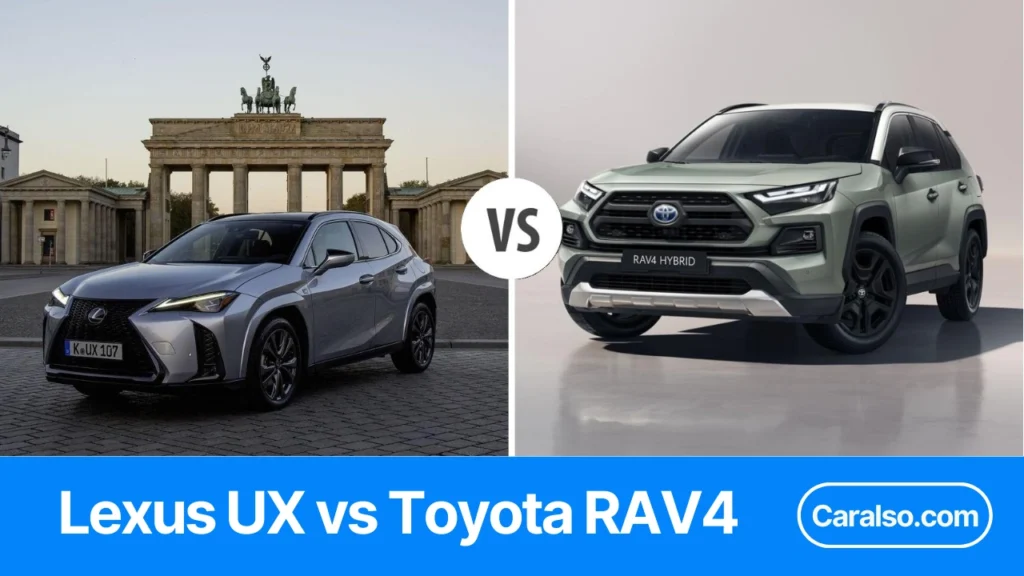
Lexus UX vs Toyota RAV4
Key Specs Compared (Most Searched Differences)
Specs below use 2025 model-year U.S. specs as the baseline, because that’s where most “UX vs RAV4” searches land. Trims can move numbers a bit, but the size and capability gap stays the same.
| Spec (Most Searched) | Lexus UX 300h | Toyota RAV4 (Gas) | Toyota RAV4 Hybrid |
|---|---|---|---|
| Starting Price (Base MSRP, Excludes Destination) | $36,740 | $29,800 | $32,850 |
| Powertrain Basics | Hybrid only | Gas engine | Hybrid only |
| EPA Efficiency (Combined) | 43 mpg (FWD) | 30 mpg | 39 mpg |
| Cargo Behind 2nd Row | 17.2 cu ft | 37.6 cu ft | 37.5 cu ft |
| Rear Legroom | 33.1 in | 37.8 in | 37.8 in |
| Max Towing | Not rated (N/A) | 1,500 lb | 1,750 lb |
| Ground Clearance | 6.3 in | 8.4 in | 8.1 in |
| Turning Circle (Curb-To-Curb) | 34.2 ft | 36.1 ft | 36.1 ft |
Which Is Bigger: Lexus UX Or Toyota RAV4?
The RAV4 is the bigger vehicle in every way that matters day to day. It has more rear-seat space, more cargo space, and a taller body. I treat the UX like a premium city crossover. I treat the RAV4 like a small family SUV.
Interior Space And Rear-Seat Comfort
Here are the numbers I look at first.
| Space Metric | Lexus UX 300h | Toyota RAV4 |
|---|---|---|
| Overall Length | 177.0 in | 180.9 in |
| Overall Height | 60.6 in | 67.0 in |
| Wheelbase | 103.9 in | 105.9 in |
| Passenger Volume | 90.4 cu ft | 98.9 cu ft |
| Rear Legroom | 33.1 in | 37.8 in |
| Rear Headroom | 36.3 in | 39.5 in |
My simple comfort rule. If I am putting adults back there for more than 30 minutes, I want at least 35 inches of rear legroom. The UX has 33.1 inches. The RAV4 has 37.8 inches. That 4.7-inch gap is the difference between “fine” and “move the front seat up.”
Cargo Space: What You Can Actually Fit
Cargo volume is where this comparison stops being close.
| Cargo Metric | Lexus UX 300h | Toyota RAV4 |
|---|---|---|
| Cargo Behind 2nd Row | 17.1 cu ft | 37.5 to 37.6 cu ft |
| Cargo With 2nd Row Folded | 46.0 cu ft (approx, varies by measurement method) | 69.7 to 69.8 cu ft |
I also like real luggage counts because they are easier to picture than cubic feet.
Real-World Carry-On Count (Seats Up)
- Lexus UX: 6 carry-on suitcases behind the second row.
- Toyota RAV4: 10 carry-on suitcases behind the second row.
Mini Fit Table (My Simple Estimation Method)
I use 3 “objects” most people recognize.
- Carry-on suitcase: 22 x 14 x 9 in.
- Grocery crate: about 13 gallons.
- Full-size stroller: usually takes 8 to 12 cu ft depending on design.
| Fit Test (Seats Up) | Lexus UX 300h | Toyota RAV4 |
|---|---|---|
| Carry-On Bags | 6 | 10 |
| Full-Size Stroller | Fits, but uses most cargo space | Fits, with room left for bags |
| 4 Grocery Crates | Fits | Fits, with extra space |
If you do airport runs, Costco trips, or you have a stroller in your life, the RAV4 is the easy answer.
Which Is Better On Gas: UX Hybrid Or RAV4 Hybrid?
On fuel economy alone, I give it to the UX. It is simply more efficient.
On road-trip range between fill-ups, I give it to the RAV4 Hybrid. It carries more fuel.
Hybrid Vs Hybrid (Apples-To-Apples MPG)
Here is the clean comparison I use for most shoppers.
| Model | EPA City | EPA Highway | EPA Combined |
|---|---|---|---|
| Lexus UX 300h FWD | 45 mpg | 41 mpg | 43 mpg |
| Lexus UX 300h AWD | 44 mpg | 40 mpg | 42 mpg |
| Toyota RAV4 Hybrid AWD | 41 mpg | 38 mpg | 39 mpg |
My take in one sentence. The UX usually saves you about 3 to 4 mpg combined versus a RAV4 Hybrid.
Plug-In Question: Do You Need RAV4 Plug-In Hybrid?
If you can plug in at home, this can change the whole decision.
RAV4 Plug-In Hybrid numbers that matter
- Electric-only range: 42 miles (EPA estimate).
- Efficiency: up to 94 MPGe (EPA estimate).
How I decide
- If most of your weekdays are under 40 miles, and you can charge overnight, a plug-in can cut your gas station stops hard.
- If you cannot charge reliably, I usually stick with the regular RAV4 Hybrid.
Charging reality (so you do not get surprised)
- Level 2, 240V: about 2.5 hours for a full charge on models with the faster onboard charger.
- Standard wall outlet, 120V: about 12 hours.
Range Realities (Highway Vs City, Winter Penalties)
Two things decide how far you go between fill-ups.
- MPG.
- Fuel tank size.
Fuel tank sizes
- Lexus UX 300h: 10.6 gallons.
- Toyota RAV4 Hybrid: 14.5 gallons.
Estimated Max Range From EPA Combined MPG (Simple Math)
- UX 300h FWD: 43 mpg x 10.6 gal = about 456 miles.
- UX 300h AWD: 42 mpg x 10.6 gal = about 445 miles.
- RAV4 Hybrid: 39 mpg x 14.5 gal = about 566 miles.
What I actually see on the road
- Highway speeds cut hybrid mpg. I plan for a 5 to 15 percent drop at 70 to 80 mph.
- Cold weather cuts hybrid mpg. Short trips cut it even more.
- The RAV4 Hybrid usually wins “miles per tank” even though the UX wins “miles per gallon.”
Performance And Driving Feel: Which One Is Nicer Day-To-Day?
I break this down by where you drive most.
If I am mostly in the city, I lean Lexus UX.
If I do more highway miles, carry more stuff, or deal with snow ruts, I lean Toyota RAV4.
Here are the numbers I use to keep it real.
| Metric | Lexus UX 300h (FWD Test Data) | Toyota RAV4 Hybrid (Test Data) |
|---|---|---|
| Total System Horsepower | 196 hp | 219 hp |
| 0 to 60 mph (Instrumented) | 7.7 sec | 7.3 sec |
| 50 to 70 mph (Passing) | 5.3 sec | 5.2 sec |
| Curb Weight | 3,457 lb | 3,817 lb |
| Turning Circle (Curb To Curb) | 34.2 ft | 36.1 ft |
| Braking 70 to 0 mph | 185 ft | 179 ft |
| Skidpad Grip | 0.79 g | 0.78 g |
City Driving: Turning, Parking, Visibility
In tight spots, the UX is easier for me.
- Turning circle is 34.2 ft in the UX.
- Turning circle is 36.1 ft in the RAV4.
That 1.9 ft difference shows up in U-turns and parking garages.
The UX is also shorter.
- UX length: 177.0 in.
- RAV4 length: 180.9 in.
Visibility is where the RAV4 fights back.
- UX ground clearance: 6.3 in.
- RAV4 Hybrid ground clearance: 8.1 in.
- RAV4 gas ground clearance: 8.4 in.
If you deal with steep driveways, curb stops, or winter ruts, the RAV4’s extra clearance matters.
Highway Driving: Noise, Ride Comfort, Passing Power
For passing power, they are closer than most people expect.
- UX 50 to 70 mph: 5.3 sec.
- RAV4 Hybrid 50 to 70 mph: 5.2 sec.
Both are quick enough for normal highway merges.
Where the RAV4 usually feels easier is load.
It carries more people and cargo without feeling maxed out.
It also has a longer wheelbase.
- UX wheelbase: 103.9 in.
- RAV4 wheelbase: 105.9 in.
The UX’s advantage on the highway is efficiency.
But you already saw that in the MPG section.
AWD Systems: Snow Confidence Vs Light Trails
This is the part most comparison pages gloss over.
The Lexus UX AWD system is designed for traction.
It is not designed for trail work.
- UX uses an AWD setup with an electric motor on the rear axle.
- It reacts fast on wet roads and light snow.
- Ground clearance stays 6.3 in.
The RAV4 gives you more room to work with.
- RAV4 Hybrid uses an electronic AWD system with a rear electric motor.
- It also gives you Trail Mode for low-speed traction help.
- Ground clearance is 8.1 in on the Hybrid.
If you actually leave pavement, clearance usually decides the day.
A 1.8-inch difference is the gap between scraping and not scraping.
Quick Rule I Use
- If you want AWD mainly for rain and light snow, UX AWD is enough.
- If you deal with deep slush, rutted roads, or you camp on rough access roads, I take the RAV4.
Technology And Features: What Do You Get For The Money?
This is where the “Lexus vs Toyota” price gap needs to earn its keep.
The UX gives you a more premium experience per feature.
The RAV4 gives you more tech per dollar if you shop trims carefully.
Infotainment + Phone Integration (CarPlay/Android Auto, Screen Size Logic)
Both get the basics right.
Wireless phone mirroring is available on both, and it is what I expect in 2025.
Screen sizes are the big difference.
| Feature | Lexus UX 300h | Toyota RAV4 / RAV4 Hybrid |
|---|---|---|
| Base Touchscreen Size | 8.0 in | 8.0 in (most trims) |
| Bigger Screen Option | 12.3 in (trim-dependent) | 10.5 in (trim-dependent) |
| Wireless Apple CarPlay | Yes | Yes |
| Wireless Android Auto | Yes | Yes |
My screen rule is simple.
If I am using maps every day, I want the bigger screen.
Luxury Features That Matter (Seats, Audio, Materials)
This is where I usually see shoppers justify the UX.
Seats
- Heated and ventilated front seats are available on the UX.
- Heated and ventilated front seats are also available on the RAV4, usually higher trims.
Audio
- UX offers an available 13-speaker Mark Levinson system.
- RAV4 offers an available 11-speaker JBL system.
If you care about audio, count the speakers first.
It is not the whole story, but it is a real starting point.
Practical Tech (360 Camera Availability, Sensors, Tailgate, Roof Rails)
This is the stuff you feel every single day.
360 Camera
- RAV4 offers an available Panoramic View Monitor style 360 system on higher trims or packages.
- UX also offers a surround-view style camera on certain trims or packages.
Parking Sensors With Auto Braking
- Both can be optioned with front and rear parking sensors and low-speed auto braking support.
Power Tailgate
- UX offers an available power rear door with a kick sensor.
- RAV4 offers an available power liftgate on higher trims and packages.
Roof Carry
If you use crossbars, boxes, or bikes, the RAV4 ecosystem is usually easier.
More trims ship ready for it, and the roofline is taller.
That matters when you are loading a box at 67.0 inches of overall height instead of 60.6 inches.
Quick Rule I Use
- If you want the nicer cabin experience and you live on your phone and audio, I lean UX.
- If you want the most features per dollar and you value utility tech like liftgate, roof gear, and parking aids, I lean RAV4.
Safety: Which One Is Safer?
If safety is your main filter, I see this as a tie on the big headline score, with a small edge to the RAV4 on published IIHS coverage.
Both the 2025 Lexus UX and 2025 Toyota RAV4 show a 5 out of 5 overall NHTSA score.
Both also show a 4 out of 5 rollover score.
The difference is the details, and which tests have been published by IIHS for each model.
Crash Ratings (NHTSA And IIHS): What To Check By Model Year
Here’s the fastest way I compare them.
| Safety Metric (2025 Data) | Lexus UX | Toyota RAV4 |
|---|---|---|
| NHTSA Overall | 5 / 5 | 5 / 5 |
| NHTSA Frontal Crash | 4 / 5 | 4 / 5 |
| NHTSA Side Crash | 5 / 5 | 5 / 5 |
| NHTSA Rollover | 4 / 5 | 4 / 5 |
| NHTSA Rollover Risk | 14.0% | 15.5% |
| IIHS Small Overlap Front | Good | Good |
| IIHS Moderate Overlap Front (Updated) | Marginal | Marginal |
| IIHS Side (Updated) | Not Listed On The 2025 UX Page | Acceptable |
| IIHS Headlights | Good | Good |
| IIHS Seat Belt Reminders | Good | Good |
My practical takeaway.
For both vehicles, the IIHS updated moderate overlap front result is the one I would actually read, not just the letter grade.
That updated test puts a lot of focus on rear-seat occupant protection.
On the IIHS pages, both vehicles show weaker rear passenger kinematics in that updated test.
That matters if you carry adults or older kids in the back often.
What I check by model year before I buy.
- The exact year’s IIHS page. Some tests apply across multiple years, but not always.
- The exact trim’s headlights. Headlight ratings can swing by trim.
- Whether the driver-assist suite is standard on the trim I’m shopping.
- The presence of blind spot monitoring and rear cross traffic alert if I do a lot of city driving.
Driver-Assist Packages And Trim Naming (Toyota Vs Lexus)
This is where the Lexus is simple.
Lexus UX:
- Lexus Safety System+ 3.0 is standard on all 2025 UX 300h models.
- Blind Spot Monitor and Rear Cross Traffic Alert are also listed as standard.
- Lexus trims you will see most: Premium, Luxury, F Sport Design, F Sport Handling.
Toyota RAV4:
- Toyota Safety Sense 2.5 is listed as standard on the 2025 RAV4 lineup.
- On the IIHS page, blind spot detection is shown as optional.
- Common RAV4 trims you will see: LE, XLE, XLE Premium, Limited.
- Hybrid trims often mirror those names with “Hybrid” added.
My quick rule.
If you want fewer “did this option get checked?” surprises, Lexus usually makes it easier.
If you are shopping RAV4 trims, I always verify the package list on the exact VIN.
Family Safety Usability: Rear Visibility, Child-Seat Anchors, Alerts
This is the part that gets ignored in most comparisons.
It matters a lot day-to-day.
Child seats and LATCH.
Both score well on the IIHS child-seat anchor evaluation.
Both also show extra LATCH positions and a middle seating position that can borrow lower anchors.
That means:
- Two car seats are straightforward.
- Three-across gets hard fast, especially in the UX.
Alerts and parking safety.
Both can be equipped with the usual modern stuff like backup camera and parking sensors, depending on trim.
On the IIHS pages, rear automatic braking is shown as optional for both.
Rear visibility.
The RAV4’s bigger glass and bigger cabin usually make life easier with kids, bags, and quick shoulder checks.
The UX is shorter and easier to place in tight city parking, which also reduces low-speed stress.
My family safety pick.
If you are regularly using the back seat, I lean RAV4.
It is not because the UX is unsafe.
It is because the RAV4 gives you more physical space to work with, and more IIHS categories are posted on the 2025 RAV4 page.
Ownership Costs: Maintenance, Resale Value, And What You’ll Pay Long Term
This is where the RAV4 usually wins for most buyers.
Not by vibes.
By math.
Depreciation And Resale Value (What The Data Suggests)
Two useful ways to look at value retention are percent depreciation and 5-year cost to own.
Depreciation percent (5-year estimate from a large used-car data set):
- Toyota RAV4: 30.8%
- Lexus UX 250h: 36.9%
That is a 6.1 percentage point gap.
Now the cleaner apples-to-apples snapshot, using 5-year Cost To Own estimates.
| 5-Year Ownership Snapshot (2025 Models) | Lexus UX | Toyota RAV4 |
|---|---|---|
| 5-Year Cost To Own | $56,161 | $45,578 |
| 5-Year Out-Of-Pocket | $36,721 | $31,937 |
| 5-Year Depreciation | $19,440 | $13,641 |
What I take from that.
- The UX costs $10,583 more over 5 years in that estimate.
- Depreciation alone is $5,799 higher on the UX in that estimate.
If you plan to sell in 3 to 5 years, this matters more than the monthly payment.
Maintenance Cost Expectations (Tires, Brakes, Hybrid Basics)
Two quick notes before the numbers.
First, “maintenance” and “repairs” are not the same thing.
Some sources blend them.
Some separate them.
Second, hybrids can reduce brake wear because of regenerative braking.
So brakes are not usually the scary part.
KBB maintenance estimates (5-year total):
- RAV4: $3,936 total, about $787 per year
- UX: $6,777 total, about $1,355 per year
RepairPal average annual repair cost:
- RAV4: $429 per year
- Lexus brand average: $551 per year
What I expect in real life.
- The Lexus can cost more on routine services and parts pricing at the dealer.
- The Toyota usually gives you more flexibility. More independent shops. More parts availability.
Hybrid basics I watch on both.
- Coolant service timing.
- Inverter and hybrid system coolant where applicable.
- Tire wear, especially if you run larger wheel packages.
Insurance And Repair Cost Tendencies (Luxury Badge Reality)
Insurance is the sneaky one.
Luxury badges often cost more to insure even when the car is not expensive-exotic.
Here are two data-based snapshots.
KBB insurance estimates (5-year total):
- RAV4: $13,000
- UX: $15,155
That is $2,155 more over 5 years for the UX, or about $431 per year.
CarEdge estimated annual insurance:
- RAV4: $1,999 per year
- UX 300h: $2,380 per year
That is $381 more per year for the UX.
Repairs over 5 years (KBB estimate):
- RAV4: $1,695
- UX: $1,149
I do not treat that last line as a guarantee.
Warranty coverage and how KBB models repairs can skew those early-year numbers.
Long-term, the Lexus badge still tends to bring higher labor rates and higher parts prices when something does break.
My ownership-cost verdict.
If you want the lower-risk financial play, I pick the RAV4.
If you want the Lexus cabin feel and you are fine paying more over 5 years, the UX can still be a smart buy.
Just go in with your eyes open.
Capability: Towing, Ground Clearance, And “Weekend SUV” Needs
If your weekends include dirt roads, snow, or towing anything heavier than a small utility trailer, I pick the RAV4.
The UX is great at being small and efficient.
It is not built around “bring the toys” capability.
Towing Capacity Comparison (Who Can Tow And Why It Matters)
This is the quick towing reality I use.
| Model | Max Towing Capacity |
|---|---|
| Lexus UX 300h | Not a towing-focused setup. Many spec sheets do not publish a tow rating. |
| Toyota RAV4 (Gas) | 1,500 lb |
| Toyota RAV4 Hybrid | 1,750 lb |
| Toyota RAV4 Plug-In Hybrid | 2,500 lb |
My rule.
If you need to tow a small teardrop, a pair of jet skis, or a light utility trailer, the RAV4 is the only one I even consider here.
Also do not ignore payload.
The RAV4 can tow, but you still have to manage tongue weight plus passengers plus cargo.
That is where people get in trouble.
Ground Clearance + Light Off-Road (What’s Realistic)
Ground clearance and approach angle decide whether you scrape.
Departure angle matters too, but the front end is usually the first thing that hits.
Here are the numbers.
| Metric | Lexus UX 300h | Toyota RAV4 (Gas) | Toyota RAV4 Hybrid | Toyota RAV4 Plug-In Hybrid |
|---|---|---|---|---|
| Ground Clearance | 6.3 in | 8.4 in | 8.1 in | 8.0 in |
| Approach Angle | 14° | 19° | 19° | 19° |
| Departure Angle | 25° | 21° | 21° | 21° |
How I translate that into real use.
- A 6.3-inch clearance vehicle is fine on maintained gravel.
- An 8.0 to 8.4-inch clearance vehicle is more forgiving on ruts, snow buildup, and rough trailheads.
- The UX approach angle at 14° is the limiter. Steep driveway lips and trail entrances are where it can tap.
If your “off-road” is a campground road and a trailhead parking lot, RAV4 is the safer bet.
If you want to explore rocky trails, neither of these is a 4Runner replacement.
Snow Checklist (Tires Beat AWD Marketing)
I drive in winter, and this is what actually moves the needle.
- Tires
- I look for the 3-Peak Mountain Snowflake symbol.
- I swap when tread gets near 6/32″ in real winter climates.
- Ground Clearance
- UX: 6.3 in.
- RAV4 Hybrid: 8.1 in.
That 1.8-inch difference helps in slush ruts and unplowed neighborhoods.
- AWD Expectations
- UX AWD helps with traction.
- It does not change clearance.
- RAV4 AWD plus higher clearance is the better combo if you see deep snow.
- Braking Distance
- AWD helps you go.
- Tires help you stop.
I do not compromise on tires for winter.
- Simple Prep
- Winter washer fluid.
- A compact shovel.
- A traction mat if you park outside.
If you want one vehicle for year-round “do everything” duty, I lean RAV4 Hybrid.
Real-World Fit Test (The Section Others Don’t Do)
I use two tests.
They tell me more than any spec table.
The “1 Stroller + 2 Carseat + Luggage” Test
I assume a normal family weekend.
Two car seats installed.
Stroller in the trunk.
Two carry-on bags.
One backpack.
Here is the space baseline.
| Metric | Lexus UX 300h | Toyota RAV4 |
|---|---|---|
| Rear Legroom | 33.1 in | 37.8 in |
| Cargo Behind 2nd Row | 17.2 cu ft | About 37.4 to 37.6 cu ft |
What happens in the UX
- Two car seats fit.
- Rear legroom at 33.1 in means the front seats usually move forward more with rear-facing seats.
- Cargo at 17.2 cu ft means a full-size stroller eats most of the space.
- If I add two carry-ons, I often end up stacking or folding a seat.
What happens in the RAV4
- Two car seats fit with less front-seat compromise because rear legroom is 37.8 in.
- Cargo around 37.5 cu ft gives me space for the stroller plus luggage without playing Tetris.
- I am less likely to block rear visibility with stacked bags.
My quick result
- UX works better as a two-person car that occasionally carries kids.
- RAV4 works better as the primary family vehicle.
The “Tight City Parking” Test
This is where the UX makes a strong case.
These are the numbers I care about.
| Metric | Lexus UX 300h | Toyota RAV4 |
|---|---|---|
| Length | 176.9 to 177.0 in | 180.9 in |
| Width | 72.4 in | 73.0 in |
| Height | 60.6 in | 67.0 in |
| Turning Circle (Curb To Curb) | 34.2 ft | 36.1 ft |
How it feels in real use
- The UX is about 3.9 inches shorter. Parallel parking is easier.
- The UX turning circle is 1.9 ft tighter. U-turns are easier.
- The RAV4 sits 6.4 inches taller. You feel that in sight lines and in loading kids.
My parking verdict
- If your life is garages, tight streets, and compact spots, I lean UX.
- If your life is cargo, people, and weekend gear, I lean RAV4.
Trim Match Cheat Sheet (Stop Cross-Shopping Confusion)
If you are comparing Lexus UX trims to a RAV4, I match them by daily comfort features first. Then I check the tech. Then I check the drivetrain.
Here’s the quickest way to stop the trim spiral.
If You’re Looking At UX Premium / F Sport… What’s The Closest RAV4 Trim?
| If You’re Shopping This Lexus UX 300h Trim | Closest RAV4 Gas Trim | Closest RAV4 Hybrid Trim | Why I Match It This Way |
|---|---|---|---|
| UX 300h (Base) | RAV4 XLE | RAV4 Hybrid XLE | Both land in the “nicely equipped daily driver” zone without going full luxury. |
| UX 300h Premium | RAV4 XLE Premium | RAV4 Hybrid XLE Premium | This is where you start caring about comfort upgrades and nicer interior touches. |
| UX 300h F Sport Design | RAV4 Limited (Appearance Plus Options) | RAV4 Hybrid XSE | Sport styling, bigger wheels, and a more “sporty spec” vibe is the goal here. |
| UX 300h F Sport Handling | RAV4 Limited (Loaded) | RAV4 Hybrid Limited | This is the “I want the most features” shopper, not the “I want the cheapest” shopper. |
Now the part people miss.
What You Gain If You Switch To A RAV4
- Rear seat space. This matters fast if you carry adults or use a rear-facing car seat.
- Cargo space. You feel it every grocery run and every airport trip.
- More tire choices. The UX leans into run-flat fitments on some F SPORT setups.
- More “SUV” tolerance. Bigger mirrors. More ground clearance. More relaxed over potholes.
What You Gain If You Stick With The UX
- Easier city life. I feel the smaller footprint in every parking lot.
- A more upscale cabin feel for the money.
- Strong mpg without trying. The UX 300h is built to sip fuel.
- Features that show up earlier in the trim walk, like parking help and upgraded displays on F SPORT trims.
If you want my blunt shortcut.
If you have kids, buy the RAV4.
If you mostly drive solo and park in tight places, buy the UX.
Buying Used? Here’s The Simplest Way To Shop This Matchup
Used shopping is where this comparison gets easier. You can ignore the marketing and focus on year changes that actually matter.
Best Years To Target (UX 250h To UX 300h Change, RAV4 Generation Notes)
Here’s how I’d narrow it down.
Lexus UX Used Targets
- If you want the stronger hybrid setup, I target 2025+ UX 300h. That is the year Lexus moved to the UX 300h name and a 196 hp hybrid system.
- If you want the newer touchscreen setup, I target 2023+. That is when the UX update brought in a touchscreen interface and other upgrades.
- If price is the whole point, 2019-2024 UX 250h can be a value play. Just accept the tighter rear seat and smaller cargo area.
Toyota RAV4 Used Targets
- If you hate buying the first year of a generation, skip 2019 and shop 2020-2021.
- If you want the newer safety suite baseline, I target 2022+. Toyota Safety Sense 2.5 shows up across the RAV4 lineup by this point.
- If you specifically want the gas Adventure or TRD Off-Road trims, shop 2024 or older. Toyota dropped those gas grades for 2025.
- If you want the easiest “one car does everything” setup, I shop RAV4 Hybrid first. The hybrid gets standard AWD and strong mpg.
One more simple filter that saves time.
If the listing has tiny wheels and cheap tires, I move on. Tires tell you how the last owner thought about maintenance.
What To Check On A Test Drive (Noise, Tires, Brakes, Hybrid Behavior)
I do the same loop every time. It takes 15 minutes.
Road Noise And Tires
- Drive at 40 mph and 70 mph.
- Listen for a low hum that rises with speed. That often points to uneven tire wear.
- Check the tire brand and model. Mismatched tires are a red flag on AWD cars.
Brakes
- Do 3 stops from 45 mph.
- Feel for a pulse in the pedal. That can mean warped rotors.
- Listen for a scrape at the last 5 mph. That can mean pads are low.
Hybrid Behavior
- In a parking lot, creep forward and back. The UX and RAV4 hybrids should feel smooth at low speed.
- On a light throttle roll-on from 15-35 mph, the transition from EV assist to engine should not feel like a lurch.
- With the A/C on, confirm it still holds EV mode at low speeds sometimes. Total EV time varies, but it should not feel broken.
Cabin Tech Quick Check
- Pair your phone once. Confirm Bluetooth and wireless CarPlay or Android Auto works.
- Test the backup camera. Then test parking sensors if equipped.
Recall/VIN Check Reminder
Before I buy, I run the VIN through the official Toyota or Lexus recall site and the NHTSA recall lookup. I want to see “0 open recalls” or proof the recall repair was completed. If a seller cannot show that, I price the car like I am doing the legwork.
FAQs
Is The Lexus UX Basically A Toyota?
Yes and no.
Lexus is Toyota’s luxury brand, and the UX is built on Toyota’s GA-C architecture. A lot of the underlying engineering is shared across Toyota products. The difference is how Lexus tunes the ride, specs the materials, and packages the features.
Is The Lexus UX More Reliable Than The RAV4?
I treat them as both being strong bets.
They are both Toyota-family vehicles, and the hybrid systems have a solid track record. The bigger difference is usage. A RAV4 is more likely to live a harder life because it hauls more people and more stuff. Condition and maintenance matter more than the badge.
Can The Lexus UX Handle Snow As Well As The RAV4?
The RAV4 usually wins in real snow.
It sits higher and has more clearance. The RAV4 Hybrid also gives you standard AWD. The UX can be great in snow with proper winter tires, but it is still a smaller crossover with less clearance.
Is The RAV4 Hybrid Worth It Over The UX 300h?
If you need space, yes.
The RAV4 Hybrid gives you a bigger rear seat and a lot more cargo room. If you drive mostly solo and want the nicer cabin feel in a smaller footprint, the UX 300h can make more sense.
Which Is Better For Families: UX Or RAV4?
RAV4.
I can make the UX work for two adults and a small kid setup. But the RAV4 is the one I pick when I know the back seat will be used every day.
Sources
- IIHS: 2025 Lexus UX Ratings
- NHTSA: 2025 Lexus UX 300h (FWD) Ratings
- Edmunds: 2025 Lexus UX Features And Specs
- Kelley Blue Book: 2025 Toyota RAV4 Cost To Own
- RepairPal: Lexus Reliability And Repair Costs (Brand Page)
- CarEdge: Lexus UX 300h Insurance Costs

Hey there,
How is it going?
I’m Meraj Sarker. I am a Car Mechanic and a student of Automobile Restoration here in Florida, USA. I’ve been studying automotive for around 9 years now. So you can rely on my recommendation. For me, studying and getting knowledge about automobile it’s really fun and entertaining. I will help you to get solutions for your car through this website. If you need any help let me know.