
If you want the short answer, I buy the Lexus RX 350 for comfort and quiet, and I buy the Toyota RAV4 for value and fuel cost. The RX is 192.5 inches long and starts around $50,525. The RAV4 is about 181.1 inches long and starts around $33,350. That size and price gap is the whole story.
I also want to call out something most comparison pages skip. These are not the same class of SUV. The RX 350 is a larger luxury crossover. The RAV4 is a smaller mainstream crossover. Comparing them still makes sense because monthly payments can overlap. But you need to judge them by what you actually do every day: commute, kids, road trips, winter driving, and running costs.
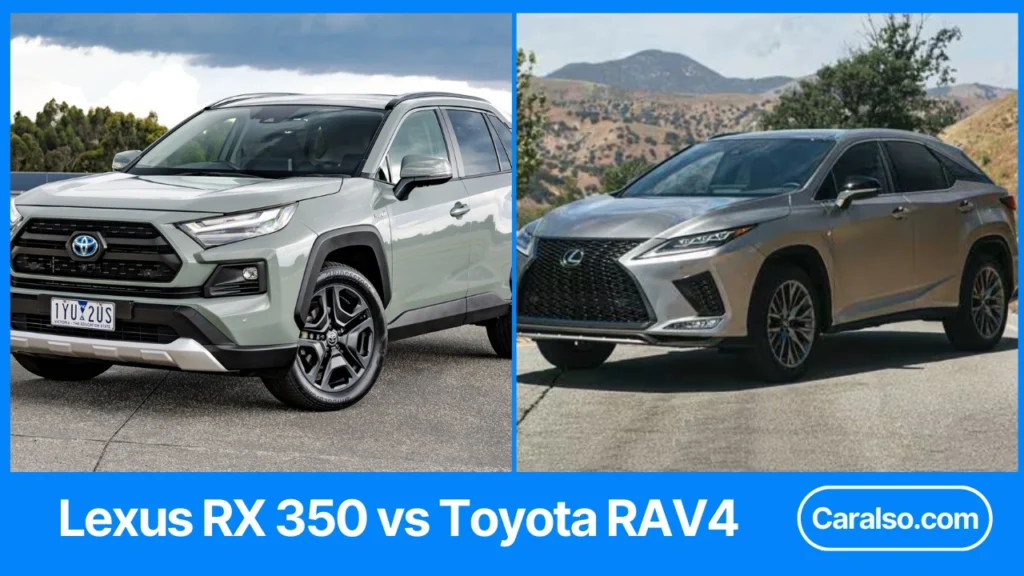
Lexus RX 350 Vs Toyota RAV4
Quick Answer: RX 350 Or RAV4?
The 10-Second Verdict
Pick The Lexus RX 350 If You Want:
- A bigger SUV footprint: 192.5 inches long
- A turbo gas engine with 275 hp and 317 lb-ft
- Up to 3,500 lb towing with the towing package
- EPA fuel economy around 22 city and 29 highway in FWD form
Pick The Toyota RAV4 If You Want:
- A smaller footprint that is easier to live with: about 181.1 inches long
- A much lower starting price: $33,350 for the base trim
- Hybrid power on every trim for 2026
- Up to 47 city and 40 highway mpg in the most efficient configuration
- Up to 3,500 lb towing on AWD models, and 1,750 lb on FWD models
The 10-Second Decision Table
| What Matters Most | Lexus RX 350 | Toyota RAV4 | Best For |
|---|---|---|---|
| Starting Price | About $50,525 (base) | $33,350 (base) | RAV4 if you want the lowest buy-in |
| Fuel Economy | 22 city, 29 highway (FWD) | Up to 47 city, 40 highway (most efficient) | RAV4 if fuel cost matters |
| Length | 192.5 in | 181.1 in | RX if you want the bigger cabin feel |
| Cargo Behind 2nd Row | 29.6 cu ft | 37.8 cu ft | RAV4 if you haul bulky stuff |
| Towing | 3,500 lb with towing package | 3,500 lb (AWD), 1,750 lb (FWD) | Tie on AWD towing, RAV4 loses on FWD |
| Power (Quick Signal) | 275 hp, 317 lb-ft | Hybrid lineup (power varies by trim and AWD) | RX if you want turbo punch |
| Money Logic | Higher payment, higher running costs | Lower payment, lower fuel use | RX for comfort-first, RAV4 for value-first |
My Simple Rule When Friends Ask Me This
If your budget tops out in the mid-$30k range, I point you to the RAV4 first. It starts at $33,350, and it gives you strong mpg without paying luxury-car money. If you are comfortable starting around $50k, I tell you to test-drive the RX 350. You feel the extra size immediately because it is 11.4 inches longer.
Are You Comparing The Right Vehicles?
Why This Comparison Is Tricky
I compare these two a lot, but I treat it like a “class jump” comparison.
The RX 350 is a midsize luxury crossover.
The RAV4 is a compact mainstream crossover.
That shows up in the hard numbers:
- Length: RX 192.5 in, RAV4 about 181.0 in
- Wheelbase: RX 112.2 in, RAV4 105.9 in
- Width: RX 75.6 in, RAV4 about 73.0 in
That is a 11.5-inch length gap.
That is a 6.3-inch wheelbase gap.
Longer wheelbase usually means a calmer ride at 70 mph.
It also usually means more rear-seat comfort.
Here’s my quick “class check” before I even talk trims:
| Vehicle | Class | Length | Wheelbase | Starting MSRP (Typical) |
|---|---|---|---|---|
| Toyota RAV4 (2026) | Compact | 181.0 in | 105.9 in | $31,900 to about $33,350 |
| Lexus RX 350 (2026) | Midsize Luxury | 192.5 in | 112.2 in | $51,175 |
If you only need a compact SUV, the RAV4 is usually the smarter buy.
If you want that bigger-body feel every day, the RX earns its price.
If You Want A Lexus Closer To RAV4 Size
This is where I steer a lot of people.
The Lexus NX is closer to a RAV4 in footprint.
The NX is about 183.5 inches long.
That puts it about 2.5 inches longer than a RAV4, not 11.5 inches longer like the RX.
If your garage is tight, or you city park a lot, that difference matters fast.
If You Want Toyota Space Closer To RX
If you love Toyota pricing and reliability, but you want more space than a RAV4, I sanity-check two options.
- Toyota Highlander: 194.9 inches long
- Toyota Grand Highlander: 201.4 inches long
Those are closer to the RX’s “big SUV” feel.
The Grand Highlander is almost 20 inches longer than a RAV4.
That is a completely different parking and garage-fit experience.
Price Breakdown: New Vs Used Reality
MSRP And Typical “Real Budget” Ranges
This is why people cross-shop RX 350 and RAV4 even though they are different classes.
Monthly payments overlap.
Not because the RX is cheap.
Because a high-trim RAV4 is not cheap anymore, and used-car interest rates are still high.
Here are the ranges I keep in my head:
- New 2026 RAV4: about $31,900 to $43,300 before taxes and fees
- New 2026 RX 350: starts at $51,175 including destination
Used RX 350 pricing depends heavily on year.
These averages are a good shortcut:
- Used 2022 RX 350: about $39,366 average
- Used 2020 RX 350: about $32,481 average
Now add loan rates.
Recent market data puts average APR around:
- New: about 6.7%
- Used: about 11.9%
That spread is why a cheaper used RX can still have a similar payment to a more expensive new RAV4.
Used RX 350 Vs New RAV4: Same Monthly Payment Showdown
I’ll show you the overlap with clean math.
Assumptions:
- 72-month loan
- 10% down
- New APR 6.7%
- Used APR 11.9%
- Taxes and fees not included
| Scenario | Price Used For Math | Estimated Payment | Estimated Interest Over 72 Months |
|---|---|---|---|
| New 2026 RAV4 LE | $33,350 | $507/mo | $6,519 |
| New 2026 RAV4 XLE Premium | $37,550 | $571/mo | $7,340 |
| New 2026 RAV4 Limited | $44,750 | $681/mo | $8,747 |
| Used 2020 Lexus RX 350 | $32,481 | $570/mo | $11,806 |
| Used 2022 Lexus RX 350 | $39,366 | $691/mo | $14,309 |
This is the “aha.”
A new RAV4 XLE Premium and a used 2020 RX 350 can land near the same payment.
But the interest cost is not the same.
In this example, the used RX burns about $4,500 more in interest over the term.
What changes in real life:
- Warranty: new RAV4 gets full new-car coverage, and Toyota’s hybrid battery warranty is 10 years or 150,000 miles
- Warranty: RX has a longer basic warranty than Toyota when it is new, but used RX mileage and in-service date matter a lot
- Tech age: a 2020 RX is older infotainment and older driver-assist behavior
- Running costs: premium fuel is not required for the RX 350, but tires and brakes can cost more than a RAV4 depending on wheel size
My rule: if you are shopping by payment, I also run the “total interest” number.
That number is where used luxury SUVs can sneak up on you.
Fuel Economy And Fuel Cost (Not Just MPG)
When I compare these two, I stop obsessing over MPG first.
I look at:
- Fuel grade (regular vs premium).
- Cost to drive 25 miles.
- Annual fuel cost using the same assumptions.
Here’s the EPA snapshot for the most common trims people cross-shop.
| Model | Fuel | EPA Combined | Cost To Drive 25 Miles | EPA Annual Fuel Cost | EPA Range |
|---|---|---|---|---|---|
| Toyota RAV4 AWD | Regular | 29 MPG | $2.53 | $1,500 | 420 mi |
| Toyota RAV4 Hybrid AWD | Regular | 39 MPG | $1.88 | $1,150 | 566 mi |
| Toyota RAV4 Plug-In Hybrid AWD | Regular + Electricity | 94 MPGe (38 MPG gas-only) | $1.35 (single charge) | $900 | 600 mi |
| Lexus RX 350 FWD | Premium | 25 MPG | $3.89 | $2,350 | 445 mi |
| Lexus RX 350 AWD | Premium | 24 MPG | $4.05 | $2,450 | 427 mi |
| Lexus RX 450h+ AWD | Premium + Electricity | 83 MPGe (35 MPG gas-only) | $1.50 (single charge) | $1,200 | 540 mi |
Gas RX 350 Vs Gas RAV4: What To Expect
If you stay gas-only, the RAV4 is the cheaper daily driver. It’s not close.
Two reasons:
- The RAV4 uses regular gas.
- The RX 350 is EPA-rated on premium gas.
On the same EPA math, the annual fuel cost gap looks like this:
- RX 350 AWD ($2,450) vs RAV4 AWD ($1,500) = about $950 per year.
- RX 350 FWD ($2,350) vs RAV4 AWD ($1,500) = about $850 per year.
Over 5 years, I’m usually looking at roughly $4,250 to $4,750 more in fuel for the RX 350. That’s before you talk insurance, tires, or brakes.
Also, look at the “Cost To Drive 25 Miles” line:
- RAV4 AWD: $2.53
- RX 350 AWD: $4.05
That difference shows up fast when you commute.
One more real-world detail I notice.
The RX has a bigger tank (17.8 gallons vs 14.5).
But the RX fill-up costs more anyway because it is premium.
RAV4 Hybrid Vs RX (And Why It Changes The Winner)
This is where the comparison flips for a lot of buyers.
The RAV4 Hybrid AWD is rated at:
- 39 MPG combined.
- $1.88 to drive 25 miles.
- $1,150 annual fuel cost.
Now compare that to the RX 350 AWD:
- 24 MPG combined.
- $4.05 to drive 25 miles.
- $2,450 annual fuel cost.
That’s about a $1,300 per year gap on the same EPA assumptions.
If you drive 15,000 miles a year, hybrid is usually the easiest “quiet win” in this whole matchup.
No charging required.
No lifestyle changes.
Just fewer gas station stops.
Plug-In Hybrids: When They’re Worth It (And When They’re Not)
Even if your keyword is RX 350 vs RAV4, this matters because a lot of shoppers realize they want “RX comfort” but “RAV4 fuel cost.”
So they start looking at:
- RAV4 Plug-In Hybrid (Prime).
- Lexus RX 450h+ plug-in.
Here’s how I decide if a plug-in is worth it.
My Break-Even Mini-Math Framework
Step 1: Estimate your electric miles per year.
- Electric miles per year = days you can charge at home × usable electric miles per day.
Step 2: Calculate your electricity cost per mile.
- kWh per mile = (kWh per 100 miles) ÷ 100
- Electricity cost per mile = kWh per mile × your $ per kWh
Example using the RAV4 plug-in rating:
- 36 kWh per 100 miles = 0.36 kWh per mile
- If your rate is $0.16 per kWh, that’s $0.0576 per mile
Step 3: Calculate your gas cost per mile for the non plug-in you would buy instead.
- Gas cost per mile = gas price ÷ MPG
Example vs a RAV4 Hybrid:
- If gas is $3.50 and you average 39 MPG, that’s $0.0897 per mile
Step 4: Find your savings per electric mile.
- Savings per mile = gas cost per mile minus electricity cost per mile
- Using the example above: $0.0897 minus $0.0576 = $0.0321 saved per electric mile
Break-even rule:
- Break-even miles = plug-in price premium ÷ savings per mile
If the plug-in costs $6,000 more and you save about $0.032 per mile, you need about 187,000 electric miles to break even.
That’s the whole game.
When I Think A Plug-In Is Worth It
- You can charge at home at least 4 nights a week.
- Most of your driving is 10 to 40 miles per day.
- Your electricity rate is reasonable.
- You plan to keep the vehicle a long time.
The EPA numbers support why people love them:
- RAV4 plug-in: 42 miles electric range, 4.5 hours to charge at 240V.
- RX 450h+: 37 miles electric range, 2.5 hours to charge at 240V.
When I Tell People To Skip The Plug-In
- You cannot charge at home.
- You live on fast chargers.
- You drive long highway miles every day.
- Your electricity rate is high and your gas price is low.
In those cases, the RAV4 Hybrid tends to be the smarter “no regret” pick.
Size, Cargo, And Family Practicality
This is the part most people get wrong.
The RX is bigger outside.
The RAV4 is often more useful inside for family stuff.
Is The Lexus RX Bigger Than The RAV4?
Yes. The RX is the bigger vehicle in the driveway.
Here are the key dimensions.
| Measurement | Toyota RAV4 | Lexus RX |
|---|---|---|
| Wheelbase | 105.9 in | 112.2 in |
| Length | 180.9 in | 192.5 in |
| Width (Without Mirrors) | 73.0 in | 75.6 in |
| Height | 67.0 in | 67.3 in |
| Turning Circle (Curb To Curb) | 36.1 ft | 38.7 ft |
How it feels in daily life:
- Parking spots feel easier in the RAV4 because it is shorter by 11.6 inches.
- Tight U-turns and parking lots feel cleaner in the RAV4 because the turning circle is smaller.
- The RX feels more “long hood, long body” when you pull into a short garage.
If your garage is about 240 inches deep (20 ft), both fit.
But the RX eats more of that depth.
Cargo Space: Why Shape Matters More Than The Number
Raw cargo numbers favor the RAV4.
| Cargo Measurement | Toyota RAV4 | Lexus RX |
|---|---|---|
| Behind Second Row | 37.5 cu ft | 29.6 cu ft |
| Behind Front Row | 69.8 cu ft | 46.2 cu ft |
That’s the part people quote.
Here’s the part people feel.
The RAV4 cargo area is more upright.
The RX rear shape is more tapered.
In real life, that changes what fits without playing Tetris:
- Strollers that stand upright tend to be easier in the RAV4.
- Taller boxes and bulk grocery hauls tend to stack better in the RAV4.
- The RX still works fine, but I usually load it “flatter” to stay under the liftgate slope.
If you do a lot of Home Depot trips, kid gear, or airport runs, the RAV4’s shape is a real advantage.
Car Seats And Rear-Seat Comfort Checklist
Here’s what I check first.
Rear seat space (numbers you actually feel):
- Rear legroom: RAV4 37.8 in, RX 37.4 in
- Rear headroom: RAV4 39.5 in, RX 38.6 in
Both are usable for adults.
Both work for rear-facing seats.
But the RAV4 gives you a little more vertical room.
Child seat anchor usability:
- IIHS rates LATCH ease of use as Good on both the RX and the RAV4.
My practical takeaway:
- If you run two car seats plus an adult in the back sometimes, bring the seats to your test drive.
- Check buckle access and how far forward the front seats need to slide.
- The numbers get you close. The install experience makes the decision.
Performance, Ride Comfort, And Noise (Real-World)
Power Delivery And Smoothness (Turbo vs NA/Hybrid Feel)
When I drive the Lexus RX 350 back-to-back with a Toyota RAV4, the powertrain feel is the biggest difference.
The RX 350 uses a 2.4L turbo four with 275 hp and 317 lb-ft, paired with an 8-speed automatic.
That torque peak starts low at 1,700 rpm.
So it pulls harder at part throttle than most RAV4 trims.
The RAV4 depends on the version you are shopping:
- RAV4 Hybrid: 219 hp total system output. eCVT feel.
- RAV4 gas: slower off the line than the hybrid in most real driving.
- RAV4 Prime or Plug-In Hybrid: the fast one in the family.
Here is the cleanest way I think about it:
- RX 350: smoother “normal automatic” feel. Stronger midrange pull.
- RAV4 Hybrid: instant shove at 0 to 20 mph. Then more engine sound when you ask for power.
Real-World Acceleration Numbers
These are useful because they tell you what passing and merging will feel like.
| Metric | Lexus RX 350 | Toyota RAV4 Hybrid |
|---|---|---|
| 0–60 mph | 6.8–7.0 sec (estimate) | 7.3 sec (tested) |
| 1/4 mile | 15.1–15.3 sec (estimate) | 15.6 sec at 90 mph (tested) |
| 50–70 mph | Not listed | 5.2 sec (tested) |
| Curb Weight | 4,150–4,300 lb (estimate) | 3,817 lb (tested) |
What I notice on the road.
The RX feels calmer when you roll into the throttle at 60 mph.
The RAV4 Hybrid is quick enough, but the 2.5L can get loud when you pin it.
Towing And Confidence At Highway Speeds
If towing is part of your plan, look at tow ratings first.
Then look at wheelbase and weight.
Those two numbers predict stability.
RX 350 towing capacity is up to 3,500 lb when properly equipped.
That is the headline number most people care about.
RAV4 towing is trim-dependent:
- Many RAV4 Hybrid trims are rated at 1,750 lb.
- Some RAV4 trims are rated up to 3,500 lb.
Now the “confidence” part.
The RX has a 112.2-inch wheelbase.
A tested RAV4 Hybrid sits at 105.9 inches.
That extra 6.3 inches matters at 75 mph.
So does the extra weight.
The RX tends to feel more planted in crosswinds and around semis.
Real-World Comfort And Noise Reality Check
I like numbers here.
So I use two kinds of data.
First, an instrumented highway noise figure.
A tested RAV4 Hybrid Woodland recorded 68 dB at 70 mph.
Second, a standardized sound meter reading at 55 mph on the same asphalt.
That test shows a big gap between these two.
| Metric | Lexus RX 350 | Toyota RAV4 Hybrid |
|---|---|---|
| Cabin Noise At 70 mph | Not listed in the test I’m using | 68 dB (tested) |
| Cabin Noise At 55 mph | 54.1 dB | 58.7 dB (Hybrid Limited) |
A 4.6 dB difference is not “a little.”
You will hear it.
Here is my simple rubric after real driving and reading owner feedback.
| Category | RX 350 | RAV4 |
|---|---|---|
| Quietness On Smooth Highway | 9/10 | 7/10 |
| Quietness On Rough Pavement | 8/10 | 6/10 |
| Ride Softness Over Potholes | 8/10 | 7/10 |
| Engine Sound Under Hard Acceleration | 8/10 | 6/10 |
My quick tip.
If you hate road noise, skip roof crossbars unless you need them.
And avoid the biggest wheel package you can.
A 19-inch tire with more sidewall usually rides better than a 21.
Reliability, Maintenance, And Long-Term Ownership
Expected Maintenance Cost Differences (What Changes With “Luxury”)
Both of these SUVs come from Toyota’s reliability universe.
That is the good news.
The ownership-cost difference is usually not about the engine exploding.
It is about parts prices and tire sizes.
RepairPal’s annual repair cost estimates are a solid starting point:
- Lexus RX 350: $550 per year
- Toyota RAV4: $429 per year
That is a $121 per year gap on average.
Where I see the RX cost add up faster:
- Tires. More RX trims use 19-inch to 21-inch sizes.
- Brakes. Bigger rotors and pads usually cost more.
- Tech. More sensors and features means more “small fixes.”
Where the RAV4 usually wins:
- More shops can service it cheaply.
- More parts overlap across Toyota models.
- Tires are often smaller and cheaper.
Common Trouble Spots To Watch (By System, Not Scary Clickbait)
I do not like “this car is doomed” lists.
I like checklists you can use on a test drive.
RAV4 Things I Personally Check
- Wind noise around the mirrors and roof area at 65–75 mph.
- Rear motor engagement on Hybrid AWD. Any clunks.
- Hybrid acceleration sound. Some people hate the drone under load.
- Hatch alignment and rattles over broken pavement.
If you live where roads get salted, I pay extra attention to hybrid AWD cable corrosion stories.
Toyota has addressed this in certain markets with service actions and warranty extensions.
RX 350 Things I Personally Check
- Infotainment behavior. Fast boots. No random restarts.
- Steering wheel controls feel. Some drivers dislike the touch-style layout.
- Suspension feel on 21-inch wheels. More impact harshness.
- Any squeaks from the dash area on rough roads.
My rule.
If a feature is expensive to replace, I test it twice.
Screens. Cameras. Power liftgate. Heated and ventilated seats.
Recalls And Safety Checks (Trust Module)
I treat recalls like routine maintenance.
They are normal.
But you need to know what is open on the exact VIN you are buying.
Here is what I do every time:
- Run the VIN on NHTSA’s recall lookup.
- Run the VIN on the Toyota or Lexus owner site too.
- Ask the seller for a repair order showing the recall was completed.
Recent context that matters for shoppers of newer model years:
- A large Toyota and Lexus recall was reported for instrument panel display failures on some 2023–2025 vehicles, including RAV4 and RX in certain configurations.
- Lexus also issued a recall on some RX vehicles for seat belt related concerns.
- Lexus also issued a recall involving head restraints on certain RX vehicles.
Do not guess.
Check the VIN.
It takes 2 minutes and can save you a headache.
Safety And Driver-Assistance (What You Actually Get)
I treat safety tech like a tool, not a trophy. I want it to do three things well.
- Brake hard when it needs to.
- Hold a lane smoothly without ping-ponging.
- Make blind spots and parking less stressful.
Standard Safety Features Comparison
Here is the baseline if you buy either SUV with zero options.
Toyota RAV4 (2026)
- Toyota Safety Sense 4.0 is standard.
- Blind Spot Monitor with Rear Cross-Traffic Alert is standard, even on LE.
- Backup camera is standard.
- Toyota Safety Sense 4.0 includes:
- Pre-Collision System with pedestrian and cyclist detection
- Full-Speed Range Dynamic Radar Cruise Control
- Lane Tracing Assist
- Road Sign Assist
- Automatic High Beams
- Proactive Driving Assist
Lexus RX 350 (2026)
- Lexus Safety System+ 3.0 is standard.
- Blind Spot Monitor with Rear Cross Traffic Alert is standard.
- Safe Exit Alert is standard.
- Lexus Safety System+ 3.0 includes:
- Pre-Collision System with Pedestrian Detection (with emergency braking support)
- Full-Speed Dynamic Radar Cruise Control
- Lane Tracing Assist
- Lane Departure Alert with Steering Assist
- Road Sign Assist
- Automatic High Beams
- Proactive Driving Assist
My take. Both give you the big-ticket safety stuff up front. The differences show up when you start shopping for the “nice” driver-assist features like a 360 camera, lane-change assist, and self-parking.
Driver-Assist Differences By Trim (Adaptive Cruise, Lane Centering, Etc.)
This is where people get surprised. Not by what exists, but by what is locked to trims or packages.
Toyota RAV4 (2026) upgrade path (simple version)
- XLE Premium adds Front and Rear Parking Assist with Automatic Braking.
- Limited adds the full “top shelf” driver-assist stack:
- 3D Panoramic View Monitor
- Advanced Park
- Front Cross-Traffic Alert
- Lane Change Assist
- Traffic Jam Assist (Drive Connect subscription after trial)
- Woodland also gets a loaded set of parking and low-speed aids, plus Multi-Terrain Monitor with the 3D camera system.
Lexus RX 350 (2026) upgrade path (simple version)
- A big chunk of the extra driver-assist tech commonly lives in the Convenience Package on many trims:
- Panoramic View Monitor
- Traffic Jam Assist (Drive Connect subscription after trial)
- Lane Change Assist
- Front Cross-Traffic Alert
- Advanced Park is typically tied to higher trims or packages (often Premium+ and above).
Now the part I think wins snippets for shoppers:
What Is Standard Vs What You Must Pay For
| Feature People Actually Use | Toyota RAV4 (2026) | Lexus RX 350 (2026) |
|---|---|---|
| Auto Emergency Braking + Forward Collision Warning | Standard | Standard |
| Adaptive Cruise Control (Full-Speed) | Standard | Standard |
| Lane Centering Assist | Standard | Standard |
| Blind Spot + Rear Cross Traffic | Standard | Standard |
| Parking Sensors + Auto Braking | XLE Premium and up | Often package or higher trims |
| 360 Camera / Surround View | Limited, Woodland, some sport grades | Often package or higher trims |
| Lane Change Assist | Limited, Woodland, higher grades | Often via Convenience Package |
| Front Cross-Traffic Alert | Limited, Woodland, higher grades | Often via Convenience Package |
| Self-Parking | Limited | Often higher trims or packages |
| Low-Speed Traffic Jam Assist | Limited, Woodland, higher grades | Often via Convenience Package |
My real-world tip. If you parallel park a lot, I would pay for the 360 camera before I pay for self-parking. I use the camera every day. I use self-parking almost never.
Which One Should You Buy? (Use-Case Verdicts)
I make this decision by lifestyle, not brand.
Best For Commuters And City Driving
My pick: Toyota RAV4.
Why I lean RAV4 in the city:
- You can get up to 44 mpg combined on the Hybrid in Toyota’s estimates for 2026.
- It is easier to thread through tight spots. The turning circle on a RAV4 is about 36.1 ft. The RX is about 38.8 ft.
- Tires cost less. Brakes cost less. Insurance is often less.
When I would still choose the RX:
- If you sit in traffic 60 minutes a day and want the calmer cabin feel.
- If you want the upgraded traffic assist features and you will actually use them.
Best For Road Trips And Comfort
My pick: Lexus RX 350.
Why I grab the RX keys for highway miles:
- It is bigger and heavier. Around 4,310 lb in AWD form versus about 3,515 lb for a gas RAV4. That extra mass helps it feel settled.
- The wheelbase difference matters. RX is 112.2 in. RAV4 is 105.9 in.
- Lexus tends to bundle more “fatigue reducers” like better seat options and higher-end audio.
When the RAV4 is the smarter road-trip buy:
- If you want the lower fuel bill on every tank.
- If you want more cargo behind the second row for luggage.
Best For Families With Kids
My pick: Depends on what you haul.
If you haul stuff, I lean RAV4.
- Cargo behind the second row is about 37.5 cu ft in a RAV4.
- Cargo behind the second row is about 29.6 cu ft in an RX.
That gap is stroller money. It is also grocery money.
If you haul people in car seats every day, I lean RX.
- The door opening and rear-seat comfort feel more premium.
- Safe Exit Alert is the kind of feature I appreciate when kids swing doors open at the worst time.
Best For Snow And Winter Driving
My pick: It is a tie, then tires decide it.
What I like about both:
- Both have modern AWD systems with fast reaction times.
- Both have strong stability control tuning.
What I would do with your budget:
- Put real winter tires on it.
- Then buy the AWD trim you want.
- Then worry about drive modes.
If you camp or deal with unplowed roads:
- I like the RAV4 Woodland idea because it is built around AWD and all-terrain intent.
- For the RX, I would focus on wheel and tire choice. Big wheels with thin sidewalls are not your friend in pothole season.
Best If You Keep Cars 10+ Years
My pick: Toyota RAV4 for most people.
Why I lean RAV4 long-term:
- ToyotaCare covers scheduled maintenance for 2 years or 25,000 miles on the 2026 RAV4.
- The hybrid battery coverage on the 2026 RAV4 is 10 years or 150,000 miles.
- Parts pricing and independent shop familiarity are better.
Why the RX still makes sense long-term:
- Lexus basic warranty is 4 years or 50,000 miles.
- If you like keeping a car until it is paid off plus 5 more years, Lexus can feel like a nicer place to spend that time.
- Just remember the RX 350 turbo is built around premium fuel. That cost shows up every week.
FAQs
Is The Lexus RX 350 Worth The Extra Money Over A RAV4?
If you value comfort, quiet, and premium features every day, yes.
If you value fuel cost, cargo space, and lower running costs, no.
I tell friends this. Pay for the RX if you are buying a nicer place to sit for the next 5 to 10 years.
Is The Lexus RX Bigger Than The Toyota RAV4?
Yes. It is longer and wider.
- RX length is about 192.5 in.
- RAV4 length is about 180.9 in.
Cargo is the twist. The RAV4 usually carries more behind the second row.
Which Is Cheaper To Maintain: RX 350 Or RAV4?
Almost always the RAV4.
You are buying cheaper tires, cheaper brakes, and simpler ownership costs. Lexus also tends to cost more at the dealer. That adds up after year 3.
RX 350 Vs RAV4 Hybrid: Which Saves More Money?
RAV4 Hybrid saves more money in most real budgets.
You save in two places:
- Fuel. A lot of it.
- Wear items. Tires and brakes.
The RX can still win if you barely drive and you care more about comfort than cost.
Should I Buy A Used RX 350 Or A New RAV4?
If your budget is tight, I like a new RAV4 for predictable costs and warranty.
I like a used RX if:
- You find one with clean service history.
- You can afford premium fuel.
- You budget for bigger tires and brakes.
Which Holds Value Better: RX 350 Or RAV4?
RAV4 is usually the safer bet for resale because demand is huge and ownership costs stay low.
RX can hold value well too, but luxury SUVs are more sensitive to condition, options, and maintenance records.
Sources
- Toyota Pressroom (2026 RAV4 announcement)
- Lexus Pressroom (2026 RX release)
- Toyota Electrified Vehicle Warranty (Hybrid Battery Coverage)
- 2025 Toyota RAV4 AWD
- Car And Driver RX Specs
- IIHS 2025 Lexus RX Ratings (Includes LATCH)

Hey there,
How is it going?
I’m Meraj Sarker. I am a Car Mechanic and a student of Automobile Restoration here in Florida, USA. I’ve been studying automotive for around 9 years now. So you can rely on my recommendation. For me, studying and getting knowledge about automobile it’s really fun and entertaining. I will help you to get solutions for your car through this website. If you need any help let me know.