
If you are cross-shopping these two, I start with one reality check. They are not the same size class. The RAV4 is a 2-row, 5-seat compact SUV. The Sorento is a 3-row midsize SUV with 6 to 7 seats.
So the “right” pick is usually about one thing. Do you need a third row or higher towing. If not, the RAV4’s simpler package and efficiency are hard to beat.
Kia Sportage Vs Toyota RAV4: Which Compact SUV Should You Buy?
Quick Answer (Short Verdict)
If you want the easiest daily SUV to live with, I would buy the RAV4. The starting MSRP is $31,900. The Sorento starts at $32,390. The RAV4 also takes up less space. It is 180.9 inches long vs 189.6 inches for the Sorento.
If you need a third row even a few times a month, I would buy the Sorento. You get 3-row seating, and the Sorento can be optioned to tow more. Kia lists up to 4,500 lb of towing capacity on the X-Pro SX Prestige AWD. Toyota lists up to 3,500 lb of towing capacity on the RAV4.
If you are shopping hybrids and plug-ins, I pick based on the numbers that change your monthly costs. Toyota lists up to an estimated 47 city and 40 highway mpg for the RAV4. Kia lists 34 mpg combined for the Sorento Hybrid. For plug-ins, Kia lists 31 miles of EPA-estimated electric range for the Sorento Plug-in Hybrid. Toyota says the RAV4 Plug-in Hybrid targets up to a 52-mile manufacturer-estimated electric range rating.
Quick nuance I always check. The Sorento Hybrid and Sorento Plug-in Hybrid are rated at 2,000 lb of towing capacity. The gas Sorento can tow a lot more when equipped. That matters if you own a boat or a camper.
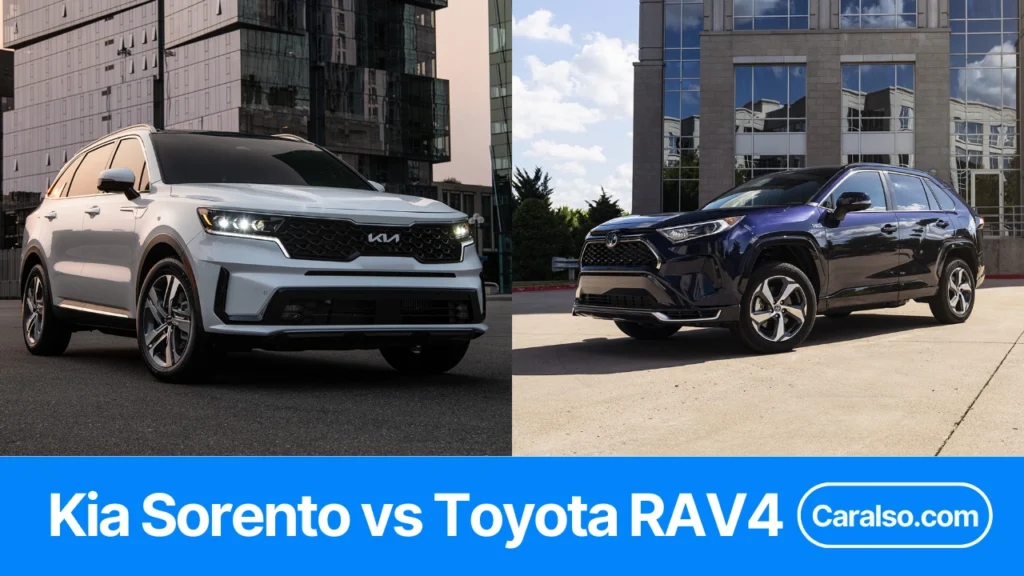
Kia Sorento Vs Toyota RAV4
Quick Verdict Box
| If You Care Most About | I Would Buy | The Number That Decides It |
|---|---|---|
| Third Row Seating | Sorento | 3 rows vs 2 rows |
| Cargo With All Seats Up | RAV4 | 37.6 cu ft vs 12.6 cu ft |
| Best City Commuter MPG | RAV4 | Up to 47 city mpg listed |
| Plug-In Electric Range | RAV4 Plug-in Hybrid | Up to 52 miles vs 31 miles |
| Max Towing | Sorento | Up to 4,500 lb vs up to 3,500 lb |
| Parking And Garage Fit | RAV4 | 180.9 in length vs 189.6 in |
Hero Asset Decision Table
I use this table when I help friends choose in 2 minutes.
| If You Care About This | I Would Buy | The Number That Decides It |
|---|---|---|
| Lowest Running Costs | RAV4 | Up to an estimated 47 city and 40 highway mpg |
| Third-Row Seating | Sorento | 3 rows, 6 to 7 seats |
| Cargo With Seats In Place | RAV4 | 37.8 cu ft vs 12.6 cu ft |
| Cargo With The 3rd Row Folded | Sorento | 38.5 to 45.0 cu ft behind the second row |
| Hybrid Value | RAV4 | Up to 47 city and 40 highway mpg vs Sorento Hybrid up to 37 mpg combined (FWD) |
| Plug-In Value (Only If You Can Charge) | RAV4 Plug-In Hybrid | Up to a 52-mile manufacturer-estimated EV range vs 31 miles (EPA-est) |
| Towing Needs | Sorento | Up to 4,500 lb vs up to 3,500 lb |
| Warranty Length Priority | Sorento | 10 years or 100,000 miles powertrain vs 5 years or 60,000 miles powertrain |
| Resale Priority | RAV4 | 5-year depreciation projection: 28% vs 57% |
Quick note I always add.
The Sorento is bigger. It is doing more jobs. That can mean more fuel and more tires over time.
Key Differences In 30 Seconds
These SUVs Are Not The Same Size Class
This is a compact 2-row vs a midsize 3-row.
Here are the numbers that make it real.
| Measurement | RAV4 | Sorento |
|---|---|---|
| Length | 180.9 in | 189.6 in |
| Seating | 5 | 6 to 7 |
| Cargo With Seats In Place | 37.8 cu ft | 12.6 cu ft |
| Cargo Behind The Second Row | 37.8 cu ft | 38.5 to 45.0 cu ft |
What that means day to day.
- The RAV4 is easier to park. It is 8.7 inches shorter.
- The Sorento can carry more people. But you pay for it in cargo when all seats are up.
- If you actually use the third row, you will be packing smarter. That 12.6 cu ft fills fast.
Who Each SUV Is Built For
I think of the RAV4 as an efficiency-first tool.
- You get 2 rows and 5 seats.
- You get up to 37.8 cu ft of cargo behind row 2.
- You get up to an estimated 47 city and 40 highway mpg listed.
- You get up to 3,500 lb of towing listed.
I think of the Sorento as a flexibility-first family hauler.
- You can seat 6 or 7.
- You get 12.6 cu ft of cargo behind row 3 with all seats up.
- You get 38.5 to 45.0 cu ft behind row 2 with the third row folded.
- You can tow up to 4,500 lb on the right trim.
- You get a 10-year or 100,000-mile powertrain warranty.
If you need seats more than you need cargo, I lean Sorento.
If you need cargo more than you need seats, I lean RAV4.
Price And Trim Strategy
Most comparisons fall apart because they match the wrong trims.
I match these SUVs by job first. Then by budget. Then by powertrain.
Trim Equivalency Map (The Fix For Bad Comparisons)
Here’s how I line them up when I want a fair fight.
| Budget Band | RAV4 Trim I’d Compare | MSRP Starting Point | Sorento Trim I’d Compare | MSRP Starting Point |
|---|---|---|---|---|
| Around $35k | LE AWD or SE FWD | $33,300 or $34,700 | S | About $36,535 |
| Around $45k | Woodland AWD or XSE AWD | $39,900 or $41,300 | SX or X-Line EX | About $43,535 or $44,035 |
| Around $55k | RAV4 Plug-In Hybrid (if priced and available) | Varies | Sorento Plug-In Hybrid EX AWD | $48,290 |
One more thing.
Destination and dealer add-ons can swing the real number by a few thousand. That is why I start with MSRP bands, then I shop actual out-the-door quotes.
What Not To Compare
These are the comparisons that look good on a chart and feel bad in real life.
- Gas Sorento vs Hybrid RAV4
The 2026 RAV4 lineup is hybrid-only. If you compare it to the Sorento’s base gas engine, you are really comparing fuel strategies, not just SUVs. - FWD vs AWD without noticing it
On the RAV4, AWD is a $1,400 step up on the trims that offer both. Same trim name. Different price. Different towing rating. - Small wheels vs big wheels
Wheel and tire sizes change ride and noise more than people expect.
On the Sorento, the spread is big. 235/65R17 on the smaller setup. 255/45R20 on the 20-inch setup.
If you want one clean rule from me.
Compare AWD to AWD. And compare the wheel size you will actually buy.
Here is my quick “good vs bad” chart.
| Don’t Do This | Do This Instead |
|---|---|
| Sorento LX gas vs RAV4 SE | Sorento Hybrid vs RAV4 SE |
| Sorento FWD vs RAV4 AWD | AWD vs AWD |
| Sorento 20-inch wheels vs RAV4 17-inch wheels | Same wheel size range if possible |
Best Value Picks (One Per Brand)
These are the trims I keep coming back to when friends ask me what to buy.
RAV4 Best Value Pick
XLE Premium.
It is the trim Edmunds calls the best value. It sits in the middle of the lineup. You avoid base-trim compromises without paying Limited money.
Sorento Best Value Pick
EX.
Edmunds recommends the EX because it gets you into the stronger turbo option territory and unlocks the feature set most people actually use.
Sorento Hybrid Best Value Pick
EX.
It is the clean entry point into the hybrid range and MPG story. If you want AWD, make sure you pick the EX AWD configuration.
Sorento Plug-In Hybrid Best Value Pick
EX AWD.
Edmunds recommends the EX here too. You get the plug-in range without jumping straight to the top trim pricing.
My practical tip.
If you are shopping Sorento for the third row, price a trim with the features that make it easier to use. Power liftgate, parking sensors, and a camera system matter more on a longer SUV.
Space And Everyday Practicality
This is where these two split hard.
The RAV4 is a 2-row with a big cargo area behind the second row.
The Sorento can seat 6 to 7, but the third row eats cargo fast.
Seating And Third-Row Reality Check
I look at 1 number first. Third-row legroom.
Sorento third-row legroom is 29.6 inches.
That is kid space. Not adult space.
Second row is the Sorento’s sweet spot.
Second-row legroom is 41.7 inches.
RAV4 is simpler.
It is 5 seats only. No third row to squeeze into.
Now the car seat scenario that catches families off guard.
Two car seats plus third-row access
If you put 2 car seats in the Sorento’s second row, third-row access depends on your setup.
- Bench second row: you are often tilting and sliding one side. That works best with 1 car seat, not 2.
- Captain’s chairs: access is easier through the middle. But you drop to 6 seats.
If you truly need 7 seats often, I plan on the bench.
If you need easy third-row access, I plan on captain’s chairs and accept 6 seats.
Cargo That Matters (Not Just A Spec Sheet)
Cargo numbers make the real story obvious.
RAV4 cargo behind the second row is 37.8 cu ft.
Sorento cargo behind the third row is 12.6 cu ft.
Sorento cargo behind the second row is 38.5 to 45.0 cu ft.
Here is how that plays out in real errands.
| Real Life Scenario | RAV4 Outcome | Sorento Outcome |
|---|---|---|
| 7 Passengers And Luggage | Not possible | Works, but 12.6 cu ft fills fast |
| 5 Passengers And Stroller | Easy. 37.8 cu ft behind row 2 | Works with row 3 folded. Tight if row 3 is up |
| 2 Passengers And Big-Box Run | Easy. Wide cargo area and 70.4 cu ft max | Best-in-class when you fold seats. 75.5 cu ft max |
My rule of thumb.
- If you regularly carry 5 people and gear, the RAV4 is effortless.
- If you regularly carry 6 to 7 people, the Sorento is the right tool, but you will be packing smarter.
Family Fit Test (Differentiator)
This is the 5-minute test I do at the dealer. I do not skip it.
- Rear-Facing Car Seat Behind A Tall Driver
- Set the driver seat where you actually drive.
- Install the rear-facing seat behind it.
- Check if the seat touches. Check if the front seat can still recline one notch.
- Stroller Load Test
- Open the cargo area.
- Drop the stroller in without removing wheels.
- Close the hatch without playing Tetris.
If the Sorento’s third row is up, this test gets real fast.
- Third-Row Access With A Car Seat Installed
- Put a car seat on the passenger-side second row.
- Try to get to the third row like a real kid would.
- Time it.
If it takes more than 10 seconds and you have to move a car seat, you will hate it in month 2.
One last everyday detail.
The Sorento is 189.6 inches long. The RAV4 is 180.9 inches long.
That is an 8.7-inch difference you feel in tight parking lots.
Powertrains (Matchups People Actually Search)
This is the section I wish every comparison started with.
Because your fuel bill and your towing limit are decided right here.
Sorento Gas Vs RAV4 (Gas Or Hybrid Depending On Model Year)
If you are shopping new, the 2026 RAV4 is hybrid-only.
There is no gas-only 2026 RAV4.
So if you want a simple gas SUV, your real comparison is this:
- New Sorento gas vs used RAV4 gas (2025 or older)
- New Sorento gas vs new RAV4 hybrid
Here are the engine numbers on the Sorento side.
| Sorento Powertrain | Output |
|---|---|
| 2.5L Gas | 191 hp, 195 lb-ft |
| 2.5L Turbo Gas | 281 hp, 312 lb-ft |
Transmission matters too.
- The 191 hp Sorento uses an 8-speed automatic.
- The 281 hp Sorento uses an 8-speed dual-clutch.
My take:
If you want quick passing power without going hybrid, the 281 hp Sorento is the one people feel on day 1.
If you want lower complexity and lower buy-in, the 191 hp Sorento is the entry point.
Sorento Hybrid Vs RAV4 Hybrid
This is the most common search matchup.
And it is the cleanest comparison.
Here are the numbers that decide it.
| Hybrid Model | System Output | MPG Snapshot |
|---|---|---|
| RAV4 Hybrid (2026) | 226 hp (FWD) or 236 hp (AWD) | Up to 47 city and 40 hwy |
| Sorento Hybrid (2026) | 227 hp | 34 mpg combined (some trims) and up to 37 mpg combined (EX FWD) |
How they feel is different.
- Sorento Hybrid uses a turbo 1.6 and a 6-speed automatic.
- RAV4 Hybrid uses an eCVT-style setup.
In real driving, I notice this:
Sorento Hybrid
- It feels more “geared.”
- You can feel the shifts under load.
- The turbo helps at highway speeds.
RAV4 Hybrid
- It feels more “smooth pull.”
- The power delivery is consistent.
- It is usually the easier MPG win in mixed driving.
If you drive 70 mph on the highway for hours, the Sorento Hybrid can feel more conventional.
If you do stop-and-go commuting, the RAV4 Hybrid usually has the MPG advantage.
Sorento Plug-In Hybrid Vs RAV4 Plug-In Hybrid (Prime-Style)
This is where I get blunt with friends.
Plug-ins only make sense if you can charge at home or at work.
If you cannot, buy the regular hybrid and move on.
Now the numbers.
| Plug-In Model | System Output | Electric Range | Level 2 Charge Time |
|---|---|---|---|
| Sorento Plug-In Hybrid | 261 hp | 31 miles (EPA-est) | 3.4 hours (240V) |
| RAV4 Plug-In Hybrid | Up to 320 hp | Up to 52 miles (manufacturer est) | 11 kW Level 2 on some trims |
The RAV4 Plug-In Hybrid also has a big trick for road trips.
Some trims use a CCS port and support DC fast charging.
Toyota has said 10% to 80% can be around 30 to 35 minutes at a compatible station.
My real-world use case rule:
- If your daily drive is 10 to 25 miles and you can charge nightly, both plug-ins can slash fuel use.
- If your daily drive is 30 to 45 miles, the RAV4 Plug-In Hybrid range advantage is hard to ignore.
- If you do not charge, you are carrying a heavier battery for no reason.
Towing And AWD Comparison (If You Tow, Read This First)
I treat towing as a yes or no question.
If you tow, I shop towing first.
Here’s the simple chart.
| Model | Max Towing | The Catch |
|---|---|---|
| RAV4 (2026) | Up to 3,500 lb | Check trim and equipment |
| Sorento Gas | Up to 4,500 lb | Only on specific trim |
| Sorento Hybrid | 2,000 lb | Hybrid trims cap lower |
| Sorento Plug-In Hybrid | 2,000 lb | Plug-in trims cap lower |
Now AWD intent.
RAV4
- AWD is about traction and stability.
- It is also the way Toyota gets the 236 hp setup.
Sorento
- AWD is available across more trims.
- The plug-in version adds off-road style features like a center locking function and terrain modes.
My quick decision rule:
- If you tow over 3,500 lb, I shop Sorento gas.
- If you tow 2,000 lb and want 3 rows, I shop Sorento Hybrid or Plug-In Hybrid.
- If you want efficiency and you tow a small trailer, I shop RAV4.
Ride Comfort, Noise, And Road Trip Fatigue
I do not judge comfort on a 10-minute test drive in city traffic.
I judge it at 70 mph and after 90 minutes.
This is what I pay attention to.
- Tire noise
- Seat pressure points
- Low-speed jitter over broken pavement
Edmunds nails a key point on the Sorento.
They felt low-speed jitters, and they called out 20-inch wheels as a possible cause.
Edmunds also calls out the RAV4 for seats that lack comfort on long drives and a ride that is not as smooth over bumps as rivals.
So I treat both like this:
The wheel and tire package can make or break the experience.
5-Minute Test Drive Script (Differentiator)
I do this same loop every time.
0 To 30 MPH On Rough Pavement
I am looking for 2 things.
- Does the suspension “jitter” over small bumps?
- Do I feel sharp impacts through the seat bottom?
If you are in a Sorento on 20-inch wheels, pay attention here.
That setup can transmit more small-bump vibration.
50 To 70 MPH On Concrete Highway
I do 3 checks.
- Tire hum
- Wind noise around mirrors
- Conversation volume
If I have to raise my voice, I score it down.
Low-Speed Parking And Steering Effort
I do one tight U-turn and one reverse park.
- Is steering light enough to park without effort?
- Does the SUV feel “big” at the nose?
- Do the brakes feel smooth at 3 mph?
This is where the RAV4 size advantage shows up.
It is 180.9 inches long.
The Sorento is 189.6 inches long.
Tire Size Effect On Noise And Ride
Here’s the tire sidewall math I use.
Sorento tire examples from the spec sheet:
- 235/65R17
- 255/45R20
That is a big sidewall difference.
More sidewall usually means more bump absorption.
Less sidewall usually means more impact feel and more tire noise on rough surfaces.
My rule:
If you care about comfort, I pick the smallest wheel I can live with.
What Usually Makes The Bigger Difference Than Horsepower
Horsepower sells cars.
Comfort keeps you happy after month 2.
These are the 3 things that decide road-trip fatigue for me.
Seat Comfort After 90 Minutes
I do a simple test.
- Set the seat where I drive.
- Drive 20 minutes.
- Stop.
- If I want to adjust the seat right away, that is a sign.
Edmunds calls out RAV4 long-drive seat comfort as a weak point.
So I take extra time here when I test one.
Cabin Noise At 70 MPH
I bring my phone and do one thing.
- I play a podcast at volume 12.
- I hold 70 mph.
- If I need volume 16, it is a noisier cabin.
Short. Repeatable. No guessing.
Wheel And Tire Package Choice
I treat this as a money decision.
Bigger wheels can cost more later too.
Tires in 20-inch sizes usually cost more than 17-inch sizes.
So I ask myself:
- Do I want the look, or do I want the ride?
Most of the time, I want the ride.
Tech And Safety
I treat tech and safety like daily-use hardware. If the screen lags, if the camera is grainy, or if lane centering ping-pongs, I feel it every single drive.
Here is what I look at first on the Sorento vs RAV4.
Infotainment And Phone Integration
I break this into 3 questions. Screen size, phone connection, and charging.
Sorento (Gas Models)
- Touchscreen: 12.3-inch system is standard across the lineup. LX and S get a 12.3-inch touchscreen radio. EX and up add 12.3-inch navigation.
- Phone: Wireless Android Auto and wireless Apple CarPlay are listed as standard.
- Charging: A wireless phone charger is not standard on the base LX. It shows up from S and up.
- Audio: Bose is not standard. It shows as optional on EX, and standard on SX and SX Prestige.
RAV4 (New Generation Tech)
- Touchscreen: Toyota lists a 10.5-inch touchscreen as standard, with a 12.9-inch upgrade available.
- Phone: Toyota’s latest system supports wireless Apple CarPlay and wireless Android Auto.
- Charging: Wireless charging availability depends on trim, like most brands.
- Bonus Tech: Toyota is also leaning into built-in apps and a more modern voice assistant in its newest infotainment setup.
Don’t Overpay Trim Notes
- If you only care about wireless CarPlay and a big screen, the Sorento gives you 12.3 inches without forcing you into top trims.
- If you care about a 360 camera and the best parking aids, the Sorento tends to gate the full camera suite higher up the trim walk.
- On the RAV4, I expect the bigger 12.9-inch screen and the fanciest camera and parking features to live on upper trims. That has been Toyota’s pattern, and the launch info points the same way.
Driver Assist Systems That Matter Daily
I care about 3 things. Adaptive cruise smoothness, lane centering behavior, and blind spot logic.
Sorento Drive Wise Highlights
- Smart Cruise Control with Stop and Go is standard on the trims Kia lists.
- Lane Following Assist is standard, which is Kia’s lane-centering style feature.
- Forward Collision-Avoidance Assist with junction turning support is standard.
- Blind Spot Collision Warning is standard. Blind Spot Collision-Avoidance shows up higher in the trim stack.
- Highway Driving Assist becomes available as you move up. Highway Driving Assist 2 with automatic lane change shows up on the upper trims.
RAV4 Toyota Safety Sense Highlights
Toyota’s newest RAV4 is built around Toyota Safety Sense 4.0. The core daily-use pieces are there.
- Dynamic Radar Cruise Control
- Lane Departure Alert with steering assist
- Lane Tracing Assist
- Pre-Collision System with pedestrian detection
- Road Sign Assist
- Automatic High Beams
- Proactive Driving Assist
My Real-World Take On This Stuff
- If you want the most “hands-on but relaxed” highway feel, I usually like systems that combine solid adaptive cruise with confident lane centering. The Sorento clearly advertises that lane-following lane-centering feature on every trim.
- Toyota’s lane tracing and radar cruise combo has been consistent for years. With Safety Sense 4.0, the feature set reads strong on paper. I still test drive it on a road with gentle curves, because tuning matters more than the checklist.
Safety Ratings And Crash Tech
This is the part where I stop guessing and check the latest test pages.
IIHS
- The 2026 Kia Sorento shows up as a Top Safety Pick+ winner, with the note that it applies only to vehicles built after September 2025.
- The 2026 Toyota RAV4 has IIHS test results posted, and one of the big headline items is the updated moderate overlap front test showing a marginal overall evaluation on the page.
NHTSA
NHTSA star ratings can vary by configuration and model year. So I do not assume.
I check the NHTSA ratings page for the exact year and drivetrain I am buying. Then I check recalls by VIN before I sign anything.
Reliability, Warranty, And Ownership Costs
I split ownership into 3 buckets. Warranty coverage, wear items, and fuel cost.
Warranty Differences
Kia’s Warranty Advantage
- 10-year or 100,000-mile powertrain limited warranty
- 5-year or 60,000-mile basic limited warranty
- 5-year or 60,000-mile roadside assistance
Toyota’s Real-World Ownership Strengths
Toyota’s factory warranty structure is typically shorter than Kia’s on paper, but Toyota leans on two things in the real world.
- Hybrid battery coverage is strong on modern Toyota hybrids. Toyota states 10 years or 150,000 miles for the hybrid battery on 2020+ model years.
- Toyota also has broad dealer coverage and a very deep independent shop ecosystem. That matters when you are 7 years in and just want normal service done fast.
Toyota clearly markets ToyotaCare style maintenance plans, but the exact inclusions can vary by model and region. I always confirm what’s included on the buyer’s order.
Maintenance And Wear Items
Tires
This is where trims quietly change your budget.
- Sorento wheel sizes run from 17-inch up to 20-inch depending on trim.
- Bigger wheels usually mean higher tire prices, fewer budget tire options, and more risk of sidewall damage on potholes.
My rough rule: If you can stay on 17s or 18s, you usually save money every time tires come due.
Brakes
Hybrids usually save you money here.
- Hybrid regen braking can reduce pad wear in stop-and-go driving.
- The flip side is rotor rust can happen faster if the friction brakes do less work. I do a few firm stops once in a while, especially after rain.
Powertrain Complexity And Service Habits
- Sorento’s turbo trims use a dual-clutch transmission. I drive it gently until it warms up, and I follow fluid service intervals closely.
- The RAV4 Hybrid uses Toyota’s hybrid system with an eCVT-style setup. It is simple to live with. It is one of the reasons I recommend the RAV4 Hybrid so often for long ownership.
Fuel Cost Calculator
Assumptions I Am Using
- Gas price: $3.50 per gallon
- Annual miles: 12,000 and 15,000
- MPG: Combined ratings or commonly listed combined figures for the configuration noted
Fuel Cost Table
| Model And Setup (Typical Shopper Pick) | Combined MPG | 12k Miles Gal Per Year | 12k Fuel Cost | 15k Miles Gal Per Year | 15k Fuel Cost |
|---|---|---|---|---|---|
| Sorento 2.5T AWD | 23 | 521.7 | $1,826 | 652.2 | $2,283 |
| Sorento Hybrid AWD | 34 | 352.9 | $1,235 | 441.2 | $1,544 |
| RAV4 Hybrid AWD | 42 | 285.7 | $1,000 | 357.1 | $1,250 |
What This Table Usually Tells People Fast
- If you are choosing between Sorento turbo AWD and RAV4 Hybrid AWD, the RAV4 Hybrid can save about $826 per year at 12,000 miles in this simple scenario.
- If you want three rows often, the Sorento Hybrid narrows the gap a lot versus the turbo Sorento.
Plug-In Scenario With Home Charging
I do plug-ins with one question: How many miles can you cover on electricity most days?
- Toyota’s newest RAV4 Plug-in Hybrid is advertised with up to 50 miles of all-electric range, plus fast charging details for certain trims. That range number can cover many commutes without gas.
- The Sorento Plug-in Hybrid is commonly listed around a low 30-mile EV range, with MPGe around the high 70s on the listings that most shoppers see.
A Simple Example (Sorento PHEV Style Math)
Assumptions
- 12,000 miles per year
- 60% of miles on electricity
- Electricity price: $0.17 per kWh
- MPGe example: 79 MPGe translates to about 42.7 kWh per 100 miles
Result
- Electric cost for 7,200 miles: about $522 per year
- Gas cost for 4,800 miles at 34 mpg: about $494 per year
- Total energy cost: about $1,016 per year
If you can charge daily and you have a longer EV range, your “electric miles share” usually goes up. That is the hidden value of the RAV4 Plug-in Hybrid’s bigger EV range claim.
Recalls And How To Check Your VIN
This is my before-you-buy routine, new or used.
- Find the VIN on the lower windshield or the driver door label.
- Run it through the NHTSA recall lookup.
- Screenshot the results and save them.
- If there is an open recall, ask the dealer to complete it before delivery.
- If you are buying used, ask for service records that show recall completion and campaign work.
If a seller acts weird about a VIN check, I walk.
Resale Value And Depreciation
Depreciation is usually the biggest cost of ownership. Not fuel. Not tires.
Here is the clean reality, using two common data sources.
| Model | 5-Year Depreciation | 5-Year Resale Value |
|---|---|---|
| Toyota RAV4 | 28% to 30.3% | $20,398 to $27,315 |
| Kia Sorento | 52.3% to 57% | $15,272 to $18,544 |
That gap matters even if the window stickers look close on day 1.
Why Resale Can Decide The True Cost
I like converting depreciation into a monthly number. It makes the decision simple.
CarEdge also estimates the 5-year depreciation dollars for both models.
- RAV4: $10,377 over 5 years
- Sorento: $24,884 over 5 years
Here is what that looks like per month.
| Model | 5-Year Depreciation Dollars | Monthly Depreciation (60 Months) |
|---|---|---|
| Toyota RAV4 | $10,377 | $173 |
| Kia Sorento | $24,884 | $415 |
That is a $242 per month swing in depreciation alone.
That is why resale can beat MSRP in the real math.
Which Trims And Powertrains Tend To Hold Value Better
I do not guess here. I look for patterns in the data.
RAV4
The RAV4 and RAV4 Hybrid depreciation rates are basically the same in iSeeCars data. About 30% after 5 years.
So I do not buy the hybrid expecting a resale jackpot. I buy it for fuel savings and daily drivability.
Sorento
iSeeCars shows the Sorento Plug-In Hybrid depreciating at about 53% after 5 years, which is very close to the standard Sorento at 52.3%.
So I do not buy the plug-in expecting it to hold value better. I buy it if I can actually use the EV miles.
My real-world rule for both brands is simple.
- Pick the trim that buyers want used.
- Avoid weird configurations that shrink the buyer pool.
- If you plan to sell in 3 to 5 years, prioritize the trims that match how most people shop: popular colors, common wheel sizes, and mainstream options.
Which One Should You Pick? (Final Decision Framework)
I pick based on your weekly routine. Not your best-case scenario.
Buy The RAV4 If
- You do not need a third row. You want 5 seats, period.
- You want more cargo with the seats in place. It is 37.8 cu ft behind row 2.
- You want better fuel numbers. Toyota lists up to 47 city and 40 highway mpg.
- You want lower depreciation risk. Data sources show about 28% to 30% at 5 years.
- You tow 3,500 lb or less.
- You park in tight places often. It is 180.9 inches long.
- You want a simpler “new only” shopping process. The RAV4 is hybrid-only for 2026.
Buy The Sorento If
- You need a third row sometimes. Even if it is 2 weekends a month.
- You want 6 to 7 seats in one vehicle.
- You tow more than 3,500 lb and you are shopping gas trims. Kia lists up to 4,500 lb on a specific trim.
- You want more second-row room for passengers. Second-row legroom is 41.7 inches.
- You want the longer powertrain warranty. It is 10 years or 100,000 miles.
- You want more powertrain choice. Gas, turbo, hybrid, plug-in hybrid.
- You want the extra length for passenger comfort and you have the parking space. It is 189.6 inches long.
My One Test Drive Checklist
I do this same checklist for both SUVs. It saves me from buyer’s remorse.
- Parking Reality Check
Pull into a tight spot. Back in. See which one fits your life. - Third-Row Reality Check (Sorento)
Sit in row 3 for 2 minutes. Measure comfort with 29.6 inches of legroom in mind. - Car Seat Test
Put a rear-facing seat behind the driver position you actually use. - Cargo Test
Load 1 stroller and 1 big suitcase. Close the hatch without forcing it. - Row 3 Up Cargo Test (Sorento)
Try the same cargo with row 3 up. You are working with 12.6 cu ft. - Highway Noise Test
Drive 70 mph on concrete for 3 minutes. Talk at normal volume. - Seat Comfort Test
After 20 minutes, ask yourself if you want to adjust the seat. - Driver Assist Feel
Turn on adaptive cruise and lane centering. See if it is smooth or twitchy. - Acceleration Feel
Do one 40 to 70 mph pass. That is your real “daily power” test. - Wheel And Tire Check
Look at the tire size on the door jamb. If it is 255/45R20, plan for higher tire costs than 235/65R17.
FAQs
Is The Kia Sorento Bigger Than The Toyota RAV4?
Yes.
- Sorento length: 189.6 inches
- RAV4 length: 180.9 inches
- Sorento seating: 6 to 7
- RAV4 seating: 5
If you have a tight garage or a short parking spot, that 8.7-inch difference shows up fast.
Does The Sorento Third Row Work For Adults?
Not for most adults.
Third-row legroom is 29.6 inches.
I treat that as kid space or short trips.
If you want adults in row 3 often, I would be looking at a larger 3-row than Sorento.
Which Is Better On Gas, Sorento Or RAV4?
If you are buying new, I lean RAV4.
The 2026 RAV4 is hybrid-only, and Toyota lists up to 47 city and 40 highway mpg.
The Sorento has gas and turbo gas options, and MPG depends a lot on engine and AWD.
If you want the best fuel spend for commuting, RAV4 Hybrid is the easy answer.
If you need 3 rows, Sorento Hybrid is the “fuel-aware” Sorento pick.
Sorento Hybrid Vs RAV4 Hybrid: Which Should I Buy?
I buy the RAV4 Hybrid if you want the best MPG per dollar.
- RAV4 Hybrid: up to 47 city and 40 highway mpg listed
- Sorento Hybrid: 34 mpg combined is a common headline, and some trims show up to 37 mpg combined (EX FWD)
I buy the Sorento Hybrid if you need the bigger cabin and extra seats.
You are trading MPG for space.
Sorento PHEV Vs RAV4 Plug-In Hybrid: Which Saves More Money?
It depends on charging.
If you can charge nightly, a plug-in can cut gas use a lot.
The EV range numbers tell you how many daily miles you can cover without gas.
- Sorento Plug-In Hybrid: 31 miles EV range (EPA-est)
- RAV4 Plug-In Hybrid: up to 52 miles EV range (manufacturer-est)
My rule: the plug-in with more EV range usually saves more fuel, if you actually plug in.
If you cannot charge at home or work, I would buy the regular hybrid instead.
Which One Is More Reliable Long Term?
If I’m keeping it 8 to 10 years, I lean RAV4.
Toyota’s hybrid system has a long track record, and the RAV4 resale trends are stronger.
Kia’s big advantage is warranty length on paper.
If you want the longest powertrain warranty, Sorento wins at 10 years or 100,000 miles.
If you want the safer “sell it later” bet, I lean RAV4.
Which One Tows More?
Sorento gas trims tow more.
- Sorento gas: up to 4,500 lb on specific trims
- RAV4: up to 3,500 lb
- Sorento Hybrid: 2,000 lb
- Sorento Plug-In Hybrid: 2,000 lb
If you tow over 3,500 lb, I shop Sorento gas first.
Sources
- Toyota RAV4 (Specs, MPG, Cargo, Towing)
- Kia Sorento (MSRP, Trim Highlights)
- Edmunds: Toyota RAV4 (Model Review)
- Cars.com: 2026 Kia Sorento Overview And Pricing
- IIHS: 2026 Toyota RAV4 Ratings
- CarEdge: Kia Sorento 5-Year Costs

Hey there,
How is it going?
I’m Meraj Sarker. I am a Car Mechanic and a student of Automobile Restoration here in Florida, USA. I’ve been studying automotive for around 9 years now. So you can rely on my recommendation. For me, studying and getting knowledge about automobile it’s really fun and entertaining. I will help you to get solutions for your car through this website. If you need any help let me know.