
If I’m choosing between a Hyundai Santa Fe vs Toyota RAV4, I start with one question. Do you need 3 rows even sometimes?
If you do, I point you to the Santa Fe. It offers 3-row seating, with 7 seats in the standard layout (or 6 with second-row captain’s chairs). If you do not, I lean RAV4. The redesigned 2026 RAV4 is hybrid-only, and it targets low fuel spend and strong resale.
The rest of this guide is about picking the right tool for your life. Not the “nicer” badge.
Quick Answer (Best Pick In 30 Seconds)
Best For Families Who Need 3 Rows
Pick the Santa Fe.
It has a third row. It is not huge, but it is real. Third-row legroom is 30 inches, and cargo behind the third row is 14.6 cubic feet. That is enough for day-to-day kid duty and short trips, not a full family road-trip load with all seats up.
Best For Lowest Fuel Spend
Pick the RAV4.
For 2026, every RAV4 is a hybrid (or plug-in hybrid). The hybrid is rated up to 44 mpg combined in front-wheel drive trims. A Santa Fe Hybrid is rated 34 mpg combined.
Best For Long-Term Resale
Pick the RAV4.
If resale is your top priority, the RAV4 has the numbers to back up the reputation. One large depreciation study puts the RAV4 at 69.7% value retained after 5 years in the small and compact SUV segment.
If You Only Read One Thing
If you do not need a third row, I would buy the RAV4 and spend the savings on better tires and a good set of floor mats. If you need 3 rows even 10% of the time, I would start with the Santa Fe and accept that the third row is a kids-first space.
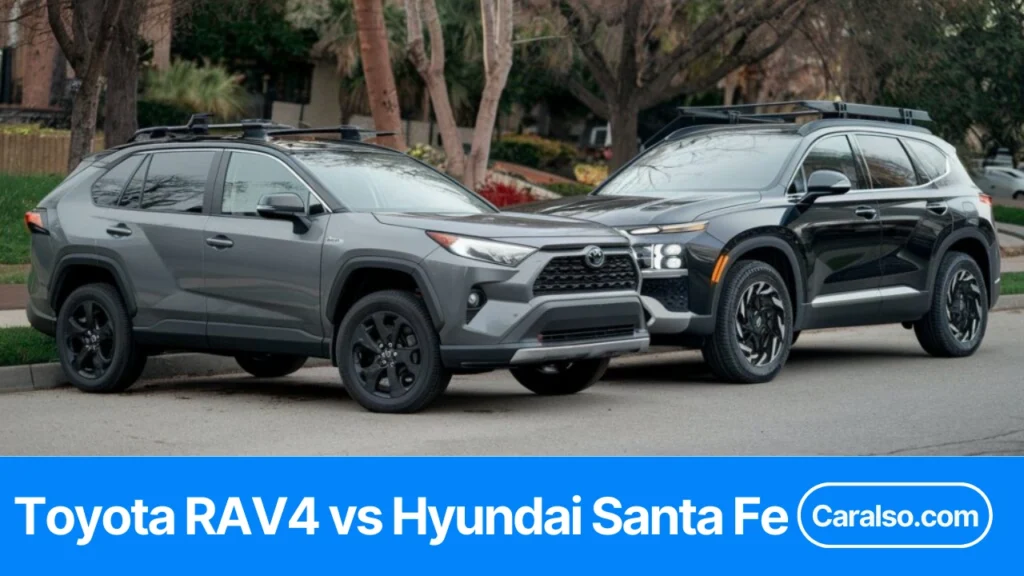
Hyundai Santa Fe Vs Toyota RAV4
Hero Asset: Santa Fe Vs RAV4 Snapshot Table
| Decision Factor | 2026 Hyundai Santa Fe | 2026 Toyota RAV4 |
|---|---|---|
| Class | Bigger 3-row option | Compact 2-row |
| Starting Price Band (MSRP) | $36,400 (gas) to $50,050 (hybrid) | $31,900 (Hybrid FWD) and up |
| Powertrains Offered | Gas (2.5L), Gas Turbo (2.5T), Hybrid (turbo 1.6L) | Hybrid, Plug-In Hybrid |
| MPG Headline (Hybrid Vs Hybrid) | 36 MPG combined (FWD) or 34 MPG combined (AWD) | Up to 44 MPG combined (FWD, manufacturer estimate) |
| Seating Capacity | 7 standard, 6 with captain’s chairs | 5 |
| Cargo Behind 2nd Row | 40.5 cu ft | 37.8 cu ft |
| Cargo Behind 3rd Row | 14.6 cu ft | Not applicable |
| Towing Headline | Up to 3,500 lb (most trims). Up to 4,500 lb (XRT) | 1,750 lb to 3,500 lb depending on grade and AWD |
| Warranty Headline | 5 yr or 60,000 mi basic. 10 yr or 100,000 mi powertrain | 3 yr or 36,000 mi basic. 5 yr or 60,000 mi powertrain. 10 yr or 150,000 mi hybrid battery |
Segment Reality Check (This Is Why People Get Confused)
If You Need A Third Row, The Decision Is Easy
I buy the Santa Fe.
The RAV4 is a 2-row SUV. It seats 5. That is it.
The Santa Fe gives you a real third row option. It is best for kids and shorter adults. But it solves the “extra seat” problem on school runs.
Here is the number that keeps me honest. Cargo behind the Santa Fe third row is 14.6 cu ft. That means you pack lighter when all 3 rows are up.
So I use this simple rule.
If you need 6 or 7 seats even 2 times per month, start with Santa Fe.
If You Want Compact Size And Hybrid-Only, The Decision Is Easy
I buy the RAV4.
It is shorter. Santa Fe is 190.2 inches long. RAV4 is 181.0 inches long. That 9.2-inch gap matters in tight garages and parking lots.
For 2026, the RAV4 is also electrified only. Hybrid or plug-in hybrid. No gas-only version.
So if you want a smaller footprint and you want hybrid standard, RAV4 is the clean pick.
One more practical note.
If you never use a third row, you are hauling extra vehicle every day for no benefit. I would rather keep the smaller SUV and spend money on tires and maintenance.
Stop Comparing The Wrong Versions (Fixes 80% Of Bad Advice)
2026 RAV4 Is Hybrid Only (What That Means For Price Comparisons)
If you compare a 2026 Santa Fe gas to a 2026 RAV4, you are not comparing the same thing.
For 2026, the RAV4 is hybrid by default. That means the “base price” already includes a hybrid system.
So when someone says, “Santa Fe starts cheaper,” I ask one follow-up question.
Are you comparing Santa Fe gas to RAV4 hybrid?
If yes, the price gap is partly powertrain, not brand value.
If you want an apples-to-apples fuel comparison, you need Santa Fe Hybrid vs RAV4 Hybrid.
Santa Fe Comes In Gas And Hybrid (Pick The Right One First)
Santa Fe is really two different buys.
- Santa Fe gas is the “bigger family SUV with towing” play.
- Santa Fe Hybrid is the “bigger family SUV with better MPG” play.
One more 2026 detail that matters.
Hyundai swapped the non-hybrid Santa Fe 2.5T from an 8-speed dual-clutch to an 8-speed torque-converter automatic for 2026.
So if you are reading older reviews, the transmission behavior can be different than what you will test-drive today.
The 60-Second “Apples To Apples” Rules
I use these rules every time. It keeps the comparison clean.
- Match The Model Year
Compare 2026 to 2026 if you are buying new. - Match The Job
Need 6 or 7 seats? Santa Fe.
Need compact size and a simpler parking footprint? RAV4. - Match The Powertrain
Santa Fe Hybrid vs RAV4 Hybrid is the clean comparison.
Santa Fe gas vs RAV4 hybrid is a budget and capability comparison, not a fuel comparison. - Match The Drivetrain
FWD vs AWD changes price and MPG. On both. - Match The Big Ticket Features
Panoramic roof. 360 camera. Premium audio. Second-row captain’s chairs. Tow hardware.
If it is not on the window sticker, I assume it is not included. - Match The Wheels
Bigger wheels usually mean higher tire cost and a firmer ride. That matters after 20,000 miles.
Trim Match Guide (Fastest Way To Compare Apples To Apples)
Santa Fe Trim Ladder (Gas Vs Hybrid Notes)
I like the Santa Fe lineup because the trims have clear roles.
Santa Fe Gas Trims And MSRPs
- SE: $35,050
The entry trim. I start here if budget matters and I still want 3 rows. - SEL: $37,590
The “balanced” trim. This is where most shoppers land. - XRT: $42,040
The rugged trim. It is the towing and ground-clearance play. It is rated up to 4,500 lb with trailer brakes. - Limited: $44,600
The comfort and tech trim. I look here when I want more premium features without going full top trim. - Calligraphy: $47,600
The top trim. I treat it as a luxury-focused family SUV.
Santa Fe Hybrid Trims And MSRPs
- SE Hybrid: $36,400
The lowest-cost way into a Santa Fe Hybrid. - SEL Hybrid: $38,690
The common hybrid sweet spot. - Limited Hybrid: $45,700
Hybrid plus premium equipment. - Calligraphy Hybrid: $48,700
Top-trim hybrid.
Quick Santa Fe Note I Always Make
If you want max towing, XRT is the trim that changes the number.
RAV4 Trim Ladder (Hybrid Standard)
For 2026, every RAV4 trim starts as a hybrid. That makes the ladder simple.
RAV4 Trims And Base MSRPs
- LE: $31,900
- SE: $34,700
- XLE Premium: $36,100
- Woodland: $39,900
- XSE: $41,300
- Limited: $43,300
Drivetrain Reality
- LE, SE, XLE Premium can be FWD or AWD.
- Woodland, XSE, Limited are AWD standard.
My quick rule
If you are comparing monthly payments, decide FWD vs AWD first. Then compare trims.
Trim Match Table (Your Differentiator)
This table is how I stop the “base vs loaded” trap fast.
| Santa Fe Trim | Closest RAV4 Trim | Price Band (MSRP) | Who It’s For | Must-Check Options |
|---|---|---|---|---|
| Santa Fe SE (Gas) | RAV4 SE | $35,050 vs $34,700 | You want the lowest price while staying in the mainstream trims | AWD choice, 360 camera, panoramic roof, tow hardware |
| Santa Fe SEL (Gas) | RAV4 XLE Premium | $37,590 vs $36,100 | You want comfort upgrades without going top-trim | Second-row layout, premium audio, parking sensors, powered liftgate |
| Santa Fe XRT (Gas) | RAV4 Woodland | $42,040 vs $39,900 | You want the rugged look and capability focus | Towing rating, tire type, roof rails, skid-style packaging details |
| Santa Fe Limited (Gas) | RAV4 Limited | $44,600 vs $43,300 | You want the premium daily driver experience | 360 camera, panoramic roof, premium audio, seat ventilation if available |
| Santa Fe Calligraphy (Gas) | RAV4 Limited | $47,600 vs $43,300 | You want the most upscale Santa Fe build and you accept the price gap | Captain’s chairs vs bench, leather grade, driver assist upgrades, camera package |
| Santa Fe SE Hybrid | RAV4 XLE Premium | $36,400 vs $36,100 | You want hybrid efficiency in a bigger body | FWD vs AWD, MPG difference, tow rating, wheel size |
| Santa Fe SEL Hybrid | RAV4 XLE Premium | $38,690 vs $36,100 | You want a feature-balanced hybrid family SUV | Panoramic roof, premium audio, 360 camera, second-row seating layout |
| Santa Fe Limited Hybrid | RAV4 Limited | $45,700 vs $43,300 | You want hybrid plus premium features without guessing | Full camera suite, seat heating and ventilation, tow equipment, tire cost |
| Santa Fe Calligraphy Hybrid | RAV4 Limited | $48,700 vs $43,300 | You want a top-trim hybrid and you plan to keep it | Warranty terms, resale expectations, battery coverage miles, tech options |
My honest summary
If you want compact size and hybrid standard, I keep you in the RAV4 trims.
If you want 3 rows, more cargo behind row two, and higher towing potential, I keep you in the Santa Fe trims.
Price And Value (Is The Hyundai Deal Real Or Not?)
This is the section where most comparisons go wrong.
Santa Fe and RAV4 do not start from the same baseline. Santa Fe is bigger and can seat 7. RAV4 is smaller and seats 5.
So I look at value in 3 price bands. Then I check which features are bundled.
Three Price Bands That Matter ($35k, $40k, $45k)
Around $35k
This is “get me the basics, no regrets” money.
What I can actually buy around here:
- Santa Fe SE (gas): $35,050 MSRP before freight.
- Santa Fe Hybrid SE: $36,400 MSRP before freight.
- RAV4 LE Hybrid FWD: Toyota announced $31,900 MSRP before dealer processing and handling.
How I decide in this band:
- If I need a third row even sometimes, I start with Santa Fe SE.
- If I do not, I start with RAV4 LE Hybrid and spend the leftover on good tires.
Around $40k
This is the danger zone. It is where “fake deals” happen.
Typical cross-shops I see:
- Santa Fe SEL (gas): $37,590 MSRP before freight.
- Santa Fe Hybrid SEL: $38,690 MSRP before freight.
- RAV4 SE Hybrid: $36,150 including destination per industry reporting.
- RAV4 XLE Premium Hybrid: $37,550 including destination per industry reporting.
My rule here:
If you want AWD, price it in first. AWD often adds cost and drops MPG. It also changes towing on the RAV4.
The other big rule:
If you care about camera tech, you might have to jump trims. That jump can be $5,000 fast.
Around $45k
This is where you are paying for the full feature stack.
What shows up here:
- Santa Fe Limited (gas): $44,600 MSRP before freight.
- Santa Fe Hybrid Limited: $45,700 MSRP before freight.
- RAV4 Limited Hybrid: $44,750 including destination per industry reporting.
My honest take:
At $45k, I stop pretending this is just about features.
This is where resale and fuel spend become the tie-breakers.
Packages That Create “Fake Deals”
Here is how people get tricked.
They compare a lower-trim Santa Fe on paper to a higher-trim RAV4 on the lot. Or the other way around. Then they say one is “overpriced.”
I watch for 5 items that swing price and daily satisfaction.
- Panoramic Roof
- This usually forces a trim jump or a package.
- It also adds repair complexity long-term.
- Premium Audio
- It is rarely a $300 add-on.
- It usually comes inside a bundle with other stuff you may not want.
- 360 Camera
- On Santa Fe, Surround View Monitor is standard on Limited and Calligraphy.
- That means a Santa Fe SEL on a dealer site might not have it, even if the photos look similar.
- Blind-Spot Camera View
- On Santa Fe, Blind-Spot View Monitor is also listed as standard on Limited and Calligraphy.
- If you want that feature, I do not waste time on lower trims.
- Driver Assist Upgrades
- Highway assist features can be standard, optional, or missing depending on trim and package.
- I test-drive it. I do not trust the brochure.
My shortcut:
I ask for the window sticker photo. Then I search the sticker for these words:
- Panoramic
- JBL or Bose
- Surround View
- View Monitor
- Assist
If it is not on the sticker, I assume it is not on the car.
Value Verdict Lists
Buy Santa Fe If:
- You need 6 or 7 seats.
- You want more cargo behind the second row. Santa Fe is listed at 40.5 cu ft behind row two.
- You tow and you want the higher rating on the gas trims. Most gas trims are rated 3,500 lb with trailer brakes. XRT is rated up to 4,500 lb with trailer brakes.
- You want the longer basic warranty and powertrain warranty coverage.
Buy RAV4 If:
- You want hybrid standard on every trim for 2026.
- You want lower fuel spend. Toyota says up to 44 mpg combined on the FWD hybrid.
- You want strong resale. It consistently shows up near the top in resale studies.
- You want the simplest shopping process. Every trim starts as a hybrid.
Fuel Economy And Powertrains (The Deciding Factor)
This is where the “which should I buy” answer usually becomes obvious.
I pick the powertrain first. Then I pick the trim.
Santa Fe Gas Vs Santa Fe Hybrid (What Changes)
Santa Fe Gas (2.5T)
- 277 hp.
- 311 lb-ft.
- 8-speed automatic for 2026.
- FWD standard. AWD available.
- Towing: 3,500 lb with trailer brakes on most trims. XRT is rated up to 4,500 lb with trailer brakes.
Santa Fe Hybrid (1.6T Hybrid)
- 231 hp combined.
- 6-speed automatic.
- FWD standard. AWD available.
- EPA estimate: 36 mpg combined (FWD) or 34 mpg combined (AWD).
- Towing: 2,000 lb.
One real-world note I pay attention to:
A long-term test on a Santa Fe Hybrid AWD averaged 27.3 mpg over about 20,000 miles. That is below the EPA estimate. It is still better than the gas version, but I would not buy it expecting 34 mpg every day.
My quick rule:
- If you tow over 2,000 lb, I do not buy the Santa Fe Hybrid.
- If I drive 12,000 miles per year or more and I do not tow heavy, I look hard at the Hybrid.
RAV4 Hybrid-Only Lineup (What You Get By Default)
For 2026, every RAV4 is electrified.
RAV4 Hybrid
- 226 hp (FWD).
- 236 hp (AWD).
- Toyota says up to 44 mpg combined on the FWD hybrid.
- Towing: 1,750 lb (FWD). Up to 3,500 lb (AWD).
RAV4 Plug-In Hybrid
- AWD standard.
- Up to 52 miles of all-electric range (manufacturer estimate).
- 324 hp combined (manufacturer figure).
- Pricing is coming later than the hybrids.
My simple takeaway:
Toyota made the base RAV4 the efficient one. You do not have to hunt for a hybrid trim. That matters.
Simple Fuel Cost Math Table (10k, 12k, 15k Miles Per Year)
Assumptions:
- Gas price: $3.50 per gallon
- MPG used:
- RAV4 Hybrid FWD: 44 mpg combined (manufacturer estimate)
- Santa Fe Hybrid AWD: 34 mpg combined (EPA estimate)
- Santa Fe Gas (typical non-XRT): 24 mpg combined as a realistic planning number
| Miles Per Year | RAV4 Hybrid FWD (44 MPG) | Santa Fe Hybrid AWD (34 MPG) | Santa Fe Gas (24 MPG) |
|---|---|---|---|
| 10,000 | $795 | $1,029 | $1,458 |
| 12,000 | $955 | $1,235 | $1,750 |
| 15,000 | $1,193 | $1,544 | $2,188 |
What I take from this:
- At 12,000 miles per year, the gap between RAV4 Hybrid FWD and Santa Fe Hybrid AWD is about $280 per year at $3.50 per gallon.
- The gap between RAV4 Hybrid FWD and Santa Fe gas is about $795 per year at the same miles and fuel price.
If you want a faster personal estimate:
Miles per year ÷ MPG = gallons per year
Gallons per year × your local fuel price = fuel cost
Space And Daily Practicality (Family Test Section)
Third Row Reality Check (Adult Fit And Cargo Behind It)
This is the core truth.
The Santa Fe is a 3-row SUV. The RAV4 is not. The RAV4 seats 5 only.
Santa Fe third-row legroom is 30.0 inches.
That is kid-friendly space. It is short-trip adult space.
Cargo behind the Santa Fe third row is 14.6 cubic feet.
That is the price you pay for having 7 seats.
My real-world rule is simple.
If the third row is up, I pack like I am using a small trunk.
If I need stroller space, I fold at least part of the third row.
If you never use the third row, the RAV4 stays easier to live with.
It gives you 37.8 cubic feet behind the second row without any “all rows up” compromise.
Real-World Pack Test (Stroller + Carry-Ons + Grocery Bags)
I use the same pack list every time I cross-shop family SUVs.
Quick setup notes:
- Santa Fe has 40.5 cubic feet behind the second row.
- Santa Fe has 14.6 cubic feet behind the third row.
- RAV4 has 37.8 cubic feet behind the second row.
Here is the fast “fits vs doesn’t” cheat sheet I use.
| Pack List | Santa Fe With 3rd Row Up | Santa Fe With 3rd Row Folded | RAV4 (2 Rows) |
|---|---|---|---|
| 2 Carry-Ons + 4 Grocery Bags | Fits | Fits | Fits |
| Full-Size Stroller Only | Does Not Fit Reliably | Fits | Fits |
| Full-Size Stroller + 2 Carry-Ons | Does Not Fit | Fits | Fits |
| Full-Size Stroller + 2 Carry-Ons + 4 Grocery Bags | Does Not Fit | Fits | Fits, Usually Needs Smart Stacking |
| 7 People + Any Bulky Cargo | Does Not Fit | Not Applicable | Not Applicable |
My quick tip at the dealership:
Bring the stroller. Open the hatch. Try it in 60 seconds.
Do it with the third row up in the Santa Fe. Then fold it and try again.
Parking And Garage Fit Notes (Why Size Class Matters)
Size is the part buyers feel every day.
Santa Fe length is 190.2 inches.
RAV4 length is 181.0 inches.
That is a 9.2-inch difference.
If you have a short garage, that matters.
If you street park, that matters.
My garage rule:
I want 12 inches of clearance in front of the bumper so I can walk around it.
If your garage is tight, measure the usable depth, not the listing.
If you want the easier parking footprint, I lean RAV4.
If you want 3 rows and more room behind the second row, I lean Santa Fe.
Driving And Comfort (What It Feels Like Every Day)
City Driving
In stop-and-go, hybrids usually feel smoother.
RAV4 is hybrid-only for 2026.
So you get hybrid low-speed behavior no matter which trim you pick.
Santa Fe gives you a choice.
- Santa Fe gas 2.5T makes 277 hp and 311 lb-ft.
- Santa Fe Hybrid makes 231 hp combined.
My take:
- If I want easy, quiet launches in traffic, I lean hybrid.
- If I want stronger midrange punch without thinking about batteries, I lean Santa Fe 2.5T.
Parking feel matters too.
The RAV4’s shorter length usually makes tight lots easier.
The Santa Fe makes up for it with available camera tech, depending on trim.
Highway Passing And Noise
This is where torque and gearing show up.
Santa Fe gas has 311 lb-ft.
That usually helps at 50 to 70 mph merges.
RAV4 Hybrid power is 226 hp (FWD) or 236 hp (AWD).
It is enough, but it can get loud when you ask for full acceleration.
My 2-minute highway test:
- Set cruise at 60 mph.
- Cancel cruise.
- Floor it to 75 mph.
- Count the seconds on a phone timer.
- Listen for engine noise and cabin boom.
If you hate loud acceleration, do that test twice.
Once in Normal. Once in Sport.
Towing Confidence (If You Actually Tow)
If you tow, this section decides it.
Santa Fe towing:
- Up to 3,500 lb with trailer brakes on most trims.
- XRT is rated up to 4,500 lb with trailer brakes.
- Santa Fe Hybrid is rated 2,000 lb.
RAV4 towing:
- Up to 3,500 lb on many trims.
- Some versions are rated 1,750 lb, so you must check the exact grade and drivetrain.
My towing rules:
- I want trailer brakes above 2,000 lb.
- I plan tongue weight at 10% to 15% of trailer weight.
- I do not shop towing off a brochure. I check the exact rating for the exact trim.
If you tow often and you want the bigger ceiling, I start with Santa Fe XRT.
If you tow light and want lower fuel spend the rest of the year, I start with RAV4 AWD trims rated at 3,500 lb.
Tech And Controls (Screens, Buttons, And Annoyances)
Infotainment And Phone Integration
Here’s the fast difference.
Santa Fe goes big on screens and still gives you some real knobs.
RAV4 goes big on screens too, but Toyota moved more stuff into the touchscreen.
Santa Fe setup (what I look for in the cabin):
- 2 screens that are 12.3 inches each in most trims that matter.
- Wireless Apple CarPlay and wireless Android Auto.
- Volume and climate knobs you can grab without looking.
RAV4 setup (what changes day to day):
- 10.5-inch screen is standard.
- 12.9-inch screen is available.
- Wireless Apple CarPlay and wireless Android Auto.
- Toyota says the big screen also puts “controls” front and center, and that lines up with how the new layout works.
The annoyance test I always do:
- Can I change fan speed in 2 seconds without staring at the screen?
- Can I hit front defrost with 1 press?
- Can I adjust seat heat with gloves on?
If you hate touchscreen climate menus, pay attention on the RAV4 test drive.
Some reviewers specifically call out that most climate controls moved onto the screen for 2026.
Driver Assist Comparison (SmartSense Vs Safety Sense)
Both SUVs cover the basics most buyers want:
- Auto emergency braking
- Adaptive cruise control that can handle stop and go traffic
- Lane assist features
Where they separate is how the system behaves and what’s bundled.
RAV4’s Toyota Safety Sense 4.0 (core feature set Toyota calls out):
- Pre-Collision System With Pedestrian Detection
- Dynamic Radar Cruise Control
- Lane Departure Alert With Steering Assist
- Automatic High Beams
- Lane Tracing Assist
- Road Sign
Which One Should You Buy? (Decision Tree)
I use this decision tree to end the debate fast.
Step 1: Do You Need A Third Row?
- Yes. I buy the Santa Fe.
- No. I keep going.
Reason: Santa Fe can seat 7 (or 6 with captain’s chairs). RAV4 seats 5.
Step 2: How Many Miles Do You Drive Per Year?
- 12,000 miles or more. I lean RAV4 Hybrid.
- Under 12,000 miles. I keep going.
Reason: RAV4 is hybrid-only for 2026. Fuel spend usually favors it.
Step 3: Do You Tow More Than 2,000 Pounds?
- Yes. I lean Santa Fe gas, and I price the trim that matches your towing goal.
- No. I keep going.
Reason: Santa Fe gas can be rated up to 3,500 lb on most trims, and XRT can be rated up to 4,500 lb. Santa Fe Hybrid is rated 2,000 lb.
Step 4: Are You A “Keep It 8 To 10 Years” Buyer?
- Yes. I lean Santa Fe if the warranty is your top comfort factor.
- No. I keep going.
Important caveat: Hyundai’s 10-year powertrain warranty is strongest for the original owner. If you buy used, I verify coverage and CPO status first.
Step 5: Do You Trade Every 3 To 5 Years?
- Yes. I lean RAV4 for resale.
- No. Either can work. I pick based on space and powertrain.
Reason: RAV4 tends to hold value better in resale studies.
My Default Picks
- I Pick Santa Fe If: I need 3 rows, I tow often, or I want a bigger cabin every day.
- I Pick RAV4 If: I want compact size, hybrid standard, and strong resale.
FAQs
Is Santa Fe Bigger Than RAV4?
Yes.
Santa Fe is 190.2 inches long. RAV4 is 181.0 inches long. That is a 9.2-inch difference.
Santa Fe also has a third row option. RAV4 does not.
Which Gets Better MPG, Santa Fe Hybrid Or RAV4 Hybrid?
RAV4 Hybrid, most of the time.
Santa Fe Hybrid is rated 36 mpg combined (FWD) or 34 mpg combined (AWD). RAV4 Hybrid is quoted up to 44 mpg combined on FWD trims.
If you compare AWD to AWD, the gap usually shrinks. But RAV4 still tends to win on fuel spend.
Is The Santa Fe Third Row Usable?
Yes, but I treat it as kid-first.
Third-row legroom is 30.0 inches. Cargo behind the third row is 14.6 cubic feet.
My rule: If the third row is up, I pack light. If I need a stroller, I fold at least part of the third row.
Which Tows More?
Santa Fe gas, if towing is your priority.
Santa Fe gas can be rated up to 3,500 lb on most trims, and XRT can be rated up to 4,500 lb. Santa Fe Hybrid is rated 2,000 lb.
RAV4 ranges from 1,750 lb to 3,500 lb depending on grade and AWD.
Which Has The Better Warranty?
It depends on what you mean by “better.”
Hyundai is longer on basic and powertrain coverage.
- Basic: 5 years or 60,000 miles
- Powertrain: 10 years or 100,000 miles
Toyota is longer on hybrid battery miles.
- Hybrid battery: 10 years or 150,000 miles
If you buy used, I always verify Hyundai powertrain transfer rules.
Which Holds Value Better?
RAV4.
If you trade in 3 to 5 years, that resale gap can matter more than a few extra features.
Key Takeaways
- If you need 6 or 7 seats even a few times per month, I pick Santa Fe. RAV4 seats 5 only.
- If you want the lowest fuel spend in 2026, I pick RAV4. It is hybrid-only.
- If you drive 12,000 miles per year or more, I lean RAV4 Hybrid on fuel math.
- If you tow over 2,000 lb often, I lean Santa Fe gas. Santa Fe Hybrid is rated 2,000 lb.
- If you want max towing headroom, I look at Santa Fe XRT at up to 4,500 lb.
- If you want the easier parking footprint, I lean RAV4. Santa Fe is 190.2 inches long. RAV4 is 181.0 inches long.
- If you want more cargo behind the second row, Santa Fe wins at 40.5 cu ft vs 37.8 cu ft.
- If you want longer basic and powertrain warranty coverage, I lean Santa Fe at 5 years or 60,000 miles and 10 years or 100,000 miles.
- If you want longer hybrid battery mileage coverage, I lean RAV4 at 10 years or 150,000 miles.
- If you trade every 3 to 5 years, I lean RAV4 for resale strength.
Sources
- Toyota Pressroom (2026 RAV4)
- Toyota RAV4 Model Page
- Edmunds 2026 Toyota RAV4 Overview
- Cars.com 2026 Hyundai Santa Fe Research
- Hyundai Santa Fe SE (Pricing/Trim)
- iSeeCars Best Resale Value Small SUVs

Hey there,
How is it going?
I’m Meraj Sarker. I am a Car Mechanic and a student of Automobile Restoration here in Florida, USA. I’ve been studying automotive for around 9 years now. So you can rely on my recommendation. For me, studying and getting knowledge about automobile it’s really fun and entertaining. I will help you to get solutions for your car through this website. If you need any help let me know.