
If you are choosing between the Pilot and the RAV4, I treat it as a size-class decision first. The Pilot is a 3-row midsize SUV built for 7–8 people and bigger road-trip loads. The RAV4 is a 2-row compact SUV built for 5 people and lower fuel use.
My simple rule: if you need a real third row or you tow often, I would buy the Pilot. If you want easier city parking and you want to burn a lot less fuel, I would buy the RAV4 (especially the hybrid).
Quick Answer (60 Seconds)
Pick the Honda Pilot if you need 7–8 seats, you regularly carry adults in the third row, or you want up to 5,000 lb of towing capacity.
Pick the Toyota RAV4 if you only need 5 seats and you want 28–39 mpg combined depending on gas vs hybrid.
Best for families with 3 kids or carpool duty: Honda Pilot
Best for commuters and city drivers: Toyota RAV4 Hybrid
Best for towing and long road trips with people and gear: Honda Pilot
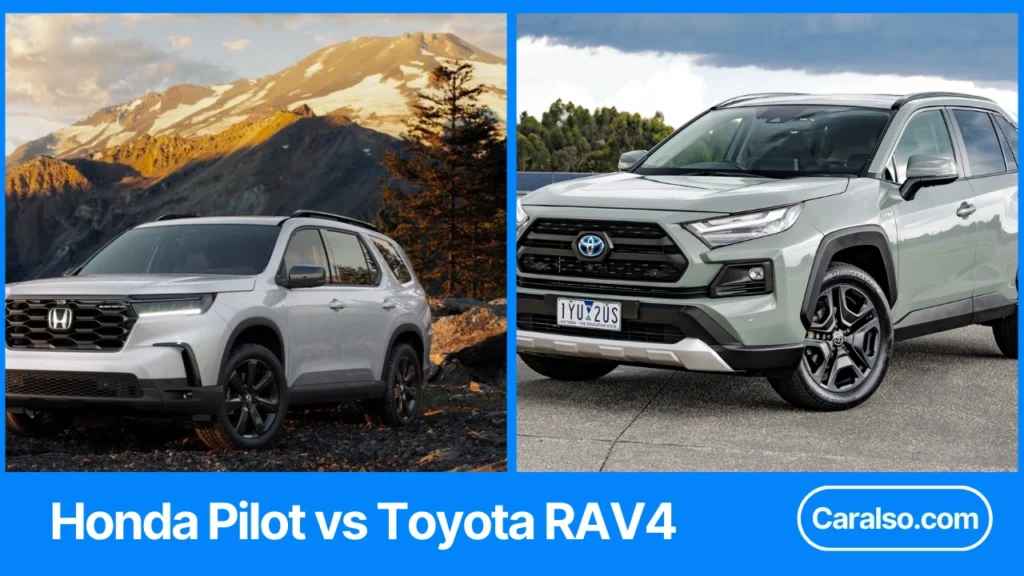
Honda Pilot vs Toyota RAV4
Side-By-Side Snapshot
| What Matters Most | Honda Pilot (Typical 2025 Specs) | Toyota RAV4 (Typical 2025 Specs) | What I Would Do With That Info |
|---|---|---|---|
| Size Class | 3-row midsize SUV | 2-row compact SUV | If you are even thinking about a third row, go Pilot. |
| Seating | Up to 8 | 5 | If you need more than 5 seats even twice a month, Pilot wins fast. |
| Third Row | Yes | No | If kids will sit back there, Pilot is the only real option here. |
| Fuel Economy (EPA Combined) | 20–22 mpg | 28–30 mpg (gas) or 37–39 mpg (hybrid) | If you drive a lot, RAV4 will usually save you real money at the pump. |
| Towing Capacity | Up to 5,000 lb | Up to 1,500 lb (gas models) | If you tow a camper or a heavier boat, Pilot is the safer bet. |
| MSRP Range (Shown In EPA Data) | Around $40k starting MSRP | About $29k–$38k (gas trims shown) | If budget is tight, RAV4 gets you into a new SUV for less. |
At-A-Glance Decision Table: Honda Pilot vs Toyota RAV4
I use this table when a friend texts me “Pilot or RAV4?” and wants an answer in 10 seconds.
| If You Care Most About… | Pick | Why (Plain English) |
|---|---|---|
| 3rd Row And People Hauling | Pilot | It seats up to 8. It is built around 3 rows. |
| Fuel Economy And Commute Costs | RAV4 | Gas models are about 28 to 30 mpg combined. Hybrid is about 37 to 39 mpg combined. |
| Easy Parking And Daily Maneuvering | RAV4 | It is about 180.9 inches long. The Pilot is about 199.9 inches long. |
| Towing And Bigger Loads | Pilot | It can tow up to 5,000 lb when properly equipped. Most RAV4 trims are much lower. |
| Family Trips With 4 Or 5 People | RAV4 | You get 5 seats plus 37.6 cu ft of cargo behind the second row. |
| Road Trips With 6 To 8 People Plus Luggage | Pilot | You get 3 rows plus 18.6 cu ft behind the third row, and up to 87.0 cu ft max with seats folded. |
If you are still stuck, I ask three questions:
- How many people do you carry every week?
- Do you tow anything heavier than 1,500 lb?
- Do you drive more than 12,000 miles per year?
First, Are You Comparing The Right SUVs? The Mismatch Explainer
This comparison feels hard because these two SUVs have different jobs.
The Pilot is a 3-row midsize SUV. It is about 199.9 inches long and about 78.5 inches wide.
The RAV4 is a 2-row compact SUV. It is about 180.9 inches long and about 73.0 inches wide.
That length gap is about 19.0 inches.
That width gap is about 5.5 inches.
The seating gap is even bigger.
- Pilot: up to 8 seats
- RAV4: 5 seats
The fuel economy gap is usually the next big separator.
- Pilot: 21 to 22 mpg combined, depending on drivetrain and trim
- RAV4 gas: about 28 to 30 mpg combined, depending on drivetrain and trim
- RAV4 Hybrid: 37 to 39 mpg combined, depending on trim
Cargo is where a lot of people get fooled. You have to compare the space behind the last row you will actually use.
- Pilot cargo behind the third row: 18.6 cu ft
- RAV4 cargo behind the second row: 37.6 cu ft
- Pilot max cargo (rows folded): 87.0 cu ft
- RAV4 max cargo (second row folded): 69.8 cu ft
So yes, the RAV4 can hold more stuff behind its last row. That is because its last row is the second row.
Mini Decision Tree I Use
If you regularly carry 6 to 8 people, I would buy the Pilot.
If you rarely need more than 5 seats, I would buy the RAV4.
If you are cross-shopping mostly on price, I would also sanity-check your alternatives:
- For 3 rows, I would also look at Toyota Highlander or Toyota Grand Highlander.
- For 2 rows, I would also look at Honda CR-V.
Then I would come back to this question: do you want a 3-row family hauler, or a 2-row daily driver that saves fuel?
Pricing And Trims That Actually Match Up
Here is the money reality up front.
A new Pilot starts at $40,200 for Sport. It runs to $54,580 for Black Edition.
A new RAV4 gas starts around $29,800 for LE. It runs to about $39,505 for Limited AWD.
A new RAV4 Hybrid starts at $34,300 for LE. It runs to $42,605 for Limited.
A new RAV4 Plug In Hybrid starts at $46,265 for SE. It runs to $50,135 for XSE.
That is why I do not compare base to base. The price gap is often $10,000 or more before you add options.
Do Not Compare Base To Base Blindly
When I compare these two, I match the big stuff first.
Drivetrain. AWD vs FWD.
Safety suite. Honda Sensing vs Toyota Safety Sense 2.5.
Seat material. Cloth vs synthetic leather vs leather.
Parking help. Sensors and 360 camera availability.
Roof. Sunroof or panoramic roof.
Audio. Standard speakers vs premium system.
Power tailgate. Manual vs power vs hands free.
Winter comfort. Heated seats and heated steering wheel.
Charging. If you can plug in at home, the RAV4 Plug In Hybrid changes the math.
One more thing. AWD availability is different.
Pilot AWD is optional on Sport, EX L, and Touring. It is standard on TrailSport, Elite, and Black Edition.
RAV4 AWD is optional on every gas trim in the lineup.
Trim Match Map
This is how I match trims when someone wants a fair fight.
| Your Budget | Pilot Trim I Would Cross Shop | RAV4 Trim I Would Cross Shop | My Quick Note |
|---|---|---|---|
| Under $35,000 | Used Pilot Only | RAV4 LE or XLE (Gas) | If you need 3 rows at this price, I shop used Pilot. If you want new, I stay with RAV4. |
| $35,000 To $40,000 | Used Pilot Or Pilot Sport With Incentives | RAV4 XLE Premium (Gas) Or RAV4 Hybrid LE/XLE | This is where the RAV4 Hybrid starts to make sense if you drive 12,000 miles a year or more. |
| $40,000 To $45,000 | Pilot Sport Or EX L | RAV4 Limited (Gas) Or RAV4 Hybrid SE/Woodland | If you want leather and a power tailgate, Pilot EX L and RAV4 XLE Premium are the clean match. |
| $45,000 To $50,000 | Pilot Touring Or TrailSport | RAV4 Plug In Hybrid SE Or RAV4 Hybrid XSE | Plug In Hybrid only pays off if you can charge at home or work. |
| $50,000 Plus | Pilot Elite Or Black Edition | RAV4 Plug In Hybrid XSE Or RAV4 Hybrid Limited | This is where you pay for the last 10 percent. HUD, premium audio, and more driver assist features. |
New Vs Used Angle
I buy used Pilot when I need the third row but I do not want a $40,000 plus payment.
I also buy used Pilot when I tow and I want the 5,000 lb rating without paying new prices.
I buy used RAV4 when I want the lowest fuel spend and the lowest tire and brake spend.
I also buy used RAV4 when I only need 5 seats and I want something easy to park every day.
If your household has two cars, I see this combo a lot.
Pilot as the weekend family hauler.
RAV4 as the daily commuter.
Space And Seating Reality Check (Where Most Pages Confuse People)
This is the part that decides the purchase for most buyers.
Pilot is a 3 row layout.
RAV4 is a 2 row layout.
That is it. Everything else is details.
Seating Capacity And Day To Day Comfort
Pilot seats 8 on most trims. TrailSport seats 7.
RAV4 seats 5.
If you carry 6 people even twice a month, I stop the debate and pick Pilot.
Now the numbers that matter.
Pilot legroom is 41.0 inches in the first row. 40.8 inches in the second row. 32.5 inches in the third row.
RAV4 legroom is 41.0 inches in the front row. 37.8 inches in the second row.
That means Pilot gives you 3.0 more inches of second row legroom than RAV4.
That is the difference between a kid seat touching the front seat and not touching.
Third row legroom at 32.5 inches is usually fine for kids.
For adults, I treat it as a short trip seat.
Cargo: Explain It The Right Way
I always compare cargo behind the last row you will actually use.
Pilot has 18.6 cu ft behind the third row.
RAV4 has 37.5 cu ft behind the second row.
That is a 18.9 cu ft gap.
Now the part people miss. The Pilot can jump way up if you fold the third row.
Pilot cargo behind the second row is 48.5 cu ft.
Pilot max cargo behind the first row is 87.0 cu ft.
RAV4 max cargo behind the first row is about 69.8 cu ft.
Here is how I think about it in real use.
- Grocery run
If you keep the Pilot third row up, you are working with 18.6 cu ft.
If you keep the RAV4 second row up, you are working with 37.5 cu ft.
If you fold the Pilot third row, you jump to 48.5 cu ft. - Stroller Plus Bags
If you need the Pilot third row for people, 18.6 cu ft gets tight fast.
If you do not need the third row, folding it gives you 48.5 cu ft and the problem disappears.
In the RAV4, you get the full 37.5 cu ft with all seats in use. - Airport Trip With Carry Ons
If you are carrying 6 to 8 people, Pilot wins because it can carry the people.
If you are carrying 4 to 5 people, RAV4 wins on seat up cargo at 37.5 cu ft.
If you are carrying 5 people and a lot of bags, Pilot wins if you can fold the third row.
Family Fit Mini Guide
This is where I get picky. Because car seats and third row access can ruin your day.
Car seats across
Pilot with the second row bench can fit three car seats across.
RAV4 does not fit three car seats across in Cars.com testing.
Second row design
Pilot has a multi function second row with a removable middle seat on trims that use the bench.
Pilot also has one touch fold flat outboard second row seats for third row access.
LATCH hardware that matters
Pilot has lower anchors in every second row seating position.
Pilot also has a third row passenger side lower anchor.
Pilot has top tether anchors in every second row seating position and in every third row seating position.
Who will hate third row access
If you run rear facing seats in the second row, a 2 row SUV is simpler.
That is the RAV4 advantage.
If you need third row access while a car seat is installed, I like Pilot with the bench because the removable middle seat gives you options.
Fuel Economy And Running Costs (With Real Math, Not Vibes)
If you drive a lot, fuel is the fastest way these two SUVs separate. The 2025 Honda Pilot AWD is rated 21 mpg combined. The 2025 Toyota RAV4 AWD (gas) is rated 29 mpg combined. The 2025 Toyota RAV4 Hybrid AWD is rated 39 mpg combined.
At my assumed fuel price, that works out to this cost per 100 miles:
- Pilot AWD: about $13.59 per 100 miles
- RAV4 AWD (gas): about $9.84 per 100 miles
- RAV4 Hybrid AWD: about $7.32 per 100 miles
Why MPG Is Not The Whole Story
MPG changes a lot based on your day-to-day driving.
City-heavy driving:
- Hybrids usually win big here because they spend more time at lower speeds and can recapture energy when you slow down.
- Short trips in cold weather hit every vehicle, because the drivetrain stays cold longer and spends more time below peak efficiency.
Highway-heavy driving:
- The gap often shrinks.
- Aerodynamics and gearing matter more than stop-and-go efficiency.
Hot weather:
- Running AC can cut fuel economy, especially on short trips.
So I treat EPA numbers like a baseline. Then I run the math for how people actually drive.
5-Year Fuel-Cost Calculator Table
Assumptions I used for this table:
- 2025 EPA city and highway ratings for each vehicle.
- A U.S. regular-gas average price (single nationwide number).
- 5 years of driving with no change in fuel price.
- “Effective MPG” is a weighted city and highway estimate based on each profile.
| Driver Profile | Pilot AWD 5-Year Fuel Cost | RAV4 AWD (Gas) 5-Year Fuel Cost | RAV4 Hybrid AWD 5-Year Fuel Cost | Estimated 5-Year Savings Vs Pilot (RAV4 Gas) | Estimated 5-Year Savings Vs Pilot (RAV4 Hybrid) |
|---|---|---|---|---|---|
| Commuter (12k/yr, 70% City) | $8,360 | $5,990 | $4,270 | $2,370 | $4,090 |
| Mixed (15k/yr, 55% City) | $10,050 | $7,280 | $5,400 | $2,770 | $4,640 |
| Road Tripper (18k/yr, 30% City) | $11,240 | $8,300 | $6,610 | $2,940 | $4,640 |
What I take from this:
- The RAV4 Hybrid can save about $4,090 to $4,640 in fuel over 5 years versus a Pilot AWD, with my assumptions.
- The RAV4 gas model still saves about $2,370 to $2,940 over 5 years versus a Pilot AWD.
- The Hybrid usually saves about $1,690 to $1,870 more than the gas RAV4 over 5 years.
Hybrid And Plug-In Considerations
RAV4 Hybrid:
- If you want the simplest win, this is it.
- No charging.
- Big mpg advantage.
RAV4 Plug-In Hybrid:
- This only makes sense if you can charge at home or at work.
- The 2025 RAV4 Plug-In Hybrid is rated 42 miles of EV range.
- EPA lists 36 kWh per 100 miles for electric driving.
- Using my electricity assumption, that is about $6.40 per 100 miles on electricity.
- On gas-only driving, it is rated 38 mpg combined, which is about $7.51 per 100 miles at my gas assumption.
One simple rule I use:
- If your electricity is under about $0.21 per kWh, EV miles tend to be cheaper than gas miles at my assumed gas price.
- If your electricity is much higher than that, the plug-in’s “fuel savings” gets harder to justify, unless you value EV driving for other reasons.
Other running-cost stuff people forget:
- Tires. Pilot trims often run 18-inch to 20-inch wheels. RAV4 trims commonly run 17-inch to 19-inch wheels. Bigger tires usually cost more per set.
- Weight. A heavier SUV generally eats brakes and tires faster when driven hard. Driving style matters more than brand here.
Power, Towing, And Capability
This is where the “right SUV” question matters most.
The Pilot is a 3-row midsize SUV. The RAV4 is a 2-row compact SUV. If you regularly carry 6 to 8 people, or tow anything beyond a small trailer, the Pilot is usually the correct tool.
Performance Feel (Merging, Passing, Loaded Cabin)
Here are the numbers that matter first:
- Pilot: 285 hp, 262 lb-ft, 10-speed automatic
- RAV4 (gas): 203 hp, 184 lb-ft, 8-speed automatic
- RAV4 Hybrid: 219 hp total system output (net combined), AWD is standard
How that feels to me:
- Pilot with a loaded cabin has an easier time holding speed on grades. That is the V6 plus gearing doing its job.
- RAV4 (gas) is fine solo or with 2 to 4 people. It works harder when you pack it out.
- RAV4 Hybrid feels more responsive at normal speeds than the gas RAV4. It also tends to feel smoother in stop-and-go.
Towing And Payload: Who Should Care
Max tow ratings (big picture):
- Pilot: up to 5,000 lbs with AWD. Up to 3,500 lbs with 2WD.
- RAV4 (gas): commonly rated up to 1,500 lbs.
- RAV4 Hybrid: commonly rated up to 1,750 lbs.
- RAV4 Plug-In Hybrid: commonly rated up to 2,500 lbs.
- Some RAV4 “adventure style” trims in some markets and years are rated up to about 3,500 lbs. You have to verify your exact trim and year.
Now my pro tip.
Tow rating is not the number that sneaks up on people. Payload is.
Payload is the total weight you can add to the vehicle:
- People
- Cargo
- Accessories
- Trailer tongue weight
Tongue weight is usually about 10% to 15% of trailer weight.
So a “5,000 lb” trailer can put 500 to 750 lbs onto the hitch.
That 500 to 750 lbs comes straight out of payload.
Real example math:
- 5 passengers at 175 lbs each is 875 lbs.
- Add 200 lbs of cargo.
- You are at 1,075 lbs before you count tongue weight.
On the Pilot, Honda lists maximum load limits around 1,173 lbs to 1,340 lbs depending on seating configuration.
So you can hit payload limits fast, even with “only” a moderate trailer.
This is why I always tell people:
- Check the Tire And Loading sticker on the driver door jamb.
- Use that payload number as your real-world limit.
- Do the same for the trailer’s actual loaded weight, not the brochure number.
Tow scenarios, quick match-up:
- Small utility trailer with yard stuff: Either can do it, as long as you stay within ratings.
- Small camper: Pilot is the safer bet most of the time.
- Bikes plus a cargo carrier: Either works. Payload is still a factor.
AWD And Snow Confidence
AWD helps you start moving.
It does not help you stop.
If you do one upgrade for winter traction, I pick tires every time.
My practical tire checklist:
- If you see real snow and ice, choose a winter tire or a severe-snow rated all-weather tire (look for the 3PMSF symbol).
- Replace tires before they get too worn for snow. I use 4/32-inch tread depth as my personal “start shopping” point for winter grip.
About AWD systems in plain terms:
- Pilot AWD plus ground clearance is better suited for rough roads, steep driveways, and towing in low-traction situations.
- RAV4 Hybrid AWD is great for daily traction and light winter duty. It is not a substitute for proper tires.
Comfort, Noise, And Road-Trip Livability
Ride Comfort
If I am doing a 3-hour drive with people in the back, the Honda Pilot usually makes that easier.
Here is why.
- The Pilot is a 3-row SUV. It is built to carry more people, more often.
- The Pilot is rated to tow up to 5,000 lb with AWD. That usually comes with a chassis tuned for higher load. Even if you never tow, that matters for highway stability.
- The RAV4 is a compact 2-row. It is lighter-duty by design. That is not bad. It is just a different job.
My practical rule:
- If you do long highway trips with 4 to 7 people, I lean Pilot.
- If you do daily commuting, 1 to 4 people, and you want the smaller footprint, I lean RAV4.
Cabin Quiet
This is one of the clearest “spec sheet” differences I can point to.
Honda calls out acoustic laminate glass on the Pilot.
- Acoustic laminate windshield glass is standard.
- Acoustic laminate front door glass is included on higher trims.
That matters because wind noise and tire noise usually show up first through the windshield and front doors.
On the RAV4 side, trim and wheel choice change the noise a lot.
- Bigger wheels usually mean shorter sidewalls.
- Shorter sidewalls usually mean more road texture gets into the cabin.
My quick takeaway:
- If quiet is a top priority, I start my test drive on the same stretch of highway at 70 mph.
- I listen for wind around the A-pillars and tire noise on coarse pavement.
- I do it twice. Once with the audio off. Once with a podcast at volume 12 to 16.
Driver Assistance + Fatigue Reduction
For long drives, I care about two things.
- Adaptive cruise that can smoothly slow down and speed back up.
- Lane support that is not “ping-pongy” between lines.
Pilot basics (Honda Sensing):
- Lane Keeping Assist works at 45 to 90 mph.
- Traffic Jam Assist extends lane support below 45 mph.
RAV4 basics (Toyota Safety Sense 2.5):
- Full-Speed Range Dynamic Radar Cruise Control.
- Lane Tracing Assist.
- Lane Departure Alert with Steering Assist.
- Automatic High Beams.
- Road Sign Assist.
My real-world advice:
- I treat both systems as driver support, not self-driving.
- I keep my hands on the wheel.
- I also test them in a gentle curve. Some systems feel great on straight highways, then get twitchy on bends.
If fatigue reduction is your main goal, this is what I would do before buying:
- Drive each one for 20 minutes on the highway.
- Turn on adaptive cruise and lane support.
- Note how often you need to correct steering.
- Note how smoothly it handles stop-and-go.
Reliability, Maintenance, And Resale Value
Reliability Snapshot (With Sources At Publish Time)
When I talk reliability, I split it into two buckets.
- Safety recalls and investigations.
- Day-to-day ownership issues like sensors, electronics, and “annoying stuff.”
On the Pilot side, recent recall topics have included:
- A fuel injection ECU software issue that can cause an engine stall or loss of power.
- A third-row seat belt routing issue on certain vehicles.
- A fuel filler neck / pipe concern on certain vehicles.
On the RAV4 side, one of the big recent recall topics across multiple Toyota models (including RAV4) involved:
- A software-related instrument panel display issue that can leave the display blank at startup.
My buyer move is simple:
- I run the VIN for open recalls before I negotiate.
- Then I run it again the day I pick up the vehicle.
- Recalls happen. What matters is whether the fix is available and completed.
Maintenance Costs: What Typically Costs More And Why
This is where the “size class” mismatch shows up again.
A Pilot is usually more expensive to run than a RAV4 because of basics:
- More weight.
- More tire.
- More brake.
- More fuel.
Cost-to-own estimates back that up.
- A 2025 RAV4 shows a 5-year cost-to-own estimate of $54,141.
- A 2025 Pilot EX-L shows a 5-year cost-to-own estimate of $72,590.
That is a difference of $18,449 over 5 years.
Here is how I use that number.
- $18,449 over 5 years is about $3,690 per year.
- That is about $307 per month.
If your budget is tight, that monthly gap matters more than most people admit.
My maintenance reality check list (things I price before buying):
- Replacement tires (quote the exact size on the door placard).
- Front brake pads and rotors.
- Insurance quote with the exact trim.
- Fuel cost at your real weekly mileage.
Resale Value / Depreciation
If you think you might sell in 3 to 5 years, resale matters a lot.
Two data points I use:
From iSeeCars depreciation comparison data:
- Honda Pilot 5-year depreciation: 48.3%
- Toyota RAV4 5-year depreciation: 30.3%
From Kelley Blue Book’s Best Resale Value Awards (Top 10 list for 2025 models):
- Toyota RAV4 is listed with a 53.9% 5-year resale value estimate.
How I translate that into a buying decision:
- If you want the lowest total ownership hit, RAV4 usually wins.
- If you want the bigger cabin and 3-row flexibility, Pilot can still be the right answer.
- You just need to go in expecting higher fuel use and a bigger depreciation swing.
Which Should You Choose? (Scenario-Based Verdicts)
I pick these two by job first. Then I worry about trim.
Choose Pilot If…
- You need 7 to 8 seats. Not “maybe.” Actually need them.
- You carry 6 people or more at least twice a month.
- You want up to 5,000 lb of towing capacity when properly equipped.
- You road trip with people plus luggage.
- You want a third row, even if it is mostly for kids.
My quick mental picture:
- Pilot is for people first.
- Gear comes second.
- Fuel economy comes third.
Choose RAV4 If…
- 95% of your trips are commuting and errands.
- You want 28 to 30 mpg combined (gas) or 37 to 39 mpg combined (hybrid).
- You only need 5 seats.
- You park in tight lots or small garages often.
- You tow rarely, or you tow a small utility trailer.
My quick mental picture:
- RAV4 is for daily miles first.
- Fuel cost comes second.
- Extra seats are not part of the plan.
If You’re Still Unsure: My 3-Question Checklist
- How many people do you carry every week?
If the answer is 6 or more even once a week, I stop and pick Pilot. - Can you charge at home?
If yes, a plug-in hybrid can change your running-cost math. - Do you tow more than a couple times per year?
If yes, I lean Pilot. If no, I lean RAV4.
If you want a Toyota with 3 rows, I cross-shop Highlander or Grand Highlander.
If you want a Honda like the RAV4, I cross-shop CR-V.
FAQs
Is The Honda Pilot Bigger Than The Toyota RAV4?
Yes. The Pilot is about 199.9 inches long. The RAV4 is about 180.9 inches long.
That is about a 19.0-inch difference.
The Pilot is also wider. It is about 78.5 inches wide. The RAV4 is about 73.0 inches wide.
Which Is Better On Gas?
The RAV4. The 2025 RAV4 AWD (gas) is rated about 29 mpg combined. The 2025 RAV4 Hybrid AWD is rated about 39 mpg combined.
The 2025 Pilot AWD is rated about 21 mpg combined.
If you drive 12,000 miles per year, that mpg gap usually turns into real money.
Which Is Better For A Family Of 5?
It depends on how you use the third row.
If you are always 5 people and you want more cargo space with all seats in use, I lean RAV4. It has about 37.5 cu ft behind the second row.
If you want room to add two more people sometimes, I lean Pilot. It seats up to 8.
Which Is Better For Snow?
Both can do winter. Tires matter more than badges.
If you run proper winter tires, either one works for most snow states.
If you want more cabin and more load ability in winter, I lean Pilot AWD.
If you want lower fuel use in winter commuting, I lean RAV4 Hybrid AWD.
Is The Third Row Worth It?
If you carry 6 to 8 people, yes. It solves a problem no 2-row can solve.
If you almost never carry more than 5, no. A third row often costs you fuel and adds complexity you do not use.
Which Costs Less To Own Long-Term?
The RAV4 usually costs less. Fuel is the big reason.
On common cost-to-own estimates, the RAV4 can be about $18,000 cheaper than a Pilot over 5 years, depending on trim and assumptions.
I always check insurance and local fuel prices too. Those can swing the gap.
What Should I Cross-Shop Instead?
If you want 3 rows and you like Toyota, I cross-shop Highlander and Grand Highlander. Both offer seating for up to 8 depending on configuration.
If you want a 2-row Honda alternative to the RAV4, I cross-shop CR-V. It seats 5, and its hybrid mpg can be in the same ballpark as RAV4 Hybrid depending on drivetrain.
Key Takeaways
- If you need 7 to 8 seats, I pick the Pilot. If you only need 5 seats, I pick the RAV4.
- The Pilot is about 199.9 inches long. The RAV4 is about 180.9 inches long. That is about 19.0 inches.
- Pilot AWD is about 21 mpg combined. RAV4 AWD (gas) is about 29 mpg combined. RAV4 Hybrid AWD is about 39 mpg combined.
- If you tow often, I pick the Pilot. It is rated up to 5,000 lb when properly equipped. Most RAV4 trims are around 1,500 to 1,750 lb, with the plug-in at about 2,500 lb.
- I compare cargo behind the last row you will actually use. Pilot is 18.6 cu ft behind the third row. RAV4 is about 37.5 cu ft behind the second row.
- If you drive 12,000 to 18,000 miles per year, I expect the RAV4 Hybrid to save about $4,000 to $4,600 in fuel over 5 years versus a Pilot AWD, using my assumptions.
- If you can charge at home, I consider the RAV4 Plug-In Hybrid. If you cannot charge, I treat the Hybrid as the clean value play.
Sources
- FuelEconomy.gov 2025 Honda Pilot MPG
- Honda Build And Price (2025 Pilot MSRP By Trim)
- Toyota 2025 RAV4 Full Specs (MPG figures by trim)
- Edmunds 2025 Honda Pilot Overview
- Cars.com Car Seat Check, 2025 RAV4 Hybrid
- U.S. Energy Information Administration Weekly U.S. Regular Gas Price

Hey there,
How is it going?
I’m Meraj Sarker. I am a Car Mechanic and a student of Automobile Restoration here in Florida, USA. I’ve been studying automotive for around 9 years now. So you can rely on my recommendation. For me, studying and getting knowledge about automobile it’s really fun and entertaining. I will help you to get solutions for your car through this website. If you need any help let me know.