
If you want the cleanest answer, here it is. I would buy the Honda HR-V for a smaller, simpler daily driver with a lower starting price. I would buy the Toyota RAV4 if I want more usable cargo space and I want a hybrid or plug-in.
One important truth up front. These two are not direct rivals. The HR-V is a subcompact SUV. The RAV4 is a compact SUV. That size jump is why the RAV4 carries 37.8 cu ft behind the rear seats, while the HR-V carries 24.4 cu ft.
In this comparison, I am treating you like a real shopper in 2025–2026. You want the right SUV for your life. Parking, road trips, fuel costs, and how much stuff you carry matter more than hype.
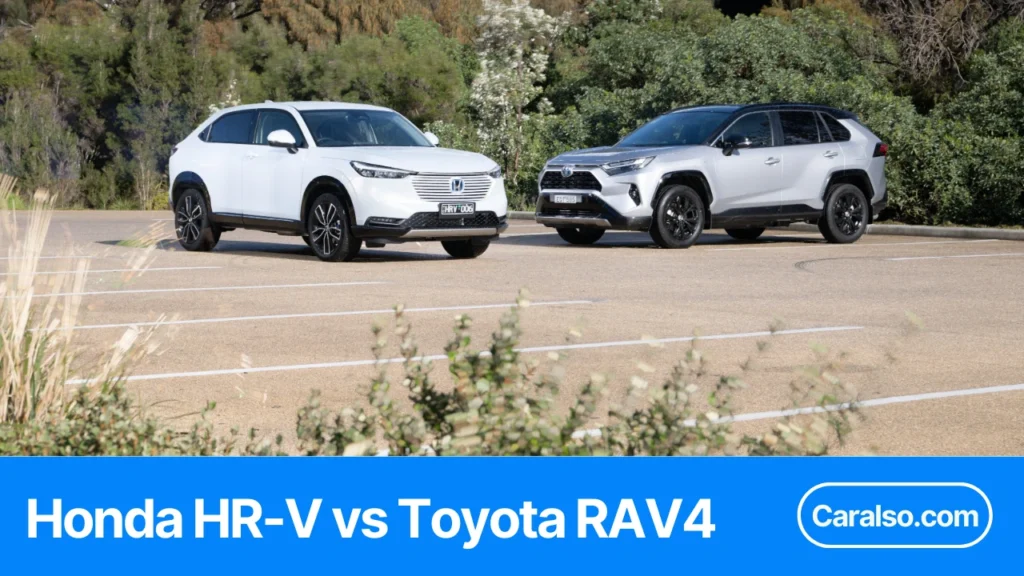
Honda HR-V vs Toyota RAV4
Quick Answer (30-Second Decision)
Quick Verdict
Choose The HR-V If You Want:
- Lower starting price.
- Better fit for tight parking and garages.
- Simple gas-only ownership.
- A smaller footprint with 158 hp.
Choose The RAV4 If You Want:
- More cargo space for strollers, dogs, and road trip gear.
- Hybrid standard, plus a plug-in option.
- More power, up to 236 hp in AWD hybrid trims.
- More capability, including up to 3,500 lb towing on certain trims.
Summary Table (Key Numbers You Can Decide From)
Specs vary by trim. These are the headline numbers most people shop on.
| Spec | Honda HR-V (2026) | Toyota RAV4 (2026) |
|---|---|---|
| Class | Subcompact SUV | Compact SUV |
| Starting Price (Base MSRP) | $26,500 | $31,900 |
| Powertrain | Gas 2.0L | Hybrid standard, plug-in available |
| Horsepower | 158 hp | 226 hp (FWD hybrid) to 236 hp (AWD hybrid) |
| EPA MPG (City/Hwy/Combined) | 26/32/28 (FWD), 25/30/27 (AWD) | Up to 47/40 (city/hwy est.) |
| Cargo Behind Rear Seats | 24.4 cu ft | 37.8 cu ft |
| Max Cargo (Seats Folded) | 55.1 cu ft | 70.4 cu ft |
| Towing | Not rated | 1,750 lb to 3,500 lb (trim dependent) |
| Ground Clearance | 7.0 in to 7.3 in | 8.1 in |
My “Don’t Pogo-Stick” Tip
If you are mainly comparing size and price, the HR-V lines up closer to a Toyota Corolla Cross. If you are mainly comparing space and family-road-trip comfort, the RAV4 lines up closer to a Honda CR-V.
Specs At A Glance (One Table That Beats The Tools)
If you only read one thing, read this table. It shows why these two do not shop the same, even when they look similar on a dealer lot.
| Item | Honda HR-V (2026, US) | Toyota RAV4 (2026, US) |
|---|---|---|
| Starting Price Range (MSRP) | $26,500 to $31,850 | $31,900 to $43,300 (Hybrid). Plug-In pricing arrives later. |
| Power (Hp/Torque) | 158 hp, 138 lb-ft | Hybrid: 226 hp (FWD) or 236 hp (AWD), 163 lb-ft gas engine torque. Plug-In: 324 hp, 172 lb-ft gas engine torque. |
| MPG (Gas) + Hybrid/Plug-In Availability | Gas-only. 26/32 mpg (FWD). 25/30 mpg (AWD). | Hybrid-only lineup. Up to 48/42 mpg (FWD) or 46/40 mpg (LE AWD). Plug-In option: up to 52 miles electric range and up to 41 mpg combined (est). |
| Cargo Behind 2nd Row + Max Cargo | 24.4 cu ft + 55.1 cu ft | 37.8 cu ft + 70.4 cu ft |
| Ground Clearance | 7.0 to 7.3 in | 8.1 in on most trims. 8.5 in Woodland. 7.5 in GR Sport. |
| Towing Capacity | Not officially rated for towing (US). | 1,750 lb on some trims. Up to 3,500 lb on select AWD trims. |
| Warranty Basics | 3 yr/36,000 mi basic. 5 yr/60,000 mi powertrain. 1 yr/12,000 mi maintenance. | 3 yr/36,000 mi basic. 5 yr/60,000 mi powertrain. Hybrid system 8 yr/100,000 mi. Hybrid battery 10 yr/150,000 mi. ToyotaCare 2 yr/25,000 mi. |
Notes: MSRPs exclude destination and fees. MPG and range figures shown above are manufacturer estimates or published ratings and can vary by trim, drive, and wheel and tire setup.
Biggest Differences That Actually Matter
Size And Class (Why The Comparison Feels Unfair)
I treat this as a “different weight class” comparison.
The HR-V is a subcompact SUV. The RAV4 is a compact SUV. That sounds like marketing, but you feel it in three places fast.
Cargo space. This is the daily-life difference.
- HR-V cargo behind the second row is 24.4 cu ft.
- RAV4 cargo behind the second row is 37.8 cu ft.
That is 13.4 cu ft more space before you even fold a seat.
Fold the rear seats and the gap stays real.
- HR-V max cargo is 55.1 cu ft.
- RAV4 max cargo is 70.4 cu ft.
That is 15.3 cu ft more room for big boxes, strollers, and trip gear.
Ground clearance and towing are the other “class” tells.
- HR-V ground clearance is 7.0 to 7.3 inches.
- RAV4 sits at 8.1 inches on most trims, and the Woodland goes to 8.5 inches.
If you deal with rutted trailheads or deep snow ruts, that extra clearance matters.
Towing is not close.
- HR-V is not officially rated for towing in the US.
- RAV4 ranges from 1,750 lb to 3,500 lb depending on trim and drivetrain.
If you have a small utility trailer in your future, I stop looking at the HR-V.
Parking and turning. This one surprises people.
- HR-V turning diameter is 35.1 to 37.1 ft depending on trim and tire package.
- RAV4 turning diameter is about 36.9 ft on the spec sheet.
So the RAV4 does not feel like a bus in a grocery lot. The bigger hit is price and fuel system, not maneuvering.
Powertrain Reality Check (US Shoppers)
This is the part that decides the purchase for most people I talk to.
In the US, the HR-V is simple.
- One gas engine. 2.0L.
- 158 horsepower.
- CVT.
It is fine for city driving. It is slow when you ask for a hard merge. Car and Driver measured 0 to 60 mph in 9.4 seconds.
Fuel economy is also straight.
- 26 city and 32 highway on FWD.
- 25 city and 30 highway on AWD.
The 2026 RAV4 is a different story. Toyota went all electrified.
Hybrid is the default.
- 226 hp in FWD.
- 236 hp in AWD.
It is quicker than the old gas-only RAV4, and it is a big jump over the HR-V. Car and Driver logged 0 to 60 mph in 7.1 seconds in testing for the hybrid.
Then there is the plug-in.
- 324 hp.
- Up to 52 miles of electric range (manufacturer estimate).
This is the one I pick if you can charge at home and your daily driving is mostly within that range. You get quiet EV miles on errands, then gas backup for long trips.
My simple rule here.
- If you want the lowest price and the simplest ownership loop, I buy the HR-V.
- If you want power, towing, and the best fuel story, I buy the RAV4 Hybrid.
- If you can plug in most nights, I look hard at the RAV4 Plug-In.
Price & Ownership Cost (What You’ll Spend, Not Just MSRP)
I look at three numbers first. MSRP. Destination. And the trim you actually want.
If you shop by base MSRP alone, you will miss the real gap.
Upfront Price Vs “Equipped Similarly”
Here is the pricing reality for 2026 models.
- Honda HR-V starts at $26,500 MSRP.
- Toyota RAV4 starts at $31,900 MSRP.
Then destination hits.
- Toyota’s destination is $1,450. That puts a base RAV4 at $33,350 before tax.
- Honda’s destination is also commonly listed at $1,450. That puts a base HR-V around $27,950 before tax.
Now the “equipped similarly” part.
Most people add AWD and heated seats.
- On HR-V, heated front seats show up even on lower trims. That is not common in this class.
- On RAV4, heated seats are tied to higher trims like XLE Premium and above.
AWD also changes the math.
- HR-V AWD is typically about a $1,500 jump over FWD.
- RAV4 AWD is about a $1,400 add on trims where it is optional.
Here’s how I price two common “real buyer” builds.
Typical Real-World Builds (MSRP Plus Destination, Before Tax)
| Build You’ll Actually Shop | HR-V (Approx. MSRP + Destination) | RAV4 (Approx. MSRP + Destination) | Gap |
|---|---|---|---|
| AWD + Basic Daily Features | HR-V Sport AWD: $29,500 + $1,450 = $30,950 | RAV4 LE AWD: $34,750 | $3,800 |
| Heated Seats + Nicer Interior | HR-V EX-L AWD: $31,550 + $1,450 = $33,000 | RAV4 XLE Premium AWD: $37,550 + $1,400 = $38,950 | $5,950 |
Two quick notes I use when budgeting.
- Taxes and fees scale with price.
A $5,000 higher sticker also means higher sales tax in most states. - Financing multiplies the difference.
Example: On a 60-month loan at 7% APR, every extra $5,000 financed is about $99 per month.
5-Year Cost To Own: What Actually Drives It
I do not obsess over one “total cost” number. I look at what creates the gap.
These are the big drivers over 5 years:
- Depreciation. This is usually the largest line item.
- Fuel. The RAV4’s hybrid-only move helps here, especially if you drive a lot.
- Insurance. Higher-priced vehicles usually cost more to insure.
- Financing. Bigger loan equals more interest.
- Maintenance and repairs. Usually smaller than people think, unless you skip service.
Here’s a clean benchmark using Edmunds True Cost to Own. Same methodology. Same miles per year. Different vehicles.
5-Year Ownership Cost Benchmarks (Edmunds True Cost To Own)
| Model Used For The Benchmark | 5-Year Total | Depreciation | Fuel | Insurance |
|---|---|---|---|---|
| 2026 HR-V LX | $33,214 | $9,272 | $8,196 | $3,931 |
| 2025 RAV4 LE (Gas) | $35,375 | $11,371 | $7,646 | $4,010 |
| 2025 RAV4 Hybrid LE (AWD) | $41,022 | $11,201 | $5,887 | $7,110 |
How I interpret that for your decision.
- HR-V wins on lower buy-in. That lowers depreciation and financing pain.
- RAV4 Hybrid wins on fuel if you drive a lot. The higher MSRP can still outweigh fuel savings if you drive fewer miles.
If you want a fast fuel-savings gut check, do this.
- Take your yearly miles.
- Divide by 28 mpg for HR-V.
- Divide by 44 mpg for a typical RAV4 Hybrid combined estimate.
- Multiply the gallon difference by your local gas price.
Example at 15,000 miles and $3.50 per gallon:
- HR-V: 15,000 / 28 = 536 gallons
- RAV4 Hybrid: 15,000 / 44 = 341 gallons
- Difference: 195 gallons
- Savings: 195 x $3.50 = $682 per year
That is real money. It just might not beat a $4,000 to $6,000 upfront gap if you drive less.
Space & Practicality (The Reason Most People Switch Models)
I have driven both types of buyers.
HR-V buyers want easy parking and a lower payment.
RAV4 buyers want to stop playing cargo Tetris.
This is where the RAV4 earns its price.
Cargo And Passenger Space
The numbers that matter are cargo behind the rear seats and cargo with seats folded.
- HR-V cargo behind the rear seats: 24.4 cu ft
- RAV4 cargo behind the rear seats: 37.8 cu ft
That is a 13.4 cu ft advantage for the RAV4. Behind the seats.
Fold the rear seats and the gap stays big.
- HR-V max cargo: 55.1 cu ft
- RAV4 max cargo: 70.4 cu ft
That is a 15.3 cu ft advantage for the RAV4.
Passenger space is closer than people expect.
- HR-V passenger volume: 98.7 cu ft
- RAV4 passenger volume: 98.9 cu ft
- Rear legroom is basically a tie: 37.7 in (HR-V) vs 37.8 in (RAV4)
Where the RAV4 helps in real life is the cabin “shape.”
- RAV4 is 0.6 in wider: 73.0 in vs 72.4 in
- RAV4 has more rear hip room: 49.6 in vs 47.4 in
- RAV4 has more ground clearance: 8.1 in vs about 7.0 to 7.3 in
That extra width and rear hip room makes car seats and big adults feel less cramped.
Space Numbers That Matter (Quick Table)
| Measurement | 2026 HR-V | 2026 RAV4 |
|---|---|---|
| Cargo Behind Rear Seats | 24.4 cu ft | 37.8 cu ft |
| Cargo With Rear Seats Folded | 55.1 cu ft | 70.4 cu ft |
| Rear Legroom | 37.7 in | 37.8 in |
| Rear Hip Room | 47.4 in | 49.6 in |
| Width (No Mirrors) | 72.4 in | 73.0 in |
| Length | 179.8 in | 181.0 in |
| Turning Circle (Curb To Curb) | 35.1 ft | 36.9 ft |
My quick takeaway.
- HR-V is easier to snake into tight spots. 35.1 ft turning circle is great.
- RAV4 carries more stuff without thinking. 37.8 cu ft behind the seats changes daily life.
Real-World Fit Test (My Dealership Checklist)
This is the exact test I run before I pick a model. I bring a tape measure.
Stroller + Travel Bags
- Put your stroller in first.
- Add 2 carry-on suitcases.
- Close the hatch without forcing it.
Two Rear-Facing Car Seats
- Install one behind the driver.
- Slide the driver seat to your normal position.
- Check if your knees hit the dash.
- Repeat on the passenger side.
Medium Dog Crate
- Measure the crate footprint.
- Compare to cargo floor width between the wheel wells.
- Check hatch opening height before you buy the crate.
Costco Run Load List
- 1 case of paper towels
- 1 case of water
- 2 full grocery boxes
- 1 bulk pack of diapers or pet food
If that list fits with the rear seats up, you are in good shape.
Tight Garage Test
- Measure garage door opening.
- Compare to vehicle width.
- Then measure your clearance on each side.
- Open the hatch and confirm it clears the garage door track.
If you live with a tight garage, the HR-V’s slightly smaller footprint can save you stress. If you live with strollers, dogs, or weekly bulk runs, the RAV4’s cargo advantage shows up every day.
Driving Experience (City Vs Highway Vs Bad Weather)
I drive these two with the same mindset. I want an SUV that is easy at 25 mph. I also want it to feel stable at 75 mph. And I want it to pull away cleanly on a snowy hill.
City Maneuverability Vs Highway Stability
In town, the HR-V feels like the easier tool.
- HR-V curb weight ranges from 3,159 to 3,336 lb, depending on trim and AWD.
- RAV4 Hybrid curb weight ranges roughly from 3,650 to 4,550 lb, depending on trim and equipment. One tested Limited AWD was 3,838 lb.
That weight difference matters in stop and go traffic. It also matters when you have to brake hard for a yellow light.
The HR-V is also quicker to rotate in tight spots.
- HR-V turning circle is 35.1 ft on some trims.
- RAV4 turning circle is about 36.9 ft.
Highway passing is where the gap shows up fast.
- HR-V hit 60 mph in 9.4 seconds in instrumented testing.
- RAV4 Hybrid AWD hit 60 mph in 7.1 seconds in instrumented testing.
That 2.3-second gap is the difference between “I can pass now” and “I need more space.”
On the highway, I also care about wheelbase and weight.
- HR-V wheelbase is 104.5 inches.
- RAV4 wheelbase is 105.9 inches.
The RAV4’s extra weight and slightly longer wheelbase usually makes it feel more planted in crosswinds and on rough concrete.
Lane centering is strong on both when the road markings are good.
- HR-V includes adaptive cruise and lane keeping in Honda Sensing.
- RAV4 includes Toyota Safety Sense 4.0, plus Lane Tracing Assist behavior when cruise is active.
If you sit in traffic a lot, this is the one feature that changes your day.
- HR-V includes Traffic Jam Assist in its driver-assist suite.
- RAV4 offers Traffic Jam Assist as an available feature, and it requires an active Drive Connect trial or subscription.
AWD Systems And Snow Confidence
I treat AWD as traction help, not a magic button.
The HR-V uses a mechanical AWD setup.
Honda calls it Real Time AWD with Intelligent Control System.
It can send torque to the rear wheels proactively when you accelerate or climb a hill.
It also reacts quickly when it senses slip.
The RAV4 Hybrid uses an electric rear motor for AWD.
Toyota calls it Electronic On-Demand AWD.
There is a dedicated rear motor on AWD hybrids.
Toyota lists rear motor torque at 89 lb-ft on the hybrid AWD setup.
Here is how I explain the difference in normal language.
- HR-V AWD feels like a front-drive SUV that can add rear grip when needed.
- RAV4 Hybrid AWD feels like a hybrid that can add rear push instantly because the rear axle has its own motor.
In snow, my rule is simple.
- Tires matter more than AWD.
- If you live where it snows often, buy winter tires.
- If you drive forest roads, consider all-terrain tires.
Also know this. Tires change fuel economy.
Toyota’s Woodland trim has all-terrain tires and a roof rack setup, and its estimated MPG is lower than the LE.
Noise And Ride Comfort Expectations
This is the part most comparison tools ignore.
The HR-V’s weakness is not ride. It is the engine and transmission when you ask for power.
In testing and reviews, the HR-V’s 2.0L and CVT can get loud when pushed.
The RAV4 Hybrid is quicker, but it still makes noise under hard acceleration.
The gas engine can sound coarse when it kicks in and you are flooring it.
If you do a lot of highway miles, do this on your test drive.
- Find a hill.
- Set cruise at 70 mph.
- Accelerate from 60 to 75 mph.
- Listen for engine drone.
- Then do the same at 35 to 55 mph on an on-ramp.
You will know which one matches your tolerance in 3 minutes.
Fuel Economy And Efficiency
I see the fuel decision as two separate questions.
- How much gas will I burn in my normal week?
- Can a hybrid or plug-in change that enough to justify the price?
Gas MPG Expectations (Why Numbers Differ In The Real World)
The HR-V is easy to predict.
EPA ratings for the HR-V are:
- 26 mpg city and 32 mpg highway in FWD.
- 25 mpg city and 30 mpg highway in AWD.
Here is the real-world clue I like.
In a 75-mph highway test loop, an AWD HR-V returned 32 mpg.
That tells me two things.
- The HR-V can do well on steady highway cruising.
- Short trips and winter warm-ups are what usually drag it down.
Now the 2026 RAV4.
Toyota moved it to a hybrid-only lineup. So the baseline is already more efficient.
Toyota’s own estimates for the hybrid are:
- 48/42/44 mpg for the most efficient FWD setup.
- 46/40/44 mpg for LE AWD.
- 41/36/39 mpg for Woodland HEV.
- 44/39/42 mpg for SE, XSE, and Limited AWD.
Real-world highway is where hybrids can look less impressive than the window sticker.
In a 75-mph highway test loop, a RAV4 Hybrid Limited AWD achieved 36 mpg.
So here is the pattern I see again and again.
- City driving favors the hybrid.
- 75 mph highway driving shrinks the advantage.
When Hybrid Or Plug-In Changes The Math
If you are choosing between HR-V gas and RAV4 Hybrid, mileage is the lever.
Here is my back-of-napkin method.
Use combined MPG numbers that match how you drive.
A simple comparison with easy math:
- HR-V AWD combined is 27 mpg.
- Many RAV4 Hybrid trims are estimated around 42 to 44 mpg combined.
Now run your miles.
Example: 15,000 miles per year.
- HR-V at 27 mpg: 15,000 / 27 = 556 gallons.
- RAV4 Hybrid at 44 mpg: 15,000 / 44 = 341 gallons.
- Difference: 215 gallons.
Multiply that by your gas price.
At $3.50 per gallon, that is $752 per year.
If you drive 8,000 miles per year, cut that almost in half.
That is why some people should still buy the HR-V.
Now the plug-in.
The RAV4 Plug-In Hybrid is the “change the game” option if you can charge at home.
Toyota claims:
- Up to 52 miles of electric range.
- 324 hp.
Here is how I decide if a plug-in makes sense.
If your round-trip commute is 20 miles:
- 5 days a week is 100 miles.
- If you charge at home each night, that can be close to zero gas for commuting.
If your round-trip commute is 70 miles:
- You will use the battery first, then the gas engine.
- You still save fuel, but you do not get the full plug-in benefit.
One more detail I like on the 2026 RAV4 Hybrid.
Toyota mentions an EV mode for short distances at low speed when conditions allow.
That is useful in parking garages and slow lots.
Safety & Tech (What’s Standard Vs What Costs Extra)
I treat safety tech like a grocery list. I want to know what I get on the base trim. Then I want to know what I have to pay for.
Here’s the big headline. Both SUVs come with a full driver-assist suite standard. The difference is the “nice-to-have” stuff like blind spot monitoring, parking aids, and traffic assist.
Honda Sensing Vs Toyota Safety Sense In Plain English
Honda HR-V (Honda Sensing, Standard On All Trims)
- Automatic emergency braking.
- Lane keeping assist.
- Adaptive cruise with low-speed follow.
- Traffic Jam Assist.
- Traffic sign recognition.
- Auto high-beams.
Toyota RAV4 (Toyota Safety Sense 4.0, Standard On All Trims)
- Automatic emergency braking with pedestrian detection.
- Adaptive cruise (dynamic radar cruise control).
- Lane tracing assist (lane centering behavior when cruise is active).
- Lane departure alert with steering assist.
- Road sign assist.
- Proactive Driving Assist.
- Auto high-beams.
My take. Both systems do the basics well. Toyota’s newest suite adds more “support” features on paper, like Proactive Driving Assist and Road Sign Assist.
What’s Standard Vs Optional (Cheat Sheet)
| Feature | 2026 HR-V | 2026 RAV4 |
|---|---|---|
| Driver-Assist Suite | Standard (all trims) | Standard (all trims) |
| Blind Spot + Rear Cross-Traffic | Sport and EX-L | Standard (all trims) |
| Rear Seat Reminder | Standard | Standard |
| Backup Camera | Standard (multi-angle) | Standard (dynamic guidelines) |
| Front And Rear Parking Sensors | EX-L | Available on higher trims |
| Traffic Jam Assist | Standard | Available, requires Drive Connect after trial |
| 360 Camera / Panoramic View | Not offered | Available on higher trims |
| Auto Parking | Not offered | Available (Advanced Park) |
If blind spot monitoring is non-negotiable for you, that is a trim decision on the HR-V. On the RAV4, it is not.
Infotainment And Phone Integration (Wireless Vs Wired)
I care about three things. Screen size. Wireless phone integration. And charging.
Honda HR-V
- 9-inch touchscreen is standard.
- Wireless Apple CarPlay and wireless Android Auto are standard.
- Wireless phone charger is standard.
- 2 USB-C ports are standard (front console and center console).
- 7-inch digital instrument cluster is standard.
Toyota RAV4
- 10.5-inch touchscreen is standard.
- 12.9-inch touchscreen is available on some trims.
- Wireless Apple CarPlay and wireless Android Auto are standard.
- Dual Bluetooth phone pairing is supported.
- 12.3-inch digital gauge cluster is standard.
- Built-in Drive Recorder is standard (captures short clips using exterior cameras).
- Up to five USB-C ports are available depending on trim.
- 1500W cargo-area outlet is available on some trims.
My take. If you want a bigger screen, Toyota gives you the path. If you want the simplest “everything is already there” setup, the HR-V’s standard wireless charger and wireless phone mirroring are hard to beat for the money.
Family-Friendly Tech (Rear Reminders, Cameras, Parking Aids)
These are the features I see families use every day.
Honda HR-V
- Rear seat reminder is standard.
- Multi-angle rearview camera is standard.
- Blind spot and rear cross-traffic come on Sport and EX-L.
- Remote start comes on Sport and EX-L.
- Front and rear parking sensors show up on EX-L.
Toyota RAV4
- Rear seat reminder is standard.
- Blind spot and rear cross-traffic are standard.
- Parking assist with automatic braking is available on higher trims.
- 3D panoramic view monitor is available on higher trims.
- Traffic Jam Assist is available, and it moves to subscription after the trial.
- Advanced Park is available.
My quick rule. If you parallel park a lot, Toyota’s available parking tech can be worth real money. If you just want the basics and you want them without climbing trims, the HR-V is strong.
Reliability, Resale Value, And “Keep It 10 Years” Confidence
I do not rank reliability by vibes. I look at repair data, resale data, and how complex the powertrain is.
Then I look at how people actually use these SUVs.
What To Expect From Each Brand In This Segment
Both are built for long ownership. The difference is complexity.
Honda HR-V
- Simple gas 2.0L engine.
- CVT.
- No hybrid system to maintain.
Toyota RAV4
- Hybrid-only lineup for 2026.
- More components (battery, motors, power electronics).
- Hybrid battery warranty coverage is long (10 years or 150,000 miles).
I also like sanity-check data from repair-cost datasets.
| Metric (RepairPal Data Across Model Years) | HR-V | RAV4 |
|---|---|---|
| Reliability Rating | 5.0 out of 5.0 | 4.0 out of 5.0 |
| Average Annual Repair Cost | $301 | $429 |
My take. Both look strong in cost-to-maintain terms. The HR-V wins on simplicity. The RAV4 wins on fuel savings potential, especially if you drive a lot.
Resale Value And Depreciation Tendencies
Resale is where Toyota usually shines. The RAV4 is one of the strongest resale nameplates in the whole small SUV market.
Here is one clean comparison using iSeeCars depreciation data.
| 5-Year Depreciation (iSeeCars) | HR-V | RAV4 |
|---|---|---|
| Value Lost Over 5 Years | 33.9% | 30.3% |
That 3.6-point gap is not huge, but it is real. It often shows up as a higher trade-in number later.
What I Inspect On A Used HR-V Vs Used RAV4
This is the part that saves you from a bad deal. I do it every time, even on a one-owner car.
First, I run the VIN for open recalls. I do not skip this step.
I also ask for service records. Oil changes and tire rotations are the easy tells. If the seller cannot show basic history, I assume the worst.
Used HR-V Checklist (Fast, Practical)
- Tires: check for uneven wear. Inside-edge wear can mean alignment issues.
- Brakes: feel for pulsation on a 55 mph stop. That can mean warped rotors.
- CVT behavior: it should feel smooth. No shudder on light throttle.
- CVT fluid history: I want proof it has been serviced on time.
- AWD maintenance (if equipped): ask if the rear differential fluid has ever been serviced.
- Cameras and sensors: confirm the camera image shows instantly in Reverse.
- Heat and AC: check full cold and full hot at idle.
Used RAV4 Checklist (Hybrid-Focused)
- Hybrid battery behavior: no warning lights. Smooth transition between EV and gas.
- Regenerative braking feel: it should be consistent. No sudden “grabby” feel at low speed.
- Tires and alignment: same uneven-wear checks as the HR-V.
- Coolant checks: look for proper level and clean coolant in the right reservoirs.
- AWD hybrid check (if equipped): confirm no drivetrain warnings and no odd noises from the rear under load.
- Camera and parking systems: confirm the backup camera and any surround cameras do not freeze or go black.
- Recall status: Toyota has had recent camera-related recall activity across multiple models. I always confirm the VIN is clear.
My final rule for 10-year ownership. Buy the one with the cleanest history, even if it is the “less exciting” trim. Condition beats badges.
Which One Should You Buy? (Use-Case Picker)
I pick the winner based on how you actually drive and what you actually carry. These two live in different size classes. The numbers make it clear.
Best For City Dwellers
I buy the HR-V.
- Lower starting MSRP: $26,500 vs $31,900.
- Smaller turning circle on some trims: 35.1 ft vs about 36.9 ft.
- Shorter length: 179.8 in vs 181.0 in.
- Gas MPG is solid for the class: 26/32 mpg (FWD).
If your day is parking garages, tight streets, and short trips, the HR-V is the easier fit.
Best For Small Families
I buy the RAV4 if you have a stroller or you do weekly bulk shopping.
- Cargo behind the rear seats: 37.8 cu ft vs 24.4 cu ft.
- Max cargo: 70.4 cu ft vs 55.1 cu ft.
- Rear legroom is basically a tie: 37.8 in vs 37.7 in.
The RAV4’s advantage is not legroom. It is cargo shape and cargo volume. If you hate stacking bags to the headliner, you will feel the difference fast.
Best For Road Trips
I buy the RAV4 Hybrid.
- Power: up to 236 hp (AWD hybrid) vs 158 hp.
- Passing gap in testing: 0 to 60 mph in 7.1 seconds vs 9.4 seconds.
- Hybrid estimates as high as 48 city and 42 highway on the most efficient setup.
The HR-V can road trip. You just need more patience on hills and merges.
Best For Outdoors And Snow
I buy the RAV4, and I plan tires first.
- Ground clearance: 8.1 in on most trims vs 7.0 to 7.3 in.
- Towing: up to 3,500 lb on select trims. HR-V is not rated for towing in the US.
- AWD on the hybrid uses an electric rear motor.
If you do trailheads, snow ruts, or a small trailer, the RAV4 is the safer choice.
If you live where it snows, I still spend money on winter tires. AWD helps you go. Tires help you stop.
Best For Fuel-Savers
I buy the RAV4 Hybrid for most people. I buy the RAV4 Plug-In if you can charge at home.
Here is the simple math I use.
Assume:
- HR-V AWD combined: 27 mpg.
- RAV4 Hybrid combined: 44 mpg.
At 15,000 miles per year:
- HR-V: 15,000 / 27 = 556 gallons.
- RAV4 Hybrid: 15,000 / 44 = 341 gallons.
- Difference: 215 gallons.
At $3.50 per gallon, that is $752 per year.
If you can plug in, the plug-in hybrid changes the routine.
- Toyota claims up to 52 miles of electric range.
If your daily driving is under 40 miles and you charge nightly, you can cut gas use hard.
If you drive under 8,000 miles per year, the fuel savings shrink. That is when the HR-V’s lower buy-in can win.
Smart Alternatives (Fix The “Wrong Cross-Shop” Problem)
I see this mistake all the time. People cross-shop HR-V vs RAV4, then realize they wanted a different size the whole time.
Here are the cleaner matchups.
If You Like HR-V But Need More Space: CR-V Vs RAV4
This is the real head-to-head in most driveways.
CR-V Hybrid quick facts:
- 204 hp hybrid system.
- EPA ratings up to 43/36/40 mpg (FWD) and 40/34/37 mpg (AWD).
- Cargo behind the second row: up to 39.3 cu ft on some trims.
If you want Honda ergonomics but you need RAV4-level cargo, I move to CR-V.
If You Like RAV4 Size But Want Toyota In HR-V Class: Corolla Cross Vs HR-V
This is the closer Toyota alternative to the HR-V.
Corolla Cross Hybrid quick facts:
- 196 hp.
- 42 mpg combined.
- Cargo behind the rear seats: 21.5 cu ft.
- Hybrid trims use standard AWD.
HR-V quick facts:
- 158 hp.
- 28 mpg combined (FWD).
- Cargo behind the rear seats: 24.4 cu ft.
- AWD is optional.
If you want the best fuel number in this smaller class, I look at Corolla Cross Hybrid. If you want more cargo behind the seats and you like Honda’s cabin layout, I stay with HR-V.
Other Smart Cross-Shops If You Are Still Not Sure
I keep these on my short list because they solve specific problems.
Mazda CX-5 (If You Want Standard AWD And A Traditional Automatic)
- Mazda confirms a hybrid is planned for 2027, not 2026.
- If you want a hybrid now, I skip it.
- If you want AWD standard and you do not care about hybrid MPG, it stays in the mix.
Subaru Forester Hybrid (If You Want AWD And Hybrid Without Plugging In)
- Fuel economy is listed around 35 mpg city and 34 mpg highway on recent model info.
- If you live in snow country and you want a hybrid, it is worth a test drive.
Hyundai Tucson Hybrid And Kia Sportage Hybrid (If You Want Hybrid MPG With Big Cargo Numbers)
- Tucson Hybrid: 36 mpg combined and about 38.7 cu ft of cargo behind the rear seats.
- Sportage Hybrid: up to 42 mpg combined on the most efficient setup, and about 39 to 40 cu ft of cargo behind the rear seats depending on trim and drivetrain.
If your priority is cargo near 38 to 40 cu ft and a hybrid powertrain, these two can be the value play.
Buying Checklist (Fast, Practical)
I buy these two the same way. I test drive first. Then I pick the trim with the fewest “I wish it had” regrets.
My 20-Minute Test Drive Route
- Parking Lot Check (2 minutes)
- Turn wheel lock to lock.
- Do a tight U-turn.
- Back into a space.
- Check camera clarity and guidelines.
- City Loop (8 minutes)
- 5 stoplights.
- 3 right turns.
- 2 left turns across traffic.
- Watch how it pulls from 0 to 35 mph.
- Listen for engine noise on light throttle.
- Highway Merge And Pass (7 minutes)
- Merge from 40 to 65 mph.
- Do one pass from 55 to 75 mph.
- Set adaptive cruise at 70 mph for 2 miles.
- Feel for steering corrections and lane centering behavior.
- Rough Road Or Speed Bumps (3 minutes)
- Hit 3 bumps at 15 mph.
- Listen for rattles.
- Feel for harsh suspension rebound.
Must-Check Features By Climate
Hot Climate Checklist
- Remote start (if you use it daily).
- Rear vents if you carry kids often.
- Seat fabric that does not trap heat.
Cold Climate Checklist
- Heated front seats.
- Heated mirrors.
- Wiper de-icer if you park outside.
- AWD if you drive before roads get plowed.
Snow And Ice Checklist
- Ground clearance matters. RAV4 is 8.1 inches on most trims. HR-V is 7.0 to 7.3 inches.
- Tires matter more than AWD. Budget for winter tires if you see real snow.
Trim Strategy (Don’t Overpay For X, Upgrade For Y)
I keep it simple.
Don’t Overpay For:
- Bigger infotainment screens if you just run CarPlay or Android Auto.
- Panoramic roofs if you never use them. They add weight and cost.
Upgrade For:
- Blind spot monitoring if you do highway miles. On the HR-V, it is not on the base trim.
- Heated seats if you see winter.
- AWD if you deal with hills, snow, or dirt trailheads.
- Parking sensors or a 360 camera if you parallel park weekly.
- Hybrid power if fuel cost is a priority. The RAV4 gives you the hybrid path. The HR-V does not in the US.
My final trim rule. Buy the trim that covers your daily pain points. Not the trim that looks best on a spec sheet.
FAQs
Is HR-V Smaller Than RAV4?
Yes. HR-V is a subcompact SUV. RAV4 is a compact SUV. The RAV4 carries 37.8 cu ft behind the rear seats. The HR-V carries 24.4 cu ft.
Which Is Better On Gas?
If you want the best fuel numbers, RAV4 Hybrid wins. Toyota’s estimates go up to 48 mpg city and 42 mpg highway on the most efficient setup. The HR-V is 26/32 mpg in FWD and 25/30 mpg in AWD.
Which Is Better In Snow?
RAV4 has more clearance. 8.1 inches on most trims. HR-V is 7.0 to 7.3 inches. RAV4 Hybrid AWD also uses an electric rear motor, which can add rear traction quickly.
My rule stays the same. Winter tires matter more than AWD.
Is The HR-V A Good Alternative To The RAV4?
It can be, but only if your needs fit the smaller class. HR-V is great for city driving and smaller loads. If you need stroller space, dog crates, or frequent bulk shopping, the RAV4’s 13.4 cu ft cargo advantage behind the rear seats is hard to ignore.
Should I Buy A Used RAV4 Instead Of A New HR-V?
Sometimes, yes. But I only do it if the used RAV4 checks three boxes.
- Clean title and clean history.
- Service records.
- No open recalls on the VIN.
Then I compare total cost, not sticker price. Insurance, tires, and interest rates can erase the savings fast. If the used RAV4 is 3 years old and still priced close to new, I lean new HR-V. If the used RAV4 price is meaningfully lower and it is in great shape, I lean used RAV4.
Key Takeaways
- HR-V starts at $26,500 MSRP. RAV4 starts at $31,900 MSRP.
- HR-V is gas-only in the US. RAV4 is hybrid-only for 2026, with a plug-in option.
- Cargo behind rear seats: 24.4 cu ft (HR-V) vs 37.8 cu ft (RAV4).
- Max cargo: 55.1 cu ft (HR-V) vs 70.4 cu ft (RAV4).
- HR-V fuel economy: 26/32 mpg (FWD) and 25/30 mpg (AWD).
- RAV4 Hybrid estimates go as high as 48/42 mpg on the most efficient setup.
- Snow and trailheads favor the RAV4 on clearance: 8.1 inches vs 7.0 to 7.3 inches.
- If you live in tight parking, the HR-V’s turning circle can be smaller: 35.1 ft on some trims.
- If you want one SUV that does road trips, cargo, and fuel savings, RAV4 Hybrid is the safe pick.
Sources
- Honda HR-V Specs & Features (Trim Comparison)
- Honda HR-V Model Page
- Toyota RAV4 Model Page (Pricing, MPG, Cargo)
- Car And Driver: Toyota RAV4 Review
- Edmunds: 2026 HR-V Cost To Own

Hey there,
How is it going?
I’m Meraj Sarker. I am a Car Mechanic and a student of Automobile Restoration here in Florida, USA. I’ve been studying automotive for around 9 years now. So you can rely on my recommendation. For me, studying and getting knowledge about automobile it’s really fun and entertaining. I will help you to get solutions for your car through this website. If you need any help let me know.