
If you want the shortest path to the right pick, I look at 4 numbers first: price, mpg, cargo, and towing. Then I check the tech you will touch every day, like the screen and driver assists.
Right now, this matchup is extra important because the 2026 RAV4 moves to an electrified lineup only, and the 2026 Terrain is a next-generation redesign. That means the gap in fuel costs and tech can be bigger than you expect.
Quick Answer (30-Second Verdict)
If you want lower fuel spend and you like the idea of a hybrid as the default choice, I point you toward the RAV4. Toyota lists up to 47 city and 40 highway mpg, up to 37.8 cu ft of cargo space behind the second row, and up to 3,500 lbs of towing for the 2026 RAV4.
If you want the biggest screen in this pair and you like the AT4 or Denali style of trim strategy, I point you toward the Terrain. GMC lists a 15-inch infotainment screen as standard on the 2026 Terrain, and the starting price is $30,200 for Elevation.
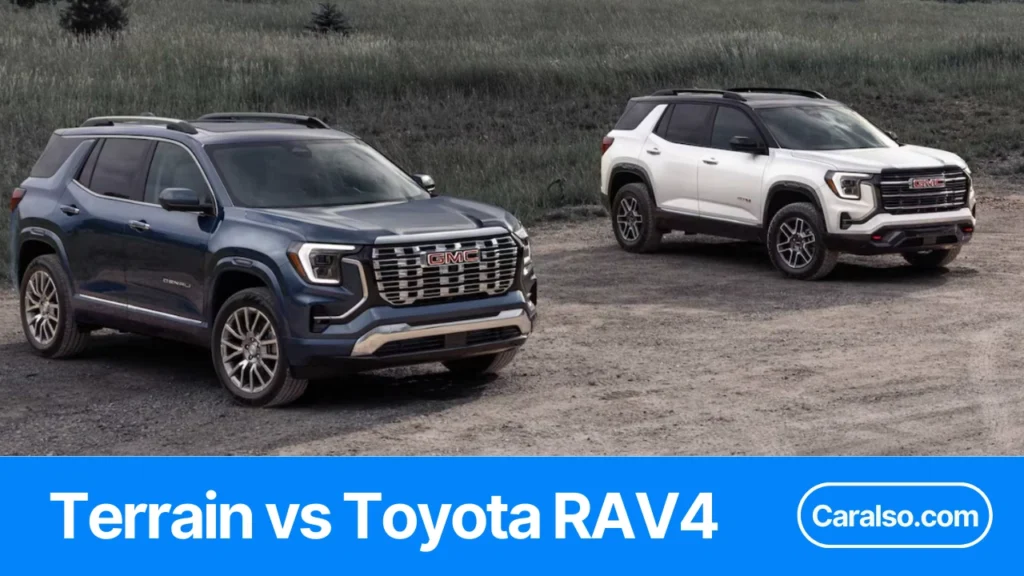
GMC Terrain vs Toyota RAV4
Hero Summary Table (Fast Comparison)
| What Most Buyers Care About | Toyota RAV4 (2026) | GMC Terrain (2026 or Latest Published) |
|---|---|---|
| Starting MSRP (Base Model) | $31,900 | $30,200 |
| Best Published MPG | Up to 47 city / 40 highway | 25 mpg combined (2025 AWD) |
| Cargo Behind 2nd Row | Up to 37.8 cu ft | 29.8 cu ft (2025 AWD) |
| Max Towing | Up to 3,500 lbs | Up to 1,500 lbs (2025) |
| Main Screen Size | 10.5 inches standard, 12.9 inches available | 15 inches standard |
| Drivetrain Note That Changes Feel | FWD or AWD depending on trim | FWD uses CVT, AWD uses 8-speed automatic (2025) |
Quick Verdict List
Pick The RAV4 If You Want:
- The best mpg numbers in this matchup, including up to 47 city and 40 highway mpg.
- More cargo room behind the second row, up to 37.8 cu ft.
- More towing headroom, up to 3,500 lbs.
Pick The Terrain If You Want:
- The biggest screen out of the box, 15 inches standard.
- A lower starting MSRP on paper, $30,200 for Elevation.
- A trim ladder that leans into looks and vibe, especially AT4 and Denali.
Decision Shortcut
Choose RAV4 If:
- You want the best mpg numbers in this matchup. Toyota lists up to 47 city and 40 highway mpg.
- You want more usable cargo space. It is 37.8 cu ft behind the second row and 70.4 cu ft with the seats folded.
- You want more towing headroom. AWD models can tow up to 3,500 lbs.
Choose Terrain If:
- You want the biggest screen without paying for a higher trim. GMC lists a 15-inch infotainment screen as standard.
- You tow light stuff. GMC lists up to 1,500 lbs when equipped.
- You want a simple trim walk. Elevation, AT4, and Denali.
Tie-Breaker:
- If you keep cars 8 to 10 years, I lean RAV4. If you lease 36 months and want the newest cabin tech up front, I lean Terrain.
Compare At A Glance (Table)
| What You’re Comparing | Toyota RAV4 (2026) | GMC Terrain (2026) |
|---|---|---|
| Starting Price (MSRP) | $31,900 | $30,200 |
| Powertrain Options | Hybrid standard; Plug-In Hybrid listed as an available powertrain | 1.5L turbo 4-cylinder; FWD or AWD |
| MPG Range (Published) | Toyota estimated mpg by trim ranges from 41 to 47 city and 35 to 40 highway | EPA numbers are not posted on GMC’s 2026 page. The outgoing 2025 AWD Terrain is 25 mpg combined. |
| Cargo Behind Second Row | 37.8 cu ft | 29.8 cu ft |
| Max Cargo (Seats Folded) | 70.4 cu ft | 63.5 cu ft |
| Max Towing | Up to 3,500 lbs (AWD) | Up to 1,500 lbs with the trailering package |
| Warranty (Basic, Powertrain) | 3 years or 36,000 miles basic; 5 years or 60,000 miles powertrain | 3 years or 36,000 miles limited; 5 years or 60,000 miles powertrain |
| Best Value Trim (My Pick) | XLE Premium | Elevation with the Elevation Premium package |
Important 2026 Update (Read This Before Comparing)
A lot of pages compare the wrong years. That can flip the winner.
2026 Toyota RAV4 Hybrid-Only Shift And What It Changes
For 2026, every RAV4 starts as a hybrid. There is no non-hybrid base engine.
That matters for 3 things.
- MPG is higher across the lineup than a typical gas-only compact SUV.
- Price looks higher if you compare it to older base gas models.
- Trim shopping changes, since your baseline is already a hybrid.
Here is the pricing detail that trips people up.
- Toyota shows $31,900 base MSRP for the RAV4 LE.
- Many outlets quote $33,350 because they include a $1,450 destination charge.
Toyota also lists a plug-in hybrid powertrain for 2026. Pricing and timing can be different than the standard hybrid trims, so I treat it as a separate decision.
2026 GMC Terrain: What’s New
The 2026 Terrain is a next-generation redesign.
The big daily-use changes are easy to see.
- A 15-inch infotainment screen is standard.
- Elevation includes heated front seats and a heated steering wheel.
- GMC lists over 16 standard safety and driver assistance features.
On the hardware side, GMC calls out a 1.5L turbo 4-cylinder engine. GMC also calls out an 8-speed automatic transmission with AWD, plus available Hill Descent Control. AT4 and Denali get AWD standard.
How To Compare Fairly
This is the rule I follow. Same model year. Similar MSRP. Similar drivetrain.
Use this quick checklist before you trust any chart.
- Same year on both sides, like 2026 vs 2026.
- Count destination in both prices, or count it in neither.
- Match FWD to FWD, or AWD to AWD.
- Match wheel and tire type. All-terrain tires change ride and mpg.
- If one side is hybrid, compare it to a hybrid. Not a base gas engine from a different year.
One more thing. GMC has not posted EPA mpg on its 2026 Terrain page. If you see mpg numbers in a comparison, it is often using 2025 data.
Pricing And Trims (Where The Value Really Is)
Starting Price Vs Real Price (What Shoppers Actually Pay)
I start with MSRP, then I build an out-the-door number.
Here is what usually moves the final price.
- Destination charge.
- Dealer doc fee.
- Add-ons, like tint, wheel locks, and paint protection.
- Incentives, which can change week to week.
For the RAV4, I treat $1,450 as the key number to remember, since many lists include it and many do not.
For the Terrain, GMC is showing purchase incentives on its site. These offers change fast, so I only use them as a shopping lever, not a guarantee.
Lease vs buy matters here.
- If you lease 36 months, incentives and monthly payment matter more than resale.
- If you buy and keep 8 to 10 years, fuel spend and resale matter more.
Terrain Trims Explained (Elevation Vs AT4 Vs Denali)
GMC keeps the 2026 Terrain lineup simple. I like that.
Elevation (Starting At $30,200)
- 15-inch infotainment is standard.
- Heated front seats and heated steering wheel are standard.
- 11-inch driver information center is listed.
AT4 (Starting At $39,400)
- Lifted ride height is listed.
- 17-inch wheels with all-terrain tires are listed.
- A front skid plate and steel underbody shield are listed.
- AT4 gets AWD standard.
Denali (Starting At $41,900)
- Heated and ventilated front seats are listed.
- Heated rear outboard seats are listed.
- 19-inch wheels are listed.
- Denali gets AWD standard.
My value note on Terrain.
- If you want the screen and the basics, Elevation is the price play.
- If you want the off-road look plus AWD, AT4 is the clean choice.
- If you care about seat features, Denali is the jump.
RAV4 Trims Explained (LE To Limited, Plus Plug-In Where It Fits)
Toyota lists 6 core trims on its 2026 RAV4 page. All of them are hybrid.
Base MSRP on Toyota’s page:
- LE: $31,900
- SE: $34,700
- XLE Premium: $36,100
- Woodland: $39,900
- XSE: $41,300
- Limited: $43,300
Drivetrain setup matters.
- LE, SE, and XLE Premium can be FWD or AWD.
- Woodland, XSE, and Limited list AWD as standard.
My best-value pick depends on what you care about.
- If you want the lowest entry price, LE is it.
- If you want the best value per dollar, I usually land on SE or XLE Premium.
- If you want the rugged look and standard AWD, Woodland is the shortcut.
- If you want the nicer cabin setup without going full Limited, XSE is the step.
Skip-this logic that saves money.
- Skip Woodland if you want max mpg. Toyota lists 41 city and 35 highway mpg for Woodland, while other trims list higher.
- Skip Limited if you do not care about premium audio and the panoramic roof style features. The price gap is real.
On the plug-in hybrid.
- Toyota lists a PHEV powertrain option for 2026.
- Some outlets report pricing and availability later than the standard hybrid trims.
Best Trim-Match By Budget
| Budget Band (MSRP, Before Taxes And Fees) | My Terrain Match | My RAV4 Match | Why I Match Them |
|---|---|---|---|
| $30,000 to $33,500 | Terrain Elevation ($30,200) | RAV4 LE ($31,900) | Entry trims with the core experience. |
| $34,000 to $37,500 | Elevation with packages | RAV4 SE ($34,700) or XLE Premium ($36,100) | This is where comfort and daily tech usually land. |
| $39,000 to $42,500 | Terrain AT4 ($39,400) | RAV4 Woodland ($39,900) or XSE ($41,300) | Off-road look or sport styling, plus standard AWD on these picks. |
| $42,500 to $45,000 | Terrain Denali ($41,900) | RAV4 Limited ($43,300) | Seat features and upgraded cabin focus. |
Engines, Performance, And Drivability
I split this section into 3 real questions. How it feels at 30 mph. How it feels at 70 mph. And what it can pull.
Powertrain Overview
Here is the simple spec story.
Terrain (2026)
- Engine: 1.5L turbo 4-cylinder
- Output: 175 hp
- Torque: 184 lb-ft (FWD) or 203 lb-ft (AWD)
- Transmission: CVT (FWD) or 8-speed automatic (AWD)
RAV4 (2026)
- Engine: 2.5L 4-cylinder with a hybrid system
- Output: 226 hp (FWD) or 236 hp (AWD)
- Transmission: eCVT style hybrid drive
If you want the fast version of the RAV4 story, it is the plug-in hybrid. Toyota lists up to 320 combined system net horsepower and a 0 to 60 mph time of 5.6 seconds for the RAV4 Plug-in Hybrid.
Acceleration And Passing Power
These two SUVs do speed in very different ways.
The Terrain uses a turbo 1.5L. It gives you a torque hit early. But with the FWD CVT, the engine can sit at a steady rpm when you push hard. That is normal CVT behavior.
The RAV4 hybrid feels different at low speeds. You get electric assist right away. That makes parking-lot and 25 mph roll-ons feel clean.
For hard numbers, I lean on instrumented tests.
- A 2025 Terrain AWD Elevation needed 8.6 seconds to reach 60 mph in Car and Driver testing.
- A 2026 RAV4 Hybrid did 0 to 60 mph in 7.1 seconds in Car and Driver testing.
If you are doing a quick test drive, do this.
- Do a 30 to 60 mph merge with your foot down.
- Note the time it takes to go from 45 to 65 mph.
- Listen for engine rpm behavior at wide-open throttle.
Towing And Hauling
This is where the gap can be huge, depending on trim.
RAV4 (2026)
- Some trims tow 1,750 lbs.
- Other trims tow up to 3,500 lbs.
- The cutoff matters. FWD models and the AWD LE are the lower number. Most other AWD trims are the higher number.
Terrain (2026)
- FWD max trailering is 800 lbs.
- AWD max trailering is 1,500 lbs.
My rule: if you tow more than 1,500 lbs even a few times a year, the Terrain is not the right tool. The RAV4 is the one that can reach 3,500 lbs when configured for it.
Also remember the towing math people forget.
- A 3,500-lb trailer can put 350 to 525 lbs on the hitch at 10% to 15% tongue weight.
- That tongue weight counts against payload.
- Add 2 adults at 350 lbs total and 100 lbs of gear and you can burn payload fast.
Fuel Economy And Running Costs
Fuel economy is where most people feel the difference every week. I see it at the pump. And I see it in range on a road trip.
MPG Comparison (City, Highway, Combined)
RAV4 (2026)
- Toyota lists up to 47 city and 40 highway mpg in the most efficient setup.
- Car and Driver says EPA ratings are not published yet, and Toyota estimates up to 44 mpg combined for the most efficient hybrid setup.
- In Car and Driver’s real-world 75 mph highway test, a RAV4 Hybrid Limited AWD achieved 36 mpg.
Terrain (2025 EPA Ratings, Useful As A Baseline)
- 2025 Terrain FWD: 27 mpg combined (26 city, 28 highway)
- 2025 Terrain AWD: 25 mpg combined (24 city, 28 highway)
Why the hybrid advantage shows up in normal life.
- Stop-and-go driving gives the hybrid more chances to recapture energy with regen.
- Short trips are where hybrids can shine, if the engine is not running hard.
When the gap shrinks.
- Long highway stretches at 75 mph.
- Winter driving with heat running.
- All-terrain tires and roof boxes.
What You’ll Spend On Fuel (Simple Calculator)
This is the formula I use:
Annual Fuel Cost = (Miles Per Year ÷ MPG) × Price Per Gallon
Here is a clean example you can copy and edit.
- Terrain: 25 mpg combined (EPA for 2025 AWD)
- RAV4: 40 mpg combined (a conservative planning number for a hybrid compact SUV)
- Gas price: $3.50 per gallon
| Miles Per Year | Terrain Gallons (25 MPG) | Terrain Fuel Cost | RAV4 Gallons (40 MPG) | RAV4 Fuel Cost | Difference Per Year |
|---|---|---|---|---|---|
| 12,000 | 480 | $1,680 | 300 | $1,050 | $630 |
| 15,000 | 600 | $2,100 | 375 | $1,312.50 | $787.50 |
If you want to tighten the estimate, swap in your numbers.
- If you buy a Terrain FWD, use 27 mpg combined.
- If you buy a RAV4 Woodland, plan for lower mpg than the most efficient trim.
- If you drive 75 mph daily, use a lower mpg number than the city estimate.
Space, Comfort, And Daily Usability
Cargo Space And Family Practicality
Here’s the stat that gets people confused.
Some pages quote the “max cargo” number with the rear seats folded and treat it like the normal trunk. That is not how you live with the car day to day.
These are the numbers that matter:
- Cargo Behind 2nd Row (Normal Grocery Run)
- RAV4: 37.8 cu ft
- Terrain: 29.8 cu ft
- Max Cargo With Seats Folded (Bike, Boxes, Costco Haul)
- RAV4: 70.4 cu ft
- Terrain: 63.5 cu ft
My real-world takeaway.
If you keep the rear seats up most of the time, the RAV4 gives you more usable space on a normal day.
Stroller test advice (this beats cubic feet).
Bring the stroller you actually use. Or measure it at home.
- Measure the stroller at its biggest folded size.
- Length
- Width
- Height
- At the dealer, open the hatch and check 3 things.
- Opening height: Can you lift it in without tilting and twisting?
- Opening width: Do the wheels snag the trim?
- Floor length with seats up: Can it lay flat without forcing the hatch down?
The Terrain does give you practical storage features like 60/40 rear seats and an underfloor storage compartment, plus passthrough storage in the console. The RAV4 also does 60/40 folding rear seats.
Rear-Seat Comfort And Car Seats
If you put adults in the back a lot, I start with rear legroom.
- Terrain rear legroom: 39.7 in
- RAV4 rear legroom: 37.8 in
That 1.9-inch gap is noticeable on longer drives. Especially if the front seats are pushed back.
Car-seat reality check.
Both are 5-seaters with LATCH anchors. But day-to-day usability is about access.
This is what I check every time:
- Can I open the rear door wide enough to rotate a bulky convertible seat in?
- Can I reach the lower anchors without scraping my hands on seat cushions?
- With a rear-facing seat installed, can a front passenger still sit comfortably?
If you are doing rear-facing behind a tall driver, the Terrain’s extra rear legroom can make the setup easier.
Ride Comfort And Noise
I do not trust a 5-minute smooth-road loop.
I test these 3 surfaces:
- Rough asphalt at 35 to 45 mph
- Concrete freeway at 65 to 75 mph
- A short pothole stretch at 15 to 25 mph
What I listen for:
- Tire roar on rough pavement
- Wind noise around the A-pillars at 70 mph
- Seat comfort after 20 minutes
One spec-sheet clue.
The Terrain lists active noise cancellation. That can help reduce certain cabin frequencies, but it will not erase loud tires.
Quick parking note.
Turning diameter is close.
- RAV4: 36.9 ft
- Terrain: 37.1 ft
That means both are easy to live with in tight lots.
Tech And Safety (What You Get For The Money)
Infotainment And Phone Integration
This is where the Terrain swings hard.
- Terrain
- 15-inch infotainment screen
- Google built-in compatibility
- Wireless Apple CarPlay and wireless Android Auto
- RAV4
- 10.5-inch Toyota Audio Multimedia
- Wireless Apple CarPlay and Android Auto
- 12.3-inch digital gauge cluster
If you love big-screen mapping and native-style apps, the Terrain’s setup is the draw. If you just want simple phone mirroring that works every time, both can deliver it.
Here’s the practical test I do:
- Connect wireless CarPlay or Android Auto.
- Start navigation.
- Start a podcast.
- Change the cabin temperature.
- Try to do all of that without hunting through menus.
If you can do it cleanly in 30 seconds, that system is a win.
Driver-Assist Features
I focus on 2 things.
- What is standard on the base trim
- Whether the system is actually useful on highways
Terrain standard safety and driver-assist highlights include a long list of features such as:
- Enhanced Automatic Emergency Braking
- Forward Collision Alert
- Lane Keep Assist With Lane Departure Warning
- Adaptive Cruise Control
- Intersection Automatic Emergency Braking
- Rear Cross Traffic Braking
- Reverse Automatic Braking
- Blind Zone Steering Assist
- Front Pedestrian And Bicyclist Braking
RAV4’s Toyota Safety Sense feature set includes the core “daily driver” assists:
- Pre-Collision System With Pedestrian Detection
- Dynamic Radar Cruise Control
- Lane Departure Alert With Steering Assist
- Lane Tracing Assist
- Road Sign Assist
For 2026, Toyota also positions the RAV4 as having Toyota Safety Sense 4.0.
My quick advice.
If you spend a lot of time on highways, test adaptive cruise and lane centering in real traffic. Do it at 65 to 75 mph. Some systems feel calm. Some feel busy.
Safety Ratings (IIHS / NHTSA)
I use IIHS as my first stop because it breaks down the crash tests by type.
Here’s what I can confirm from IIHS pages right now:
- Toyota RAV4 (ratings apply to 2019 to 2026 models)
- Small overlap front: Good
- Moderate overlap front, updated test (applies to 2021 to 2026 models): Marginal
- GMC Terrain prior generation (ratings apply to 2018 to 2024 models)
- Small overlap front: Good
- Moderate overlap front, original test: Good
- Side, updated test: Marginal
Important context for your 2026 comparison.
The 2026 Terrain is a next-generation model. That means you should not assume the 2018 to 2024 IIHS results carry over.
My process:
I check the IIHS page for the exact model year you are buying. Then I check the trim because headlights and crash-prevention performance can vary.
If you want to double-check NHTSA star ratings, use the NHTSA vehicle lookup for the exact year and drivetrain. Ratings can differ by configuration.
Reliability, Resale Value, And Ownership Horizon
Reliability Expectations (How I Think About It Without Hype)
I look at 2 things first. Repair frequency. Repair cost.
Here is a simple benchmark from RepairPal:
- RAV4 reliability rating: 4.0 out of 5.0. Rank: 3rd out of 26 compact SUVs. Average annual repair cost: $429.
- Terrain reliability rating: 3.5 out of 5.0. Rank: 22nd out of 26 compact SUVs. Average annual repair cost: $558.
Now the reality check.
The 2026 Terrain is a redesign. The 2026 RAV4 is also a redesign. First-year vehicles can be fine, but I plan for more unknowns than a mid-cycle year.
My personal risk rule:
- If I’m buying to keep 8 to 10 years, I lean toward the model with the stronger long-run reliability track record and lower average repair cost.
- If I’m leasing 36 months, I care more about warranty coverage and monthly payment than decade-long durability.
Warranty Coverage Comparison
These are the numbers that matter if you keep the SUV past the honeymoon phase.
Toyota (RAV4)
- Basic warranty: 3 years or 36,000 miles
- Powertrain warranty: 5 years or 60,000 miles
- Hybrid system coverage: 8 years or 100,000 miles
- Hybrid battery coverage: 10 years or 150,000 miles
GMC (Terrain)
- Limited bumper-to-bumper: 3 years or 36,000 miles
- Powertrain: 5 years or 60,000 miles
- Rust-through coverage is also listed separately by GM, and it runs longer than the basic warranty
My takeaway:
If you are worried about big hybrid components, Toyota puts real mileage behind the battery coverage.
Resale And Depreciation Outlook
This is where the RAV4 usually creates real money.
Two data points I use a lot:
- KBB listed the 2025 RAV4 in its Best Resale Value Top 10, with a projected 53.9% 5-year resale value.
- iSeeCars shows 5-year depreciation of 30.3% for the RAV4 vs 49.3% for the Terrain in its comparison.
Here is what that looks like with simple math on a $35,000 purchase price:
- 30.3% depreciation: $10,605 lost value over 5 years
- 49.3% depreciation: $17,255 lost value over 5 years
- Difference: $6,650
You will not land exactly on those numbers. Your trim, miles, and zip code matter.
But the direction is the point.
Resale value changes the true cost of ownership fast.
3 Ownership Profiles, Who Wins?
I use this scorecard when friends ask me “keep it or flip it.”
| Ownership Profile | What I Prioritize | My Pick | Why I Pick It |
|---|---|---|---|
| Lease 36 Months | Monthly payment, tech per dollar, warranty coverage inside the lease | Terrain | You get the 15-inch screen standard and you live inside the warranty window. |
| Keep 5 To 6 Years | Depreciation, fuel spend, fewer surprise repairs | RAV4 | Depreciation trends favor RAV4, and mpg is higher for most drivers. |
| Keep 10+ Years | Repair cost history, hybrid coverage, resale backstop | RAV4 | RepairPal shows lower annual repair cost, and Toyota’s hybrid battery coverage runs to 10 years or 150,000 miles. |
My simple rule:
If you plan to sell in 3 years, buy the one you will enjoy daily. If you plan to keep it past 60,000 miles, let depreciation and repair cost do the talking.
Which Should You Buy? (Use-Case Decision Matrix)
Best For Commuting And MPG
If your drive has traffic lights, school lines, and 30 to 60 mph bursts, I pick the RAV4.
Verdict: Buy the RAV4 if you want fewer fuel stops and a hybrid every day.
Best For Families And Cargo
If you haul strollers, groceries, and sports gear with the rear seats up, I pick the RAV4.
Cargo behind the 2nd row is 37.8 cu ft in the RAV4 vs 29.8 cu ft in the Terrain.
Verdict: Buy the RAV4 if cargo space is your daily problem.
Best For Snow And Winter Driving
Both offer AWD, but ground clearance matters when roads get rutted.
Terrain ground clearance is listed at 5.75 inches, and RAV4 Woodland is listed at 8.5 inches.
Verdict: Buy the RAV4 if you deal with deeper snow or unplowed side streets.
Best For Road Trips
On long highway days, I care about range and fatigue.
More mpg usually means fewer stops, and that usually means less time lost.
Verdict: Buy the RAV4 if you do long drives and want fewer fuel stops.
Best For Long-Term Ownership
If you are keeping the SUV until 120,000 miles, I lean hard on reliability and coverage.
RepairPal shows $429 average annual repair cost for RAV4 vs $558 for Terrain, and Toyota’s hybrid battery coverage goes to 10 years or 150,000 miles.
Verdict: Buy the RAV4 if you plan to keep it for the long run.
Real-World Test Drive Checklist (My Pro Tip)
I do the same 10-minute loop every time. It tells me more than a spec sheet.
My 10-Minute Route
Minute 0 to 2: Parking Lot And Neighborhood (0 to 25 Mph)
- Turn full lock left and right. Listen for tire scrub and steering clunks.
- Do 2 slow stops from 15 mph. Check brake pedal feel and initial bite.
- Check visibility. Count how many head turns you need to clear the rear pillars.
Minute 2 to 6: Rough City Road (25 to 45 Mph)
- Hit a few patched seams. Note suspension rebound. One bounce is fine. Two is not.
- Roll on from 20 to 40 mph at half throttle. Note how fast it responds.
- Try lane centering on a straight section. Keep hands on the wheel. Check for ping-ponging.
Minute 6 to 10: Highway On-Ramp And 65 To 75 Mph Cruise
- Do one merge run from 45 to 65 mph. Count seconds in your head.
- Set adaptive cruise at 70 mph. Let the car adjust speed behind another vehicle.
- Turn the radio off for 20 seconds. Listen for wind noise and tire roar.
The 6 Things I Always Score (1 To 10)
Power Delivery
- Does it respond in 1 second when I tip in at 30 mph?
Transmission Behavior
- Terrain: Does the CVT feel steady under load in FWD?
- RAV4: Does the hybrid feel smooth at low speed and steady at highway speed?
Braking Feel
- Does it stop straight from 45 mph?
- Does the pedal get softer after 2 quick stops?
Cabin Noise At 70 Mph
- Can I talk at normal voice level?
- Do I hear mostly wind, or mostly tires?
Driver Assist Behavior
- Does lane centering hold the middle of the lane, or hunt?
- Does adaptive cruise brake hard, or brake early?
Cargo And Seat Fold Reality
- Open the hatch and measure with your eyes.
- Fold the rear seats. Time it.
- Aim for under 15 seconds to fold both sides and create a flat load floor.
Quick Checks That Save Me From Regret
Phone Test
- Pair wireless CarPlay or Android Auto.
- Start maps and music.
- Change temp and fan speed.
- If it takes more than 30 seconds, I know I will hate it later.
Camera Test
- Back into a tight spot.
- Check if the view is wide enough to see curb edges.
Rear Seat Test
- Put the driver seat where you need it.
- Sit behind it.
- If your knees touch, it is a no for long trips.
FAQs
Is The Toyota RAV4 More Reliable Than The GMC Terrain?
Based on RepairPal, yes.
The RAV4 shows a 4.0 out of 5.0 reliability rating and $429 average annual repair cost.
The Terrain shows a 3.5 out of 5.0 rating and $558 average annual repair cost.
If I plan to keep the SUV past 100,000 miles, that gap matters.
Which Gets Better Gas Mileage: Terrain Or RAV4?
The RAV4.
Toyota lists up to an estimated 47 city and 40 highway mpg for the 2026 RAV4.
For the 2025 Terrain, EPA shows 27 mpg combined for FWD and 25 mpg combined for AWD.
If you drive 12,000 miles per year, a 15 mpg combined gap can be hundreds of dollars per year at the pump.
Which Is Bigger Inside: Terrain Or RAV4?
It depends on what “bigger” means to you.
Terrain gives more rear legroom at 39.7 inches, versus 37.8 inches in the RAV4.
RAV4 gives more cargo behind the second row at 37.8 cu ft, versus 29.8 cu ft in the Terrain.
If you carry people, Terrain wins that specific measurement. If you carry stuff, RAV4 wins.
Which Is Better In Snow?
If you get deep snow, I look at ground clearance first.
Edmunds lists 5.75 inches for the Terrain and 8.4 inches for the RAV4 it compares.
That is a 2.65-inch difference.
For icy roads, tires matter more than badges. Budget for a real winter tire if you see regular ice.
Is The 2026 RAV4 Hybrid-Only, And Does It Matter?
Yes. Toyota positions the 2026 RAV4 as a fully hybrid lineup.
It matters because your base model mpg is higher than a typical gas compact SUV.
It can also matter for price, because you are not comparing to an old gas base model anymore.
Which Trims Are The Best Value?
Here is how I spend real money.
Best Value Terrain Trim
- Elevation.
- You get the 15-inch screen without jumping to AT4 or Denali.
Best Value RAV4 Trim
- SE or XLE Premium.
- The price jump is usually tied to comfort and daily-use features, not just looks.
If you want standard AWD without thinking about it
- Terrain AT4.
- RAV4 Woodland, XSE, or Limited.
Key Takeaways
- Best MPG: RAV4. Toyota lists up to 47 city and 40 highway mpg for 2026.
- Best Cargo With Seats Up: RAV4. 37.8 cu ft behind the second row vs 29.8 cu ft for Terrain.
- Best Rear Seat Legroom: Terrain. 39.7 inches vs 37.8 inches for RAV4.
- Best Towing Headroom: RAV4. Up to 3,500 lbs on AWD models, versus up to 1,500 lbs on Terrain when equipped.
- Best Big-Screen Value: Terrain. GMC lists a 15-inch screen as standard.
- Best Long-Run Ownership Math: RAV4. Lower RepairPal annual repair cost and stronger resale data in major forecasts.
Sources
- Toyota Official RAV4 Page
- GMC Official Terrain Page
- IIHS: 2025 Toyota RAV4 Ratings
- RepairPal: Toyota RAV4 Reliability
- Kelley Blue Book: 2025 Best Resale Value Awards

Hey there,
How is it going?
I’m Meraj Sarker. I am a Car Mechanic and a student of Automobile Restoration here in Florida, USA. I’ve been studying automotive for around 9 years now. So you can rely on my recommendation. For me, studying and getting knowledge about automobile it’s really fun and entertaining. I will help you to get solutions for your car through this website. If you need any help let me know.