
Quick Answer
If you want the safer long-term bet, I’d buy the RAV4. For 2026, it is hybrid-only, it is newly redesigned, and it keeps the strongest “buy it and keep it” vibe in this class.
I’d pick the Escape if you want a smaller-feeling SUV that is easy to live with, you want a plug-in that drives the front wheels only, or you find a great deal on remaining inventory.
Pick The RAV4 If You…
- Plan to keep it 5 to 10 years.
- Want standard hybrid power across the lineup for 2026.
- Want stronger towing on most AWD trims up to 3,500 lb.
- Want the quicker plug-in option with 320 hp and AWD.
Pick The Escape If You…
- Want multiple powertrains, including a 2.0L turbo option.
- Want strong cargo space in a compact footprint and a sliding rear seat feel.
- Want a plug-in hybrid that is simple and front-wheel drive only.
- Find a price that is clearly lower than a comparable RAV4.
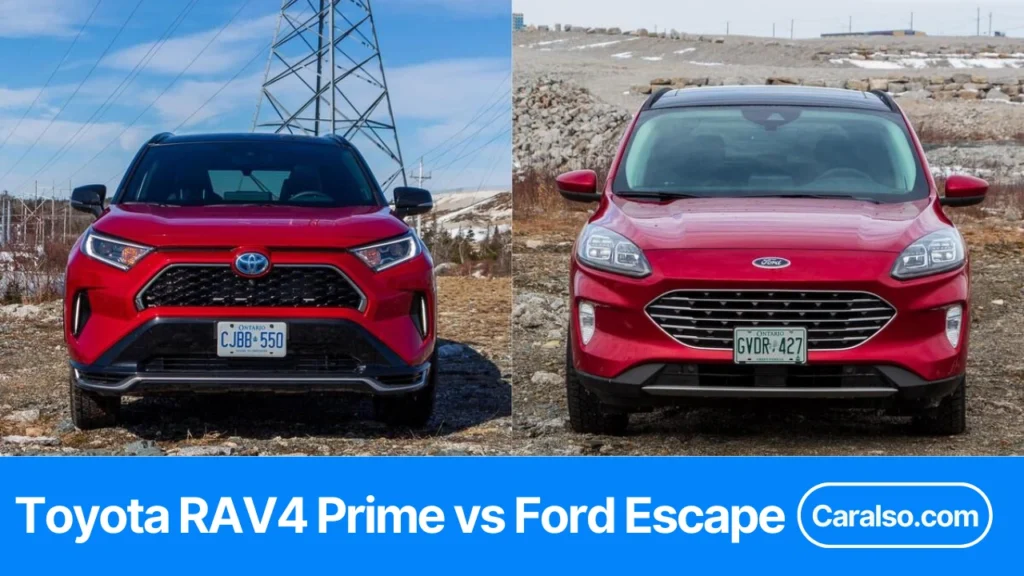
Ford Escape Vs Toyota RAV4
At-A-Glance Winners (2026)
| Category | Winner | The Reason I’d Care |
|---|---|---|
| Long-Term Ownership Confidence | RAV4 | 2026 is a full redesign and hybrid-only setup. It is built around electrified power from day one. |
| Hybrid Lineup | RAV4 | Hybrid is standard for 2026. AWD hybrid is a core part of the lineup. |
| Plug-In Punch | RAV4 | The 2026 plug-in is rated at 320 hp and comes with AWD. |
| Plug-In Simplicity | Escape | The Escape PHEV is front-wheel drive only, which can be a plus if you do not need AWD. |
| Towing On Non-Hybrid Models | Escape | Up to 3,500 lb with the 2.0L EcoBoost when properly equipped. |
| Towing On Hybrid Models | RAV4 | Many AWD trims are rated up to 3,500 lb. Escape Hybrid and PHEV are rated at 1,500 lb. |
| Cargo Behind 2nd Row | RAV4 (By A Hair) | 37.8 cu ft vs 37.5 cu ft for the Escape gas model. Hybrid Escape trims can be lower. |
| Max Cargo With Seats Folded | RAV4 | About 70 cu ft class max vs about 65 cu ft max in the Escape gas model. |
| “Buy It New In 2026” Clarity | RAV4 | Easy story: hybrid-only RAV4 for 2026. Escape is late in its lifecycle and inventory-based in many areas. |
Biggest Differences (30-Second Summary)
You can make this decision fast if you focus on three things.
- The 2026 RAV4 is hybrid-only and all-new.
- The 2026 Escape gives you more powertrain variety, but its plug-in is FWD only and the model is near the end of its current run.
- If you tow, the details matter. RAV4 AWD trims can hit 3,500 lb. Escape can hit 3,500 lb only with the 2.0L turbo. Hybrid and PHEV Escapes are 1,500 lb.
What The Escape Does Better
More powertrain choices.
For 2026 you can still shop 1.5L turbo, 2.0L turbo, hybrid, or plug-in hybrid. I like having that menu because it lets you buy based on your driving, not just a trim badge.
A strong “deal” angle.
Because the Escape is late-cycle, I often see sharper pricing and incentives. If your goal is a lower out-the-door number, Escape is usually the easier path.
Turbo towing option.
If you want 3,500 lb towing in this matchup, Escape can do it with the 2.0L EcoBoost and the right equipment.
What The RAV4 Does Better
A cleaner 2026 lineup.
Every 2026 RAV4 is a hybrid. That makes shopping simpler. It also means you are not paying extra to “upgrade” into electrified power.
More towing on the trims people actually buy.
Once you step into many AWD trims, you are looking at up to 3,500 lb. That is enough for a small camper or a pair of jet skis with the right trailer setup.
The plug-in setup is the enthusiast pick.
If you want the plug-in that feels like the performance option, the 2026 RAV4 Plug-in Hybrid is the one. It is rated at 320 hp and it comes with AWD.
New For 2026 That Changes The Decision
If you are shopping new, 2026 is not a normal year for this matchup.
The RAV4 is a full redesign and it goes hybrid-only. The Escape is basically a carryover and many sources now treat 2026 as its last model year. That changes pricing, availability, and resale math.
2026 Change Snapshot
| Topic | 2026 Ford Escape | 2026 Toyota RAV4 |
|---|---|---|
| Big Picture | Carryover. Widely positioned as the final model year. | Full redesign. Hybrid or plug-in hybrid only. |
| Base Powertrain | 1.5L turbo gas available. | Hybrid standard. No gas-only model. |
| Hybrid Output | 192 total system hp (hybrid). | 226 hp (FWD hybrid) or 236 hp (AWD hybrid). |
| Plug-In EV Range | 37 miles EPA-estimated. | Up to 52 miles manufacturer-estimated. |
| Plug-In Drivetrain | FWD only. | AWD standard. |
| Fast Charging | No DC fast charging. | Select trims offer DC fast charging with a CCS port. |
| Availability Note | Ford flags CARB-state certification risk for 2026. | Broad availability expected. Plug-in arrives later than hybrid. |
2026 Toyota RAV4: Hybrid Only Standard (Why It Matters For MPG And Pricing)
This is the big one.
For 2026, the RAV4 drops the gas-only model. Every 2026 RAV4 is either a regular hybrid or a plug-in hybrid.
What I care about as a buyer is simple.
- Your “base RAV4” now includes an electrified powertrain.
- The price floor rises because Toyota removed the cheaper gas entry point.
- Your fuel cost per mile usually improves, especially if you drive a lot of city miles.
Toyota also brings back something I wanted for years. Hybrid FWD is a thing again on the RAV4 for 2026. That can be the mpg sweet spot.
Power numbers matter here.
The 2026 RAV4 hybrid is 226 hp in FWD form and 236 hp with AWD. If you want the plug-in hybrid, output climbs into the low 320s and AWD is standard.
The plug-in hardware is the other real change.
Toyota is adding DC fast charging capability on specific plug-in trims, plus faster AC charging with an available 11 kW onboard charger. That matters if you road trip and rely on public chargers.
One more timing note.
Hybrid models were slated to reach dealers first, with plug-in models later. If you want plug-in, you may be shopping a smaller pool for a while.
2026 Ford Escape: Model Availability And “Final Model Year” Positioning
For 2026, the Escape story is less about upgrades and more about strategy.
A lot of major references are framing 2026 as the last model year for the Escape. If that is true in your market, it usually means two things at the dealer.
- More motivation to move inventory.
- More variance in trim availability as the year goes on.
The Escape still gives you a wide menu.
Ford lists four powertrains for 2026: plug-in hybrid, hybrid, 1.5L EcoBoost, and 2.0L EcoBoost.
Here is the part many shoppers miss.
Ford also posts an availability notice for the 2026 Escape tied to CARB emissions states. If you live in California, Massachusetts, New York, Oregon, Vermont, or Washington, I would verify registration eligibility before you get emotionally attached to a specific VIN.
On the plug-in side, the Escape PHEV is straightforward.
It is rated at 37 miles of electric range and 210 total system horsepower. It is also FWD only. That is the trade.
What This Means For Incentives, Resale Confidence, And “Buy Now Vs Wait”
This is how I would play it.
If you want the best chance at a discount, the Escape is usually the better bet. A carryover model, plus “final year” vibes, often equals more incentive activity. Not always. But often.
If you care about resale value, the RAV4 has a strong track record. Data sets that track depreciation typically show the RAV4 holding value far better than the Escape over a 5-year window.
If you are deciding when to buy, here is my rule.
Buy now if:
- You are seeing a real out-the-door deal on an Escape that fits your needs.
- You do not want to pay early-cycle pricing on a redesigned RAV4.
- You want a simple gas powertrain option at a lower entry price.
Wait if:
- You specifically want the redesigned 2026 RAV4 hybrid-only lineup.
- You want the newest plug-in tech from Toyota, including DC fast charging on certain trims.
- You plan to keep it 5 to 10 years and resale is part of your math.
Price & Value (New And Used)
Typical MSRP Spread (Use Ranges By Trim)
I look at this in two layers.
Layer 1 is gas vs hybrid.
Layer 2 is hybrid vs plug-in.
Here is the cleanest new-MSRP framing using current published ranges.
| New MSRP Range (Typical) | What You Are Really Comparing |
|---|---|
| Escape (Gas) | Lower entry price. You are giving up the standard hybrid advantage. |
| Escape Hybrid | Priced closer to RAV4 territory. Competes on features and deal size. |
| RAV4 Hybrid | Higher floor than past years because hybrid is standard. |
| RAV4 Plug-In | Price not always published early. Expect a jump over the hybrid. |
In plain numbers, published MSRP ranges put the Escape gas lineup roughly in the low $30k range into the high $30k range. Escape Hybrid is typically mid $30k into the high $30k range. 2026 RAV4 hybrid trims run from the low $30k range into the mid $40k range depending on trim and drivetrain.
That tells me something important.
If you were already planning to buy an Escape Hybrid, the “RAV4 costs way more” argument gets smaller fast.
Which One Is The Better Value For Features
This is how I see value in 2026.
RAV4 value is powertrain-first.
You are paying for standard hybrid hardware, plus the newest generation packaging and tech.
Escape value is deal-first.
If you find meaningful rebates or dealer discounts, the Escape can undercut the RAV4 on monthly payment. Especially on gas trims.
For plug-ins, the value swing is about charging reality.
- Escape PHEV gives you 37 miles of EV range and it is FWD only.
- RAV4 plug-in aims higher on EV range and adds DC fast charging on select trims, plus AWD standard.
If your plan is “I will charge on trips,” the RAV4 plug-in’s charging options can matter more than you think.
Best Value Trims (Short List)
Here is how I would shortlist trims if you told me you want value, not a showroom trophy.
RAV4:
- LE Hybrid FWD if you want the lowest buy-in and best mpg potential.
- SE Hybrid if you want the popular comfort and safety adds without jumping to the top trims.
- XSE or Woodland Plug-In if DC fast charging is a must-have for you. Not every plug-in trim gets it.
Escape:
- Active with the 1.5L if you are chasing the lowest entry price and you drive mostly highway miles.
- ST-Line Select Hybrid if you want hybrid hardware and AWD in the mix without going straight to the priciest trim strategy.
- Plug-In Hybrid only if you are good with FWD and you can actually charge at home or at work.
What To Watch On Dealer Add-Ons
This is where people donate money without realizing it.
I watch five line items.
- Dealer “protection package”
If it adds $1,000 to $2,500 and you did not ask for it, I treat it as optional. - Paint and fabric protection
If it is not a real ceramic coating invoice with a product name and warranty terms, I pass. - Nitrogen tires
Tires already contain mostly nitrogen. I do not pay for this. - Extended warranty packed into financing
If you want coverage, price it separately first. Do not roll it in blindly. - Mandatory accessories
Roof rails, mats, wheel locks, tint. Fine. But only if the price matches real parts and labor.
My move is simple.
I ask for an out-the-door quote with every fee itemized. Then I compare two dealers.
Powertrains Explained (Gas Vs Hybrid Vs Plug-In) | Choose The Right One
This matchup is weird in 2026 because the RAV4 does not offer a gas-only model. The Escape still does.
So I start with one question.
Do you want to plug in?
Gas Models: Who They’re For
If you are shopping a 2026 Escape gas model, you are choosing between two engines.
1.5L EcoBoost (FWD or AWD)
- 27 city, 34 highway, 30 combined with FWD
- 26 city, 32 highway, 28 combined with AWD
2.0L EcoBoost (AWD only)
- 23 city, 31 highway, 26 combined
- Towing can reach 3,500 lb with the right tow package
I buy the gas Escape when:
- I drive mostly highway miles.
- I do not have home charging.
- I want the lowest entry price and I plan to trade in 3 to 5 years.
- I tow more than 1,500 lb and I want the simplest setup.
Hybrid Models: Who Benefits Most
In 2026, every RAV4 is a hybrid or a plug-in hybrid.
That makes the RAV4 hybrid the default choice if you want a normal ownership routine. No plugging in. No charger decisions.
RAV4 Hybrid (2026)
- 226 hp with FWD
- 236 hp with AWD
- Up to an estimated 47 city and 40 highway mpg in the most efficient trims
- Towing can reach 3,500 lb on specific AWD trims
Escape Hybrid (2026)
- Up to 42 city, 36 highway, 39 combined mpg (Ford’s posted EPA estimates)
- Towing is 1,500 lb when properly equipped
I buy the hybrid version of either SUV when:
- My commute has stop-and-go driving.
- I do lots of short trips under 10 miles.
- I want a big mpg jump without changing my routine.
My quick way to decide between hybrid versions is towing and trim availability.
If you will tow over 1,500 lb, the Escape Hybrid is not my pick.
If you want a hybrid-only shopping experience with fewer powertrain decisions, I lean RAV4.
Plug-In Hybrids: The Real Tradeoffs
A plug-in hybrid only makes sense if you can charge it consistently.
Home charging is the cheat code.
Work charging is the next best thing.
If you cannot charge at least 4 days a week, I usually tell friends to buy the regular hybrid.
Here is the clean comparison that matters.
Plug-In Mini-Table (Range, Drivetrain, Towing, Who Should Buy)
| Plug-In Model | EV Range | Drivetrain | Towing | Who I’d Buy It For |
|---|---|---|---|---|
| Escape Plug-In Hybrid | 37 miles (EPA-estimated) | FWD only | 1,500 lb | Short commutes. Home charging. No need for AWD. Lowest plug-in complexity. |
| RAV4 Plug-In Hybrid | Up to 52 miles (manufacturer-estimated) | AWD standard | Up to 3,500 lb (on key trims) | Longer EV commutes. Snow states. Higher towing needs. Want the strongest plug-in setup. |
Two more plug-in details I pay attention to.
Charging hardware
- Escape PHEV includes a 120V mobile cord. It can run like a normal hybrid if you never plug in.
- RAV4 Plug-In Hybrid adds faster AC charging options, and some trims add DC fast charging with a CCS port.
Winter impact
Cold weather hits EV range hard. I plan for a noticeable drop when temps are near freezing.
Seat heaters, defrost, and short trips make it worse.
My rule is simple.
If you want a plug-in because gas is expensive, you need charging access.
If you want a plug-in because you like electric driving, you need even more charging access.
Fuel Economy & Range (And Why Your MPG May Differ)
I care about two numbers.
Your highway mpg at 70 to 80 mph.
Your city mpg when traffic is real.
EPA Vs Real-World Patterns
These are the baseline numbers I use for 2026.
Fuel Economy Snapshot (Most-Common Configs)
| Model | Rating Type | Key Numbers |
|---|---|---|
| Escape 1.5T FWD | EPA estimates | 27 city, 34 highway, 30 combined |
| Escape 1.5T AWD | EPA estimates | 26 city, 32 highway, 28 combined |
| Escape 2.0T AWD | EPA estimates | 23 city, 31 highway, 26 combined |
| Escape Hybrid (listed config) | EPA estimates | 42 city, 36 highway, 39 combined |
| Escape Plug-In Hybrid | EPA estimates | 101 MPGe combined, 37 miles EV range, 40 mpg combined on gas after EV range |
| RAV4 Hybrid (best-case trims) | Estimated MPG | Up to 47 city, 40 highway, 43 combined |
| RAV4 Woodland Hybrid (AWD) | Estimated MPG | 41 city, 35 highway, 38 combined |
| RAV4 Plug-In Hybrid | Manufacturer estimates | Up to 52 miles EV range, up to 41 mpg combined in hybrid operation |
Now the real-world part.
Speed is the mpg killer.
At 75 mph, both SUVs will drop versus the window sticker.
Bigger wheels can drop mpg too.
AWD matters.
On hybrids, AWD usually costs a few mpg.
On the plus side, it often helps resale in snow states.
Cold starts matter more than people think.
A 2-mile trip can tank your average.
A 20-mile trip is where hybrids start to shine.
Tires and roof gear matter.
All-terrain tires, roof boxes, and hitch racks can cut mpg in a way you will feel at the pump.
If You Drive Mostly City
This is the easy one.
- I pick RAV4 Hybrid if I want a simple hybrid-only shopping experience for 2026.
- I pick Escape Hybrid if I get a stronger deal and I do not tow over 1,500 lb.
- I pick either plug-in only if I can charge most days.
If your daily drive is under 25 miles and you can charge at home, a plug-in can cut gas use hard.
If your daily drive is 40 to 60 miles, the RAV4 plug-in’s longer EV range becomes a bigger advantage.
If You Drive Mostly Highway
This is where people get surprised.
Hybrids can still do well, but the gap shrinks at 70 to 80 mph.
That is why I look at real highway habits.
- If you cruise fast and you want the lowest buy-in, the Escape 1.5T can make sense.
- If you tow, the Escape 2.0T AWD is the Escape I look at first.
- If you want the “one powertrain for everything” approach, the RAV4 hybrid-only lineup for 2026 keeps it simple.
For plug-ins on highway-heavy driving, I keep expectations realistic.
If you do not recharge during the day, you are basically hauling a battery for the first 30 to 40 miles.
Performance And Driving Feel
This is where the two SUVs split hard.
If you care about quick passing power, the Escape with the 2.0L turbo is the fast gas option. If you care about quick electric punch, the RAV4 Plug-In Hybrid is the fast electrified option.
Acceleration And Passing
Here are the 0-60 mph numbers I use to set expectations.
| Model | Powertrain | 0-60 mph |
|---|---|---|
| Escape (1.5L Turbo) | Gas | 7.7 sec |
| Escape (2.0L Turbo) | Gas | 5.8 sec |
| Escape Hybrid | Hybrid | 7.7 sec |
| Escape Plug-In Hybrid | Plug-In | 7.7 sec |
| RAV4 Hybrid (AWD Test) | Hybrid | 7.1 sec |
| RAV4 Plug-In Hybrid | Plug-In | 5.6 sec |
How I translate that into real life.
If you merge onto short on-ramps a lot, I aim for sub-6.5-second 0-60 mph. That usually feels relaxed at highway speed. In this matchup, that points to Escape 2.0L or RAV4 Plug-In Hybrid.
If you drive mostly city and suburbs, anything in the low 7s is fine. That is RAV4 Hybrid territory. The Escape Hybrid and Escape 1.5T are fine too. You just need to plan passing.
One note on the Escape plug-in. It is not the quick Escape. It is the efficient Escape. I buy it for EV miles, not for 0-60 mph.
Ride Comfort Vs Handling
I think both are tuned for daily driving, not for back roads.
I notice the Escape feels lighter on its feet in tight city turns. It is easy to place in a lane. The steering is light.
The RAV4 feels more planted at highway speed. I notice less float on long sweepers. The hybrid power blending is smooth in normal driving.
If you want to judge ride quality fast, do this on your test drive.
- Drive 25 mph over a rough patch. Listen for suspension thumps.
- Drive 55 mph on a wavy road. Feel for vertical bounce.
- Do one quick lane change at 45 mph. Feel for body roll and recovery.
I also watch wheel size. Bigger wheels usually mean sharper impacts over potholes. It can also mean more tire noise.
Cabin Noise (What To Listen For On Test Drive)
I do a noise check every time. It takes 3 minutes.
At idle
- Turn off the fan.
- Listen for vibration through the seat base and steering wheel.
At 35 mph
- Light throttle.
- Listen for a low hum from the tires.
At 70 mph
- Hold steady speed for 20 seconds.
- Listen for wind noise at the mirrors.
- Listen for a whistle around the A-pillars.
On hybrids and plug-ins, I also test the handoff.
- Feather the throttle from 20 to 40 mph.
- Listen for a clunk when the engine starts.
- Feel for a surge when power switches from electric to gas.
If you hear a rattle over bumps, I do not ignore it. I make the salesperson ride with me and I recreate it twice.
Interior Comfort, Space, And Car-Seat Practicality
I care about three things here.
Seat comfort after 60 minutes.
Rear seat space with a real car seat installed.
Storage you actually touch every day.
Front Seat Comfort And Visibility
The Escape feels roomy up front. The published front legroom number is 42.4 inches. That is big for this class.
The RAV4 front legroom is 41.0 inches in published specs.
In real use, the difference is not just the number. It is how far you can slide the seat back and still keep a comfortable steering wheel reach.
My quick front-seat test:
- Set the seat so your knee has 2 fingers of space from the dash.
- Put your wrists on top of the steering wheel.
- If your shoulders lift off the seat, the wheel is too far.
Visibility is personal, but I always check two things:
- Can I see the end of the hood from the driver seat?
- Do the mirror housings block my view in a left turn?
If either one bothers me, I do not talk myself into it.
Rear Seat Legroom Plus Car-Seat Fit Tips
Here are the rear legroom numbers that matter for car seats.
| Model | Rear Legroom |
|---|---|
| Escape (Gas) | 40.7 inches |
| Escape (Hybrid And Plug-In) | 38.9 inches |
| RAV4 (Hybrid Lineup) | 37.8 inches |
The Escape has a big advantage if you buy the gas version. It gives you more space for a rear-facing seat behind a tall driver.
But the battery packaging changes the Escape story. Hybrid and plug-in models drop to 38.9 inches of rear legroom in published specs. That is still usable. It just tightens the margin.
The RAV4 is the tighter one on paper. It can still fit rear-facing seats, but I pay attention to front-seat position.
My car-seat checklist:
- Bring your actual car seat.
- Install it behind the driver seat first.
- Set the driver seat for your normal driving position.
- Check for clearance at your knees and at the seatback.
- Close the rear door slowly and check for contact at the top of the car seat.
If you are buying an Escape, I also test the second-row slide function. It can save you in a two-car-seat setup.
If you are buying a RAV4, I test rear door opening angle. It matters when you are loading a toddler in a tight parking spot.
Storage And Daily Usability (Cupholders, Console, Door Bins)
This is where the Escape feels very family-friendly.
It has a sliding second row and a tall cargo area. Published cargo space behind the second row is 37.5 cubic feet on gas trims. Hybrids can be lower, around the mid 34 cubic foot range in published specs.
The RAV4 is right there. Published cargo behind the second row is 37.8 cubic feet, with 70.4 cubic feet max with seats folded.
My daily storage test is simple:
- Two 24 oz bottles in the front cupholders.
- Sunglasses in the overhead area.
- Phone in a spot that does not block the shifter or climate controls.
- A tissue box in the center console.
- A backpack in the door bin.
If I cannot do those without improvising, I know I will get annoyed in week two.
One more thing I always do.
I sit in the rear seat and check for rear vents and USB ports. If you drive with passengers, that is not a luxury. It is a convenience item you use every day.
Cargo Space And Versatility
Cargo numbers look close until you shop the hybrid versions.
So I look at two things.
Cargo volume with the rear seat up.
Cargo volume with the rear seat folded.
The Numbers That Matter
| Model | Cargo Behind 2nd Row | Max Cargo With Seats Folded |
|---|---|---|
| Escape (EcoBoost Gas) | 37.5 cu ft | 65.4 cu ft |
| Escape (Hybrid Or Plug-In) | 34.4 cu ft | 60.8 cu ft |
| RAV4 (Hybrid Lineup) | 37.8 cu ft | 70.4 cu ft |
If you buy an Escape Hybrid or Escape Plug-In, you give up 3.1 cu ft behind the rear seat compared to the gas Escape.
If you buy a RAV4, you get the bigger max cargo number in this matchup.
I also care about shape, not just volume.
The RAV4 cargo bay is described as wide and square with minimal wheel-arch intrusion.
That makes it easier to stack boxes.
The Escape’s hard measurement I like is width between the wheelhouses.
It is 41.4 inches on the Escape.
That is a clean number to compare against your stroller width.
“Real Cargo” Scenarios: Stroller, Carry-On Stack, Costco Run
This is how I think about it in the real world.
Stroller plus groceries
- Escape gas is easy mode because you get 37.5 cu ft and a sliding second row to trade legroom for cargo.
- Escape Hybrid and Plug-In still work, but you feel the 34.4 cu ft when the stroller is bulky.
- RAV4 is simple because you get 37.8 cu ft even on the hybrid trims.
Carry-on stack for 4 people
- The RAV4 is the one I pick if I want to stack higher. The boxier shape helps.
- The Escape can do it, but I usually end up using the sliding rear seat to gain a little depth.
Costco run with paper towels and a case of water
- Both work with the second row up.
- The RAV4’s max cargo number gives you more breathing room if you also throw in a cooler or a folding table.
Fold-Flat Usability And Load Floor Notes
I always test this in person.
Second-row action
- The Escape gives you a sliding second row plus a 60/40 split. That is a real versatility win.
- The RAV4 rear seatback is designed to fold flat to maximize cargo space.
Lift-over and loading
- If you load heavy stuff, you want a low lift-over and a flat floor.
- I bring one suitcase and one storage bin on a test drive. I load them. I unload them. Twice.
What Fits Checklist
I use this list because it catches problems fast.
- A stroller that is 23 to 25 inches wide
- A cooler that is 28 inches long
- A flat-pack box that is 40 inches long
- A golf bag that is 48 inches long
- A folded 6-foot ladder
- A 24-inch roller suitcase standing upright
- Two paper towel packs stacked
- A medium dog crate
If any one of those is a must for you, measure it.
Then compare it to the SUV you are test-driving.
AWD, Snow, And Light-Duty Capability
Most people do not need a rock crawler.
They need confident starts on ice.
They need stable cornering in slush.
They need enough clearance for a rutted dirt road.
That is what I focus on.
AWD Systems In Plain English (What They Do And Don’t Do)
Here is the short version.
AWD helps you move.
It does not help you stop.
Ford Escape AWD
- Escape offers available all-wheel drive with AWD Disconnect.
- That system can decouple the rear driveline when AWD is not needed.
- Escape also has selectable drive modes, including Slippery.
Toyota RAV4 AWD (Hybrid And Plug-In)
- RAV4 hybrid AWD uses a dedicated rear electric motor to power an electronic on-demand AWD setup.
- Plug-in models have AWD standard.
What these systems do well
- Pull away from a stop in snow.
- Reduce front wheelspin on wet on-ramps.
- Help stability when traction is mixed side to side.
What they do not do
- Replace winter tires.
- Turn the SUV into a trail rig with low range.
- Save you from driving too fast for conditions.
Ground Clearance And Approach Expectations
Ground clearance is easy to compare.
It is not everything, but it is a good baseline.
| Model | Ground Clearance |
|---|---|
| Escape | 7.5 inches |
| RAV4 (LE, XLE Premium, SE, XSE) | 8.1 inches |
| RAV4 Woodland | 8.5 inches |
| RAV4 GR SPORT | 7.5 inches |
The RAV4 gives you more clearance in most trims.
The Woodland trim gives you the most clearance in the RAV4 lineup at 8.5 inches.
How I translate those numbers.
7.5 inches
- Fine for plowed roads and light gravel.
- You need to be careful with deep ruts.
8.1 to 8.5 inches
- More margin for snow buildup in unplowed neighborhoods.
- More margin for uneven forest service roads.
Approach and departure are the real limit.
Front bumpers hit before the tires run out of traction.
So I keep it light-duty.
No boulders. No deep washouts.
Best Tire Strategy For Snow (Bigger Impact Than Most Expect)
This is my snow recipe.
It works on both SUVs.
Step 1: Buy tires for stopping, not for acceleration
- If you live where snow sticks for weeks, I run winter tires.
- If you get mixed weather, I run all-weather tires with the 3PMSF rating.
Step 2: Do not oversize wheels if you care about snow
- Bigger wheels usually mean shorter tire sidewalls.
- Shorter sidewalls usually mean less compliance on potholes and ruts.
Step 3: Keep tread depth real
- If you are under 4/32 inch tread, I plan replacement.
- Traction drops fast when tread is low.
Step 4: Use the correct drive mode
- In the Escape, I use Slippery when roads are icy or wet.
- In the RAV4, I use the drive modes that soften throttle response when traction is low.
If you do just one thing, do tires.
AWD is nice.
Tires are non-negotiable.
Towing Capacity And Hitch-Friendly Trims
If towing is on your checklist, I start with one reality check. Most compact SUVs are either “light trailer” rigs or “occasional 3,500-lb” rigs. The trims and powertrains matter more than the badge.
Here is the fastest way to sort it.
| Setup | Max Rated Tow | What I’d Use It For |
|---|---|---|
| 2026 Escape Hybrid | 1,500 lbs | Small utility trailer. Light gear. Not a camping trailer habit. |
| 2026 Escape Plug-In Hybrid | 1,500 lbs | Same story as the Hybrid. Great daily powertrain. Limited tow ceiling. |
| 2026 Escape 1.5 EcoBoost | 2,000 lbs | Small trailer. But you are shopping hitch and wiring details carefully. |
| 2026 Escape 2.0 EcoBoost | 3,500 lbs (when properly equipped) | The only Escape setup I’d pick for regular towing. |
| 2026 RAV4 FWD Models | 1,750 lbs | Light duty only. Think hitch rack plus tiny trailer use. |
| 2026 RAV4 LE AWD | 1,750 lbs | Same as FWD. AWD helps traction, not tow rating here. |
| 2026 RAV4 AWD Most Grades | 3,500 lbs | The sweet spot if you need 3,500 lbs in a compact SUV. |
| 2026 RAV4 Woodland AWD | 3,500 lbs | Bonus points for hitch-friendly equipment on this trim. |
What “Rated Towing” Means In Real Life
I treat the tow rating like a ceiling, not a target.
Here is what changes the real number you can tow without drama.
- Tongue weight eats payload fast.
A normal ball trailer wants about 10% to 15% of the trailer weight on the hitch.
A 3,500-lb trailer can put 350 to 525 lbs on the back of the SUV.
Now add passengers, cargo, and the hitch hardware. - “When properly equipped” is not marketing fluff.
It usually means cooling, wiring, sway control, and sometimes the hitch receiver itself. - Trailer frontal area matters more than most people think.
A tall, wide trailer is harder work at 65 mph than a low flat trailer at the same weight.
On the Escape, Ford publishes frontal-area limits that increase when the tow package is installed. - Trailer brakes are a real line in the sand.
If your trailer has electric brakes, you need a compatible brake controller setup.
I do not tow electric-brake trailers without the right controller and wiring.
Hitch-Friendly Trims And Packages
This is where the two SUVs feel very different to shop.
Ford Escape Hitch Reality
If you want the Escape for towing, I focus on one target: 2.0 EcoBoost plus the Class II Trailer Tow Package.
Why I like that combo:
- The 2.0 EcoBoost is the only way to get to 3,500 lbs on the Escape.
- Ford’s tow package is more than a hitch. It bundles the hardware that makes towing less stressful.
What to look for on the window sticker:
- Class II Trailer Tow Package (option code 536).
- 4-pin trailer wiring harness.
- Hitch receiver.
- Automatic transmission oil cooler.
- Trailer sway control.
One more buying tip. Not every Escape configuration gets factory-installed towing equipment. Some setups push you into dealer accessory installs, which can change cost and parts availability.
Toyota RAV4 Hitch Reality
For 2026, the RAV4 towing story is simple once you know the split:
- All FWD models and the LE AWD sit at 1,750 lbs.
- Most other AWD grades jump to 3,500 lbs.
If I want the easiest path to a hitch-ready RAV4, I look hard at Woodland. That trim is called out with a 2-inch tow hitch receiver as part of the package, and it is built around the “use it outdoors” buyer.
For other 3,500-lb AWD RAV4 trims, I assume I may still be adding hitch and wiring depending on how the vehicle is optioned and how the dealer orders inventory.
One more real-world note. If you buy a RAV4 with a hands-free liftgate kick sensor, a hitch can interfere with that sensor. Plan on adjusting how you use it, or disabling the feature if needed after install.
Who Should Avoid Towing With A Compact SUV
I love these SUVs. I still tell some people to skip towing with them.
I would avoid towing with an Escape or RAV4 if:
- Your loaded trailer will be over 3,500 lbs.
- You plan to tow more than a few times per month.
- You tow in mountains in summer heat.
- Your trailer is tall and boxy and you drive 70 mph for hours.
- You need a heavier tongue weight setup than a compact SUV can comfortably carry.
- You are shopping travel trailers first and the vehicle second.
In those cases, I shop a midsize SUV or a body-on-frame SUV, then work backward.
Tech And Infotainment (What Actually Matters Day-To-Day)
Most people ask about screen size. I care more about three things.
- Wireless phone connection that behaves.
- Fast menus that do not lag.
- Driver-assist that matches your commute.
Here is the quick tech matchup.
| Item | 2026 Escape | 2026 RAV4 |
|---|---|---|
| Main Screen | 8.0 inches on some trims, 13.2 inches available | 10.5 inches standard on most, 12.9 inches on higher trims |
| Wireless CarPlay And Android Auto | Yes | Yes |
| Voice Assistant | SYNC 4 voice features | “Hey Toyota” voice assistant plus updated system |
| Highway Assist Feel | Strong when you option Assist+ features | Strong baseline suite standard, with extra features on higher grades |
| Built-In Recorder | Not a core headline feature | Standard Drive Recorder uses exterior cameras for short clips |
Screen Size Vs Usability
I like bigger screens for one reason. Map plus audio plus phone info fits without constant swapping.
On the Escape:
- 8.0-inch is the baseline on lower trims.
- 13.2-inch is the upgrade, and it is the screen I would choose if you road trip.
On the RAV4:
- 10.5-inch is the standard screen on most trims.
- 12.9-inch shows up on higher trims.
- Toyota also rolled out a newer Audio Multimedia system for 2026, and it is built around faster responses and a more modern home layout.
My simple rule:
- If you drive more than 12,000 miles per year, I want the larger screen in either SUV.
- If you drive mostly under 8 miles per trip, the smaller screen is fine.
Phone Connectivity Reliability
Both SUVs check the box on wireless Apple CarPlay and wireless Android Auto. That is table stakes now.
What I do to keep wireless connections stable:
- Update the phone OS. Old iOS and Android builds cause most “random disconnect” stories.
- Remove old vehicles from your phone’s Bluetooth list.
- Keep one primary phone paired. Too many paired devices can create auto-connect fights.
- If you have issues, run wired for a week and see if the problem disappears. That isolates wireless interference fast.
One Toyota-specific plus for households: dual Bluetooth phone connectivity is available, which helps if two drivers swap seats often.
Driver-Assistance Features Buyers Care About Most
This is where I see real day-to-day value.
Escape Features I Actually Use
Ford splits features between the standard Co-Pilot360 suite and the higher Assist+ type content depending on trim and packages.
The features that matter most for commuting:
- Adaptive cruise control with stop-and-go.
- Lane centering.
- Blind-spot monitoring.
- Rear cross-traffic alerts.
- Automatic emergency braking type features.
If you want the highway convenience features on the Escape, I shop trims and packages carefully. I do not assume they are included.
RAV4 Features I Actually Use
Toyota makes Toyota Safety Sense 4.0 standard for 2026. That is a big deal for value.
Core features called out in the suite include:
- Pre-collision system with pedestrian detection.
- Full-speed dynamic radar cruise control.
- Lane departure alert with steering assist.
- Lane tracing assist.
- Road sign assist.
- Automatic high beams.
- Proactive driving assist.
Then higher grades add the “parking and traffic” extras that people love:
- Advanced Park.
- Traffic Jam Assist.
- Lane Change Assist.
- Panoramic view camera systems on certain trims.
My real-world takeaway:
- If you want a strong baseline safety suite without option hunting, the RAV4 is easier.
- If you enjoy configuring packages and you want Ford’s feature mix, the Escape can match up well, but you have to spec it right.
Safety And Crash Ratings (How To Compare Correctly)
IIHS Vs NHTSA (What Each Tells You)
Here’s how I use the two big safety scoreboards.
IIHS is my go-to for details that change trim-to-trim. Headlights. Crash-avoid tech. And their tougher small-overlap and updated side tests. IIHS also has award criteria that can quickly show you if a vehicle has a weak spot.
NHTSA is my baseline for the government 5-star program. It focuses on frontal, side, and rollover resistance. It is great for an easy “stars” snapshot, but it does not rate every model-year and configuration.
Now the part most “vs” pages mess up.
You cannot compare safety ratings unless you match:
- Model year
- Body style and drivetrain (FWD vs AWD can change curb weight and rollover results)
- Headlights and driver-assist package on the exact trim
To keep this practical, here’s what IIHS shows for the current-generation versions of both SUVs (using the 2025 rating pages as a clean reference point).
| IIHS Category (2025 Rating Pages) | Ford Escape | Toyota RAV4 |
|---|---|---|
| Small Overlap Front | G | G |
| Moderate Overlap Front (Updated) | G | M |
| Side (Updated) | M | A |
| Headlights | A | G |
| Front Crash Prevention (Vehicle-To-Vehicle 2.0) | M | A |
| Front Crash Prevention (Pedestrian) | Not Listed On Escape Rating Overview | G |
Key: G = Good, A = Acceptable, M = Marginal.
What I take away from that table:
- The Escape is strong in the updated moderate-overlap test, but takes a hit in the updated side test and its vehicle-to-vehicle crash prevention rating.
- The RAV4 is the opposite. Better updated side score, but a marginal updated moderate-overlap score.
And yes, those marginal scores matter. IIHS award criteria are strict. A single “M” in the wrong place can keep a vehicle out of Top Safety Pick territory. I treat that as a signal to double-check trim equipment, not a reason to panic.
Important Safety Features To Confirm On The Exact Trim
If you buy used, this is where people get burned. They assume every Escape and every RAV4 has the same safety kit. They do not.
Here’s what I personally confirm before I commit.
Must-Confirm Features (I Check These First)
- Automatic emergency braking (AEB) with pedestrian detection
- Blind spot monitoring
- Rear cross-traffic alert
- Lane centering or lane-keep assist (not just a beeper)
- Adaptive cruise control
- Rear automatic braking (if you park in tight spaces or have kids around the driveway)
Trim Reality Check (This Is The Shortcut)
- On the IIHS feature list, Escape shows blind spot detection as standard, and rear automatic braking as standard.
- On the IIHS feature list, RAV4 shows blind spot detection as optional, and rear automatic braking as optional.
That does not mean “no RAV4 has it.” It means you need to verify the exact trim and option package.
My Simple Rule
If safety tech is a deciding factor for you, shop by the window sticker, not the badge. I want to see the feature names listed. Not “safety suite” marketing language.
Reliability, Recalls, And Ownership Risk (Practical, Not Alarmist)
I treat recalls like smoke alarms. Common. Not always scary. But I want them working.
The real risk is buying a used SUV with an open safety recall and no plan to close it.
How To Check Open Recalls By VIN
This takes me 3 minutes.
- Grab the VIN. It is 17 characters.
- Run it on the NHTSA recall lookup.
- Run it on the brand’s recall lookup too.
- Save or print the results.
Important detail: the NHTSA VIN tool is designed to show unrepaired recalls. It will not show recalls that were already completed. So I always ask for paperwork or a dealer “closed campaigns” printout if the seller claims everything is done.
If I’m buying from a dealer, I make this a condition of sale:
All open safety recalls completed before delivery.
Recent Recall Headlines Worth Knowing
I do not use this to scare anyone. I use it to guide my used-buy questions.
Ford Escape (Certain 2020 To 2022 Models With 1.5L)
- Ford expanded a recall to cover 694,271 vehicles total (Escape included) tied to cracked fuel injectors and potential underhood fire risk.
- The recall paperwork lists an estimated 0.3% of vehicles with the defect.
- The interim remedy centers on software intended to detect the condition and reduce risk while a final remedy is developed.
Toyota RAV4 (Included In A Large Multi-Model Campaign)
- Toyota announced a campaign that includes RAV4 among roughly 591,000 vehicles.
- The issue described is a 12.3-inch instrument panel display that can be blank at startup.
- The remedy is an inspection and a programming update, or a combination meter replacement if needed.
Toyota RAV4 (Small, Build-Date Specific Example)
- Toyota also published a small campaign affecting a limited batch of RAV4 vehicles produced in September 2024.
- The description involves bolts that may not have been properly tightened, with potential for brake caliper or wheel detachment.
- The remedy is to torque bolts to spec and replace any damaged components.
If you want the cleanest used-buy strategy, it is simple.
Avoid “trust me” sellers. Buy the VIN story.
Deal-Breakers Vs Fine With Inspection
Deal-Breakers (I Walk Or I Demand A Fix First)
- Any open safety recall with a “no remedy available yet” status
- Any active fuel smell in the engine bay after a drive
- Overheating, coolant loss, or milky oil on the dipstick
- Transmission flare or harsh engagement that repeats on a warm test drive
- Airbag warning light, ABS light, or stability control light that stays on
Usually Fine With Inspection (If Price Matches)
- Cosmetic wear and interior rattles
- A dead 12V battery on a hybrid that tests weak (I still negotiate)
- Tires near the wear bars (but I price 4 new tires into the deal)
- Minor infotainment glitches that reset after an update
My Escape-Specific Caution
If the Escape you are shopping is a 1.5L from the affected years, I check recall status before I even schedule a test drive.
My RAV4-Specific Caution
I check that the trim actually has the driver-assist features I want. A base used RAV4 can look like a higher trim in photos. The safety tech list tells the truth.
Used-Buy Inspection Checklist (10 Bullets)
- Run the VIN on NHTSA and the brand recall tool.
- Scan for codes with an OBD reader, even if no lights are on.
- Cold start the engine and listen for ticking that lasts more than 10 seconds.
- Check coolant level and look for dried residue around the reservoir and radiator area.
- Sniff for fuel odor near the hood after a 15-minute drive.
- Do a full-brake stop from 45 mph in a safe area. No pull. No pulsation.
- Test every driver-assist function you care about. Cruise, lane assist, AEB warnings.
- Check tire wear across the tread. Uneven wear can mean alignment or suspension issues.
- Confirm service history. Oil changes, coolant, transmission service if applicable.
- For hybrids and plug-ins, verify charging behavior and ask for hybrid system health info if the seller has it.
Resale Value And Depreciation (Why It Changes The True Cost)
Why Resale Is Part Of Your Payment Even If You Finance
I treat resale like a second bill.
If you buy new, you pay interest and fees.
But depreciation is usually the biggest number.
Here is a clean example.
Assume you buy at $35,000 and sell in 5 years.
One data set shows the Escape losing 51.3% over 5 years.
The same data set shows the RAV4 losing 30.3% over 5 years.
That is a 21.0-point swing in depreciation.
On a $35,000 purchase, that is about $7,350 more value left in the RAV4 after 5 years.
That $7,350 is real money.
It can cover a lot of fuel.
It can cover tires, brakes, and insurance gaps.
Typical Segment Pattern
This is the pattern I see across most mainstream sources.
RAV4 tends to sit near the top of resale in the compact SUV class.
Escape tends to sit below the leaders.
Here are three quick reference points that make the story clear.
| Source | Time Frame | What It Shows |
|---|---|---|
| iSeeCars model-to-model comparison | 5 years | Escape depreciation 51.3%. RAV4 depreciation 30.3%. |
| Kelley Blue Book Best Resale Value Awards | 5 years | RAV4 listed at 53.9% expected 5-year resale value. |
| Edmunds Best Resale Value Cars list | 3 years | RAV4 and RAV4 Hybrid listed at 85% three-year retained value. |
KBB also spells it out in plain language on the Escape page.
They call Escape resale value “sub-par” and specifically say it trails leaders like the RAV4.
Trims And Powertrains That Usually Hold Value Best
I cannot promise any one trim will be the best investment. Markets change.
But I can tell you what I see hold value more consistently.
RAV4
- Hybrid is standard for 2026, so the “best resale” play is usually trim demand, not powertrain choice.
- AWD trims tend to be easier to sell in snow states.
- Plug-in hybrids can hold value well when supply is tight, but incentives can swing the math fast.
Escape
- The Escape takes a bigger depreciation hit in many data sets. That can help you if you buy used.
- If you buy new, I focus on trims that are easy to re-sell. Common colors. Common wheels. Popular driver-assist options.
- If you tow, the 2.0 EcoBoost setup is the functional pick. That can also help demand inside the smaller “tow-capable Escape” niche.
My simple resale strategy:
- Buy the trim most people want.
- Skip weird wheel upgrades if you hate tire costs.
- Keep miles realistic.
- Keep service records.
If you do that, the RAV4 usually pays you back more at trade-in time.
Which Should You Buy? (Decision Matrix)
This is the screenshot section.
Use it and move on.
Choose The RAV4 If
- You want the cleanest 2026 lineup. Hybrid is standard.
- You plan to keep it 5 to 10 years.
- You want the strongest resale pattern in this matchup.
- You want AWD hybrid towing up to 3,500 lbs on most AWD grades.
- You want the plug-in with AWD and higher EV range targets.
Choose The Escape If
- You want a cheaper entry price on a gas trim.
- You want powertrain choice. 1.5 turbo, 2.0 turbo, hybrid, or plug-in.
- You want the 2.0 turbo tow setup and you will use it.
- You are shopping used and you want more SUV for the money because depreciation is higher.
- You want a plug-in hybrid that stays FWD only.
Choose Hybrid Vs Plug-In If
Hybrid makes sense when:
- You cannot charge at home or work.
- You drive mixed city and highway.
- You want better mpg without changing habits.
Plug-in makes sense when:
- You can charge at least 4 days a week.
- Your daily drive is shorter than the EV range most days.
- You want to reduce gas use, not just improve mpg.
If you cannot charge regularly, I buy the regular hybrid and stop thinking about it.
Mini Table: Buyer Type To Best Pick To Best Trim
| Buyer Type | Best Pick | Best Trim Shortcut |
|---|---|---|
| Keep-It-10-Years Owner | RAV4 | RAV4 Hybrid AWD in a mid trim you like |
| Cheapest New Payment | Escape | Escape 1.5 EcoBoost FWD in a low trim |
| Snow State Commuter | RAV4 | RAV4 Hybrid AWD |
| Home Charger With Short Commute | Escape PHEV or RAV4 Plug-In | Escape PHEV if FWD is fine. RAV4 Plug-In if you want AWD |
| Frequent Towing Under 3,500 lbs | Tie, depends on powertrain | Escape 2.0 EcoBoost with tow package, or RAV4 AWD grade rated 3,500 lbs |
| Used Value Hunter | Escape | 3 to 5-year-old Escape with service records |
| Best Resale Focus | RAV4 | Hybrid AWD in a popular trim and color |
If you want my one-line answer again.
RAV4 is the safer long-term buy.
Escape is the value play when the price is right.
Test Drive Script (10 Minutes, No Fluff)
I do the same 10-minute loop every time. It keeps me honest.
Time Plan
- 2 minutes parked checks
- 6 minutes on-road checks
- 2 minutes dealer questions
5 Things To Test On The Road
- 0 To 40 mph Pull
From a stop, go 0 to 40 mph with moderate throttle.
I want smooth power. No surge. No hesitation.
On hybrids and plug-ins, I want a clean transition when the engine starts. - 40 To 70 mph Passing
Find a safe straight. Roll into the throttle from 40 to 70 mph.
If it feels slow, it will feel slower with passengers.
This is where the Escape 2.0T and the RAV4 Plug-In stand out. - Brake Feel From 45 mph
Do one firm stop from 45 mph.
I want straight tracking. No steering shake. No pedal pulsation.
On hybrids and plug-ins, I want a smooth blend between regen and friction brakes. - Cabin Noise At 70 mph
Hold 70 mph for 20 seconds.
Listen for wind around mirrors.
Listen for tire hum.
If you hear a whistle, you will hear it every day. - Driver Assist That Matches Your Commute
Turn on adaptive cruise and lane centering if equipped.
Check two things.
Does it hold the center without ping-ponging?
Does it brake smoothly in traffic?
5 Things To Check Parked
- Driving Position In 30 Seconds
Seat. Wheel. Mirrors. Done.
If you cannot get comfortable fast, that is a red flag. - Rear Seat Reality With Your Setup
If you have kids, bring your actual car seat.
Install it.
Then set the driver seat where you drive.
Do not guess. - Cargo Floor And Liftgate Height
Open the liftgate.
Check the lift-over height.
Check if the load floor is flat when seats fold.
This matters when you lift a 40 lb stroller. - Phone Pairing And Menus
Pair your phone.
Open maps.
Play music.
Make one call.
If menus lag now, they will annoy you later. - Plug-In Stuff If You Are Looking At A PHEV
Open the charge door.
Look for damage.
Ask where the charging cord is stored.
Confirm a 120V mobile cord is included on the Escape PHEV.
Confirm what the RAV4 Plug-In includes in the box.
Questions To Ask The Dealer
These questions save me money.
Battery Warranty
- What is the hybrid battery warranty in years and miles?
- For Toyota hybrids, the hybrid battery warranty is 10 years or 150,000 miles.
- For Ford hybrids and EV batteries, coverage is 8 years or 100,000 miles.
Maintenance Plan
- Is scheduled maintenance included? For how long?
- ToyotaCare covers factory scheduled maintenance for 2 years or 25,000 miles.
- Ford does not include complimentary scheduled maintenance from the factory.
Plug-In Charging Details
- What charge speeds does this exact trim support?
- For RAV4 Plug-In, ask if this trim has the 11 kW onboard charger.
- For RAV4 Plug-In, ask if this trim has the CCS DC fast charging port.
- For Escape PHEV, confirm it is Level 1 and Level 2 AC charging only.
Tow Setup
- If it has a hitch, is it factory or aftermarket?
- Does it include wiring?
- If you plan to tow, ask for the tow package details on paper.
Used Car Proof
- Any open recalls right now? Show me the VIN lookup.
- Show me service records. Oil changes. Brake service. Tire history.
- On hybrids and plug-ins, ask if they can provide a hybrid system health printout.
FAQs
Which Is More Reliable, Ford Escape Or Toyota RAV4?
I lean RAV4 for long-term ownership. Two reasons.
It tends to hold value better. It also has a stronger reliability reputation across third-party data sets.
One example: RepairPal rates the RAV4 higher than the Escape and ranks it higher in the compact SUV class. That matches what I see in resale numbers.
I still check the exact model year and recall history. Year matters more than brand slogans.
Which One Is Bigger Inside?
It depends on powertrain.
Front seat space
- Escape front legroom is 42.4 inches.
- RAV4 front legroom is 41.0 inches.
Rear seat space
- Escape gas rear legroom is 40.7 inches.
- Escape hybrid and plug-in rear legroom is 38.9 inches.
- RAV4 rear legroom is 37.8 inches.
Cargo space
- RAV4 is bigger at max cargo with seats folded. 70.4 cu ft vs 65.4 cu ft for Escape gas.
- Escape hybrid and plug-in cargo is smaller than Escape gas.
If you need rear-facing car seat space behind a tall driver, I test the Escape gas first. Then Escape hybrid. Then RAV4.
Which Hybrid Is Better For City Driving?
Both are good at city miles. Hybrids love stop-and-go.
On paper, the most efficient RAV4 hybrid trims can reach 47 city mpg.
The Escape Hybrid is rated up to 42 city mpg.
My real-world pick depends on your habits.
- If you want the simplest 2026 shopping story, I pick RAV4 because it is hybrid-only.
- If you find a strong deal on an Escape Hybrid and you do not tow, it can be a smart buy.
Is The Escape PHEV Worth It Without AWD?
Yes, if you can charge most days and you do not need AWD.
The Escape PHEV has 37 miles of EV range and it is FWD only.
If your daily drive is under 25 miles and you can charge at home, you can cut gas use a lot.
If you need AWD for snow or you tow more than 1,500 lbs, I skip it and look at the RAV4 Plug-In.
Which Is Better For Snow: RAV4 AWD Or Escape AWD?
I give the edge to the RAV4 for snow confidence in most trims.
Two reasons.
- Ground clearance is higher on most RAV4 trims at 8.1 inches, versus 7.5 inches for Escape.
- The RAV4 hybrid AWD uses a rear electric motor, which can respond fast to wheel slip.
The bigger truth is tires.
If you run winter tires or true all-weather tires with the 3PMSF rating, either SUV will feel far better in snow.
What Should I Avoid When Buying Used?
I avoid these every time.
- Any open safety recall with no remedy completed
- Warning lights that stay on
- Fuel smell after a drive
- Uneven tire wear that suggests suspension or alignment issues
- Missing maintenance records
Escape-specific used note
If you are shopping a 2020 to 2022 Escape 1.5L, I check recall status before I drive it.
Hybrid and plug-in used note
I want proof the charging system works. I also want a clean 12V battery test. A weak 12V can cause weird hybrid behavior.
Sources
- Toyota Pressroom: The Next Adventure Begins: 2026 RAV4 Arrives This Winter (Oct 22, 2025)
- Ford Official Site: 2026 Ford Escape Model Page And EPA Estimates
- Car And Driver: 2026 Ford Escape Review, Specs, 0-60 Testing
- Edmunds: 2026 Ford Escape Overview Page
- IIHS: 2025 Ford Escape Crash Ratings

Hey there,
How is it going?
I’m Meraj Sarker. I am a Car Mechanic and a student of Automobile Restoration here in Florida, USA. I’ve been studying automotive for around 9 years now. So you can rely on my recommendation. For me, studying and getting knowledge about automobile it’s really fun and entertaining. I will help you to get solutions for your car through this website. If you need any help let me know.