
If you want the bigger 2-row SUV with more rear-seat space, I lean Ford Edge.
If you want better MPG and stronger resale value, I lean Toyota RAV4.
There is one big reality check. The Ford Edge was retired for the 2025 model year in the U.S., so 2024 is the last model year most people can buy new. That means this comparison is usually used Edge vs new or used RAV4.
To keep this apples-to-apples, I’m using these reference points for the numbers you see below.
Ford Edge as a 2024 model. Toyota RAV4 as a 2026 model. For used pricing, I’m using recent market ranges.
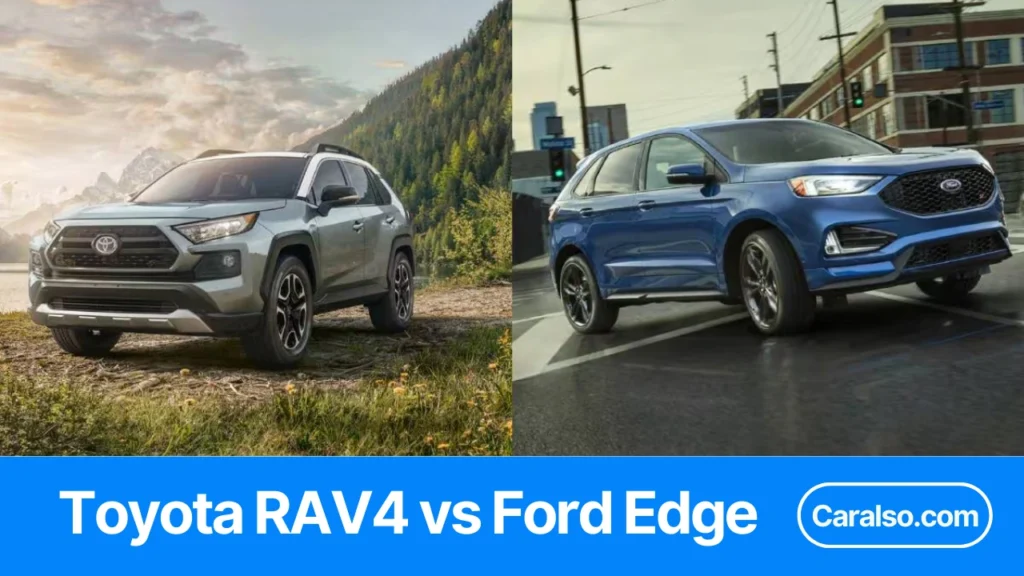
Ford Edge Vs Toyota RAV4:
Key Differences Between The Edge And RAV4 (Quick Summary)
Quick Verdict (Pick By Priority)
- I Pick The Edge If You Want: More cargo, more rear legroom, and a bigger midsize feel.
- I Pick The RAV4 If You Want: Higher MPG, stronger resale, and a safer long-term value play.
Summary Table (Fast Answer)
| Category | Ford Edge (2024) | Toyota RAV4 (2026) |
|---|---|---|
| U.S. New-Car Status | Retired for 2025 | Current model |
| Starting MSRP (Base Trim) | $38,365 | $33,350 |
| Typical Used Price Range (Recent Listings) | $23,192 to $39,631 | $29,901 to $41,971 |
| Fuel Economy Headline | 23 mpg combined (2.0L AWD) | Up to 44 mpg combined (hybrid) |
| Cargo Behind 2nd Row | 39.2 cu ft | Up to 37.8 cu ft |
| Max Cargo (Seats Folded) | 73.4 cu ft | Up to 70.4 cu ft |
| Towing Capacity Range | 1,500 to 3,500 lbs | 1,750 to 3,500 lbs |
| 5-Year Depreciation (Reference Data) | About 56.3% | About 30.3% |
| Best Fit Buyer | Used shopper who wants space | MPG and resale focused buyer |
What I Think This Means In Real Life
- If you regularly fill the back seat, the Edge is the easier daily driver. It has 40.6 inches of rear legroom, and the cargo floor is big.
- If you drive 12,000 to 15,000 miles a year, the RAV4’s MPG advantage usually beats the Edge by real dollars.
- If you plan to sell in 3 to 6 years, the RAV4’s resale math is hard to ignore. A 30.3% five-year depreciation rate is a different world than 56.3%.
Size And Space (Is The Edge Too Big, Or Just Better?)
Midsize Vs Compact SUV (What That Means For Daily Driving)
When I drive these back-to-back, the Edge feels like the bigger class because it is.
It is longer. It is wider. It also needs a bit more room to turn.
Here is the quick size math I use.
| Measurement | Ford Edge (2024) | Toyota RAV4 (2026) |
|---|---|---|
| Length | 188.8 in | 181.0 in |
| Wheelbase | 112.2 in | 105.9 in |
| Width (No Mirrors) | 75.9 in | 73.0 in |
| Height | 68.3 in | 67.0 in |
| Ground Clearance | 8.0 in | 8.1 in |
| Turning Circle | About 39.2 ft | 36.9 ft |
What I notice in real life:
- In tight parking lots, the RAV4 is easier to place. It turns in less space.
- On the highway, the Edge feels more like a “bigger SUV” in how it fills a lane.
Passenger Space And Rear Seat Comfort
This is where the Edge earns its keep.
The numbers back it up.
Rear legroom:
- Edge: 40.6 in
- RAV4: 37.8 in
- Difference: 2.8 in
Front legroom:
- Edge: 42.6 in
- RAV4: 41.0 in
- Difference: 1.6 in
Passenger volume:
- Edge: 113.9 cu ft
- RAV4: 98.9 cu ft
- Difference: 15.0 cu ft
If you run rear-facing car seats, that rear legroom gap matters.
I get more “front seat breathing room” in the Edge with a bulky car seat behind me.
Cargo Space For Strollers, Dogs, And Costco Runs
Cargo space is closer than most people expect.
The Edge still wins, but it is not a blowout.
Cargo behind the second row:
- Edge: 39.2 cu ft
- RAV4: 37.8 cu ft
- Difference: 1.4 cu ft
Max cargo with seats folded:
- Edge: 73.4 cu ft
- RAV4: 70.4 cu ft
- Difference: 3.0 cu ft
My takeaway:
- If you care about “big boxes,” both work.
- If you care about “more people plus their stuff,” the Edge is the easier pack.
Parking And Visibility (Real-World Pain Points)
This is the part nobody tells you in a comparison tool.
The Edge is 188.8 inches long.
That is 7.8 inches longer than the RAV4.
I feel that in parallel parking and short garage bays.
The Edge is also 75.9 inches wide without mirrors.
If you have a tight garage, width is the number that bites first.
Turning:
- Edge turning circle is about 39.2 ft.
- RAV4 turning circle is 36.9 ft.
That 2.3 ft difference shows up in U-turns and tight drive-thrus.
If you live in a dense city, I think the RAV4 is simply less work.
Price And Value (New Vs Used)
New-Car Reality In 2026
Here is the honest situation.
The Edge is discontinued for the 2025 model year in the U.S.
So “new Edge” usually means leftover 2024 inventory.
Base pricing reference points:
- 2024 Ford Edge SE AWD: $38,365
- 2026 Toyota RAV4: starts at $33,350
What I do with that info:
- If I’m shopping Edge, I treat it like a clearance item. I push harder on price.
- If I’m shopping RAV4, I focus on total deal. Out-the-door price matters more than a tiny discount.
Used Pricing Ranges (What You’ll Actually See)
This is where the Edge can look like a bargain.
Depreciation hits it harder, so used pricing can be friendlier.
Recent market ranges from iSeeCars:
| Model Year Example | Used Ford Edge Price Range | Used Toyota RAV4 Price Range |
|---|---|---|
| 2024 vs 2025 | $23,192 to $39,631 | $29,901 to $41,971 |
| 2022 vs 2022 | $19,205 to $33,500 | $23,798 to $34,592 |
| 2018 vs 2018 | $10,497 to $21,448 | $14,667 to $25,991 |
My real-world read:
- If you want the most space per dollar, used Edge often wins.
- If you want the safest resale bet, used RAV4 still holds its price.
Depreciation And Resale (Who Loses Less Money)
If you buy new and sell in 5 years, the RAV4 usually wins the resale math.
iSeeCars 5-year depreciation rates:
- Edge: 56.3%
- RAV4: 30.3%
That is a 26.1-point gap.
CarEdge puts the 5-year picture like this:
- Edge: about 60% depreciation and about $18,753 resale value in their example
- RAV4: about 28% depreciation and about $27,315 resale value in their example
My rule is simple:
- If I’m buying an Edge, I prefer used. Let the first owner eat the depreciation.
- If I’m buying a RAV4, new or lightly used can both make sense. Used prices stay high, so I compare the payment, not just the sticker.
Warranty And Coverage Strategy For Used Buyers
If you buy used, warranty strategy matters more than trim badges.
Ford basics:
- New vehicle limited warranty: 3 years or 36,000 miles
- Powertrain warranty: 5 years or 60,000 miles
- Ford Blue Advantage CPO can add coverage, but the level matters (Blue vs Gold)
What I do on a used Edge:
- I prioritize a lower-mile Edge that still has powertrain warranty left.
- If it’s Certified, I strongly prefer the higher coverage tier.
- If it’s not Certified, I price in an extended service plan or I keep shopping.
Toyota basics:
- Basic warranty: 3 years or 36,000 miles
- Powertrain: 5 years or 60,000 miles
- Hybrid components: 8 years or 100,000 miles
- Hybrid battery: 10 years or 150,000 miles
- ToyotaCare scheduled maintenance: 2 years or 25,000 miles
What I do on a used RAV4:
- If it’s a Toyota Certified Used Vehicle, I value that coverage because used RAV4 prices are already strong.
- If it’s not Certified, I still want service records and a clean inspection. I do not skip that step.
Fuel Economy And Real-World Running Costs
If you care about day-to-day spend, I give this one to the RAV4. Most 2026 RAV4 trims land in the 39 to 44 mpg combined range. The 2024 Edge AWD sits at 23 mpg combined.
MPG And Range Differences That Actually Matter
Here’s the part most comparison articles skip. The 2026 RAV4 is hybrid-only. So you are not comparing gas-to-gas anymore if you are shopping new.
| Model (Typical Picks) | City MPG | Highway MPG | Combined MPG | Notes |
|---|---|---|---|---|
| 2024 Ford Edge AWD (2.0T) | 21 | 28 | 23 | Regular gas. 8-speed automatic. |
| 2026 Toyota RAV4 Hybrid LE AWD | 46 | 40 | 44 | This is the “cheap to run” sweet spot. |
| 2026 Toyota RAV4 Hybrid XLE Premium AWD | 45 | 39 | 42 | Still strong mpg. More features. |
| 2026 Toyota RAV4 Hybrid Woodland AWD | 41 | 36 | 39 | More rugged setup. Lower mpg. |
| 2026 Toyota RAV4 Plug-In Hybrid (SE, XSE) | 44 | 38 | 41 | Plus up to 52 miles electric-only per charge. |
A quick range reality check.
- The Edge carries more fuel. 18.5 gallons.
- The RAV4 carries less. 14.5 gallons.
- But the RAV4 can still go farther on a fill because it burns fewer gallons per mile.
What You’ll Spend On Gas In A Year
I like simple math. Here’s a clean example using:
- $3.50 per gallon
- 23 mpg combined for the Edge AWD
- 42 mpg combined for a typical AWD RAV4 Hybrid trim
| Miles Per Year | Edge Fuel Cost | RAV4 Hybrid Fuel Cost | Difference |
|---|---|---|---|
| 10,000 | $1,520 | $830 | $690 |
| 12,000 | $1,830 | $1,000 | $830 |
| 15,000 | $2,280 | $1,250 | $1,030 |
If you drive 15,000 miles a year, the RAV4 Hybrid can save about $1,000 a year in fuel in this example.
If you can plug in at home, the RAV4 Plug-In Hybrid can cut gas spend even more. Some commutes can be mostly electric if you drive under 52 miles a day and charge regularly.
Maintenance And Repairs
I look at two buckets.
- Typical annual repairs.
- Longer-term maintenance and repair totals.
Here are the benchmarks I use:
| Cost Benchmark | Ford Edge | Toyota RAV4 |
|---|---|---|
| Average Annual Repair Cost | $611 per year | $429 per year |
| 5-Year Maintenance And Repair Cost (Est.) | $3,035 | $1,938 |
| 10-Year Maintenance And Repair Cost (Est.) | $9,590 | $6,005 |
Warranty and coverage also matters for stress-free ownership.
- The 2026 RAV4 Hybrid battery is covered for 10 years or 150,000 miles.
- Hybrid-related components are covered for 8 years or 100,000 miles.
- The 2026 RAV4 includes ToyotaCare scheduled maintenance for 2 years or 25,000 miles.
- The Edge does not include complimentary scheduled maintenance.
“Hidden” Running Costs
This is where real budgets get blown.
- Tires
Edge ST trims can run 21-inch wheels. Bigger tires usually cost more per tire than 17-inch or 18-inch sets on many RAV4 trims. - Brakes
Hybrids tend to use regenerative braking. That can reduce brake wear in stop-and-go driving. It depends on how you drive. - AWD Service
Both can have extra drivetrain service compared to a basic FWD setup. I always plan for fluid changes over time, especially on used buys. - Plug-In Charging Setup
If you go RAV4 Plug-In Hybrid, your “fuel” becomes gas plus electricity. Home charging is the difference-maker. Public charging is convenience, not always savings.
Performance And Towing (The Truth Behind The Numbers)
This is where I split buyers into two types.
- “I want smooth daily power.”
- “I want towing and passing power.”
The Edge feels stronger at low speeds because it is turbo gas power with a normal automatic. The RAV4 Hybrid feels smooth and efficient, but it is tuned for mpg first.
Engines And Powertrains
| Model | Power | Torque | Transmission | Notes |
|---|---|---|---|---|
| 2024 Ford Edge 2.0L Turbo AWD | 250 hp | 280 lb-ft | 8-speed automatic | Strong torque for passing. |
| 2024 Ford Edge ST 2.7L Twin-Turbo AWD | 335 hp | 380 lb-ft | 7-speed automatic | Fastest Edge. Also the thirstiest. |
| 2026 Toyota RAV4 Hybrid FWD | 226 hp (net) | 163 lb-ft (engine) | e-CVT | Front-drive hybrid option. |
| 2026 Toyota RAV4 Hybrid AWD | 236 hp (net) | 163 lb-ft (engine) | e-CVT | Rear electric motor for AWD. |
| 2026 Toyota RAV4 Plug-In Hybrid AWD | 324 hp (net) | 172 lb-ft (engine) | e-CVT | Up to 52 miles electric-only range. |
Real-world acceleration feel.
- The Edge 2.0T has that turbo shove when you roll into the throttle.
- The RAV4 Hybrid feels quick off the line in town because electric torque is instant.
- At highway speeds, the Edge often feels more confident without working as hard.
Numbers help.
- I’ve seen a 6.8-second 0 to 60 mph result for an Edge 2.0T test vehicle.
- I’ve seen a 7.1-second 0 to 60 mph result for a 2026 RAV4 Hybrid AWD test vehicle.
That’s close. The feel is different.
Towing Capacity By Setup (Stop Guessing)
I’m strict about this. Always match towing numbers to the exact trim and equipment.
| Vehicle | Towing Capacity | What You Need |
|---|---|---|
| 2024 Ford Edge AWD | 1,500 lbs | Base towing rating. |
| 2024 Ford Edge AWD (With Class II Tow Package) | 3,500 lbs | AWD plus the Class II Trailer Tow Package. |
| 2026 Toyota RAV4 Hybrid LE AWD | 1,750 lbs | This trim is the exception. |
| 2026 Toyota RAV4 Hybrid AWD (Most Other Trims) | 3,500 lbs | Higher towing trims and certain grades. |
| 2026 Toyota RAV4 Plug-In Hybrid AWD (Certain Configurations) | 3,500 lbs | Also depends on grade. |
Two practical notes I always share with friends:
- Hitch hardware matters. Some trims include more of it from the factory than others.
- Payload matters. You can hit payload limits before you hit tow limits, especially with a family and gear.
Ride Comfort Vs Handling (Who Feels Better Every Day?)
This is my quick read after driving both styles of SUV.
- Ford Edge
It feels more like a bigger crossover. It is heavier, and it rides like it. That can be a plus on rough highways. It also has a more traditional powertrain feel when you accelerate. - Toyota RAV4
The hybrid setup is smooth in traffic. The ride is tuned for daily comfort, not sport driving. Some trims add more body control, but it is still a practical SUV first.
If you want the sharpest Edge, that is the ST. But you pay for it in fuel and tire costs.
AWD And Winter Driving (Confidence Factors)
Both can do winter well. Tires still matter more than badges.
Here’s how I think about the systems:
- Edge AWD is a traditional AWD setup paired with turbo gas power. It feels predictable when merging, climbing, or passing in snow.
- RAV4 Hybrid AWD uses an electronic on-demand setup with a rear electric motor. That gives quick rear assist when traction drops.
My winter checklist for either one:
- Budget for real winter tires if you get snow and ice.
- Check tread depth before you buy used. I want at least 6⁄32 inch going into winter.
- Do a parking-lot test. Tight turns. Light throttle. Listen for binding or clunks.
Tech And Driver Assist (What’s Better To Live With?)
I spend more time with the screen and driver assist than I ever thought I would. So I care about three things.
- Screen speed and layout.
- Wireless phone life.
- How smooth the lane centering and adaptive cruise feel on a boring highway.
Here’s what matters between the Ford Edge and Toyota RAV4.
Infotainment And Controls
Both are modern. But the RAV4 is the fresher system if you’re looking at the newest model years.
Quick tech snapshot (newer models):
| Tech Item | Ford Edge (2024) | Toyota RAV4 (2026) |
|---|---|---|
| Center Screen Size | 12-inch | 10.5-inch standard, 12.9-inch available |
| Wireless Phone Mirroring | Yes | Yes |
| Built-In Cellular | 4G LTE | 5G |
| Built-In Dashcam Style Recording | No | Yes, standard (Drive Recorder) |
What I notice in daily use:
- The Edge’s SYNC 4A setup is simple. The 12-inch screen is a big win for maps and camera views.
- The RAV4’s 2026 system is more “phone-like.” You get a customizable home screen with widgets. Toyota also added a quick control menu that can toggle driver assist settings faster.
- Toyota also moved navigation info deeper into the driver display. It can show navigation full screen in the digital gauge cluster on the newer setup. That’s a legit quality-of-life upgrade.
If you hate digging through menus, I give the nod to the newest RAV4 interface.
If you just want a big screen that works, the Edge is still solid.
Phone Integration And Charging
This is where the little numbers matter.
Ford Edge (2024) highlights I actually use:
- Wireless Apple CarPlay and Android Auto.
- 4G LTE Wi-Fi hotspot capability that can connect up to 10 devices.
- Wireless charging pad is available, and it is common on higher trims.
Toyota RAV4 (2026) highlights I care about:
- Wireless Apple CarPlay and Android Auto.
- 5G connectivity for the onboard system.
- USB-C counts can be very trim-dependent.
- Example: One trim list shows 3 USB-C ports with 2 front ports rated at 15W plus a media USB-C in the console.
- Another trim list shows 5 USB-C ports total, including rear-seat ports.
- Qi wireless charging can be 1 pad or even 2 pads depending on trim.
My real-world take:
- If you road trip with kids or passengers, the RAV4’s available USB-C and charging layout can be the better family move.
- If you run a lot of devices, the Edge’s hotspot setup is easy to live with.
Driver Assist Suites (Co-Pilot360 Vs Toyota Safety Sense)
This is the section most people get wrong.
They compare “features,” not how often they actually come on the vehicle.
Ford Edge (2024) driver assist, in plain English:
Co-Pilot360 (core suite) includes things like:
- Auto high beams
- Blind spot monitoring with cross-traffic alert
- Lane-keeping system
- Forward collision warning with automatic emergency braking
- Rear view camera
Co-Pilot360 Assist+ adds the stuff I want for highway driving:
- Adaptive cruise control with stop-and-go
- Lane centering
- Evasive steering assist
- Connected navigation (typically bundled by trim or package)
Toyota RAV4 (2026) driver assist:
Toyota Safety Sense 4.0 includes:
- Pre-collision system with pedestrian detection (and wider detection language that includes bicyclists and motorcyclists)
- Full-speed range adaptive cruise control
- Automatic high beams
- Lane tracing assist (lane centering behavior when cruise is active)
- Road sign assist
- Proactive driving assist (subtle braking and steering help in certain situations)
Then, on higher trims, Toyota stacks on extra tools like:
- Front and rear parking assist with automatic braking
- 3D panoramic view monitor
- Advanced Park
- Front cross-traffic alert
- Lane change assist
- Traffic Jam Assist (subscription or trial rules can apply)
My take after living with systems like this:
- If you want lane centering and adaptive cruise, make sure the Edge you’re buying actually has the Assist+ equipment.
- On the newest RAV4, Toyota makes the baseline suite strong, then adds real upgrades on higher trims.
What I Would Prioritize On A Used One
If you’re shopping used, I filter hard for tech that changes daily life.
Used Ford Edge checklist:
- Confirm it has Co-Pilot360 Assist+ if you do highway miles.
- Test adaptive cruise stop-and-go and lane centering on a real road, not a parking lot.
- Check the SYNC screen for lag and random reboots.
- Make sure wireless CarPlay or Android Auto connects fast.
- If it has the wireless charging pad, test it with your phone case on.
Used Toyota RAV4 checklist:
- If you care about the newest tech, I would specifically hunt a 2026 model year.
- Choose your screen size up front. 10.5-inch vs 12.9-inch changes the vibe every time you drive.
- Count ports in person. USB-C layouts vary by trim.
- If you want the fancy parking tech, confirm it has the panoramic camera and park assist features.
- If it has Traffic Jam Assist or connected services, ask what’s trial-based vs subscription-based.
If you want the easiest win:
- Edge buyers should prioritize the right driver assist package.
- RAV4 buyers should prioritize model year and trim tech, because Toyota spread the best bits across trims.
Safety, Reliability, And Recalls
When I’m choosing between these two, I do 3 quick checks.
- Crash test track record.
- Ownership signals like repair cost and reliability scoring.
- Recall history, especially for used SUVs.
Crash Test Ratings (IIHS And NHTSA)
I like starting with IIHS because it gives you very specific test categories.
Here’s what IIHS shows for these two models.
IIHS Snapshot
| IIHS Category | Ford Edge (2024) | Toyota RAV4 (2026) |
|---|---|---|
| Small Overlap Front | Good | Good |
| Moderate Overlap Front | Good (Original Test) | Marginal (Updated Test) |
| Side (Updated Test) | Good | Acceptable |
| Pedestrian Front Crash Prevention (Day) | Advanced | Not Listed On The IIHS Page |
| LATCH Ease Of Use | Acceptable | Good+ |
Two things I want you to understand before you panic about the RAV4 row.
- The Edge is scored on the older “original” moderate overlap test. IIHS does not show an “updated” moderate overlap result for the Edge on that page.
- The RAV4 is scored on the newer “updated” moderate overlap test, and that one is harder.
So I treat that moderate overlap line like an “apples vs oranges” warning.
But the updated side test is apples-to-apples, and the Edge does better there.
For NHTSA star ratings, I use them as a second opinion.
- The 2024 Ford Edge shows a 5-star overall rating in published summaries.
- For the 2026 RAV4, NHTSA testing and ratings can lag behind a new model year. I always verify the exact trim and year before I call it “rated.”
If you want a fast rule, here it is.
- If you’re buying a 2024 Edge, the crash test track record is strong.
- If you’re buying a 2026 RAV4, I still like the safety tech suite, but I always check the newest NHTSA listing for your exact model.
Reliability And Long-Term Ownership Signals
I don’t rely on one score. I stack 2 or 3 signals.
Here are the ones I trust for quick comparisons.
Reliability And Repair Cost Signals
| Signal | Ford Edge | Toyota RAV4 |
|---|---|---|
| RepairPal Reliability Rating | 3.5 out of 5 | 4.0 out of 5 |
| RepairPal Avg Annual Repair Cost | $611 | $429 |
| iSeeCars Reliability Rating | 7.8 out of 10 | 8.2 out of 10 |
My take in plain English.
- The RAV4 is usually the “lower surprise bill” pick.
- The Edge is not a disaster. But turbo midsize SUVs tend to cost more to run than a compact hybrid in the long run.
If you are buying used, I also watch resale value trends.
In my experience, strong resale usually follows strong owner confidence.
Recalls That Matter For Used Buyers
Recalls are normal. The only thing that matters is whether the fix is done.
These are the ones I would actually pay attention to.
Ford Edge Recalls I Would Check First
- 2015 to 2018 Edge brake hose recall
This one matters because it can reduce braking performance if a hose fails and brake fluid leaks.
Things I would watch for on a test drive:
- Brake pedal travel feels longer than normal
- Pedal feels softer than normal
- Brake warning light shows up
- You smell brake fluid after a drive
- 2021 to 2024 Edge rearview camera software recall
This is a “camera image freezes, delays, or goes blank” type recall.
It’s annoying. It also matters for safety.
Toyota RAV4 Recalls I Would Check First
- Backup camera image freeze or no image (Panoramic View Monitor)
Toyota has a recall tied to the panoramic system where the backup image may freeze or not display under certain conditions.
Not every RAV4 has this equipment, and not every year is affected.
That’s why the VIN check matters. - 12.3-inch instrument display may be blank at startup (certain vehicles)
This is another one where the fix matters because warning indicators can be harder to see if the display is blank.
My rule is simple.
- If the VIN shows an open recall, I do not “plan to fix it later.”
- I get it fixed before I take a road trip, and ideally before I buy.
How To Run A VIN Recall Check In 60 Seconds
I do this for every used car. Even if it’s at a nice dealership.
- Copy the VIN.
You can grab it from the lower windshield on the driver side, the driver door jamb, or the registration. - Run the VIN on NHTSA’s recall tool.
It will show open safety recalls tied to that exact vehicle. - Run the VIN on the brand site too.
Ford and Toyota both have VIN recall lookups. Sometimes they show extra campaign detail. - Ask for proof.
If a seller says “it’s done,” I ask for the repair order or a recall completion printout. - If it’s open, make the fix part of the deal.
Recalls are repaired at no charge. I still want the appointment scheduled.
Discontinued Model Reality Check
Does Discontinued Automatically Mean “Don’t Buy”?
No. I would still buy a Ford Edge.
But I buy it differently than I buy a “current” model.
Here’s what changes when a model is discontinued.
What Gets Better For You
- You usually get better used-car pricing for the space you’re getting.
- You can often negotiate harder on leftover new inventory, since it is the end of the run.
What Gets Worse For You
- Resale value usually drops faster. That matters if you plan to sell in 2 to 5 years.
- Trim and color selection gets tighter over time.
- Some tech features can feel “one generation behind” compared to a brand-new redesign like the 2026 RAV4.
What Does Not Scare Me
- Service support. Ford is still supporting Edge owners through maintenance and support channels.
- Routine parts. Filters, brakes, tires, and wear items are not the issue. The issue is long-term resale, not basic upkeep.
My simple rule:
- If you keep cars a long time and want space, a used Edge can be a smart buy.
- If you trade often, I prefer the RAV4 because resale is usually stronger.
My Used Edge Checklist (Before You Hand Over Money)
I do this every time. It takes about 20 minutes. It saves me from bad buys.
Paperwork And History
- Service records. I want oil change history and proof of scheduled maintenance.
- Title history. Clean title matters.
- VIN recall check. I want proof open recalls are closed.
Tires And Brakes
4) Tire tread depth. I want at least 6/32 if I’m buying it before winter.
5) Brake feel on a test drive. No long pedal travel. No brake warning lights.
Powertrain And Drivetrain
6) Cold start. I listen for weird rattles and rough idle.
7) Turbo feel. I want smooth boost, not surging.
8) Transmission behavior. I want clean shifts at light throttle and medium throttle.
9) AWD check. Full-lock slow turns in a parking lot. No binding noises.
Tech That Changes Daily Life
10) Test wireless CarPlay and Android Auto. Connect fast, stay connected.
11) Test the backup camera. No freezing. No black screen.
12) If it has adaptive cruise and lane centering, I test both on a real road.
Two recall checks I always take seriously on used Edge listings:
- 2015 to 2018 brake hose recall
- Rear camera related campaigns on newer model years
My “Fair Price” Rule Of Thumb (Simple Buyer Guidance)
I keep pricing simple. I compare three things.
- Same year. Similar miles. Similar condition.
- Edge price vs RAV4 price in my area.
- How long I plan to keep it.
Here is the reality I see in the market.
A used Edge often lists cheaper than a comparable RAV4. And it usually needs to, because it depreciates faster.
My rule when I’m cross-shopping an Edge and a RAV4 with similar miles:
- If the Edge is not at least $3,000 cheaper, I usually walk and buy the RAV4.
- If the Edge is $5,000 to $8,000 cheaper, I take it seriously, assuming the inspection is clean.
My rule if I’m looking at a leftover new 2024 Edge:
- I do not pay full sticker at the end of a model run.
- If the dealer is not moving on price, I shift to a lightly used Edge or I buy a new RAV4.
My ownership-length rule:
- Keeping it 8 to 12 years: Edge value can be excellent if you buy used right.
- Selling it in 3 to 5 years: RAV4 value is usually the safer bet.
Trim Matchmaker (Apples-To-Apples Picks)
I match these two by real life needs, not by badge.
The Edge is a midsize 2-row SUV.
The RAV4 is a compact SUV with much better MPG, especially in 2026 when the lineup is hybrid-focused.
Best Edge Trims To Target Used
If I’m shopping used Edge, these are the trims I target first.
Edge SEL (Best All-Around Value)
- Synthetic leather upholstery
- Heated power front seats
- Upgraded audio
- Keypad entry
- Optional driver assist packages worth having for highway miles
Edge ST-Line (Best Look For The Money)
- Sporty exterior touches
- 20-inch wheels on many builds
- ActiveX seating material
- Convenience features often included
Edge Titanium (Best Comfort Value)
- Leather upholstery
- Hands-free liftgate
- Heated steering wheel
- Rain-sensing wipers
- Optional “Lux” style packages can add ventilated seats and more driver assist
Edge ST (Best Power)
- 335 hp 2.7L V6
- Sport suspension tuning
- Bang and Olufsen audio on many builds
- This trim is also where tire costs can jump, especially with 21-inch performance packages
If you want towing on an Edge, I also check one thing:
- Does it have the Class II tow equipment needed for the higher tow rating?
Closest RAV4 Trims To Cross-Shop
For a new RAV4 in 2026, I think in two buckets.
Hybrid (Most Buyers)
- LE Hybrid: best price entry point
- SE Hybrid: a bit more style and equipment
- XLE Premium Hybrid: comfort and daily features
- Woodland Hybrid: more rugged setup, lower MPG
- XSE Hybrid: sportier look
- Limited Hybrid: top comfort trim
Plug-In Hybrid (If You Want Power Or Electric Miles)
- SE Plug-In Hybrid: value entry point
- XSE Plug-In Hybrid: better-equipped
- Woodland Plug-In Hybrid and GR Sport Plug-In Hybrid exist for buyers who want a more specialized setup
The plug-in is the closest “power match” to an Edge ST.
It also adds up to 52 miles of electric range on a full charge, which can cut gas use a lot if you charge at home.
Best Value Pairings (3 Quick Recommendations)
Pairing 1: Best Space-Per-Dollar Used Buy
- Buy: Used Edge SEL
- Cross-shop: RAV4 LE Hybrid or SE Hybrid
Why I like it: The Edge gives you 40.6 inches of rear legroom and a big cargo area for the money.
Pairing 2: Best Daily Driver For High Miles
- Buy: RAV4 XLE Premium Hybrid
- Cross-shop: Used Edge Titanium
Why I like it: RAV4 fuel costs are usually far lower. Titanium gives you comfort, but the Edge still burns more gas.
Pairing 3: Best “Fast And Capable” Family SUV
- Buy: Edge ST if you want turbo V6 feel
- Cross-shop: RAV4 Plug-In Hybrid XSE if you want quick acceleration plus EV miles
Why I like it: Both can feel quick. The difference is running costs. The plug-in can be much cheaper to “fuel” if you charge consistently.
Which One Should You Choose? (Decision By Buyer Type)
I’m going to make this simple. I’ve owned and driven enough crossovers to know what matters after week 3.
Best For Commuters
I pick the RAV4.
Why:
- 2026 RAV4 Hybrid trims sit around 39 to 44 mpg combined.
- 2024 Edge AWD sits at 23 mpg combined.
- At 12,000 miles a year and $3.50 gas, that can be about $830 a year in fuel savings for the RAV4 Hybrid.
If you do a lot of highway miles, the Edge can still feel relaxed.
But fuel cost is fuel cost.
Best For Families
I pick the Edge if you want rear-seat space first.
I pick the RAV4 if you want lower running costs first.
Rear legroom is the Edge’s big win:
- Edge: 40.6 in
- RAV4: 37.8 in
- Difference: 2.8 in
Cargo is close:
- Edge cargo behind 2nd row: 39.2 cu ft
- RAV4 cargo behind 2nd row: 37.8 cu ft
- Difference: 1.4 cu ft
If you run rear-facing car seats and tall adults up front, I feel the Edge advantage fast.
Best For Towing
I pick based on the exact setup, not the badge.
Edge towing:
- 1,500 lbs standard
- 3,500 lbs with the Class II Trailer Tow Package
RAV4 towing:
- 1,750 lbs on the Hybrid LE AWD
- 3,500 lbs on many other AWD trims
My rule:
- If you want 3,500 lbs, confirm the equipment before you buy.
- Then check payload on the door sticker. Payload can limit you before tow rating does.
Best For Long-Term Keep-It-10-Years Ownership
I pick the RAV4.
These numbers decide it for me:
- Average annual repair cost: RAV4 $429, Edge $611
- 10-year maintenance and repairs estimate: RAV4 about $6,005, Edge about $9,590
If you keep cars a long time, fuel and repairs usually matter more than the “bigger cabin” feeling.
Best For A Budget Used Buyer
I pick the Edge if you want the most space per dollar.
I pick the RAV4 if you want the safest resale and lowest stress.
How I shop it:
- If the Edge is not at least $3,000 cheaper than a similar-mile RAV4, I usually buy the RAV4.
- If the Edge is $5,000 to $8,000 cheaper, I take the Edge seriously, assuming the inspection is clean.
And I treat the Edge like a “buy used” vehicle.
I let the first owner take the depreciation.
FAQs
Is The Ford Edge Bigger Than The Toyota RAV4?
Yes. It’s a midsize 2-row SUV.
Key numbers:
- Passenger volume: Edge 113.9 cu ft, RAV4 98.9 cu ft
- Rear legroom: Edge 40.6 in, RAV4 37.8 in
- Length: Edge 188.8 in, RAV4 181.0 in
Cargo is close, but the Edge is still higher:
- Max cargo: Edge 73.4 cu ft, RAV4 70.4 cu ft
Which Is Cheaper To Maintain, Ford Edge Or Toyota RAV4?
The RAV4.
Two quick benchmarks:
- Average annual repair cost: RAV4 $429, Edge $611
- 10-year maintenance and repairs estimate: RAV4 about $6,005, Edge about $9,590
Can A RAV4 Tow As Much As An Edge?
Sometimes, yes. But you have to match the exact trim.
- Edge can tow up to 3,500 lbs only with the right tow package.
- Many AWD RAV4 trims can tow up to 3,500 lbs.
- The Hybrid LE AWD is lower at 1,750 lbs.
If towing is your top priority, confirm the tow rating on the exact vehicle you’re buying.
Is It Risky To Buy A Discontinued SUV?
Not automatically.
I worry about two things:
- Resale value if you sell in 3 to 5 years
- Buying the wrong used example with poor maintenance or open recalls
I worry less about:
- Routine service support
- Normal wear parts like brakes and filters
My rule:
- If you plan to keep it a long time, a used Edge can be a smart value.
- If you trade often, the RAV4 is usually safer.
Which Holds Value Better?
The RAV4.
Five-year depreciation benchmarks I’ve used:
- Edge: about 56.3%
- RAV4: about 30.3%
That gap is why used Edges can look like deals, and why used RAV4 prices stay high.
Sources
- Ford Edge Discontinuation Page
- Ford Warranty Guide (2024 Model Year PDF)
- Toyota RAV4 Official Page
- Edmunds 2024 Ford Edge MPG
- TrueCar Compare (Ford Edge Vs Toyota RAV4)

Hey there,
How is it going?
I’m Meraj Sarker. I am a Car Mechanic and a student of Automobile Restoration here in Florida, USA. I’ve been studying automotive for around 9 years now. So you can rely on my recommendation. For me, studying and getting knowledge about automobile it’s really fun and entertaining. I will help you to get solutions for your car through this website. If you need any help let me know.