
I look at this matchup as a budget subcompact SUV versus a do-it-all compact SUV. They can both move 5 people. But they do not solve the same daily problems.
Here are the numbers that matter first. Trax is FWD only. RAV4 can be FWD or AWD. Trax makes 137 hp. RAV4 makes 203 hp. Trax cargo is 25.6 cu ft behind row 2. RAV4 cargo is 37.6 cu ft behind row 2.
Quick Answer (Featured Snippet Target)
If you want the lowest price for a brand-new SUV and you live on plowed roads, I buy the Chevy Trax. It starts at $20,500 and returns 30 mpg combined. It is simple and it is easy on the budget.
If you need AWD, more cargo, more power, and more overall flexibility, I buy the Toyota RAV4. The 2025 gas RAV4 starts at $29,800 and returns 30 mpg combined. It also gives you 37.6 cu ft of cargo behind the second row and 8.4 in of ground clearance.
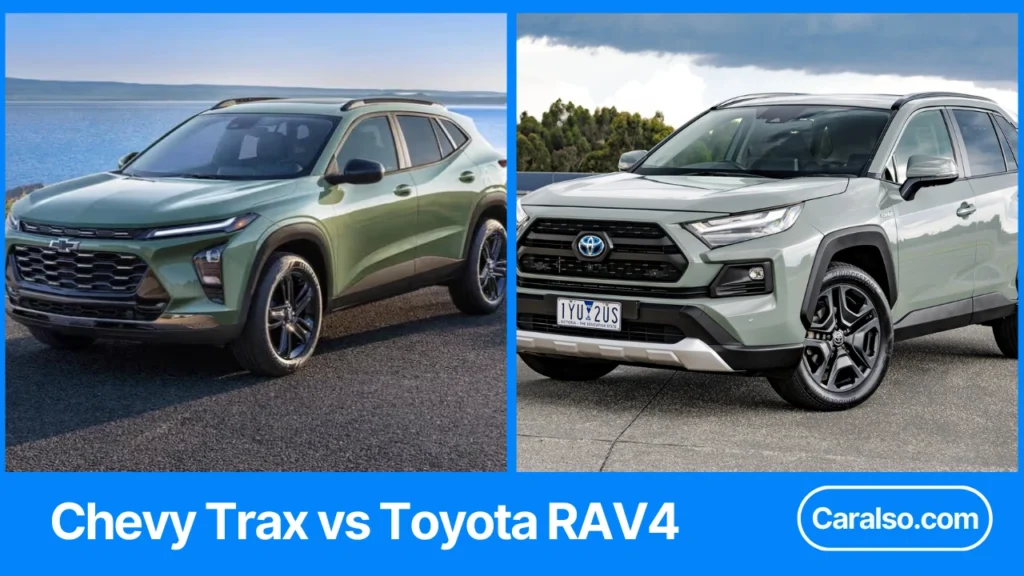
Chevy Trax Vs Toyota RAV4
My one-sentence rule: If you are price-first and AWD is not required, I buy Trax. If you ever say “snow, camping gear, strollers, or long-term value,” I buy RAV4.
| 60-Second Decision | Buy Trax | Buy RAV4 |
|---|---|---|
| Budget Cap Under $25,000 | Starts at $20,500 | Usually above this new |
| AWD Needed | Not available | Available |
| Power For Merging And Passing | 137 hp | 203 hp |
| Cargo Behind Row 2 | 25.6 cu ft | 37.6 cu ft |
| Ground Clearance | 7.3 in | 8.4 in |
| Combined MPG | 30 mpg | 30 mpg (gas) |
60-Second Decision Table (Table #1)
I use this table when someone wants the answer fast. Pick the row that matches your life. Then buy the winner.
| If This Is You | Buy Trax | Buy RAV4 | The Number That Makes It Obvious |
|---|---|---|---|
| My Budget Is Under $25,000 New | Starts at $20,500 | Starts at $29,800 | $20,500 vs $29,800 |
| I Need AWD For Winter Roads | FWD only | AWD available | Trax: no AWD. RAV4: AWD available |
| I Merge Into 70 mph Traffic Often | 137 hp | 203 hp | 137 hp vs 203 hp |
| I Carry Big Stuff With Seats Up | 25.6 cu ft behind row 2 | 37.6 cu ft behind row 2 | 25.6 vs 37.6 cu ft |
| I Fold Seats And Haul Often | 54.1 cu ft max | 69.8 cu ft max | 54.1 vs 69.8 cu ft |
| I Deal With Snow Ruts Or Rough Driveways | 7.3 in ground clearance | 8.4 in ground clearance | 7.3 in vs 8.4 in |
| I Want Best MPG Without Paying For A Hybrid | 30 mpg combined | 30 mpg combined (gas LE FWD) | 30 vs 30 mpg combined |
| I Want Better MPG Than Both Gas Options | Not the move | RAV4 Hybrid can hit 39 mpg combined | 30 vs 39 mpg combined |
Key Differences At A Glance
- Starting MSRP: Trax starts at $20,500. RAV4 starts at $29,800. That is a $9,300 gap.
- Combined MPG: Trax is 30 mpg combined. RAV4 gas can be 28 to 30 mpg combined depending on trim and AWD. RAV4 Hybrid can reach 39 mpg combined.
- Power: Trax is 137 hp. RAV4 is 203 hp.
- Drivetrain: Trax is FWD only. RAV4 offers FWD or AWD.
- Cargo Behind Row 2: Trax is 25.6 cu ft. RAV4 is 37.6 cu ft.
- Max Cargo: Trax is 54.1 cu ft. RAV4 is 69.8 cu ft.
- Ground Clearance: Trax is 7.3 in. RAV4 is 8.4 in.
Specs Snapshot That Actually Matters (Table #2)
I built this table around the stuff you feel every day. Price. MPG. Power. Cargo. Winter ability. Towing.
Base-trim examples: 2025 Trax LS, 2025 RAV4 LE (gas), 2025 RAV4 Hybrid LE.
| Spec That Actually Changes The Decision | Chevy Trax (2025) | Toyota RAV4 Gas (2025) | Toyota RAV4 Hybrid (2025) |
|---|---|---|---|
| Starting MSRP | $20,500 | $29,800 | $32,850 |
| EPA Combined MPG | 30 mpg | 30 mpg | 39 mpg |
| Horsepower | 137 hp | 203 hp | 219 hp (net combined) |
| Drivetrain | FWD only | FWD or AWD | AWD standard |
| Ground Clearance | 7.3 in | 8.4 in | 8.1 in |
| Cargo Behind Row 2 | 25.6 cu ft | 37.6 cu ft | 37.6 cu ft |
| Max Cargo | 54.1 cu ft | 69.8 cu ft | 69.8 cu ft |
| Towing | Not designed to tow a trailer | 1,500 lb | 1,750 lb |
| Length | 178.6 in | 180.9 in | 180.9 in |
| Curb Weight | 2,983 lb | 3,370 lb | 3,690 lb |
What Each Is Best For (Use-Case Buckets)
Best For Tight Budgets And City Parking
I buy the Trax when the budget ceiling is the real ceiling.
The price gap is $9,300 versus a base RAV4. That is the whole story for a lot of people.
Trax also weighs less. About 2,983 lb versus 3,370 lb for a base RAV4. It feels lighter at low speeds. It is easy to place in traffic.
What you give up is important.
- No AWD option. Zero.
- 137 hp. That is fine in town. It is not the same on highway merges.
- 25.6 cu ft behind row 2. If you live with a stroller, you will feel this.
Best For Families And Big Cargo Days
I buy the RAV4 if you do family stuff with seats up.
Behind the second row, you get 37.6 cu ft in the RAV4 versus 25.6 cu ft in the Trax. That is 12.0 cu ft more space before you fold anything.
Max cargo matters too. 69.8 cu ft in the RAV4 versus 54.1 cu ft in the Trax. That is 15.7 cu ft more when you are hauling boxes, Costco runs, or camping bins.
If you want the RAV4 shape but you also care about fuel cost, I point you at RAV4 Hybrid. You can get 39 mpg combined without giving up the cargo number that makes the RAV4 useful.
Best For Winter States
If you truly need AWD, the choice is simple.
Trax is FWD only. There is no trim that fixes it. The RAV4 gives you AWD availability. The RAV4 Hybrid comes with AWD standard.
Ground clearance is the other winter number I care about. Trax is 7.3 in. RAV4 gas is 8.4 in. RAV4 Hybrid is 8.1 in. That helps when the snow turns into ruts and slush piles.
If you still buy Trax in a snow state, I do it with one rule. Budget for real winter tires. That changes stopping distance and traction more than most people expect.
Best For Road Trips
I buy the RAV4 for road trips when the car will be loaded.
Power matters on long grades and passes. 203 hp in the RAV4 versus 137 hp in the Trax is a real gap. You feel it when you are doing 60 to 75 mph with 4 people and gear.
Cargo also matters on trips. I would rather start with 37.6 cu ft behind row 2 than 25.6 cu ft. It keeps the cabin clear. It keeps your rear window usable.
Fuel cost can flip this for some people. If you drive a lot of highway miles, I run the RAV4 Hybrid math. 39 mpg combined adds up fast.
The Price Gap Reality Check
The Trax and the RAV4 are not priced like competitors. They are priced like two different plans.
Base MSRP numbers I use:
- Trax LS: $20,500
- RAV4 LE: $29,800
- RAV4 Hybrid LE: $32,850
That means the Trax saves you:
- $9,300 vs a gas RAV4
- $12,350 vs a RAV4 Hybrid
What The RAV4 Costs Extra List
Here is what I’m paying for when I step up to the RAV4.
- AWD Availability
Trax is FWD only. RAV4 can be AWD. RAV4 Hybrid is AWD standard. - Cargo You Can Use With Seats Up
Trax is 25.6 cu ft behind row 2. RAV4 is 37.6 cu ft.
That is 12.0 cu ft more space without folding anything. - Passing And Merging Power
Trax is 137 hp. RAV4 is 203 hp.
That is a 66 hp gap. - Resale Strength
iSeeCars pegs 5-year depreciation at 47.3% for Trax and 30.3% for RAV4.
That is a 17.0 percentage point gap.
Here is how I translate that into real money using base MSRPs.
Example 5-year resale math:
- Trax at $20,500 with 47.3% depreciation leaves about $10,804 of value.
- RAV4 at $29,800 with 30.3% depreciation leaves about $20,771 of value.
That is about a $9,967 difference in value after 5 years in this example.
Yes, markets and trims change the result. But the direction is consistent. If you trade often, resale is the RAV4’s secret weapon.
5-Year Value Translator (Mini Table)
If you buy the Trax to save money, I like seeing the savings assigned to real needs. This is how I do it.
Example: You save $9,300 buying Trax instead of RAV4 LE.
| Where I’d Spend The Savings | What It Buys You | Budget I’d Set Aside |
|---|---|---|
| Winter Tires | Traction and shorter braking on snow | $600 to $1,200 |
| Roof Box | Extra cargo for trips without folding seats | $700 to $900 |
| “Truck Stuff” Rentals | Pickup rental days for mulch and lumber | $150 to $600 per year |
| Depreciation Buffer | Protection if you trade in 3 to 5 years | $3,000 to $10,000 |
My simple rule:
- If you keep cars 8 to 12 years, the Trax savings matter more up front.
- If you trade at 3 to 5 years, I put resale on the scoreboard before I call Trax “cheaper.”
Winter And Bad Weather: AWD, Ground Clearance, And Tires Explained Simply
Winter driving is traction plus clearance. AWD helps traction. Clearance helps you not get stuck.
AWD Vs FWD In One Paragraph
Trax is FWD only. That means the front tires do all the work. Go, turn, and stop.
RAV4 can be FWD or AWD. RAV4 Hybrid is AWD standard. AWD helps you get moving when the surface is slick. It does not magically shorten braking distance. Tires do that.
Ground Clearance Numbers That Matter
Trax ground clearance is 7.3 in.
RAV4 ground clearance is 8.4 in.
That is a 1.1 in difference.
You feel that 1.1 in when snow turns into ruts and slush piles. It is also the difference between scraping and not scraping on steep driveways.
If you see deep snow more than a few days per winter, clearance starts to matter as much as AWD.
The Tire Rule (The Most Practical Advice On The Page)
If you remember one thing, remember this.
Tires beat drivetrain.
Here is my tire checklist:
- If you see snow 5 to 15 days per year, I like all-weather tires with the 3PMSF symbol.
- If you see snow and ice weekly, I run true winter tires.
- I replace winter tires when tread drops under 6/32 in for snow season.
- I check tire pressure monthly in winter. Cold air drops PSI.
- I keep the same tread depth side to side on the driven axle. That helps stability systems do their job.
My quick pick:
- Trax with winter tires can be totally fine on plowed roads.
- RAV4 AWD with winter tires is the safer bet when roads are unplowed or rutted.
Cargo And Daily Utility Reality Check
Cargo is where this comparison stops being close.
With The Rear Seats Up:
- Trax: 25.6 cu ft
- RAV4: 37.6 cu ft
That is a 12.0 cu ft gap in the mode people use most.
With The Rear Seats Folded:
- Trax: 54.1 cu ft
- RAV4: 69.8 cu ft
That is a 15.7 cu ft gap when you go full cargo mode.
Stroller Test, Grocery Test, Airport Bags Test (Mini Table)
This is how I translate those numbers into daily life. I still test-fit big items. Cargo shape matters.
| Real Life Load | Trax Reality | RAV4 Reality | What I Check In Person |
|---|---|---|---|
| Stroller Plus Diaper Bag | 25.6 cu ft seats up. It can work, but tall items can fight the rear glass angle. | 37.6 cu ft seats up. More margin before you fold seats. | Bring the stroller. Check if it stands upright or has to lay flat. |
| Weekly Grocery Run | Edmunds calls the Trax cargo area wide and deep. It handles normal grocery loads well. | More space plus a taller opening. Easier when you add bulky items. | Try a case of water and a tall box. Close the hatch slowly. |
| Airport Bags For 3 To 5 People | You will fold seats sooner. 54.1 cu ft max is the limit. | You keep seats up longer. 69.8 cu ft max helps on family trips. | Load your biggest suitcase first. Then see what’s left without stacking above the rear window line. |
Loading Height And Rear Hatch Practicality
Two quick notes I use when I walk around the back.
Trax:
- Cargo is wide and deep.
- Tall items can be harder because the rear window angle can get in the way.
RAV4:
- Edmunds calls it easy to load thanks to a low cargo floor.
- The boxier shape helps with tall bins and square coolers.
My quick test:
- Measure the height of your tallest item.
- Then measure the lowest point under the open hatch.
If your item is taller than that number, you will hate loading it.
Power And Driving Feel (Merging, Passing, Hills)
This is where the RAV4 feels like the bigger class.
Horsepower Snapshot
Here are the numbers I care about.
- Trax: 137 hp, 162 lb-ft
- RAV4: 203 hp, 184 lb-ft
Acceleration testing from Car and Driver:
- Trax 0 to 60 mph: 8.8 seconds
- RAV4 0 to 60 mph: 8.3 seconds (tested on a TRD Off-Road)
Power-to-weight is the other quick reality check.
- Trax LE curb weight is about 2,983 lb.
- RAV4 LE curb weight is about 3,370 lb.
That works out to:
- Trax: 21.8 lb per hp
- RAV4: 16.6 lb per hp
Lower is better.
Where You Will Notice It Most
Highway On-Ramps:
- Trax needs more planning.
- I leave a bigger gap and roll on earlier.
- RAV4 has more punch from 50 to 70 mph.
Two-Lane Passing:
- Trax can do it, but I pick longer windows.
- RAV4 gives you more confidence when the road tilts uphill.
Hills With People And Cargo:
- Trax torque peaks at 2,500 rpm, so it feels decent around town.
- RAV4 torque peaks at 5,000 rpm, so it likes revs when you ask for speed.
- With 4 people and luggage, the RAV4 gap feels bigger than the spec sheet suggests.
If you want the quickest Toyota option in this size class, RAV4 Hybrid and RAV4 Plug-in Hybrid are faster. But even the gas RAV4 is the easier daily drive when traffic is fast.
Towing And “Doing Truck Stuff” Without A Truck
I’m going to be blunt here, because towing mistakes get expensive fast.
The Towing Reality Check Box
- Chevy Trax: I do not tow a trailer with it. The owner’s manual says never tow a trailer because it was not designed or intended to tow a trailer.
- Toyota RAV4 (Gas): 1,500 lb max trailering capacity.
- Toyota RAV4 Hybrid: 1,750 lb max trailering capacity.
My rule:
- If you need towing for a small camper, a jet ski, or a utility trailer, I stop looking at Trax.
- If you only need a bike rack, Trax can still work. But that is not towing. That is a carrier. I still check the hitch and accessory ratings.
“Truck Stuff” Alternatives That Actually Work
If you buy the Trax, you can still handle “truck days.” You just do it differently.
Small Utility Trailer Rentals
- Rent a pickup or a cargo van for the 2 days per year you haul mulch, lumber, or appliances.
- It is cheaper than buying a bigger vehicle you do not need 360 days a year.
Roof Solutions
- Roof box for light, bulky stuff.
- Think sleeping bags, jackets, and soft duffels.
- I do not use the roof for heavy items. It kills convenience fast.
Hitch Bike Racks
- This is the best utility add-on for most people.
- Bikes ride cleaner and easier than on the roof.
- Again, it is not towing. I treat it as a carrier and I follow the accessory limits.
If you know you will haul often, I buy the RAV4 and keep life simple.
Reliability, Resale, And Ownership Costs
This is where the RAV4 earns its higher price over time.
Resale Value Reality
Here is a clean data point I use from iSeeCars.
5-year depreciation estimates:
- Toyota RAV4: 30.3%
- Chevrolet Trax: 47.3%
That is a 17.0 percentage point gap.
What that means in plain terms:
- If you trade at 3 to 5 years, RAV4 usually gives you more money back.
- If you keep cars 8 to 12 years, depreciation matters less. But it still matters if you ever sell.
Reliability Signals (Keep It Real)
I do not treat any single score like the truth. I use it like a weather forecast.
iSeeCars reliability rating:
- RAV4: 8.2 out of 10
- Trax: 7.4 out of 10
They also estimate:
- Chance of reaching 200,000 miles: RAV4 31.2%, Trax 2.2%
- Average life expectancy: RAV4 15 years, Trax 10.1 years
My takeaway:
- RAV4 is the safer long-term bet if you keep cars forever.
- Trax can still be a good buy if your plan is a shorter ownership window and you stay on top of maintenance.
Warranty And Basics
Here is the quick warranty math most buyers want.
Chevrolet warranty basics:
- 3 years or 36,000 miles bumper-to-bumper limited warranty
- Roadside assistance is included for 5 years or 60,000 miles
Toyota warranty basics:
- 3 years or 36,000 miles basic warranty coverage
- ToyotaCare covers scheduled maintenance for 2 years or 25,000 miles
My rule:
- If you want the lowest monthly spend right now, Trax wins.
- If you want the best chance of being happy in year 7, RAV4 wins.
The Ownership Cost Line I Actually Use
Fuel:
- Trax is 30 mpg combined.
- RAV4 gas is about 28 to 30 mpg combined depending on drivetrain.
So fuel does not decide this matchup the way it does in hybrid comparisons.
The real cost drivers are:
- Resale gap at 5 years.
- Winter needs. AWD and clearance can prevent stuck-days and repairs.
- Usage. If you load the car and run highway speed daily, the RAV4 power reserve is less stressful.
Trim Matchmaker
I pick trims based on 3 things. Price. Daily comfort. The stuff you cannot add later.
Best Trax Trim For Value (Short And Direct)
Here’s how I choose Trax trims.
Trax LS
- I buy this when the price is the whole point.
- Chevy lists Chevy Safety Assist, wireless phone integration, and 17-inch steel wheels with covers as key LS features.
- If you just need a new SUV that gets 30 mpg combined, LS does the job.
Trax LT
- This is my value pick.
- Chevy lists an 11-inch touchscreen and an 8-inch driver information center, remote start, and automatic climate control as LT highlights.
- If you want the Trax to feel “modern” every day, LT is where I start.
Trax ACTIV
- I buy this for the look and the steering wheel.
- Chevy lists 18-inch black-painted aluminum wheels, unique interior accents, and a heated wrapped steering wheel for ACTIV.
- If you want a tougher vibe without paying RAV4 money, this is the one.
Trax 1RS And 2RS
- I buy these for the wheels and styling.
- Chevy lists 18-inch wheels on 1RS, and 19-inch wheels on 2RS.
- Bigger wheels can mean higher tire costs later. That matters.
My simple Trax rule: If you can swing LT money, I skip LS. The 11-inch screen plus remote start is a daily win.
Best RAV4 Trim For Value
I treat the RAV4 lineup as “gas for price” and “hybrid for the smart long game.”
RAV4 LE (Gas)
- Starting MSRP is $29,800.
- It can hit 30 mpg combined in FWD form.
- You still get the big utility numbers. 37.6 cu ft behind row 2. 69.8 cu ft max cargo.
- I buy LE when you want the RAV4 shape but you are keeping the payment down.
RAV4 XLE (Gas)
- Starting MSRP is $32,710 on an AWD example.
- MPG is 29 combined on that AWD configuration.
- This is usually where convenience and safety upgrades show up in a meaningful way, like Blind Spot Monitor and Rear Cross-Traffic Alert on many builds.
- I buy XLE when you want the RAV4 to feel nicer every single day.
RAV4 Hybrid LE
- Starting MSRP is $32,850.
- It can hit 39 mpg combined.
- AWD is standard on the Hybrid.
- I buy this when you want AWD anyway, or you drive 12,000 miles per year or more.
My simple RAV4 rule: If you want AWD, I price the Hybrid first. The MPG jump is real.
FAQs
Is The Chevy Trax Bigger Than The Toyota RAV4?
No.
Length:
- Trax: 178.6 in
- RAV4: 180.9 in
Width:
- Trax: 71.8 in
- RAV4: 73.0 in
Cargo behind row 2:
- Trax: 25.6 cu ft
- RAV4: 37.6 cu ft
Does The Chevy Trax Have AWD?
No. It is FWD only.
If AWD is required, I move you to RAV4.
Which Gets Better MPG, Trax Or RAV4?
They are basically a tie if you compare gas models.
- Trax: 30 mpg combined
- RAV4 LE FWD: 30 mpg combined
- RAV4 AWD trims can drop to 29 mpg combined depending on trim
If you want the MPG winner, it is the RAV4 Hybrid at up to 39 mpg combined.
Can A Chevy Trax Tow A Trailer?
I do not tow a trailer with a Trax.
Chevy’s owner guidance says it was not designed or intended to tow a trailer. That is enough for me to call it a no.
If you need towing, I buy the RAV4.
- RAV4 gas: 1,500 lb
- RAV4 Hybrid: 1,750 lb
Is The RAV4 Worth The Extra Money Over A Trax?
For many people, yes.
Here is what changes the decision fast:
- Cargo behind row 2: 37.6 vs 25.6 cu ft
- Horsepower: 203 vs 137 hp
- AWD: available on RAV4, not offered on Trax
- 5-year depreciation estimates: RAV4 30.3% vs Trax 47.3%
If you will keep the car a long time, or you live where weather gets messy, I usually land on RAV4.
Which Is Better In Snow, Trax Or RAV4?
RAV4.
Two reasons:
- AWD is available. Trax is FWD only.
- Ground clearance: RAV4 is 8.4 in. Trax is 7.3 in.
My tire rule still applies. Winter tires help both. But clearance and AWD make the RAV4 the easier winter tool.
Is The Trax A Good Alternative If I Only Drive In The City?
Yes, if you do not need AWD.
It does 30 mpg combined and it costs less up front.
But you are giving up 12.0 cu ft of cargo behind row 2 and 66 hp versus the RAV4.
Sources
- Chevrolet Trax Overview And Specs
- EPA Fuel Economy, 2025 Chevrolet Trax
- Car And Driver 2025 Chevrolet Trax Review
- Toyota RAV4 (2025)
- U-Haul Truck Rentals (General)

Hey there,
How is it going?
I’m Meraj Sarker. I am a Car Mechanic and a student of Automobile Restoration here in Florida, USA. I’ve been studying automotive for around 9 years now. So you can rely on my recommendation. For me, studying and getting knowledge about automobile it’s really fun and entertaining. I will help you to get solutions for your car through this website. If you need any help let me know.