
If you are cross-shopping these two, I want to say the quiet part out loud first.
The Blazer is a midsize SUV. The RAV4 is a compact SUV.
That sounds like a deal-breaker. In real life, it is not.
Because the RAV4 can actually beat the Blazer on the stuff families feel daily. Like cargo space and fuel spend.
I am going to compare them in a way that is fair, fast, and decision-ready.
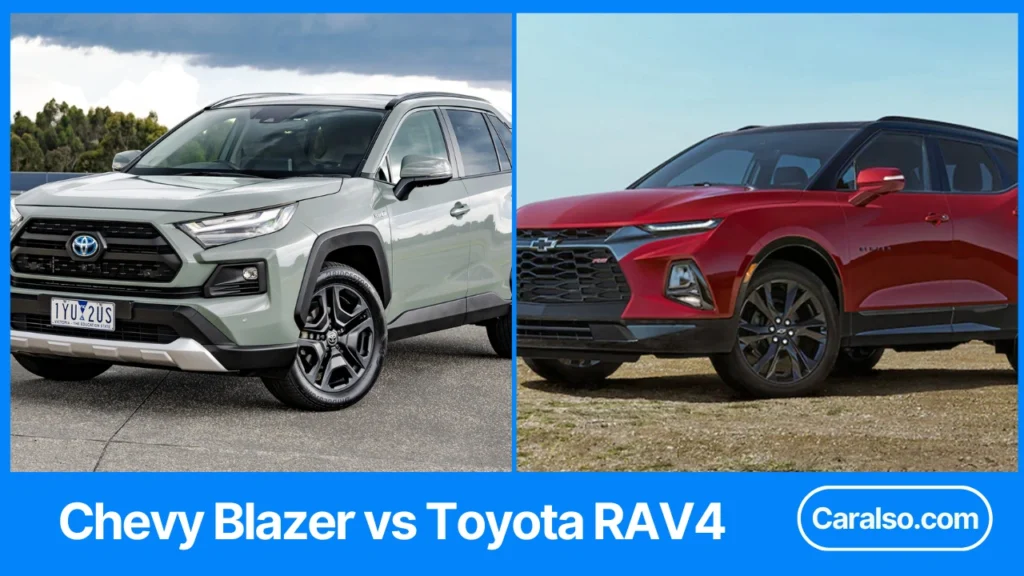
Chevy Blazer Vs Toyota RAV4
Quick Verdict (Answer In 20 Seconds)
Winner For Most People
Toyota RAV4.
You spend less to buy it.
You spend less to fuel it.
You get more cargo space behind the rear seats.
Winner If You Want Power And Towing
Chevy Blazer with the available 3.6L V6.
It makes 308 hp.
It tows up to 4,500 lbs with the trailering package.
That is real capability.
Winner If You Want Lowest Weekly Costs
Toyota RAV4.
I used the current AAA national regular gas price of $2.902 per gallon and a simple 250 miles per week example.
The RAV4 comes out way cheaper on fuel.
Decision Scoreboard
Assumptions I Used For The Weekly Fuel Line
250 miles per week, regular gas, $2.902 per gallon.
Note On The 5-Year Cost Line
Edmunds publishes a 5-year True Cost To Own for the 2026 Blazer.
For the redesigned 2026 RAV4, the closest published baseline is the 2025 RAV4 TCO at the time I wrote this section.
| Category | Chevy Blazer (Typical New Spec) | Toyota RAV4 (Typical New Spec) | Quick Read |
|---|---|---|---|
| Price (Starting MSRP) | $34,300 (2LT) | $31,900 (LE FWD) | RAV4 costs less to get in |
| MPG (Combined) | 24 mpg (2.0T) | 44 mpg combined (hybrid-only, most efficient setup) | RAV4 uses about half the fuel |
| Weekly Fuel Cost (250 mi) | $30.23 per week | $16.49 per week | RAV4 saves about $13.74 per week |
| Cargo Behind Rear Seats | 30.5 cu ft | 37.8 cu ft | RAV4 fits more groceries and strollers |
| Rear Legroom | 39.6 in | 37.8 in | Blazer gives passengers more knee room |
| Max Towing | 4,500 lbs (V6) | 3,500 lbs (most trims, some are 1,750 lbs) | Blazer wins if towing matters |
| Safety Snapshot | IIHS small overlap front: Good | IIHS small overlap front: Good | Both are solid, but trim details matter |
| 5-Year Cost To Own (Edmunds) | $53,745 (2026 Blazer 2LT FWD) | $40,448 (2025 RAV4 LE FWD) | RAV4 is the lower-cost play |
First, A Fair Comparison (Because These Are Different Classes)
Blazer Is Midsize, RAV4 Is Compact. What That Changes
Here is what I see in daily usability.
The Blazer usually feels roomier for rear passengers.
It has 39.6 inches of rear legroom.
The RAV4 usually feels roomier for stuff.
It has 37.8 cubic feet behind the rear seats.
The Blazer has 30.5 cubic feet behind the rear seats.
So yeah, the “bigger” SUV can lose the cargo fight.
That sloped Blazer rear design costs you usable box space.
Blazer Vs Trailblazer. Don’t Mix Them Up
The Chevy Trailblazer is a different vehicle.
It is smaller.
It is cheaper.
It does not drive or tow like a Blazer.
If the listing says Trailblazer, you are not comparing the same class anymore.
Make sure the badge says Blazer.
Also, do not confuse Blazer with Blazer EV.
The EV is a different platform and a totally different shopping decision.
Pick Your “Fair Match” (3 Ways)
When I help friends shop this matchup, I use one of these three “fair” methods.
- Budget Match (Same Purchase Price)
You set one price ceiling and shop both brands under that number.
Example: $40,000 cap.
That can mean a higher-trim RAV4 versus a lower-trim Blazer. - Feature Match (Same Equipment)
You match the stuff you actually touch every day.
Heated seats.
360 camera.
Driver assist package.
Bigger screen.
Then you compare prices. - Capability Match (Towing And Snow)
You match the job, not the trim.
If you truly need more than 3,500 lbs of towing, the Blazer V6 is the logical direction.
If you want the lowest fuel spend and easy winter traction with AWD, the RAV4 hybrid setups are hard to beat.
If you tell me which of the three matches you want, the rest of the comparison becomes simple.
Price Comparison (New And Used) That’s Actually Fair
New MSRP Reality And What People Actually Pay
Here’s how I keep this fair.
I compare base trims that most people actually buy. Then I look at what buyers are paying, not just the window sticker.
Two quick truths:
- The Blazer usually gets bigger discounts.
- The RAV4 usually holds closer to MSRP.
New Price Snapshot
| Model (New) | Typical Sticker | Typical “Real” Price | Typical Discount Pattern |
|---|---|---|---|
| Chevy Blazer 2LT FWD | $34,200 to $36,095 | About $33,843 in a sample market | Buyers often pay about 4.7% under sticker, around $1,815 savings |
| Toyota RAV4 LE FWD | $31,900 to $33,350 | About $32,105 in a sample market | Buyers often pay about 2.4% under sticker, up to about $981 savings |
How I use that:
- If you want the lowest payment on a new, comfortable midsize SUV, Blazer discounts help.
- If you want the strongest resale and the least “price shock” later, the RAV4 usually wins.
One more thing.
AWD pricing can swing the comparison fast.
- On the Blazer, AWD is often about a $2,700 step from 2LT FWD to 2LT AWD.
- On the RAV4, AWD add-ons depend on trim, but it is often a smaller step than the Blazer.
Used Market Reality (2–4 Years Old)
This is where the Blazer vs RAV4 story flips around depending on year.
I like looking at 2 to 4 years old because you can dodge the steepest early depreciation, but still get a modern interior and safety tech.
What Average Used Prices Often Look Like
| Model Year (Used) | Chevy Blazer Avg Price | Toyota RAV4 Avg Price |
|---|---|---|
| 2024 (1 year old) | $34,728 | $31,949 |
| 2023 (2 years old) | $28,559 | $30,011 |
| 2022 (3 years old) | $27,337 | $28,465 |
| 2021 (4 years old) | $25,330 | $26,158 |
What I take from that:
- The 2023 Blazer is often a value sweet spot. You can see pricing in the high $20k range.
- The 2023 RAV4 tends to stay closer to $30k.
- If you are shopping with a hard ceiling like $28,000, the Blazer usually gives you more size per dollar.
Best Value Trims To Compare
I see people cross-shop trims that do not match equipment. Then they feel ripped off.
Here are the two trim matchups I use.
Blazer 2LT Vs RAV4 XLE
This matchup is mostly for used buyers.
The RAV4 XLE is a common “sweet spot” trim in the last generation. It usually has the comfort and safety stuff people want without the top-trim price.
The Blazer 2LT is the equivalent idea on the Chevy side.
How I call it:
- If you want the best value used RAV4, I look for an XLE or XLE Premium.
- If you want the best value used Blazer, I look for a 2LT with the fewest bundled packages.
Quick trim sanity check I use before I compare two listings:
- Same drivetrain type. FWD vs AWD changes price.
- Same wheel size. Bigger wheels often mean pricier tires later.
- Same driver assist level. Some listings say “safety package” but it is not the same thing.
Blazer RS V6 Vs RAV4 Hybrid Limited
This is the “loaded daily driver” matchup.
These land in a similar sticker zone.
- Blazer RS starts around $43,600.
- RAV4 Limited starts around $44,750.
Here’s the real decision point.
- If you are paying for the RS, you are paying for power and road feel. The V6 is available on RS.
- If you are paying for the Limited, you are paying for lower fuel spend and resale strength, plus a high equipment level.
My “Don’t Overpay” Checklist (Fees, Packages, AWD Markup)
This is the checklist I use at the dealer desk.
- Ask for a full itemized out-the-door quote before you talk monthly payment.
- Watch “dealer add-ons” that are not factory options.
- Compare AWD pricing line-by-line. Some dealers bury it inside a package.
- Do not pay extra for a package that only adds cosmetic trim.
- If the quote has paint protection, VIN etching, nitrogen, or wheel locks, ask to remove it or cut the price.
If you do nothing else, do this:
Get two quotes on the same trim. Same drivetrain. Same options.
That is how you force a real discount.
5-Year Cost To Own
The 4 Buckets That Decide Real Ownership Cost
I break ownership cost into four buckets because that’s what moves the needle.
- Depreciation
What you lose when you sell or trade. - Fuel
Your weekly cost that never stops. - Insurance
Often higher on the Blazer than people expect. - Maintenance And Repairs
Tires, brakes, fluids, plus the random stuff.
If you want a fast gut check, this is it:
- Depreciation and fuel are usually the biggest gap between these two.
- That gap can be bigger than the difference in MSRP.
5-Year Ownership Cost Table (Blazer Vs RAV4)
These are 5-year totals based on a standard set of assumptions from a major cost-to-own calculator.
This is not “cash spent.” It includes depreciation as a cost.
I like it because it makes comparisons clean.
5-Year Total Cost Snapshot
| Category (5 Years) | 2026 Blazer 2LT FWD | 2025 RAV4 Hybrid LE AWD |
|---|---|---|
| Depreciation | $18,378 | $12,948 |
| Fuel | $12,614 | $5,764 |
| Insurance | $4,853 | $4,280 |
| Maintenance | $5,568 | $5,264 |
| Repairs | $1,016 | $778 |
| Taxes And Fees | $4,977 | $3,583 |
| Financing | $6,339 | $6,049 |
| Total 5-Year Cost | $53,745 | $38,666 |
Now I turn that into a decision-ready number.
- Blazer 2LT: about $896 per month for 60 months.
- RAV4 Hybrid: about $644 per month for 60 months.
That is a gap of about $250 per month.
Over 5 years, that is about $15,079.
Depreciation Reality Check (Why The Same MSRP Can Cost More)
This is where a lot of comparisons fall apart.
Two vehicles can have similar MSRPs, but totally different value loss.
A simple depreciation snapshot:
- Chevy Blazer: about 52% depreciation after 5 years in one depreciation model.
- Toyota RAV4: about 28% depreciation after 5 years in that same style of model.
That is why the RAV4 often “wins” on cost even when the payment looks close.
Decision-Ready Budget Box
This is the box I wish every comparison had.
If you buy new and keep it 5 years:
- Blazer 2LT FWD: Plan around $54,000 total ownership cost.
- RAV4 Hybrid LE AWD: Plan around $39,000 total ownership cost.
If you buy used, I add a buffer. Every time.
My rule:
- Set aside $1,500 for any used SUV right after purchase.
- Add another $1,000 if it has larger wheels or you expect to need tires soon.
- Add another $500 if the vehicle has a long list of dealer-installed accessories you did not choose.
That buffer is what keeps a “great deal” from turning into stress.
Fuel Economy And Range (MPG Vs What You Pay Weekly)
MPG Comparison (Gas RAV4 Vs Blazer)
I’m going to use real EPA-style numbers and keep it simple.
Here are the combined MPG figures that matter most in this matchup.
| Vehicle | Powertrain | Combined MPG |
|---|---|---|
| Chevy Blazer | 2.0T FWD | 25 |
| Chevy Blazer | 2.0T AWD | 24 |
| Chevy Blazer | 3.6L V6 FWD | 22 |
| Chevy Blazer | 3.6L V6 AWD | 21 |
| Toyota RAV4 (2025 And Older Gas Model) | 2.5L Gas | 30 |
| Toyota RAV4 Hybrid | Hybrid | 39 |
| Toyota RAV4 Hybrid (2026 New Gen, Best Case) | Hybrid | Up To 41 |
One note I always tell people. The Blazer’s 2.0T often lists premium fuel as recommended for best performance. You can still run regular. I use regular prices below so the comparison stays apples to apples.
Hybrid Shortcut (Why RAV4 Hybrid Changes The Math)
This is the cheat code.
The RAV4 Hybrid can be around 39 mpg combined in the current model cycle. The new-gen 2026 hybrid setup can reach up to 41 mpg combined in the most efficient configuration.
That is why the RAV4’s weekly fuel bill stays low even when gas prices move.
And if you drive mostly city miles, the hybrid advantage usually grows. More stops means more regen, and less wasted fuel.
Weekly Fuel Cost Table At 150, 250, 350 Miles Per Week
I used the AAA national average price for regular gas of $2.891 per gallon (early February 2026).
| Miles Per Week | Blazer 2.0T FWD (25 MPG) | Blazer V6 AWD (21 MPG) | RAV4 Gas (30 MPG) | RAV4 Hybrid (39 MPG) | RAV4 Hybrid (41 MPG) |
|---|---|---|---|---|---|
| 150 | $17.35 | $20.65 | $14.46 | $11.12 | $10.58 |
| 250 | $28.91 | $34.42 | $24.09 | $18.53 | $17.63 |
| 350 | $40.47 | $48.19 | $33.73 | $25.94 | $24.68 |
How I use this table:
- If you want the Blazer for towing and power, budget the V6 fuel line.
- If you want the lowest weekly spend, the RAV4 Hybrid is the clean win.
- If you are shopping a used gas-only RAV4, it still beats the Blazer 2.0T on fuel.
Range Reality (Bigger Tank Vs Better MPG)
People see the Blazer’s bigger fuel tank and assume it goes farther.
It depends on MPG.
Here’s a clean comparison using tank size and combined MPG.
| Vehicle | Tank Size | Combined MPG Used | Estimated Range Per Tank |
|---|---|---|---|
| Blazer 2.0T FWD | 19.4 gal | 25 | 485 miles |
| RAV4 Gas (2025 And Older) | 14.5 gal | 30 | 435 miles |
| RAV4 Hybrid | 14.5 gal | 39 | 566 miles |
| RAV4 Hybrid (Best Case) | 14.5 gal | 41 | 595 miles |
This is why the RAV4 Hybrid feels like it barely stops for fuel on road trips.
Performance And Driving Feel (What The Extra Money Buys)
Engines And Numbers That Matter
I start here because engine choice drives everything else.
| Vehicle | Engine | Power | Torque | Transmission |
|---|---|---|---|---|
| Blazer | 2.0T | 228 hp | 258 lb-ft | 9-speed auto |
| Blazer | 3.6L V6 | 308 hp | 270 lb-ft | 9-speed auto |
| RAV4 Hybrid (New Gen) | 2.5L Hybrid FWD | 226 hp | Hybrid system | eCVT |
| RAV4 Hybrid (New Gen) | 2.5L Hybrid AWD | 236 hp | Hybrid system | eCVT |
Two quick takeaways:
- The Blazer gives you a real step up in power when you get the V6.
- The RAV4 Hybrid’s numbers look lower, but the electric torque fills in low-speed response.
Passing Power And Highway Merging
This is where I focus.
0 to 60 matters, but 50 to 70 matters more on real highways.
Here are the best published benchmarks I lean on:
- Blazer V6 (RS AWD tested): 0 to 60 in 6.6 seconds.
- RAV4 Hybrid (Woodland tested): 0 to 60 in 7.3 seconds.
- RAV4 gas-only model (tested): 0 to 60 in 8.0 seconds.
- RAV4 Hybrid (new gen tested): 0 to 60 in 7.1 seconds.
What it means on the road:
- If you want the quickest Blazer, you want the V6.
- If you want consistent “easy” passing without watching the fuel gauge, the RAV4 Hybrid feels efficient and quick enough.
One honest note. There is not a widely-cited instrumented 0 to 60 number for the base Blazer 2.0T from the same test source that ran the V6. That is why I do not pretend the 2.0T is a rocket. I treat it as the “daily driver” engine.
Ride And Handling. What Changes With Wheel Size
Wheel size changes the feel more than most people expect.
Here’s what I watch:
- Bigger wheels usually mean less tire sidewall.
- Less sidewall usually means more impact over potholes.
- Bigger wheels also raise tire replacement cost.
Typical wheel ranges:
- Blazer: factory sizes can reach 21-inch wheels depending on trim.
- RAV4: most trims live in the 17 to 19-inch range.
My quick rule:
- If you care about ride comfort and tire costs, I aim for 18s or 19s on the Blazer.
- If you care about steering feel and the “sporty” look, the big wheels do that, but you pay later.
My 10-Minute Test Drive Route (So Buyers Can Feel The Differences)
This is the route I use so the decision feels obvious.
- Parking Lot Loop (1 minute)
Full lock turns both directions.
Listen for tire scrub.
Check steering effort at low speed. - Rough Road Patch (2 minutes)
Drive 25 to 35 mph.
Feel the suspension over broken pavement. - On-Ramp Pull (2 minutes)
Roll in at 35 mph.
Go to 70 mph.
Note engine sound and how fast it builds speed. - Highway Cruise (3 minutes)
Set 70 mph.
Listen for wind noise.
Check lane centering behavior if equipped. - Two-Lane Pass (2 minutes)
From 50 to 70 mph.
This is the “can I pass safely” moment.
If the Blazer V6 makes you smile enough to justify higher fuel and a higher 5-year cost, you will know right here. If it does not, the RAV4 Hybrid is the smarter tool for most people.
Space, Comfort, And Family Usability
Cargo Numbers That Actually Matter (Seats Up, Seats Down)
This is the part where the “bigger SUV” can lose.
The Blazer is a midsize SUV.
But its cargo area is more tapered.
The RAV4 is more upright.
That shape matters.
| Cargo Measurement | Chevy Blazer | Toyota RAV4 |
|---|---|---|
| Behind Rear Seats | 30.5 cu ft | 37.6 to 37.8 cu ft |
| Max With Seats Folded | 64.2 cu ft | 69.8 to 70.4 cu ft |
My quick read:
- If you carry bulky stuff a lot, the RAV4’s boxier opening is the advantage.
- If you carry people first and cargo second, the Blazer can still work. It just runs out of “square space” sooner.
One Blazer detail I like.
It has sliding rear seats.
So you can trade rear legroom for more cargo depth on the fly.
Rear Seat Space (Legroom And Car Seat Practicality)
Rear legroom is simple math.
- Blazer rear legroom: 39.6 inches
- RAV4 rear legroom: 37.8 inches
That 1.8-inch gap is real.
Adults feel it on longer drives.
Now the kid-seat reality.
Both can handle two car seats easily in the back.
Neither is a guaranteed “three car seats across” win.
Here’s what I go by:
- Cars.com testing on the Blazer says it has easy-access LATCH and plenty of room for two car seats, but it does not fit three car seats well.
- Cars.com testing on the 2026 RAV4 grades the LATCH setup as good but not perfect. The lower anchors can be harder to access, and the top tether anchors are a little buried.
My real-world takeaway:
- If you have two car seats and you want an adult in the middle, try it in person.
- The Blazer gives you more rear seat width feel.
- The RAV4 gives you more cargo room for the stroller and bags.
Real-World Fit Tests (My Simple “Does It Actually Work” Check)
I use two tests.
Carry-on luggage.
And the stroller plus groceries combo.
Carry-On Suitcase Test (Easy To Visualize)
| Test | Chevy Blazer | Toyota RAV4 |
|---|---|---|
| Carry-Ons Behind Rear Seats | 11 | 10 |
| Carry-Ons With Seats Folded | 26 | 24 |
This matches what I see in day-to-day use.
- Blazer: strong people space, decent cargo, very usable for airport runs.
- RAV4: slightly fewer carry-ons in the published test, but the cargo bay is taller and squarer. It is easier to stack odd-shaped stuff.
Stroller + Groceries Test (What Most Families Actually Do)
This is how I judge it in a parking lot.
Blazer checklist:
- One full-size stroller fits, but you usually need to lay it flatter.
- You have less “height” for stacking groceries on top of it.
RAV4 checklist:
- One full-size stroller fits more upright.
- You usually keep more open space for a weekly grocery run behind it.
Two Car Seats + Adult In The Middle
I will be blunt.
Most adults will not love the middle seat in either SUV for long drives.
It is the seat you use for a 10-minute hop.
If this matters to you, do this test at the dealership:
- Install both car seats.
- Put a real adult in the middle.
- Drive 15 minutes.
- Check shoulder contact and buckle access.
If the adult is going to ride there often, you might actually want a three-row SUV.
Towing, Snow, And Light Off-Road Ability
Towing Capacity Explained The Right Way
I only trust tow numbers when they include the package and the engine.
Here’s the clean breakdown.
Chevy Blazer Towing
| Blazer Setup | Towing Rating |
|---|---|
| Standard (No Trailering Equipment) | 1,500 lbs |
| 2.0T With Factory Trailering Equipment | 3,250 lbs |
| 3.6L V6 With Factory Trailering Equipment | 4,500 lbs |
My advice:
- If towing is a real need, I skip the “standard tow” setup.
- I look for the factory trailering equipment on the window sticker.
- And if you want 4,500 lbs, you are shopping the V6.
Toyota RAV4 Towing
RAV4 towing changes a lot by year and trim.
If you are shopping the newest generation:
- 2026 RAV4 FWD and AWD LE tow 1,750 lbs.
- Other 2026 AWD trims tow up to 3,500 lbs.
If you are shopping used:
- Many gas RAV4 trims are 1,500 lbs.
- Hybrids are often 1,750 lbs.
- Plug-in hybrids are often 2,500 lbs.
- Some older Adventure and TRD Off-Road trims were rated up to 3,500 lbs.
My simple rule:
If you need 3,500 lbs or more, confirm the exact trim and model year before you buy.
The Part Everyone Ignores: Payload And Tongue Weight
Tow rating is not the whole story.
You also have payload.
That is people plus cargo inside the SUV.
Then you have tongue weight.
A simple towing math check I use:
- A 3,500 lb trailer can put about 350 to 525 lbs on the hitch.
- Add two adults at 350 lbs combined.
- Add 150 lbs of cargo.
- You can be near the limit fast.
That is why midsize SUVs with higher tow ratings tend to feel less stressed.
Snow Driving: Tires Beat AWD
I love AWD.
But tires are the real grip.
My winter checklist:
- Get tires with the 3PMSF rating if you see real snow.
- Replace tires before they hit 4/32-inch tread depth if winter traction matters.
- Keep a small shovel and traction boards if you travel rural roads.
Now, AWD system behavior.
Blazer:
- Has a Snow/Ice drive mode.
- RS AWD models can use an advanced twin-clutch AWD system that can send torque independently to either rear wheel.
RAV4 (newer hybrid AWD setups):
- Has Snow and Trail drive modes.
- In Trail mode, the rear electric drive can stay more active to help you keep moving in loose or slick conditions.
My take:
- On all-seasons, both are “fine” in light snow.
- On proper winter tires, both are dramatically better.
- If you live on steep driveways or unplowed roads, I would rather have RAV4 AWD with winter tires than Blazer FWD with all-seasons.
Light Off-Road Reality (Trailheads, Dirt Roads, Campsites)
Neither of these is a rock crawler.
That is not the job.
But trailheads and forest roads are fair game.
Ground clearance tells you a lot:
- Blazer ground clearance: about 7.5 inches.
- 2026 RAV4 ground clearance varies by trim:
- 8.1 inches on many trims
- 8.5 inches on Woodland
- 7.5 inches on GR Sport
What that means:
- The RAV4 is less likely to scrape on ruts and dips.
- The Blazer is more likely to touch the front lip on uneven entrances, especially on big wheels.
If you do dirt roads often, I also care about tire sidewall.
- Avoid low-profile tires.
- Smaller wheels usually ride better and survive potholes better.
Best Trims For Capability (And Which To Avoid)
Best Picks If Capability Is The Goal
Blazer:
- Best: V6 + factory trailering equipment if you tow.
- Best: AWD if you deal with regular snow.
RAV4:
- Best: AWD trims if you see real winter.
- Best: Woodland if you want more clearance and a more trail-friendly setup.
- Best: Any AWD trim rated at 3,500 lbs if towing is on your list.
Trims I Would Avoid For This Use Case
Blazer:
- Avoid: Base towing setup if you actually plan to tow.
- Avoid: Big wheel packages if your roads are rough or you do dirt roads often.
RAV4:
- Avoid: FWD if you live in snow country.
- Avoid: Assuming any used RAV4 can tow 3,500 lbs without checking the exact trim and year.
Tech And Safety Features That Matter (Not Just A List)
I care about tech for one reason. I use it every single day. If it is annoying at 7:30 AM, I will hate the car by month three.
The 6 Features Most Buyers Use Daily
- Wireless Phone Projection
Blazer: 10.2-inch touchscreen. Wireless Apple CarPlay and wireless Android Auto.
RAV4: Standard 10.5-inch touchscreen. Available 12.9-inch screen on some trims. - Adaptive Cruise Control
Blazer: Available. Not standard on every trim.
RAV4: Dynamic Radar Cruise Control is part of the safety suite. - Lane Centering
Blazer: Lane keeping is standard. Full lane centering depends on trim and options.
RAV4: Lane Tracing Assist is in the safety suite. It works with radar cruise. - Blind Spot Monitoring
Blazer: Lane Change Alert with Side Blind Zone Alert is standard for 2026.
RAV4: Blind Spot Monitor with Rear Cross Traffic Alert is standard on all 2026 models. - Parking Sensors
Blazer: Rear Park Assist is standard for 2026.
RAV4: Parking sensors depend on trim. Expect them more often on higher trims. - 360 Camera
Blazer: Available, but not a “base trim” expectation.
RAV4: Available Panoramic View Monitor. It gives a 360 top-down view.
What’s Standard Vs What’s Locked Behind Packages
Here’s the clean way I think about it.
If you want the key safety basics without trim regret, both can do it.
The difference is how fast you hit “package land” to get the nicer stuff.
Blazer (2026 Focus)
- Standard on all trims: Chevy Safety Assist items like Automatic Emergency Braking, Front Pedestrian Braking, Lane Keep Assist, and IntelliBeam.
- Also standard for 2026: Driver Confidence Package with blind spot alert, rear cross traffic alert, and rear parking sensors.
- Usually extra: Adaptive Cruise Control. 360 camera. Upgraded audio. Built-in navigation.
RAV4 (2026 Focus)
- Standard safety suite: Toyota Safety Sense 4.0 with pre-collision, lane alert, lane tracing, auto high beams, and radar cruise.
- Standard daily-use safety add-ons: Blind Spot Monitor with Rear Cross Traffic Alert. Safe Exit Assist.
- Usually extra: 360 camera and the largest screen.
If you are the kind of driver who wants lane centering and adaptive cruise every day, I would price both with those options included. Not “starting MSRP.”
Safety Ratings And What To Verify (IIHS, NHTSA)
Safety ratings are trim-sensitive. Headlights and driver-assist options can change results.
Here’s what I take away from the public crash data.
RAV4 (IIHS, 2025 Model Year)
- Small overlap front: Good
- Moderate overlap front, updated test: Marginal
- Side, updated test: Acceptable
- Headlights: Good
- Front crash prevention, vehicle-to-vehicle: Acceptable
- Front crash prevention, pedestrian: Good
Blazer (IIHS, 2025 Model Year)
- Small overlap front: Good
- Pedestrian front crash prevention with the standard braking system: Advanced
For NHTSA, I always verify by exact year, drivetrain, and trim. Some vehicles show “Not Rated” for certain configurations. I do not guess.
5-Minute Safety Check (Do This On The Test Drive)
I do this every time. It takes 5 minutes and saves me from surprises.
- Confirm the driver-assist icons are actually present in the menus.
Look for AEB, lane assist, and blind spot settings. - Drive 2 miles on a clearly marked road.
Turn on lane support and cruise. See if it holds center or just bounces off the line. - Check the backup camera and parking sensors in a tight spot.
If the sensors are loud, delayed, or inconsistent, I treat that as a red flag. - Look at the windshield.
If it has a replacement sticker or obvious work, ask who recalibrated the cameras. - Pull the VIN and check open recalls before you negotiate.
I do this on my phone while the salesperson is getting the keys.
Reliability And Common Ownership Risks (Especially For Used Buyers)
I like both of these models for different reasons. But used buyers do not buy “the model.” They buy a specific year, a specific powertrain, and a specific maintenance history.
What Tends To Fail And What It Costs (Blazer Vs RAV4)
I look at ownership risk in two buckets.
Bucket 1: Predictable wear items
Tires. Brakes. Fluids. Battery. Suspension links.
Bucket 2: “This can ruin my week” problems
Infotainment failures. Sensor issues. Water leaks. High-voltage hybrid corrosion in salt states.
Decision-ready numbers I use:
- Estimated maintenance and repair cost over the first 5 years: about $3,586 for a Blazer vs about $2,562 for a RAV4.
- Estimated chance of a major repair in 10 years: about 26.91% for Blazer vs about 16.08% for RAV4.
Those are estimates, not guarantees. But they match what I see in the real world. Toyota usually asks less of your wallet over time.
Blazer ownership risks I watch closely
- Infotainment and phone projection glitches. I have seen service bulletins tied to screen and connectivity complaints. If the screen freezes or drops the phone, I want proof of the latest software update.
- 9-speed automatic behavior. On a test drive, I watch for harsh 2-3 shifts, delayed engagement, or shudder under light throttle.
- AWD service history. If it is AWD, I want evidence of regular fluid service.
RAV4 ownership risks I watch closely
- Roof rail water leaks on certain years. I check the headliner corners and cargo area for staining. I also smell for damp carpet.
- Hybrid high-voltage cable corrosion in road-salt areas. I inspect underneath for corrosion and ask about warranty coverage or prior repairs.
- Wheels and alignment damage. RAV4s get curb-checked a lot. I look for uneven tire wear.
Used Buyer Checklist (What To Inspect Before You Buy)
If you only do one thing, do this checklist.
Paperwork
- Pull the Carfax or dealer history. Look for repeat visits for the same complaint.
- Confirm open recalls are closed by VIN.
Test Drive
- Cold start. Listen for rough idle and watch for warning lights.
- Drive 10 minutes on mixed roads. City plus highway.
- Do 2 medium stops from 45 mph. Feel for steering shake.
Cabin Tech
- Pair your phone. Use wireless projection if equipped.
- Run navigation for 3 minutes. If it crashes, walk away or negotiate hard.
- Test every USB port.
Leak Checks
- For RAV4: check headliner edges, rear cargo floor, and spare tire well for moisture.
- For Blazer: check under the cargo floor and around the liftgate seals.
Best Used Years Strategy (And Which Powertrain Combos To Target)
This is how I shop when I want the lowest regret.
Chevy Blazer Used Strategy
- I usually avoid the very first model year unless the price is a steal and the service history is perfect.
- If I want the smoother experience, I lean toward the 3.6L V6 models. They tend to feel less strained in a heavier SUV.
- If I buy the 2.0T, I want a clean maintenance record and a transmission that shifts smoothly when cold.
Toyota RAV4 Used Strategy
- If I live in a road-salt state and I want a hybrid, I check the high-voltage cable area and confirm any warranty support program coverage by VIN.
- If I want to reduce leak risk, I lean toward newer examples after the roof rail issue window.
- If I want the simplest long-term bet, a well-maintained gas RAV4 or a newer hybrid with documented inspections is usually my “sleep well” pick.
If you want a single sentence from me as a used-buyer rule:
I will take a slightly newer RAV4 with boring service records over a cheaper Blazer with spotty history.
Best Pick Recommendations (By Buyer Type)
I’m going to make this simple. I’ll tell you what I’d buy based on how you actually use the SUV.
| Buyer Type | My Pick | The Numbers That Decide It |
|---|---|---|
| Best For Commuters | RAV4 Hybrid | 250 miles per week: about $18.53 (39 mpg) vs $28.91 (Blazer 25 mpg) |
| Best For Families | RAV4 Hybrid For Cargo, Blazer For Rear Legroom | Cargo: 37.8 cu ft (RAV4) vs 30.5 (Blazer). Rear legroom: 37.8 in (RAV4) vs 39.6 (Blazer) |
| Best For Towing And Road Trips | Blazer V6 With Trailering | Max tow: 4,500 lbs (Blazer V6) vs up to 3,500 lbs (RAV4 AWD trims) |
| Best For Long-Term Ownership | RAV4 Hybrid | 10-year maint + repair: $6,005 (RAV4) vs $9,390 (Blazer). Major repair chance: 16.6% vs 26.9% |
| Best If You’re Buying Used Under $30k | It Depends On Your Priorities | Avg 2023 prices: about $27,283 (Blazer) vs $28,036 (RAV4) |
Best For Commuters
I pick the RAV4 Hybrid.
Fuel spend is the whole story here.
At 250 miles per week:
- Blazer 2.0T FWD at 25 mpg: about $28.91 per week
- RAV4 Hybrid at 39 mpg: about $18.53 per week
That is about $10.38 more per week for the Blazer.
That is about $540 per year if you drive that pattern.
If you do 350 miles per week, the gap gets bigger fast.
Best For Families
This one splits.
If you carry more stuff, I pick the RAV4.
If you carry taller teens and adults in the back seat a lot, I lean Blazer.
The numbers:
- Cargo behind row 2: 37.8 cu ft (RAV4) vs 30.5 (Blazer)
- Rear legroom: 37.8 in (RAV4) vs 39.6 (Blazer)
My real-world take:
- The RAV4 feels easier for strollers, wagons, and grocery hauls.
- The Blazer feels easier for rear passengers on long drives.
Best For Towing And Road Trips
If towing is real for you, I pick the Blazer V6 with the trailering package.
The tow ratings that matter:
- Blazer V6 with factory trailering: 4,500 lbs
- Blazer 2.0T with factory trailering: 3,250 lbs
- Blazer without trailering equipment: 1,500 lbs
RAV4 towing depends on trim and drivetrain.
- Some trims are 1,750 lbs
- Some AWD trims go up to 3,500 lbs
My towing rule:
If you want to tow a small camper without stress, I’d rather have the Blazer V6.
For road trips with no towing, the RAV4 Hybrid wins on fewer fuel stops.
It can run around 566 miles per tank using 39 mpg and a 14.5-gallon tank estimate.
Best For Long-Term Ownership
I pick the RAV4 Hybrid.
Here are the two numbers that decide it for me:
- 10-year maintenance and repair estimate: $6,005 (RAV4) vs $9,390 (Blazer)
- 10-year major repair probability: 16.6% (RAV4) vs 26.9% (Blazer)
If you want to keep it past 100,000 miles, that gap matters.
Best If You’re Buying Used Under $30k
This is where the Blazer can look tempting.
Average used pricing example for 2023 models:
- Blazer: about $27,283
- RAV4: about $28,036
My decision rule under $30k:
- If you want the most space for the money and you found a clean service history, the Blazer can be a smart buy.
- If you want the lowest ownership risk and the strongest resale, I still lean RAV4.
My used-buyer must-do list:
- Verify open recalls by VIN.
- Test wireless phone projection.
- Check tire tread depth on all 4 corners.
- Look for smooth shifts when cold.
- Inspect for water intrusion in the cargo area and headliner.
FAQs
Is The Chevy Blazer Bigger Than The RAV4?
Yes on the outside.
Blazer length is about 191.8 inches.
RAV4 length is about 181.0 inches.
But bigger outside does not mean bigger cargo.
Behind the rear seats:
- RAV4: 37.8 cu ft
- Blazer: 30.5 cu ft
Which Is Better On Gas, Blazer Or RAV4?
The RAV4 Hybrid.
Typical combined mpg:
- Blazer 2.0T AWD: 24 mpg
- RAV4 Hybrid: about 39 mpg
- Most efficient RAV4 hybrid setup can reach about 44 mpg by estimate
If you drive 250 miles per week on regular gas:
- Blazer 25 mpg: about $28.91 per week
- RAV4 Hybrid 39 mpg: about $18.53 per week
Can A Chevy Blazer Tow More Than A RAV4?
Yes, if you choose the right engine and package.
Max towing:
- Blazer V6 with trailering: 4,500 lbs
- RAV4: up to 3,500 lbs on certain AWD trims, and lower on others
If you need more than 3,500 lbs, the Blazer is the cleaner answer.
Which Is More Reliable, Chevy Blazer Or Toyota RAV4?
I trust the RAV4 more for long-term ownership.
Two decision-ready numbers:
- 10-year maintenance and repair estimate: $6,005 (RAV4) vs $9,390 (Blazer)
- Major repair chance over 10 years: 16.6% (RAV4) vs 26.9% (Blazer)
Is The Blazer Worth The Money Over A RAV4 Hybrid?
It can be, but only for the right buyer.
I’d pay for the Blazer if:
- You want the available 308 hp V6.
- You want up to 4,500 lbs towing.
- You want 39.6 inches of rear legroom.
I’d pick the RAV4 Hybrid if:
- You want lower weekly fuel spend.
- You want 37.8 cu ft of cargo behind row 2.
- You want lower long-term maintenance and repair risk.
Key Takeaways
- Blazer is larger outside: about 191.8 inches long vs about 181.0 inches for RAV4.
- RAV4 carries more behind row 2: 37.8 cu ft vs 30.5 cu ft in the Blazer.
- RAV4 Hybrid wins fuel cost: 250 miles per week is about $18.53 vs $28.91 for a 25 mpg Blazer.
- Blazer wins towing if you spec it right: up to 4,500 lbs with the V6 and trailering package.
- Long-term cost risk favors RAV4: 10-year maint + repair estimate $6,005 vs $9,390, and major repair chance 16.6% vs 26.9%.
Sources
- Toyota 2026 RAV4 (Official Model Page)
- Chevrolet 2026 Blazer (Official Model Page)
- Edmunds 2026 Chevrolet Blazer True Cost To Own
- Car And Driver 2026 Chevrolet Blazer Review
- IIHS 2025 Chevrolet Blazer Safety Ratings

Hey there,
How is it going?
I’m Meraj Sarker. I am a Car Mechanic and a student of Automobile Restoration here in Florida, USA. I’ve been studying automotive for around 9 years now. So you can rely on my recommendation. For me, studying and getting knowledge about automobile it’s really fun and entertaining. I will help you to get solutions for your car through this website. If you need any help let me know.