
If you want the closest match to a RAV4, I start with the Honda CR-V. It hits the same 2-row, 5-seat compact SUV brief, and it offers both gas and hybrid power. If you want a plug-in option like the RAV4 Plug-in Hybrid, I’d look first at the Kia Sportage Plug-in Hybrid, Hyundai Tucson Plug-in Hybrid, and Ford Escape Plug-in Hybrid.
Use this page like a shortcut. Pick your top priority, then jump to the models that fit it best.
Best RAV4-Like SUVs By Priority
| Priority | My Pick | Why It Matches A RAV4 | Trade-Off Vs RAV4 |
|---|---|---|---|
| Most Similar Overall | Honda CR-V (Gas Or Hybrid) | Same “do-it-all” compact SUV formula. Hybrid available. AWD available. | Driving feel is a bit more “soft and calm” than a RAV4 for some shoppers. |
| Hybrid Without Plug-In | Honda CR-V Hybrid | Hybrid power, strong daily usability, AWD available. | Not a plug-in. No EV-only commuting. |
| Plug-In Alternative | Kia Sportage Plug-In Hybrid | Plug-in option with an EPA-est 34 miles of electric range. Available AWD. | You need a place to charge to get the point of a PHEV. |
| Best Feature Value | Hyundai Tucson Hybrid | Hybrid option with lots of tech and safety features for the money. | Resale can vary more by market than Toyota. |
| Snow And Bad-Weather Focus | Subaru Forester (Gas Or Hybrid) | AWD-first positioning and visibility-focused design. | It is not the quickest in the class. |
| Nicer Cabin Feel | Mazda CX-5 Or Mazda CX-50 | Cabin materials and road manners tend to feel more “premium” than typical mainstream picks. | Some trims trade soft ride for sharper handling. |
| Plug-In With Flexible Packaging | Ford Escape Plug-In Hybrid | Plug-in option, plus a normal hybrid and gas engines in the same lineup. | Interior space and trim execution depend heavily on spec. |
The goal here is not to crown one winner. It’s to get you into the right “RAV4 neighborhood” fast, then pick the one that fits your driving.
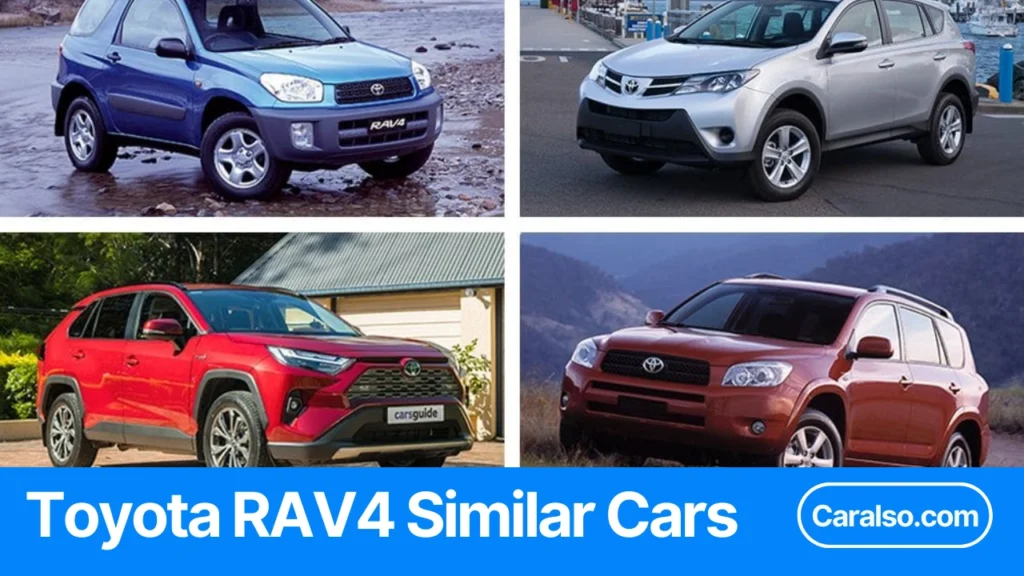
Cars Similar To The Toyota RAV4
What Does “Similar To A RAV4” Actually Mean?
When someone asks me for “cars similar to a RAV4,” I translate it into a short checklist. The RAV4 sits in the middle of the compact SUV world. So “similar” is usually about size, daily usability, and ownership expectations, not just brand badges.
The 5 Traits Most Shoppers Mean
- 2-Row, 5-Seat Layout
You want the same everyday shape. Easy parking. Easy Costco run. Enough rear seat for adults and kids. - A Practical Cargo Area
Not “the biggest SUV.” Just the kind of cargo space that works with strollers, groceries, and a weekend trip without playing Tetris. - AWD As An Option
A lot of people do not need hardcore off-road hardware. They want traction for rain, snow, dirt driveways, and the occasional rough road. - Low-Drama Ownership
This is the big one. People choose the RAV4 because they want fewer surprises at 60,000 miles and 120,000 miles. - A Hybrid Path
Many RAV4 shoppers are specifically thinking about the RAV4 Hybrid or the RAV4 Plug-in Hybrid. So the “similar” list has to include real hybrid and plug-in alternatives, not just gas-only crossovers.
If a model misses 2 of these 5, I stop calling it “RAV4-like.” It might still be a good SUV. It just is not a true substitute.
Quick Self-Check: Choose Your RAV4 Reason
Pick the sentence that sounds like you.
- I want reliability and simple ownership.
- I want hybrid MPG, but I do not want to plug in.
- I want plug-in capability for short daily drives.
- I want a nicer cabin without jumping to a luxury badge.
- I want the best deal, even if resale is not number 1.
- I deal with snow often and I want AWD confidence.
Once you pick your reason, the “right” alternatives get obvious. For example, if you want plug-in capability, I do not waste your time with gas-only picks. If you want a nicer cabin feel, I move Mazda up the list fast.
The Short List: 10 Cars Most Similar To The RAV4 (Ranked By Match)
I rank “most similar” by 3 things I see RAV4 buyers care about most. Size. AWD availability. Hybrid or plug-in options.
I also watch cargo behind the second row. That is the number that decides if your Costco run is easy or annoying.
1) Honda CR-V
- Best for: I point most RAV4 cross-shoppers here first because it nails the same “do everything” mission.
- Beats RAV4:
- More cargo space behind the second row in gas trims: 39.3 cu ft.
- Big max cargo number with seats down: 76.5 cu ft.
- Loses to RAV4:
- Hybrid cargo is smaller than gas CR-V: 36.3 or 34.7 cu ft, depending on hybrid trim.
- RAV4 has a plug-in option. CR-V does not in the US lineup.
- Powertrain note: Gas or hybrid. AWD is available.
- Used-buyer watchouts:
- Confirm which powertrain you are buying. Gas and hybrid drive very differently.
- Test the liftgate and all cameras. These get used a lot in family duty.
- Check tire matching on AWD models. I avoid mixed tire brands and tread depths.
2) Hyundai Tucson (Gas, Hybrid, And Plug-In Hybrid)
- Best for: I like it for people who want RAV4-like space with a strong tech and warranty vibe.
- Beats RAV4:
- Cargo behind second row on gas and hybrid: 38.7 cu ft.
- Plug-in option exists if you want a short electric commute.
- Loses to RAV4:
- Plug-in cargo is smaller: 31.9 cu ft.
- Resale is usually not as strong as Toyota in many markets.
- Powertrain note: Gas, hybrid, and plug-in hybrid are available. AWD depends on trim and powertrain.
- Used-buyer watchouts:
- If it is a plug-in, confirm it charges properly and the charging cable is included.
- Check for even tire wear and a straight steering wheel on the test drive.
- Make sure all driver-assist features calibrate and behave normally on the highway.
3) Kia Sportage (Gas, Hybrid, And Plug-In Hybrid)
- Best for: If you want maximum cargo in this class but still want hybrid or plug-in options.
- Beats RAV4:
- Cargo behind second row is huge for the segment: 39.6 cu ft with the cargo floor in the low position.
- Available plug-in option for short electric driving.
- Loses to RAV4:
- Dual-level cargo floor means you need to check which position you will live with. It can be 36.6 cu ft in the high position.
- RAV4 hybrid resale usually stays stronger.
- Powertrain note: Gas, hybrid, and plug-in hybrid exist. AWD depends on trim and powertrain.
- Used-buyer watchouts:
- Verify the cargo floor pieces are present. People lose them.
- If it is a plug-in, test public charging and the home charger setup if possible.
- Confirm you are buying the powertrain you think you are. Sportage has multiple “look-alike” trims.
4) Mazda CX-50
- Best for: If you want a RAV4-sized SUV but care more about steering and road feel.
- Beats RAV4:
- AWD is a core part of the CX-50 lineup.
- Strong towing options on certain trims: up to 3,500 lb on turbo models.
- Loses to RAV4:
- Cargo behind the second row is smaller than RAV4: 31.4 cu ft.
- Hybrid availability is newer, so used supply can be tighter.
- Powertrain note: Gas and hybrid are available. AWD is part of the CX-50 identity.
- Used-buyer watchouts:
- If you tow, confirm hitch wiring quality and look for evidence of heavy trailer use.
- Check for wheel damage. CX-50 wheels get curb rash easily.
- On hybrids, confirm smooth transitions at low speeds and during parking maneuvers.
5) Nissan Rogue
- Best for: If you want RAV4-like space and MPG without paying hybrid money.
- Beats RAV4:
- Cargo behind second row is right in the RAV4 zone: 36.5 cu ft without a moonroof.
- Often priced aggressively compared to hybrid rivals.
- Loses to RAV4:
- No hybrid option in the lineup.
- Long-term resale is usually weaker than Toyota.
- Powertrain note: Gas only. AWD is available.
- Used-buyer watchouts:
- Do a long test drive. I want smooth takeoff and smooth passing power.
- Confirm service history. I like documented oil changes and inspections.
- Check for wind noise on the highway. Door seals and glass alignment matter.
6) Ford Escape (Hybrid And Plug-In Hybrid Angle)
- Best for: If you want hybrid MPG or a plug-in commute in a compact SUV footprint.
- Beats RAV4:
- Strong hybrid MPG on paper: 42 city and 39 combined for the FWD hybrid.
- Plug-in option with an EPA-estimated 37 miles of electric range.
- Cargo behind second row is good on gas models: 37.5 cu ft.
- Loses to RAV4:
- Cargo behind second row drops on hybrid and plug-in models: 34.4 cu ft.
- Plug-in is front-wheel drive only.
- Powertrain note: Gas, hybrid, and plug-in hybrid are available. AWD availability depends on which version you pick.
- Used-buyer watchouts:
- If you want AWD, confirm it on the window sticker. Do not assume.
- If it is a plug-in, check charging speed and confirm the charge port door works cleanly.
- Look underneath for damaged aero panels. These get scraped on parking curbs.
7) Subaru Forester (Including Forester Hybrid)
- Best for: If your RAV4 shopping list starts with AWD confidence and visibility.
- Beats RAV4:
- Symmetrical AWD is standard on Forester.
- Hybrid option exists if you want better MPG without plugging in.
- Loses to RAV4:
- Cargo behind second row depends on trim and moonroof. Expect roughly 26.9 to 28.9 cu ft on many trims.
- Forester hybrid MPG is good, but it is not a plug-in.
- Powertrain note: Gas and hybrid are available. AWD is standard.
- Used-buyer watchouts:
- Check windshield condition. Foresters tend to live hard highway lives.
- Inspect tires carefully. AWD systems like matched tires.
- Confirm EyeSight and all cameras work in rain and low light.
8) Hyundai Tucson Plug-In Hybrid
- Best for: If your “similar to RAV4” definition is “I want a plug-in compact SUV, not a full EV.”
- Beats RAV4:
- 32 miles of electric range on a full charge is enough for many commutes.
- Loses to RAV4:
- Plug-in cargo is smaller: 31.9 cu ft behind the second row.
- Powertrain note: Plug-in hybrid. AWD availability depends on trim and market.
- Used-buyer watchouts:
- Verify Level 2 charging works. Watch charge rate and time estimates.
- Ask if it has had software updates. Plug-ins often get drivability updates.
- Check the condition of charge door hinges and seals.
9) Volkswagen Tiguan (Space And Value Play)
- Best for: If you want a European feel and you do not need a hybrid.
- Beats RAV4:
- Strong value packaging and a roomy cabin feel for many drivers.
- Loses to RAV4:
- Cargo behind second row is smaller on paper: 26.5 cu ft.
- No hybrid or plug-in option in this lineup.
- Powertrain note: Gas only. AWD is available on some trims.
- Used-buyer watchouts:
- I always check maintenance records closely on VW. Fluids matter.
- Test every window switch and the infotainment. Small glitches are common in used cars.
- If it is AWD, listen for odd noises on tight turns in a parking lot.
10) Chevrolet Equinox (Value Angle)
- Best for: If you want a compact SUV that is simple and typically priced well.
- Beats RAV4:
- Often a strong “monthly payment” option.
- Loses to RAV4:
- No hybrid or plug-in option in this nameplate.
- Cargo behind second row is smaller: 29.8 cu ft.
- Powertrain note: Gas only. AWD availability varies by trim.
- Used-buyer watchouts:
- Check for even brake feel and straight-line tracking.
- Inspect for paintwork and bumper repairs. City parking damage is common.
- Make sure the rear hatch opens smoothly and does not creak.
Specs Snapshot Table
I built this so you can compare the stuff you actually feel every day. Cargo. Powertrain. AWD.
All cargo numbers below are behind the second row. They can change by trim, spare tire, and moonroof.
| Model | Segment Fit | Powertrain Highlight | AWD Availability | Cargo Behind 2nd Row (Cu Ft) | Ride/Handling Vibe | Ownership Vibe |
|---|---|---|---|---|---|---|
| Toyota RAV4 | Same-Size Baseline | Gas, Hybrid, Plug-In (42 mi EV range on 2025 PHEV) | Yes | 37.6 | Balanced | Resale Strong |
| Honda CR-V | Same-Size | Gas or Hybrid | Yes | 39.3 (gas), 36.3 to 34.7 (hybrid) | Comfort | Resale Strong |
| Hyundai Tucson | Same-Size | Gas, Hybrid, Plug-In (32 mi EV range on PHEV) | Trim-Dependent | 38.7 (gas or hybrid), 31.9 (PHEV) | Comfort | Warranty Play |
| Kia Sportage | Same-Size | Gas, Hybrid, Plug-In (34 mi EV range on PHEV) | Trim-Dependent | 39.6 (low cargo floor), 36.6 (high) | Balanced | Warranty Play |
| Mazda CX-50 | Same-Size | Gas or Hybrid | Yes | 31.4 (gas), about 29 (hybrid) | Sporty | Premium Lean |
| Nissan Rogue | Same-Size | Gas Only | Yes | 36.5 (no moonroof), 36.3 (with) | Comfort | Value Play |
| Ford Escape | Same-Size | Hybrid MPG (39 combined on FWD hybrid), PHEV (37 mi EV range) | Trim-Dependent | 37.5 (gas), 34.4 (hybrid or PHEV) | Balanced | Value Play |
| Subaru Forester | Same-Size | Gas or Hybrid | Yes, Standard | About 26.9 to 28.9 (trim-dependent) | Comfort | AWD-First |
| Volkswagen Tiguan | Same-Size | Gas Only | Trim-Dependent | 26.5 | Balanced | Value Play |
| Chevrolet Equinox | Same-Size | Gas Only | Trim-Dependent | 29.8 | Comfort | Budget Pick |
| Mazda CX-5 | Same-Size | Gas Only | Yes | 29.1 | Sporty | Premium Lean |
Pick The Best RAV4 Alternative Based On Your Use Case
Here’s how I’d pick, fast, if you told me “I like the RAV4, but I’m shopping around.”
| Your Use Case | My Top Pick | The Numbers I Care About | Quick Reason |
|---|---|---|---|
| Closest “Do Everything” Feel | Honda CR-V | Hybrid: 40 mpg combined (FWD) or 37 mpg combined (AWD) | Big, easy, balanced. Feels like the default answer for a reason. |
| Best Hybrid Alternative To RAV4 Hybrid | Kia Sportage Hybrid | 43 mpg combined (FWD) or 38 mpg combined (AWD) | Hybrid efficiency that can beat RAV4, plus a very usable cabin. |
| Best Plug-In Alternative To RAV4 Plug-In | Ford Escape PHEV | 37 miles EV range, 40 mpg combined (gas) | The plug-in option that is easiest to live with day to day. |
| Cheaper Than A RAV4 (New) | Kia Sportage (Gas) | Starts around $27,390 MSRP | Similar size and function for less money up front. |
| Quieter, More Comfortable Ride | Hyundai Tucson Hybrid | 231 hp, 38 mpg combined (Blue) | Comfort-first tuning. Feels more relaxed than most. |
| Sportiest Drive | Mazda CX-50 Turbo | 0–60 in 6.4 sec | If you want actual punch, this is where I start. |
| Snow / Rough Roads Often | Subaru Forester | 8.7 in ground clearance | Clearance and AWD-focused setup. Built for bad weather routines. |
If You Want The Closest “Do-Everything” Feel
I point most RAV4 shoppers to the Honda CR-V first. It nails the same daily rhythm. Easy visibility. Easy controls. Easy resale.
On the hybrid side, the CR-V Hybrid is rated at 40 mpg combined in FWD form, or 37 mpg combined with AWD. That lines up with what most people want from a RAV4 Hybrid style purchase, just with a different vibe.
Buy this if you want one compact SUV that works for commuting, family duty, and weekend errands without drama. Avoid this if you must have Toyota’s hybrid plus AWD combo in one package, because the CR-V Hybrid mpg drops when you go AWD.
If You Want The Best Hybrid Alternative To RAV4 Hybrid
If mpg is the whole game, I look hard at the Kia Sportage Hybrid. The FWD hybrid is rated at 43 mpg combined. The AWD hybrid is rated at 38 mpg combined.
That is a real matchup against a RAV4 Hybrid, which is rated at 39 mpg combined (and it is AWD).
Buy this if you want hybrid mpg that can match or beat a RAV4 and you are fine shopping trims carefully. Avoid this if you want the simplest “buy any hybrid trim and it’s basically the same” experience.
If You Want A Plug-In Alternative To RAV4 Plug-In
If your goal is electric miles first, you’re really shopping EV range and charging routine.
The RAV4 Plug-In Hybrid is rated at 42 miles of EV range and 94 MPGe combined on electricity, plus 38 mpg combined on gas only.
Here’s how I line up the closest plug-in alternatives by EV range:
- Ford Escape PHEV: 37 miles EV range
- Kia Sportage PHEV: 34 miles EV range
- Hyundai Tucson PHEV: 32 miles EV range
My “buy” pick for most people is the Escape PHEV, because 37 miles is a big chunk of daily driving and the package is straightforward.
Buy this if you do 10 to 35 miles most days and you can charge at home. Avoid this whole category if you cannot charge at least 3 nights a week, because you will drive it like a heavy hybrid.
If You Want Something Cheaper Than A RAV4 (New Or Used)
If you want cheaper, I focus on starting MSRP first. Then I look at resale second, because “cheap today” can get expensive later.
Some starting MSRP anchors:
- Toyota RAV4: starts around $29,800 MSRP
- Kia Sportage: starts around $27,390 MSRP
- Hyundai Tucson: starts around $28,705 MSRP
- Mazda CX-5: starts around $29,050 MSRP
Used shopping shortcut I actually use: look for 3-year-old off-lease units with one owner and a clean service trail. That’s where the “value per dollar” usually shows up.
Buy this if your top priority is a lower out-the-door number and you’re fine giving up some resale strength. Avoid this approach if you trade every 3 to 5 years and hate negative equity.
If You Want A Quieter, More Comfortable Ride
If you tell me “I’m tired, I want calm,” I start with the Hyundai Tucson Hybrid.
The Tucson Hybrid makes 231 hp. The Blue trim is rated at 38 mpg combined. In head-to-head testing, it tends to score well for comfort and quiet compared to the RAV4 Hybrid.
Buy this if you want comfort and features to feel like the point of the vehicle. Avoid this if you want the most proven long-term ownership story in this segment and you sleep better with Toyota.
If You Want The Sportiest Drive
Most compact SUVs feel fine. Very few feel quick.
If you want speed you can measure, I like the Mazda CX-50 Turbo. Car and Driver clocked 0–60 mph in 6.4 seconds.
That is the kind of number you feel on short on-ramps and two-lane passes.
Buy this if you care about throttle response and passing power more than mpg. Avoid this if your #1 goal is 38 to 43 mpg combined, because turbos are not built for that mission.
If You Deal With Snow / Rough Roads Often
If snow is weekly life, I care about 2 numbers: ground clearance and tires. AWD helps, but clearance and tires decide whether you plow.
The Subaru Forester has 8.7 inches of ground clearance. That’s a meaningful gap versus many compact SUVs. A typical RAV4 is around 8.4 inches of ground clearance.
Buy this if you see snow, slush, and rutted roads every winter and you want margin. Avoid this if you mostly drive dry highways and want the quietest cabin, because snow-focused setups can trade some refinement.
Differentiation Section (The “Caralso-Only” Module)
The RAV4 Alternative Match Score (60-Second Quiz + Scoring Matrix)
This is what I use when a friend says, “Just tell me what to buy.”
You can do it in under a minute.
Step 1: Pick Your Top 3 Priorities
Give your priorities points like this:
- Priority #1 = 3 points
- Priority #2 = 2 points
- Priority #3 = 1 point
Step 2: Use This 7-Question Quiz
Circle your answers. Then add points to the matching category.
- How many miles do you drive per day, most days?
- Under 20: EV Range +3
- 20 to 40: EV Range +2
- Over 40: Hybrid MPG +2
- Can you charge at home with a 240V outlet?
- Yes: EV Range +3
- No: Hybrid MPG +2
- Do you need AWD for where you live?
- Yes: Snow Capability +3
- No: Price Value +1
- What matters more: fuel cost or acceleration?
- Fuel cost: Hybrid MPG +3
- Acceleration: Performance +3
- What kind of ride do you want?
- Calm and quiet: Comfort +3
- Tight and responsive: Performance +2
- Do you keep cars 5+ years?
- Yes: Resale +2
- No: Price Value +2
- Do you carry adults in the back seat often?
- Yes: Space +2
- No: Performance +1
Step 3: Apply The Scoring Matrix
Now match your top categories to the vehicles below. Higher numbers win.
| Vehicle | Hybrid MPG | EV Range | Comfort | Performance | Snow Capability | Space | Resale | Price Value |
|---|---|---|---|---|---|---|---|---|
| Honda CR-V (Hybrid) | 4 | 1 | 4 | 2 | 3 | 4 | 4 | 3 |
| Hyundai Tucson Hybrid | 4 | 1 | 5 | 2 | 3 | 4 | 3 | 3 |
| Kia Sportage Hybrid | 5 | 1 | 4 | 2 | 3 | 4 | 3 | 4 |
| Ford Escape PHEV | 3 | 4 | 3 | 2 | 2 | 3 | 2 | 4 |
| Kia Sportage PHEV | 3 | 3 | 4 | 2 | 3 | 4 | 2 | 3 |
| Hyundai Tucson PHEV | 3 | 3 | 5 | 2 | 3 | 4 | 2 | 3 |
| Mazda CX-50 Turbo | 2 | 1 | 3 | 5 | 3 | 3 | 3 | 3 |
| Subaru Forester | 2 | 1 | 3 | 2 | 5 | 4 | 4 | 3 |
| Toyota RAV4 Hybrid (Baseline) | 4 | 1 | 3 | 2 | 4 | 3 | 5 | 3 |
How I use it: If you end up with EV Range as your #1 category, you should be looking at plug-ins. If you end up with Comfort as your #1 category, I steer you away from “sport” trims and big wheels.
“Toyota Tax” Reality Check
Here’s the clean way I think about paying extra for a RAV4.
Resale math matters. iSeeCars pegs 5-year resale value around:
- RAV4: 69.7%
- CR-V: 65.5%
- CX-5: 57.6%
- Average SUV depreciation: about 49% over 5 years
Let’s turn that into a simple example with a $35,000 new price:
- RAV4 at 69.7%: about $24,395 after 5 years
- CR-V at 65.5%: about $22,925 after 5 years
- CX-5 at 57.6%: about $20,160 after 5 years
That’s a spread of $1,470 between RAV4 and CR-V, and $4,235 between RAV4 and CX-5, using the same starting price.
When Paying Extra For A RAV4 Makes Sense
- You keep cars 5 to 10 years.
- You care about resale and low drama ownership.
- You want the Toyota hybrid setup specifically.
When It Does Not
- You flip cars every 2 to 3 years and you are buying new in a hot market.
- You want the quietest, softest ride more than you want resale.
- You can get a well-equipped rival for less money and you will keep it long enough to enjoy it.
Buy this if resale and long-term ownership are your top 2 priorities. Avoid paying extra if you are not actually going to keep it long enough to get that value back.
What To Check Before Buying Any RAV4-Like Used SUV
I buy used a lot. I do the same routine every time. It saves me from the “looks great in photos” trap.
Test Drive Checklist (10 Minutes)
I do this in order. I keep it simple. I want facts I can feel.
- Cold Start (1 Minute)
- I start it after it has been sitting.
- I want it to fire in under 2 seconds.
- I listen for 30 seconds. No knocking. No belt squeal. No loud ticking that speeds up fast.
- Idle And Basic Electronics (1 Minute)
- I turn on the headlights, wipers, and rear defrost.
- I want idle to stay steady.
- I test every window switch once. I test the locks once.
- Low-Speed Steering And CV Joints (1 Minute)
- I do a full-lock turn left, then right, in a parking lot.
- I listen for clicking.
- I feel for hopping or binding on AWD models.
- Acceleration Check (2 Minutes)
- I do 2 pulls from 15 mph to 45 mph.
- I want smooth power. No hesitation. No surging.
- If it is a hybrid, I watch for weird jolts when the gas engine joins in.
- Braking Check (2 Minutes)
- I do 3 stops from 45 mph.
- I want a straight line. No steering wheel shake.
- I want the pedal to feel consistent across all 3 stops.
- Highway Noise And Tracking (2 Minutes)
- I take it to 60 to 70 mph if I can.
- I lightly relax my grip. It should track straight.
- I listen for wind roar and tire howl. Loud noise often means cheap tires or bad alignment.
- HVAC And Cabin Function (1 Minute)
- I run AC on max for 30 seconds.
- Then heat on max for 30 seconds.
- I check that the fan speeds actually change.
Quick Rule I Use
If 2 things feel “off,” I stop. I do not negotiate with a weird test drive.
Paperwork Checklist (VIN Checks, Service History, Open Recalls)
I do paperwork before I get emotional about the car. I want proof.
- VIN Match In 3 Places
- Dash VIN at the windshield
- Driver door jamb sticker
- Title or registration paperwork
If 1 of these does not match, I walk.
- Title Status
I want a clean title.
If it is rebuilt, salvage, flood, or branded, I only buy it if the discount is big and the documentation is perfect. - Open Recall Check
I run the VIN through the official recall lookup.
If there is an open recall, I want it scheduled before I take delivery. - Theft And Salvage Records
I run a free theft and salvage check.
This catches stuff that does not show up in a casual conversation with a seller. - Vehicle History Report
I pull a history report if I am serious.
I look for 3 things:
- Odometer consistency
- Accident entries with dates and mileage
- Rental or fleet history
- Service Records
This is what I want to see, minimum:
- Oil change history with dates and mileage
- Brake service at least once if it is over 50,000 miles
- Coolant and transmission service evidence if the mileage is higher
If the seller says “I did everything,” I ask for receipts.
- Tires On AWD Models
I want 4 matching tires.
Same brand. Same model. Similar wear.
On AWD, I aim for no more than 2/32 inch tread difference across the set. - Keys, Fobs, And Manuals
I want 2 keys.
Replacing a smart key can cost real money.
If there is only 1, I price that into the deal. - Pre-Purchase Inspection
If I’m spending real money, I pay a shop to inspect it.
I want it on a lift.
I want photos of leaks, torn boots, and exhaust rust.
FAQs
What SUV Is Most Similar To The Toyota RAV4?
If you want the closest overall match, I start with the Honda CR-V.
It hits the same compact 2-row mission. It has available AWD. It has a hybrid option. It also has up to 39.3 cu ft of cargo behind the second row in gas trims, which is right in the RAV4 zone.
What’s The Best Alternative To The RAV4 Hybrid?
It depends on what you mean by “best.”
If you want the closest all-around replacement, I pick the CR-V Hybrid. It is rated at 40 mpg combined in FWD form, or 37 mpg combined with AWD.
If you want the best mpg headline, I pick the Kia Sportage Hybrid. It is rated at 43 mpg combined in FWD form, or 38 mpg combined with AWD.
What’s Like A RAV4 But Cheaper?
If your goal is a lower starting price, I look at these first:
- Kia Sportage: $27,390 starting MSRP
- Hyundai Tucson: $28,705 starting MSRP
- Mazda CX-5: $29,050 starting price
- Toyota RAV4: $29,800 starting MSRP
I still check trim content before I call it a deal. Some “cheap” trims delete stuff you will want every day, like heated seats or driver assists.
Which RAV4 Alternative Has The Most Cargo Space?
If cargo behind the second row is your main filter, the Kia Sportage is the standout.
It offers 39.6 cu ft behind the second row with the cargo floor in the low position. It can be 36.6 cu ft in the high position, so I always check how the car is set up.
For context, a gas Honda CR-V lists 39.3 cu ft behind the second row. A Hyundai Tucson lists 38.7 cu ft. A RAV4 lists 37.6 cu ft.
Which Is More Reliable: RAV4 Or CR-V (Or CX-5 Or Forester)?
If you want my real answer, I do not treat this like a one-point contest.
RAV4 and CR-V both have strong long-run reputations. When I’m buying used, condition and service history matter more than a 1-step difference in brand reputation.
Here is the clean data point I use as a proxy for “trust in the market.” Five-year resale value:
- Toyota RAV4: 69.7%
- Honda CR-V: 65.5%
- Subaru Forester: 62.8%
- Mazda CX-5: 57.6%
That does not prove reliability by itself. But it shows what buyers are willing to pay later. And it usually lines up with ownership confidence.
Is There A RAV4-Like SUV With A Plug-In Hybrid Option?
Yes. And the numbers make this easy.
EPA-estimated electric range:
- Toyota RAV4 Plug-In Hybrid: 42 miles
- Ford Escape Plug-In Hybrid: 37 miles
- Kia Sportage Plug-In Hybrid: 34 miles
- Hyundai Tucson Plug-In Hybrid: 32 miles
My rule is simple. If you can charge at home 3 nights a week, a plug-in can make sense. If you cannot, I usually steer you to a normal hybrid.
Key Takeaways
- If you want the closest “I like the RAV4” replacement, I start with the Honda CR-V.
- If you want hybrid mpg that can match or beat the RAV4 Hybrid, I look hard at the Kia Sportage Hybrid.
- If you want plug-in electric miles in a compact SUV, I compare 42, 37, 34, and 32 miles of EPA range first.
- If you want more cargo behind the second row than a RAV4, the Sportage and CR-V are the first two I check.
- If you want cheaper than a RAV4 up front, the Sportage and Tucson usually get you there on starting price.
- If you want “reliability” in a used buy, I prioritize service records, tire matching on AWD, and a clean test drive over brand debates.
- If you cannot charge at home, I skip plug-ins and go straight to hybrids.
Sources
- EPA Fuel Economy (2025 Honda CR-V, Including Hybrid MPG)
- Honda Newsroom (2025 CR-V Specs, Including Cargo Volume)
- Kia Media (2025 Sportage Specs, Including Cargo With Dual-Level Floor)
- Car And Driver (Toyota RAV4 Specs, Including Cargo)
- Subaru (Forester Features, Ground Clearance Reference)

Hey there,
How is it going?
I’m Meraj Sarker. I am a Car Mechanic and a student of Automobile Restoration here in Florida, USA. I’ve been studying automotive for around 9 years now. So you can rely on my recommendation. For me, studying and getting knowledge about automobile it’s really fun and entertaining. I will help you to get solutions for your car through this website. If you need any help let me know.