
If you want the easiest ownership path, I lean Toyota RAV4. It is the one I point friends to when they care about mpg, resale, and long-term hassle.
If you want the more trail-minded vibe and you like that “boxy gear hauler” feel, I lean Ford Bronco Sport. It comes standard with 4×4, and it is tuned for dirt-road life more than most compact crossovers.
Quick Answer (30-Second Verdict)
If you want the most efficient daily driver, pick the Toyota RAV4. The current RAV4 lineup is hybrid-focused, and Toyota quotes up to 47 city and 40 highway mpg, plus up to 37.8 cu ft of cargo behind the second row.
If you want standard 4×4 and you actually plan to use it, pick the Ford Bronco Sport. Ford rates it at 25 city and 30 highway mpg with the 1.5L, and towing can hit 2,700 lbs on the Badlands.
If your priority is mpg, buy the RAV4. If your priority is trail-first hardware, buy the Bronco Sport.
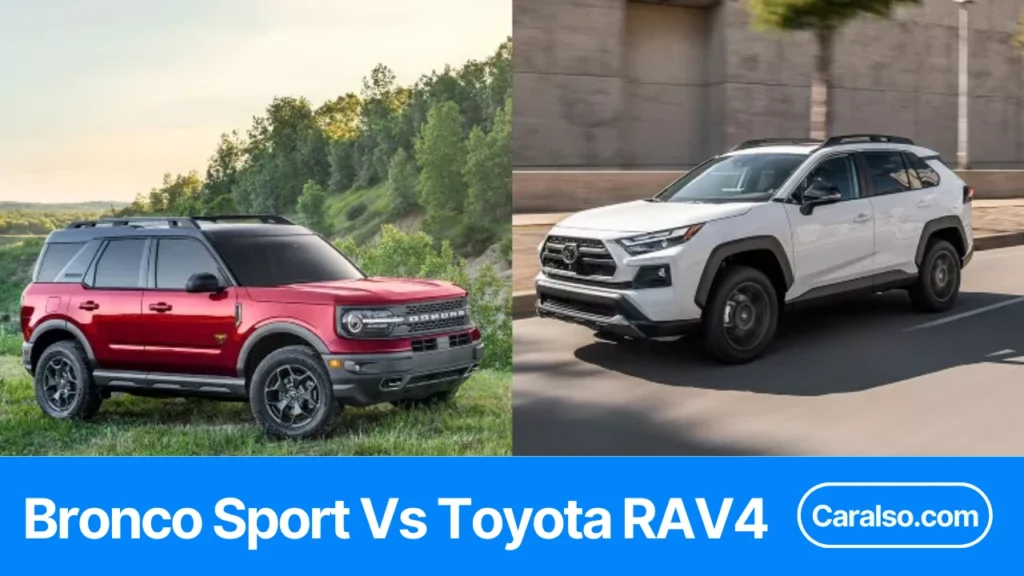
Bronco Sport Vs RAV4
Quick Verdict Box
- Buy The RAV4 If You Care Most About: mpg, cargo space, long-term resale.
- Buy The Bronco Sport If You Care Most About: standard 4×4, dirt-road capability, “adventure” trim hardware.
- My Fast Tie Breaker: commute and road trips equals RAV4. Camping roads and winter trailheads equals Bronco Sport.
Comparison Snapshot Table
| Item | Ford Bronco Sport | Toyota RAV4 |
|---|---|---|
| Starting MSRP (Base) | $31,845 | $31,900 |
| Standard Drivetrain | 4×4 | Varies by trim |
| EPA Est. MPG (City/Hwy) | 25/30 (1.5L) | Up to 47/40 |
| Max Towing (Properly Equipped) | Up to 2,700 lbs | Up to 3,500 lbs |
| Cargo Behind 2nd Row | 32.5 cu ft (1.5L) | Up to 37.8 cu ft |
Notes I Use When I Talk To Friends
- Bronco Sport towing splits by trim. Big Bend and Outer Banks are 2,200 lbs with the tow package. Badlands is 2,700 lbs.
- RAV4 numbers vary by trim, too. Toyota markets “up to” mpg, cargo, and towing, so you need to match the spec to the exact trim you are shopping.
Decision Shortcut
Choose Bronco Sport If
- I want standard 4×4 on every trim.
- I want a shorter SUV feel in tight parking spots and on narrow trails.
- I tow up to 2,200 lbs (Big Bend, Heritage, Outer Banks when properly equipped).
- I specifically want the 2.0L setup and higher tow rating. Badlands can tow up to 2,700 lbs when properly equipped.
Choose RAV4 If
- I want the mpg advantage that comes with a hybrid-focused lineup. Up to 47 city and 40 highway mpg on certain trims.
- I want more cargo space behind the second row. 37.8 cu ft in the RAV4 vs 32.5 cu ft in the Bronco Sport (with the common non-Sasquatch cargo figure).
- I tow more than 2,700 lbs. AWD RAV4 trims can tow up to 3,500 lbs (FWD trims are lower).
- I plan to keep it 8 to 12 years and I care about long-term resale.
Tie Breaker
- If I tow 3,000 to 3,500 lbs even a few times a year, I buy the RAV4.
- If I drive dirt, sand, or snow trails monthly and want 4×4 every day, I buy the Bronco Sport.
- If I do mostly commute miles and weekend errands, I lean RAV4 for fuel costs and cargo.
- If I want a more “trail-first” layout and packaging, I lean Bronco Sport.
Compare At A Glance (Hero Table)
Quick note from me: these numbers vary by trim, drivetrain, and options. I’m using manufacturer and major-spec sources for the most common 2026 configurations.
| Category | 2026 Ford Bronco Sport | 2026 Toyota RAV4 |
|---|---|---|
| Starting MSRP (Base) | $31,845 (plus $1,995 destination) | $31,900 (plus $1,450 destination) |
| Main Trims | Big Bend, Heritage, Outer Banks, Badlands | LE, SE, XLE Premium, Woodland, XSE, Limited (Plug-In Hybrid timing and pricing vary) |
| Powertrains | 1.5L turbo I-3: 180 hp, 200 lb-ft. 2.0L turbo I-4 (Badlands): 250 hp, 280 lb-ft | Hybrid 2.5L system. 226 hp (FWD). 236 hp (AWD). Plug-in hybrid models are higher output (published around 320+ hp in some guides) |
| Drivetrain | 4×4 standard on all trims | FWD standard on some trims. AWD optional on some trims and standard on others |
| EPA-Est MPG (City/Hwy) | 25/30 on the 1.5L trims. 21/27 on Badlands (2.0L) | Up to 47/40 (FWD trims). AWD trims are typically lower than the top FWD figure |
| Cargo Behind 2nd Row | 32.5 cu ft (common 1.5L figure). Drops with Sasquatch-equipped setups | 37.8 cu ft |
| Max Cargo (Seats Folded) | Up to 65.2 cu ft (common 1.5L figure) | 70.4 cu ft |
| Max Towing | Up to 2,700 lbs (Badlands when properly equipped). Up to 2,200 lbs on other trims when properly equipped | Up to 3,500 lbs on AWD trims. 1,750 lbs on FWD trims |
| Ground Clearance | About 7.8 in base spec, up to about 8.8 in when properly equipped | About 8.1 in on many trims. Woodland listings commonly show about 8.5 in |
| Warranty Basics | 3 yr or 36,000 mi basic. 5 yr or 60,000 mi powertrain | 3 yr or 36,000 mi basic. 5 yr or 60,000 mi powertrain. Hybrid battery warranty coverage is 10 yr or 150,000 mi |
| My Best Value Trim Pick | Big Bend for price. Badlands if I actually tow near 2,700 lbs or want the 2.0L | SE or XLE Premium for feature value. Woodland if I want the higher-clearance vibe and AWD standard |
Compare Fairly First (Most Pages Get This Wrong)
I see the same mistake over and over. A tool compares 2 different model years. Then the “winner” is basically random.
Match Year To Year
Here is a real example.
A popular compare page lines up a 2026 RAV4 against a 2025 Bronco Sport.
That matters because pricing, features, and even standard equipment can change by year.
A 2026 chart can make a 2025 vehicle look worse than it is. Or better than it is.
My rule:
- If you are shopping 2026, compare 2026 to 2026.
- If one model is not out yet, either wait or compare both in 2025.
Match Trim To Trim By Budget
Base-to-base is rarely fair.
I match by money first, then hardware.
- Price band 1: $32,000 to $35,000
- Price band 2: $35,000 to $40,000
- Price band 3: $40,000 to $45,000
Then I match the stuff you actually use:
- Drivetrain: AWD vs 4×4
- Tires: all-season vs all-terrain
- Tow rating: 2,200 vs 2,700 vs 3,500 lbs
- Seat features: heated, power, etc.
Destination fees also matter.
- Bronco Sport destination: $1,995
- RAV4 destination: commonly quoted at $1,450
If you compare “starting MSRP” without destination on one side and “price with destination” on the other, the math is wrong.
Match Tires And Wheels
Tires change everything.
Mpg. Noise. Ride.
If one test vehicle has all-terrain tires and the other has all-seasons, it is not an apples-to-apples drive.
All-terrain tires usually cost you mpg and add road noise.
My test-drive trick:
- Take the same stretch of rough pavement at 45 mph.
- Turn the radio off for 20 seconds.
- If you can hear the tread pattern, you will hear it every day.
Pricing And Trims (Where The Value Really Is)
Bronco Sport Trims Explained
Ford keeps Bronco Sport trims simple. There are 4 main ones for 2026.
Big Bend
- Price: $33,840 including destination.
- Engine: 1.5L turbo, 180 hp, 200 lb-ft.
- Towing: up to 2,200 lbs with the available Class II Trailer Tow Package.
- This is the value play if you want the Bronco Sport look and standard 4×4 without chasing the top trim.
Heritage
- Price: $36,140 including destination.
- Same 1.5L powertrain family.
- You are paying for the styling theme.
- I like it if you care about the retro vibe and still want a sensible monthly payment.
Outer Banks
- Price: $38,940 including destination.
- Same 1.5L powertrain family.
- This trim is about comfort and appearance upgrades.
- I buy this one when I care more about daily cabin feel than trail hardware.
Badlands
- Price: $42,260 including destination.
- Engine: 2.0L turbo, 250 hp, 280 lb-ft.
- Towing: 2,700 lbs. Class II tow package is standard on Badlands.
- G.O.A.T. modes: 7 total, including Rock Crawl and Rally.
- If I am the person who actually drives dirt and ruts, this is the trim I pick.
The towing shortcut I use:
- Big Bend, Heritage, Outer Banks: 2,200 lbs when equipped.
- Badlands: 2,700 lbs.
RAV4 Trims Explained
For 2026, Toyota lists these core trims:
- LE
- SE
- XLE Premium
- Woodland
- XSE
- Limited
Toyota also positions a plug-in hybrid version for 2026, but pricing and timing are handled differently than the standard trims on many sites.
Base MSRP on Toyota’s model page:
- LE: $31,900
- SE: $34,700
- XLE Premium: $36,100
- Woodland: $39,900
- XSE: $41,300
- Limited: $43,300
The price most shoppers actually see includes destination.
One major outlet lists:
- LE (FWD): $33,350
- Limited (AWD): $44,750
Drivetrain shopping matters on RAV4.
- Some trims offer FWD or AWD.
- Woodland, XSE, and Limited are typically positioned with AWD standard.
- Towing splits by configuration.
- FWD and AWD LE: 1,750 lbs
- Other AWD trims: up to 3,500 lbs
My trim-value take:
- SE and XLE Premium are usually the sweet spot for features per dollar.
- Woodland is the “look and clearance” pick, and mpg is lower than the top mpg trims.
- Limited is for buyers who want the top trim and will pay for it.
Best Trim Match By Budget
| Budget Band (Sticker, Before Tax) | Bronco Sport Match | RAV4 Match | Why I Match Them |
|---|---|---|---|
| $32,000 to $35,000 | Big Bend | LE or SE | Entry trims with the core experience. |
| $35,000 to $40,000 | Heritage or Outer Banks | SE or XLE Premium | This is where comfort features usually land. |
| $40,000 to $45,000 | Badlands | Woodland, XSE, or Limited | Trail hardware vs higher-trim RAV4 setups. |
Engines, Performance, And Drivability
Powertrain Overview
Here is the short version.
Bronco Sport gives you 2 engines.
- 1.5L turbo I-3 on Big Bend, Heritage, and Outer Banks.
- 2.0L turbo I-4 on Badlands.
RAV4 is hybrid-only for 2026.
- Hybrid is the default powertrain.
- Plug-In Hybrid is a separate step up.
Here are the key numbers I use.
Bronco Sport (2026)
- 1.5L: 180 hp, 200 lb-ft
- 2.0L: 250 hp, 280 lb-ft
- Transmission: 8-speed automatic
RAV4 (2026)
- Hybrid output: 226 hp (FWD) or 236 hp (AWD)
- Plug-In Hybrid: 0 to 60 mph in 5.6 seconds is the published claim
How it feels in normal driving.
- The Bronco Sport 1.5L feels fine at 25 to 45 mph. It is not the one I pick for heavy loads.
- The Bronco Sport Badlands 2.0L feels like the “passing power” choice.
- The RAV4 Hybrid feels quick off the line because electric assist helps at low speeds.
Highway Passing And Merge Test
I do the same two checks on every test drive.
Test 1: 30 To 60 Mph
- Start at 30 mph in a flat, straight lane.
- Press to about 70% throttle.
- Count “one one-thousand” until you hit 60.
Test 2: 45 To 70 Mph
- Start at 45 mph.
- Press to about 70% throttle.
- Count again to 70.
Then I compare those results to real test numbers.
0 To 60 Mph Benchmarks From Instrumented Testing
- Bronco Sport 1.5L (Outer Banks): 8.2 seconds
- Bronco Sport 2.0L (Badlands): 5.9 seconds
- RAV4 Hybrid AWD: 7.1 seconds
My take.
- If you do short on-ramps weekly, the Badlands 2.0L is the Bronco Sport I would buy.
- If you want steady “always ready” commuting response, the RAV4 Hybrid works well.
Towing Reality
Towing is trim-dependent. This is where people buy the wrong setup.
Bronco Sport Towing
- 1.5L models: up to 2,200 lbs when properly equipped
- 2.0L Badlands: up to 2,700 lbs when properly equipped
RAV4 Towing
- All FWD models: 1,750 lbs
- LE AWD: 1,750 lbs
- Other AWD grades: up to 3,500 lbs
My tongue-weight math, because this is what breaks payload.
- 2,700-lb trailer at 10% to 15% tongue weight: 270 to 405 lbs on the hitch
- 3,500-lb trailer at 10% to 15% tongue weight: 350 to 525 lbs on the hitch
If you are shopping campers, do this before you pick a trim.
- Look up the trailer’s loaded weight, not the dry weight.
- Assume 12% tongue weight as a quick planning number.
- Add 2 adults and your gear.
- Then check the payload sticker on the driver door.
If you tow over 2,700 lbs, I skip Bronco Sport.
If you tow under 2,200 lbs and drive dirt roads often, Bronco Sport makes sense.
Fuel Economy And Running Costs
Published MPG Patterns
These two SUVs live in different fuel economy worlds.
Bronco Sport (2026)
- 1.5L 4×4 trims: 25 city, 30 highway, 27 combined
- Badlands 2.0L: 21 city, 27 highway, 23 combined
This is the best proof that tires matter.
Ford lists the Outer Banks Sasquatch package at 23 city, 26 highway, 24 combined.
That is a 3 mpg combined hit versus the standard Outer Banks rating.
RAV4 (2026)
- Toyota lists up to 47 city and 40 highway mpg for the most efficient setup.
- Real-world results depend on trim, AWD, speed, and tire choice.
Where mpg drops in real life.
- All-terrain tires
- Roof boxes
- 75 mph highway cruising
- Winter driving and short trips
My rule.
If you want the best mpg, keep the tires closer to stock and keep the roof clean.
12,000 Miles Per Year Fuel Cost Table (Editable)
Here is the formula I use.
Annual Fuel Cost = (Miles Per Year ÷ MPG) × Price Per Gallon
Example Inputs
- Miles per year: 12,000
- Gas price: $3.50 per gallon
- Bronco Sport 1.5L combined mpg: 27
- Bronco Sport Badlands combined mpg: 23
- RAV4 Hybrid combined mpg planning number: 42
| Scenario | MPG Used | Gallons Per Year At 12,000 Miles | Fuel Cost Per Year At $3.50 | 3-Year Fuel Cost |
|---|---|---|---|---|
| Bronco Sport 1.5L | 27 | 444.44 | $1,555.56 | $4,666.67 |
| Bronco Sport Badlands 2.0L | 23 | 521.74 | $1,826.09 | $5,478.26 |
| RAV4 Hybrid | 42 | 285.71 | $1,000.00 | $3,000.00 |
How I use this table.
- If you buy Bronco Sport for trails, I budget the extra fuel.
- If you buy RAV4 for commuting, the fuel math is a big part of the win.
Space, Comfort, And Daily Usability
Cargo Space You Actually Use
This is the fastest “real life” difference.
Cargo Behind The Second Row
- Bronco Sport: 32.5 cu ft with the 1.5L setup.
- Bronco Sport: 29.4 cu ft with the Sasquatch package or the 2.0L setup.
- RAV4: 37.8 cu ft.
Max Cargo With Seats Folded
- Bronco Sport: 65.2 cu ft with the 1.5L setup.
- Bronco Sport: 60.6 cu ft with the Sasquatch package or the 2.0L setup.
- RAV4: 70.4 cu ft.
My take.
If you load bulky stuff weekly, the RAV4 is easier.
If you run bigger tires on Bronco Sport, you give up cargo space. That is the trade.
My Parking Lot Cargo Test
- Bring 1 carry-on suitcase.
- Bring 1 medium cooler.
- Bring 1 stroller, even if you do not have kids.
- Put them in with the second row up.
- If the hatch will not close without stacking, it will annoy you later.
Rear Seat Space And Car Seats
Rear Legroom
- Bronco Sport: 36.9 inches.
- RAV4: 37.8 inches.
That 0.9-inch gap matters with a rear-facing car seat.
It also matters if you have a tall driver.
My quick fit check
- Set the driver seat for your legs.
- Put a rear-facing seat behind it.
- Sit in the passenger seat.
- If your knees touch the dash, move on.
Noise And Ride
Tires decide the cabin.
All-terrain tires usually add noise.
This is what I do on every test drive.
My 3-Surface Loop
- Smooth asphalt at 35 mph. Listen for wind noise.
- Rough patched road at 45 mph. Count suspension bounces.
- Highway at 70 mph for 60 seconds. Radio off.
What I listen for
- Tire roar that rises with speed.
- A thump over sharp bumps.
- Steering wheel shake at 65 to 75 mph.
One note I like on the 2026 RAV4.
Toyota talks about retuned suspension parts and bushings meant to reduce vibration and noise.
That is exactly what I want in a daily driver.
Capability And Snow (The Real Off-Road Section)
AWD Vs 4×4 In Plain English
Bronco Sport is simple to shop.
Every trim has 4×4.
It also has drive modes baked in.
- Big Bend, Heritage, Outer Banks: 5 G.O.A.T. Modes.
- Badlands: 7 G.O.A.T. Modes, adding Rock Crawl and Rally.
Badlands also gets the hardware upgrade.
Ford calls it Advanced 4×4 with a twin-clutch rear drive unit.
Ford also says it can send torque to a single rear wheel when traction is low.
RAV4 is different.
For 2026, Toyota explains AWD on the hybrid models as an Electronic On-Demand AWD system with a dedicated rear electric motor.
Toyota lists 89 lb-ft of torque for that rear motor.
My take.
Bronco Sport is the easier pick if you want guaranteed traction hardware without trim research.
RAV4 AWD works well for snow and wet roads, but you need to make sure the trim you want actually has AWD.
What Matters Most Off Pavement
I care about 4 things more than marketing.
- Tires
- A true all-terrain tire changes grip on dirt and snow.
- It also changes mpg and noise.
- Ground Clearance
- Bronco Sport can reach 8.8 inches when properly equipped.
- RAV4 is 8.1 inches on several trims.
- RAV4 Woodland is 8.5 inches.
- RAV4 GR Sport is 7.5 inches.
- Underbody Protection
- Badlands calls out steel-plated front bumper and underbody protection.
- Low-Speed Control
- Bronco Sport offers Trail Control for speeds under 20 mph.
That keeps you from riding the brake on loose descents.
Snow Advice I Actually Use
- Buy winter tires if you see ice.
- If you stay on all-seasons, slow down earlier.
- Use the traction mode that softens throttle. Bronco Sport calls that Slippery.
The 2 Trails Test
This is my quick reality check.
It keeps me honest.
Trail 1: Gravel Road, 3 Miles
- Drive 25 to 35 mph.
- Turn gently left and right.
- Do 2 stops from 30 mph.
What I want
- No ABS panic on washboard.
- No steering shake.
- No traction system cutting power in a way that feels unsafe.
Trail 2: Rutted Dirt, 10 Minutes
- Crawl at 3 to 8 mph.
- Pick a line that forces 1 wheel to get light.
- Do not rush it.
What I do in Bronco Sport
- Start in Off-Road mode.
- If it is Badlands, I try Rock Crawl on the same section.
- If I have Trail Control, I test it on a gentle descent.
What I do in RAV4
- I keep inputs smooth.
- I let the AWD system do its job.
- I avoid wheelspin, because that is where heat builds up.
My stop-now rules
- If the tires rub at full lock, I stop.
- If I hear underbody scraping, I stop.
- If the vehicle smells hot after 10 minutes, I stop and let it cool.
Tech And Safety (What You Get For The Money)
Infotainment And Phone Integration
This is the first thing I touch on a test drive. Because I use it every single day.
Bronco Sport (2026)
- 13.2-inch center touchscreen
- SYNC 4
- Wireless Apple CarPlay and wireless Android Auto
RAV4 (2026)
- 10.5-inch Toyota Audio Multimedia screen on many grades
- 12.9-inch Toyota Audio Multimedia screen on higher grades
- Wireless Apple CarPlay and wireless Android Auto
- Dual Bluetooth phone pairing
- Built-in drive recorder (standard, per Toyota’s launch details)
My 5-Minute Screen Test Script
- Pair your phone with Bluetooth.
- Start wireless CarPlay or Android Auto.
- Set a destination.
- Zoom the map 3 times.
- Switch to audio.
- Skip forward 5 tracks.
- Call voicemail.
- Then hit the physical volume control.
What I’m looking for
- Time from start button to audio playing
- A map that stays smooth when I pinch-zoom
- Buttons that are easy to hit without looking
Small money tip
- I do not pay extra for premium audio unless I listen at 60% volume or higher.
- If you mostly listen to podcasts, save the money.
Driver Assist Features That Matter
I focus on 4 systems because they change daily stress.
- Adaptive Cruise Control
- Bronco Sport: available with Stop-and-Go and Lane Centering as part of driver-assist packages
- RAV4: Toyota Safety Sense 4.0 includes Full-Speed Range Dynamic Radar Cruise Control
- Lane Assist That Feels Natural
- Bronco Sport: lane-keeping is common. Lane centering comes with the adaptive cruise feature set.
- RAV4: Lane Tracing Assist is part of Toyota Safety Sense 4.0
- Blind Spot And Rear Cross Traffic
- Bronco Sport: blind spot monitoring with cross-traffic alert is called out with Co-Pilot360 Assist+
- RAV4: blind spot monitor with rear cross-traffic alert shows up in Toyota’s trim feature lists, but I still verify it on the exact trim
- Parking Help
- Bronco Sport: 360 camera and reverse brake assist show up in tech packages
- RAV4: higher grades list features like panoramic view monitor, advanced park, and front and rear parking assist with automatic braking
My Lane-Centering Test Script
- Get to a straight highway.
- Set cruise at 65 mph.
- Put both hands on the wheel with light pressure.
- Count 20 seconds.
- If the steering constantly ping-pongs, I turn it off.
- If it holds center with small corrections, I keep it on.
The money takeaway
- If you do 12,000 highway miles a year, adaptive cruise and lane centering are worth real dollars.
- If you drive mostly city miles, I care more about blind spot and rear cross-traffic.
Safety Ratings And How To Verify
I like hard data here. But I also want you to verify it the right way.
How I Check IIHS
- Go to the IIHS vehicle ratings site.
- Pick the exact year.
- Read the “rating applies to” line.
- Make sure it matches your trim and body style.
How I Check NHTSA
- Use the NHTSA vehicle ratings search.
- If it shows “not rated,” do not guess.
- Then check recall status by VIN while you are there.
One important note for 2026
- If a model is refreshed or redesigned, older crash tests may not reflect the exact new build.
- I treat older ratings as a baseline, not a guarantee.
Reliability, Recalls, And Ownership Horizon (Keep It Or Flip It)
What I’d Watch On Bronco Sport (By Model Year)
I do not panic over recalls. I do take them seriously.
Here are the Bronco Sport items I would specifically check before I buy used.
2021 To 2024 Bronco Sport With The 1.5L
- Ford issued a major recall tied to cracked fuel injectors and underhood fire risk.
- The remedy has been software-focused as an interim step while a permanent fix is developed.
- My move: I only buy one if the recall work shows “completed” on the VIN lookup.
2025 To 2026 Bronco Sport
- There is a recall tied to the digital instrument cluster potentially going blank at startup.
- The fix is a software update, either at the dealer or via over-the-air update depending on vehicle setup.
- My move: I confirm the update is applied before I sign.
My VIN Check Routine (Takes 3 Minutes)
- Run the VIN on the NHTSA recall lookup.
- Run the VIN on the Ford owner recall page.
- Ask the selling dealer for a printed recall repair history.
- If any recall is “open,” I schedule the fix before delivery.
What About The RAV4?
- 2026 is hybrid-only, so I factor in hybrid system warranty coverage and the long track record of Toyota hybrid tech.
- I still do the same VIN recall check. Every time.
Resale Value And Depreciation Logic
This is where these 2 SUVs split hard.
Depreciation is not just a finance thing.
It changes your risk.
Here is the simplest way I frame it.
- If you might sell in 3 to 5 years, buy the one that holds value.
- If you will keep it 10 years, buy the one you like living with.
The data I use
- One major depreciation analysis shows about 30.3% 5-year depreciation for the RAV4.
- The same analysis shows about 51.1% 5-year depreciation for the Bronco Sport.
That gap is why I often see this pattern:
- RAV4 leases can pencil out better at the same selling price.
- Bronco Sport buyers should negotiate harder up front, or plan to keep it longer.
3 Ownership Profiles Scorecard (Unique Table)
Scores are 1 to 10. Higher is better.
| Ownership Profile | Bronco Sport Score | RAV4 Score | My Fast Reason |
|---|---|---|---|
| Lease 36 Months | 6 | 9 | RAV4 depreciation tends to be lower. That usually helps residual-based payments. |
| Keep 5 To 6 Years | 7 | 9 | RAV4 fuel costs and resale stack up well. Bronco Sport is great if you actually use 4×4. |
| Keep 10+ Years | 7 | 9 | I trust Toyota hybrid history. I still buy Bronco Sport if the trail use is real and recalls are cleared. |
My “Keep It Or Flip It” Rule
- If you will flip it in 3 years, I lean RAV4.
- If you will keep it 8 to 10 years and you want the Bronco Sport lifestyle, buy it. But do the VIN checks and keep up with software updates.
Which Should You Buy? (Use-Case Decision Matrix)
Best For Daily Commuting
I pick the RAV4.
Here is why.
- Up to 47 city and 40 highway mpg on the most efficient trims.
- More cargo space behind the second row at 37.8 cu ft.
- If you drive 12,000 miles a year, the fuel gap adds up fast.
My quick rule:
If your week is 80% pavement, I buy RAV4 first and I ask questions later.
Best For Weekend Trails
I pick the Bronco Sport. Especially Badlands.
Here is why.
- 4×4 is standard on every trim.
- Badlands adds a higher-output engine and trail-focused hardware.
- You get G.O.A.T. modes built around dirt, sand, and low-speed traction control.
My quick rule:
If you hit rutted dirt monthly, Bronco Sport is the easier tool to live with.
Best For Snow States
It depends on the snow you actually drive in.
If you drive plowed roads and highway slush, I pick the RAV4 AWD.
- The hybrid AWD setup is smooth.
- You get good efficiency even in winter, but it will drop.
If you drive unplowed access roads, I lean Bronco Sport or RAV4 Woodland.
- Ground clearance matters.
- 2026 RAV4 Woodland is listed at 8.5 inches.
- Bronco Sport can reach 8.8 inches when properly equipped.
My tire rule:
- If you see ice, buy winter tires.
- I would rather have FWD on winters than AWD on worn all-seasons.
Best For Families And Cargo
I pick the RAV4.
Here is why.
- 37.8 cu ft behind the second row.
- 70.4 cu ft with the seats folded.
Bronco Sport is still solid.
But cargo can drop to 29.4 cu ft behind the second row on certain setups like Sasquatch or the 2.0L configuration.
My reality check:
If you run a stroller and groceries in the same trip, the RAV4 is the safer bet.
Best For Towing Small Campers
I pick the RAV4 if towing is a priority.
Here is the towing ceiling difference.
- Bronco Sport Badlands: up to 2,700 lbs.
- Other Bronco Sport trims: up to 2,200 lbs when equipped.
- RAV4: up to 3,500 lbs on most AWD trims, with 1,750 lbs on FWD and AWD LE.
My rule:
- Under 2,200 lbs and you want 4×4 every day, Bronco Sport can work.
- Over 2,700 lbs, I skip Bronco Sport and I shop RAV4 AWD.
Best For Long-Term Ownership
I pick the RAV4 for most people.
Here is the ownership math I care about.
- Lower depreciation tends to protect you if life changes and you sell.
- Toyota hybrid battery coverage is 10 years or 150,000 miles.
My rule:
If you plan to keep it 8 to 12 years, I want the RAV4 track record and warranty coverage in my corner.
Real-World Test Drive Checklist (Pro Tip Section)
My 10-Minute Route
Minute 0 To 2: Parking Lot And Side Streets (0 To 25 Mph)
- Do 2 full-lock turns each way.
- Do 2 stops from 15 mph.
- Check visibility over your right shoulder.
Minute 2 To 6: Rough City Road (25 To 45 Mph)
- Hit 3 patched seams.
- Count bounces. One is fine. Two is not.
- Do a 20 to 40 mph roll-on at half throttle.
Minute 6 To 10: Highway Merge And Cruise (65 To 75 Mph)
- Do one 45 to 70 mph pull.
- Set adaptive cruise at 70 mph.
- Turn the radio off for 20 seconds.
10 Things To Test
- Low-Speed Throttle
- Can I creep smoothly at 3 mph without surging?
- Passing Response
- From 45 to 70 mph, does it pull without hesitation?
- Transmission Behavior
- Bronco Sport: does the 8-speed hunt on mild hills?
- RAV4 Hybrid: does the hybrid drive feel smooth when I ask for power?
- Brake Feel
- Two quick stops from 35 mph.
- Pedal should stay firm.
- Steering Effort
- One-hand turn at 10 mph.
- No clunks. No dead zone.
- Cabin Noise At 70 Mph
- Radio off for 20 seconds.
- If tires dominate the sound, that is your daily life.
- Seats At 20 Minutes
- If your lower back complains now, it will complain later.
- Phone And Screen Speed
- Pair wireless CarPlay or Android Auto.
- Start maps and music.
- If it takes more than 30 seconds, I downgrade that trim.
- Driver Assist Behavior
- Adaptive cruise smoothness.
- Lane centering should not ping-pong.
- Cargo Loading Reality
- Open the hatch.
- Fold the seats.
- Time it.
- Aim for under 15 seconds to get a flat load floor.
My stop-now rules:
- Tire rub at full lock.
- Underbody scrape on a curb cut.
- Hot smell after a short hill climb.
FAQ (Featured-Snippet Targets)
Is Bronco Sport Better Off-Road Than RAV4?
If I am talking real trail use, I give the edge to Bronco Sport.
4×4 is standard on every trim. Badlands adds trail-focused hardware and extra drive modes.
If I am talking snow roads and dirt roads, RAV4 AWD is still a strong pick.
But if you want the easiest “buy it and go find a trailhead” setup, Bronco Sport is simpler.
Which Is More Reliable: Bronco Sport Or RAV4?
If I am buying for 8 to 12 years, I lean RAV4.
Toyota’s hybrid system track record and battery coverage help reduce long-term risk.
With Bronco Sport, I pay extra attention to model year and recall status.
If the VIN shows open recalls, I do not buy until they are closed.
Which Has Better MPG: Bronco Sport Or RAV4?
RAV4.
Toyota lists up to 47 city and 40 highway mpg on the most efficient trims.
Bronco Sport depends on engine and package.
- 1.5L trims are rated 25 city and 30 highway mpg.
- Badlands 2.0L is rated 21 city and 27 highway mpg.
- Sasquatch-equipped setups can drop further.
Which Has More Cargo Space?
RAV4.
It is 37.8 cu ft behind the second row and 70.4 cu ft with the seats folded.
Bronco Sport varies more by configuration.
- 32.5 cu ft behind the second row on common 1.5L setups.
- Some setups drop to 29.4 cu ft behind the second row.
- Max cargo is up to 65.2 cu ft on common setups.
If you haul bulky stuff weekly, I pick RAV4.
Can Bronco Sport Tow A Small Camper?
Yes, but you need to match the camper to the trim.
Here is the quick towing map.
- Big Bend, Heritage, Outer Banks: up to 2,200 lbs when properly equipped.
- Badlands: up to 2,700 lbs when properly equipped.
My rule is simple.
If the loaded trailer is over 2,700 lbs, I stop shopping Bronco Sport.
If I am in the 1,500 to 2,200 lb range and I want 4×4, Bronco Sport makes sense.
Which Trim Is The Best Value?
My Bronco Sport pick:
- Big Bend if I want the lowest cost with standard 4×4.
- Badlands if I actually tow near 2,700 lbs or I want the 2.0L power.
My RAV4 pick:
- SE or XLE Premium for the best features per dollar.
- Woodland if I want the higher-clearance look and standard AWD without overthinking options.
Key Takeaways
- Best MPG: RAV4. Up to 47 city and 40 highway mpg on the most efficient trims.
- Best Standard Traction Hardware: Bronco Sport. 4×4 is standard on every trim.
- Best Cargo With Seats Up: RAV4. 37.8 cu ft vs 32.5 cu ft on common Bronco Sport setups.
- Best Towing Ceiling: RAV4 AWD trims. Up to 3,500 lbs vs Bronco Sport up to 2,700 lbs on Badlands.
- Best Trail-First Trim: Bronco Sport Badlands. 2.0L power and extra off-road modes.
- Best Long-Term Ownership Bet: RAV4. Depreciation trends and hybrid battery coverage favor it.
- Best “Don’t Get Burned” Tip: Run the VIN for open recalls before you buy either one, especially Bronco Sport.
Sources
- Toyota RAV4 Official Page
- Ford Bronco Sport Official Page
- CarGurus Compare Page (Example Of Year-Mismatch Issue)
- Car And Driver: Toyota RAV4 Specs
- Edmunds: 2026 Toyota RAV4 Overview
- iSeeCars: Toyota RAV4 vs Ford Bronco Sport Depreciation Comparison

Hey there,
How is it going?
I’m Meraj Sarker. I am a Car Mechanic and a student of Automobile Restoration here in Florida, USA. I’ve been studying automotive for around 9 years now. So you can rely on my recommendation. For me, studying and getting knowledge about automobile it’s really fun and entertaining. I will help you to get solutions for your car through this website. If you need any help let me know.