
If you are cross shopping an Audi Q5 and a Toyota RAV4, you are really deciding what you want to pay for every mile you drive.
I have driven and lived with both “types” of SUV. The Q5 wins on cabin feel, power, and highway comfort. The RAV4 wins on cost, simplicity, and daily practicality.
For the numbers below, I’m using current 2026 U.S. specs where they are available. Trims and drivetrain choices move the numbers a bit, but the gap between these two stays the same.
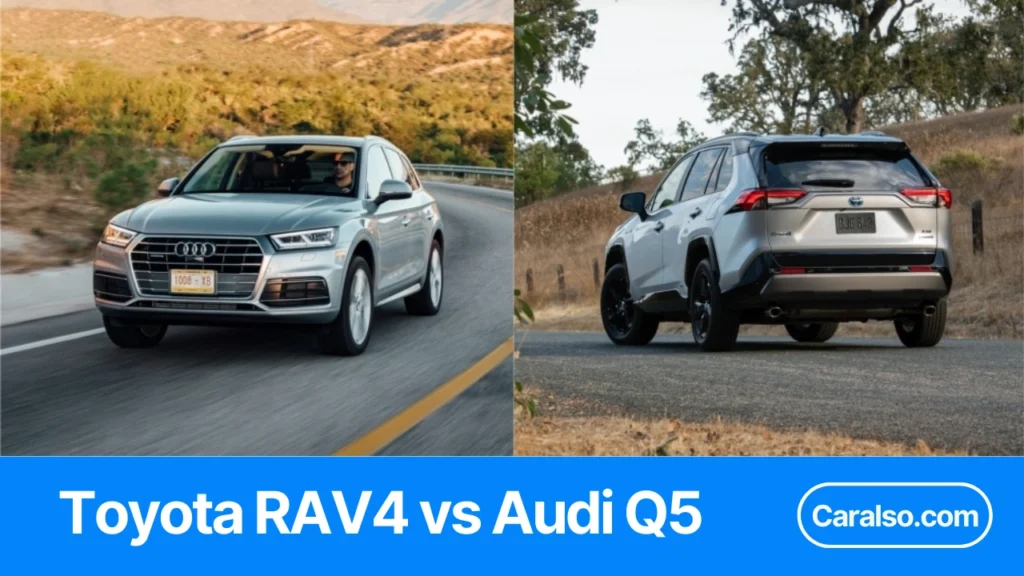
Audi Q5 vs Toyota RAV4:
Quick Verdict In 15 Seconds
- Pick the Audi Q5 if you want the nicer drive and you are fine paying about $20,000 more up front.
- Pick the Toyota RAV4 if you want the lowest long term cost and the most cargo per dollar.
- Pick the RAV4 Hybrid (and consider the plug in RAV4) if you want the best mix of power and fuel economy.
At A Glance Comparison (Key Numbers)
| Category | Audi Q5 (2026) | Toyota RAV4 (2026) |
|---|---|---|
| Starting MSRP | $52,800 | $31,900 (base MSRP) |
| Power | 268 hp | 226 hp (FWD) or 236 hp (AWD) |
| EPA Fuel Economy | 25 mpg combined (22 city, 30 highway) | 39 to 44 mpg combined (est, varies by trim) |
| Cargo Behind 2nd Row | 28 cu ft | 38 cu ft |
| Max Cargo | 57 cu ft | 70 cu ft |
| 0 to 60 mph (tested) | 5.8 sec | 7.1 sec |
| Basic Warranty | 4 years or 50,000 miles | 3 years or 36,000 miles |
| Powertrain Warranty | 4 years or 50,000 miles | 5 years or 60,000 miles |
| Hybrid System Coverage | Not applicable | 10 years or 150,000 miles |
| Included Maintenance | 3 years or 30,000 miles | 2 years or 25,000 miles |
Audi Q5 vs Toyota RAV4: The Quick Verdict For Most Buyers
Buy The Toyota RAV4 If You Want The Lowest Long Term Cost
If you told me you want the least drama over 5 years, I’d pick the RAV4.
Here is why, in plain numbers:
- You start around $31,900 for a new RAV4, versus $52,800 for a new Q5.
- You get more space for your stuff. Think 38 cu ft behind the second row in the RAV4, versus 28 cu ft in the Q5.
- Toyota backs the hybrid system hard. Hybrid component coverage goes to 10 years or 150,000 miles.
What that feels like day to day is simple. I load more. I worry less. I keep more money for tires, brakes, and life.
Buy The Audi Q5 If You Want A Quieter, More Premium Driving Experience
If you want your SUV to feel expensive every time you merge onto the highway, the Q5 is the one I’d point you to.
The Q5’s advantage shows up fast:
- It is quicker. Car and Driver ran 0 to 60 mph in 5.8 seconds.
- It is tuned for higher speed comfort. At 70 mph, the cabin noise number they recorded was 67 dBA.
- You get Audi’s warranty at 4 years or 50,000 miles, plus included scheduled maintenance for 3 years or 30,000 miles.
I also like the Q5 for people who do a lot of highway miles and want less fatigue. It is not about “status.” It is about how calm the car feels at 70 mph.
The Surprise Pick: RAV4 Hybrid (And When It Beats Both)
For most real people I talk to, the best answer is not “RAV4 vs Q5.” It is “Which RAV4 powertrain?”
For 2026, the RAV4 lineup goes hybrid across the board. That changes the math.
- Power is closer than you think. The RAV4 makes 226 hp in FWD form or 236 hp with AWD.
- Fuel economy is not close. Toyota estimates roughly 39 to 44 mpg combined depending on trim.
- Cargo space stays big. You still get 38 cu ft behind the second row and 70 cu ft max.
If you want one SUV that is easy to own, easy to fuel, and still feels quick enough, the 2026 RAV4 Hybrid is the move I’d make most often.
If your commute is short and you can charge at home, the plug in RAV4 is worth a look later in this guide, because it can shrink gas station stops even more.
Price Difference: How Much More Does An Audi Q5 Cost Than A RAV4?
If you trim-match these two, I usually see a $18,000 to $25,000 gap. Sometimes more. It depends on how far you option the Q5, and whether you pick a high-trim RAV4 Hybrid or the Plug-In Hybrid.
MSRP Vs Real-World Transaction Pricing (What To Expect)
Here’s the cleanest way I look at it: base-to-base and then typical “paid” pricing.
| Pricing Snapshot (2026 Models) | Audi Q5 | Toyota RAV4 Hybrid | Difference |
|---|---|---|---|
| Starting MSRP (Base Trim) | $52,800 | $33,350 | $19,450 |
| Typical “Paid” Price (National Avg For Base Trim) | $53,308 | $32,712 | $20,596 |
My takeaway: the “paid” price gap is basically the same as the MSRP gap. I do not see huge discounts that magically make the Q5 “close” to a RAV4.
Also, one quick reality check. A loaded RAV4 Limited can land in the mid-$40,000 range. A mid-trim Q5 can run into the high-$50,000s quickly.
What You Actually Get For The Extra Money (Materials, Tech, Ride)
This is where the Q5 earns some of its premium. Not all of it, but some.
What I notice right away in the Q5:
- Cabin tech is more “cockpit” style, with a big center screen and a digital cluster.
- Sound systems get serious. Audi’s available Bang and Olufsen setup is a 685-watt system with 16 speakers.
- Ride comfort options go further. Adaptive air suspension is on the menu.
- The cabin tends to feel more buttoned-down at speed. Less tire noise. Less wind noise.
What the RAV4 fights back with:
- Hybrid power is standard. That is a real cost offset over time.
- You can get high-end features without luxury-brand pricing. Think panoramic roof packages, JBL audio, and ventilated seats on the right trims.
- Newer RAV4 trims can run big screens too, including a 12.9-inch center screen on higher trims.
So yes, the Q5 gives you the more premium driving and cabin experience. But the RAV4 gives you a lot of “nice stuff” without forcing you into luxury-car operating costs.
Trim-Match Table (Fair Comparison)
This is my favorite way to keep the comparison honest. I match “features you actually feel” instead of badges.
| Fair Trim Match | Audi Q5 Pick | RAV4 Pick | What Makes It A Fair Match | Key Callouts |
|---|---|---|---|---|
| Best Value Daily Driver | Q5 Premium | RAV4 XLE Premium (FWD or AWD) | Both are comfort-first, mainstream-feature builds | RAV4 can be FWD or AWD. Q5 is AWD. |
| Feature-Forward Sweet Spot | Q5 Premium Plus | RAV4 XSE AWD (With JBL Package, Panoramic Moonroof Package) | This is where both get the “wow” features most people want | Premium audio, panoramic roof, upgraded tech. |
| Top Trim Comfort Build | Q5 Prestige | RAV4 Limited AWD | Both are “I want all the comfort features” choices | RAV4 Limited can stack luxury-like features for less money. |
Quick pro tip I use: if your must-haves are panoramic roof, premium audio, and driver assists, price the RAV4 XSE or Limited first. Then build a Q5 Premium Plus to match. That is where the real gap shows up.
Fuel Economy And Fuel Type: MPG, Premium Gas, And What You’ll Spend
This part is simple. The RAV4 costs less to feed. And it is not close if you drive average miles per year.
Gas Q5 Vs RAV4 Hybrid (Simple MPG + Fuel Grade Reality)
Here’s the “gas station truth”:
- Audi Q5: premium gasoline
- Toyota RAV4 Hybrid: regular gasoline
And MPG:
- Q5 is around 25 mpg combined in EPA-style ratings.
- RAV4 Hybrid can reach the low-to-mid 40s mpg combined depending on trim and drivetrain.
That fuel grade difference matters because premium often costs noticeably more per gallon than regular. Even if MPG were equal, you would still spend more in the Q5.
RAV4 Hybrid Vs Q5 (Best Efficiency Path)
If you want the best efficiency path without changing your lifestyle, I point most people to the RAV4 Hybrid.
Why?
- You do not have to plug in.
- You still get strong mpg.
- You can still get AWD on the trims that matter.
Real-world note: highway mpg usually drops below city mpg in hybrids. That is normal. City driving is where hybrids print the biggest mpg wins.
RAV4 Plug-In Hybrid Vs Q5 PHEV (If Applicable): MPGe, EV Range, Charging Basics
In the U.S., you can buy the RAV4 as a Plug-In Hybrid. The Q5 plug-in situation depends on market and timing. Some regions get a Q5 e-hybrid, but it has not been a consistent, easy “go buy one today” option in the U.S. the way the Toyota is.
If you can charge at home, the RAV4 Plug-In Hybrid can cut your gas stops hard.
What I look at:
- EV range: Toyota is targeting about 50 miles of electric range on the newest plug-in model.
- Charging: it supports faster home charging, and some versions even add DC fast charging capability.
If you drive 25 to 40 miles a day and charge nightly, you can do most weekday driving on electricity.
Fuel Cost Cheat Sheet
I’m going to use a simple scenario: 12,000 miles per year, and current national-average fuel pricing.
Estimated annual fuel spend (12,000 miles):
- Q5 at 25 mpg on premium: about $1,830 per year
- RAV4 Hybrid at 43 mpg on regular: about $810 per year
- Difference: about $1,020 per year
What that means in plain English: the Q5 can cost roughly $80 to $90 more per month in fuel for an average driver.
Electricity note for plug-ins:
- A typical U.S. residential electricity rate is around $0.18 per kWh.
- A plug-in SUV running about 36 kWh per 100 miles costs about $6 to $7 per 100 miles in electricity at that rate.
- That is often similar to a very efficient hybrid on regular gas, and it can be cheaper if your electricity is closer to $0.12 per kWh.
5-Year Cost To Own: Depreciation, Insurance, Maintenance, And Repairs
This is where the Audi Q5 and Toyota RAV4 split hard.
If I only look at the purchase price, I miss the real hit. Depreciation and running costs decide the winner for most people.
For the scorecard below, I’m using:
- 5-year depreciation, fuel, maintenance, and repairs from Edmunds True Cost To Own estimates (2025 model-year examples)
- Full-coverage insurance estimates from CarEdge (assumes a 40-year-old good driver, full coverage, good credit, about 13,000 miles per year)
5-Year Real Cost Scorecard
| 5-Year Cost Bucket (Comparable Trims) | Audi Q5 (2025 Example) | Toyota RAV4 Hybrid (2025 Example) | What It Means |
|---|---|---|---|
| Depreciation (5 Years) | $36,561 | $12,788 | This is the biggest gap. It is why luxury can cost more even if you drive fewer miles. |
| Fuel (5 Years) | $10,906 | $5,845 | Premium fuel plus lower mpg stacks up fast. |
| Insurance (5 Years, Full Coverage Estimate) | $13,065 | $9,950 | Higher replacement parts and higher claim costs often push luxury premiums up. |
| Maintenance + Repairs (5 Years) | $8,448 | $5,588 | More shop visits and higher labor rates show up here. |
| Big-Ticket Total (5 Years) | $68,980 | $34,171 | About $34,800 more for the Q5 in these core buckets. |
My takeaway: if you keep the SUV five years, the Q5 can cost about $35,000 more in the stuff most owners actually feel.
Depreciation Expectations (The Part People Underestimate)
Depreciation is not a vibe. It is math.
Here’s the cleanest way I frame it:
- Audi Q5: about 54% depreciation after 5 years (CarEdge estimate)
- Toyota RAV4: about 28% depreciation after 5 years (CarEdge estimate)
That one line explains why the RAV4 is such an easy recommendation for budget-minded buyers.
Insurance Range Notes (Why Luxury Often Costs More)
Insurance is messy. ZIP code and driver profile matter more than the badge.
But the direction usually stays the same:
- Q5 parts and labor rates tend to be higher.
- Sensors, lights, and driver-assist hardware can raise claim size.
- Luxury SUVs can carry higher comprehensive and collision costs.
If you want the real number, get quotes before you buy. I do this every time.
Maintenance And Repair Budgeting (What I Plan For)
If you want a simple planning number:
- RAV4: I budget about $400 to $600 per year for routine basics once the free maintenance period ends.
- Q5: I budget about $800 to $1,200 per year once you are out of included maintenance and warranty.
That does not mean you will spend that every year. It means that when the Q5 needs something, it tends to be a bigger bill.
The Hidden Costs People Forget
These are the costs that sneak up on buyers.
Premium Tires
- Q5 commonly runs 19-inch to 21-inch tires depending on trim.
- RAV4 commonly runs 17-inch to 19-inch tires depending on trim.
- Bigger tires usually cost more per tire, and you buy four at a time.
Brakes
- Heavier wheels and higher performance trims can mean pricier pads and rotors.
- Luxury labor rates often add more than the parts do.
Tech Repairs
- A single failed sensor can trigger warnings and calibration work.
- Calibrations after windshield replacement or front-end repairs can add real labor time.
Out-Of-Warranty Risk
- I care less about “average” reliability and more about “what happens when it breaks.”
- A $900 repair hurts. A $2,500 repair changes how you feel about the car.
Reliability And Ownership Risk: What To Expect Long-Term
I look at reliability in three ways:
- How often it needs unscheduled work
- How expensive that work tends to be
- How risky it feels after 100,000 miles
RAV4 Reliability Profile (Why It’s The Safer Bet For Most)
The RAV4 is the low-risk pick for most owners.
Here are the numbers that matter:
- RepairPal reliability rating: 4.0 out of 5
- Average annual repair cost: $429
- Unscheduled shop visits: about 0.3 times per year
- Probability of a major repair: about 10%
If you want to keep a vehicle 8 to 12 years, that low visit rate is huge. It means fewer surprise weekends at the shop.
Q5 Reliability Profile (What Can Get Expensive, Especially Used)
The Q5 is not “unreliable.” It is just a different risk profile.
Here is what stands out in the data:
- RepairPal reliability rating: 3.0 out of 5
- Average annual repair cost: $928
- Unscheduled shop visits: about 1.2 times per year
- Probability of a major repair: about 9%
The key detail is frequency. The Q5 tends to visit the shop more often. Even if issues are “minor,” they still cost time and money.
Also, the Q5 runs more complex systems. Turbocharging, premium electronics, and luxury-grade parts raise the stakes once the warranty is gone.
Used-Buyer Checklist (What I Inspect Before Purchase)
I do the same checklist every time, no matter the badge.
Service History
- Oil change records with dates and mileage
- Proof of major scheduled services
- Brake and tire receipts
Tires And Brakes
- Tire tread depth across all four corners
- Matching tire brands and sizes on AWD models
- Brake pad thickness and rotor condition
Leaks And Fluids
- Coolant level and any dried residue near hoses and fittings
- Oil seepage under the engine and around the transmission
- Any burning smell after a test drive
Electronics
- Every window, seat motor, camera, sensor, and driver-assist feature
- No warning lights at start-up
- Bluetooth, CarPlay, and the full screen system check
AWD System Check
- Tight low-speed turns with no binding
- No vibration under acceleration
- Smooth engagement in wet or loose surfaces if possible
For RAV4 Hybrid Specific
- Hybrid system warnings: none
- Smooth transitions between gas and electric drive
- A pre-purchase scan for stored hybrid codes
For Audi Q5 Specific
- Cold start behavior: no rough idle or odd noises
- Coolant and oil condition: no mixing, no unexplained loss
- A pre-purchase scan for stored codes is non-negotiable
CPO Vs Non-CPO (My Simple Rule)
If I’m buying a used Q5, I strongly prefer CPO or a real extended warranty. The repair cost per visit is the whole story.
If I’m buying a used RAV4 with clean records, non-CPO is usually fine. I still do an inspection, but the downside risk is smaller.
nterior, Comfort, And Tech: Which Feels Better Every Day?
If you care about how an SUV feels for 60 minutes a day, this is the section that decides it.
Here’s my quick call:
- Cabin Winner: Audi Q5
- Practicality Winner: Toyota RAV4
Road Noise, Ride Comfort, And Seat Comfort (Daily Driver Reality)
I like using cabin noise numbers because they cut through opinions.
At 70 mph:
- Audi Q5: 67 dBA
- Toyota RAV4 Hybrid: 69 dBA
Under hard acceleration:
- Audi Q5: 71 dBA
- Toyota RAV4 Hybrid: 75 dBA
That matches what I feel. The Q5 stays calmer when you ask for power. The RAV4 can get buzzy when the gas engine is working hard.
Seat comfort is more about adjustability and heat management.
What I look for:
- Ventilated front seats
- Lumbar adjustment
- Heated rear seats if you haul people in winter
Both can be optioned with heated and ventilated front seats on higher trims. The difference is cost. You usually pay less to get those features on a high-trim RAV4 than on a Q5 with packages.
Infotainment And Controls (What’s Easy Vs Frustrating)
Both SUVs finally do the basics well. Wireless phone connection matters more than most people admit.
Screen sizes and layouts are the big split.
Audi Q5 tech setup:
- 14.5-inch center touchscreen
- 11.9-inch digital gauge cluster
- Optional 10.9-inch passenger display
- Wireless Apple CarPlay and Android Auto
- Optional 685-watt Bang and Olufsen audio with 16 speakers
Toyota RAV4 tech setup:
- 10.5-inch center screen standard
- 12.9-inch center screen available on higher trims
- 12.3-inch digital gauge cluster standard
- Wireless Apple CarPlay and Android Auto
- JBL audio available with 9 speakers
My day-to-day tip: if you share the car with a partner, look hard at the Toyota’s ability to keep two phones paired. It supports two phones over Bluetooth. That saves arguments.
Cargo And Family Usability (Strollers, Car Seats, Luggage Test)
This is where the RAV4 lands punches that show up every week.
Cargo space behind the second row:
- Audi Q5: 27.6 cu ft
- Toyota RAV4: 38 cu ft
Max cargo with the rear seats folded:
- Audi Q5: 56.9 cu ft
- Toyota RAV4: 70 cu ft
Rear legroom:
- Audi Q5: 38.0 inches
- Toyota RAV4: 37.8 inches
So the back seat is basically a tie. The cargo area is not.
Car seat reality check matters too. Cars.com grades the 2026 RAV4’s LATCH access as a B, with lower anchors that are partly exposed and tight to the cushions. That can make hook-style connectors annoying. Top tethers are there, but they can be buried in the seatback carpet.
My take: if you are doing rear-facing seats daily, bring the actual seat to the test drive. Do the install once. You will know in 5 minutes if it fits your life.
AWD And Winter Driving: Quattro Vs Toyota AWD
Both can do winter. They just do it in different ways.
If you drive in snow a lot, I care about two things:
- How fast the system reacts when grip drops
- What tires you run
How Quattro Behaves Vs Typical Toyota AWD Setups
Audi Q5 quattro (with ultra technology) is a mechanical AWD system that can also run in front-wheel drive to save fuel.
Key detail: it uses clutches to connect and disconnect the rear driveline. Audi has described a setup with a multi-plate clutch near the transmission and a decoupling clutch at the rear differential to reduce drag when AWD is not needed. Car and Driver reported engagement can happen in up to 250 milliseconds.
Toyota RAV4 Hybrid AWD is different. It uses a third electric motor to drive the rear axle. No driveshaft. No center differential.
What I like about the Toyota approach in snow:
- The rear motor can add traction quickly at low speeds.
- You do not get the same mechanical complexity of a traditional AWD driveline.
What I like about the Audi approach in snow:
- It feels consistent at highway speed.
- It is built around AWD behavior as a core part of the vehicle’s identity.
Best Trims For Snow (Tires Matter More Than Badges)
I will say this plainly. Tires decide winter performance more than AWD badges.
If you live where roads stay below 45 F for months, I run winter tires. If not, I at least buy a real all-weather tire with the 3PMSF snow rating.
How I’d spec each SUV for snow:
Audi Q5
- Any trim gets quattro.
- Pick smaller wheels if you can. More tire sidewall helps on potholes and ruts.
- If you can get adaptive air suspension, it gives you the ability to adjust ride height.
Toyota RAV4
- AWD versions add the rear electric motor and bump output to 236 hp.
- Woodland, XSE, and Limited trims are common AWD picks.
- Do not assume the sport trims are best in snow. Some trims can come with more performance-focused tires.
Quick tip: I would rather have a base AWD trim on good winter tires than a top trim on wide “looks-first” tires.
If You Drive Gravel Or Light Trails: Ground Clearance + Angles (Simple)
I keep this simple. Ground clearance is the quick filter.
Ground clearance:
- Audi Q5: up to about 8.2 inches (varies by wheel and suspension setup)
- Toyota RAV4 Hybrid: about 8.1 inches on standard trims
- Toyota RAV4 GR Sport: about 7.5 inches
In practice:
- The RAV4’s extra cargo space makes it a better “gear hauler” for camping and weekend trips.
- The Q5 can feel more planted on rough paved roads, and ride-height adjustability can help if you option the air suspension.
Neither of these is a rock crawler. If you are doing real trails, you should be looking at dedicated off-road SUVs.
But for snow, gravel roads, muddy parking lots, and steep driveways, both can work. I just put my money into the right tires first.
Towing And Capability: Which One Handles A Small Trailer Better?
If towing is a big deal for you, I give the edge to the Audi Q5. It has a higher tow rating and a clear factory hitch option.
But the 2026 RAV4 is not weak. Most trims are rated to 3,500 lb. The base trims can be lower.
Towing Numbers (And What They Mean In Real Life)
Here are the numbers I use when I’m deciding what is realistic.
| Spec | Audi Q5 (2026) | Toyota RAV4 (2026) |
|---|---|---|
| Max Towing Capacity | 4,400 lb | 3,500 lb (most trims) |
| Low Tow Rating Trims | Not typical with factory hitch option | 1,750 lb (FWD models and AWD LE) |
| Max Tongue Weight | 440 lb | Depends on hitch and trim. I treat 10% to 15% as the planning range. |
| Trailer Sway Assist | Available with towing equipment | Trailer-Sway Control is listed on 2026 RAV4 feature sets |
What that means in real life:
- Utility trailer with yard gear: 800 to 2,000 lb loaded. Both handle this.
- Two motorcycles plus trailer: often 1,500 to 2,500 lb loaded. Both can do it if your trim is rated.
- Small teardrop camper: often 1,800 to 3,000 lb loaded. Both can work on the right RAV4 trims.
- Heavier small camper: 3,000 to 4,000 lb loaded. This is where the Q5 starts to make more sense.
One more trim detail I like: the 2026 RAV4 Woodland is built with towing in mind. Toyota calls out a 2-inch tow hitch receiver and a wiring harness on that trim.
Cooling, Brakes, And “Don’t Tow Like This” Tips
I tow with a simple rule. I do not tow at the max rating if I can avoid it.
Here’s how I keep it boring and safe.
Stay Under 80% When You Can
- 80% of 4,400 lb is 3,520 lb.
- 80% of 3,500 lb is 2,800 lb.
If you are towing in heat, mountains, or long highway runs, this cushion matters.
Tongue Weight Is The Real Limit
Most stable trailers want 10% to 15% tongue weight.
The 2026 Q5 is listed at 440 lb max tongue weight.
That makes the “stable trailer weight” math easy:
- At 12% tongue weight, 440 lb supports about 3,700 lb of trailer.
- At 15% tongue weight, 440 lb supports about 2,900 lb of trailer.
So yes, the Q5 is rated at 4,400 lb. But tongue weight can pull you down before the tow rating does, depending on the trailer.
Use Trailer Brakes Earlier Than You Think
If I am towing over 2,000 lb, I want trailer brakes. Period.
It reduces stopping distance and heat in the tow vehicle brakes.
Do Not Ignore Payload
Tongue weight counts as payload.
So do people, cargo, and a full cooler.
I always check the driver door sticker before I commit to a trailer.
Avoid These Common Mistakes
- Too little tongue weight. That is how sway starts.
- Old tires on the trailer. Trailer tires age out fast.
- Loading heavy gear behind the trailer axle. That makes sway worse.
- Towing in a high gear at low rpm on long grades. I downshift and keep the engine in its power band.
If you tow a few times a year with a light trailer, the RAV4 is fine on the 3,500 lb trims.
If you tow often, or your trailer is near 3,200 lb loaded, I lean Q5.
Which Should You Buy? (Decision Based On Your Profile)
Here is the fastest way I’d tell a friend to choose.
Quick Picks
- High-mile commuter: RAV4 Hybrid
- Family buyer: RAV4 XLE Premium AWD or Limited AWD
- Luxury upgrader: Q5 Premium Plus
- Used-car bargain hunter: Used RAV4 with records. Used Q5 only if CPO or you budget for repairs.
The Commuter (High Miles, Fuel Cost Sensitive)
I buy for cost per mile here.
Pick: Toyota RAV4 Hybrid
- Toyota is quoting up to 44 mpg combined on the most efficient setup.
- Even the other trims sit around 39 to 42 mpg combined in Toyota estimates.
- Regular gas helps every single week.
If you can charge at home and your commute is short, the RAV4 Plug-In Hybrid can cut gas stops even more. Toyota is talking up to 52 miles of EV range on certain PHEV grades.
The Family Buyer (Space, Safety Tech, Simplicity)
I buy for cargo, back seat reality, and low stress ownership.
Pick: Toyota RAV4 (XLE Premium AWD or Limited AWD)
- 38 cu ft behind the second row and 70 cu ft max cargo is the big win.
- Toyota Safety Sense is standard across the line.
- The powertrain warranty goes to 5 years or 60,000 miles, and hybrid coverage goes longer.
If you road trip a lot, I like the Limited because it is where you can get the comfort features without forcing a luxury payment.
The Luxury Upgrader (Quiet Cabin, Premium Feel)
I buy for highway comfort and cabin experience.
Pick: Audi Q5 (Premium Plus is the sweet spot)
- 0 to 60 mph in 5.8 seconds in testing.
- 67 dBA at 70 mph in testing is a real number that matches the calmer feel.
- Audi includes scheduled maintenance for 3 years or 30,000 miles on 2026 models.
If you do 20,000 highway miles per year, that quiet cabin and stable AWD feel can be worth real money to the right owner.
The Used-Car Bargain Hunter (Best Value Path + Biggest Risks)
This is where I get picky.
Best value path: Used Toyota RAV4 with service records
- Lower annual repair cost averages.
- Fewer surprise visits.
If you want a used Q5, I would do it like this:
- Buy CPO if possible.
- Get a pre-purchase inspection.
- Run a full scan for stored codes.
- Budget about $928 per year in repair costs as a planning number.
A used Q5 can be an awesome deal. It can also become a monthly bill if it was neglected.
FAQs
Is The Audi Q5 More Reliable Than The Toyota RAV4?
No. I trust the RAV4 more for long-term ownership.
Here is the quick data I use:
- Reliability rating: Q5 is 3.0 out of 5. RAV4 is 4.0 out of 5.
- Average annual repair cost: Q5 is $928. RAV4 is $429.
- Unscheduled shop visits per year: Q5 is 1.2. RAV4 is 0.3.
- Chance a repair is “major”: Q5 is 9%. RAV4 is 10%.
That last line surprises people. The RAV4 can still have a major repair. It just happens less often overall, and the average bill is lower.
If I’m buying used and keeping it past 100,000 miles, I pick the RAV4 almost every time.
Is The Audi Q5 Bigger Than The Toyota RAV4?
Yes in footprint. No in cargo.
Here is what “bigger” looks like in inches:
- Length: Q5 is 185.7. RAV4 is 181.0.
- Width: Q5 is 74.8. RAV4 is 73.0.
- Height: Q5 is 65.7. RAV4 is 66.7.
- Wheelbase: Q5 is 111.0. RAV4 is 105.9.
Now the part you feel every weekend:
- Cargo behind the second row: Q5 is 27.6 cu ft. RAV4 is 38 cu ft.
- Max cargo: Q5 is 56.9 cu ft. RAV4 is 70 cu ft.
Rear legroom is basically a tie:
- Q5 is 38.0 inches.
- RAV4 is 37.8 inches.
So the Q5 takes up more space on the outside. The RAV4 carries more stuff on the inside.
Which Is Cheaper To Maintain: Q5 Or RAV4?
The RAV4. By a lot.
This is the fastest proof:
- Q5 average annual repair cost: $928
- RAV4 average annual repair cost: $429
And this matters just as much:
- Q5 unscheduled shop visits: 1.2 per year
- RAV4 unscheduled shop visits: 0.3 per year
If you hate surprise appointments, the RAV4 is the calmer ownership plan.
Is The RAV4 Hybrid A Better Buy Than A Q5?
For most people, yes.
I think “better buy” means cost per mile, not badge.
Here is why I lean RAV4 Hybrid for the average driver:
- It runs on regular gas.
- It targets around 39 to 44 mpg combined depending on trim.
- It has 38 cu ft of cargo behind the second row.
- RepairPal puts it at 4.0 out of 5 for reliability.
Here is why I still buy the Q5 in the right situation:
- 0 to 60 mph in 5.8 seconds in testing.
- 67 dBA at 70 mph in testing.
- 4,400 lb towing capacity.
My rule: if you want a quiet, fast, premium SUV and you are fine paying more every year, I get the Q5 choice. If you want the smartest overall ownership math, I take the RAV4 Hybrid.
Should I Buy A Used Q5 Or A New RAV4?
If you want low risk, I buy the new RAV4.
If you want luxury for less money, I consider a used Q5, but only with guardrails.
Here is how I decide:
Buy The New RAV4 If:
- You want a warranty with no history questions.
- You plan to keep it 8 to 12 years.
- You drive a lot and want lower fuel cost.
Consider A Used Q5 If:
- You are buying CPO or you have a real warranty plan.
- You can show proof of service history.
- You can budget higher running costs.
One quick money filter I use: if the used Q5 saves you $15,000 up front versus a new RAV4, that is real. But the Q5 can still claw back thousands in fuel, tires, and repairs over five years. I want the upfront savings to be big enough that I still feel good if a $2,000 to $3,000 repair shows up later.
If you want my simplest answer: new RAV4 for peace of mind. Used Q5 only if it is CPO or you are comfortable paying for luxury upkeep.
Sources
- TrueCar Compare: Audi Q5 vs Toyota RAV4
- CarGurus Compare: Audi Q5 vs Toyota RAV4
- CarBuzz Compare: Audi Q5 vs Toyota RAV4
- Lithia Compare Page (Q5 vs RAV4)
- DriveDuel Compare (UK market)

Hey there,
How is it going?
I’m Meraj Sarker. I am a Car Mechanic and a student of Automobile Restoration here in Florida, USA. I’ve been studying automotive for around 9 years now. So you can rely on my recommendation. For me, studying and getting knowledge about automobile it’s really fun and entertaining. I will help you to get solutions for your car through this website. If you need any help let me know.