
If you are looking at a 2017 RAV4, you are in a pretty good spot.
It is not a perfect year. No SUV is. But it sits between some rougher RAV4 years and has fewer serious horror stories than 2013 or 2019.
Most of the noise around 2017 comes from three areas:
steering that pulls, headlights that feel weak, and a newer battery fire recall that covers 2013 to 2018 RAV4s.
My goal here is simple. If you own a 2017 RAV4, I want you to know which problems to watch. If you are shopping one, I want you to know when to walk away and when a used 2017 is actually a smart buy.
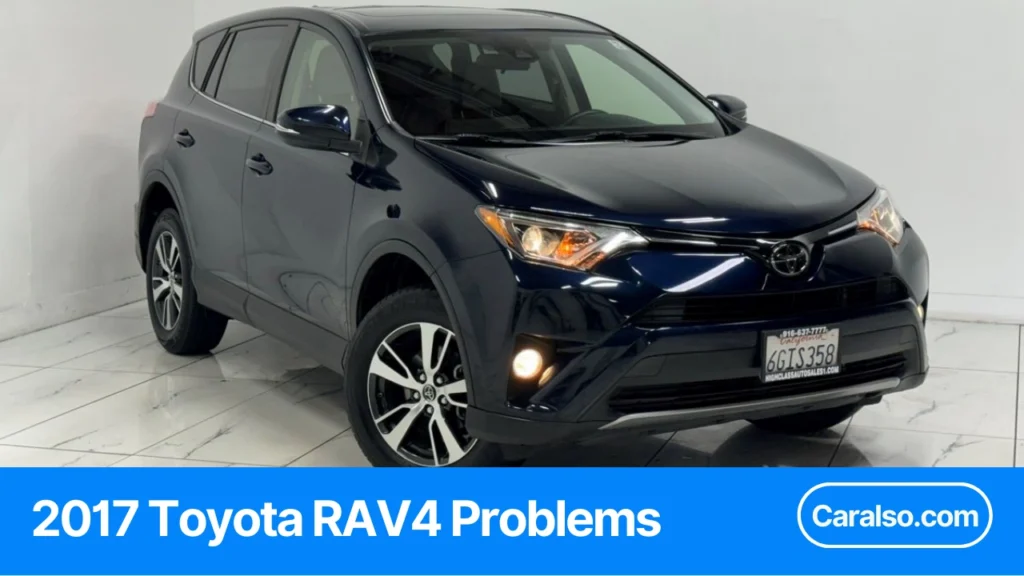
Is the 2017 Toyota RAV4 Reliable or a Headache?
Short answer. The 2017 RAV4 is more reliable than many people think.
Owner data shows a few hundred reported problems, with most in three buckets: steering, lights, and some engine or electrical complaints.
Big rating sites like Consumer Reports and J.D. Power put 2017 at or above average for reliability, and well clear of the worst RAV4 years.
The main things I watch are:
- Steering that pulls or feels nervous at highway speed
- Weak low beams and poor night visibility
- A small number of engine stall or surge complaints
- A big recall for 12 volt battery fires that covers 2013 to 2018 RAV4s
- On the hybrid, a few AC drain and electrical issues, but low complaint counts overall
If you sort those out, 2017 looks like a solid used RAV4 year.
Here is the quick snapshot I use when someone asks me in a parking lot if they should buy a 2017.
2017 Toyota RAV4 Problem Snapshot
| Problem area | How common it looks* | Typical symptoms | Risk level | Rough repair cost if not covered | Deal breaker for me? |
|---|---|---|---|---|---|
| Steering pulls or drifts | Common in owner complaints | RAV4 wanders, needs constant correction, feels like crosswind | Medium. Can tire you out and hurt confidence | $100 to $300 for alignment. $400 to $1,200 if steering parts are worn | No, if it can be fixed with alignment or parts and test drive then feels straight |
| Weak headlights and visibility | Common complaint early in ownership | Dim low beams, poor cutoff, hard to see on dark roads | Medium. Comfort and safety issue at night | $50 to $300 for better bulbs and aim. More for full headlight swap | No, but I always budget for a headlight upgrade |
| Rough or clunky 6 speed automatic | Reported, but not at crisis levels | Hard shifts, slight delay into gear, gear hunting on hills | Medium. Annoying but usually not sudden failure | $150 to $300 for fluid service or software check. Up to $3,000+ for major work | Maybe. If it still shifts badly after updates, I walk |
| Engine stalls or surges | Dozens of reports, not hundreds | Engine cuts out, jerks, or races while braking or at cruise | High if repeatable. Can be a safety risk | Highly variable. $200 for sensors. $1,000+ if deeper fuel or engine issue | Yes, unless a dealer proves it was fixed and it will not come back |
| Brake noise and feel | Fairly common but mostly minor | Squeal or grinding at low speed, soft pedal feel | Low to medium. Annoying and can hurt stopping distance | $250 to $600 for pads and rotors. More if calipers are bad | No, as long as a shop can sort it with normal brake work |
| Electrical and interior quirks | Scattered complaints across systems | Dim dash lights, infotainment glitches, odd warning lights | Low to medium. Can hide bigger issues if ignored | $100 for simple bulbs. $300 to $1,000+ for wiring or module work | Only if there are many warning lights and no clear diagnosis |
| 2017 RAV4 Hybrid AC drain and climate issues | Reported but overall low hybrid complaint count | Water on floor, musty smell, weak AC | Low to medium. Can damage wiring if left wet | $150 to $500 for cleaning, drain repair, or minor wiring work | No, if caught early and fixed right |
| 12 volt battery fire recall (23V734000) | Affects about 1.8 million 2013 to 2018 RAV4s | In worst case, battery shifts in tray, shorts and can start a fire | High if recall not done. Free fix once done | $0 at dealer. Recall covers clamp, tray, and terminal shield | Yes, I park it until the recall is completed, then I am fine with it |
*Based on public complaint counts, recall info, and owner reviews, not exact failure rates.
If I am shopping a 2017, I do three things up front:
- Run the VIN on the Toyota and NHTSA recall tools to confirm the battery recall and any others are done.
- Drive it on the highway to feel for steering pull and transmission weirdness.
- Check for leaks, smells, and any warning lights, gas or hybrid.
If it passes those, a clean 2017 RAV4 or RAV4 Hybrid is usually a rig I am happy to recommend.
2017 Toyota RAV4 Problem & Recall Snapshot
2017 RAV4 basics
I like to start with what this thing is on paper.
- Generation: 4th gen RAV4, sold in North America for 2013–2018
- Gas engine: 2.5-liter 4-cylinder, about 176 hp and 172 lb-ft, with a 6-speed automatic
- Drivetrain: Front wheel drive or optional all wheel drive
- Fuel economy (gas): Roughly 23 city / 29 highway mpg FWD, 22 / 28 mpg AWD
- Hybrid option: 2.5-liter hybrid system, 194 net hp, AWD with e-motor, about 34 city / 30 highway mpg, 32 combined
So you are looking at a simple non-turbo engine, normal 6-speed auto, and a proven Toyota hybrid setup if you go that route.
Reliability scores and owner sentiment
On paper, 2017 actually scores well.
- J.D. Power gives the 2017 RAV4 an overall 83 / 100 and 87 / 100 for quality and reliability, which they call “Great.”
- Consumer Reports says the 2017 RAV4 is more reliable than the average 2017 vehicle and notes three NHTSA recalls for the year.
- CarComplaints shows 444 owner-reported problems for the 2017 gas RAV4, with the worst categories being transmission, electrical, and steering.
- For context, their RAV4 overview flags 2019 as the worst modern year, not 2017.
So yeah, there are problems. But 2017 sits in the “better half” of RAV4 years if you avoid abused examples.
Complaints and recalls in numbers
Here is the quick numbers view.
- Top gas-model complaints on CarComplaints:
- Pulls to one side
- Poor headlights
- Poor windshield visibility
- Transmission complaints:
- 14 total transmission complaints, led by rough shifting, jumping gears, slipping and jerking, a few torque converter shudder cases, and two reported transmission failures.
- Engine complaints:
- 48 engine complaints on CarComplaints. The main ones are engine stalls while driving, excessive engine noise, a rear main seal leak, and a few unintended acceleration reports.
- Hybrid complaints:
- 26 total problems reported for the 2017 RAV4 Hybrid, with the worst being a clogged A/C condensation hose causing water damage and a couple of “engine started automatically” stories.
- Key recalls that hit 2017 RAV4 and RAV4 Hybrid:
- 12-volt battery fire risk (23V734000) affecting about 1.8 million 2013–2018 RAV4s. If a replacement battery is the wrong size or not clamped right, it can move, contact the hold-down bracket, and short. Dealers replace the battery clamp, tray, and positive terminal cover free.
- Label and tire related recalls on some 2017s, like incorrect load or spare tire pressure info. Annoying, but they are quick dealer sticker jobs.
Bottom line in this snapshot. Most 2017 RAV4 issues are steering feel, lighting, and some shifting or engine behavior. The battery recall is the serious one, and that has a clear free fix at the dealer once you get it done.
Top 2017 Toyota RAV4 Problems (Gas Models)
Here I am talking about the regular gas RAV4, not the hybrid. I will hit the stuff I actually watch for on a test drive.
Steering pulls to one side at highway speeds
This is the big complaint headliner for 2017.
Owners report the RAV4 drifts or pulls, usually at highway speed. You end up making constant tiny corrections like you are driving in a crosswind. CarComplaints lists “pulls to one side” as the number one 2017 problem, with an average mileage around 6,450 and a “pretty bad” score.
Often it comes down to:
- Alignment that is out of spec
- Tire issues or pressures that do not match
- Electric power steering feel and centering
- In a few cases, parts in the column or suspension that need work
What I do on a test drive
- Get it up to 60 to 70 mph on a flat road.
- Loosen my grip a bit and feel if it drifts.
- Check that the wheel recenters itself after turns.
If it pulls, I budget for an alignment and tire check at minimum. If that does not fix it, I have a shop inspect the steering gear and suspension before I buy.
Rough or clunky 6-speed automatic transmission
The 2017 uses a 6-speed automatic. It is not a glass transmission, but it is not butter smooth either.
CarComplaints lists 14 transmission issues, with the worst being rough shifting, jumping gears, slipping and jerking, a couple of torque converter shudder cases, and two failures around 47,000 miles.
CoPilot calls out clunky shifts, hesitation going from reverse to drive, and abrupt downshifts on hills. They also point out a lot of this is calibration and feel, not mass mechanical failure.
Typical fixes range from:
- Software updates at the dealer
- Fluid change or flush if the fluid is old
- In rare bad cases, torque converter or full transmission replacement, which can run over $3,000 at a dealer.
What I do
- Drive it from cold. Feel every shift at light throttle.
- Do a few firm accelerations and highway merges.
- Pay attention to delays going from reverse to drive and how it behaves on long grades.
If it is a little firm but consistent, I am not worried. If it jumps gears, slams into gear, or feels like it slips, I want a transmission specialist to look at it before I sign anything.
Poor headlights and night visibility
“Poor headlights” is the number two complaint on CarComplaints for 2017. Owners say the low beams are weak and the cutoff is low, so you cannot see very far down a dark road.
This matches what IIHS and other testers found when they started rating SUV headlights. The 2017 RAV4 got marginal to acceptable headlight scores depending on trim and options, and only some setups qualified the RAV4 for Top Safety Pick Plus.
What helps
- Make sure the headlights are aimed correctly. Mis-aimed lights can feel awful.
- Use good quality legal bulbs, or factory LED/projector options if your trim has them.
- Take a night test drive, not just a daytime loop around the block.
Bad headlights are not a reason I walk away by themselves. I just plan on some upgrades.
Engine stalling, surging, and noise
The 2017 gas RAV4 has far fewer engine horror stories than older oil-burning years, but I still pay attention.
CarComplaints lists 48 engine problems. The top ones are stalls while driving, excessive engine noise, a rear main seal leak, and rare unintended acceleration reports tied to braking. Most of the NHTSA engine and speed control complaints cluster there too.
True engine failures are not common for 2017. What you mostly see are isolated cases that may be tied to sensors, fuel delivery, or software.
What I do
- Listen for rattles, knocks, or harsh noise at cold start.
- Watch for any stumble or surge on steady throttle.
- Scan for codes and check for open engine related TSBs.
If a 2017 RAV4 has a clear history of stalling or surging that nobody can pin down, I do not try to be a hero. I keep looking.
Brake noise and feel issues
You will see some complaints about brake grinding or squeal at low miles, including one case at around 16,000 miles with a “horrible grinding sound” on braking.
Most of this is basic wear:
- Pads and rotors
- Rust on rotors if it sits outside a lot
- Cheap replacement parts on used rigs
Typical fixes run in the $250 to $600 range for pads and rotors on both axles at an independent shop.
For me, noisy brakes are not a deal breaker. I just use them as a bargaining chip and plan to refresh brakes right after I buy.
Electrical and interior annoyances
The 2017 RAV4 shows a chunk of electrical complaints, but they are spread out.
Stuff owners mention:
- Dash and control lights that are not bright or not lit where they expect
- Occasional infotainment glitches
- Random warning lights that trace back to sensors or low 12-volt battery health
There is also the separate 12-volt battery fire recall, which I treat as its own safety topic. That is more about battery fitment and the hold-down clamp than day-to-day electrical quirks.
What I do
- Check every switch, window, light, and the infotainment system during the test drive.
- Look for any warning lights on the dash.
- Ask how old the 12-volt battery is and whether the battery recall fix has been done.
Small electrical annoyances are fine if I love the truck. A dash full of warning lights is not.
Suspension noises and alignment quirks
Some 2017 owners also report vibrations, knocks, or general “loose” feeling from the suspension and steering at relatively low mileage. NHTSA complaints and owner stories talk about vibration over bumps and uneasy highway manners.
The usual suspects:
- Worn or out-of-spec alignment
- Tired or cheap replacement tires
- Worn bushings or struts on higher mile rigs
What I do
- Drive it over rough pavement and listen.
- Check for uneven tire wear.
- Have a shop put it on a lift if anything feels off.
Most of the time this is not a structural problem. It is just normal wear that nobody has dealt with yet.
Paint peeling on Blizzard Pearl and Super White
If the 2017 RAV4 is white or pearl white, I always walk around it slowly.
Toyota has a paint peeling and clear coat issue on Blizzard Pearl (070) and Super White (040) across many models from 2008 to 2017, including the RAV4. Toyota set up a customer support program and extended paint coverage for those colors, with repaint coverage on peeling metal panels for a limited time.
By now, a lot of that coverage is timed out, but some trucks were already repainted.
What I do
- Look at the roof, hood, and tops of doors for peeling or flaking paint.
- Ask if any paint repair was done under Toyota’s paint program.
Peeling paint hurts resale more than anything. I do not mind a mechanically great 2017 with a few paint flaws if the price is right.
2017 Toyota RAV4 Hybrid Problems (And How They Compare)
If you are eyeing a 2017 RAV4 Hybrid, you are usually in better shape than with the gas model.
How many complaints vs gas model
CarComplaints lists about 444 problems for the 2017 gas RAV4 and 26 problems for the 2017 RAV4 Hybrid.
For the hybrid, the worst categories are:
- Electrical
- AC and heater
- Seat belts and air bags
So the hybrid does have issues. But the raw volume is much lower than the gas model. That tells me 2017 Hybrid is not a problem child year.
AC condensate drain and water in the cabin
The headline hybrid issue is a clogged A C condensation hose.
CarComplaints shows one big case where the A C condensation hose clogged, water backed up, and damaged wiring and interior. The average repair bill there was reported at over six grand.
What it looks like in the real world:
- Wet passenger floor
- Musty smell
- Sometimes fogging windows
- In bad cases, electrical problems from soaked wiring
Toyota and independent techs point to a blocked drain or hose routing as the usual cause. The fix is to clear the drain, replace the hose if needed, and repair any wiring it hurt.
What I do with a 2017 Hybrid:
- Feel the carpet on the front passenger side
- Smell for mildew
- Run the A C and check for leaks under the car
If I catch it early, it is a small job. If the carpet is soaked and there are electrical issues, I walk unless the price is crazy low.
“Engine starting on its own” and electrical quirks
CarComplaints lists two weird 2017 Hybrid reports where the engine started by itself in the middle of the night. Both happened around 21,000 miles.
On hybrids with keyless entry and remote start, it is easy for:
- A remote start system to be misconfigured
- A key fob or telematics app to trigger a start
- An electrical fault to confuse the system
Public data does not prove a single root cause here. It just says the car woke up when it should not have. I treat that as a wiring or software problem until a dealer proves otherwise.
What I do:
- Ask if the car has factory or aftermarket remote start
- Ask if this has ever happened
- Scan for codes and check for hybrid or body system TSBs
If a 2017 Hybrid is doing ghost starts today and nobody can explain it, I move on.
Hybrid specific worries that are not big problems
Here is the good news. The 2017 RAV4 Hybrid does not have a wave of hybrid battery failures in the complaint data. Most of the trouble is AC drain, some electrical noise, and normal wear parts.
For this model year, Toyota hybrid system coverage is:
- About 8 years or 100,000 miles on hybrid components from new in most states
- In some emissions states, battery coverage can stretch longer under emissions rules
Toyota hybrids in general see packs last 10 to 15 years or 150,000 to 200,000 miles in normal use, based on warranty info and owner reports.
So if I am choosing between a 2017 gas RAV4 and a 2017 RAV4 Hybrid:
- I worry more about steering and transmission feel on the gas model
- I worry more about AC leaks and electrical oddities on the hybrid
For this year, I usually lean toward the hybrid if:
- The battery recall is handled
- The carpets are dry
- There are no unexplained warning lights
It is smoother, more efficient, and not clearly less reliable.
2017 RAV4 Recalls, Investigations, and TSBs That Matter
Recalls are free fixes. I always start here before I spend a dollar at a shop.
12 volt battery fire risk recall 23V734000
This is the big one.
NHTSA recall 23V734000 covers about 1.8 to 1.9 million 2013 to 2018 RAV4s, including 2017 gas and hybrid models.
The problem:
- The RAV4 is designed for a Group 35 12 volt battery
- Some cars got wrong size replacement batteries or batteries installed without the correct adapter
- If the battery is too small, it can move in the tray, hit the hold down bracket, and short out
- That short can overheat the battery and parts around it and start a fire
The fix at the dealer:
- Inspect the battery size and how it is mounted
- Install a new battery clamp sub assembly, battery tray, and positive terminal cover if needed
- Do it free of charge as part of the recall
Owner letters started going out in late 2024, with more batches through mid 2025.
If I own or am buying a 2017 RAV4, I park this front and center:
- I do not ignore any burning smell or smoke in the engine bay
- I confirm the recall is complete before I daily drive it
- I make sure the correct battery group size is in there
Once the recall work is done and the right battery is fitted, I am comfortable again.
Load capacity and spare tire pressure label recalls
The 2017 RAV4 and RAV4 Hybrid also have smaller label and tire related recalls.
Two key items show up in recall lists:
- A spare tire pressure recall where the temporary spare was not inflated to the value on the label
- A load carrying capacity label recall where the sticker weight info can be wrong
These sound minor. They still matter because:
- A low spare can fail if you rely on it at highway speed
- Wrong load info can mislead you when towing or loading the SUV
The fix is simple and free:
- Dealer checks and inflates the spare to the correct pressure
- Dealer replaces the label with the correct weight info
I do not treat these as deal breakers. I just like to see them done.
NHTSA investigation into battery “thermal events”
Before the big battery recall, NHTSA opened an investigation into fires on parked RAV4s from 2013 to 2018. Complaints often mentioned the left front of the engine bay, where the battery is.
That probe is what pushed Toyota to dig deeper and eventually issue recall 23V734000.
The takeaway for a 2017 buyer:
- The fire issue is real
- It is tied to battery size and mounting
- It has a clear recall fix when you get the work done
So again, I never skip the recall check step.
How to check if a 2017 RAV4 has all recall work done
Here is the quick way I do it on any used RAV4.
- Get the VIN.
It is on the dash at the base of the windshield and on the driver door jamb. - Run it through NHTSA.
Go to the NHTSA recall lookup and enter the VIN. It will show any open safety recalls in the last 15 years. - Run it through Toyota.
Use Toyota’s official recall and service campaign checker and plug in the same VIN. This can also show campaigns that are not full NHTSA recalls. - Ask a dealer for a printout.
When you bring the SUV in, ask the service advisor to print the full recall and campaign history tied to that VIN.
If the 2017 RAV4 you are looking at still shows an open recall, I do two things:
- I get the recall booked and done before I worry about smaller issues
- I use the open recall as leverage in price if I am still shopping
A 2017 RAV4 with all recall work done and clean TSB history is a very different truck from one that has been ignored.
Is the 2017 Toyota RAV4 a Good Used Buy?
For most people, yes. I put 2017 in the “good used buy” column if the history is clean and the recalls are done.
On the data side, J.D. Power gives the 2017 RAV4 an 83 out of 100 overall score and 87 out of 100 for Quality and Reliability. They label that “Great,” which is their second highest band.
Consumer Reports calls the 2017 RAV4 more reliable than the average 2017 vehicle, and notes only a small number of recalls and problem spots compared to some rivals.
When you look at problem-year lists, 2017 rarely shows up as a “year to avoid.” Those lists usually flag 2006 to 2008, 2013, and 2019 instead.
Owner reviews back that up. On Edmunds, reliability for the 2017 RAV4 sits at 5 out of 5 stars from owners. Many people say it is boring but dependable, which is what you want from a daily SUV.
For the 2017 RAV4 Hybrid, Consumer Reports specifically notes that it is “much more reliable than other cars from the same model year” and lists only one recall.
So where does 2017 land in the lineup:
- Safer pick than older oil burning years
- Safer pick than 2019 with its heavier transmission and drivability issues
- Not as new as 2020 plus, but much cheaper to buy
If I find a 2017 RAV4 or RAV4 Hybrid with full service records, clean body, and all recall work done, I am comfortable recommending it to friends as a daily driver.
2017 Toyota RAV4 Maintenance & Ownership Costs
The RAV4 has a good reputation for low running costs. The 2017 fits that pattern.
RepairPal pegs the average annual repair and maintenance cost for a Toyota RAV4 at about 429 dollars, and rates the model 4.0 out of 5.0 for reliability. That ranks it 3rd out of 26 compact SUVs in their system.
CarBuzz and CarEdge pull similar numbers. They quote around 429 dollars per year and a 10 year cost near 6,000 dollars for maintenance and repairs, which is lower than the compact SUV average of about 8,200 dollars.
Real world shops and RAV4 guides often say the same thing. Expect roughly 400 to 600 dollars per year in routine maintenance on a healthy RAV4, depending on how many miles you drive and whether you use a dealer or an independent shop.
Most 2017 issues are not engine grenades. They are things like:
- Brake pads and rotors
- Alignments and tires for steering pull
- Fluid services
- Headlight or bulb upgrades
Big ticket risks show up if you are unlucky:
- Full automatic transmission replacement
- Steering rack or EPS repairs
- Collision avoidance or sensor replacement after a crash
Those jobs can run into the thousands. I treat them as reasons to walk if they pop up on a used 2017 that is already out of warranty.
If you keep up with oil, coolant, brakes, and basic inspections, a 2017 RAV4 or RAV4 Hybrid should be a low drama, low cost SUV to live with.
2017 RAV4 Used Buying Checklist (Gas and Hybrid)
Here is the checklist I would use if you told me you were test driving a 2017 RAV4 this afternoon. Screenshot it and take it with you.
1. VIN and recall check
Before you fall in love:
- Get the VIN
- Run it on the NHTSA recall lookup to see open safety recalls
- Run it on Toyota’s official recall checker for campaigns and service programs
Make sure the battery fire recall 23V734000 is closed on that VIN, or at least scheduled.
2. Test drive checks
You want at least 20 to 30 minutes behind the wheel.
Straight line and steering
- Get it up to 60 to 70 mph on a flat road
- Lighten your hands and see if it pulls left or right
- Feel if the wheel recenters smoothly after turns
Transmission behavior
- Start from cold and feel every upshift at light throttle
- Do a few harder merges and hill climbs
- Watch for slips, bangs, or big delays going from Reverse to Drive
Brakes
- Make a few medium to hard stops from city speeds
- Listen for grinding or squeal
- Feel for vibration in the wheel or pedal
Headlights and visibility
- If you can, drive it after dark
- Check how far you can see on low beams
- Make sure high beams work and the pattern looks even
Hybrid specific
- On a 2017 Hybrid, run the A C for a while
- Look under the car for water dripping from the drain
- Make sure there is no water on the front passenger floor or a moldy smell
3. Visual checks
Walk around it slowly and get your hands dirty.
- Look for peeling or flaking paint, especially on white or pearl trucks
- Check for uneven panel gaps or overspray that might hint at crash repairs
- Look at tire wear. Feathering or inside edge wear can point to alignment or suspension issues
- On hybrids, pull up the front mats and feel the carpet for dampness
In the engine bay:
- Check coolant level and look for dried coolant trails
- Check oil level and color
- Look for hacked wiring, off brand batteries, or crusty terminals
4. Paperwork, codes, and pro inspection
Before I buy, I want:
- A scan for codes, even if the dash is clean
- Service records that show oil changes and basic care
- Proof of recall work and any big repairs
If the truck still feels right after that, I take it to a mechanic who knows Toyota or hybrids and pay for a pre purchase inspection. I ask them to focus on:
- Suspension and steering
- Transmission health
- For hybrids, the high voltage system and AC drain area
If the shop says it is solid, I am happy to move forward. If they hand me a list of four figure jobs, I walk and find a better 2017. There are plenty out there.
FAQ – 2017 Toyota RAV4 Problems
Is the 2017 Toyota RAV4 a reliable SUV?
Yes. I put the 2017 RAV4 in the “safe to buy” group if the history is clean. J.D. Power scores it 83 out of 100 overall and 87 out of 100 for Quality and Reliability, which they call Great. Consumer Reports also says the 2017 RAV4 is more reliable than the average 2017 vehicle.
What is the most common problem on the 2017 RAV4?
The thing I see most in complaints is steering pull and wandering, followed by weak headlights and some rough shifting reports. The serious item is the battery fire recall, but once the recall fix is done that problem is basically removed for that SUV.
Does the 2017 RAV4 have transmission problems?
Some 2017 RAV4s have a 6 speed automatic that feels clunky or hunts for gears, and a small number have real slip or failure. CarComplaints lists 14 transmission complaints for 2017, with rough shifting and jerking as the main themes. Most are fixed with software or fluid service. I only get nervous if it still shifts badly after a dealer has updated it.
Is the 2017 RAV4 Hybrid more reliable than the gas model?
For this year, yes in my opinion. The 2017 RAV4 Hybrid shows far fewer total complaints than the gas model in public data, and most of its issues are around the A C drain and small electrical quirks. Consumer Reports also calls the 2017 RAV4 Hybrid much more reliable than the average 2017 vehicle.
What recalls affect the 2017 Toyota RAV4?
The big one is recall 23V734000 for the 12 volt battery and tray. If the wrong size battery is fitted or not clamped right, it can move, short, and in rare cases cause a fire. There are also simpler recalls for load capacity labels and spare tire pressure labels. Those are quick dealer fixes but still worth getting done.
How many miles can a 2017 RAV4 last if maintained?
With regular oil changes and basic care, I expect a 2017 RAV4 to run well past 150,000 to 200,000 miles, and many go beyond that. That comes from Toyota’s reliability track record plus how the 2017 scores on J.D. Power, Consumer Reports, and low average annual repair costs. The big thing is simple. Keep fluids fresh, fix small issues early, and avoid one that was already abused.
Sources
- 2017 Toyota RAV4 problems – CarComplaints
https://www.carcomplaints.com/Toyota/RAV4/2017/ - 2017 Toyota RAV4 reliability & owner ratings – J.D. Power
- 2017 Toyota RAV4 reliability (trouble spots) – Consumer Reports
- NHTSA Safety Recall Report 23V734000 – battery fire risk
- Toyota recall lookup (official VIN checker)
- Toyota RAV4 reliability rating & average annual repair cost – RepairPal

Hey there,
How is it going?
I’m Meraj Sarker. I am a Car Mechanic and a student of Automobile Restoration here in Florida, USA. I’ve been studying automotive for around 9 years now. So you can rely on my recommendation. For me, studying and getting knowledge about automobile it’s really fun and entertaining. I will help you to get solutions for your car through this website. If you need any help let me know.