
If you are shopping a 2004 RAV4, I look at it as a two-step decision. Step 1 is safety. I check the VIN for the Takata driver airbag inflator recall before I do anything else. Some 2004 to 2005 RAV4s were included in a Do Not Drive advisory. That changes everything. Step 2 is mechanical risk. The biggest money risk I watch for on these is overheating or coolant loss.
After that, it is harsh shifting or delayed engagement on the automatic, then check engine lights from EVAP or oxygen sensor issues, plus steering and brake wear.
This guide is built for real buying. I will show you the symptoms that matter, the fastest yes or no checks, and when I would walk away.
Quick Answer (Read This First)
Quick Verdict
- First check: Run the VIN for open recalls. If it flags a Do Not Drive airbag notice, do not drive it and do not buy it without a completed repair record.
- Biggest money risk: Any sign of overheating or coolant loss. If the temp gauge climbs, I treat it as a walk-away unless you have strong repair documentation.
- Most common drivability complaint: Hard shifting or delayed engagement on the automatic. A 10-minute test drive usually exposes it.
- Most common check engine light type: EVAP and sensor codes. These can be cheap or annoying, not always catastrophic. Misfire codes are different. Those can kill the catalytic converter.
- Quick myth-buster: The 2.4L uses a timing chain, not a timing belt. I ignore “timing belt due” quotes on this engine.
2004 Toyota RAV4 Problems – Summary Table
| Problem Area | How Serious? | Fast Yes Or No Check | Walk Away? |
|---|---|---|---|
| Open Takata Driver Airbag Inflator Recall (Some With Do Not Drive) | Critical | Run VIN on Toyota and NHTSA sites. If it shows Do Not Drive, the car stays parked until repaired. | Yes, until fixed |
| Overheating Or Coolant Loss | High | Cold engine: check coolant level and look for dried coolant crust near the radiator and water pump area. Warm idle 10 minutes: gauge must stay stable, fans should cycle. | Yes if it overheats, pushes coolant, or keeps losing coolant |
| Hard Shifting, Delayed Engagement, Or “Lunge” Into Drive | Medium To High | Cold start: shift R to D. Engagement should feel normal within about 1 second. Test drive: light throttle 1 to 2 shift should not slam or flare. | Yes if it slips, bangs repeatedly, or has burnt ATF smell |
| Check Engine Light (EVAP, O2, Catalyst, Misfire) | Low To High | Plug in a basic OBD scanner. EVAP codes are often livable. Misfire codes mean stop and diagnose before buying. | Maybe. Walk if misfire, flashing CEL, or multiple drivetrain codes |
| Steering Clunk, Loose Steering Feel, Brake Pulsation, ABS Light | Medium | Parking lot: full-lock turns both directions. Listen for clunks. Road test at 45 mph: firm braking should be smooth, no violent shake. | Maybe. Walk if steering feels unsafe or there is serious rust underneath |
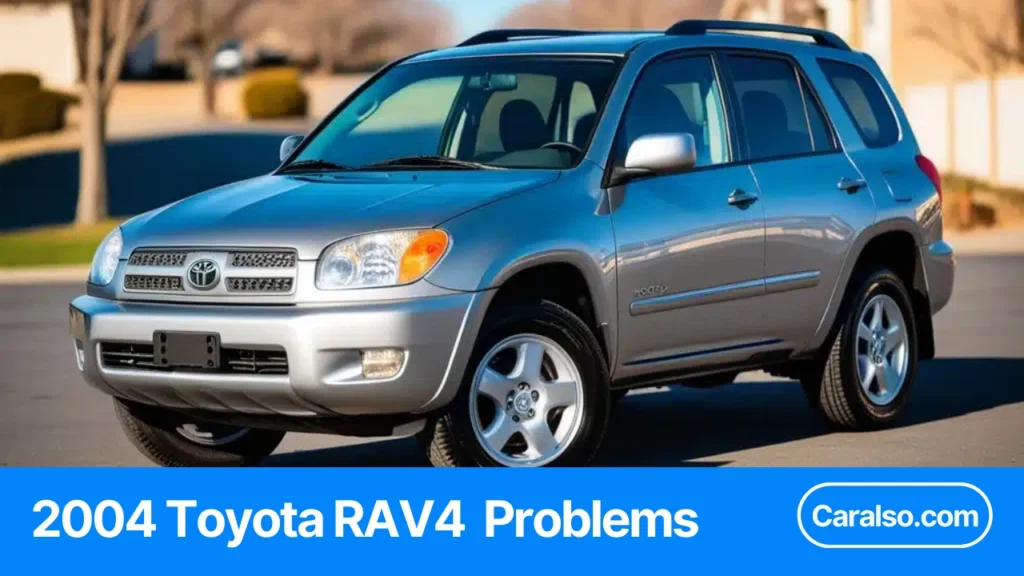
2004 Toyota RAV4 Problems
My Fast Buying Rule For This Year
If the VIN is clean on recalls and the cooling system passes a simple warm-up test, a 2004 RAV4 can still be a solid used buy at 150,000 miles or more. If it has any overheating story, I assume the worst until proven otherwise.
2004 Toyota RAV4 Problems Problems Snapshot (What Owners Report Most)
When I scan owner complaints and shop-style problem lists for the 2004 RAV4, the pattern is pretty consistent.
Cooling issues show up because overheating can turn into a big repair fast. Automatic shifting complaints show up next. Then it is check engine lights from EVAP and sensor faults. After that, you get the age-and-mileage stuff like steering clunks, brake warnings, oil leaks, and road noise.
Here is the quick, usable version.
| Issue | What You’ll Notice | Likely System | Quick Driveway Check | Typical Fix Path | Deal-Breaker Rule |
|---|---|---|---|---|---|
| Overheating Or Coolant Loss | Temp gauge climbs. Heater blows cool at idle. Coolant smell after a drive. | Cooling system, head gasket risk | Cold start: coolant level at the radiator neck, not just the overflow. Warm idle 10 minutes: gauge stays steady, fans cycle. | Fix leak source first. Pressure test. If it has repeated overheating, plan deeper engine diagnosis. | I walk if it overheats on a test drive or pushes coolant out |
| Hard Shifting Or Delayed Engagement | Slam into Drive. Flare between gears. Delay going into Reverse. | Automatic transmission, controls | Cold: shift R to D. Engagement should be within about 1 second. Test drive: light throttle 1 to 2 shift should be smooth. | Fluid check. Scan for solenoid codes. Rule out a control issue before calling the trans “dead.” | I walk if it slips, bangs repeatedly, or has burnt fluid smell |
| EVAP Codes And Fuel Smell | Check engine light after fueling. Fuel smell near rear of car. | EVAP canister and valves | Listen near fuel tank area after shutdown. Scan for EVAP codes. Check cap seal. | Often a canister and valve assembly fix. Some jobs require tank access. | Not a walk by itself, unless you cannot pass emissions where you live |
| Oxygen Sensor Or Air-Fuel Ratio Sensor Faults | Check engine light. MPG drop. Occasional roughness. | Upstream A/F sensor, wiring | Scan for sensor heater circuit codes. Look for exhaust leaks before the sensor. | Verify wiring and fuses. Replace the correct upstream sensor if confirmed. | I do not walk unless it also misfires or runs poorly |
| False Catalytic Converter Code | Check engine light with “cat efficiency” language, but it drives fine. | ECU logic, emissions monitoring | Scan the exact code. Look at fuel trims and misfire history if you can. | Check for updates and proper diagnosis before replacing a catalytic converter. | I walk if it has misfire history or runs rich for long periods |
| Oil Leaks And Burning Oil Smell | Oil spots. Burning smell after a drive. Wet engine edges. | Engine gaskets or oil system parts | Flashlight check around valve cover area and front of engine. Look for oil on the subframe. | Clean and re-check. Fix the actual leak point. Do not guess. | I walk if oil is dripping onto the exhaust or it is leaving a puddle after 5 minutes |
| Steering Clunk Or Loose Feel | Clunk at low speed turns. Steering feels vague. | Intermediate shaft, rack play, bushings | Parking lot test: figure 8 turns at 5 mph. Listen for clunk on initial wheel input. | Start with inspection of shaft play and rack mounting points. Repair the worn part, not the whole front end. | I walk if it feels unsafe or has heavy play you can feel at the wheel |
| Brake Pulsation Or ABS, VSC, Trac Lights | Shake on braking. ABS chatter at low speed. Warning lights. | Rotors, wheel speed sensors | Road test at 45 mph: firm brake should be smooth. Slow roll at 5 to 10 mph: ABS should not chatter on dry pavement. | Measure rotors. Inspect sensors and wiring. Confirm codes before buying parts. | I walk if the pedal sinks, the car pulls hard, or multiple brake lights stay on |
| Road Noise And Rattles | Loud highway noise. Cargo area rattle. | Tires, worn seals, interior trim | 60 mph cruise on smooth pavement. Listen for tire hum and rear rattle. | Often tires and hatch area trim fixes. Sometimes weatherstrips. | Never a walk. I use it to negotiate price |
| Rust Underneath (Region Dependent) | Flaky brake lines. Crusty subframe. | Brake lines, underbody | 2-minute look: brake lines near rear axle, pinch welds, suspension mounts. Tap with a screwdriver handle. | Address early rust with cleaning and coating. Replace rusted lines and hardware as needed. | I walk if brake lines are heavily scaled or mounts are compromised |
The 10 Most Common 2004 RAV4 Problems (Symptoms To Fix Options)
Overheating Or Coolant Loss (And Why It Can Become An Engine-Killer)
Symptoms I Watch For
Temp gauge creeping up in traffic. Heater goes cool at idle. Sweet coolant smell after shutdown. Overflow bottle looks overfull, then low later.
Why It Happens
Most starts as a normal cooling failure. Radiator, water pump, thermostat, hoses, or a weak cap. The risk is what comes next. A few overheats can turn into a head gasket leak. Some owner complaints also describe head gasket leaks tied to pulled or stripped head bolt threads.
How I Confirm It Fast
I only trust a cold check and a warm check.
Cold: radiator level at the neck. Oil cap underside looks clean, not milky.
Warm: I let it idle 10 minutes with the heater on. I want steady heat and a stable gauge. I also look for bubbling in the overflow.
Fix Options
Pressure test first. Find the leak. Fix the simplest leak before chasing bigger theories.
If it has a known overheat history, I treat it like an engine diagnosis job, not a quick parts swap.
My Buy Or Walk Rule
If it overheats during my drive, I walk.
If coolant is disappearing with no clear leak, I pause the deal until a shop confirms the cause.
Oil Leaks (Valve Cover Area, Front Of Engine, And “Oil Smell After A Drive”)
Symptoms I Watch For
Oil spots where it parks overnight. Burning oil smell after a 15-minute drive. Wet grime around the engine edges.
Why It Happens
Gaskets harden with age. Seals seep. It is normal on a 20-plus-year vehicle. The problem is when the leak hits the exhaust or drops oil fast.
How I Confirm It Fast
I look from above and below.
Above: valve cover perimeter and the back side of the engine.
Below: oil on the subframe and oil on the lower splash shield.
Fix Options
Clean the area. Re-check after a short drive. Then fix the exact leak point.
A shop leak inspection is money well spent if everything is coated.
My Buy Or Walk Rule
I do not walk for light seepage.
I walk if oil is actively dripping onto the exhaust or it leaves a puddle after 5 minutes of idling.
Harsh Shifting Or Delayed Engagement (Automatic)
Symptoms I Watch For
Delay going into Drive or Reverse. Hard 1 to 2 shift. A “bang” feeling on downshifts when rolling to a stop.
Why It Happens
Sometimes it is internal wear. Sometimes it is control side, like a solenoid issue. I also see people replace parts based on one code and still have the same shift feel. That is why I treat it like a test-drive problem first.
How I Confirm It Fast
Cold test matters.
I start it cold and shift R to D. I want engagement in about 1 second with normal feel.
Then I drive 10 minutes. Light throttle from 0 to 25 mph tells me a lot. So does a rolling stop, then gentle throttle back on.
Fix Options
Check fluid condition and level the right way. Scan for transmission and solenoid codes.
If it drives fine but has stored codes, I want diagnosis before I trust any “needs a transmission” quote.
My Buy Or Walk Rule
I walk if it slips or flares consistently.
I also walk if it bangs into gear repeatedly and the seller says, “It’s always done that.”
Check Engine Light From EVAP Problems
Symptoms I Watch For
Check engine light that shows up after fueling. Occasional fuel smell. Sometimes it runs totally normal.
Why It Happens
EVAP issues are common on older vehicles. One known failure pattern is the charcoal canister breaking down and clogging the vent side. That can set EVAP leak and vent-related codes.
How I Confirm It Fast
I bring a basic scanner.
If I see EVAP codes like P0441, P0442, or P0446, I treat it as an EVAP diagnosis path, not an engine problem.
I also check the fuel cap seal and make sure the cap clicks.
Fix Options
Start with the cap and obvious hose cracks.
If codes point to the canister and vent side, the fix is often a canister assembly replacement.
My Buy Or Walk Rule
Not a walk if it drives well and the price makes sense.
It becomes a walk if you cannot pass emissions in your area and the seller refuses to address it.
Oxygen Sensor Or Air-Fuel Ratio Sensor Failure (Common Code Language: P1155)
Symptoms I Watch For
Check engine light. MPG drop by 2 to 5 mpg. Idle feels a little rough at stops.
Why It Happens
The upstream air-fuel ratio sensor has a heater circuit. When the heater or wiring fails, you can get a heater circuit code like P1155. Exhaust leaks ahead of the sensor can also confuse readings.
How I Confirm It Fast
I scan codes and freeze-frame data if available.
I also listen for exhaust leaks near the manifold.
If the code is heater-related, I check fuses and wiring before I buy a sensor.
Fix Options
Diagnose first. Replace the correct upstream sensor if confirmed.
Avoid the cheapest no-name sensors. Fitment and signal quality matter on Toyotas.
My Buy Or Walk Rule
Not a walk by itself.
I walk if it also misfires, stumbles badly, or has a flashing check engine light.
False Catalytic Converter Failure Code (Software Update Angle)
Symptoms I Watch For
Check engine light. It drives normal. No misfire feel. No rotten egg smell.
Why It Happens
Some owners report a check engine light that flags catalytic converter failure when the converter is not actually bad. A software update can be the real fix in those cases.
How I Confirm It Fast
I scan the code. Then I look for misfire history and fuel trim extremes.
A car that is misfiring will kill a converter. That is a different situation.
Fix Options
Rule out misfires and exhaust leaks first.
Then check whether a software update or reflash is applicable before replacing a catalytic converter.
My Buy Or Walk Rule
I do not walk for a single cat-efficiency code with a clean-running engine.
I do walk if it has misfire codes, raw fuel smell, or obvious performance issues.
Steering Clunk Or Pop At Low Speed
Symptoms I Watch For
Clunk when I start turning the wheel from center. Noise at 5 to 15 mph over small bumps. A pop during a parking lot turn.
Why It Happens
On older RAV4s, the clunk can come from play in the intermediate steering shaft. Some owners also chase rack play or rack mounting bushings.
How I Confirm It Fast
Parking lot test.
I do figure 8 turns at 5 mph. Then I do quick left-right inputs while rolling slowly.
If I can feel a knock in the wheel, I want a closer look.
Fix Options
Inspect for play. Start with the simplest worn piece.
If it is shaft related, the fix is usually shaft service or replacement. If it is rack movement, address bushings and mounts.
My Buy Or Walk Rule
I walk if it feels unsafe or has heavy free play.
If it is just noise with tight steering, I use it as a bargaining chip.
Brake Pulsation, ABS Lights, Or “Jerks When Stopping”
Symptoms I Watch For
Shudder in the pedal when braking from 50 mph. ABS chatter at 5 to 10 mph on dry pavement. ABS, VSC, and Trac lights staying on.
Why It Happens
Warped rotors cause pulsation. Wheel speed sensors and wiring can trip ABS and stability lights. Low voltage can also create weird warning light combos.
How I Confirm It Fast
One hard stop from 45 mph tells me a lot.
Then I do a slow roll stop at 5 mph. On dry pavement, the pedal should feel normal.
If warning lights are on, I scan for ABS codes if my scanner supports it.
Fix Options
Measure rotors before replacing them.
Inspect wheel speed sensors and tone rings.
Do not guess. Brake electronics get expensive when people shotgun parts.
My Buy Or Walk Rule
I walk if the pedal sinks or the car pulls hard under braking.
I also walk if multiple brake system lights are on and the seller cannot explain why.
Road Noise And “Old Car” Annoyances
Symptoms I Watch For
Tire hum at 60 mph. Wind noise around the doors. Cargo area rattle at idle or on bumps.
Why It Happens
Tires get loud as they wear. Old weatherstrips stiffen. Interior clips loosen over 20 years.
How I Confirm It Fast
I do 2 minutes at 60 mph on smooth pavement.
Then I coast in neutral for 10 seconds. If the noise stays, it is usually tires, not drivetrain.
Fix Options
Start with tires. Then chase hatch trim and loose heat shields.
Weatherstrip work can help if wind noise is obvious.
My Buy Or Walk Rule
Never a walk.
I price it into the deal.
Rust And Underbody Wear (Region Dependent)
Symptoms I Watch For
Flaky brake lines. Heavy scaling on brackets. Soft metal near suspension mounts. Exhaust hangers ready to snap.
Why It Happens
Salt and moisture. Simple as that. Time matters more than mileage here.
How I Confirm It Fast
I do a 2-minute underbody check with a flashlight.
I look at brake lines near the rear axle and where hard lines meet flex lines.
I also check pinch welds and suspension mounting points.
Fix Options
Surface rust can be cleaned and coated.
Brake line corrosion is a replace job, not a “spray it and hope” job.
My Buy Or Walk Rule
I walk if brake lines are heavily scaled or wet with brake fluid.
I also walk if a suspension mount looks compromised.
Recalls And Safety Checks (Must-Read Before You Buy)
Before I look at fluids or take a test drive, I run the VIN for open recalls. I do this every time. It takes 60 seconds.
This matters a lot on the 2004 RAV4. Toyota’s driver airbag inflator recall covers about 159,700 RAV4s from the 2004 to 2005 model years. A smaller subset of unremedied vehicles is tied to a Do Not Drive advisory. That subset includes about 44,100 RAV4s.
Here is the part most buyers miss. There are no warning signs that tell you the inflator is about to fail. You cannot inspect your way out of this. You have to check the VIN.
My 5-Step VIN Routine
- Find the VIN on the dash at the base of the windshield. Driver side.
- Run the VIN on Toyota’s recall lookup.
- Run the VIN on NHTSA’s recall lookup too.
- If it shows Do Not Drive, I do not start the car. I do not test drive it. I call the dealer.
- I ask what support options they can offer. Mobile repair, towing, pickup and delivery, or a loaner are common options for this advisory.
What The “Do Not Drive” Label Means In Real Life
It means Toyota wants that vehicle parked until the recall remedy is done. The risk is not “the airbag might not work.” The risk is a rupturing inflator that can fire metal fragments.
If I am buying used, I want proof the recall repair was completed. I like seeing a repair order with the VIN on it. If the seller cannot show it, I treat it as not done until the VIN lookup says it is done.
A Note On Other Recalls
A 2004 vehicle can have other recalls or service campaigns. Those vary by VIN and build date. I do not guess. I run the VIN and read the open items list. Then I decide if the fix is quick, or if it is a deal-killer for my use.
Deal-Breaker Vs OK If Priced Right
This is where I stop thinking like a fan and start thinking like a buyer.
A 2004 RAV4 can be a good deal. But only if the big-ticket risks are off the table. Here is how I sort it.
| Condition Found | Risk Level | Buy Only If… | Walk Away If… |
|---|---|---|---|
| Open Driver Airbag Inflator Recall With Do Not Drive Status | Critical | The seller agrees to complete the recall before delivery, or you have a written plan with the dealer for repair and transport. | The seller wants you to drive it home before repair, or refuses to share the VIN |
| Any Overheating On Your Test Drive | High | You have documented recent cooling repairs and a shop confirms no ongoing coolant loss. | The temp gauge climbs, heater goes cold at idle, or coolant pushes out of the overflow |
| Coolant Loss With No Clear Leak | High | A pressure test and inspection identifies a fixable source, and you can verify it was repaired. | The seller says, “It just needs topped off,” or there is evidence of repeated overheating |
| Oil That Looks Milky Or Foamy Under The Cap | High | A shop confirms it is not coolant contamination. | You see coolant in oil, or the exhaust smells sweet and steamy after warm-up |
| Transmission Slips Or Flares Under Light Throttle | High | A scan shows no major transmission faults and a transmission specialist test drives it and signs off. | It slips, bangs into gear repeatedly, or the fluid smells burnt |
| Check Engine Light With Active Misfire Codes | High | You can diagnose and fix it before purchase, and you can verify the catalytic converter is still healthy. | The check engine light is flashing, or the engine shakes at idle |
| ABS, VSC, Or Brake Warning Lights Stay On | Medium To High | You can scan the brake system and confirm it is a sensor or wiring issue, not a hydraulic problem. | The pedal sinks, the car pulls hard, or braking feels unpredictable |
| Heavy Rust On Brake Lines Or Structural Mount Points | High | A trusted shop inspects it on a lift and calls it safe. | Brake lines are heavily scaled, wet, or the mounts look compromised |
| EVAP Codes Only, Drives Fine | Low To Medium | You can price in diagnosis and repair, and emissions compliance is possible in your area. | The seller cleared codes right before you arrived and refuses a scan |
| Road Noise, Minor Seepage, Worn Tires | Low | You use it to negotiate, and everything else checks out. | It is hiding a bigger issue like vibration, overheating, or driveline noise |
What I Usually Negotiate On
These are the items I treat as price levers, not deal breakers, if the car drives well.
- EVAP codes with normal drivability
- Brake pulsation that feels like rotors
- Tire noise at 60 mph
- Small oil seepage with no active drips
- Interior rattles and worn weatherstrips
My rule is simple. I only “buy the deal” after I avoid the big risks.
30-Minute Pre-Purchase Inspection + Test Drive Script
I do this the same way every time. It takes 30 minutes. It catches most of the expensive 2004 RAV4 surprises.
Before Starting (Cold Checks) (8 Minutes)
Bring:
- Flashlight
- Paper towel
- Cheap OBD2 scanner
- Small mirror (optional)
Walkaround (2 minutes)
- Look for uneven panel gaps.
- Check headlight haze and cracked lenses.
- Check tire tread depth on all 4 corners.
- Compare inner vs outer tread. Inner-edge wear often points to alignment or worn suspension.
Underhood Quick Checks (4 minutes)
- Oil level. Pull dipstick. Wipe. Recheck.
- Oil cap. Look for thick tan sludge. A light film can happen on short trips.
- Coolant reservoir level. Note the level line before you start.
- Look for fresh wetness around the radiator end tanks, upper hose, and water pump area.
- Look down the side of the engine for oil seepage. Pay attention to the valve cover area.
Belts And Hoses (2 minutes)
- Squeeze upper radiator hose when cold. It should feel firm, not crunchy.
- Check for cracks on accessory belt ribs.
- Look for green or pink crust around hose connections.
Idle + Warm-Up Checks (7 Minutes)
Cold Start Behavior (2 minutes)
- Start it cold if possible. If the seller warmed it up first, I treat that as a data point.
- Listen for 3 sounds:
- High-pitched squeal (belt or pulley).
- Rapid ticking that stays after 30 seconds (could be valvetrain noise).
- Deep knocking (I walk away).
Idle Quality (2 minutes)
- Idle should stabilize within about 30 to 60 seconds.
- Turn on headlights and AC. Idle should not hunt up and down continuously.
Cooling Fan And Heat (3 minutes)
- With AC on, the cooling fan should cycle as needed.
- Set heat to max after a few minutes. You want steady hot air.
- Sniff for sweet coolant smell near the front. Do not put your face in the fan area.
OBD2 Quick Scan (Optional, 1 minute)
- Check for stored and pending codes.
- If monitors are “not ready” across the board, it might have been recently cleared.
Test Drive Route (10 Minutes City + 5 Minutes Highway) (12 Minutes)
City Loop (10 minutes)
- Do 6 to 10 gentle stops from 25 mph.
- Do 2 to 3 moderate pulls from 0 to 45 mph.
Automatic Transmission Feel (Repeatable Triggers)
- From a stop, use light throttle to 30 mph.
- Repeat 3 times.
- I watch for:
- Shift flare. RPM rises, then it catches.
- Harsh 1 to 2 or 2 to 3 shift.
- Delay going into Drive or Reverse after you pause.
Brake Test (Safe Empty Road)
- Do one straight stop from 30 mph to 0.
- Hands light on the wheel.
- I feel for:
- Steering shake (warped rotors or worn front suspension).
- Pedal pulsation (rotor runout or ABS activation from a wheel speed issue).
Steering Clunk Test (Parking Lot Figure-8)
- Full lock left. Slow roll. Full lock right. Slow roll.
- I listen for:
- Clicking (outer CV joint).
- Clunking (tie rod ends, ball joints, sway bar links, strut mounts).
Wheel Bearing Quick Check (45 To 60 mph)
- On a safe road, do a gentle lane change left then right.
- A bad bearing often changes tone when load shifts.
AWD Binding Check (If AWD) (1 minute)
- In a tight parking lot circle at low speed, listen and feel.
- Binding, hopping, or heavy shudder is a red flag.
- Some tire mismatch issues can mimic this, so I check tire brand and size on all 4 corners.
After Drive (3 Minutes)
Pop the hood again
- Look for fresh leaks that appeared hot.
- Recheck coolant reservoir level. Compare to your “before” line.
- Smell for hot oil or coolant near the radiator and valve cover area.
Final Quick Undercar Look
- Look behind the front wheels for wetness flung onto the inner fender.
- Check the exhaust tip. A little soot is normal. Wet oily residue is not.
If 2 or more of these show up, I price it like a project:
- Overheat history signs
- Transmission flare or delayed engagement
- Loud front-end clunk on turns
- Multiple codes plus “not ready” monitors
Preventive Maintenance That Actually Reduces These Failures
If I buy a 2004 RAV4 with unknown history, I assume nothing. I baseline it. These are the services that reduce the big-ticket failures I see most.
My Baseline Plan (First 30 Days)
Fluids First
- Engine oil and filter.
- Coolant condition check. I look for clean color and no oil sheen.
- Brake fluid check. If it is dark brown, I flush it.
- Power steering fluid condition. If it is dark, I exchange it.
Rubber And Heat Management
- Radiator cap and hoses inspection.
- Thermostat history. If overheating is even a rumor, I replace thermostat with an OE-quality part.
Ignition And Air Metering
- Air filter.
- Clean the throttle body if idle is unstable.
- Clean the MAF sensor only with MAF-safe cleaner.
Intervals That Matter Most (Simple Table)
| Item | Interval I Follow | Why I Care On A 2004 RAV4 |
|---|---|---|
| Engine Oil + Filter | 5,000 miles or 6 months | Cheap insurance against sludge and timing chain wear |
| Engine Coolant | 100,000 miles or 10 years, then 50,000 miles or 5 years | Overheating is the fastest way to total the value of an older RAV4 |
| Spark Plugs | 120,000 miles | Misfires kill catalysts and mileage |
| Brake Fluid | 2 to 3 years | Old fluid raises corrosion risk in ABS parts |
| ATF Drain And Fill (Automatic) | 30,000 to 60,000 miles (depends on use) | Helps shift quality and extends transmission life |
| Rear Diff + Transfer Case (AWD) | 30,000 to 50,000 miles | Old gear oil accelerates bearing wear |
I treat those intervals as the “keep it alive” plan. I adjust based on towing, heat, and stop-and-go driving.
Cooling System Habits That Pay Off
This is the one system I do not ignore on a 2004.
- I keep the radiator fins clean. A soft brush and gentle hose flow works.
- I replace a weak radiator cap before summer.
- I never mix random coolant types. If I do not know what is in it, I drain and refill correctly.
- I watch the temperature gauge on long grades. Any spike is a stop-now event.
Fluid Change Philosophy For High-Mileage RAV4s
Automatic transmission
- I prefer drain-and-fill over power flush.
- I measure what came out and refill the same amount.
- If the fluid is black and smells burnt, I do smaller changes more often.
AWD gear oil
- I check for leaks at the rear diff and transfer case.
- If I see wetness, I fix the leak first, then refill.
Cheap Parts I Avoid (Because They Cause Repeat Failures)
I have learned this the hard way.
- No-name oxygen sensors. They trigger repeat check engine lights.
- No-name ignition coils. They create intermittent misfires that are hard to chase.
- Cheap radiator caps and thermostats. Bad pressure control leads to boil-over.
- Ultra-cheap motor mounts. They sag fast and bring back vibration.
When I go aftermarket, I stick to a known brand and match the exact spec.
FAQs
Is The 2004 RAV4 Reliable At 200,000 Miles?
It can be. I want proof of cooling system care and regular oil changes. I also want a clean test drive with no transmission flare.
What Is The Most Expensive 2004 RAV4 Problem?
Overheating damage. It can turn into head gasket issues or worse. I treat any overheating story like a major risk.
Should I Avoid The Automatic Transmission?
Not automatically. I focus on shift feel, delayed engagement, and fluid condition. If it flares or bangs shifts, I price it like a repair is coming.
How Do I Tell If The Front-End Clunk Is Serious?
I do the parking lot figure-8 test and a brake stop from 30 mph. If it clunks on turning and shakes on braking, I expect suspension work soon.
What Maintenance Should Be Done Right After Buying?
Oil and filter, scan for codes, check coolant condition, and verify tire match on AWD. Then I plan fluids based on condition.
Is AWD Worth It On A 2004 RAV4?
For snow and wet roads, yes. But it adds diff and transfer case fluid to your maintenance list. I also insist on matched tires.
Is A 2004 Toyota RAV4 Reliable At 150,000+ Miles?
Yes, if the basics check out. I want stable engine temperature, clean shifting, and no active misfires.
At 150,000 miles, I expect wear items. Think struts, brakes, and a few leaks. I budget for that.
What I will not gamble on is overheating history. One bad overheat can erase the savings.
What Is The Most Common Problem On A 2004 RAV4?
The most common issues I see people chasing are check engine lights and cooling problems.
Check engine lights are often EVAP or sensor related. They can be annoying, but many are fixable without tearing the engine apart.
Cooling issues matter more. If it runs hot or loses coolant, I treat it as the top risk on this year.
Does The 2004 RAV4 Have A Timing Belt Or Timing Chain?
It has a timing chain.
That means there is no normal timing belt replacement interval like older belt engines. The chain still depends on clean oil.
If oil changes were skipped, chain noise on cold start can show up. I listen for rattling for the first 2 to 3 seconds after a cold start.
How Do I Check Recalls On My 2004 RAV4?
I run the VIN in two places.
First, I use Toyota’s recall lookup. Second, I check the VIN on the NHTSA recall page.
I do not rely on a seller saying “it was done.” I want the VIN status to show completed, or I want paperwork with the VIN on it.
If the result shows Do Not Drive, I do not test drive it. I call a Toyota dealer and ask how they handle the repair and transport.
What Are The Signs Of Overheating Damage?
I watch for repeatable symptoms, not a single story.
Here are the signs that make me slow down and dig deeper:
- Coolant keeps dropping over a few days with no obvious leak.
- Temperature rises on hills or in traffic.
- Heater air goes cold at idle when the engine is warm.
- Sweet smell after shutdown, or steam at the hood line.
- Bubbles in the overflow bottle after a drive.
- White exhaust smoke that lingers after warm-up.
- Rough cold starts that clear up in 30 to 60 seconds.
- Oil that looks milky under the cap or on the dipstick.
If I see two or more of those, I stop treating it like a simple thermostat problem. I plan for real diagnosis before I buy.
Key Takeaways
- I check the VIN for open recalls before I do anything else.
- I treat any overheating, coolant loss, or repeat warm running as a walk-away risk.
- A 10-minute test drive usually exposes harsh shifting, flare, or delayed engagement.
- EVAP and sensor check engine lights are common. Misfire codes are the ones I do not ignore.
- Steering clunks and brake pulsation are often negotiable. Unsafe steering play and brake warning lights are not.
- The 2.4L uses a timing chain. Clean oil matters more than mileage on that part.
Sources
- Toyota Recall Lookup (VIN): Look Up Safety Recalls And Service Campaigns
- NHTSA Recall Lookup (VIN): Check For Recalls
- RepairPal: 2004 Toyota RAV4 Problems And Complaints
- CarComplaints: 2004 Toyota RAV4 Transmission Problems
- Edmunds: 2004 Toyota RAV4 Consumer Reviews

Hey there,
How is it going?
I’m Meraj Sarker. I am a Car Mechanic and a student of Automobile Restoration here in Florida, USA. I’ve been studying automotive for around 9 years now. So you can rely on my recommendation. For me, studying and getting knowledge about automobile it’s really fun and entertaining. I will help you to get solutions for your car through this website. If you need any help let me know.