
If you are shopping a 2003 RAV4, I want you to do 2 things before you fall in love with it.
First, I scan it for a very specific set of transmission codes. Second, I test-drive it long enough to let the problem show up.
The biggest pattern on 2001 to 2003 automatic RAV4s is harsh shifting that often traces back to the ECM. Toyota even published a service bulletin for it, with a list of codes to look for. The scary part is that the shift issue can come and go, and Toyota notes it can take 30 minutes of driving to duplicate. So a 5-minute test drive can lie to you.
Quick Answer (Most Common 2003 RAV4 Problems)
Here are the problems I see come up the most on the 2003 RAV4, in the order I care about as a buyer.
- Harsh 2 to 3 upshift, slam shifts, or delayed engagement on the automatic. I scan for P0750, P0753, P0755, P0758, P1760. If those show up, I treat it like an ECM-first diagnosis.
- Delays in shifting, lurch forward, engine races. One complaint tracker lists an average fix cost of $1,600 at 103,000 miles.
- Transmission and ECM failed. That same tracker lists an average fix cost of $4,500 at 121,000 miles. I want proof, not promises.
- Transmission jerks. Reported average fix cost is $3,600 at 93,000 miles.
- “No recalls” confusion. Some recall databases show 0 NHTSA safety recalls for the 2003 RAV4, but I still run the VIN on Toyota and NHTSA because campaigns and coverage can be VIN-specific.
- Normal 20+ year wear items. Suspension clunks, wheel bearings, and CV axle clicking show up. I listen for noise in tight turns and over bumps.
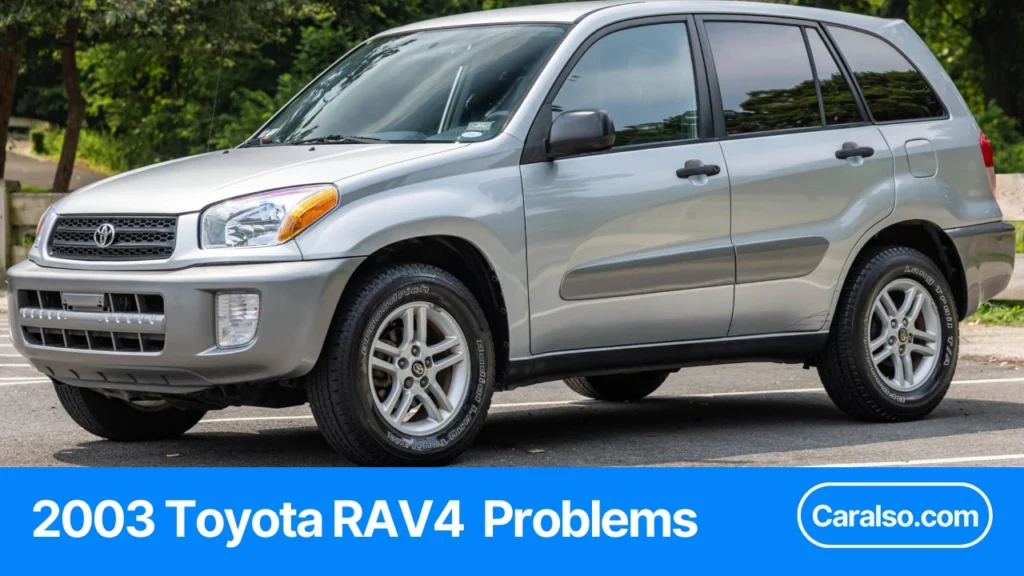
2003 Toyota RAV4 Problems
60-Second Problem Snapshot
| Problem | What You Feel | Fast Check (1 To 2 Minutes) | Typical Consequence If Ignored | Buy Or Walk? |
|---|---|---|---|---|
| ECM-Linked Harsh Shifting On Automatic | Hard 2 to 3 shift, slam shift, delayed engagement | OBD scan for P0750, P0753, P0755, P0758, P1760 | Can progress into bigger transaxle damage and higher repair bills | Walk If Codes Are Present And No Proof Of Repair |
| Harsh Shift That Hides On Short Drives | “Feels fine” for 10 minutes, then flares or slams later | Ask for a 30-minute drive. Do stop and go, then steady 35 to 55 mph | You buy it, then the next commute shows the problem | Walk If Seller Refuses A Longer Drive |
| Transmission Wear From Ongoing Slip Or Heat | RPM rises without matching speed, then catches | 3 light accelerations from 15 to 45 mph. Watch for flare | More heat and more wear. Diagnosis gets harder | Walk If It Slips Or Lurches More Than Once |
| EVAP Leak Check Engine Light | Check engine light, sometimes fuel smell | Tighten gas cap. Scan codes. Look for cracked hoses | Emissions fail. Can turn into parts swapping | Buy If You Can Scan It And Budget Diagnosis |
| Oxygen Sensor Or Catalyst Efficiency Codes | Check engine light, sometimes no symptoms | Scan codes. Listen for exhaust leaks at idle | Emissions fail and MPG can drop | Buy If Price Reflects It And You Can Diagnose |
| Suspension Clunks And Uneven Tire Wear | Clunk over bumps, steering feels loose | Full-lock circle test. Look at inside tire edges | Tire wear. Alignment issues. More parts later | Buy If It Is Light And Price Drops |
| Rust In Structural Areas | Crunchy flaking rust, soft metal, missing fasteners | Flashlight under rear suspension mounts and subframe areas | Safety and inspection failure risk | Walk If Rust Is Flaking Or Perforated |
| Wheel Bearing Hum Or CV Clicking | Hum that changes with speed, clicking on turns | Steady 45 mph hum check. Tight turn at 5 to 10 mph | More noise and parts cost | Buy If It Is Minor And You Price It In |
2003 RAV4 At A Glance (What You’re Actually Shopping)
Generation And Powertrain Basics
This is the second-generation RAV4. In the US, 2003 is still the smaller, lighter RAV4 before the 2006 redesign.
Here are the numbers I use when I am comparing listings.
- Engine: 2.0L inline-4
- Output: 148 hp at 6,000 rpm
- Torque: 142 lb-ft at 4,000 rpm
- Transmission: 5-speed manual or 4-speed automatic
- Drivetrain: 2WD or 4WD (often listed as AWD)
- Wheelbase: 98.0 inches
- Length: 166.2 inches
- Curb Weight: about 2,777 to 2,943 lbs depending on trim and drivetrain
- Fuel Economy (Common AWD Automatic Spec): 20 mpg city, 25 mpg highway, 22 mpg combined
- Cargo: about 29 cu ft behind the rear seat, up to about 68 cu ft with the rear seat folded
If you are shopping the automatic, I focus on shift quality first. That is where this model-year can bite you.
If you are shopping 4WD, I also plan for more fluids and more driveline parts to inspect. Rear differential. Transfer case. CV joints. Wheel bearings.
Who This Car Still Makes Sense For
I still like a clean 2003 RAV4 for a few use cases.
- City driving. 166 inches long is easy to park.
- A 2nd car for errands. Short trips. Hardware store runs.
- Snow regions if the 4WD system is healthy and tires are good.
- Buyers who want simple controls and do not care about modern infotainment.
- Anyone who can scan codes before purchase and will do a proper test drive.
If you want a “buy and forget” used SUV with no scan tool and no test-drive time, this is not my first pick. The ECM and harsh shift pattern makes the pre-purchase check mandatory.
The 8 Most Common 2003 Toyota RAV4 Problems (Ranked)
1) Harsh Shifting And Delayed Engagement (ECM Failure Pattern)
Symptoms
- Hard 2 to 3 upshift
- Slam shifts at light throttle
- Delayed engagement when shifting into Drive
- Random shift quality changes between drives
- Check engine light on with transmission-related codes
What’s Usually Going On
On 2001 to 2003 automatics, Toyota documented a pattern where the ECM can cause harsh shifting and related code storage. The ECM is often the first fix when the condition and codes match.
How To Check It Fast
- Scan the car before you drive it. I want to see what codes are stored.
- Do a 30-minute test drive if the seller allows it. This problem can hide on a short loop.
- Do stop and go driving, then steady 35 to 55 mph, then a few gentle 15 to 45 mph accelerations.
Severity
High
Buy, Negotiate, Or Walk
- If it harsh-shifts and has the matching code set with no proof of repair, I walk.
- If it drives perfect and the scan is clean, I keep going with the inspection.
2) Transmission Damage After Prolonged Harsh Shift
Symptoms
- RPM flare, then a hard catch
- Lurching on upshifts or downshifts
- Burnt-smelling transmission fluid
- Shift quality gets worse after the car is warmed up
What’s Usually Going On
When the harsh shift condition is ignored, the transmission can take real wear. Toyota’s own repair flow ends with transaxle replacement if the ECM swap does not fix the condition.
How To Check It Fast
- Check ATF condition if the dipstick is accessible. I look for dark fluid and burnt smell.
- Do a steady 45 mph cruise, then tiny throttle changes. I watch for flare.
- Do 3 gentle accelerations from 15 to 45 mph and feel for delayed shifts.
Severity
High
Buy, Negotiate, Or Walk
- If it slips or flares more than once, I treat it as a walk-away unless the price is built for a transmission job.
3) Check Engine Light With Shift Solenoid Codes (Same Root Issue)
What Codes Are Linked To The 2003 RAV4 ECM Problem?
P0750, P0753, P0755, P0758, P1760.
Symptoms
- Check engine light on
- Harsh shifting, delayed shifting, or both
- Drives fine cold, then acts up warm
What’s Usually Going On
Those codes read like solenoid circuit problems. On this model-year range, Toyota’s documentation ties that exact code set to the harsh shift condition that often points back to the ECM.
How To Check It Fast
- I scan for codes first. No guessing.
- I clear nothing before purchase. I want to see what comes back.
- I drive it long enough to see if the behavior repeats.
Severity
High
Buy, Negotiate, Or Walk
- Codes present plus harsh shifting equals walk for me without paperwork.
- Codes present but no harsh shifting today still counts as a risk. I price it like a project.
4) Delays In Shifting, Lurches Forward, Engine Races
Symptoms
- Delay, then sudden shift
- Engine revs rise but speed does not match
- Lurch forward after the delay
- Worse after 15 to 30 minutes of driving
What’s Usually Going On
In owner complaint data, this is the top “feel” description on the 2003 RAV4 automatic. It can overlap with the ECM issue, or it can be an already-damaged transmission.
How To Check It Fast
- From a roll at 15 mph, I do light throttle to 45 mph. I repeat 3 times.
- I do a steady 35 mph cruise, then light throttle increase, then light lift.
- I pay attention to consistency. A good transmission repeats the same shift every time.
Severity
High
Buy, Negotiate, Or Walk
- If I can reproduce it twice in 10 minutes, I walk.
- If it happens once but the scan is clean, I still budget diagnosis and negotiate hard.
5) Transmission And ECM Failed (The Expensive End State)
Symptoms
- Jerking and harsh shifts that keep getting worse
- Limp-like behavior or very limited drivability
- Codes plus severe drivability issues
What’s Usually Going On
This is the “both parts” scenario that shows up in long-term complaint tracking. It usually means the car was driven too long with the harsh shift condition.
How To Check It Fast
- Scan for codes.
- Ask for receipts that show ECM replacement and transmission work.
- If the seller says “it was fixed” but cannot show paperwork, I assume it was not fixed.
Severity
High
Buy, Negotiate, Or Walk
- I only buy this if it is already repaired with paperwork, or it is priced like a full drivetrain project.
6) Transmission Jerks (Even Without A Full “Failure” Story)
Symptoms
- Jolt on 1 to 2, 2 to 3, or 3 to 4 shift
- Jerk on light braking downshifts
- Feels worse in stop and go traffic
What’s Usually Going On
This can be part of the same ECM-driven pattern. It can also be worn mounts, worn drivetrain components, or a transmission that is already damaged.
How To Check It Fast
- I do a parking lot crawl at 5 to 15 mph and watch for jerkiness.
- I do 10 slow stops from 25 mph and feel for downshift jolts.
- I do a steady 40 mph cruise and lightly roll in and out of throttle.
Severity
Medium To High
Buy, Negotiate, Or Walk
- If it is paired with the known code set, I treat it as High and usually walk.
- If the scan is clean, I negotiate and plan for deeper diagnosis.
7) Oil Sludge In Engine
Symptoms
- Poor maintenance history and thick deposits under the oil cap
- Low oil pressure warnings or noisy top end on cold start
- Overheating after long drives in hot weather
What’s Usually Going On
Complaint tracking shows “oil sludge in engine” as a notable engine issue on this model-year. The fix can be expensive if it reaches the point of internal damage.
How To Check It Fast
- I pull the oil cap and look for thick black buildup.
- I check the dipstick for level and condition.
- I ask for oil change intervals in miles. I want a number.
- I check for overheating signs on the test drive.
Severity
High
Buy, Negotiate, Or Walk
- No service history plus visible sludge equals walk for me.
- Clean under the cap plus regular oil records is the pass condition.
8) Rust And Water Intrusion Checks (Regional)
Symptoms
- Wet carpets, foggy windows, musty smell
- Rust bubbles at wheel arches or along seams
- Crunchy underbody scaling and stuck fasteners
What’s Usually Going On
At 20+ years old, location matters. Salt states can turn simple maintenance into broken bolts and failed inspections. Water leaks can ruin carpets, wiring, and floor pans over time.
How To Check It Fast
- I lift floor mats and press down on the carpet. Front and rear.
- I check the spare tire well and cargo corners for moisture.
- I use a flashlight under the rear suspension mounting areas and subframe.
- I look for fresh undercoating that hides flaky rust.
Severity
Medium To High (Depends On Region)
Buy, Negotiate, Or Walk
- Perforation or structural rust is a walk.
- Light surface rust is a negotiation item.
Recalls And Service Campaigns That Matter (And How To Check Yours)
Are There Recalls On A 2003 RAV4?
You will see mixed answers online.
Some recall aggregator pages show 0 NHTSA safety recalls for the 2003 RAV4. That does not mean the car has no known issues. It just means no safety recalls are currently recorded in that database view.
Here is how I think about it.
- Safety recall: a safety defect with a free remedy tied to VIN eligibility.
- Service campaign or customer support program: coverage Toyota may offer for a known issue, often with time and mileage limits.
- TSB: a repair playbook for a known pattern. It is not free by default.
For this model-year range, the ECM harsh shift issue is the big one to understand. Even if it is not a “recall,” it is still a documented pattern with a documented repair path.
How To Check In 2 Minutes (VIN Steps)
This is my exact process.
- Get the VIN from the seller or from the dash.
- Run the VIN on the NHTSA recall lookup tool.
- Run the VIN on Toyota’s recall and campaign lookup.
- Screenshot the results for your records.
- If anything is open, I ask the seller to have a dealer close it before I buy.
If the seller says “no recalls,” I still do the checks myself. It takes less time than a coffee order.
Why TSBs Still Matter For Buyers
Toyota’s bulletin for 2001 to 2003 RAV4 automatics ties harsh shifting and the exact code set to a specific repair direction.
This is the part I care about as a buyer.
- If the condition and codes match, the bulletin points to ECM replacement first.
- Then you road test after ECM learning.
- If harsh shifting and certain codes remain, the bulletin says to replace the automatic transaxle assembly.
That flow explains why some owners end up paying for both parts. It also explains why a short test drive is not enough. One Toyota bulletin notes the condition may require about 30 minutes of operation before you can duplicate it.
If you take only one thing from this section, take this.
Scan it. Then drive it long enough to prove it.
Deal Breakers Vs OK-If-Priced-Right (Buyer Rubric)
On a 2003 RAV4, I make my decision in this order. Codes. Shifts. Rust. Water. Then everything else.
Deal Breakers
| Issue | Walk Away If | Proceed If | What It Usually Costs If You Guess Wrong |
|---|---|---|---|
| Harsh Shifting Plus The Known Code Set | It harsh-shifts and you see P0750, P0753, P0755, P0758, or P1760, and there is no proof of proper repair | The scan is clean and the transmission shifts the same way for the whole drive | ECM repair averages around $1,490 in complaint tracking. ECM plus transmission averages around $4,600. Transmission replacement quotes often land in the $5,800 to $7,400 range. |
| Seller Will Not Allow A Scan | They refuse an OBD scan or claim “it is just a sensor” | You can scan stored and pending codes before money changes hands | A $40 scan can save a $4,600 mistake. |
| Flood Or Water History Signs | Wet carpet, musty smell, foggy headlights, corrosion on under-seat hardware, silt in spare tire well | Interior is dry, no water lines, spare tire well is dry | Electrical chasing can turn into weeks of time and random parts. |
| Structural Rust | Flaking rust on subframe or suspension mounting points, holes, or soft metal | Surface rust only, solid metal, fasteners look serviceable | Rust fixes are not “one part.” They are a chain of broken bolts and extra labor. |
| No Title Clarity | Salvage or rebuilt with no documentation and the car has multiple red flags | Clean title and consistent service story | This one is not a repair bill. It is resale and insurance pain. |
OK If Priced Right (With Proof)
| Issue | OK If You Have | What I Ask For | How I Price It |
|---|---|---|---|
| EVAP Codes | A scan result and a plan, not guesses | The exact code, freeze frame data if available, and proof of a real diagnosis | I treat it like an emissions project. I negotiate for diagnostic time and parts. |
| Suspension Clunks | Receipts or an inspection showing what is worn | Any shop note that names the part, like links, bushings, or struts | If it clunks, I assume it needs parts soon. I negotiate up front. |
| Minor Oil Seepage | Stable oil level and no burning smell | Oil change records with miles listed | If it is a seep and the dipstick stays full, I negotiate but I do not panic. |
| Wheel Bearing Hum Or CV Clicking | A mild noise with a clear source | A quick bearing check or a shop inspection | I price in a bearing or axle job if I can reproduce the noise. |
| Cosmetics | Realistic expectations for a 20+ year car | Nothing. I just inspect it | Cosmetic issues should lower price. They should not hide drivetrain issues. |
If you want one simple rule, use this.
If the transmission does anything weird and you cannot scan it, I walk.
30-Minute Used-Buyer Inspection + 10-Minute Test-Drive Script (Printable)
This is the script I use so I do not forget steps.
What I Bring (3 Items)
- Flashlight
- Paper towels
- Basic OBD-II scanner
Walkaround (10 Minutes)
- VIN And Title Basics (2 Minutes)
- Check the VIN on the dash and the door jamb.
- They must match the title.
- Tire And Alignment Clues (2 Minutes)
- Look at the inside edges of all 4 tires.
- Inside-edge wear can mean alignment or worn parts.
- Rust Check Points (3 Minutes)
- Look under the rear suspension mounting areas.
- Look at subframe areas you can see without jacking the car.
- Surface rust is normal. Flaking rust is the warning.
- Water History Clues (3 Minutes)
- Open the rear hatch. Lift the cargo floor.
- Check the spare tire well for dampness or stains.
- Smell the interior. Musty smell counts.
Under Hood (10 Minutes)
- Fluid Level Baseline (3 Minutes)
- Check engine oil level on the dipstick.
- Check coolant in the reservoir.
- Look for oil in coolant or coolant smell in oil.
- Belt And Hose Quick Look (3 Minutes)
- Look for cracks and wetness at hose ends.
- Squeeze the upper radiator hose. It should feel firm, not crunchy.
- Leak And Seep Scan (4 Minutes)
- Use a flashlight around the valve cover area.
- Look for fresh wet oil, not just old grime.
- Wipe one spot with a paper towel to confirm.
Interior + Scan Tool Check (10 Minutes)
- Wet Carpet Test (2 Minutes)
- Press the carpet with your palm in front and rear.
- Damp carpet is a big clue.
- Start-Up Light Check (2 Minutes)
- Key on. Confirm warning lights come on.
- Start the car. Confirm they go off.
- OBD Scan (6 Minutes)
- Read stored codes.
- Read pending codes.
- Write them down. Do not clear anything before purchase.
If you see P0750, P0753, P0755, P0758, or P1760, I treat the car like a transmission risk until proven otherwise.
Test Drive Script (10 Minutes)
This is the short version. I use it even when the seller is impatient.
- Initial Pull Away (2 Minutes)
- From a stop, light throttle to 25 mph.
- Feel for delayed engagement or a lurch.
- Shift Quality Segment (4 Minutes)
- Do 3 light accelerations from 15 to 45 mph.
- Hold steady speed at 35 to 45 mph for 60 seconds.
- Make small throttle changes. Feel for flare or slam.
- Parking Lot Full-Lock Test (2 Minutes)
- Do 2 full-lock circles each direction at 5 to 10 mph.
- Listen for clicking or popping.
- Brake Feel (2 Minutes)
- Do 2 firm stops from 35 mph.
- Feel for pulsation or pull.
Optional But Smart: Extend The Drive To 30 Minutes
I ask for this on any 2001 to 2003 automatic RAV4.
Toyota’s own bulletin notes the harsh shift condition can require 30 minutes to duplicate.
If the seller allows it, I do this loop.
- 10 minutes stop and go.
- 10 minutes steady 35 to 55 mph.
- 10 minutes mixed throttle changes and a few stops.
If the transmission is going to act up, this is when it usually shows itself.
Preventive Maintenance That Reduces The Biggest Risks
On a 2003 RAV4, I think about “preventive” in a simple way. I cannot stop an ECM from failing. But I can stop that failure from cooking the transmission.
Here is what I do.
1) Use Toyota’s 5,000 Or 7,500 Mile Rhythm
Toyota’s scheduled maintenance guide for 2003 says your interval is either 5,000 miles or 7,500 miles. It depends on how you drive.
I use 5,000 miles if any of these are true.
- Dusty roads
- Towing
- Repeated trips under 5 miles in below-freezing temps
That is not overkill on a 20+ year SUV. It is cheap insurance.
2) Protect The Automatic By Treating Harsh Shifting Like A Stop-Driving Event
If the automatic starts doing a hard 2 to 3 shift, I do not “drive it until it gets worse.” I scan it the same day.
If I see the known code set, I stop driving it until I have a plan.
- P0750
- P0753
- P0755
- P0758
- P1760
This is the single best way to avoid the expensive “ECM plus transmission” outcome.
3) Inspect ATF Often, And Change It When Your Use Is Hard
Toyota’s guide calls for automatic transmission fluid inspection at major intervals like 60,000 miles and 90,000 miles.
If the fluid looks dark or smells burnt, I do not ignore it. I also do not do a “power flush” as my first move on an unknown-history transmission. I start with a careful inspection, the right fluid, and a measured service plan.
If you tow, Toyota also calls out extra services. It specifically lists replacing transmission fluid or oil under towing or heavy-use conditions.
4) If You Own 4WD, Treat Driveline Fluids Like A Schedule Item
4WD adds more parts. It also adds more fluid checks.
In Toyota’s guide, towing triggers additional services like replacing differential oil and transfer case oil. Even if you never tow, I still inspect for leaks and plan a baseline fluid service if the history is unknown.
5) Stay Ahead Of EVAP And Vacuum Hose Aging
A lot of “random check engine lights” on old cars come down to air leaks and vapor leaks. Rubber does not last forever.
Here is my routine.
- I inspect the fuel cap gasket. If it is cracked, I replace the cap.
- I inspect fuel vapor vent hoses for cracks and loose clamps.
- I look for brittle vacuum hoses under the hood and replace them before they split.
This reduces surprise EVAP codes and failed emissions tests.
6) Cooling System: Use Miles And Months, Not Hope
Toyota’s maintenance guide lists engine coolant replacement at 60,000 miles or 48 months, then again at 90,000 miles or 72 months.
On a 2003, time matters more than miles. If you do not know when coolant was last changed, I treat it as due. I also inspect radiator and hoses at every oil change because a 10-minute look can prevent a tow.
7) Belts And Boots: Inspect On A Clock
Toyota’s guide calls for drive belt inspections at major intervals. I still look more often.
I check these every 5,000 miles.
- Serpentine belt cracks
- CV boots for grease sling
- Drive shaft boots on 4WD
A torn boot is a timing problem. Fix it early or you buy an axle later.
FAQs
What Are The Most Common 2003 Toyota RAV4 Problems?
The big one is harsh shifting on the automatic that often traces back to the ECM. After that, I see check engine lights from EVAP and age-related suspension and bearing noise. I treat any shift issue as the priority.
What Are The Signs Of ECM Failure On A 2003 RAV4?
I watch for a hard 2 to 3 upshift, delayed engagement, and inconsistent shifting that changes between drives. I also watch for the check engine light with transmission-related codes. A 30-minute drive can reveal what a short test drive hides.
What Codes Are Linked To The 2001–2003 RAV4 Harsh Shifting Problem?
The core list I scan for is P0750, P0753, P0755, P0758, and P1760. If those codes show up with harsh shifting, I treat it as an ECM-first diagnostic path. I do not clear codes before a proper diagnosis.
Does The 2003 RAV4 Have Any Recalls?
Many recall databases show 0 NHTSA safety recalls for the 2003 RAV4. I still run the VIN on both Toyota and NHTSA because recall and campaign status is VIN-specific. It takes 2 minutes.
Should I Buy A 2003 RAV4 With Harsh Shifting?
Not without a scan and paperwork. If it harsh-shifts and shows the known code set, I assume real repair risk and I usually walk. If the scan is clean and it shifts the same way for the whole drive, I consider it.
Key Takeaways
- I scan every 2003 RAV4 automatic before I test drive it. I look for P0750, P0753, P0755, P0758, and P1760.
- I do not trust a 5-minute test drive. I push for a 30-minute drive because the harsh-shift pattern can take time to show up.
- If it harsh-shifts and the code set is present with no proof of repair, I walk.
- If the seller will not allow an OBD scan, I walk.
- I check for water and rust before I care about cosmetics. Wet carpet and flaking underbody rust are big risk flags.
- EVAP and oxygen sensor codes are often “OK if priced right,” but only if I can scan the car and budget diagnosis time.
- On 4WD models, I treat driveline fluids like a real ownership cost. Rear differential and transfer case matter.
- If the transmission shifts the same way for the whole drive and the scan is clean, a 2003 RAV4 can still be a solid used buy.
Sources
- Toyota TSB T-SB-0156-10 Rev2 (Harsh Shift And MIL With DTCs)
- CarComplaints 2003 Toyota RAV4 Overview
- Edmunds 2003 RAV4 Features And Specs
- Cars.com 2003 RAV4 Recalls Page
- NHTSA Recall Lookup (VIN)

Hey there,
How is it going?
I’m Meraj Sarker. I am a Car Mechanic and a student of Automobile Restoration here in Florida, USA. I’ve been studying automotive for around 9 years now. So you can rely on my recommendation. For me, studying and getting knowledge about automobile it’s really fun and entertaining. I will help you to get solutions for your car through this website. If you need any help let me know.