
If you are cross-shopping a 2026 RAV4 and a 2026 Crosstrek, I want to save you time. These two are not the same size class. The RAV4 is the bigger family crossover. The Crosstrek is the smaller, city-friendly option with real ground clearance.
My rule for this matchup is simple. If you carry people and gear a lot, I point you at the RAV4 first. If you park in tight spots, drive rough roads often, or want the smallest AWD daily driver you can live with, I start with the Crosstrek.
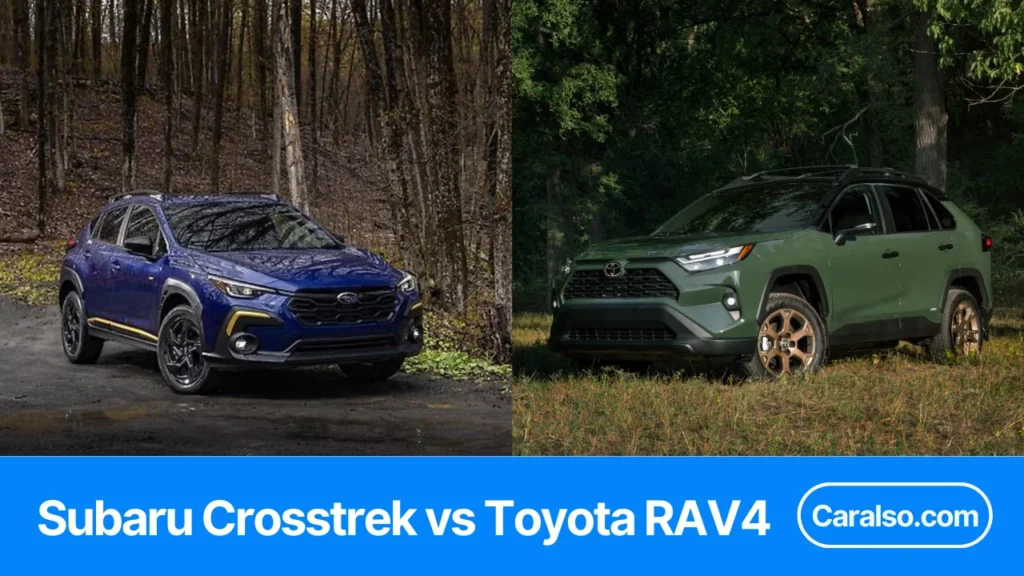
Toyota RAV4 vs Subaru Crosstrek
Quick Answer (Pick This If…)
Hero Asset: 60-Second Quick Verdict Table
| What You Care About Most | Pick | The Numbers That Matter (2026) |
|---|---|---|
| Cargo Space With Seats Up | RAV4 | RAV4: up to 37.8 cu ft. Crosstrek: 19.9 cu ft on most trims, 18.6 cu ft on Hybrid trims |
| Rear-Seat Space For Adults | RAV4 | Crosstrek rear legroom: 36.5 in (36.7 in on some trims) |
| Best MPG Without Plugging In | RAV4 | RAV4 Hybrid (manufacturer estimates): up to 44 mpg combined on FWD trims, other trims vary by grade |
| Hybrid Availability | Tie, Different Goals | RAV4: Hybrid or Plug-in Hybrid only. Crosstrek: gas plus a Hybrid option on select trims |
| Ground Clearance | Crosstrek | Crosstrek: 8.7 in, Wilderness: 9.3 in. RAV4: 8.1 in on several grades, Woodland: 8.5 in, GR SPORT: 7.5 in |
| Towing | It Depends On Trim | RAV4: up to 3,500 lb. Crosstrek: 1,500 lb on most trims, Wilderness: 3,500 lb |
| Small Footprint For City Parking | Crosstrek | Crosstrek length: 176.4 in (most trims) |
Choose The RAV4 If You Want
- You want the easy win on space.
- You want almost double the cargo behind the second row. Up to 37.8 cu ft vs 19.9 cu ft.
- You want a hybrid-focused lineup. Every 2026 RAV4 is Hybrid or Plug-in Hybrid.
- You want higher towing on more trims. Up to 3,500 lb is on the table.
- You do a lot of highway miles and want the calmer, bigger-car feel that usually comes with the larger body.
Choose The Crosstrek If You Want
- You want a smaller vehicle you can park anywhere.
- You want more clearance for rutted roads and snow berms. 8.7 in is standard, and 9.3 in is available on Wilderness.
- You want Subaru’s standard AWD setup across the lineup.
- You want a simple daily driver with a standard 2.5L engine, and you are fine giving up cargo space to get the smaller footprint.
- You want to keep purchase price down by skipping the “bigger crossover tax,” and you do not need the RAV4’s space.
One Quick Reality Check I Use Before Choosing
- If you regularly carry 2 adults in the back seat, I lean RAV4.
- If you routinely haul bulky stuff like strollers, coolers, or a big dog crate, I lean RAV4.
- If your daily life includes tight parking, narrow streets, and rough access roads, I lean Crosstrek.
60-Second Decision Table
| Category | Winner | Why It Wins (With Numbers) | Who Should Care |
|---|---|---|---|
| Price And Value (Entry Vs Equipped) | Crosstrek For Entry Price | Starting MSRP: Crosstrek $26,995. RAV4 Hybrid FWD $31,900. Difference is $4,905. | If you want the lowest buy-in cost. Or you plan to keep monthly payments low. |
| Cargo And Family Practicality | RAV4 | Cargo behind 2nd row: RAV4 up to 37.8 cu ft. Crosstrek 19.9 cu ft on most trims. Hybrid trims list 18.6 cu ft. | If you carry a stroller, a big dog crate, or 2 suitcases plus groceries. |
| Highway Power | RAV4 | Net combined hp: RAV4 Hybrid 226 hp (FWD) or 236 hp (AWD). Crosstrek gas 180 hp. Crosstrek Hybrid lists 194 hp estimated. | If you do a lot of 70 mph passing, steep grades, or drive loaded with people and gear. |
| Snow And Light-Trail Confidence | Crosstrek | Ground clearance: Crosstrek 8.7 in. Wilderness 9.3 in. RAV4 is 8.1 in on several trims and 8.5 in on Woodland. | If you hit rutted roads, snow berms, or trailheads where clearance is the limiter. |
| MPG And Hybrid Options | RAV4 | RAV4 is Hybrid or Plug-In Hybrid only. Up to 44 mpg combined on the Hybrid in published estimates. Plug-in claims up to 52 miles of EV range. Crosstrek Hybrid trims list 36 city and 36 hwy. | If you want the highest fuel efficiency without going full EV. Or you want a plug-in option. |
| Best “Buy It And Keep It” Choice | Depends | I look at 2 numbers first: entry price gap ($4,905) and your annual miles. High miles usually favors the higher-MPG hybrid. Low miles usually favors the lower starting price. | If you keep cars 8 to 12 years and want the better long-term fit. |
The Big Thing Most Comparisons Miss
Most people miss this because the names sound similar, but these are different size classes in real life. The RAV4 gives you up to 37.8 cu ft behind the second row. The Crosstrek gives you 19.9 cu ft on most trims, and 18.6 cu ft on Hybrid trims. That is a gap you feel every week. Same story with towing. The RAV4 can be rated up to 3,500 lb. The Crosstrek is 1,500 lb on most trims, and you need Wilderness to reach 3,500 lb. If you buy the smaller one hoping it will live like the bigger one, you end up shopping for roof boxes and hitch carriers. If you buy the bigger one when you really needed a smaller footprint, you notice it every time you park.
How We’re Comparing So Readers Trust The Verdict
Model-Year And Trim Assumptions
I am comparing 2026 models in the U.S.
I am also treating this like a real purchase. Not a spec-sheet game.
That means I try to match the stuff that changes how the car feels day to day.
Here is my match checklist.
- Drivetrain: AWD vs AWD
- Powertrain: hybrid vs hybrid when possible
- Wheel size: 17 vs 18 vs 20 inches
- Tire type: all-season vs all-terrain
- Heated front seats: yes or no
- Roof rails: yes or no
- Blind-spot monitoring and rear cross-traffic alert: yes or no
- Adaptive cruise with lane centering: yes or no
- Liftgate: manual vs power
- Moonroof: yes or no
One big note.
For 2026, every RAV4 is electrified. Hybrid or plug-in hybrid.
For 2026, every Crosstrek has AWD. Gas trims and Hybrid trims.
So if you compare a base Crosstrek to a mid-trim RAV4, you are usually comparing AWD gas with fewer options to a hybrid-focused crossover with more equipment available.
That is why I keep pulling the comparison back to matched features.
Primary Sources I Use
When I confirm numbers, I stick to a short list.
- Manufacturer trim pages for MSRP and standard features
- Manufacturer press releases when trims or powertrains change mid-cycle
- EPA fuel economy pages for official mpg
- IIHS and NHTSA pages for crash ratings once they post results
- Reputable road tests for braking, noise, and real-world mpg
If a number is not confirmed on a primary source, I treat it as a “check the window sticker” item.
Price & Value (What You Pay To Get The Same Stuff)
Typical Pricing Spread (New)
I look at price in 2 layers.
Layer 1 is base MSRP.
Layer 2 is what it costs to get the features people actually want.
Here are the base MSRP floors for 2026.
RAV4 Hybrid lineup on Toyota’s site:
- LE: $31,900
- SE: $34,700
- XLE Premium: $36,100
- Woodland: $39,900
- XSE: $41,300
- Limited: $43,300
Crosstrek pricing from Subaru’s release:
- Base: $26,995
- Premium: $27,995
- Sport: $30,625
- Limited: $32,995
- Wilderness: $33,795
- Sport Hybrid: $33,995
- Limited Hybrid: $34,995
Now the part most people miss.
Those numbers are not the price you will see on every website.
Some sources include destination and fees. Some do not.
Example: One major outlet lists the RAV4 LE Hybrid FWD at $33,350 and says AWD is a $1,400 add on that trim. Toyota lists the LE at $31,900 as base MSRP.
So I treat MSRP as the floor. Then I compare “equipped the same way.”
Here is where the extra money usually goes.
What the RAV4 upcharge usually buys:
- Hybrid is standard across the lineup
- More cargo space behind the second row. Up to 37.8 cu ft vs 19.9 cu ft on most Crosstrek trims
- More power on paper on many trims. 226 hp on FWD hybrids and 236 hp on AWD hybrids
- More available comfort features as you move up trims
What the Crosstrek value pitch buys:
- Standard AWD on every trim
- Roof rails show up early on Premium
- Ground clearance that starts at 8.7 inches, then jumps to 9.3 inches on Wilderness
- A clear ladder to “I want heated seats and blind-spot” without forcing a huge price jump
One number that matters fast.
Base MSRP gap between the cheapest versions:
$31,900 minus $26,995 equals $4,905.
If $4,905 changes your payment, start with Crosstrek and only move up if you truly need RAV4 space.
Best Value Trims (Shortlist)
I am assuming you want 4 things.
AWD, heated front seats, roof rails, and blind-spot monitoring.
Here is how I would shop it.
Crosstrek Shortlist
- Crosstrek Premium With The $2,245 Option Package
This is my budget value play. Premium adds raised roof rails. Subaru also offers an option package that bundles blind-spot detection, rear cross-traffic alert, heated front seats, heated mirrors, wiper de-icer, a power driver seat, and a moonroof. The package is $2,245 MSRP. - Crosstrek Sport
This is the clean “skip the package math” pick. Subaru says the Sport includes the all-weather package and a wireless phone charger. It also keeps the $30,625 starting point. - Crosstrek Wilderness
I pick Wilderness when clearance and towing matter. It is $33,795 MSRP. It has 9.3 inches of ground clearance and 3,500 lb towing. Most other trims are rated at 1,500 lb.
RAV4 Shortlist
- RAV4 LE Hybrid
This is the cheapest way into the RAV4 size. It starts at $31,900. If you live in snow or you hit dirt roads, I would price it both ways, FWD and AWD, since AWD can be an add-on on some trims. - RAV4 XLE Premium
This is where Toyota starts listing comfort features that most people pay for anyway. Heated front seats and a power liftgate show up here. Base MSRP is $36,100. - RAV4 Woodland
I pick Woodland for people who actually use roof rails and want an outdoors setup from the factory. Toyota lists raised roof rails with cross bars on Woodland. Base MSRP is $39,900.
If you are deciding purely on value, here is my quick rule.
- If you want the most space per dollar, I start with RAV4 LE.
- If you want AWD, heated seats, and roof rails at the lowest price, I start with Crosstrek Premium plus the package.
- If you want maximum clearance and 3,500 lb towing, I start with Crosstrek Wilderness.
Size, Cargo, And Day-To-Day Livability (Most Shoppers Decide Here)
Cargo Reality (Seats Up Vs Seats Folded)
This is the part that usually ends the debate for me.
If you want the most space with the second row up, the RAV4 wins fast.
- RAV4 cargo behind the second row: 37.8 cu ft
- Crosstrek cargo behind the second row: 19.9 cu ft on most trims
- Crosstrek Hybrid trims: 18.6 cu ft
With the seats folded, the gap is still real.
- RAV4 cargo behind the front row: 70.4 cu ft
- Crosstrek cargo with seats folded: 1,549 L (54.7 cu ft) on most trims
- Crosstrek Hybrid trims seats folded: 1,433 L (50.6 cu ft)
Here is the extra detail I like on the Crosstrek, because it helps you visualize fit.
- Cargo floor length, seats up: 816 mm (32.1 in)
- Cargo floor length, seats folded: 1,624 mm (63.9 in)
- Liftgate opening width, lower: 1,034 mm (40.7 in)
- Width between wheel wells: 1,090 mm (42.9 in)
- Cargo liftover height: 780 mm (30.7 in)
What Fits (My Quick Fit Checklist)
I do not guess. I measure 3 things on my biggest item.
- Length
- Width
- Height
Then I compare it to the car.
If you buy a Crosstrek, I want you to pay attention to these fit checks.
- Will it clear a 40.7 in liftgate opening width?
- Will it fit between 42.9 in wheel wells if it is a hard box?
- Will it clear a 30.7 in liftover height without scraping?
This is how I test the common stuff people actually carry.
- Stroller: measure length folded and height folded
- Cooler: measure width at the widest point
- Carry-on suitcases: measure length including wheels
- Dog crate: measure width and height, then check if you can still close the hatch
If you need this to be easy, I lean RAV4. The extra cargo volume gives you more “no math” room.
Rear Seat Comfort And Car-Seat Friendliness
The rear-seat legroom numbers are close, but they still matter.
- RAV4 rear legroom: 37.8 in
- Crosstrek rear legroom: 36.5 in
That is a 1.3 in difference.
Here is my rear-facing car seat test checklist. I do this every time.
- Set the driver seat to your real driving position first
- Install the rear-facing seat behind the driver
- Check how much you need to move the driver seat forward to clear the car seat
- Close the door and make sure the car seat does not touch the front seat hard
- Check head clearance when you lift the car seat in and out
- Check if the front passenger can still sit with knees off the dash
If you are tall and you put a rear-facing seat behind you, that 1.3 in matters. I feel it.
City Use: Parking Footprint Plus Maneuverability
This is where the Crosstrek earns its keep.
The size difference is not massive, but it is enough to notice in a tight garage.
- RAV4 length: 181.0 in
- Crosstrek length: 176.4 in
- Difference: 4.6 in
Turning circle is also tighter on the Crosstrek.
- RAV4 turning diameter: 36.9 ft
- Crosstrek turning circle: 35.4 ft
- Difference: 1.5 ft
If your garage is tight, I measure these 3 things before I choose.
- Garage depth from the door to the back wall
- Garage door opening width
- Your driveway turn-in space, because a 1.5 ft turning circle gap can be the difference between 1 swing and 2
If you live in a dense city, that is real daily time.
Performance And Drivability (Commute Vs Road Trip)
Around-Town Feel
Both of these drive like modern crossovers. Both use a CVT-style setup.
The difference is the powertrain strategy.
RAV4 for 2026 is hybrid-only or plug-in hybrid. That usually means more electric assist at low speeds.
Power numbers tell the story.
- RAV4 Hybrid: 226 hp (FWD) or 236 hp (AWD)
- Crosstrek gas: 180 hp and 178 lb-ft
- Crosstrek Hybrid: 194 hp total system output (estimated)
If you do a lot of stop-and-go, I like how hybrids tend to use electric torque early. It can cut down on the “rev up” feeling you get with a gas engine and CVT.
If you are sensitive to CVT feel, here is my simple test drive routine.
- 0 to 25 mph in normal traffic
- 25 to 40 mph with a half throttle roll-on
- A full stop, then a quick gap jump across an intersection
If the engine sound jumps but the speed does not, you will notice it in daily driving.
Highway Passing And Loaded Driving
I care about 2 situations.
- Merging at 70 mph with 2 adults and cargo
- Passing on a 2-lane road from 55 to 70 mph
More power helps here. So does having less strain when you add weight.
The RAV4 has a clear advantage on horsepower in most versions.
And the Crosstrek gas model has a published 0 to 60 mph time of 8.6 seconds.
I also look at towing because it is a good proxy for how much “extra” the vehicle is built to handle.
- RAV4 max towing: up to 3,500 lb
- Crosstrek towing: 1,500 lb on most trims
- Crosstrek Wilderness towing: 3,500 lb
If you regularly do road trips with a loaded rear cargo area, I lean RAV4. If you want the smaller footprint but still tow up to 3,500 lb, I lean Crosstrek Wilderness.
Fuel Economy And Hybrids (Where The Gap Can Flip)
If you only look at mpg, the RAV4 can look like the easy winner.
But the gap can flip depending on 2 things.
- Do you need AWD?
- Can you charge at home?
Gas Vs Hybrid Vs Plug-In: Who Benefits
Here is the decision tree I use.
- If you drive 12,000 miles a year or more and most trips are stop-and-go, I lean hybrid.
- If you can charge at home and your daily drive is under 30 to 45 miles, I lean plug-in hybrid.
- If you drive low miles and you want the lowest buy-in price, I lean gas.
Now the numbers for 2026.
Fuel Economy Snapshot (Manufacturer Ratings)
| Vehicle And Powertrain | Rating Format | Published Rating |
|---|---|---|
| 2026 RAV4 Hybrid FWD | Combined | Up to 44 mpg combined |
| 2026 RAV4 Hybrid (Example: Woodland AWD) | Combined | 39 mpg combined |
| 2026 RAV4 Plug-In Hybrid (SE and XSE) | City / Hwy / Combined | 44 / 38 / 41 mpg |
| 2026 Crosstrek Gas (Most Trims) | Hwy / City | Up to 33 / 26 mpg |
| 2026 Crosstrek Hybrid | Hwy / City | 36 / 36 mpg |
| 2026 Crosstrek Wilderness | Hwy / City | 29 / 24 mpg |
The fairness note.
Every 2026 Crosstrek is AWD.
Some 2026 RAV4 Hybrid trims are FWD, and FWD is where Toyota posts the “up to 44 mpg combined” number.
So if you are set on AWD, I compare RAV4 AWD trims to Crosstrek AWD trims.
What Hybrid Changes Besides MPG
Hybrid changes how the car feels in 3 places.
- First 20 mph
- Stop-and-go traffic
- Long downhill grades
I look at torque and how the system delivers it.
Crosstrek Hybrid publishes this for the electric propulsion motor.
- Electric motor torque: 199 lb-ft
- Total hybrid system power: 194 hp estimated
Toyota publishes this for the RAV4 Hybrid system.
- Engine torque: 163 lb-ft
- Front electric motor torque (MG2): 153 lb-ft
- System power: 226 hp (FWD) or 236 hp (AWD)
Then I look at what you give up.
On the Crosstrek, the Hybrid trims list less cargo and no spare tire.
- Cargo behind second row: 19.9 cu ft on most trims, 18.6 cu ft on Hybrid trims
- Temporary spare tire: standard on most gas trims, not listed on Hybrid trims
On the RAV4 side, the big “give up” is usually price. Especially when you step into plug-in territory.
But you get one big thing that Subaru does not offer on Crosstrek.
A real EV range option.
Toyota’s plug-in hybrid RAV4 is rated up to 52 miles of EV range on SE and XSE.
Charging can also matter on road trips.
Toyota says XSE and Woodland plug-in trims can charge from 10% to 80% in about 30 minutes under ideal conditions with DC fast charging.
Latest Powertrain Snapshot (2026)
Here is what changed that actually affects this comparison.
- Every 2026 RAV4 is electrified. Hybrid or plug-in hybrid.
- 2026 RAV4 Hybrid offers FWD or electronic on-demand AWD, depending on grade.
- 2026 RAV4 Plug-In Hybrid is AWD only.
- Every 2026 Crosstrek uses a 2.5-liter engine as the standard gas option in the lineup.
- Crosstrek Hybrid is offered in Sport Hybrid and Limited Hybrid trims and is rated 36 / 36 mpg.
AWD, Snow, And Light Off-Road (What Matters More Than Marketing)
I care about 3 things here.
- Tires
- Ground clearance
- How the AWD system sends torque
AWD Systems Explained In Plain English
Crosstrek is simple.
- AWD is standard on every trim.
- Subaru calls it Symmetrical All-Wheel Drive.
- Dual-Function X-MODE is listed as standard, including Snow/Dirt and Deep Snow/Mud.
- Hill Descent Control is listed as standard.
RAV4 depends on which version you pick.
- Hybrid models can be FWD or AWD, depending on grade.
- Toyota calls the AWD option “Electronic On-Demand All-Wheel Drive.”
- Toyota describes it as a system that uses wheel speed sensors and driver inputs, then commands the rear motor to control rear wheel torque.
Plug-in hybrid RAV4 is AWD only.
Toyota also describes a dedicated rear electric motor in the plug-in system.
That matters if you want AWD without a mechanical driveshaft to the rear.
Snow Performance = Tires First
If you do one thing for snow, do tires.
AWD helps you go.
Tires help you stop and turn.
Here is my winter setup checklist.
- Get winter tires if you see ice and packed snow each season.
- If you stay on all-seasons, pick a set with the 3-peak mountain snowflake rating.
- Replace tires before they hit 4/32 of tread if winter traction matters to you.
- Check tire pressure when temps drop. Pressure falls as temps fall.
- Keep a real snow brush, a shovel, and a tow strap in the cargo area.
- If your driveway is steep, test Hill Descent Control in a safe empty lot first.
Ground clearance is the next limiter.
- Crosstrek: 8.7 inches. Wilderness: 9.3 inches.
- RAV4: 8.1 inches on LE. Woodland: 8.5 inches. GR SPORT: 7.5 inches.
If you drive through unplowed neighborhoods or tall snow berms, I start with the clearance number.
Trail Readiness: Trims That Actually Make Sense
Most people do not need a hardcore off-road trim.
They need a trim that does not get bullied by potholes, washboard, and rocky parking lots.
Here is what I would actually buy for light trails.
Crosstrek Picks
- Crosstrek Wilderness
- Ground clearance: 9.3 inches
- Towing: 3,500 lb
- Standard all-terrain tires
- Dual-Function X-MODE listed as standard
- Crosstrek Sport (Gas)
- Same 8.7 inches clearance as most trims
- Better value if you do not need 3,500 lb towing
RAV4 Picks
- RAV4 Woodland (Hybrid)
- Standard AWD
- 3,500 lb towing capacity
- 8.5 inches ground clearance
- All-terrain tires and a tow hitch receiver are called out by Toyota
- RAV4 Woodland (Plug-In Hybrid)
Same idea, plus EV range. Toyota lists 49 miles EV range on Woodland PHEV.
If you are choosing between these for trailheads, here is my quick rule.
- If clearance is the limiter, I lean Crosstrek Wilderness.
- If cargo is the limiter, I lean RAV4 Woodland.
- If you want EV driving for daily trips plus trail access, I lean RAV4 Plug-In Hybrid, but only if you can charge at home.
Towing And Hauling (Small Trailer Truth)
If towing is on your list, I want you to ignore the marketing photos and look at the numbers. This matchup usually comes down to one question. Do you need more than 1,500 lb?
Here’s the reality for most buyers. Most Crosstrek trims top out at 1,500 lb. Crosstrek Wilderness jumps to 3,500 lb. RAV4 splits too. Many AWD trims go up to 3,500 lb, but some trims and FWD setups are down at 1,750 lb.
Towing Capacity Depends On Trim
| What You’re Towing | RAV4 Rating You Want | Crosstrek Rating You Want | What I’d Buy |
|---|---|---|---|
| 4×8 Utility Trailer, Light Yard Loads | 1,750 lb Is Fine | 1,500 lb Is Fine | Either, Based On Space And Budget |
| Small Popup, Small Boat, Heavier Utility Trailer | 3,500 lb | 3,500 lb | RAV4 AWD Or Crosstrek Wilderness |
| “I Might Tow One Day” | 3,500 lb If You Can | 1,500 lb Usually | I’d Still Buy For The Highest Rating You Can Afford |
Here’s how the trims typically shake out.
- RAV4: Many AWD trims are rated up to 3,500 lb. Front-wheel drive and some lower AWD trims are rated 1,750 lb.
- Crosstrek: Most trims are rated 1,500 lb. Wilderness is rated 3,500 lb.
That trim spread is not random. The higher tow rating usually means extra cooling and tow specific hardware. Subaru calls out towing differences by trim, and the Wilderness hitch and tongue specs are higher too.
The Hitch And Tongue Weight Part People Skip
I see people buy a hitch and assume they are ready. That is not how towing works.
Two rules I follow every time:
- The vehicle rating is the limit. Not the hitch’s marketing rating.
- Tongue weight matters as much as tow rating.
For the Crosstrek, Subaru spells it out in the accessory info:
- Standard Crosstrek hitch: 1,500 lb tow rating, 150 lb tongue weight.
- Crosstrek Wilderness hitch: 3,500 lb tow rating, 350 lb tongue weight.
For the RAV4, I plan tongue weight as roughly 10% of the trailer’s weight as a starting point. That means:
- A 1,750 lb trailer can put around 175 lb on the hitch.
- A 3,500 lb trailer can put around 350 lb on the hitch.
That tongue weight eats into payload fast. Add two adults, a cooler, and camping gear, and you can hit limits sooner than you think.
What I Do To Tow Safely With Either One
I keep it simple.
- I weigh the trailer when possible. Even once helps.
- I keep tongue weight in the safe range. Too light can sway.
- I use trailer brakes when the trailer is heavy. Laws vary by state.
- I do a short test loop at 25 mph, then 45 mph.
- I recheck hitch pins, chains, and lights after 10 miles.
One more thing. The RAV4 spec sheets often list Trailer Sway Control as part of the towing equipment. That is a nice safety net. It does not replace proper loading.
Safety And Driver Assistance (What’s Standard Vs Optional)
Both of these are safety focused picks. But they do it differently. Subaru leans hard on EyeSight and standard AWD. Toyota leans on Toyota Safety Sense and, on newer models, a newer suite version.
If you care about driver assists, your trim choice matters as much as your brand choice. I never assume features are included. I verify on the window sticker.
Crash Test And Ratings Reality
I look at two places first.
- IIHS crash tests
- NHTSA 5-Star ratings
IIHS currently shows ratings pages for both vehicles. Those pages include detailed results by test type.
For NHTSA, what matters right now is timing. NHTSA lists the 2026 RAV4 Hybrid and RAV4 Plug-in Hybrid as selected for testing. It also lists the 2026 Crosstrek Hybrid as selected for testing. That means you may not see a complete 5-Star score posted yet for every 2026 variant when you shop.
My advice. Use IIHS test details now. Then check NHTSA closer to purchase if star ratings are posted for your exact model and drivetrain.
What’s Standard On Crosstrek
This is where Subaru is easy to understand.
EyeSight Driver Assist Technology is standard across the lineup. Subaru also explains how EyeSight works. Dual cameras sit near the rearview mirror, scanning the road. Some models add a third camera.
From the Crosstrek trim comparison, EyeSight includes:
- Advanced Adaptive Cruise Control With Lane Centering
- Pre-Collision Braking
- Lane Departure And Sway Warning
- Lane Keep Assist
- Automatic Emergency Steering
Now the trim differences.
On Crosstrek, features like Blind-Spot Detection and Reverse Automatic Braking vary by trim.
From the same trim comparison:
- Blind-Spot Detection with Lane Change Assist and Rear Cross-Traffic Alert
- Optional on Premium
- Standard on Limited, Hybrid Sport, Hybrid Limited, and Wilderness
- Not available on Base and some trims
- Reverse Automatic Braking
- Standard on Limited, Hybrid Sport, Hybrid Limited, and Wilderness
Subaru also lists rear-seat side airbags as standard across trims in the trim comparison. That is something I like to see in a small SUV.
What’s Standard On RAV4
Toyota positions Toyota Safety Sense as standard on the RAV4 lineup, with the 2026 model year commonly described as using Toyota Safety Sense 4.0.
The core features you will see listed for Toyota Safety Sense 4.0 include:
- Pre-Collision System
- Lane Departure Alert
- Lane Tracing Assist
- Automatic High Beams
- Dynamic Radar Cruise Control
- Proactive Driving Assist
The big practical takeaway. Toyota’s lane centering feature name is usually Lane Tracing Assist. Subaru’s lane centering is part of EyeSight’s adaptive cruise with lane centering.
Everyday Usability (The Stuff You Feel In A Test Drive)
This is where I get picky. I do the same mini test drive loop on both.
Highway checklist:
- Set adaptive cruise at 65 mph.
- Turn on lane centering.
- Watch steering corrections in gentle curves.
- Check how it behaves with faded lane lines.
- Test a few follow distance settings in traffic.
City checklist:
- Make sure forward collision warning is enabled.
- Check if blind-spot monitoring is present on that exact trim.
- Try a tight parking lot. Look for rear cross-traffic alert.
- Confirm if the trim has reverse auto braking or not.
Visibility checklist:
- Sit in your normal driving position.
- Check the A-pillar blind spots at a 4-way stop.
- Check rear window height and wiper coverage.
If you want the safest experience for your money, I usually tell friends this. Pick the trim that gives you the safety features you will actually use every day. Lane centering and adaptive cruise matter if you commute. Blind-spot monitoring matters if you do lots of lane changes. Rear cross-traffic alert matters if you back out of busy parking spots.
Reliability And Ownership Costs (Honest)
What Reliability Really Means For These Two
When I say “reliable,” I mean 3 things.
- How often it needs an unscheduled repair
- How expensive those repairs tend to be
- How easy it is to live with the maintenance rhythm
Here is the cleanest data point I use first.
RepairPal publishes both a reliability rating and an average annual repair cost.
- RAV4: 4.0 out of 5.0. Average annual repair cost: $429
- Crosstrek: 4.5 out of 5.0. Average annual repair cost: $492
That is the big picture.
Now the “keep it 10 years” picture.
CarEdge estimates total maintenance and repair spend over the first 10 years.
- RAV4: about $6,005 over 10 years
- Crosstrek: about $8,460 over 10 years
I treat those as planning numbers. Not a promise.
The warranty story matters too.
Both brands cover the basics the same way.
- Basic warranty: 3 years or 36,000 miles
- Powertrain warranty: 5 years or 60,000 miles
Toyota adds two ownership perks that can change your first 2 years.
- ToyotaCare scheduled maintenance: 2 years or 25,000 miles
- Roadside assistance: 2 years, unlimited miles
On the electrified RAV4, Toyota also spells out hybrid coverage clearly.
- Hybrid system components: 8 years or 100,000 miles
- Hybrid battery: 10 years or 150,000 miles
That hybrid battery number is one reason I am not scared of buying a RAV4 Hybrid and keeping it past 100,000 miles.
For the Crosstrek, Subaru’s pitch is simple. Standard AWD across the lineup and a long track record for owners who keep them a long time.
Subaru also makes a specific claim I see repeated on their Crosstrek pages.
- 97% of Crosstrek vehicles sold in the last 10 years are still on the road today
I read that as a durability signal. I still do the same used-car checks either way.
Maintenance Rhythm And Cost Drivers
Most owners will not spend money on “big failures.”
They will spend money on wear items.
Here are the cost drivers I see most often on compact SUVs like these.
- Tires
- Brakes
- Fluid services for AWD components
- Batteries
Tires are a bigger deal than people think on AWD.
If you shred one tire and the tread depth is way off, you can end up replacing 2 tires or 4 tires to keep rolling diameters close. That matters on Subaru AWD, and it matters on any AWD crossover.
What I do.
- I rotate every 5,000 to 7,500 miles.
- I replace tires as a set when I can.
- I measure tread depth with a $6 gauge.
Brakes can be different between these two.
Hybrids often use regenerative braking, which can stretch brake pad life. It depends on how you drive and where you drive.
If your commute is stop-and-go, the RAV4 Hybrid can save you pad and rotor wear over time.
Fluids are where people get surprised.
AWD means extra hardware. That means extra fluids.
What I do.
- I follow the normal schedule if I drive mostly highway.
- I follow the severe schedule if I do towing, mountains, dirt roads, or lots of short trips.
Here is a simple planning table I use.
| Item | When It Usually Hits | What Drives The Cost |
|---|---|---|
| Tires | 30,000 to 60,000 miles | Wheel size, tire type, alignment, rotations |
| Brakes | 40,000 to 100,000 miles | City driving, hills, hybrid regen use |
| AWD Fluid Service | Varies by use | Towing, heat, dirt roads, water crossings |
| 12V Battery | 3 to 6 years | Climate, short trips, accessory use |
If you want low hassle, I buy the trim with the wheel and tire setup you can afford to replace. A 17-inch tire is usually cheaper than a 20-inch tire. That matters at 40,000 miles.
Resale Value Logic
Resale is where both of these do well.
I use Kelley Blue Book resale projections as a quick anchor because they publish percentages.
For the 2025 model year awards list:
- Toyota RAV4: 53.9% projected 5-year resale value
- Subaru Crosstrek: 51.0% projected 5-year resale value
Here is how I translate that into buying advice.
I lean RAV4 for resale when:
- You want the bigger mainstream crossover that more people shop.
- You want a hybrid-only lineup, because hybrids tend to stay in demand when fuel prices jump.
I lean Crosstrek for resale when:
- You want the smallest practical AWD daily driver, because that niche stays hot.
- You want a Wilderness trim, because “capability trims” often hold value well in the used market.
If you keep cars 8 to 12 years, resale still matters, but it matters less. In that case, I focus on buying the one that fits your life so you do not trade it early.
Which One Should You Buy? (Use-Case Verdicts)
Pick The RAV4 If You Are
- A family gear hauler who needs real cargo behind the second row. Up to 37.8 cu ft vs 19.9 cu ft.
- A long-commute driver who wants hybrid efficiency without trying to find a gas version. Every 2026 RAV4 is electrified.
- A frequent highway traveler who cares about passing power. 226 hp to 236 hp on the hybrid system depending on drivetrain.
- A small-trailer owner who wants a 3,500 lb rating without being forced into one specific off-road trim.
- A buyer who wants longer published hybrid battery coverage. 10 years or 150,000 miles.
Pick The Crosstrek If You Are
- A city parker who wants the shorter body. 176.4 in vs 181.0 in.
- A light-trail or rough-road driver who needs clearance first. 8.7 in standard, 9.3 in on Wilderness.
- A snow-state buyer who wants AWD on every trim without thinking about it.
- A buyer who wants the lower buy-in price. $26,995 vs $31,900.
- A towing buyer who wants 3,500 lb, but only if you are fine buying Wilderness to get it.
If You’re Still Stuck, I Use 3 Questions
- How often do adults sit in the back?
If it is weekly, I lean RAV4. The extra space shows up every trip. - How often do you road trip at highway speeds with cargo?
If it is monthly, I lean RAV4. Bigger cargo space reduces packing problems. - Are you realistically going hybrid or plug-in hybrid?
If yes, I lean RAV4 first because the whole lineup is built around it. If no, and price matters, I lean Crosstrek gas.
Differentiation Section
Most RAV4 vs Crosstrek comparisons stop at spec tables.
That is not how I buy a car.
I buy with my real stuff. And I test the same 4 situations every time.
Here is what I bring to the dealer or use at home.
- Tape measure
- 2 storage totes
- My stroller or my biggest weekly item
- 2 backpacks
- A 20-minute route with 1 highway merge and 1 rough patch of road
Then I run the tests below. You can copy and paste them.
The Costco Run Test (Bins + Stroller + 2 Backpacks)
This test answers 1 question.
Can you load your normal week without playing Tetris?
What I Use
- 2 Greenmade 27-gallon totes
- Each tote is listed at 30.4 in x 14.7 in x 20.4 in
- Your stroller, folded
- 2 backpacks
The Setup
- Put the rear seats up.
- Set the cargo floor to the position you would actually use.
- Load the 2 totes first. Flat. Side-by-side if possible.
- Add the stroller next.
- Add 2 backpacks last.
Pass Or Fail
- Pass if the hatch closes with no forcing.
- Pass if you can still see out the rear window enough for a normal lane change.
- Fail if you have to tilt the stroller into the glass.
- Fail if you have to move the front seats forward to fit the stroller.
Quick Packing Math (This Helps You Predict The Winner)
A 27-gallon tote is about 3.6 cu ft of volume.
| Vehicle | Cargo Behind 2nd Row | Tote Volume Math | What That Means In Real Life |
|---|---|---|---|
| RAV4 | 37.8 cu ft | 37.8 / 3.6 = 10.5 totes | You usually have room to load bulky items without stacking to the ceiling |
| Crosstrek (Most Trims) | 19.9 cu ft | 19.9 / 3.6 = 5.5 totes | You will stack sooner, and the stroller fit becomes the make or break moment |
| Crosstrek Hybrid Trims | 18.6 cu ft | 18.6 / 3.6 = 5.2 totes | Same story, plus less floor space because of the battery packaging |
Real life is never 100% efficient. Handles, wheel wells, and odd shapes eat space. I use the tote math to predict the winner. Then I do the actual load to confirm it.
Pro Tip
If you do not want to buy totes, use 2 IKEA FRAKTA bags. One bag is 55 cm x 37 cm x 35 cm. That is about 21.6 in x 14.6 in x 13.8 in.
The 2 Adults In Back Comfort Test (20-Minute Checklist)
This test tells you if the back seat will be fine for real people.
The Numbers I Keep In My Head
- RAV4 rear legroom: 37.8 in
- Crosstrek rear legroom: 36.5 in
- RAV4 rear shoulder room: 56.4 in
- Crosstrek rear shoulder room: 55.3 in
That is a 1.3 in legroom gap and a 1.1 in shoulder room gap.
Here Is The Checklist
- Set the driver seat for a 6 ft driver. Or set it for you.
- Put 2 adults in the back. Both should sit straight.
- Check knee clearance behind the driver.
- Check foot space under the driver seat.
- Check shoulder contact. If shoulders touch at normal posture, note it.
- Check headroom with the seatback at a normal recline.
- Do a 10-minute ride on real roads.
- Swap the two adults left and right. Repeat steps 3 to 7.
Pass Or Fail
- Pass if both adults can sit 10 minutes without shifting for knee space.
- Pass if the middle buckle hardware is not digging into anyone’s hip.
- Fail if one adult has to angle their shoulders to avoid contact.
- Fail if knees are pressed into the front seatback at your real driving position.
Pro Tip
Bring a tape measure. Measure knee gap from the back of the front seat to the front of the rear seat cushion. If it is under 2.0 in, I call it a long-trip problem.
The Snow-Day Prep Checklist (Tires + Clearance + Visibility + Recovery)
I do not care what badge is on the AWD system if the tires are wrong.
This is my snow-day setup list.
Tires
- Winter tires if you see ice and packed snow each season
- If you stay on all-seasons, look for the 3-peak mountain snowflake rating
- Replace before 4/32 tread depth if winter grip matters
Clearance (This Decides If You High-Center)
- Crosstrek: 8.7 in
- Crosstrek Wilderness: 9.3 in
- RAV4: 8.1 in on several trims, and 8.5 in on Woodland
If your route includes ruts, berms, or unplowed alleys, I start with clearance. Then I pick tires.
Visibility
- Clean the backup camera lens
- Replace wiper blades before winter
- Fill washer fluid with winter rated fluid
Recovery Kit I Keep In The Cargo Area
- Compact shovel
- Tow strap
- Gloves
- Flashlight
- Tire pressure gauge
Pro Tip
Do 1 practice run in an empty lot. Test hill descent and traction modes. Learn what the car does before the storm.
The Trim Equivalency Cheat Sheet (What To Option To Match)
This is where most online comparisons go wrong. They compare mismatched trims.
I match features first. Then I compare price.
| Feature You Want | Cheapest Way On Crosstrek (2026) | Cheapest Way On RAV4 (2026) | What I Do |
|---|---|---|---|
| AWD | Standard on every trim | Some trims are FWD, AWD depends on grade | If AWD is non-negotiable, price RAV4 trims that include AWD |
| Heated Front Seats | Premium with the All-Weather package, or higher trims | XLE Premium is where heated seats show up clearly | I price the exact trims with heated seats, not the base model |
| Blind-Spot Monitoring + Rear Cross-Traffic | Optional on Premium, standard on Limited, Hybrid trims, Wilderness | Varies by grade and packages | I verify on the window sticker every time |
| Roof Rails | Standard on Premium and up (raised rails) | Woodland has raised rails with cross bars called out | If you will use rails weekly, I pick the trim that includes them from the factory |
| 3,500 lb Tow Rating | Wilderness | Many AWD trims can hit 3,500 lb, some are 1,750 lb | I only shop trims that are rated for my trailer |
| Plug-In Option | Not available | Plug-in hybrid available | If you can charge at home, plug-in is a real advantage |
My Shortcut
If you want AWD, clearance, and towing in one package, Crosstrek Wilderness is the cleanest one-click answer. If you want space plus hybrid efficiency without thinking about it, the RAV4 lineup makes the decision easier because it is electrified across the board.
FAQs
Is The Crosstrek The Same Size As The RAV4?
No. They are close on paper, but they live different.
The Crosstrek is 176.4 in long. The RAV4 is 181.0 in long.
Cargo is the bigger gap. RAV4 is up to 37.8 cu ft behind the second row. Crosstrek is 19.9 cu ft on most trims and 18.6 cu ft on Hybrid trims.
Which Is Better For Snow: RAV4 Or Crosstrek?
If you run the right tires, both can be strong snow cars.
If ground clearance is your limiter, I lean Crosstrek. It is 8.7 in, and Wilderness is 9.3 in. Many RAV4 trims are 8.1 in, and Woodland is 8.5 in.
If you want hybrid efficiency in winter traffic, I lean RAV4 because every 2026 RAV4 is electrified.
My snow rule is simple. Tires first. Clearance second. AWD third.
Which Has More Cargo Space?
RAV4. By a lot.
- RAV4 behind second row: up to 37.8 cu ft
- Crosstrek behind second row: 19.9 cu ft on most trims
- Crosstrek Hybrid trims: 18.6 cu ft
With seats folded:
- RAV4: 70.4 cu ft
- Crosstrek: 54.7 cu ft on most trims
- Crosstrek Hybrid trims: 50.6 cu ft
Which Is More Reliable Long-Term?
Both have a strong long-term track record. I treat them as “buy and keep” options.
If I want a simple outside data point, I look at RepairPal and long-range maintenance estimates.
- RepairPal rating: Crosstrek 4.5 out of 5.0, RAV4 4.0 out of 5.0
- Average annual repair cost: RAV4 $429, Crosstrek $492
- 10-year maintenance and repair estimate: RAV4 about $6,005, Crosstrek about $8,460
I also like the RAV4 hybrid warranty coverage for long-term planning. Hybrid battery coverage is 10 years or 150,000 miles.
Is The RAV4 Worth The Extra Money?
It is worth it if you will use the space and the hybrid-focused lineup.
The base MSRP gap is about $4,905 between the cheapest 2026 Crosstrek and the cheapest 2026 RAV4 Hybrid.
I personally pay the gap when any of these are true:
- I carry bulky gear weekly
- I road trip monthly
- I want hybrid efficiency without hunting for the right trim
- I tow more than 1,500 lb and do not want to be locked into one specific trim
If none of those are true, I start with Crosstrek and spend the savings on tires, roof gear, and maintenance.
Should I Buy Hybrid (And When Does It Pay Off)?
If you drive a lot of miles in stop-and-go, hybrid usually pays off first.
I use this quick method.
- Pick the EPA combined mpg for the exact trims you want.
- Estimate your annual miles.
- Multiply fuel savings by your local gas price.
- Compare that annual savings to the price gap between trims.
Here is a clean example you can copy.
Assume 12,000 miles per year and $3.50 per gallon.
- A 29 mpg vehicle uses about 414 gallons per year.
- A 39 mpg vehicle uses about 308 gallons per year.
- Difference is about 106 gallons per year.
- Savings is about $371 per year at $3.50.
If the hybrid price gap is $2,000, that is about 5.4 years. If the gap is $4,000, that is about 10.8 years.
My personal shortcut:
- Under 8,000 miles per year, I care more about purchase price.
- Over 12,000 miles per year, I care more about mpg.
- If you can plug in at home and your daily drive is under 30 to 45 miles, plug-in can change the math fast.
Key Takeaways
- RAV4 wins on cargo. Up to 37.8 cu ft behind the second row vs 19.9 cu ft on most Crosstrek trims.
- Crosstrek wins on clearance. 8.7 in standard, 9.3 in on Wilderness. Many RAV4 trims are 8.1 in, and Woodland is 8.5 in.
- RAV4 is electrified only for 2026. Hybrid or plug-in hybrid.
- Crosstrek is AWD only for 2026. Every trim.
- If you need 3,500 lb towing, shop carefully. Crosstrek needs Wilderness. RAV4 depends on trim, with several AWD trims rated up to 3,500 lb.
- The base MSRP gap is about $4,905. I pay it when I need space, highway strength, or hybrid efficiency.
- For snow, tires matter more than the badge. Clearance is the next limiter.
- If you drive 12,000 miles a year and fuel is $3.50, a 10 mpg gain can be about $371 per year. Use your exact mpg and local price to do the math.
Sources
- Toyota Pressroom: The Next Adventure Begins: 2026 RAV4 Arrives This Winter
- Subaru: 2026 Crosstrek Compare Specs PDF (Pricing, MPG By Trim, Towing, Cargo, Features)
- Car And Driver: 2026 Toyota RAV4 Costs More, But Hybrid Power Is Now Standard
- Edmunds: 2026 Subaru Crosstrek Specs And Features
- IIHS: 2025 Subaru Crosstrek Ratings (Applies To 2024–26 Models)
- RepairPal: Subaru Crosstrek Reliability (Rating + Average Annual Repair Cost)

Hey there,
How is it going?
I’m Meraj Sarker. I am a Car Mechanic and a student of Automobile Restoration here in Florida, USA. I’ve been studying automotive for around 9 years now. So you can rely on my recommendation. For me, studying and getting knowledge about automobile it’s really fun and entertaining. I will help you to get solutions for your car through this website. If you need any help let me know.