
If you want the simplest answer, here it is. I would buy the Hyundai Kona if you want the lowest price and an easy-to-park SUV for city life. I would buy the Toyota RAV4 if you want more cargo space and the option of a high-MPG hybrid.
One quick reality check. The Kona is a subcompact SUV. The RAV4 is a compact SUV. They do not take up the same space in your garage, or your budget.
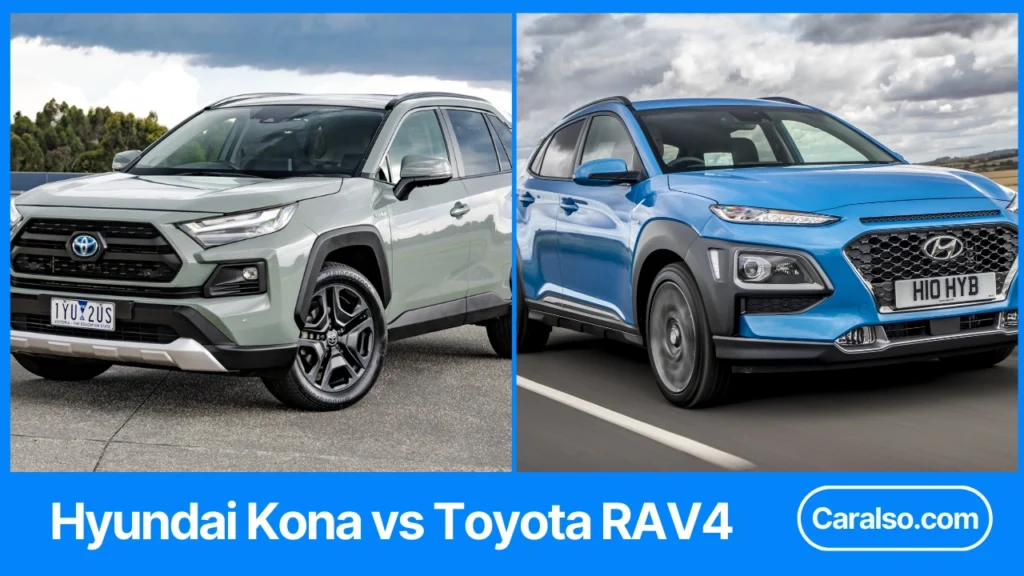
Toyota RAV4 Vs Toyota Kona
Kona Vs RAV4 In 30 Seconds (Pick This If…)
Quick Verdict List
- Lowest price: Kona starts at $24,550. RAV4 starts at $29,250.
- Cargo behind the rear seats: Kona has 25.5 cu ft. RAV4 has 37.5 cu ft.
- Best non-plug-in MPG: Kona gas is up to 31 combined. RAV4 Hybrid is 39 combined.
- Overall size: Kona is 171.3 in long. RAV4 is 180.9 in long.
- Warranty: Kona is 5 years or 60,000 miles basic, and 10 years or 100,000 miles powertrain (original owner). RAV4 is 36 months or 36,000 miles basic, and 60 months or 60,000 miles powertrain.
Key Numbers Table
| Spec (2025 Models) | Hyundai Kona | Toyota RAV4 |
|---|---|---|
| Starting MSRP (Range) | $24,550 to $32,100 | $29,250 to $37,555 |
| EPA Combined MPG (Gas) | Up to 31 combined (FWD) | 30 combined (FWD) |
| EPA Combined MPG (Hybrid Option) | No Kona Hybrid listed by EPA | 39 combined (RAV4 Hybrid AWD) |
| Cargo Behind 2nd Row | 25.5 cu ft | 37.5 cu ft |
| Max Cargo | 63.7 cu ft | 69.8 cu ft |
| Length | 171.3 in | 180.9 in |
Choose Kona If… / Choose RAV4 If…
| Choose Kona If… | Choose RAV4 If… |
|---|---|
| You want the lowest starting price. | You want more space behind the rear seats. |
| You parallel park a lot. 171.3 in length helps. | You haul bulkier stuff. 37.5 cu ft behind row 2 makes life easier. |
| You want a smaller SUV with a big warranty. | You want a hybrid option that hits 39 MPG combined. |
| Your “stuff” is mostly groceries, backpacks, and carry-ons. | Your “stuff” is strollers, coolers, dog crates, or Home Depot runs. |
| You want a great daily driver and you do not need maximum cargo. | You want the safer bet for growing into your needs. |
The One Question That Decides Most Buyers (Space Vs Price)
I ask this one question.
Do you want to save about $4,700 up front, or do you want about 12.0 extra cubic feet of cargo space behind the rear seats?
If you are tight on budget, the Kona’s starting price is hard to argue with.
If you routinely load bigger items, the RAV4’s cargo area is the whole point. The difference between 25.5 and 37.5 cu ft is the difference between “it fits” and “I need to fold seats every time.”
Key Differences At A Glance (Price, MPG, Space, AWD, Towing)
I’ll save you the scroll.
These two are only “similar” because they are both small SUVs.
They do not solve the same problems.
Key Numbers Table (2025 Models)
| Category | Hyundai Kona | Toyota RAV4 |
|---|---|---|
| Base MSRP | $24,550 (SE) | $29,800 (LE) |
| Best EPA Combined MPG (Gas) | 31 mpg (FWD) | 30 mpg (FWD) |
| Best EPA Combined MPG (Hybrid) | No Kona Hybrid | 39 mpg (Hybrid AWD) |
| Cargo Behind 2nd Row | 25.5 cu ft | 37.5 cu ft |
| Max Cargo (Seats Folded) | 63.7 cu ft | 69.8 cu ft |
| Length | 171.3 in | 180.9 in |
| Width (No Mirrors) | 71.9 in | 73.0 in |
| AWD Availability | Optional on many trims | Optional on gas trims. Standard on Hybrid |
| Towing | Not recommended for towing trailers | 1,500 lbs gas, 1,750 lbs Hybrid, 2,500 lbs Plug-In Hybrid |
Price And Monthly Payment Reality (Budget Bands)
This is how I see the budget split.
Kona Lane
- $24,550 to $33,600 based on trim and AWD.
- AWD adds about $1,500 on the SE and SEL.
RAV4 Lane
- $29,800 to $39,505 based on trim and AWD.
- AWD adds about $1,400 on the LE.
My rule.
If your target payment is built around the lowest MSRP, the Kona is the easier start.
If you already know you need space, the RAV4 is the easier decision.
MPG And Fuel Cost Headline
Here’s the clean takeaway.
- Kona gas can hit 31 mpg combined in FWD form.
- RAV4 gas is about 30 mpg combined in FWD form.
- RAV4 Hybrid is the efficiency cheat code at 39 mpg combined.
If you drive mostly city miles, I usually lean RAV4 Hybrid first.
If you drive mostly highway and you want the cheapest buy-in, I lean Kona.
Cargo Space Headline (Behind 2nd Row And Max)
This is the biggest day-to-day difference.
- Kona: 25.5 cu ft behind the second row.
- RAV4: 37.5 cu ft behind the second row.
That is a 12.0 cu ft gap.
That gap is why people “outgrow” the Kona faster.
Max cargo is closer, but still a RAV4 win.
- Kona max cargo: 63.7 cu ft.
- RAV4 max cargo: 69.8 cu ft.
AWD Availability And Who Needs It
Both can be had with AWD.
But the “who needs it” answer is the same.
I buy AWD if:
- You see snow and ice every winter.
- You have steep hills where you live.
- You drive on gravel roads often.
I skip AWD if:
- You live in a warm climate.
- You mainly drive city roads and highways.
- You’d rather keep the MPG and the lower price.
Price reality:
- Kona AWD is usually a $1,500 step up on the same trim.
- RAV4 AWD is usually a $1,400 step up on the LE.
Towing Reality Check (And How To Verify It)
This is where most comparison pages get sloppy.
Here’s my straight answer.
- Kona: Hyundai does not recommend towing with the Kona for the U.S. market.
- RAV4: Towing is real, but it depends on the powertrain.
RAV4 towing limits I actually use:
- Gas RAV4: up to 1,500 lbs
- RAV4 Hybrid: up to 1,750 lbs
- RAV4 Plug-In Hybrid: up to 2,500 lbs
My quick “verify it” checklist:
- Check your exact trim and drivetrain.
- Check the owner’s manual towing section.
- Check the hitch rating and tongue weight rating.
- If you are near the limit, weigh the trailer and payload.
If towing matters, the RAV4 is the only one I put on the list.
First Reality Check: These SUVs Are Not The Same Size
I treat this matchup like a sizing decision first.
Then I talk about MPG and features.
Kona Vs RAV4 Exterior Footprint (Length, Width)
| Exterior Size | Hyundai Kona | Toyota RAV4 |
|---|---|---|
| Length | 171.3 in | 180.9 in |
| Width (No Mirrors) | 71.9 in | 73.0 in |
That is a 9.6-inch difference in length.
If you park in a tight garage, you will feel that.
Cargo Space That You Actually Use Every Day
I care most about cargo with the second row up.
That is “real life” mode.
- Kona: 25.5 cu ft behind row 2
- RAV4: 37.5 cu ft behind row 2
If you carry bigger items weekly, this is the RAV4’s whole argument.
Here’s how I translate it.
The Kona cargo area is fine for groceries and backpacks.
The RAV4 cargo area is built for bulkier stuff like strollers, coolers, and dog crates.
Family Fit Test (Car Seat And Stroller Logic Using Cargo Numbers)
Rear legroom is closer than most people expect.
- Kona rear legroom: 38.2 in
- RAV4 rear legroom: 37.8 in
So the back seat space is not the problem.
Cargo is.
If you run a rear-facing car seat and you keep the second row up:
- The Kona gives you 25.5 cu ft for everything behind the seat.
- The RAV4 gives you 37.5 cu ft.
That 12.0 cu ft difference is what keeps you from folding seats every time.
It also gives you more room for a stroller plus bags without playing trunk Tetris.
Price And Trims Explained (Why People Cross-Shop These)
If you are cross-shopping a Kona and a RAV4, you are usually doing one of two things.
You want a new SUV for under $30,000 and you are wondering if the RAV4 is worth the jump.
Or you want a RAV4-sized SUV, but the Kona price looks tempting.
Here is how I break it down.
What You Get For $26k To $30k (Kona Lane)
This is the Kona sweet spot.
Most of the time, you are looking at these trims and prices:
- Kona SE FWD: $24,550
- Kona SE AWD: $26,050
- Kona SEL FWD: $25,900
- Kona SEL AWD: $27,400
- Kona SEL Convenience FWD: $28,100
- Kona SEL Convenience AWD: $29,600
- Kona N Line S FWD: $29,550
My take.
If you want the lowest price, the SE is fine.
If you want the best value, I usually land on SEL or SEL Convenience.
Here is why.
- SEL is where the Kona starts feeling “complete” for daily use.
- SEL Convenience is where you start getting the nicer comfort and tech stuff people actually notice every day.
- N Line S is the cheapest path to the 190 hp turbo engine.
If AWD matters for your winters, I keep the Kona goal simple.
Get the trim you like, then add AWD.
That is usually a $1,500-ish jump on the sticker, depending on trim.
What You Get For $33k To $40k (RAV4 Lane)
This is where the RAV4 lives.
Gas RAV4 MSRP by trim:
- RAV4 LE: $31,250
- RAV4 XLE: $32,760
- RAV4 XLE Premium: $35,650
- RAV4 Limited: $39,555
Hybrid RAV4 MSRP by trim:
- RAV4 Hybrid LE: $34,300
- RAV4 Hybrid XLE: $35,810
- RAV4 Hybrid SE: $36,995
- RAV4 Hybrid Woodland: $37,520
- RAV4 Hybrid XLE Premium: $38,700
- RAV4 Hybrid XSE: $39,960
My take.
If you are spending $33,000 to $40,000, the RAV4 Hybrid is the one I keep circling back to.
You get AWD standard and strong fuel economy without changing your routine.
If you want the most RAV4 for the money, the gas XLE is the “normal person” trim.
It is the one I see most people happy with.
Trim Translation Guide (Apples To Apples)
These SUVs are not the same size.
So this is not a perfect match.
But if you want a quick “closest equivalent” map, this is how I line them up.
| What You Care About | Kona Pick | RAV4 Pick |
|---|---|---|
| Lowest Buy-In Price | SE | LE |
| Value Trim Most People Should Start With | SEL | XLE |
| Comfort And Tech Without Going Luxury | SEL Convenience | XLE Premium |
| Sporty Look And Stronger Gas Engine | N Line S / N Line | Hybrid SE or Hybrid XSE |
| Near-Luxury Daily Driver Feel | Limited | Limited or Hybrid XSE |
Two quick notes I use when helping friends shop.
- A Kona Limited AWD at $33,600 is still usually cheaper than a RAV4 XLE Premium.
- A RAV4 Hybrid LE at $34,300 is often the “first step” into RAV4 ownership that actually feels like a big upgrade from the Kona.
“Value Trim” Comparison (Quick Pick)
If you told me “I want the smart trim, not the cheap trim,” this is where I start.
- Kona SEL (around $25,900 to $27,400 depending on AWD)
- RAV4 XLE (around $32,760 before options)
The Kona SEL wins on price.
The RAV4 XLE wins on space, and it usually holds value better.
“Comfort And Tech Trim” Comparison (Where Cross-Shoppers Get Stuck)
This is the exact lane where people hesitate.
- Kona SEL Convenience: $28,100 (FWD) or $29,600 (AWD)
- RAV4 XLE Premium: $35,650
If you want heated-seat comfort and daily tech features at the lowest price, Kona SEL Convenience is hard to beat.
If you want a bigger cabin and a more family-proof layout, I pay the RAV4 money and move on.
Used Car Shortcut (When A Used RAV4 Beats A New Kona, And Vice Versa)
I use a simple rule.
If you are shopping used because you want more SUV for the money, a used RAV4 can make sense fast.
But if you are shopping used just to hit a payment, a new Kona often wins because the price is lower to start with.
Here is what I see a lot:
- Used RAV4s often sit in the low $20,000s to mid $20,000s once miles get into the 60,000 to 100,000 range.
- Used Konas can drop into the teens faster with similar miles.
My practical advice.
- Buy a used RAV4 when you need the space and you drive a lot of highway miles.
- Buy a new Kona when you want the newest tech and the warranty story, but you do not need the RAV4’s size.
Powertrains And Drivetrains (Gas Vs Hybrid Vs EV)
This is the section that decides the whole purchase for a lot of people.
So I keep it simple.
Kona Powertrain Options (And Who They Fit)
The Kona gives you two gas engines.
Base gas engine:
- 2.0L
- 147 hp
- CVT style automatic
- FWD or AWD
Turbo gas engine:
- 1.6L turbo
- 190 hp
- 8-speed automatic
- FWD or AWD
The quick way I match this to real buyers.
- If you want the lowest running costs and you are fine with “normal” power, the 2.0L is the one.
- If you want the Kona to feel quick in traffic and on highway merges, I go turbo.
EPA fuel economy snapshots I use:
- 2.0L FWD: 31 mpg combined
- 2.0L AWD: 28 mpg combined
- 1.6T FWD: 28 mpg combined
- 1.6T AWD: 26 mpg combined
RAV4 Powertrain Options (Hybrid-Forward Strategy)
The RAV4 has three lanes.
Gas RAV4:
- 2.5L
- 203 hp
- 8-speed automatic
- FWD standard, AWD optional
RAV4 Hybrid:
- 219 hp total system output
- AWD standard
RAV4 Plug-In Hybrid:
- 42 miles electric range
- 94 MPGe combined on electricity
- 38 mpg combined once the battery is drained
- AWD standard
My real-world take.
If you want one simple choice that fits most people, it is the RAV4 Hybrid.
You get the better power feel, strong mpg, and AWD without changing how you fuel up.
The Plug-In Hybrid is awesome if you can actually charge at home or at work.
If you cannot charge, you are paying extra and not using the main benefit.
Kona Electric Vs RAV4 Hybrid (If You Are Considering EV Life)
This is where people get stuck, so I use one question.
Can you charge where you park overnight?
If yes, Kona Electric starts making a lot of sense.
FuelEconomy.gov lists these EPA ranges:
- Kona Electric Standard Range: 200 miles
- Kona Electric (17-inch wheels): 261 miles
- Kona Electric (19-inch wheels): 230 miles
If no, the RAV4 Hybrid is the easy answer.
It gets hybrid mpg with gas-station convenience.
My “commuter math” shortcut.
- Under 40 miles a day, home charging, and cheap electricity: I lean Kona Electric.
- Mixed driving, long road trips, or no charging plan: I lean RAV4 Hybrid.
AWD Systems And Snow Driving Expectations
Both can do AWD.
But the expectation should be realistic.
Neither is a body-on-frame off-roader.
Neither has a low-range transfer case.
Here is what I actually care about in snow.
- AWD helps you start moving.
- Tires help you stop and turn.
So if you live in a real winter area, I budget for winter tires before I pay for a bigger wheel package.
My quick AWD breakdown.
- Kona: AWD is available on basically any trim, which is nice.
- RAV4 gas: FWD is standard. AWD is usually an option.
- RAV4 Hybrid and Plug-In: AWD is standard.
If your driveway is steep or your streets stay unplowed, I put the advantage on the RAV4 Hybrid AWD setup.
But I still treat tires as the deciding factor.
Fuel Economy And Running Costs (Where The Money Goes)
Fuel economy is where these two can flip on you.
The Kona can beat the gas RAV4 on paper.
But the RAV4 Hybrid usually beats every non-hybrid Kona in real-world mixed driving.
MPG Comparison That Matches Real Driving (City, Highway, Mixed)
Here are the EPA numbers I use when I compare them.
| Model (Common Config) | City MPG | Hwy MPG | Combined | EPA Annual Fuel Cost |
|---|---|---|---|---|
| Kona 2.0 FWD | 29 | 34 | 31 | $1,400 |
| Kona 2.0 AWD | 27 | 29 | 28 | $1,600 |
| Kona 1.6T FWD | 26 | 32 | 28 | $1,600 |
| Kona 1.6T AWD | 24 | 29 | 26 | $1,700 |
| RAV4 Gas FWD | 27 | 35 | 30 | $1,450 |
| RAV4 Gas AWD (Most Trims) | 27 | 33 | 29 | $1,500 |
| RAV4 Hybrid AWD | 41 | 38 | 39 | $1,150 |
| RAV4 Plug-In Hybrid AWD | 94 MPGe | $900 | ||
| RAV4 Plug-In Hybrid AWD (Gas Only) | 38 MPG |
A quick way to read that table.
- Mostly city driving: I lean RAV4 Hybrid. 41 city MPG is the big deal.
- Mostly highway driving: the gap shrinks. Aerodynamics and speed matter more than hybrid magic.
- Want AWD: the Kona takes a bigger MPG hit than the RAV4 does.
If you are also considering EV life, the Kona Electric changes the math again.
- Kona Electric (17-inch wheels): 116 MPGe combined, 261-mile EPA range, $650 annual “fuel” cost
- Kona Electric (19-inch wheels): 103 MPGe combined, 230-mile EPA range, $700 annual “fuel” cost
Simple Annual Fuel Cost Table (10k, 15k, 20k Miles)
This is the table I use when someone tells me how much they drive.
These are scaled from the EPA annual fuel cost numbers.
| Model | 10,000 Miles Per Year | 15,000 Miles Per Year | 20,000 Miles Per Year |
|---|---|---|---|
| Kona 2.0 FWD | $930 | $1,400 | $1,870 |
| Kona 2.0 AWD | $1,070 | $1,600 | $2,130 |
| Kona 1.6T AWD | $1,130 | $1,700 | $2,270 |
| RAV4 Gas FWD | $970 | $1,450 | $1,930 |
| RAV4 Hybrid AWD | $770 | $1,150 | $1,530 |
| RAV4 Plug-In Hybrid AWD | $600 | $900 | $1,200 |
Two reminders I always give friends.
- Your local gas price matters. So does your electric rate if you go EV or plug-in.
- Winter, short trips, and roof racks can move your MPG by 2 to 5 mpg.
Insurance And Tire Cost Notes (Size And Wheel Packages)
Insurance is hard to “average” because zip code and driver profile change everything.
But I still see two patterns.
- The RAV4 can cost more to insure because it costs more to replace.
- Hybrids and plug-ins can cost more to repair after a front-end hit because of extra components.
Tires are the sneaky cost people forget.
Kona wheel and tire sizes by trim commonly look like this:
- 17-inch wheels on lower trims
- 18-inch wheels on mid trims
- 19-inch wheels on N Line and Limited trims
- Example tire on 19s: 235/45R19
RAV4 wheel and tire sizes commonly look like this:
- 17-inch wheels on lower trims
- 19-inch wheels on XLE Premium and Limited style trims
- Example tire on 17s: 225/65R17
My simple tire-cost rule.
- Moving from 17-inch to 19-inch usually adds about $50 to $120 per tire in the same quality tier.
- It can also cut 1 to 2 mpg, depending on tire model and wheel weight.
If you want the lowest running costs, I avoid the biggest wheels on both SUVs.
I would rather spend that money on better tires.
Interior, Tech, And Driver Assists (Easy To Live With?)
This is where the Kona can feel like a newer design.
And it is also where the RAV4 feels like the safer bet for long-term simplicity.
Screen And Controls (What You Touch Every Day)
Here is the quick screen reality.
Kona:
- 12.3-inch infotainment screen is the core setup
- Many trims pair it with a 12.3-inch digital cluster
RAV4:
- 8.0-inch touchscreen on lower trims
- 10.5-inch touchscreen on higher trims
- Many trims use a 7.0-inch gauge display, with a 12.3-inch digital cluster on certain trims
What matters more than screen size is how you use it.
I look for three things on a test drive:
- Physical volume knob or easy steering-wheel volume controls
- Climate controls that do not require 3 taps
- A backup camera that is clear in shade and at night
Phone Integration (Wireless CarPlay, Android Auto)
This is a tie in the way most people care about.
Both:
- Wireless Apple CarPlay
- Wireless Android Auto
Two practical notes.
- Wireless CarPlay can lag if your phone is older or your Wi-Fi is crowded.
- Wired is still the most reliable if you road trip a lot.
If I am commuting every day, I also check charging.
- Kona: wireless charging is trim-dependent
- RAV4: wireless charging is trim-dependent
I treat USB-C ports as more important than wireless charging.
Wireless pads can overheat phones in summer.
Driver Assist Feature Comparison (Adaptive Cruise, Lane Centering)
I use one question.
Do you want lane centering that feels calm on the highway?
RAV4:
- Toyota Safety Sense 2.5 is the baseline safety suite
- Lane Tracing Assist works with radar cruise to help center the car
- Full-speed adaptive cruise is a core feature set
Kona:
- Hyundai SmartSense is the baseline safety suite
- Lane Keeping Assist helps keep you from drifting
- Adaptive cruise control is available, depending on trim and package
- Higher trims can add more highway-focused assist features
My real-world rule.
- If you want the easiest “set it and supervise it” highway system, I usually prefer how Toyota’s lane tracing and radar cruise behave.
- If you want a lot of features for the money, Hyundai often gives you more per dollar.
No matter what you buy, I treat these systems as helpers.
Hands stay on the wheel.
Pro Tip: The 10-Minute Test Drive Checklist For Tech
I do this on every test drive.
It takes 10 minutes.
- Pair your phone in the parking lot.
- Start wireless CarPlay or Android Auto.
- Make a call. Check mic clarity at 30 mph.
- Play a podcast. Listen for rattles on rough pavement.
- Set a destination. Try voice commands once.
- Check the backup camera. Look at clarity and guideline accuracy.
- Try the climate controls while driving. Count how many taps you need.
- Turn on adaptive cruise in light traffic. Confirm it holds distance smoothly.
- Test lane assist on a straight road. Confirm it is not ping-ponging.
- Check your charging plan. Count USB-C ports you can actually reach.
If any one of those steps annoys you on day one, it will annoy you on day 100.
Reliability, Warranty, And Ownership Risk (What Spec Pages Ignore)
This is the part I care about most.
Because this is where a “good deal” turns into a long-term bill.
Warranty Comparison (Hyundai Advantage Explained)
Here is the clean warranty math.
| Coverage | Hyundai Kona | Toyota RAV4 |
|---|---|---|
| Basic Warranty | 5 years or 60,000 miles | 3 years or 36,000 miles |
| Powertrain Warranty | 10 years or 100,000 miles for the original owner | 5 years or 60,000 miles |
| Powertrain For 2nd Owner | 5 years or 60,000 miles | 5 years or 60,000 miles |
| Complimentary Maintenance | 3 years or 36,000 miles (oil and filter changes, tire rotations at normal intervals) | 2 years or 25,000 miles (ToyotaCare scheduled maintenance) |
| Roadside Assistance | 5 years, unlimited miles | 2 years, unlimited miles with ToyotaCare |
My real-world takeaway.
If you are buying new and keeping it, Hyundai’s warranty is a real advantage.
But you have to understand the fine print.
The 10 year or 100,000 mile powertrain coverage is for the original owner only.
If you are buying used, the warranty gap shrinks fast.
That is why I never treat a used Kona like it still has the full 10 and 100 package.
Long-Term Ownership Risk (Complexity And Repair Cost Logic)
I look at two things.
How many expensive systems are you betting on.
And what the repair history data says about the odds.
CarEdge has a simple way to think about it over 10 years.
- Kona: $8,463 in maintenance and repairs over 10 years. 24.76% chance of a major repair.
- RAV4: $6,005 in maintenance and repairs over 10 years. 16.61% chance of a major repair.
That is a $2,458 gap in the estimate.
And an 8.15-point gap in major-repair probability.
My logic from that.
If you plan to own it past the warranty window, the RAV4 is the lower-risk play more often.
If you plan to buy new and trade early, the Kona warranty can cover a lot of the “unknowns.”
One more note.
Hybrids have more components than pure gas cars.
But Toyota’s hybrid system has a long track record, and Toyota backs the hybrid battery for 10 years or 150,000 miles.
Maintenance Plan Reality (Intervals And Typical Wear Items)
Most owners do not go broke on engines.
They go broke on the boring stuff.
Here is the running-cost reality I plan for on both SUVs.
- Tires every 40,000 to 60,000 miles, depending on tire and driving
- Brakes often last longer on hybrids because regen does some of the work
- Alignment checks if you hit potholes often
- Cabin air filter and engine air filter on schedule
Maintenance cadence matters too.
Toyota’s own guide says to get scheduled maintenance every 5,000 miles or 6 months.
That does not always mean an oil change every 5,000.
But it does mean you should be checking in on a 5,000-mile rhythm.
Hyundai’s complimentary maintenance covers oil and filter changes and tire rotations at the normal schedule intervals for 3 years or 36,000 miles.
That can save real money early on.
Used-Buyer Checklist (Kona Vs RAV4)
If I am buying either used, this is what I do before money changes hands.
- Run a VIN recall check.
- Ask for service records. Oil changes and tire rotations matter.
- Look at tire wear. Uneven wear can mean alignment or suspension issues.
- Test every switch and screen feature. Especially backup camera and driver assists.
- Scan for stored codes with a basic OBD2 scanner if you can.
- Do a 15-minute test drive that includes:
- a cold start
- 0 to 60 mph merge
- a rough road section
- a parking lot full-lock turn
Kona-specific checks I do.
- Confirm whether it is the 2.0L or 1.6T.
- Make sure the transmission shifts cleanly in stop-and-go.
- Check for any warning lights that were “just reset.”
RAV4-specific checks I do.
- If it is a hybrid, listen for odd cooling fan noise and confirm smooth transitions.
- Check that AWD engages normally if equipped.
- Verify all Toyota Safety Sense functions behave normally on the road.
If you want the lowest-risk used purchase, I usually prefer a well-maintained RAV4 with records over a “mystery” Kona with no paperwork.
Resale Value And Depreciation (The Hidden Cost)
Depreciation is the cost you pay even if nothing breaks.
It is also why a cheaper SUV can cost more than you expect.
Depreciation Snapshot (Easy Comparison)
CarEdge estimates:
- Kona: 42% depreciation after 5 years. 5-year resale value about $18,395.
- RAV4: 28% depreciation after 5 years. 5-year resale value about $27,315.
Those are estimates based on assumptions like mileage and condition.
But the direction is consistent.
The RAV4 usually holds value better.
Why RAV4 Often Wins Resale (Category Demand)
I see a few reasons.
- The RAV4 is in the high-demand compact SUV size class.
- Toyota buyers pay extra for reputation and low running costs.
- The RAV4 Hybrid is a strong resale story because fuel prices change, but efficiency stays useful.
If you think you might sell in 3 to 5 years, resale value is a big reason the RAV4 often pencils out.
When Kona Wins (Lower Buy-In, Warranty Transfer Logic)
The Kona wins in two situations I see all the time.
- You buy it new, you keep it during the warranty years, and you value the lower starting price.
- You buy it used after the steep part of depreciation already happened.
Here is the used-car angle.
Higher depreciation can be a gift if you are the second owner.
You can sometimes get a lot of features for less money.
Just remember the 10 year or 100,000 mile powertrain warranty is not the same for a second owner.
If you want a used Kona with a stronger warranty story, I usually point people to Hyundai Certified.
That can change the coverage conversation.
Best Strategy By Timeline (3 Years Vs 7+ Years)
I pick differently based on how long you plan to keep the SUV.
If You Will Own It For 3 Years
- I lean RAV4 if you want the easiest resale.
- I lean Kona if the lowest payment is the priority and you are buying new with the warranty.
If You Will Own It For 7 Years Or Longer
- I lean RAV4 more often because the long-run maintenance and repair risk looks lower in the data.
- I lean Kona if you are buying new, you like the size, and you will actually use the warranty and free maintenance early on.
My bottom-line rule.
Short ownership favors resale.
Long ownership favors lower risk and predictable costs.
Real-World Buyer Scenarios (Pick The Right One For You)
I pick between these two by looking at your parking situation, your cargo, and your miles.
Scenario A: City Driver, Tight Parking, Short Trips
If you parallel park a lot, the Kona makes life easier.
Here are the numbers that matter in a city:
- Length: Kona 171.3 in. RAV4 180.9 in.
- Turning circle: Kona 34.8 ft. RAV4 36.1 ft.
- Cargo behind row 2: Kona 25.5 cu ft. RAV4 37.5 cu ft.
My pick:
- Choose Kona if you mostly carry groceries and backpacks, and you want the lowest buy-in.
- Choose RAV4 if you regularly carry bulky items, even if you drive in the city.
Trim I’d start with:
- Kona SEL if you want value.
- RAV4 Hybrid LE if you want city MPG without changing your routine.
Scenario B: Small Family, Stroller, Weekend Trips
This is a cargo decision.
Rear legroom is close:
- Kona rear legroom: 38.2 in.
- RAV4 rear legroom: 37.8 in.
Cargo is not close:
- Kona: 25.5 cu ft behind row 2.
- RAV4: 37.5 cu ft behind row 2.
My pick:
- If you have a stroller plus weekend bags, I pick the RAV4.
- If you have one kid, pack light, and want a smaller footprint, I pick the Kona.
Trim I’d start with:
- Kona SEL Convenience if you want comfort and tech for the money.
- RAV4 XLE if you want space without jumping to the top trim.
Scenario C: Snow Belt, AWD Needs, Winter Tires
I treat snow as tires first, then AWD, then ground clearance.
Ground clearance matters when ruts get deep:
- Kona: 6.9 in.
- RAV4: 8.4 in.
That is a 1.5-inch gap.
MPG matters too if you drive a lot:
- Kona 2.0 AWD: 28 mpg combined.
- RAV4 Hybrid AWD: 39 mpg combined.
My pick:
- If you want AWD plus better winter clearance, I pick the RAV4.
- If you want the smallest AWD SUV for tight streets and you do not deal with deep snow, I pick Kona AWD.
My winter setup rule:
- I would rather run 17-inch wheels and winter tires than pay for 19-inch wheels.
Scenario D: You Are EV Curious (Kona Electric Vs RAV4 Hybrid)
This is the question that decides it.
Can you charge where you park overnight?
If yes, Kona Electric is a real option.
Here are the EPA range numbers by trim:
- Kona Electric SE: 200 miles
- Kona Electric N Line: 230 miles
- Kona Electric SEL and Limited: 261 miles
If no, the RAV4 Hybrid is the simple answer.
You get 39 mpg combined with gas-station convenience.
My quick math shortcut:
- If your daily driving is under 40 miles and you can charge at home, I lean Kona Electric.
- If you road-trip often or you cannot charge reliably, I lean RAV4 Hybrid.
FAQs
Is The Kona Too Small Compared To A RAV4?
For cargo, yes.
The Kona is 25.5 cu ft behind the second row.
The RAV4 is 37.5 cu ft behind the second row.
That is 12.0 cu ft more space in the RAV4 with the seats up.
For back seat legroom, not really.
Kona is 38.2 in.
RAV4 is 37.8 in.
My rule:
If you carry bulky items weekly, I pick RAV4.
If you mostly carry people and small bags, Kona can fit fine.
Is The RAV4 Worth The Extra Money?
Usually, yes, if you will keep it for a while or you need the space.
Two reasons:
- 5-year depreciation estimates favor RAV4. About 28% for RAV4 versus about 42% for Kona.
- 10-year maintenance and repair estimates favor RAV4. About $6,005 for RAV4 versus about $8,463 for Kona.
If your priority is the lowest buy-in price and a longer basic warranty, Kona still makes sense.
Which Is Better In Snow?
If both have good winter tires, I usually lean RAV4.
Here is why:
- Ground clearance: RAV4 8.4 in. Kona 6.9 in.
- Hybrid AWD availability: RAV4 Hybrid AWD is a common setup and it is rated 39 mpg combined.
If you live where roads are mostly plowed and your main challenge is light snow, Kona AWD can be enough.
Tires still matter more than AWD badges.
Which Is Cheaper To Own For 5 Years?
For most buyers, I expect the RAV4 to come out better.
Here is the simple logic:
- Depreciation tends to hit the Kona harder. About 42% at 5 years versus about 28% for RAV4.
- Fuel costs can favor RAV4 Hybrid. EPA annual fuel cost is about $1,150 for RAV4 Hybrid AWD versus about $1,400 for Kona 2.0 FWD.
If you buy a Kona used after the big depreciation drop, the Kona can win.
That is the main exception.
Should I Buy A Used RAV4 Instead Of A New Kona?
If you need the RAV4’s space, yes, a used RAV4 can be the smarter move.
I like a used RAV4 when:
- You want 37.5 cu ft of cargo behind the second row.
- You want a lower long-term cost estimate.
- You can find service records.
I like a new Kona when:
- You want the lowest price new.
- You want a 5-year or 60,000-mile basic warranty.
- You want 3 years or 36,000 miles of free maintenance.
My used-car rule:
Get a pre-purchase inspection.
Run a VIN recall check.
If the seller has no service records, I price it like a risk or I walk.
Bottom Line: The Best Choice For Most People
If you want my default pick, I choose the Toyota RAV4. It costs more up front, but it gives you more space, better hybrid MPG, and better resale math.
Who Should Buy The Hyundai Kona
- You want the lowest starting price. $24,550 versus $29,800 for a RAV4 LE.
- You park in tight spots every day. 171.3 inches long, and a 34.8-foot turning circle.
- You want a smaller SUV with a long warranty story. 5 years or 60,000 miles basic, and 10 years or 100,000 miles powertrain for the original owner.
Who Should Buy The Toyota RAV4
- You need real cargo space with the second row up. 37.5 cu ft versus 25.5 cu ft in the Kona.
- You want the best MPG without going full EV. RAV4 Hybrid is 39 mpg combined.
- You want towing capability. Up to 1,500 lbs on gas, 1,750 lbs on Hybrid, and 2,500 lbs on Plug-In Hybrid.
Two Exceptions When The “Other” Is The Better Call
- Pick The Kona Over The RAV4 if your budget is strict and you do not need the RAV4’s cargo space. Saving about $5,000 on MSRP can beat everything else.
- Pick The RAV4 Over The Kona even if you love the Kona’s price if you have a stroller, a big dog crate, or bulky gear every week. The 12.0 cu ft cargo gap behind row 2 is the difference.
Sources
- EPA FuelEconomy.gov (2025 Hyundai Kona PowerSearch)
- Edmunds (2025 Hyundai Kona Specs And Features)
- Car And Driver (Hyundai Kona Overview)
- Car And Driver (2025 Hyundai Kona Review Page)
- Hyundai USA (Complimentary Maintenance)
- Toyota (ToyotaCare Maintenance Plans)

Hey there,
How is it going?
I’m Meraj Sarker. I am a Car Mechanic and a student of Automobile Restoration here in Florida, USA. I’ve been studying automotive for around 9 years now. So you can rely on my recommendation. For me, studying and getting knowledge about automobile it’s really fun and entertaining. I will help you to get solutions for your car through this website. If you need any help let me know.