
I am talking only about used U.S. RAV4s here. All generations.
There is no single perfect year for everyone. A budget commuter, a big family, and a mileage nerd all need different things.
So I am going to give you one best all-around year, then the best backup years by budget and use case, plus the short list of years I avoid. I am leaning on CarComplaints, NHTSA, J.D. Power, Consumer Reports, CoPilot, Car Talk, MotorBiscuit, and big dealer guides. Not just forums and feelings.
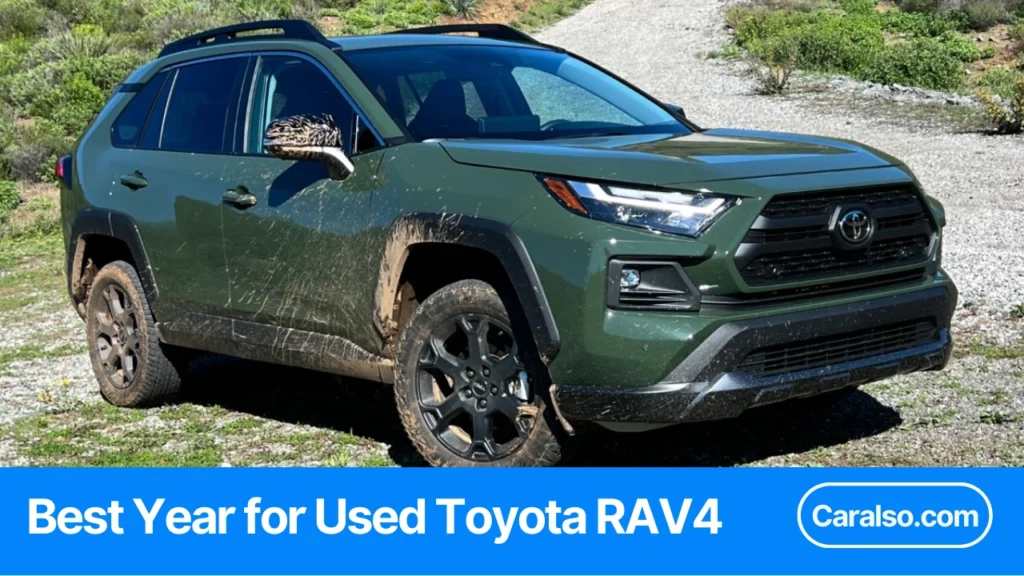
What’s the best year for a used Toyota RAV4?
If you just want the fast answer and you are not picky about color or trim:
My single best all-around used RAV4 year is 2018.
Here is why.
My single best all-around used RAV4 year
I put 2018 RAV4 at the top of the list.
- Generation: Last year of the 4th gen. Toyota had 6 model years to fix bugs.
- Safety and tech: Modern enough. Toyota Safety Sense on most trims. Good crash scores. Decent infotainment even without fancy screens.
- Reliability data: J.D. Power gives the 2018 RAV4 an 88 / 100 quality and reliability score, which they rate as “Great.” Dealer and auction data also single out 2018 as one of the most dependable RAV4 years with strong resale.
CoPilot and several dealer guides also call 2018 one of the best used years because it adds features over 2017 with similar used pricing.
In real life, I like 2018 because:
- It avoids early 4th-gen quirks.
- It is cheaper than a clean 2021 or 2022 5th-gen.
- It feels modern enough to keep for 5 to 10 years.
If I had to buy one used RAV4 today with my own money, and I wanted a simple answer, I would start with 2018 and hunt for a clean XLE or SE with good service records.
Top alternative used RAV4 years (quick list)
If 2018 does not line up with your budget or the listings near you, here are the other year ranges I reach for.
- Budget workhorse:
- 2010–2012
- 3rd gen. Big cargo space, optional V6 and 3rd row. Good long term reliability once you avoid the early oil burners. Tech and safety are older.
- Best value sweet spot:
- 2016–2018
- 4th gen facelift years. Car Talk, CoPilot, MotorBiscuit, and several buying guides all point to 2016–2018 as the best mix of reliability, safety, and price.
- Modern tech and safety:
- 2021–2022
- 5th gen. You skip the rough 2019 launch year and the early 2020 fuel pump mess, but still get the new look, Apple CarPlay and Android Auto, and strong safety tech.
- Best for MPG:
- 2020–2022 RAV4 Hybrid
- 2022 RAV4 Prime / Plug-in Hybrid if you want EV miles
- These years show high owner satisfaction and strong reliability so far, with real world 38–40 mpg for the Hybrid and long EV range for the Prime. Car and Driver and MotorBiscuit both highlight RAV4 Hybrid as one of the best used hybrid SUVs.
If you start your search inside those windows and skip the known problem years, you are already ahead of most buyers.
Best used RAV4 years at a glance
Here is the cheat sheet I keep in my notes.
| Year or range | Generation | Powertrain | Why it is a top used pick | Best for |
|---|---|---|---|---|
| 2018 | 4th gen | Gas, some Hybrid | Last year of 4th gen. Strong J.D. Power reliability score. Multiple guides and dealers call it one of the most dependable RAV4 years with great resale. Good safety and simple tech. | One-and-done choice if you just want a solid RAV4 to keep long term. |
| 2010–2012 | 3rd gen | Gas 4-cyl, V6 | Spacious cabin, optional 3rd row and strong V6 with 3,500 lb tow rating. Later 3rd-gen years avoid the worst oil-burn issues and have solid reliability scores. | Budget buyers who want space or towing and do not mind older tech. |
| 2016–2018 | 4th gen | Gas, Hybrid | Facelift years with better styling, Toyota Safety Sense, and available Hybrid. Car Talk, CoPilot, MotorBiscuit, and others all mark 2016–2018 as prime used years. | Value hunters who want a modern cabin and safety without 5th-gen prices. |
| 2021–2022 | 5th gen | Gas, Hybrid | Later 5th-gen years that avoid the rougher 2019 launch and early fuel pump issues. Strong safety, standard CarPlay and Android Auto, and good reliability so far. | Buyers who want a newer truck feel, better screens, and plan to keep it for a long time. |
| 2020–2022 Hybrid | 5th gen | Hybrid | 38–40 mpg combined. Toyota’s mature hybrid system. Early data and buyer guides rate these Hybrids as some of the best used hybrid SUVs for daily use and low running cost. | Commuters who care more about fuel cost than 0–60 times. |
| 2022–2024 Prime / Plug-in | 5th gen | Plug-in hybrid | 300+ hp, long EV range, strong early reliability picture, and still plenty of battery warranty left. Later years iron out some early build quirks. | Folks who want EV driving most days but need gas backup for trips. |
From here, the next step is to match one of these year ranges to your budget and use case, then zoom in on trims and maintenance history. That is what I cover in the next sections of the guide.
How I picked the best year for a used RAV4
I did not just grab a year that “felt” right. I cross-checked a few hard data sources and then weighted them like I would if I was buying for myself.
Data sources and tools
Here is what I leaned on:
- CarComplaints + NHTSA
I looked at complaint counts, typical failure mileage, and the type of issues that show up by year. Serious engine, transmission, and fuel system problems matter more than squeaks and rattles. - Consumer Reports, J.D. Power, CoPilot
These roll up owner surveys into “predicted reliability” and “quality” scores. CoPilot also has specific lists of most reliable RAV4 years and RAV4 Prime years, with 2012, 2016 to 2018, and 2020 to 2022 showing up a lot. - Big buying guides
CarGurus, Clutch, and regional guides all point to the same core sweet spots: 2009 to 2012, 2016 to 2018, and 2020 to 2022 as best value used RAV4 years. - Opinion sites and forums
MotorBiscuit, AutoTrek, and owner threads help confirm which years people actually like living with every day. These often praise 2012, 2016 to 2018, and 2020+ as safe used bets.
What “best year” means here
When I say “best year for a used RAV4”, I mean:
- Very few serious engine, transmission, or hybrid system failures in the data.
- No active major safety defect that still bites owners.
- Good crash test scores and Toyota Safety Sense on most trims.
- Pricing that makes sense versus a newer RAV4 with only a tiny bump in reliability or features.
- A generation that shops and independent mechanics already know well.
So a year can be “good” on paper but still lose out if it is too new and too expensive for what you get.
Years that start on my “caution” list
These years are not auto-fail, but I treat them as high risk and usually look elsewhere:
- 2001 to 2003
ECM issues that can kill the automatic transmission. Often flagged as years to avoid in best-worst lists. - 2006 to 2008
2.4 liter engines with a known oil consumption pattern. Many owners report heavy oil use or engine work. - 2013
First 4th gen year. More complaints about transmission feel and interior quality than 2016 to 2018. - 2019
First 5th gen year. Transmission shifting complaints plus fuel pump and fuel tank issues on early 5th gen RAV4 and RAV4 Hybrid.
If I find a perfect one of these with proof that the problem has been fixed, I might consider it. But when there are so many better years available, I usually move on.
Best used Toyota RAV4 years by generation
Here is the short version, generation by generation, so you can see where the good years sit.
3rd gen RAV4 (2006–2012) – best used years
3rd gen is the bigger, boxier RAV4 with optional V6 and an available small 3rd row. Tons of space. Older tech.
- I focus on 2009 to 2012.
- By 2009, Toyota had updated the 4 cylinder to 2.5 liters and refined the powertrains. These later years show better reliability and fewer oil consumption complaints than 2006 to 2008.
- You can still get the strong 3.5 liter V6 and up to 3,500 pounds of towing with the right package, which many owners rave about in forums and guides.
If you want max space and towing on a budget, a clean 2010 to 2012 V6 with good service records is hard to beat.
4th gen RAV4 (2013–2018) – best used years
4th gen drops the V6 and 3rd row, brings a liftgate, better safety, and a more car-like cabin.
- I skip 2013 unless it is dirt cheap. It is the launch year and shows more complaints than later 4th gen trucks.
- The best used years in this gen are 2016, 2017, and 2018.
- These are the facelift years with Toyota Safety Sense and cleaner styling.
- MotorBiscuit lists 2016 to 2018 among the best RAV4 years for owner satisfaction.
- J.D. Power and several buyer guides highlight 2018 in particular for high reliability and owner scores.
If your budget fits, 2018 is my favorite 4th gen year. It is the most “sorted” version before the big 5th gen redesign.
5th gen RAV4 (2019–2025) – best used years
5th gen is the chunky one you see everywhere now. New platform, 2.5 plus 8 speed, modern safety, Hybrid and Prime.
- I do not pick 2019 as a best year. It has more complaints about rough shifting and early fuel system issues than later 5th gen years.
- For gas models, my best used bets are 2021 to 2023.
- These skip the very early launch issues.
- They keep all the safety tech and CarPlay / Android Auto.
- CarGurus and other guides treat 2020+ as the “modern” sweet spot, with 2021+ even better for used buyers.
For Hybrids and Prime:
- RAV4 Hybrid: I like 2020 to 2023. Good MPG, strong owner satisfaction, and they show up often in “best used hybrid SUV” lists.
- RAV4 Prime / Plug in: I lean toward 2022 to 2024 based on CoPilot and other guides that flag 2022 as the safest early year with less launch noise than 2021.
If you want a newer SUV feel and can spend more, 5th gen 2021+ is where I start.
6th gen RAV4 (2026+) – early used considerations
6th gen is a different animal. Hybrid only. New Arene software platform. New hybrids and PHEVs with more power and more tech.
Right now, 2026+ trucks are basically near new, not typical used deals. Also, we do not have long term reliability data yet. So I treat 2026 and 2027 as early adopter years, not best value used years.
If you want that tech and hybrid only lineup, great. Just know you are paying for newness more than proven history.
Best year for a used RAV4 by budget (cheap to near-new)
Money first. Then year. That is how I shop RAV4s with friends. Prices shift a lot by region, but these bands are a good starting point.
Under ~$10,000 – older but tough
In this range you are deep into 3rd gen, maybe late 2nd gen.
- I start with 2009–2011.
- If the price is really low and the history is great, I might consider a 2006–2008 V6, but only if the oil-consumption issue has been fixed and it passes a compression / leak-down test. MotorBiscuit and other guides flag 2006–2008 for oil burn, so I’m strict here.
Tradeoffs:
- Older safety and infotainment.
- Many will have 150k+ miles.
- Maintenance history matters more than the exact year.
~$10,000–$18,000 – best value zone
This is where you can get a solid RAV4 that still feels modern.
- I focus on 2012–2016, plus some higher-mile 2017s.
- MotorBiscuit and CoPilot both lean on 2016 as a top “all-around” year. It is mid-cycle 4th gen, with better safety and reliability than early 4th gen without 5th-gen prices.
Why I like this band:
- Late 3rd-gen 2012 if you want space and maybe V6.
- Early 4th-gen 2014–2016 if you want better safety and a newer cabin.
At this money I pick the cleanest 2016 I can find, then look at 2015–2014, then 2012.
~$18,000–$25,000 – newer gas or early Hybrid
Here you can usually reach low-mile 4th gen or early 5th gen.
- I target 2017–2018 gas and 2020 gas / Hybrid.
- 2017–2018 give you the nicest 4th-gen trucks with Toyota Safety Sense and good reliability data.
- 2020 gets you into 5th-gen styling and tech, with Android Auto added and the Hybrid improving MPG in a big way.
In this band I decide based on use:
- More space / cheaper insurance → 2017–2018.
- More tech / better MPG → 2020 gas or Hybrid.
$25,000+ – late 5th-gen and plug-ins
Now you are shopping the “almost new” stuff.
- I point people at:
- 2021–2023 RAV4 Hybrid
- 2022–2024 RAV4 Prime / Plug-in Hybrid
- Or a nicely optioned 2023–2024 gas if you do not want hybrid.
Why:
- 2021+ avoids the rough 2019 launch and early fuel pump issues.
- 2022+ Prime / Plug-in gives you long EV range and less first-year drama than 2021.
At this budget, condition and options (XSE vs base, pano roof, tow package, etc.) matter just as much as the exact year.
Best year for used Toyota RAV4 Hybrid (and RAV4 Prime)
Hybrids and plug-ins are their own game. Great MPG. More complexity. I’m a little stricter with years here.
Best used RAV4 Hybrid years
Short history:
- RAV4 Hybrid shows up in the U.S. in 2016 (4th gen).
- It carries into the 5th gen from 2019 onward.
Here is how I rank the used years:
- Top late 4th-gen Hybrid year: 2018
- Last year of the generation.
- Bugs mostly ironed out.
- MotorBiscuit and other guides point to 2018 as one of the best overall RAV4 years, Hybrid included.
- Inventory is thin, though, so prices can be high for the age.
- Top 5th-gen Hybrid years: 2020–2022
- Big MPG jump. Many trims land around 38–40 mpg combined.
- You get full modern safety and infotainment.
- Early data from CoPilot, dealer guides, and review sites puts 2020–2022 RAV4 Hybrid in the “safe bet” bucket for used buyers.
Years I treat with caution:
- 2016–2017 Hybrids as first-year tech.
- 2019 Hybrid for the same fuel tank and fuel pump issues that hit the gas 2019 RAV4.
So if you want used Hybrid and can pay for it, I start with 2020–2022, then look at 2018 if a really clean one pops up.
Best used RAV4 Prime / Plug-in years
Plug-in history is short:
- 2021–2024: sold as RAV4 Prime in North America.
- 2025+: the same general vehicle starts carrying RAV4 Plug-in Hybrid branding.
- 2026+: 6th-gen PHEV arrives with more power and range.
For used buyers right now:
- My pick is 2022–2024.
- 2021 is the launch year, so I treat it as slightly higher risk.
- CoPilot and other guides highlight 2022 as the safest early Prime year, with fewer reported issues and plenty of battery warranty left.
Why I like these:
- Roughly 300+ hp and long EV range.
- Strong owner satisfaction scores so far.
- You can commute on electricity most days, then road-trip on gas without worrying about chargers.
If you are cross-shopping Hybrid vs Prime, I usually say:
- Mostly city / short drives, gas is expensive → look hard at RAV4 Prime / Plug-in (2022+).
- Mixed driving, price sensitive → a 2020–2022 RAV4 Hybrid is the smarter play.
Best used RAV4 years for towing, space and light off-road
This is where I stop looking at brochures and start thinking about trailers, kids, and dirt.
Towing – when you actually need 3,500 lb
If you really plan to tow close to 3,500 lb, only a few RAV4 setups make sense.
Best used years for max tow:
- 2009–2012 RAV4 V6 with tow package
- 3.5 liter V6, 5-speed auto, factory rating up to 3,500 lb with the right hitch and cooling.
- 5th-gen Adventure and TRD Off-Road (2019–2024)
- 2.5 gas, 8-speed, AWD, also rated up to 3,500 lb when properly equipped.
Anything else in the lineup is closer to 1,500 lb. That is fine for a small utility trailer or a couple of dirt bikes, not great for a boat or camper.
On any year, I check:
- Transmission service history
- Signs of overheating
- Brake condition and fluid
The badge says 3,500. The maintenance decides if it will actually live there.
Space and family use
If you haul kids and gear more than you tow, I focus on seating and safety.
3rd row years:
- Only 2006–2012 offer a tiny 3rd row from the factory. It is kid-only, but useful in a pinch.
Best all-round family years:
- 2013–2018
- Good rear seat space, flat cargo floor, decent LATCH access, and better crash performance than older trucks.
- 2020+
- Even better safety tech, more airbags, and nicer cabin for long trips. Toyota Safety Sense and modern crash ratings across the board.
If you need a real 3rd row often, I actually nudge people into a bigger SUV. If you just need solid 2-row family space, 2016–2018 or 2020+ are my usual picks.
Light off-road and snow duty
The RAV4 is not a rock crawler, but some years and trims do much better when the road disappears.
Years and trims I like off pavement:
- 2009–2012 V6 AWD (3rd gen)
- Strong torque, decent clearance, and a simple AWD system. Great for forest roads and snow if you run good tires.
- 2018 Adventure (4th gen)
- Slightly higher ride height, tougher front styling, and a mild off-road focus. Nice bridge between old RAV4s and the 5th-gen Adventure.
- 2020–2024 TRD Off-Road and Woodland Hybrid (5th gen)
- TRD Off-Road brings all-terrain tires and tuned suspension.
- Woodland Hybrid adds hybrid MPG with extra ground clearance and trail-friendly bits.
- 2026+ Woodland and GR Sport PHEV (6th gen)
- Woodland continues as the rugged hybrid.
- GR Sport PHEV gets more power and a firmer Gazoo Racing tune for spirited gravel driving.
No matter the year, I still throw on real all-terrain tires and check for skid plates if I know the truck will see rocks and ruts.
Used RAV4 years to avoid (and why they still show up in searches)
Every RAV4 generation has a couple of landmines. Here is the short list I treat as high risk, plus why some sites still hype those years.
Short list of “avoid or be very careful” years
These are the years I usually cross off first when I help someone shop.
- 2001–2003
- 2nd gen with well-documented ECM failures that can ruin the automatic transmission. Car Talk, CoPilot, and several buyer guides all flag these as years to avoid.
- 2006–2008
- Early 3rd gen with the 2.4 liter 2AZ-FE that is known for heavy oil consumption. Many owners report engine work or replacements.
- 2013
- First year of the 4th gen. Higher complaint counts for transmission feel, interior quality, and random electronics than 2016–2018.
- 2019
- First year of the 5th gen. Rough 8-speed shifting, fuel pump recall, and fuel tank issues on some Hybrids. Shows up as the worst modern RAV4 year on several lists.
If I find one of these with perfect maintenance, documented fixes, and a big discount, I might still consider it. But if there is a clean 2012, 2016, 2018, or 2021 sitting next to it, I go there instead.
Why you still see these on “best year” lists
It gets confusing when you Google this stuff. Some sites still praise years I avoid. Here is why that happens.
- Different weighting
- Some lists lean hard on crash test scores, owner star ratings, or feature count, not on complaint data and repair costs. A year can be safe in a crash and loaded with tech but still have a weak transmission.
- Averages hide specific problems
- “4th gen RAV4 is reliable” can be true overall, but 2013 can still be worse than 2016–2018. Same story for 5th gen and the 2019 launch year.
- Global info vs U.S. reality
- Some guides pull data from markets where engines and gearboxes are different from the U.S. spec trucks. What is true for a diesel RAV4 in Europe is not always true here.
That is why I always cross-check a year in a complaint-based source, a survey-based source, and at least one used-car buyer guide before I call it “best.”
If you want the deep dive on these bad years and the fixes, that lives in my separate “Toyota RAV4 best and worst years (backed by data)” guide on Caralso.
How to choose between several “best” RAV4 years
You have a short list now. Here is how I narrow it down in real life.
Step 1 – Start with your budget and use case
First, match how you drive to a year range.
- Cheap commuter (tight budget)
- Target: 2009–2012, 2013–2015
- You want reliable, simple, and cheap to insure.
- Family hauler (kids, trips)
- Target: 2016–2018, 2020–2022
- You want better safety, crash scores, and comfort.
- Tow and camp (light trailers, toys)
- Target: 2010–2012 V6, 2019–2024 Adventure / TRD Off-Road / Woodland
- You care about tow rating and AWD more than big screens.
- Hybrid mileage hunter (fuel cost focus)
- Target: 2020–2022 RAV4 Hybrid, 2022–2024 RAV4 Prime / Plug-in
- You want MPG or EV miles and low running cost.
Pick the row that sounds most like your life. That is your starting year band.
Step 2 – Pick a generation and powertrain
Now decide what mix of age, tech, and complexity you are OK with.
- 3rd gen (2006–2012)
- Pros: big space, V6 power, 3rd row option, cheaper to buy.
- Cons: older safety and tech, watch early years for oil use.
- I choose this only when budget is tight or towing is the priority.
- 4th gen (2013–2018)
- Pros: more modern ride, better safety, Toyota Safety Sense on later years.
- Cons: no V6, no 3rd row.
- This is my default for most used buyers who do not need the latest gadgets.
- 5th gen (2019–2025)
- Pros: newest styling, best safety, CarPlay and Android Auto, Hybrid and Prime options.
- Cons: higher price, avoid 2019.
- I go here when you plan to keep it a long time or want a “new” feel.
Then choose gas, Hybrid, or Prime:
- Gas if you want lower purchase price and simple ownership.
- Hybrid if you daily drive a lot and care more about fuel than complexity.
- Prime / Plug-in if you can plug in often and want EV miles plus strong power.
Step 3 – Compare years and trims inside your short list
Once you have a band like “2016–2018” or “2021–2022 Hybrid”, now it is about the actual truck.
What matters more than year by itself:
- Trim
- XLE vs Limited vs Adventure vs TRD Off-Road etc.
- Higher trims bring better seats, safety options, and sometimes different AWD setups.
- Maintenance history
- Regular oil changes, transmission service, coolant, brakes.
- Recalls done, especially fuel pump, rear suspension, and hybrid-related work.
- Options I actually look for
- Toyota Safety Sense (on 2016+).
- AWD if you see snow or dirt.
- Tow package if you haul.
- Heated seats and good headlights if you drive in winter.
- CarPlay / Android Auto if you live on your phone.
If I have to choose between:
- A 2018 XLE with full records, and
- A 2017 LE with no records,
I take the 2018 XLE every time.
Same idea for 2021 vs 2022. Trim and condition usually beat a one year difference.
Used RAV4 buying checklist (for any model year)
Here is the quick checklist I use when I go look at a used RAV4 with someone.
Paperwork and history
Do this before you fall in love with the paint.
- Run the VIN for recalls
- Check NHTSA’s recall lookup and Toyota’s recall site.
- Make sure big campaigns (fuel pump, rear suspension, battery, hybrid updates) are closed.
- Ask for service records
- Oil changes roughly every 5k–10k miles.
- Transmission and coolant service at proper intervals.
- Hybrid coolant and brake fluid on time for Hybrids and Prime.
- Check title and accident history
- Avoid branded titles unless the price and repair quality are both very convincing.
- Big structural hits or airbag deployments are often a deal breaker for me.
Test drive and inspection
Drive it like you own it, not like you are borrowing it.
On every RAV4:
- Start cold. Listen for rattles, knocking, or long crank times.
- Drive in the city and on the highway. Feel every shift.
- Brake hard once (safely). Check for pull, vibration, or noise.
- Turn the wheel lock to lock in a parking lot. Listen for clunks.
Generation-specific checks:
- 3rd gen (2006–2012)
- Listen for steering shaft clunks over bumps.
- Watch for blue smoke on startup and heavy oil use, especially on 2006–2008.
- Ask for proof that the rear suspension arm recall was done by a dealer.
- 4th gen (2013–2018)
- On 2013–2015, feel for hesitation or shudder in low speed shifts.
- Check paint and interior for more wear than the odometer suggests. Early 4th gen had more complaints.
- Make sure all warning lights go out after start.
- 5th gen (2019–2025)
- Pay close attention to the 8 speed automatic at low speed. Any harsh shift or lag is a red flag.
- Confirm fuel pump recall is complete. Ask about any past fuel tank issues on Hybrids.
- Check for water leaks around the roof and windshield on early 5th gen.
No matter the year, I still pay a good shop for a pre purchase inspection. It is cheap insurance.
Hybrid and Prime specific checks
Hybrids and plug-ins need a little extra attention.
- Hybrid battery and warranty
- Ask the dealer to print the hybrid battery warranty status.
- Check for hybrid system warning lights or past hybrid error codes.
- Listen for the battery cooling fan. A loud fan can hint at overheating or clogged vents.
- Hybrid system behavior
- In city driving, the engine should shut off and restart smoothly.
- Transitions between gas and electric should feel clean, not jerky.
- Regenerative braking should feel smooth, not grabby or inconsistent.
- Prime / Plug-in extras
- Inspect the charge port for damage or corrosion.
- Plug it in and make sure it starts charging correctly.
- Compare the reported EV range to what that year should get. If a 2022 Prime shows a tiny EV estimate on a full charge, something is off.
- If it supports DC fast charging, test it or at least confirm the owner has used it without issues.
If a used RAV4 clears this checklist and the price makes sense, I stop worrying so much about whether it is a “best” or “second best” year. At that point, you are picking between good options.
FAQ – best year for a used Toyota RAV4
What year Toyota RAV4 is most reliable overall?
There is no official single winner. But 2018 comes up over and over.
- J.D. Power gives the 2018 RAV4 an 88 / 100 quality and reliability score, rated “Great.”
- CoPilot and several dealer guides call 2016–2018, and especially 2018, some of the safest bets for a used RAV4.
If you want one year to aim at, I pick 2018. Right behind it I like 2016–2017 and 2010–2012 when they have strong service history.
What is the best year to buy a used RAV4 on a budget?
For a real budget buy, I start with:
- 2010–2012 if you want space and maybe the V6
- 2014–2016 if you want more modern safety and cabin feel
Guides from CarTalk, CoPilot, and others all highlight 2012 and 2016 as great value years. You get solid reliability without paying 5th-gen prices.
If I had to pick one budget year, I would look hard at a clean 2016 with good records.
What is the best year for a used RAV4 Hybrid?
My short list for used RAV4 Hybrid:
- Best overall: 2020–2022 RAV4 Hybrid
- Older but good: 2018 RAV4 Hybrid
The 2020–2022 Hybrids sit in the 38 to 40 mpg range and get strong reliability and owner satisfaction marks in CoPilot and other buyer guides.
2018 is the most mature 4th-gen Hybrid year and shows up in “best RAV4 years” lists too. There are fewer of them though, so prices stay firm.
Is a high-mileage 2010–2012 RAV4 worth it?
Yes, it can be. But only if the price and maintenance history both make sense.
A 2010–2012 RAV4 can often go 200,000 miles and beyond with proper care. Many owners report 200k+ and even 300k+ on these trucks.
What I look for:
- Regular oil changes
- Transmission and coolant service at least once
- No major rust
- Rear suspension recall done correctly
If a 2010–2012 has over 200k miles, I want a big discount and a clean pre purchase inspection before I say yes.
Should I avoid a 2019 RAV4 even if it’s cheap?
In most cases, yes. I treat 2019 as a “last resort” year.
Why:
- First year of the 5th gen
- Many owner complaints about harsh 8-speed shifts
- Fuel pump recall and fuel tank issues on some 2019 gas and Hybrid models
If the deal is huge, all recalls are done, and a good shop signs off after a full inspection, I might consider it. But if a clean 2018, 2020, or 2021 is anywhere close in price, I take that instead.
How many miles is too many for a used RAV4?
There is no hard cut-off, but this is how I think about it:
- Under 120,000 miles
- Normal for a used RAV4. I focus on history, not the number.
- 120,000–200,000 miles
- Still fine if maintenance is strong. Price should reflect the mileage.
- Over 200,000 miles
- Now I want a big discount and proof that major services are up to date.
With good care, a RAV4 can usually go 200,000–250,000 miles, and many push past 300,000 in owner reports.
So “too many miles” is when the price does not leave room for repairs. A high-mileage truck at a high price is the one I walk away from.
Sources (links)
Here are the main sources I leaned on for this guide:
- CarComplaints – Toyota RAV4 overview
- J.D. Power – Toyota RAV4 ratings (2018 and other years)
- Car and Driver – RAV4 Hybrid and Prime coverage

Hey there,
How is it going?
I’m Meraj Sarker. I am a Car Mechanic and a student of Automobile Restoration here in Florida, USA. I’ve been studying automotive for around 9 years now. So you can rely on my recommendation. For me, studying and getting knowledge about automobile it’s really fun and entertaining. I will help you to get solutions for your car through this website. If you need any help let me know.